A funding rate is a small payment that traders on a crypto perpetual futures contract make to each other, traditionally every eight hours, in whichever direction keeps the contract’s price close to the price of the coin itself. When the rate is positive, traders holding long positions (bets on a rise) pay traders holding short positions (bets on a fall); when it is negative, shorts pay longs. It exists because a perpetual contract never expires, so nothing else pulls its price back toward the coin’s actual price. This guide explains the number, the payment behind it, and what a bot that holds perpetual positions has to do about it. Funding is one branch of the market data map that opened this step.
What is a funding rate in crypto?
A perpetual futures contract lets you bet on a coin’s price with leverage without owning the coin: you deposit a smaller amount as collateral, called margin, and the exchange lets you hold a position several times larger than that deposit, long (it gains when the price rises) or short (it gains when the price falls). Leverage multiplies losses as well as gains: a position that moves far enough against you is liquidated, meaning the exchange closes it and your margin is gone. Sizing that risk gets its own guide on risk management.
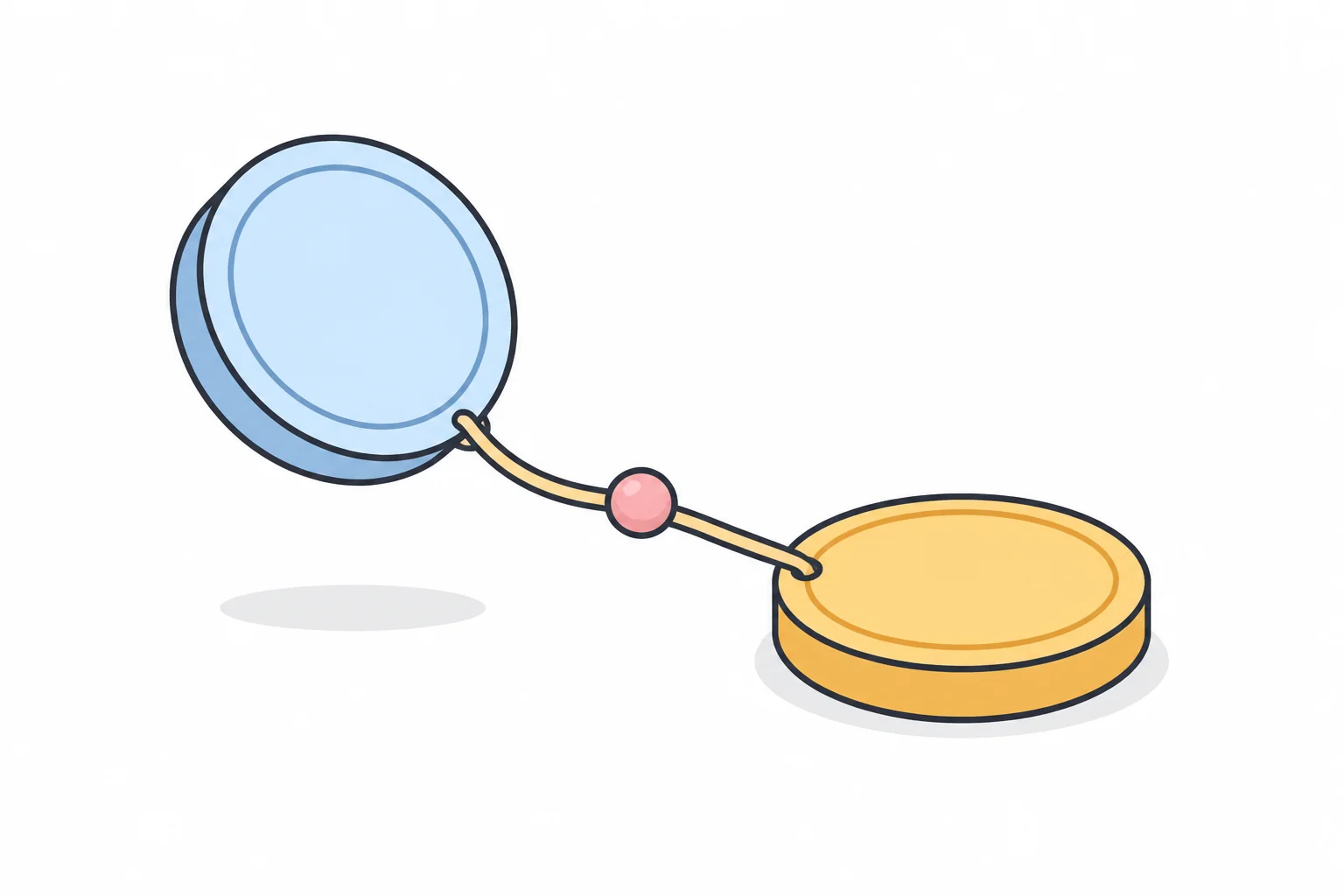
A regular futures contract has an expiry date, and on that date it is settled at the coin’s actual price; because everyone knows that day is coming, its price cannot stay far from the coin’s spot price (the price on ordinary exchanges where the coin itself changes hands) for long. A perpetual never expires, so nothing stops its price from drifting away from the spot price. Funding is the replacement for that missing expiry. At fixed times, every trader with an open position pays or receives a small amount, sized by how far the perpetual’s price sits from the index price, an average of the coin’s spot price across several major exchanges. Above the index, the rate is positive and longs pay shorts (longs who have to pay have a reason to close), which nudges the contract price down toward the index. Below the index, the rate is negative, shorts pay longs, and the nudge goes the other way. The money moves from trader to trader; the exchanges’ own rules state that they take no cut. The design dates from 2016, when the earliest of today’s perpetuals launched with funding based only on lending rates; within a month the contract was trading far above spot, and the exchange began charging that premium as funding too. That is why the rate still has two parts today: an interest part and a premium part.
How does funding work: who pays whom, when, and how much?

The schedule. The default on the large centralized venues is a funding payment every eight hours, at three fixed clock times a day, but many contracts there now pay every four hours, and some venues pay every hour. Several large venues also switch a contract to hourly payments, or step by step toward them, automatically and without announcement, once its rate hits the cap or floor. Read the interval per contract; do not assume eight hours.
Who pays. Only positions open at the funding timestamp pay or receive. Close ten minutes before it and you pay nothing; open one minute before it and you pay the full amount, because the amount does not depend on how long you have held the position.
How much. Payment = position notional × funding rate. Notional is the position’s size in coins × the mark price (the exchange’s smoothed estimate of the contract’s fair value; one large venue uses its spot index price instead), and it is the full size of the position, not the margin you posted. A $10,000 long at a rate of +0.01% pays $1; at 0.05%, $5; at 0.10%, $10. Hold it through all three payments in a day at 0.01% and it costs $3; at 0.10%, $30. At 10x leverage that $10,000 position is backed by $1,000 of margin, and the payment is still charged on $10,000, so at 0.10% you pay 1% of your margin at every timestamp.
How is the funding rate calculated?

Most large venues use the same two-part formula. The interest term (I) is a fixed number, usually 0.01% per eight hours (0.03% per day), meant to reflect the cost of borrowing dollars versus the coin. The premium (P) is how far the perpetual is trading from the index price, as a percentage, sampled every few seconds or every minute, depending on the venue, and averaged over the interval.
The rate is then: rate = P + clamp(I − P, −0.05%, +0.05%). Clamp means: take I − P, but hold it between −0.05% and +0.05%. As long as I − P stays inside those limits, it is not changed, so the formula becomes P + (I − P) = I: the premium cancels out and the rate is exactly the interest term, 0.01%. That is the case whenever the premium is between −0.04% and +0.06%, which is why the number sits at 0.01% so much of the time. Above +0.06%, the rate is the premium minus 0.05% (a premium of 0.10% gives 0.05%); between −0.04% and −0.05% the rate slides from 0.01% down to zero, and below −0.05% it turns negative (a premium of −0.10% gives −0.05%).
Each contract then has a cap and a floor per interval; on one large venue the two biggest contracts are capped at ±0.3%, a few other majors slightly higher, and most others at ±2%. Contracts that pay funding every four hours or every hour use the eight-hour-style rate divided by two or by eight, so a rate shown for a shorter interval is smaller by design. A few venues use other designs entirely.
What does a positive or negative funding rate mean?
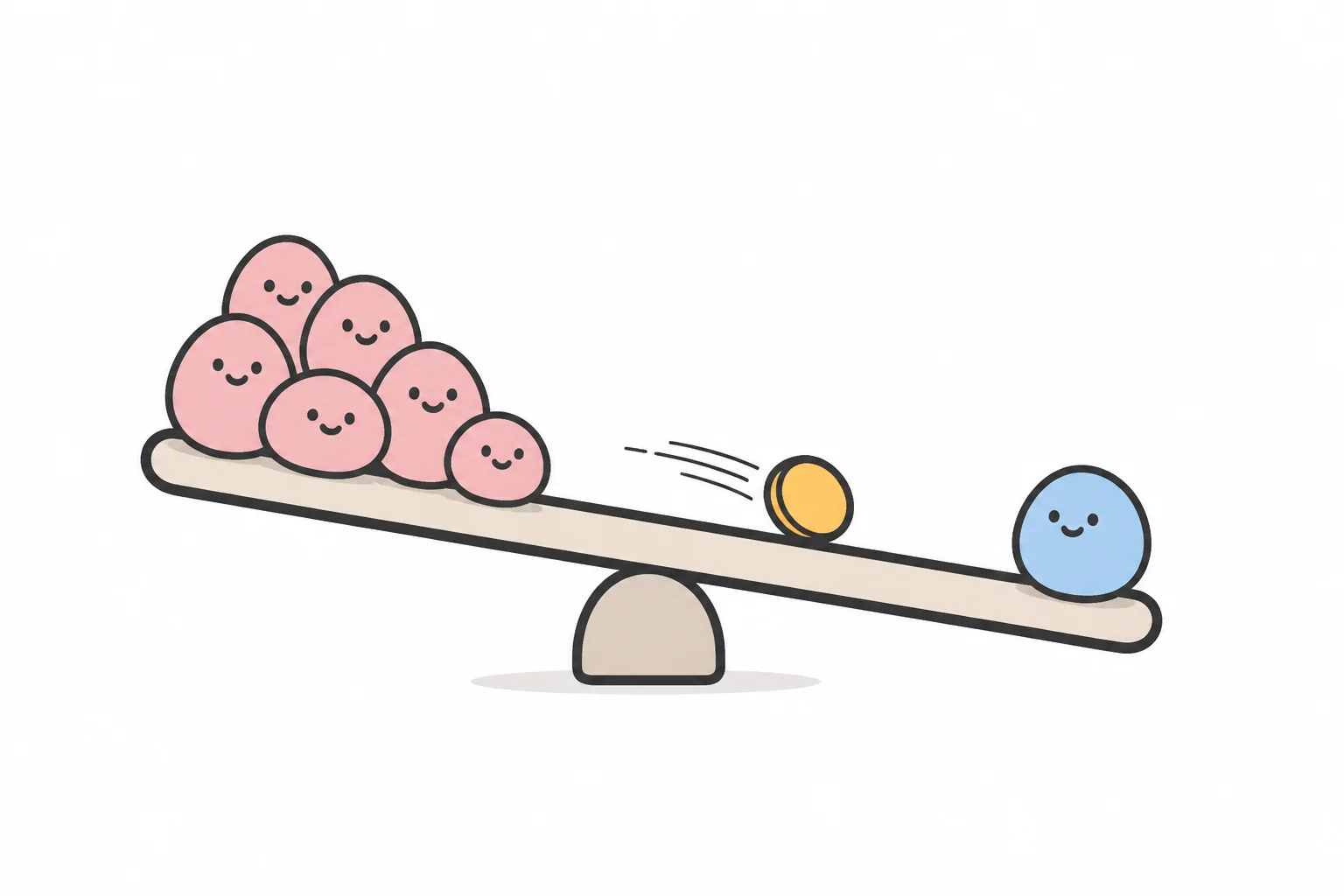
A rate above the 0.01% default means the perpetual is trading above the index: more traders want to be long than short, and the longs are paying for it. A negative rate means the perpetual is below the index: the shorts are the crowded side, and they are paying. The sign tells you which side is crowded right now, and the size tells you how much that side is willing to pay to stay there. It describes what traders have already done, not what the price does next, which is why “is negative funding bullish or bearish?” has no fixed answer. Some read a deeply negative rate as a warning that the price could jump (a “short squeeze”), because if the price starts rising, the many shorts have to buy back to get out, and that buying pushes the price up further; others read it as confirmation of a downtrend.
Because of the interest term, the neutral state is +0.01%, not zero, which is one reason positive rates dominate the record: over nine years of the longest-running bitcoin perpetual, the exchange that runs it found the rate positive in 71.4% of 9,941 funding periods. Negative funding is rarer, and because it has to overcome that built-in tilt toward 0.01%, it is a stronger sign that the short side is crowded.
What counts as a high funding rate, and how do you read one?
Three reference points help, all per eight-hour interval. At 0.01% the market is neutral. Around 0.05% to 0.10%, longs are paying noticeably: in 2024, the oldest bitcoin perpetual’s highest rate was 0.1308% and its average 0.0173%. At 0.3% you are at the cap that one large venue sets for its bitcoin and ether contracts, a level the oldest bitcoin perpetual saw routinely in its first years and that held around 0.2–0.3% for some weeks in 2021. The extremes appear on small, thinly traded coins (few buyers and sellers), where caps run to 2% per interval and higher.
An annualized rate is the per-interval rate multiplied by the number of intervals in a year, as if the rate never changed: 0.01% × 3 × 365 = 10.95% per year, and 0.10% per eight hours is about 110% per year. No venue promises a constant rate; annualized figures are for comparison, not expected return. The interval changes the meaning of a number in the same way: 0.01% per hour is 0.24% per day and 87.6% per year, eight times the eight-hour figure, so always read the interval next to the number.
To check a rate, the contract’s trading page shows the predicted rate and a countdown; the prediction keeps changing until the payment is made. The exchange’s API returns the history of settled rates, which is what a backtest needs, and some data sites publish heatmaps that line up many coins’ rates so the crowded ones stand out.
How does funding affect the price and your open position?
On the price, funding works through incentives: longs who pay every eight hours have a reason to close, shorts who receive have a reason to open, and that pressure pulls the perpetual toward the index. The rate is computed from a premium that already exists, so it follows the gap between the perpetual and the index; it does not tell you where the coin’s price goes next.
On your position, your balance changes at every timestamp, so a position that looks flat on the chart is still paying or earning. On the major venues the payment is taken from your available balance, and from the position’s margin once the balance is empty, so each payment reduces your equity (the total value of your account), and when you have posted little margin, repeated payments push the liquidation price closer. Because the mark price already reflects the upcoming funding, a position close to its liquidation price is usually liquidated by the losses on the still-open position before the payment itself arrives. Over days, the payments add up to the real cost of holding leverage: think of them as the interest you would pay on borrowed money.
What does funding mean for a trading bot?

For a bot, funding is money that leaves or enters the account at fixed times, whether or not the bot trades, so it has to be handled in three places.
In the profit-and-loss record (the P&L ledger), as its own line: every payment with its timestamp, rate, notional, and direction, separate from trade profit.
In the backtest: fetch the funding history and apply each rate, at its timestamp, to whatever position was open. A strategy that holds for days pays or receives dozens of times, and 30 days at 0.01% three times a day is about 0.9% of notional; at 0.10% it is about 9%. Leave that out and a marginal strategy looks profitable. The backtesting guide covers the rest.
In the decision to hold or close: compare the expected gain from staying through the timestamp against the payment for doing so. Placing orders around that moment belongs to the order execution guide.
So far funding has been a cost; it can also be income: a bot on the receiving side collects what the other side pays. Collecting it on purpose, by holding the receiving side of the perpetual while an opposite position in the coin itself offsets the price move, is a strategy with its own income and its own risks; it gets its own guide in this series.
FAQ
Is funding rate arbitrage profitable?
It can produce income, and it can lose money; the answer depends on the period and the execution. The income is the funding itself, collected by holding the side that receives it while an opposite position in the coin itself offsets the price move. The risks are that the rate flips sign and starts costing you, that the two positions are opened and closed at worse prices than expected, and that the leveraged position can still be liquidated on its own during a sharp move, because the exchange judges that position by itself. The strategy gets its own guide in this series.
Do I pay funding if I close my position before the funding time?
No. Funding is charged only to positions that exist at the moment the payment is made, so a position closed before that moment pays and receives nothing for that interval. Two cautions: closing has its own cost in fees and the gap between buy and sell prices, which can exceed a small funding payment, and exchanges warn that an order placed within seconds of the timestamp, or on some venues up to a minute, may or may not be counted in that cycle.
Does funding apply to spot trading or to regular futures?
No. Buying a coin on the spot market involves no funding, because you own the coin. A regular futures contract with an expiry date has no funding either; its price is pulled toward the spot price by the settlement on that date. Funding exists only on perpetual contracts, which have no expiry to do that job.
Can a funding payment liquidate my position?
Usually not on its own, but it moves you closer. On most venues the payment comes out of your available balance first and out of the position's margin only when the balance is empty, and it is small next to a normal price move, so a position near its liquidation price is normally finished off by the price before the payment lands. Repeated payments on a thinly margined position, however, shrink the room you have left every interval.