Algorithmic trading means writing your trading rules down precisely and letting a program called a trading bot follow them for you. This guide is the map of how to learn it, in the order that works: understand what a bot is, set one up, learn what data it sees, choose a strategy, test it against history, learn what happens when it places an order, put risk rules around it, and finally run it around the clock. It is written for complete beginners, and it teaches understanding and a safe way to start, not a strategy that makes money. Each step below is a short summary with a link to the full guide for that step.
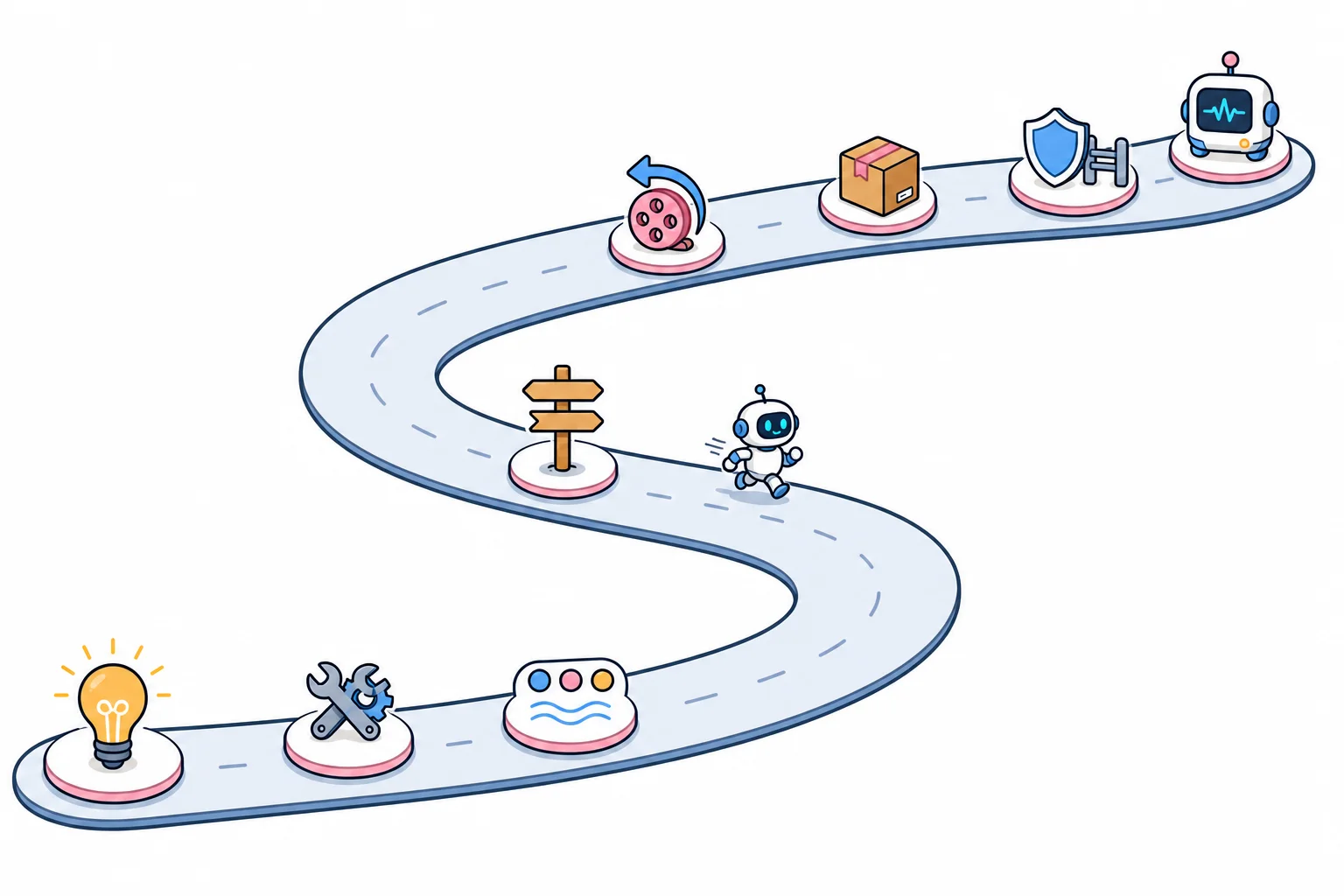
Step 1. What is algorithmic trading, and is it for you?
A trading bot is a program that watches the market, applies rules you wrote, and sends orders, over and over, for as long as you let it run. In crypto that solves a real problem: the market never closes, and nobody can watch it calmly at 4 a.m. A simple strategy is not mysterious. “Buy when the price falls 3% below its 24-hour average, sell when it returns to the average” is a complete rule that a program can follow.
Three things it is not. It is not high-frequency trading, which is a race between institutions measured in microseconds; a retail bot decides over minutes and hours. It is not a money machine; a bot with a bad rule loses money faster than a human would. And in most countries it is allowed, though rules on leverage and taxes differ by country and the exchange’s own terms apply as well.
Start here if any of those sentences surprised you: What is algorithmic trading, exactly? walks through how a bot works, what a first strategy looks like, why traders automate, and where a beginner should begin, which is with fake money first, not real money.
Step 2. How do you build a trading bot?
A simple bot is a weekend project, and a bot you would trust with real money takes much longer, because most of the time goes into safety rather than strategy. You need an exchange account with an API key that can trade but not withdraw, a programming language (Python is the usual choice), and a rule you can state in one sentence.
The build path is the same for everyone: connect to the exchange and read prices, write the rule as code, run it against history, run it in real time with fake money (traders call this paper trading), then trade at a size so small that a bug costs you almost nothing. AI coding assistants can write much of the code now, which makes the first steps faster and makes understanding what the code does even more important.
How do you actually build a trading bot? gives the full path in order, what you need before you start, and the mistakes that cost beginners real money.
Step 3. What data does a bot actually see?
Most beginners are surprised to learn that there is no single “price”. The last trade, the best bid, and the best ask are three different numbers, and a rule that mixes them up behaves strangely. A bot does not look at a chart. What it reads is a stream of numbers: those prices, candles that summarize each minute or hour as open, high, low, close, and volume, and the order book that shows where buyers and sellers are waiting. Every strategy is a rule about some of these numbers, so knowing which number your rule uses, and how fresh it is, is the whole foundation.
The second surprise is that you do not need to pay for data to start: every major exchange publishes prices, candles, and the order book through its own API for free, and that is enough for a first bot and for testing it against history.
What does a trading bot actually see? maps the data types, explains where prices come from, and shows how to get the data and where a first bot should start.
Step 4. What strategies do trading bots run?
Almost every bot runs one of five ideas, or a mix of them: trend following (ride a move that is already under way), mean reversion (bet that a sharp move returns to the average), grid trading (a ladder of buy and sell orders inside a range, profiting each time the price crosses one of those orders and comes back), arbitrage (the same asset at two prices in two markets), and market making (quote both a buy and a sell, and earn the gap between them).
Each one works in some market conditions and loses in others: trend following suffers in sideways markets, mean reversion suffers in strong trends, grids suffer when the price leaves the range and keeps going. So the useful question is not “which strategy works?” but “in which conditions does mine work, and how will I notice when the conditions change?” A beginner should choose for learning speed: a rule you can explain out loud, that decides slowly and trades rarely, and that is easy to test.
What strategies do trading bots actually run? lays out the five families, what makes each one win and lose, why most beginner strategies lose money, and how to pick a first one.
Step 5. How do you backtest a strategy honestly?
A backtest replays your rule over past prices and lists every trade it would have made. Killing a bad idea this way costs nothing, which makes it the cheapest test there is. Done carelessly, though, it does the reverse and makes a rule that never worked look good.
Four traps produce almost all of that false confidence: letting the rule see the future by even one candle, tuning the rule until it fits one stretch of history perfectly, ignoring fees and spread, and testing only one lucky period. What a backtest is for matters more than how to run one. A backtest is a filter, not a forecast: a bad result is worth trusting, and a good result only earns the idea a second test with fake money.
How do you backtest a crypto strategy, honestly? explains how a backtest works step by step, the four traps, how much testing is enough, and the order of backtesting, paper trading, and live trading at small size.
Step 6. What happens when a bot places an order?
Deciding to buy and actually getting the buy done are two different jobs, and the second is never as tidy as the first. The bot sends a request to the exchange, the exchange checks it and either rejects it or puts it in the queue, and from then on the order has a life of its own: waiting, partly filled, filled, or canceled. The two basic order types, limit and market, trade certainty about price against certainty about time: a limit order names its price and may never fill; a market order fills now at whatever price is there. Everything else on the list is a variation of that trade-off.
Between the decision and the fill sit small costs and problems that backtests do not feel: slippage, the gap between the price the bot decided on and the price it got; partial fills, where a $500 order fills $180 and then sits; rejected orders, timeouts, and rate limits (the exchange cutting off a bot that asks too often). The habit that handles all of them is the same: after every action, ask the exchange what really happened before acting again.
What happens between your bot’s decision and a filled order? follows that journey once, slowly, and explains how much execution quality matters at beginner scale, which is less than strategy at first and more every month after.
Step 7. How does risk management work for a bot?
Lose 50% of an account and you need a 100% gain to get back; lose 5% and you need a little over 5%. That is why risk management, the part of the bot that decides how much it may lose before it stops, on one trade, on one day, and in total, matters more than the strategy. Every strategy has losing streaks, and the size of each bet decides whether a streak is a bad month or most of the account.
For a bot the rules are code, and that helps and hurts: it applies every rule you wrote, without fear or hope, and it never applies a rule you forgot. The handful of rules that matter are risking about 1% of the account per trade, with the position size worked back from how far away the exit is; a defined exit for every position; no leverage (borrowed money) for a first bot; a loss limit that turns the bot off when the account has fallen too far from its high point (a drawdown limit); and a kill switch, a way to stop the bot from anywhere, that you have tested on purpose. Bots also have risks a human does not, such as a bug that repeats an order in a loop or a price feed that has quietly stopped updating, and the defenses are an order-size cap in the code, a rule to stop trading when the data is old, and an API key that cannot withdraw.
How does risk management work when a bot is doing the trading? covers each rule with worked numbers.
Step 8. How do you run a bot in production?
A bot that runs only while your laptop is open is not finished. Running one for real means four things. A machine that stays on, usually a small cloud server for a few dollars a month. A process manager that restarts the bot when it crashes, plus a bot that asks the exchange what it really holds every time it starts, instead of trusting what it saved. Logs that record every decision with its reason. And a heartbeat, a regular “I am alive” message, watched by a separate program that alerts your phone when the message stops.
Then there is the routine: ten minutes every morning to compare the bot’s positions with what the exchange says, read the trade record, check the errors and the drawdown. Most days it finds nothing; it exists for the one day it does. Changes to a running bot follow the same discipline as the first build, one at a time, tested with fake money or tiny size before normal size, and never at midnight after a losing streak.
How do you actually run a trading bot 24/7? covers hosting choices, keeping the bot alive, logging, monitoring, the daily routine, what it costs, and how to change a running bot safely.
Where should you actually begin?
Read Step 1 and Step 2, then open an exchange account with an API key that cannot withdraw and write one rule you can say in a sentence. Get the data (Step 3), find out which strategy family your rule belongs to and what kind of market it will lose in (Step 4), and backtest it with fees and spread included (Step 5). Run it with fake money for a few weeks, and use that time to learn what happens to each order it sends (Step 6). Only then trade at a size you would not mind losing entirely, with the risk rules from Step 7 in place from the first order, and the routine from Step 8 from the first morning.
The series will keep growing with deeper guides inside each step; the eight above are the ones to read first.
FAQ
Is algorithmic trading good for beginners?
As a way to learn trading with discipline, yes: writing a rule down forces you to be precise, and a bot cannot panic. As a way to make money quickly, no. It is common for beginners to lose at first, usually to fees, bugs, and backtests that made a bad idea look good. Follow the steps in order, keep the size tiny, and expect the first months to cost some money while you learn.
How long does it take to learn algorithmic trading?
The concepts in this series take a few weeks of evenings. A first bot that trades with fake money takes a weekend or two. A bot you would trust with real money usually takes weeks at the least, and often months, because most of that time goes into testing, safety rules, and watching it for small failures before you let it risk anything large.
Do you need to know how to code to do algorithmic trading?
Not much, at the start. Python is the common choice, a simple rule-based bot is short, and AI assistants can write most of it. What you cannot skip is understanding what the code does, because the mistakes that cost money are in the logic, not the typing.
Is algorithmic trading in crypto legal?
In most places, using a bot on your own account is allowed, and most major exchanges publish APIs precisely so that people can do it. Rules on leverage, derivatives, and taxes differ by country, and some exchanges restrict certain regions. Check the rules where you live and read the exchange's terms before going live.