Yes, trading bots work, in the sense that a program will follow your trading rules day and night without getting tired, bored, or scared. Whether a bot makes money is a different question, and the honest answer is: only when its rules have a real edge, and most rules people start with do not. No independent body publishes a success rate for bot users, but everything measured about short-term trading says most lose, and a bot inherits the same fees and the same market.
What does it mean for a trading bot to “work”?
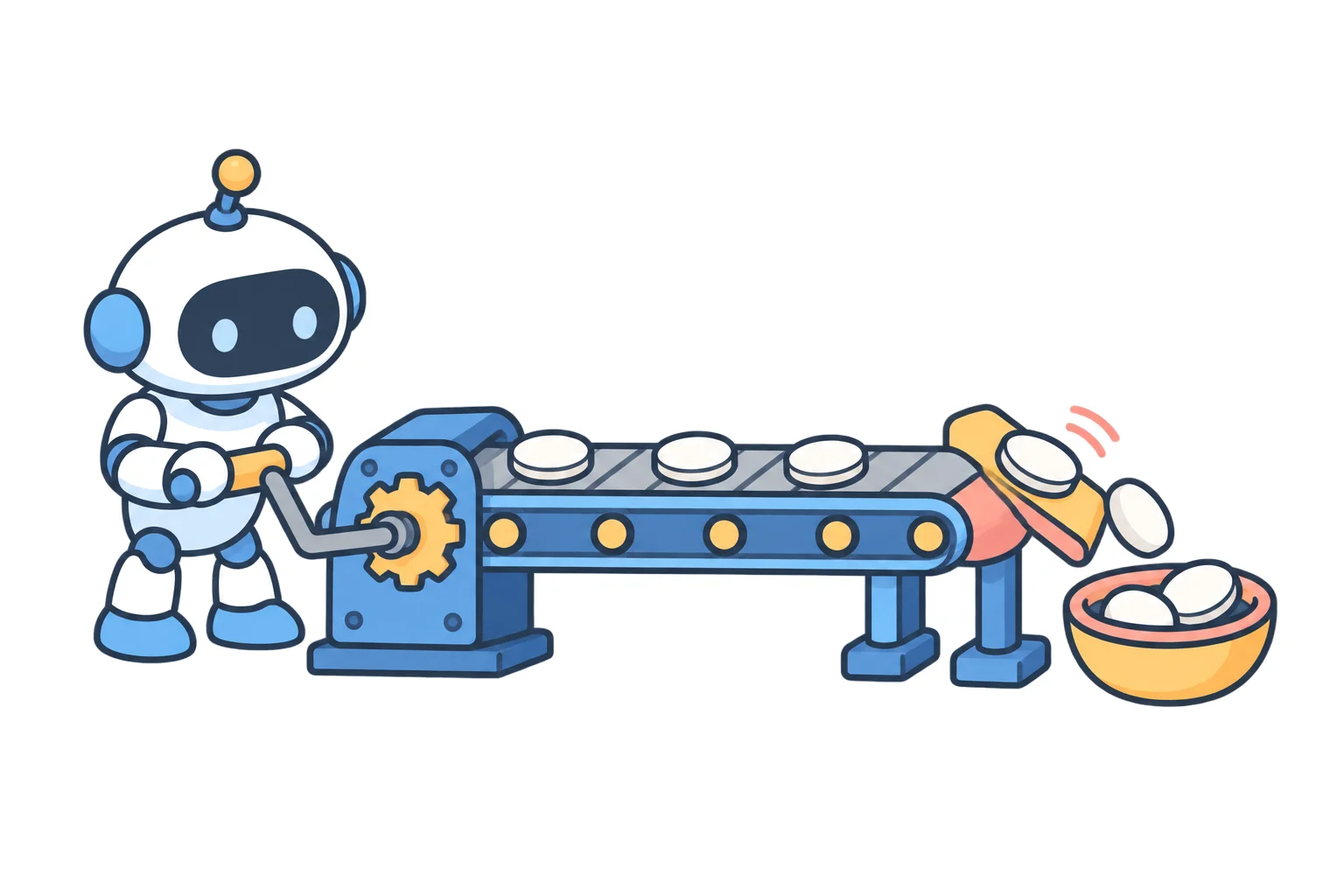
Separate the two things people mean by “work.”
Does it run? Yes. A properly built bot connects to the exchange, watches prices, and places orders exactly as told, all day, every day. That part is engineering: hard the first time, but a solved problem.
Does it make money? Only if the rules do, because the bot has no opinion of its own. If the rule has an edge, a reason to win more than it loses after costs, the bot applies that edge consistently. If not, the bot loses consistently, and with leverage (trading with borrowed money) it can lose the whole account, because a large enough move against you triggers liquidation, the forced closure of your position.
So there are really two questions: does my strategy have an edge, and can I run it without breaking it?
How do trading bots make money when they do?
Every profitable bot is exploiting one of a few kinds of edge.
A price pattern that repeats. In some markets a sharp drop is followed by a bounce; in others a move that has started keeps going. A bot bets on the pattern hundreds of times, so a small edge per trade adds up. Suppose a rule wins 55 trades out of 100, and wins and losses are the same size, $20 each. Over 100 trades that is 55 × $20 − 45 × $20 = $200 of profit. Small, boring, and only visible over many trades: that is what an edge looks like.
Being paid for a service. Market-making and arbitrage bots earn the spread or a price gap between venues: real edges, thin, and crowded with professionals.
Discipline rather than prediction. A dollar-cost-averaging (DCA) bot buys a fixed amount on a schedule; a grid bot places buy orders below the price and sell orders above it and collects the difference each time the price bounces between them. Neither predicts anything: a grid bot earns while prices move sideways and gives it back in a trend, and a DCA bot earns what the coin earns. Economists at the Bank for International Settlements simulated exactly that for crypto app users in 95 economies, $100 of bitcoin a month from the month each user first installed an exchange app: as of December 2022, an estimated 73-81% would have lost money, the median user down about $431 of $900. The bot ran perfectly. The market did not cooperate.
The strategy families and the bot types each get their own guide in this series.
Why do most trading bots not work?

Five reasons.
No edge to begin with. Most beginner rules are hunches written down as numbers, and hunches average out to zero, minus costs.
Fees and slippage. Slippage is the gap between the price you expected and the price you got. Take the 55% rule above: $200 of profit over 100 trades. If each trade costs $2 in fees and slippage, the edge is gone. When the UK regulator (FCA) examined retail accounts at eight firms selling CFDs (contracts for difference, leveraged bets on price moves), clients who placed 100 or more trades in a year lost an estimated GBP 3,500 on average, against about GBP 400 for those who traded less. Those were humans; a bot simply trades more.
A backtest that was too good. A backtest runs the rule against past prices. Tune the rule long enough and it fits last year’s noise perfectly, then meets a future it has never seen. Backtesting honestly gets its own guide, and so does why live results fall short of backtests.
The market changed. A grid bot can earn for months in a range and lose it all in one week when the price falls out of the bottom of the grid; when it breaks out above, the bot sells everything and simply stops earning. The rule was built for a range, and the range ended.
Operations. The connection drops, the exchange goes down while you hold a position, a bug sends an order twice, or an API key (the credential your bot uses to act on your account) is stolen, and it had withdrawal permission it never needed. These lose money whether or not the strategy had an edge, and they end most first bots.
How much do trading bots make? What are realistic results?

No regulator, and no independent study we know of, publishes what share of bot users make money; every success rate in an advertisement came from the seller. The closest verified evidence is what happens to people who trade short-term, often with leverage:
- In several EU countries, national regulators found that 74-89% of retail accounts trading CFDs lose money, with average losses per client of EUR 1,600 to EUR 29,000; in 2018 the EU regulator ESMA made that finding the standard CFD risk warning wording.
- In Brazil, of 1,551 people who kept day trading index futures for more than 300 trading days, 97% lost money after fees and 3% made a profit. The longer people persisted, the smaller the profitable share; the authors found no evidence of learning by day trading.
- In Taiwan, across roughly 450,000 day traders a year over 15 years, about 20% of the more active ones were profitable after fees in a typical year, but less than 1% were profitable consistently from year to year.
Many people win for a few months; very few keep winning, so one good month proves little. None of this is a bot statistic, and a bot with a real, small edge can sit in the profitable minority. But it pays the same fees and faces the same market.
If a bot does have an edge, expect small, uneven returns and a drawdown (the fall from the account’s peak to its lowest point afterwards) that will very likely one day exceed anything in the backtest. What makes people quit is not the average return but the drawdown: a $1,000 account down 30% sits at $700 and needs a 43% gain to get back to even.
Do AI trading bots work any better?

“AI trading bot” means one of two things, and neither changes the answer.
The first is a bot whose code was written by an AI assistant. That is a real convenience, but the assistant supplies code, not edge. The rule is still your hunch, now inside code you may not be able to read when it misbehaves at 3 a.m.
The second is machine learning inside the strategy, a model that searches past data for patterns on its own. Markets are noisy and they change, and a flexible model has more ways to memorize the noise than a simple rule does, so everything above about backtests that were too good applies with more force.
There is no independent evidence that retail AI bots earn more than rule-based ones. The US commodities regulator (CFTC) put out a customer advisory in 2024 titled “AI Won’t Turn Trading Bots into Money Machines,” and its central line is worth memorizing: “AI technology can’t predict the future or sudden market changes.” What AI bots really do gets its own guide in this series.
Are trading bots legit, legal, or a scam? How do you tell?

Legal, in most countries, yes: running a bot on your own account is ordinary trading, and exchanges publish APIs (interfaces for programs) for exactly that. Check your country’s rules and the exchange’s terms; the introduction covers both.
Whether they are legitimate is a different question, because two very different things are sold under the word “bot.” The first is software: you run it on your own exchange account with an API key, the money stays in your own exchange account, you can switch it off, and the worst case is bad trades. Plenty of these are honest, whether or not they are any good.
The second is “send us your money and our bot trades it for you,” and this is where the fraud lives. The CFTC advisory above described schemes promising returns of “tens of thousands of percent” or “100 percent ‘win’ rates”; customers lost tens of millions of dollars and, in one case, nearly 30,000 bitcoins, worth about $1.7 billion at the time, to a scheme that promised at least 10% a month from a proprietary bot. The same day, the SEC, FINRA, and NASAA (the association of state securities regulators) warned about platforms advertising “Our proprietary AI trading system can’t lose!” and stated the rule plainly: claims of high guaranteed returns with little or no risk are classic warning signs of fraud.
The red flags:
- Guaranteed, fixed, or “no-loss” returns, or win rates near 100%. Real strategies have losing months.
- You must deposit with them instead of trading on your own exchange account.
- The pitch came from a stranger online, an influencer, or a direct message.
- Results shown only as screenshots, or as a curve with no losing periods.
The CFTC’s own checklist costs nothing: research the company and the people behind it, reverse-image-search their photos, check how old the website’s domain registration is (a public record), get a second opinion, and subtract fees, spreads, and subscription costs from any promised return. One more test: can the seller say in one sentence where the profit comes from, and show the periods when it lost?
Are trading bots worth it for a beginner, and what should you do first?
First, the question most people are really asking: can a bot make you rich? Do the arithmetic. Suppose your bot earned 20% a year with no losing years, which would already be an excellent result. Turning $1,000 into $1,000,000 at that rate takes about 38 years. The only way to get there faster is to take much bigger risks, usually with leverage, which is also the fastest way to lose the whole $1,000. A bot is not a shortcut. It is a tool for applying a small edge without emotion.
So are they worth it? Yes, as a way to learn discipline, test an idea honestly, and automate boring jobs like scheduled buying. No, as an income machine you buy and switch on.
What to do first, in this order:
- Write down what “works” would mean before you run anything: for example, positive after fees over three months and at least 100 trades, with a drawdown no worse than 15%. Set the bar first, or you will move it later.
- Backtest honestly, then run it in real time with fake money, on a testnet (a practice copy of the exchange) or a paper account.
- Go live at a size where losing all of it changes nothing, with position sizing, stops, and a kill switch (a rule that shuts the bot down) decided in advance.
- Judge the result against the bar from step 1, on months of data, not days.
If you want to build it yourself, the build guide starts from zero. Start from “what is my edge, and how will I know when it is gone?” and the bot becomes the easy part.
FAQ
Can a trading bot lose more than I put in?
On a spot account, no: the worst case is that the coins you bought fall to zero. With leverage it is possible. During five weeks of extreme price swings in 2020, Australia's regulator ASIC found that at a sample of 13 CFD providers, more than 15,000 retail accounts fell into negative balance, owing a total of about AUD 10.9 million. Those were human traders. A bot trading with borrowed money can end up in the same place, and faster.
Do the bots built into exchanges work?
They run reliably, and that is what the exchange is really selling: convenience. They do not supply an edge. A grid bot earns while the price moves sideways, loses when it drops through the grid, and stops earning when it rises out of it; a DCA bot just buys on a schedule, so its result is the coin's result over that period. Judge them the way you would judge your own code: which market is this built for, and what happens to it when that market ends?
Do copy trading bots work?
You inherit another person's results, minus fees, minus the slippage from copying a moment after they trade. The leaderboard you pick from is a list of recent winners, and recent winners are common: in one long study of day traders, roughly 20% of the active ones were profitable in a typical year, but less than 1% of all of them stayed profitable year after year. A leaderboard is a backtest you did not run: interesting, unproven.
How long until I know whether my bot works?
Long enough to see it in more than one kind of market, and enough trades that luck averages out. For most strategies that means months rather than days, and at least a hundred or so trades. A bot that has only ever seen a rising market has not been tested yet.