Nearly every trading bot a beginner meets belongs to one of seven types: grid bots, DCA bots, arbitrage bots, market-making bots, signal or Telegram bots, copy trading bots, and AI bots. Each type is a machine built for one market condition, and each loses in a predictable way when that condition ends. This guide explains what each type does mechanically and how to match one to a purpose; what algorithmic trading is in general, and whether it is legal, is covered in the introduction to this series.
What do trading bots do, and what are the main types?

An automated trading bot is a program connected to your exchange account through an API (an interface the exchange publishes so that programs can place orders). The bot watches prices and places or cancels orders according to a fixed rule, all day, without you touching anything. That is everything a bot does; the types differ only in the rule.
- Grid bots buy small dips and sell small rises inside a price range you set.
- DCA bots buy a fixed amount on a schedule, or buy more as the price falls.
- Arbitrage bots buy an asset where it is cheaper and sell it where it is more expensive at the same moment.
- Market-making bots offer to both buy and sell at once, earning the small gap between the two prices.
- Signal and Telegram bots place the trades that a signal, or a chat command you type, tells them to place.
- Copy trading bots mirror another trader’s positions onto your account.
- AI bots use a machine-learning model, or an AI label, on top of one of the ideas above.
The first four contain a rule about the market; the last three outsource the rule to a signal, a person, or a model. That split decides what you must examine before switching one on: the rule itself, or the source you are trusting.
How does a grid trading bot work?
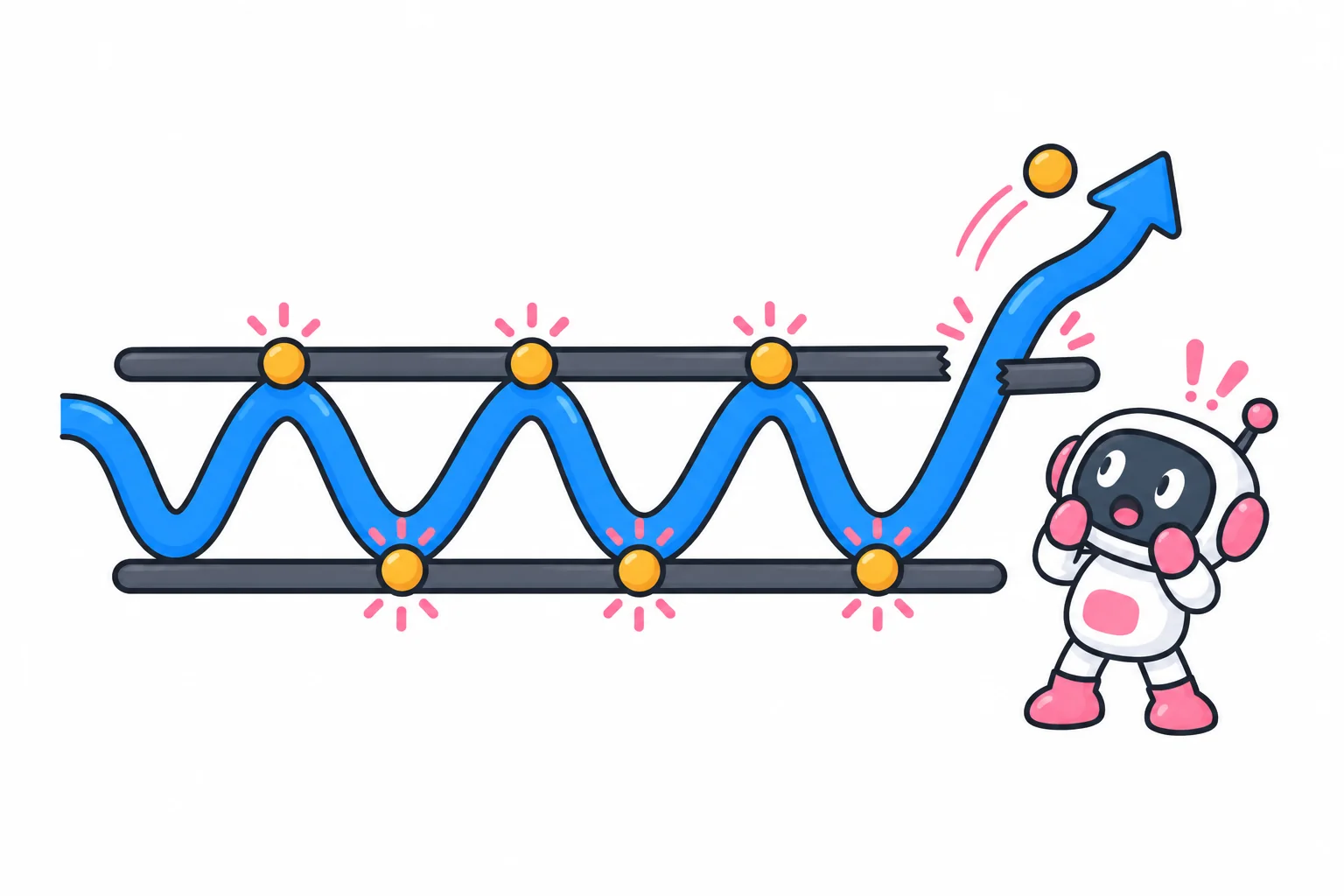
A grid bot trades a range. Suppose a coin trades at $100 and you set a grid from $90 to $110 with levels every $2. The bot places buy orders at $98, $96, and so on down to $90, and sell orders at $102 up to $110. To fund the sell orders, the bot buys some of the coin when it starts, and each time a buy order fills, it places a new sell order one level higher. When the price dips to $98, the bot buys; when it climbs back to $100, that new sell order fills and the bot pockets the $2 move, minus two trading fees. Every wobble inside the range becomes one small completed trade, which is why grid bots feel so productive in a sideways market: they earn a little on movement that goes nowhere.
The losses are just as mechanical. If the price falls through $90, the bot has bought at every level on the way down and now holds all of it at a loss; the earning stops, and nothing in the grid logic cuts the loss unless you added a stop. If the price rises past $110 instead, the bot has sold everything and goes idle, which costs you nothing in cash, only the rest of the rally.
Spot grid or futures grid? A spot grid buys and sells the actual coin with money in your account; no borrowing is involved, so the worst case is holding coins that fell. A futures grid trades futures contracts, agreements that track a price without owning the coin. That allows two things a spot grid cannot do: running the grid in reverse to profit from a falling market, and using leverage, meaning trading with borrowed money. Leverage multiplies every profit and loss equally, and a large enough move against the position triggers liquidation: the exchange force-closes the position and the money you deposited for it, the margin, is gone. The same fall that leaves a spot grid holding cheap coins can leave a leveraged futures grid holding nothing, which is why a first grid should be a spot grid.
So is grid trading profitable? Inside a durable range it earns modestly, but one break below the range can hand back many weeks of small wins. A grid is only as good as the range’s ability to hold, and whether the small wins outweigh the breaks in practice is the subject of a separate guide on whether bots make money.
What is a DCA bot, and how does DCA work?
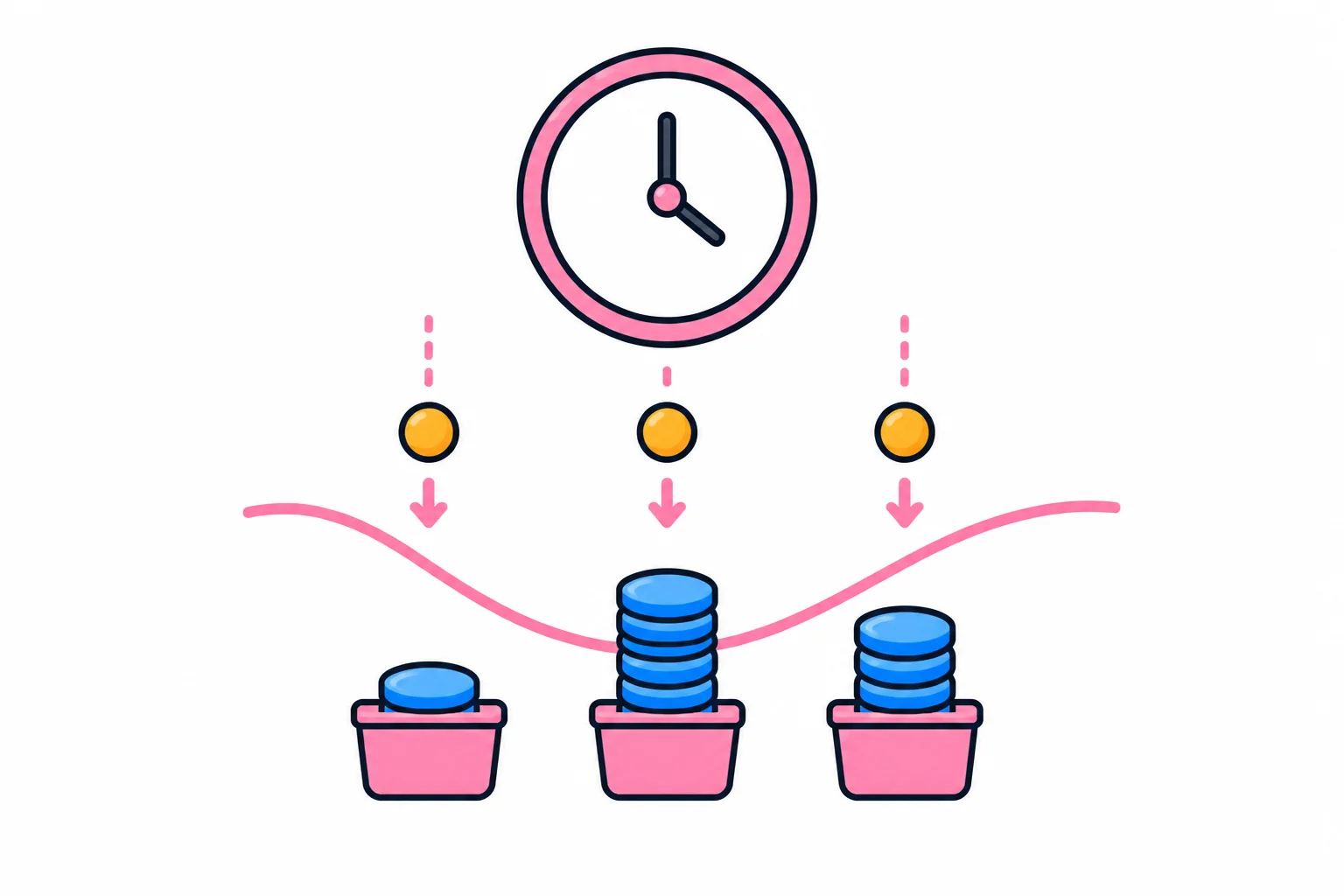
DCA stands for dollar-cost averaging: investing a fixed dollar amount at fixed intervals regardless of price. Suppose you buy $50 of a coin every Monday. At $100 your $50 buys 0.5 units; if the price halves to $50, the next $50 buys a full unit. You now hold 1.5 units for $100, an average cost of about $67, because the fixed amount automatically bought more when the coin was cheap. A schedule DCA bot simply runs this plan so you never skip a week out of fear or greed.
Most bots sold under the DCA name inside exchanges are more aggressive. They open a starting position, and each time the price drops a set percentage they buy again, often a larger amount, pulling the average cost down; the moment the price recovers to a small profit above that average, the bot sells everything and starts over. In a market that dips and recovers, this harvests the dips repeatedly. Its designed failure is the dip that never recovers: the bot buys bigger and bigger into a falling price, runs out of budget, and leaves you with a large position worth far less than you paid for it. Averaging down feels safest exactly when it is most dangerous.
The schedule version makes no prediction: over months its result is mostly the coin’s result, so it suits accumulating an asset you would hold anyway. The averaging-down version is a repeated trade, not an accumulation plan, and deserves the caution above.
How do arbitrage and market-making bots make money?

These two types earn from tiny price differences rather than from betting on direction. An arbitrage bot watches the same asset in two places and acts when the prices disagree: buy at $99.90 on one exchange, sell at $100.10 on another, keep the $0.20. Such gaps are tiny, last for moments, and are hunted by professional firms with faster systems, so after fees, transfer delays, and the risk that one side of the trade fails while the other completes, a beginner’s bot usually arrives at gaps that no longer exist.
A market-making bot posts a buy offer just below the current price and a sell offer just above it, earning the spread, the gap between the highest price buyers offer and the lowest price sellers ask. In a calm market with traffic in both directions, it collects that gap all day. Its designed loss is the sharp one-way move: when the price plunges, everyone sells to the bot’s standing buy offer, and it accumulates a falling coin until the move ends. Both types genuinely work, which is exactly why they are crowded with professionals; they are the two a beginner is least able to compete in.
What are Telegram trading bots and copy trading bots?

A Telegram trading bot lives inside the Telegram messaging app: you send chat commands, and the bot trades for you, usually buying newly listed tokens directly on the blockchain within seconds, because in that market, speed decides who profits. The mechanical catch is custody: these bots typically create a wallet for you and hold its private key, the secret code that controls the funds, so your money is only as safe as the bot’s operators. A close cousin, the signal bot, executes trades whenever an alert arrives from an indicator or a paid signal group; it is an obedient pair of hands, and the signal source is the actual strategy you are buying.
A copy trading bot mirrors a trader you choose: when they buy, your account buys in proportion to your balance, and when they close, you close. It earns exactly when the copied trader earns, minus fees or a share of profits, and minus a little more because your order lands moments after theirs at a slightly worse price. It loses by design in two ways: you inherit every losing streak with no warning, and the list you picked the trader from shows recent winners, which is no evidence about the future. The copying itself rarely fails; the investment result depends on the trader you picked continuing to be right.
What are the types of AI trading bots?

“AI trading bot” covers three different things. The first uses a machine-learning model to decide trades: the model searches past prices for patterns and bets that they repeat. Its built-in weakness is that markets change, and a flexible model is better than a simple rule at memorizing patterns that will not return. The second is a bot whose code an AI assistant wrote for you; the AI supplied the programming labor, but the strategy is still whatever you asked for. The third is ordinary grid or DCA logic wearing an AI label, because the label sells.
None of the three escapes the same mechanics: whatever chose the trade, the account pays the same fees, faces the same market conditions, and loses the same way when the pattern behind it stops. The label only tells you who, or what, wrote the rule.
Which type of trading bot is best for a beginner?

The best bot depends on what you want it to do, and before picking a type you face a more basic choice: a prebuilt bot or a custom-coded one. Prebuilt bots inside exchange apps offer the common types ready to run: you pick a pair, set a range or a budget, and the exchange’s servers do the rest. The cost is only trading fees; the limit is that you can run only the types and settings on the menu. A custom-coded bot can run any rule you can write, in exchange for you building, hosting, and debugging it; building one from scratch has its own guide in this series.
Then match the type to the purpose:
- Accumulating a coin for the long term: a schedule DCA bot, the simplest and hardest to misuse.
- Earning small amounts from a market you expect to move sideways: a spot grid without leverage, with a written plan for when the price leaves the range.
- Testing your own trading idea: a custom bot, or a signal bot fed by your own alerts.
- Handing the decisions to someone else: copy trading, treated as an experiment with money you can lose, not as investing.
- Earning from price gaps and spreads: in practice, arbitrage and market-making belong to the professional firms that already dominate them; understand them, but do not start there.
The test that matters more than any feature list: can you say, in one sentence, which market condition your bot needs and exactly how it loses when that condition ends? If you cannot, you do not yet understand what you are buying; the strategy guide exists to build exactly that sentence.
FAQ
What is the safest type of trading bot?
No type is safe in the sense of guaranteed, so rank them by worst case instead. A spot bot without leverage can at worst leave you holding coins that fell in price. A futures bot with leverage can lose its entire deposit through liquidation. A bot or service that holds your funds or your private key adds a different worst case: losing everything to theft or a shutdown, with no trade ever going wrong.
How much money do I need to start using a trading bot?
Less than most people expect, because exchange minimum order sizes are small. A schedule DCA bot can run on tens of dollars a month. A grid bot needs enough to fund every level, so ten levels of $20 each need about $200. The practical rule is different from the technical minimum: start with an amount you could lose entirely and treat that loss as the cost of learning.
Can I run more than one type of bot at the same time?
Yes, and pairing types with different jobs, such as a long-term DCA plan next to a small grid, is common. Give each bot its own budget or trading pair so they do not compete for the same funds, and remember that risks add up: three bots that can each lose $200 are one portfolio that can lose $600, often in the same bad week, because most crypto prices tend to fall together.