— Contents 10 sections
- 01 Is the KuCoin referral code “CXEMBYUP” still active?
- 02 What the KuCoin referral code “CXEMBYUP” gets you
- 03 KuCoin sign-up steps with the referral code
- 04 What to do after signing up at KuCoin
- 05 The KuCoin referral code cannot be added after sign-up
- 06 What is KuCoin
- 07 What makes KuCoin distinct
- 08 KuCoin regulatory landscape
- 09 KuCoin availability across major jurisdictions
- 10 Risks to acknowledge before using KuCoin
chainhelm’s exclusive KuCoin referral code is .
As of 2026-07-17, we signed up as a new user and confirmed that the referral code was applied.
Enter the code at sign-up to receive up to 11,000 USDT equivalent in new-user bonuses. You can only do this during registration, so we recommend entering it right then and there.
This article covers the sign-up process with the KuCoin referral code, KuCoin’s distinguishing features, availability in major markets, and the risks to acknowledge — with the sign-up flow and code application verified first-hand by chainhelm’s editorial team.
Is the KuCoin referral code “CXEMBYUP” still active?
The chainhelm editorial team created a fresh KuCoin account on 2026-07-17 and confirmed that the referral code “CXEMBYUP” is still active.
Here is the actual screen captured during verification.
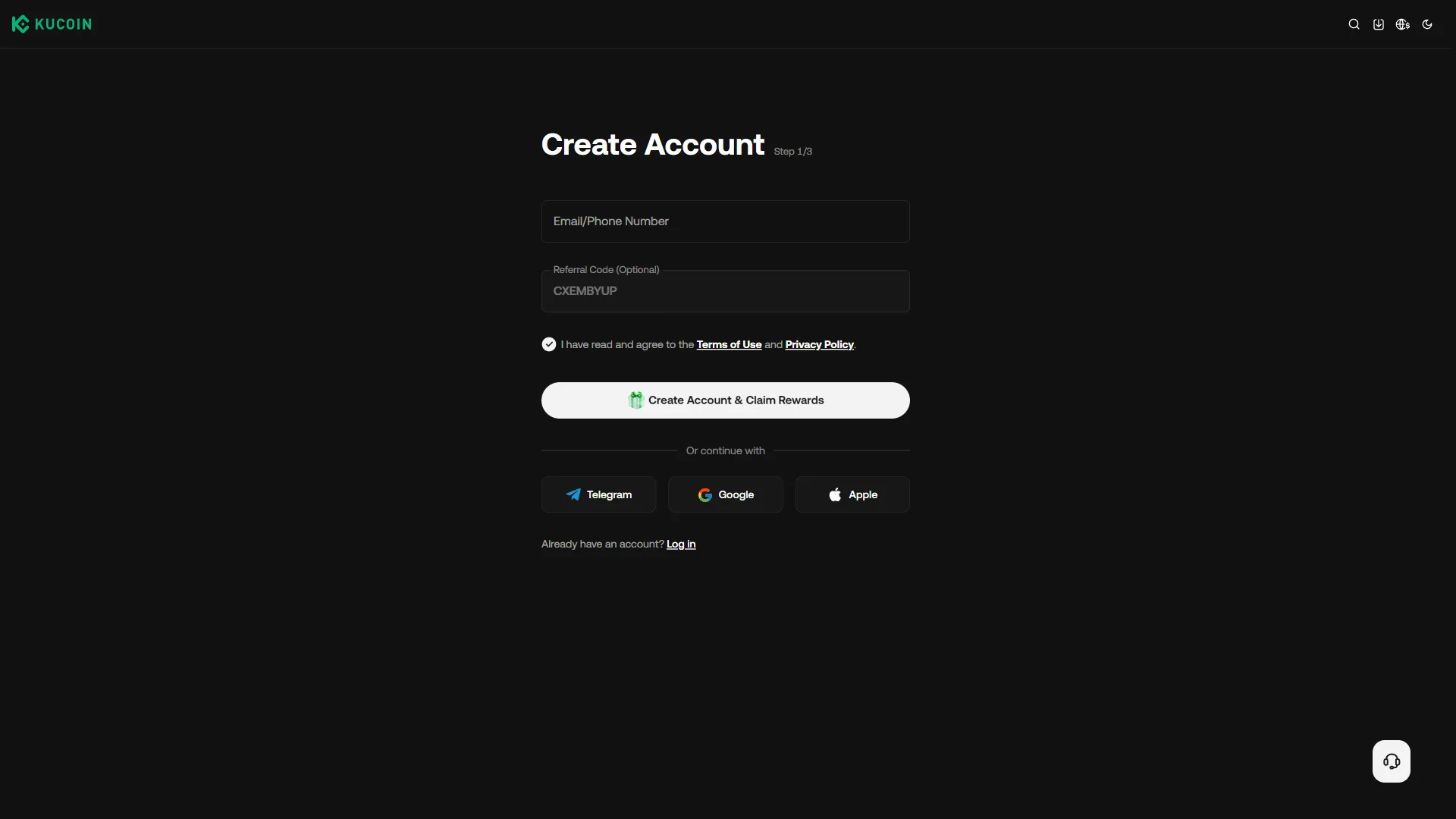
The “Referral Code (Optional)” field already shows “CXEMBYUP”, confirming that the referral code was correctly applied. On completing sign-up, the UI shows “Sign up successful! You are now logged in.”
chainhelm continuously verifies the validity of the code and confirms it remains usable.
What the KuCoin referral code “CXEMBYUP” gets you
Apply this code at sign-up to receive the following benefits on KuCoin:
- Benefit: up to 11,000 USDT equivalent in new-user bonuses
- Expiration: None
- Eligibility: New users
To receive the benefits, you need to enter the code when you create your account. Be careful not to miss this step.
KuCoin sign-up steps with the referral code
We cover the sign-up process separately for PC/browser and smartphone (mobile).
PC/browser sign-up steps
-
First, open the KuCoin official sign-up page (the link applies the referral code). When you open it, you’ll see a screen like the one below.
-
Open the sign-up form
— Figure 2Sign-up form, step 1 of 32026-07-17 The email field is empty and the referral code "CXEMBYUP" is prefilled. Source: chainhelm editorial Open the sign-up page and type your address into the “Email/Phone Number” field. The “Referral Code (Optional)” box already shows “CXEMBYUP”, so leave it as it is to keep the referral tied to your account.
Check that the “Terms of Use” and “Privacy Policy” box is ticked. You could start from “Telegram”, “Google”, or “Apple” instead, but the email route keeps the whole sign-up on one screen. Once your address is in the field, the form is ready to submit.
-
Submit the sign-up form
— Figure 3Sign-up form, filled in2026-07-17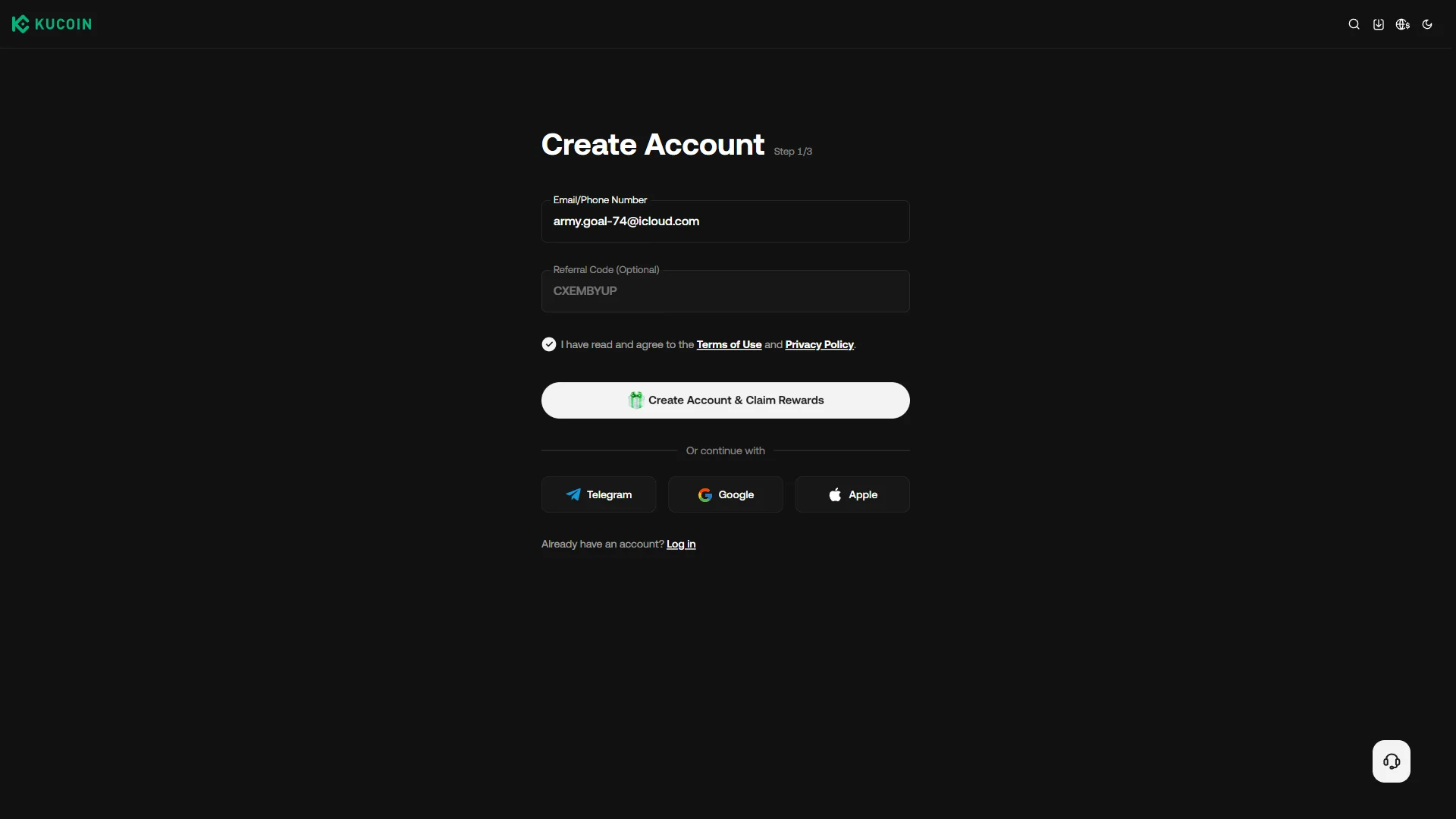
The email address is entered and the form is ready to submit. Source: chainhelm editorial With your address showing in the “Email/Phone Number” field and “CXEMBYUP” still in the referral box, select “Create Account & Claim Rewards”.
kucoin then moves you to the security verification step and sends a one-time code to the address you entered.
-
Enter the email verification code
— Figure 4Security verification, step 2 of 32026-07-17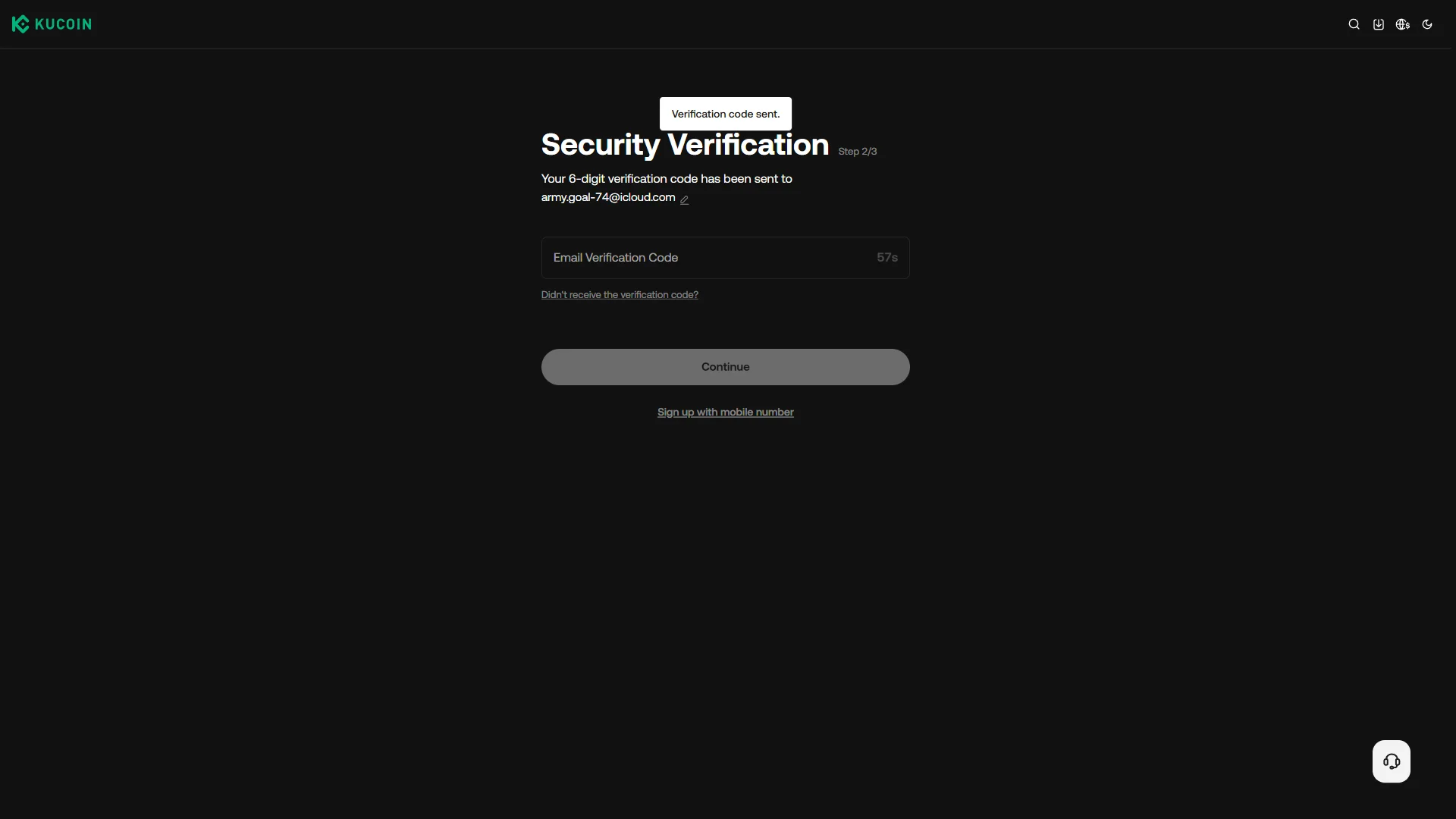
A code has been sent to the email and the entry field is still empty. Source: chainhelm editorial Open the inbox for the address you signed up with and find the code email from kucoin (shown next). Copy the six-digit code and type it into the “Email Verification Code” field.
The “Continue” button stays inactive until the field is filled. The countdown beside the field is a resend timer; once it reaches zero, “Didn’t receive the verification code?” becomes active and sends a new code. With the code entered, select “Continue” to move on to setting your password.
-
Get the code from your inbox
— Figure 5Verification code email2026-07-17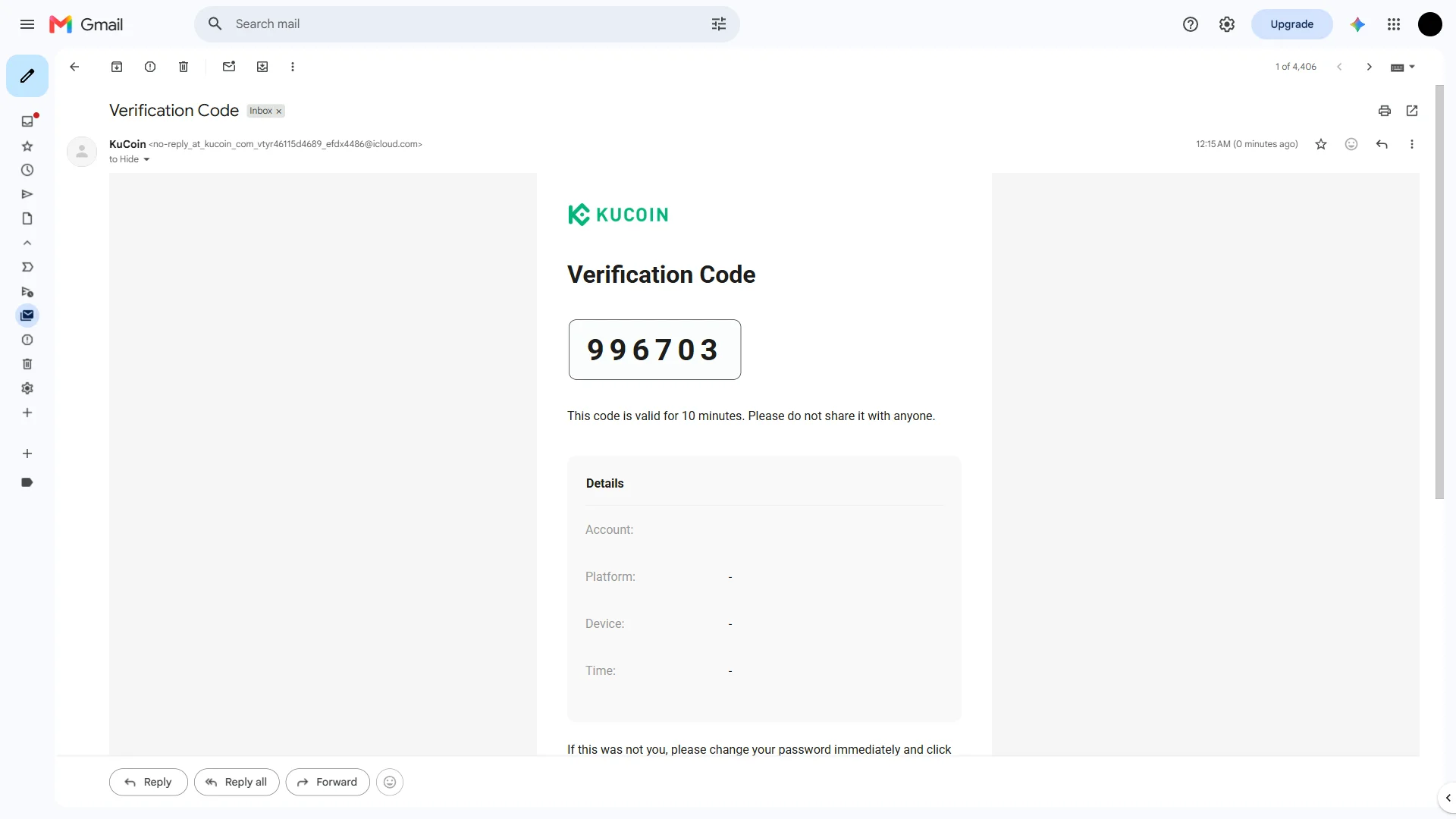
The kucoin email shows a six-digit code that stays valid for ten minutes. Source: chainhelm editorial Open the “Verification Code” email that kucoin sends to your inbox. It shows a six-digit code in a single box near the top of the message.
The email notes that the code is valid for 10 minutes and asks you not to share it with anyone. Copy the code, then return to the verification screen to enter it.
-
Create your password
— Figure 6Create your password, step 3 of 32026-07-17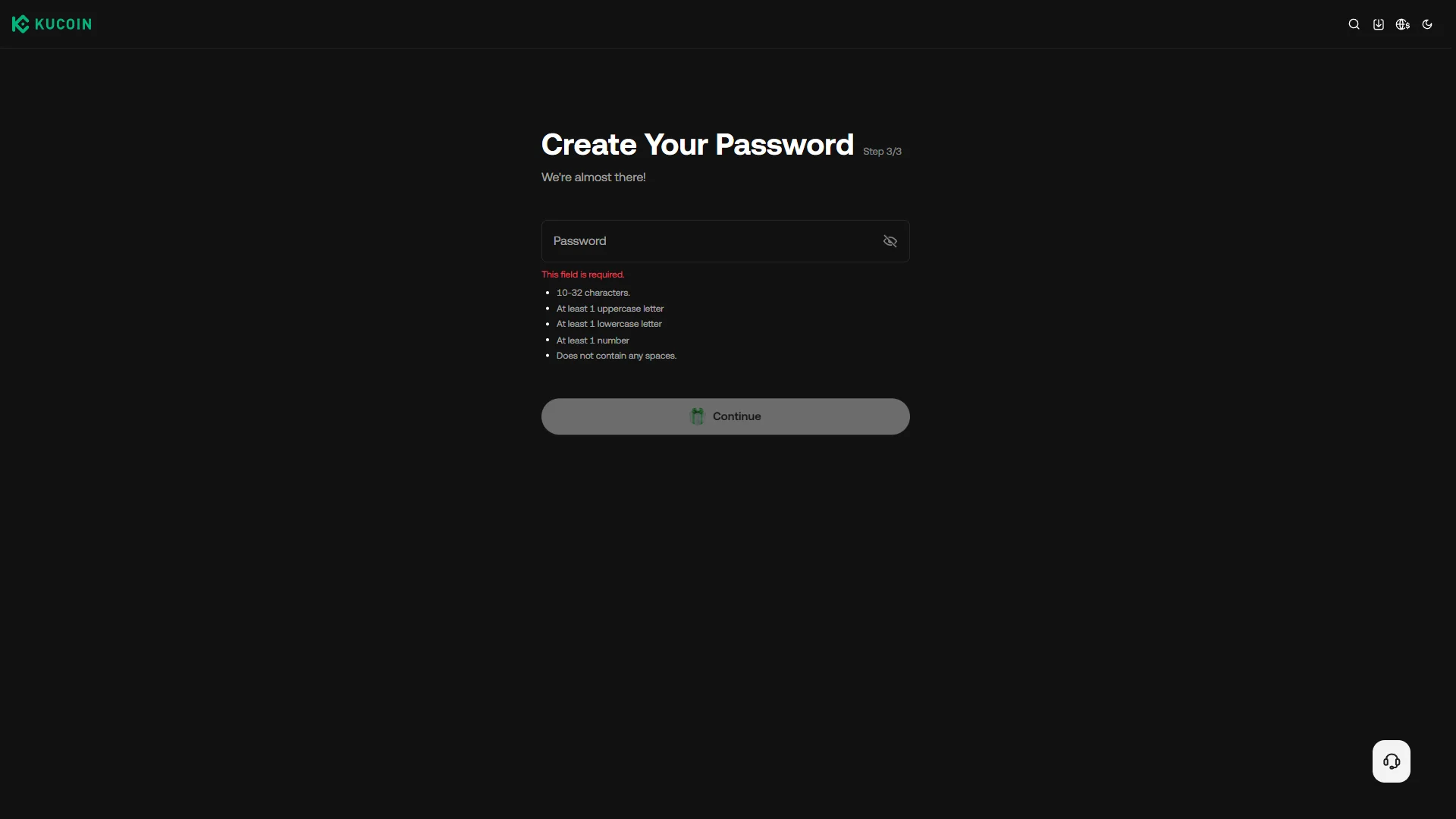
The password field is empty and its requirements are listed below it. Source: chainhelm editorial On the “Create Your Password” step, type a password into the “Password” field. The list below it sets the bounds: 10 to 32 characters, with at least one uppercase letter, one lowercase letter, one number, and no spaces.
Each rule is checked off as your entry satisfies it, and the “Continue” button stays inactive until all of them are met. Use the eye icon in the field to reveal what you have typed if you want to check it.
-
Confirm the password and continue
— Figure 7Password set, all checks passed2026-07-17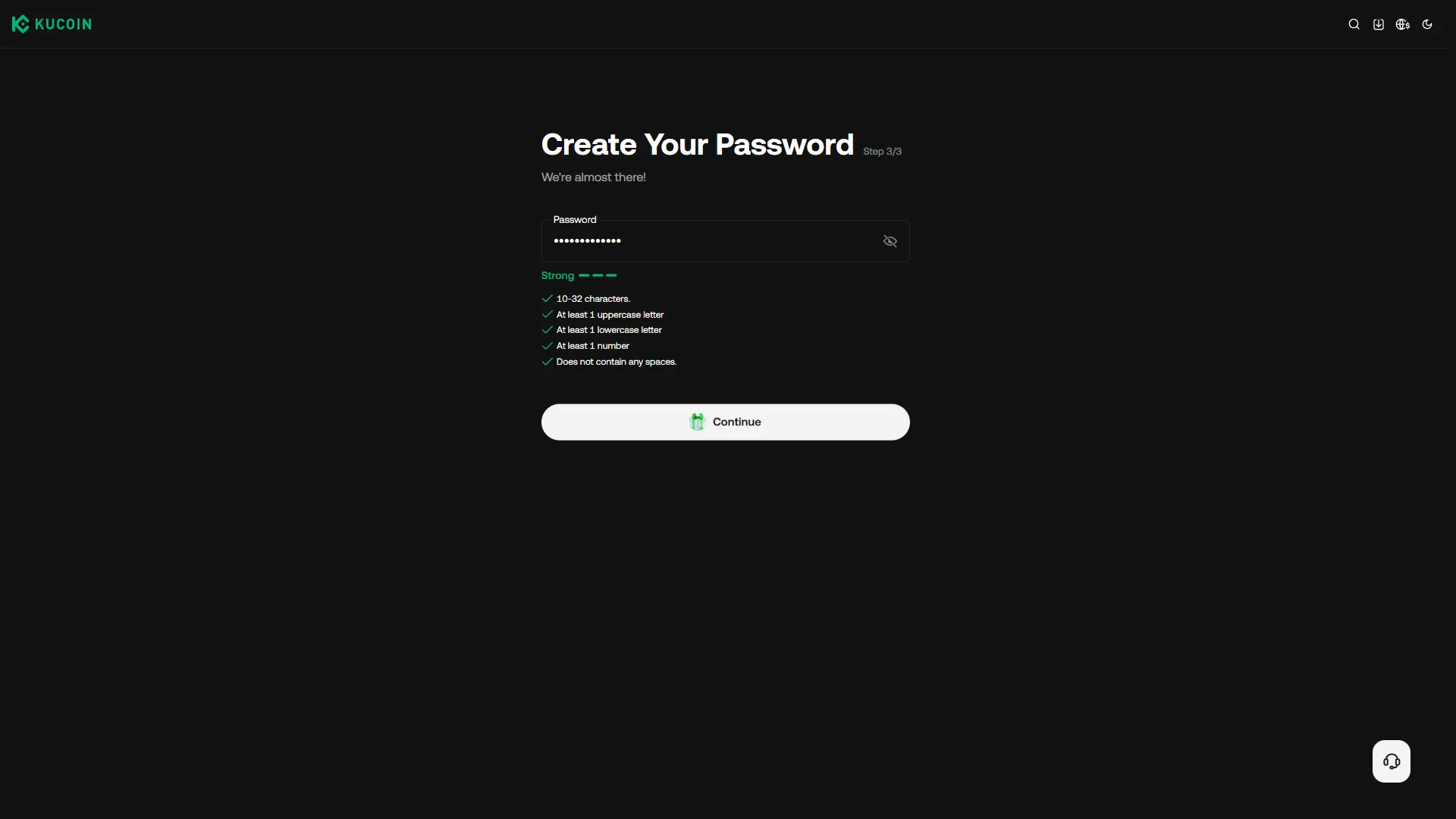
Every rule is met, the strength reads "Strong", and "Continue" is active. Source: chainhelm editorial Once your entry meets every rule, the strength indicator reads “Strong” and each requirement below it shows a green check, and the “Continue” button becomes active.
Select “Continue” to finish creating the account. kucoin confirms the sign-up and logs you in.
-
Sign-up complete
— Figure 8Sign-up complete confirmation2026-07-17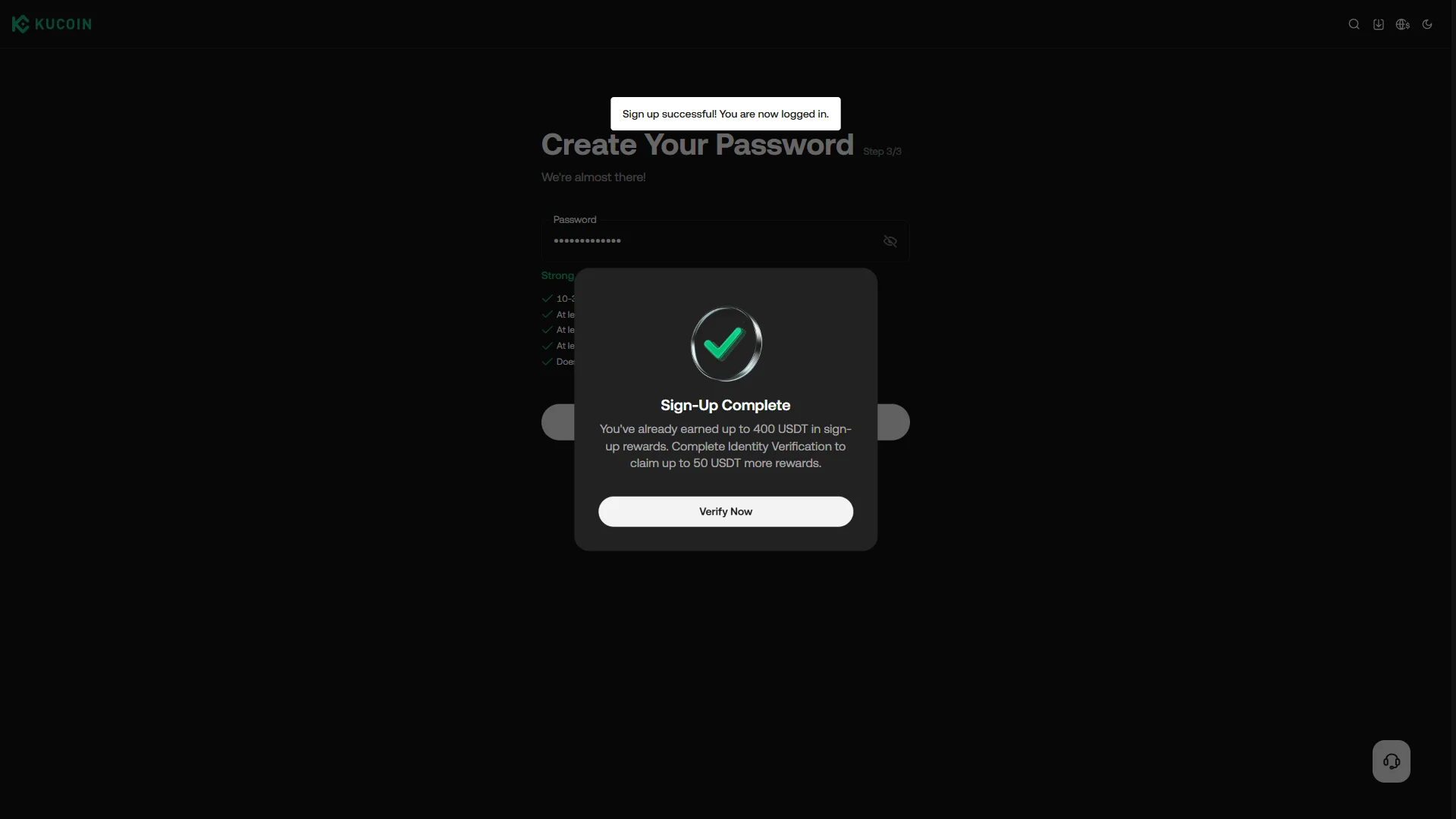
The account is created and logged in, with identity verification offered as the next step. Source: chainhelm editorial A “Sign up successful! You are now logged in.” message appears and a “Sign-Up Complete” panel opens. It notes the sign-up rewards already earned and that completing identity verification releases the rest.
Select “Verify Now” to begin identity verification, which is the step that enables deposits, withdrawals, and trading on the account.
Smartphone (iOS / Android) sign-up steps
-
First, open the KuCoin official sign-up page in the mobile app or browser (the link applies the referral code). When you open it, you’ll see a screen like the one below.
-
Open the sign-up form
— Figure 9Sign-up form, step 1 of 32026-07-17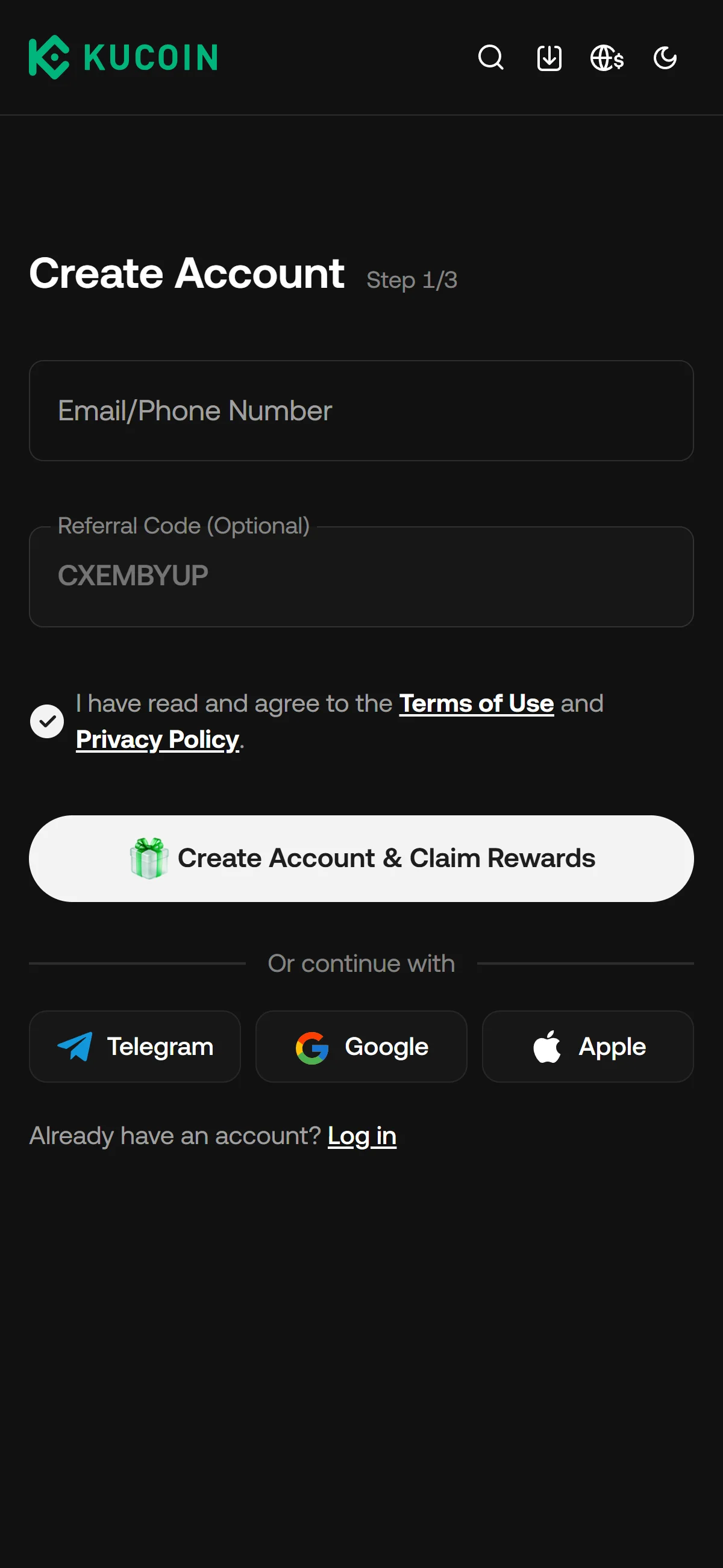
The email field is empty and the referral code "CXEMBYUP" is prefilled. Source: chainhelm editorial Open the sign-up page and type your address into the “Email/Phone Number” field. The “Referral Code (Optional)” box already shows “CXEMBYUP”, so leave it as it is to keep the referral tied to your account.
Check that the “Terms of Use” and “Privacy Policy” box is ticked. You could start from “Telegram”, “Google”, or “Apple” instead, but the email route keeps the whole sign-up on one screen. Once your address is in the field, the form is ready to submit.
-
Submit the sign-up form
— Figure 10Sign-up form, filled in2026-07-17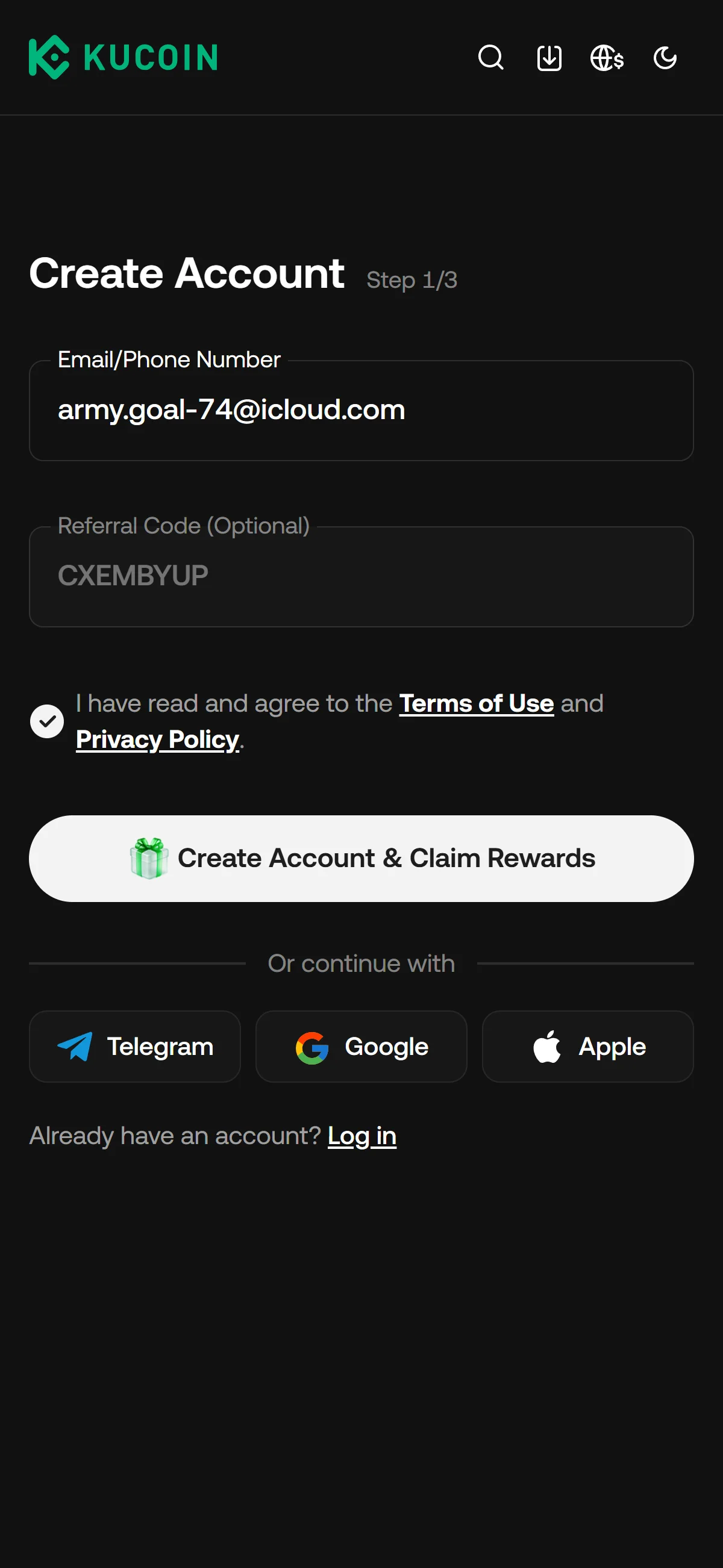
The email address is entered and the form is ready to submit. Source: chainhelm editorial With your address showing in the “Email/Phone Number” field and “CXEMBYUP” still in the referral box, select “Create Account & Claim Rewards”.
kucoin then moves you to the security verification step and sends a one-time code to the address you entered.
-
Enter the email verification code
— Figure 11Security verification, step 2 of 32026-07-17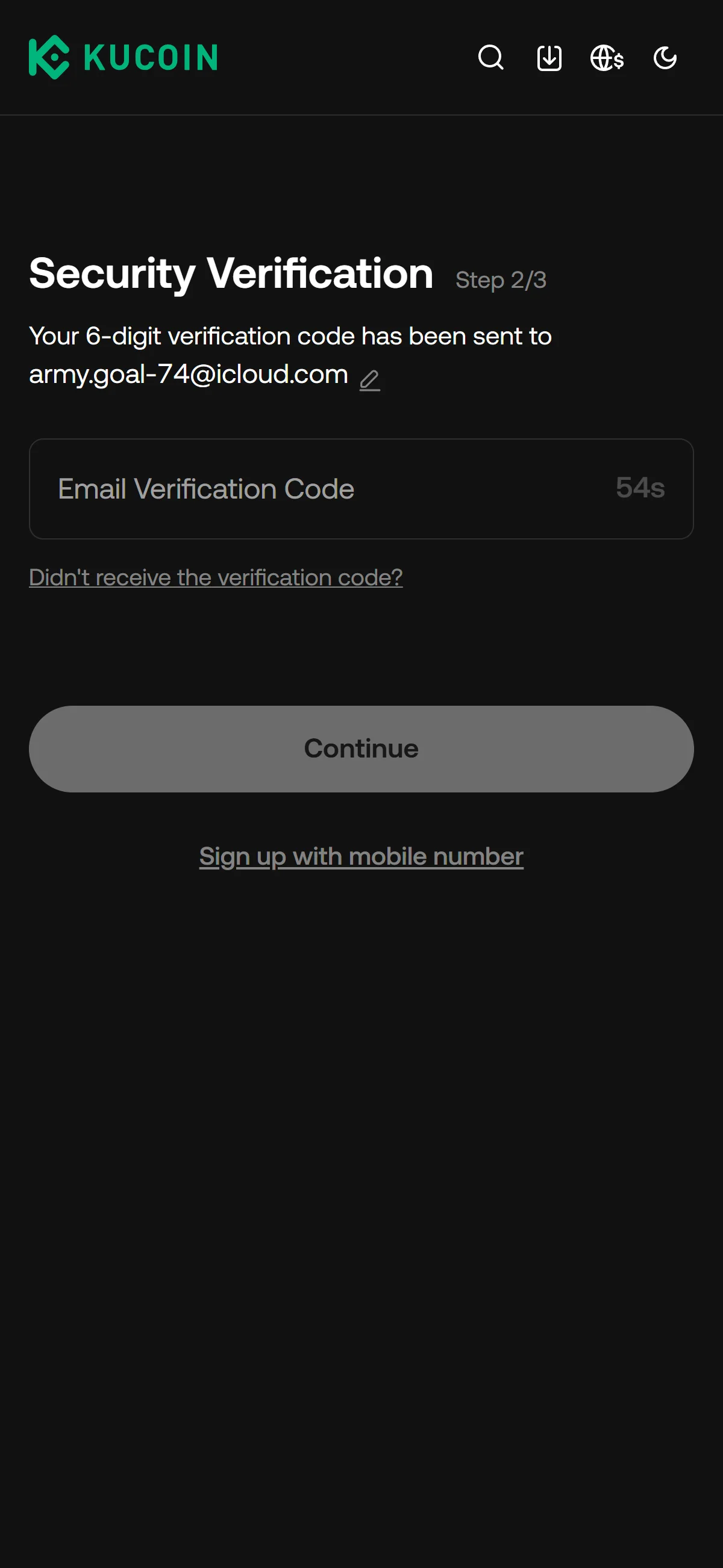
A code has been sent to the email and the entry field is still empty. Source: chainhelm editorial Open the inbox for the address you signed up with and find the code email from kucoin (shown next). Copy the six-digit code and type it into the “Email Verification Code” field.
The “Continue” button stays inactive until the field is filled. The countdown beside the field is a resend timer; once it reaches zero, “Didn’t receive the verification code?” becomes active and sends a new code. With the code entered, select “Continue” to move on to setting your password.
-
Get the code from your inbox
— Figure 12Verification code email2026-07-17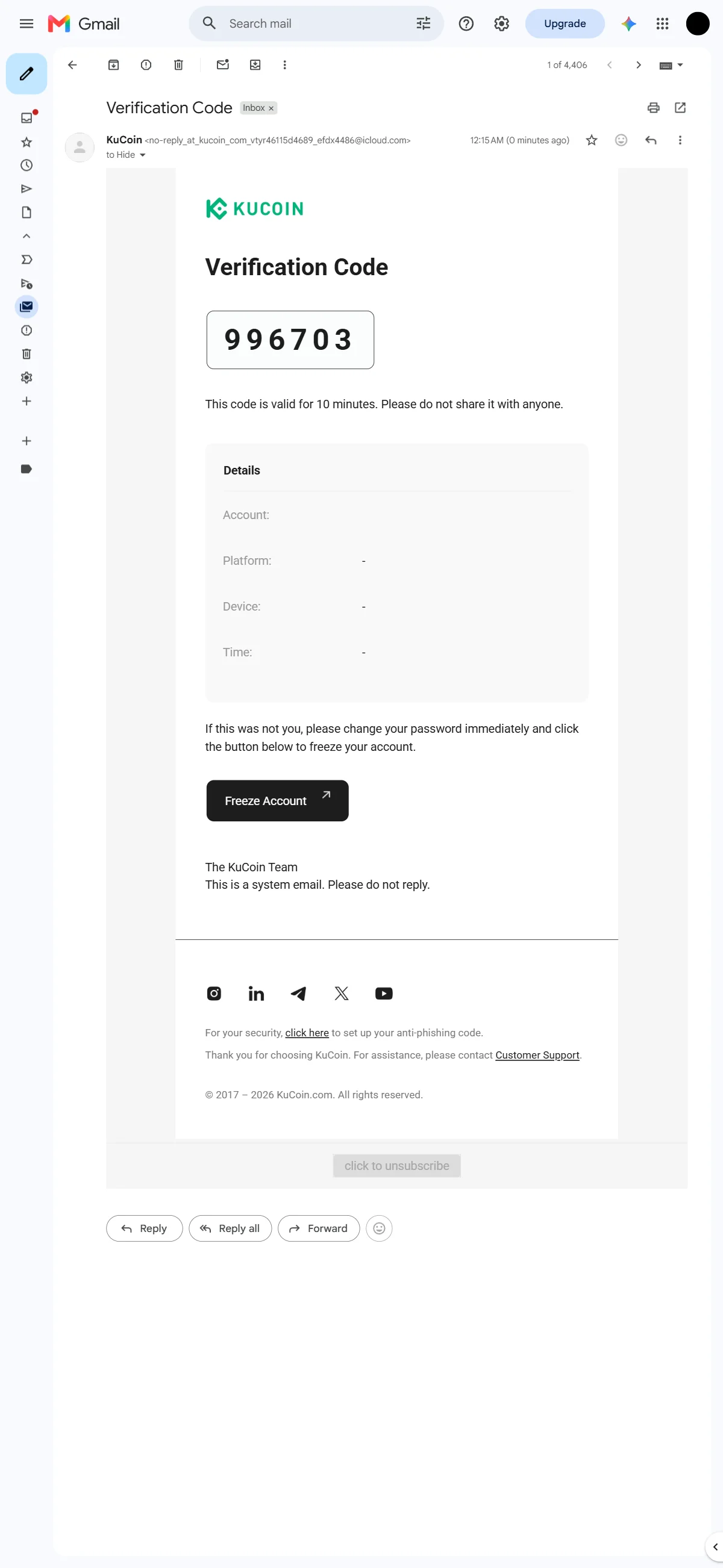
The kucoin email shows a six-digit code that stays valid for ten minutes. Source: chainhelm editorial Open the “Verification Code” email that kucoin sends to your inbox. It shows a six-digit code in a single box near the top of the message.
The email notes that the code is valid for 10 minutes and asks you not to share it with anyone. Copy the code, then return to the verification screen to enter it.
-
Create your password
— Figure 13Create your password, step 3 of 32026-07-17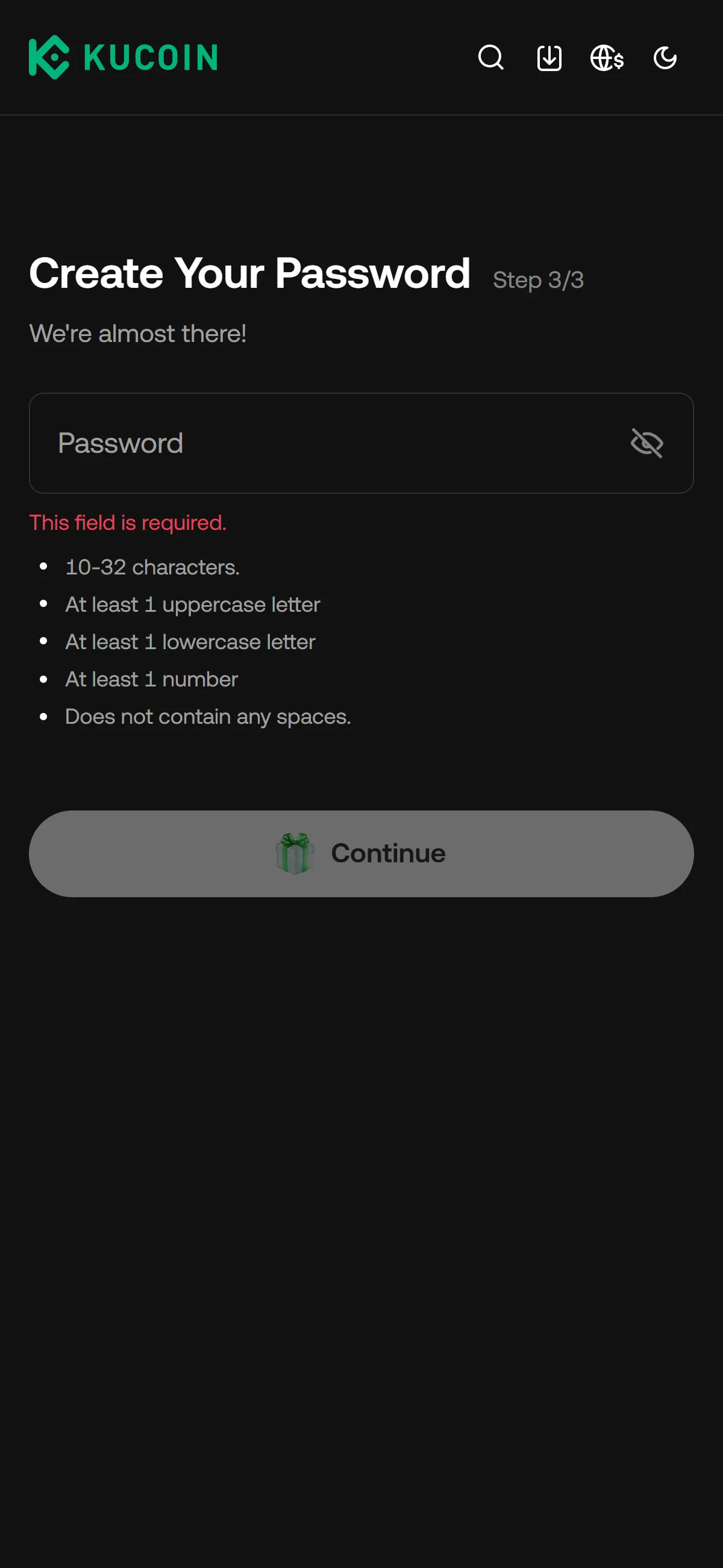
The password field is empty and its requirements are listed below it. Source: chainhelm editorial On the “Create Your Password” step, type a password into the “Password” field. The list below it sets the bounds: 10 to 32 characters, with at least one uppercase letter, one lowercase letter, one number, and no spaces.
Each rule is checked off as your entry satisfies it, and the “Continue” button stays inactive until all of them are met. Use the eye icon in the field to reveal what you have typed if you want to check it.
-
Confirm the password and continue
— Figure 14Password set, all checks passed2026-07-17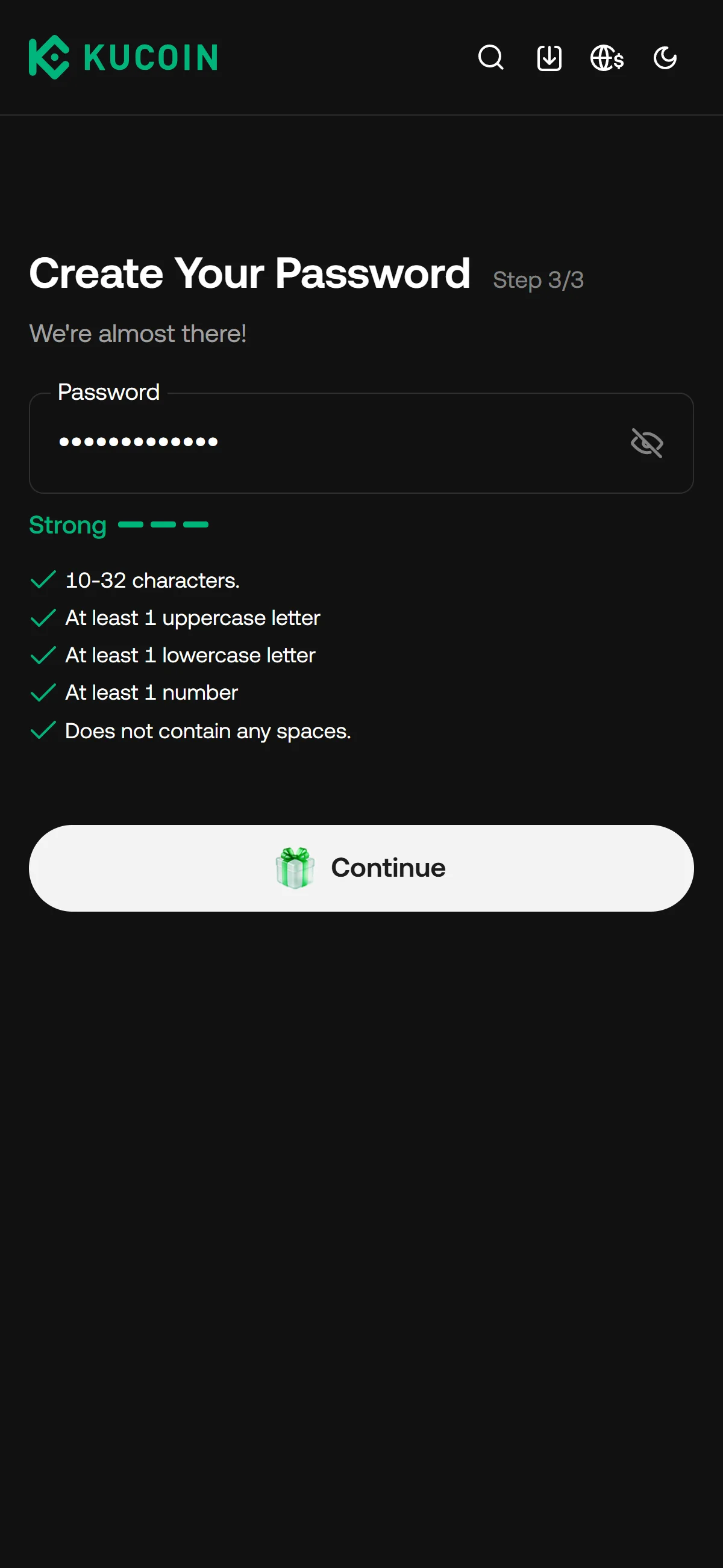
Every rule is met, the strength reads "Strong", and "Continue" is active. Source: chainhelm editorial Once your entry meets every rule, the strength indicator reads “Strong” and each requirement below it shows a green check, and the “Continue” button becomes active.
Select “Continue” to finish creating the account. kucoin confirms the sign-up and logs you in.
-
Sign-up complete
— Figure 15Sign-up complete confirmation2026-07-17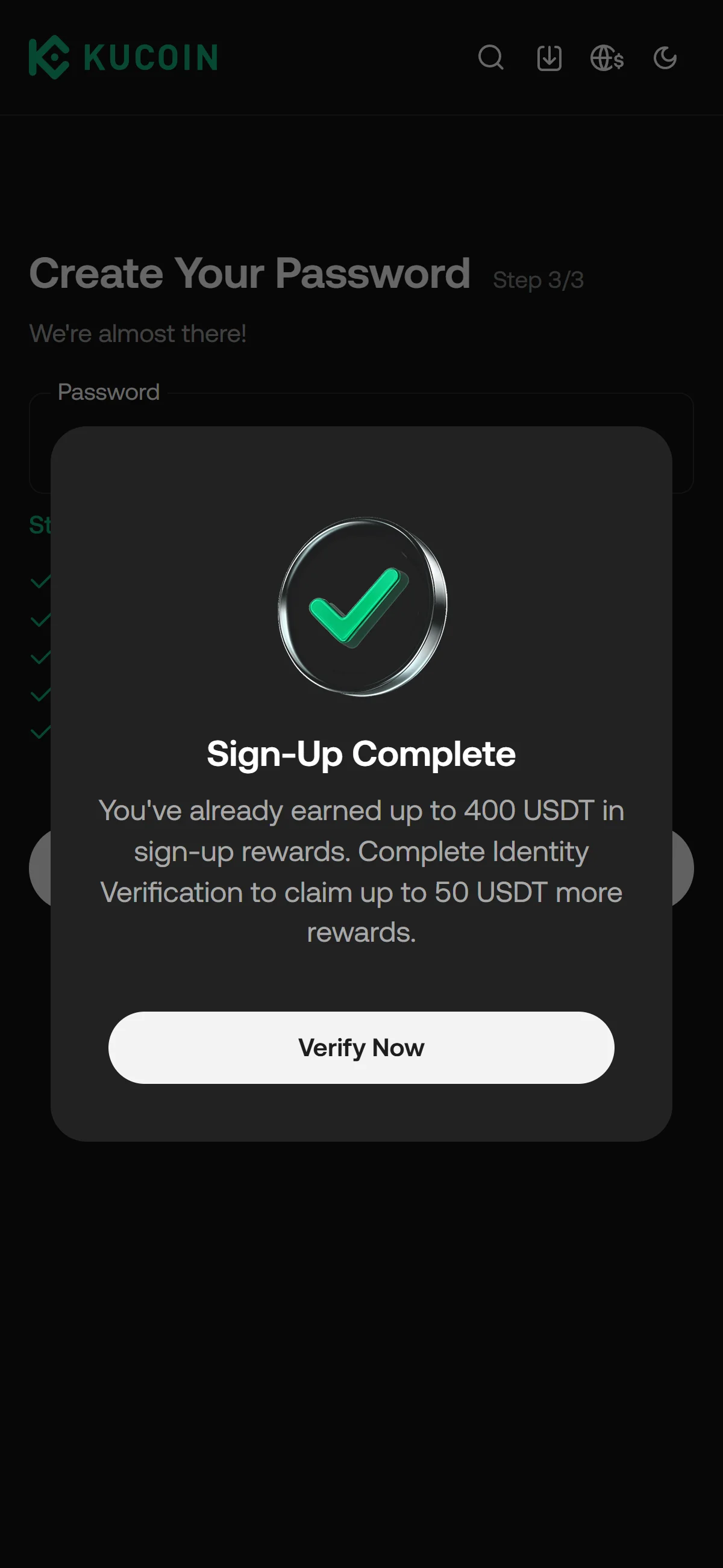
The account is created and logged in, with identity verification offered as the next step. Source: chainhelm editorial A “Sign up successful! You are now logged in.” message appears and a “Sign-Up Complete” panel opens. It notes the sign-up rewards already earned and that completing identity verification releases the rest.
Select “Verify Now” to begin identity verification, which is the step that enables deposits, withdrawals, and trading on the account.
What to do after signing up at KuCoin
We cover identity verification separately for PC/browser and smartphone (mobile).
PC/browser identity verification
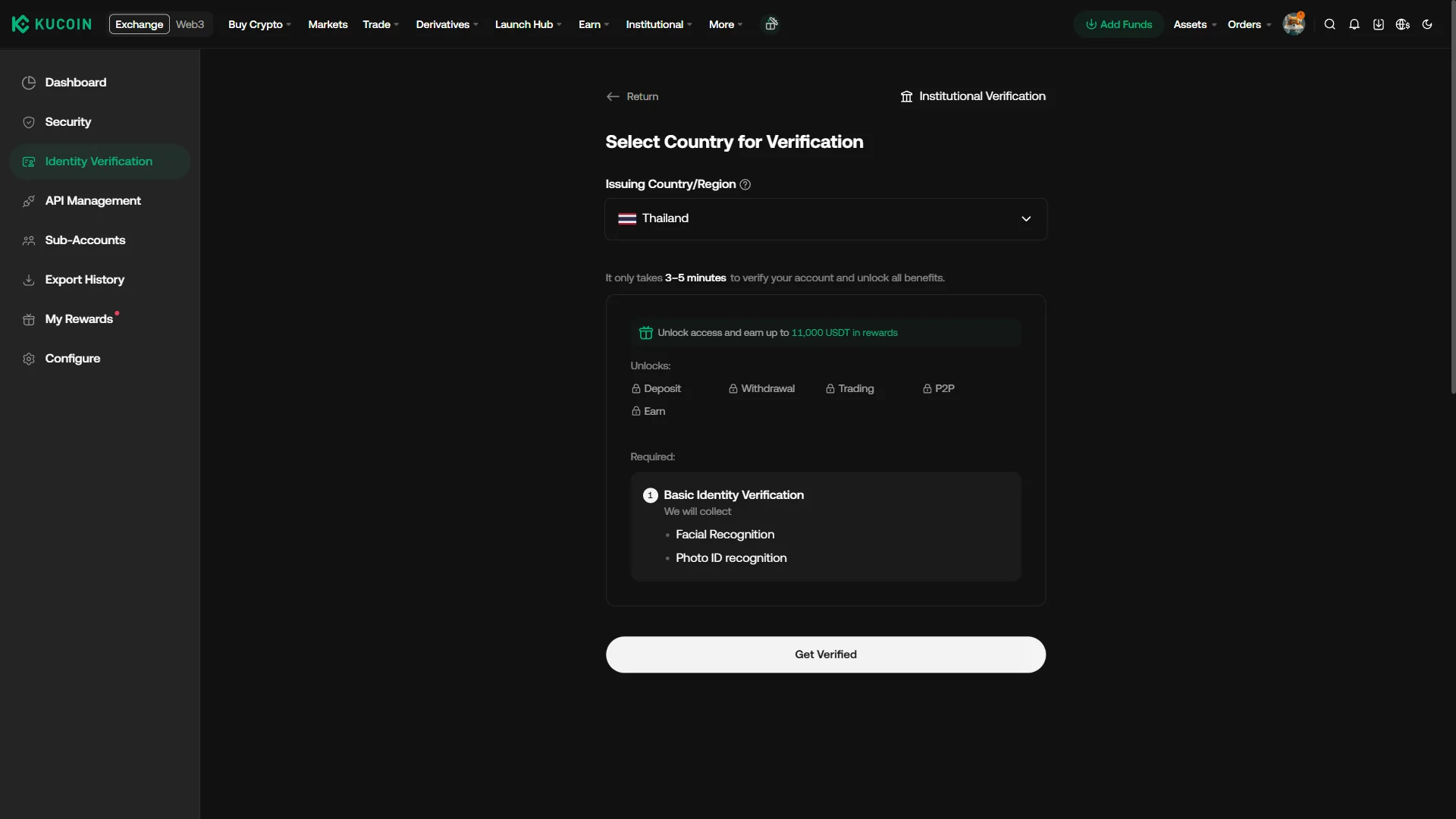
On the “Select Country for Verification” screen, open the “Issuing Country/Region” dropdown and choose the country that issued your ID; the capture here shows “Thailand” selected as an example.
The screen sets out what verification unlocks, deposit, withdrawal, trading, P2P, and Earn, and a notice above that list states you can earn up to 11,000 USDT in rewards. It also lists what “Basic Identity Verification” collects: facial recognition and photo ID recognition. Select “Get Verified” to move on to choosing your document.
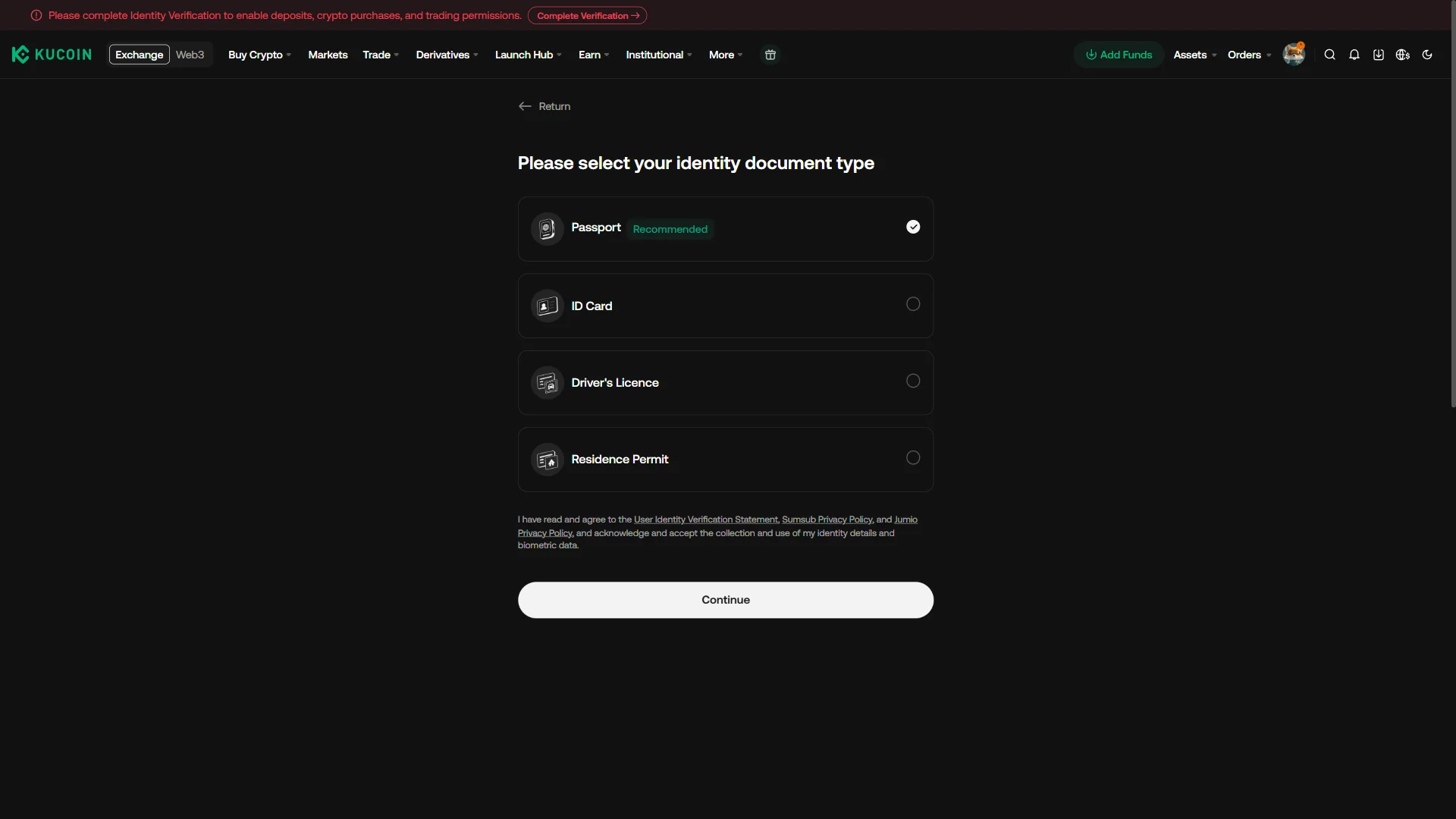
Choose the document you will verify with. “Passport” is preselected and marked “Recommended”, with “ID Card”, “Driver’s Licence”, and “Residence Permit” as the other options.
Below the list, a statement covers the collection and use of your identity and biometric data. With a document type chosen, select “Continue” to proceed with verification.
Smartphone (iOS / Android) identity verification
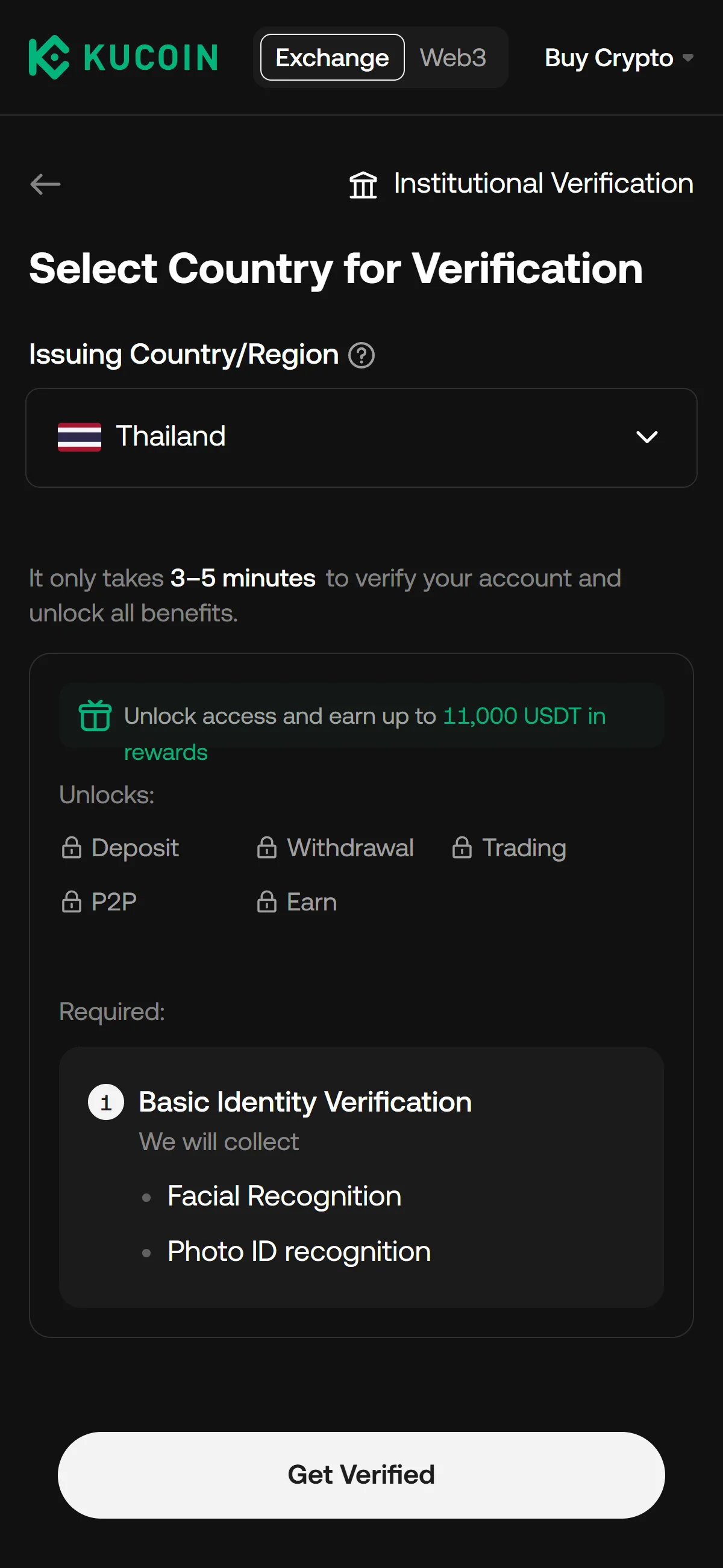
On the “Select Country for Verification” screen, open the “Issuing Country/Region” dropdown and choose the country that issued your ID; the capture here shows “Thailand” selected as an example.
The screen sets out what verification unlocks, deposit, withdrawal, trading, P2P, and Earn, and a notice above that list states you can earn up to 11,000 USDT in rewards. It also lists what “Basic Identity Verification” collects: facial recognition and photo ID recognition. Select “Get Verified” to move on to choosing your document.
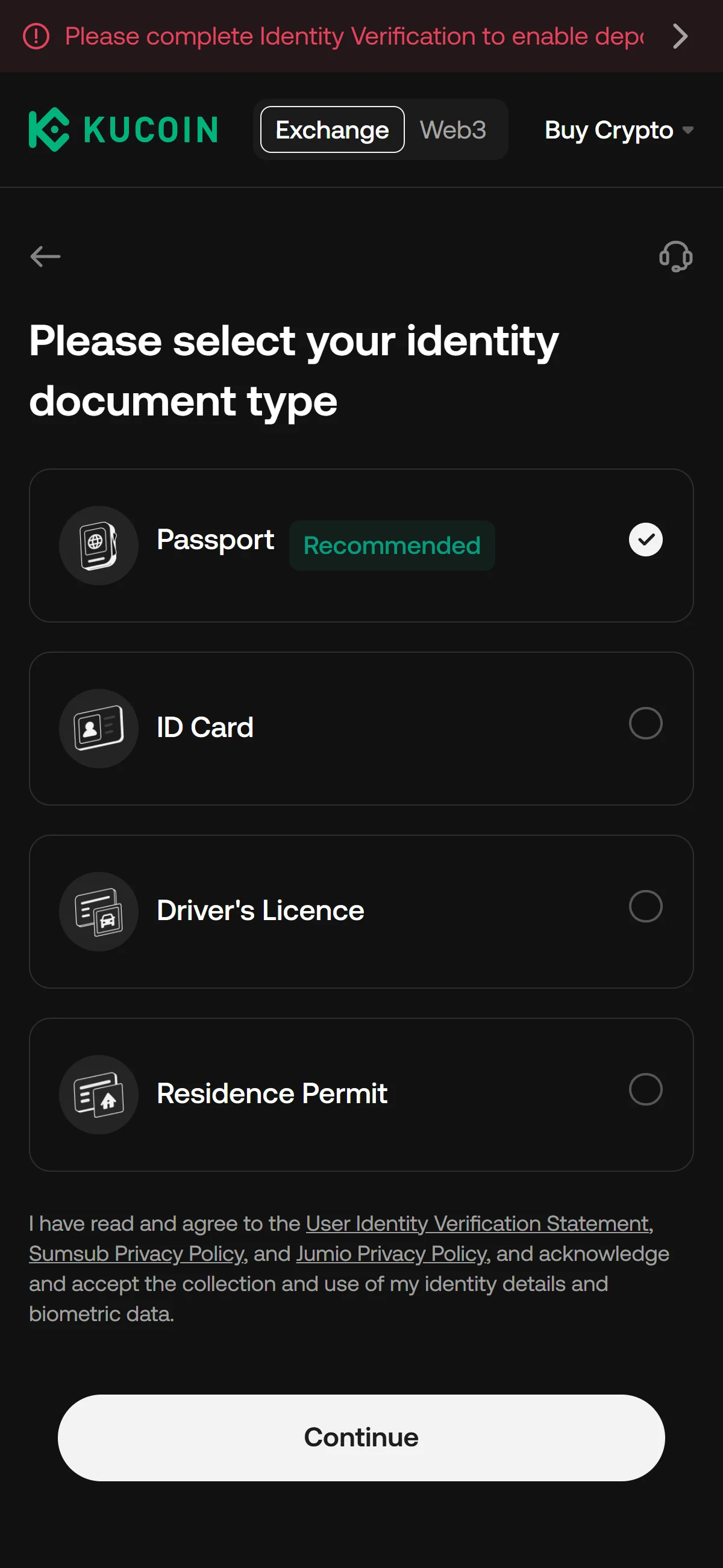
Choose the document you will verify with. “Passport” is preselected and marked “Recommended”, with “ID Card”, “Driver’s Licence”, and “Residence Permit” as the other options.
Below the list, a statement covers the collection and use of your identity and biometric data. With a document type chosen, select “Continue” to proceed with verification.
Completing identity verification is what turns the account on for deposits, withdrawals, and trading, and it takes only a few minutes to finish, with the remaining sign-up rewards released once it is done.
The KuCoin referral code cannot be added after sign-up
The referral code can only be entered at sign-up — it cannot be added afterwards.
If you overlook this and complete registration without the code, there is no mechanism for linking it to that account after the fact.
If you have not yet completed KYC (identity verification), creating a fresh account is an option worth considering. Some exchanges, though, restrict opening more than one account in their terms of use.
- Does the sign-up screen show referral code CXEMBYUP as applied? (Going through the link applies it automatically; where the exchange provides a code field, check there as well.)
- Once registration is complete, open the Referral / Rewards page and confirm that the referral shows as linked to your account
◆ ◇ ◆
What is KuCoin
KuCoin’s origins, scale, and product range
KuCoin launched in 2017 out of China, then moved its operations offshore — first to Singapore and later to the Seychelles — after China tightened its grip on crypto. The global business now runs through PEKEN Global Limited in the Seychelles, and the brand still calls itself “The People’s Exchange.” A more recent shift matters for the reader: BC Wong was installed as CEO in January 2025 to run a compliance-first strategy, and the two co-founders, Chun Gan and Ke Tang, stepped away from management and operations under the January 2025 US settlement.
The numbers put that history in perspective. KuCoin is large by user base and mid-pack by traded volume — a top-tier venue that is not a top-three one.
Read together, those standings say the edge here is breadth rather than raw spot depth: KuCoin spreads across more than 200 countries and ranks higher on derivatives than on spot. That breadth shows up most clearly in what you can actually trade.
- Spot
- ≈854 coins across ≈1,025 pairs, with a long tail of early and small-cap listings
- Derivatives
- USDT- and coin-margined futures up to 125x, plus margin up to 10x
- Automation
- futures copy-trading and free native trading bots
- Earn and Web3
- staking, savings, dual-investment and launchpad, plus a self-custodial KuCoin Web3 wallet
The surface is wide but not fixed: options trading was delisted on 2026-01-15. For a code searcher, the practical takeaway is that the account you are opening reaches deep into altcoins and leveraged products — which is also why the fee structure and the regulatory picture below deserve a close read before you fund it.
Trading fees and the native KCS token
Your real cost is more than the headline trading fee — it is the maker/taker fee plus what you pay to move assets in and out. The schedule below reflects the published rates as of 2026-07-17.
- Spot (standard)
- 0.10% maker / 0.10% taker at the base tier, scaling down to 0% maker / 0.025% taker at the top VIP tier
- Futures (standard)
- 0.020% maker / 0.060% taker, plus a 0.025% settlement fee charged when a contract settles
- Withdrawals
- per-asset flat network fees that vary by coin and chain — there is no single figure
The lever that lowers those spot rates is KCS, KuCoin’s own utility token: paying trading fees in KCS takes 20% off the spot fee, on top of the tiered VIP and holder benefits. For an active spot trader that turns the flat 0.10% base into a materially lower running cost; for an occasional trader it changes little. Either way, it is a standing feature of the fee schedule that applies to every trade you make.
What makes KuCoin distinct
KuCoin’s core draws: broad altcoins, native bots, and Web3 access
Strip away the marketing and KuCoin competes on two things: how many assets it lists, and how much self-service tooling it wraps around them. Its long-tail altcoin book — around 854 coins — is one of the broadest among global venues, and it pairs that with a flat 0.10% spot base and the 20% lower spot fees when you pay in KCS covered above. The rest of its identity is the built-in toolkit.
Native trading bots
High-leverage futures
Web3 in one app
Put together, these features point at a specific user: someone who wants a wide altcoin menu, automated strategies and on-chain access without leaving the app, and who is comfortable trading leverage. That is who KuCoin is built for — which also frames who it is not built for.
KuCoin relative to Binance, Bybit, and OKX
The venues a broad-altcoin trader actually weighs KuCoin against are the global majors, not local exchanges.
- Binance
- the deepest global spot book, at roughly #2 on CoinGecko spot
- Bybit
- a broad derivatives-led major, at roughly #8 on CoinGecko spot
- OKX
- a comparable broad-altcoin and derivatives venue
- KuCoin
- CoinGecko spot #17 at about USD 0.84–0.86B a day — below the majors on spot depth, ahead of most regional and licensed venues on altcoin breadth
Treat those standings as directional, not precise. Exchange volume figures mix spot and derivatives, are inflated by wash trading, and self-reported listing counts can be padded — which is why chainhelm keeps to a small, neutral set of metrics rather than a crowded league table. The honest read is that KuCoin trades spot depth for reach: you go to Binance or OKX for the deepest book, and to KuCoin when the coin you want is more likely to be listed.
The right fit for KuCoin — and when another venue serves better
KuCoin is not the right account for everyone, and the split is mostly about regulation rather than features.
KuCoin suits
Another venue serves better
The second column is not hypothetical. US residents cannot use KuCoin at all. In spot-only regulated regimes such as Singapore and Hong Kong, and in the UK — where crypto derivatives are banned for retail — MAS-, SFC- and FCA-registered venues give you local fiat rails and statutory protections KuCoin does not. And even where KuCoin has pursued a license, friction has followed: new customers on its EU entity hit an onboarding suspension from the Austrian regulator in February 2026. Whether KuCoin is even available to you is the next question — and it is answered market by market below.
KuCoin regulatory landscape
KuCoin is, at heart, an offshore operator with one significant regulated foothold and a long list of places it does not serve. The foothold is European: through KuCoin EU Exchange GmbH it secured a MiCAR authorization in Austria in November 2025, passportable across 29 EEA states. The friction arrived almost immediately — in February 2026 the Austrian FMA barred the EU entity from onboarding new customers pending anti-money-laundering and compliance staffing, while letting existing EU services continue.
Against that single beachhead sits a broad map of restrictions. KuCoin’s Terms of Use (Article 17(5)), which chainhelm read on 2026-07-17, enumerate the places it will not serve.
The list also covers the Russia-occupied regions of Ukraine (Crimea, Donetsk, Luhansk, Zaporizhzhia and Kherson) as sanctioned areas. Two caveats matter for anyone cross-checking third-party trackers: the US bar is court-ordered through the DOJ and CFTC rather than a voluntary choice, and Thailand — which some trackers list as globally restricted — is not in this primary Terms-of-Use list, though KuCoin’s Thai situation is its own story, covered below. On top of the current map, KuCoin has a record of being forced out: the United States (a January 2025 DOJ guilty plea, made permanent by a March 2026 CFTC injunction), New York (a December 2023 settlement with the state Attorney General), and Ontario (a 2022 OSC ban). Canada remains a partial restriction reciprocated across provinces via the CSA, and the EU/EEA is partial after the 2026 onboarding suspension. The practical point is that the map is not static — so where you sit is worth checking directly.
A compliance-first regulatory trajectory
There is a clear direction to all of this. After a run of enforcement from 2022 to 2025 — Ontario, then New York, then the US DOJ — KuCoin exited the United States permanently, installed a compliance-first CEO, and went after an EU MiCAR license, only for the EU entity to hit the 2026 onboarding ban. The arc bends one way even as it stalls in places.
The direction of travel is unmistakably toward compliance — and just as unmistakably unfinished.
One consequence of that pivot is a set of separate KuCoin entities that should not be confused with the global platform this code applies to: KuCoin EU (the Austria-seated, MiCAR-authorized entity), KuCoin Thailand (operated by ERX Co., Ltd., under Thai SEC operational suspension since 2026-01-03), and KuCoin TR (kucoin.tr, listed on the Turkish CMB’s List of Operators). Each serves a specific market under its own regulator, and none of them is the global account described here.
Where Australia and India sit in this picture
Two of this article’s markets — Australia and India — can currently reach KuCoin, but each on distinctive terms that are worth stating as landscape rather than a straight yes.
In Australia, KuCoin first pulled products under regulatory pressure: it withdrew leveraged tokens and Earn structured products (effective 2024-05-15) and its global futures (effective 2024-06-10) for Australian users, citing ASIC instructions. It then announced an AUSTRAC Digital Currency Exchange registration on 2025-11-25, through an undisclosed subsidiary, and relaunched regulated futures via the ASIC-licensed issuer Echuca Trading Pty Ltd (AFSL 297499).
India took a more adversarial path that has since normalized. FIU-IND served KuCoin (operating entities Mek Global Limited and PhoenixFin Pte. Ltd) a compliance show-cause notice on 2023-12-28, its URLs and app were blocked in January 2024, and FIU-IND imposed an INR 34.5 lakh penalty (about USD 41,000) under Section 13 of the PMLA (order PGL Order 08/2024, dated 2024-03-22). KuCoin settled, registered as a FIU-IND reporting entity, and resumed on 2024-03-23. As of 2026-07-17 it is FIU-registered and legal in India, with the statutory 1% TDS and 30% gains tax applying to Indian taxpayers. For readers in either market the message is the same: KuCoin is reachable and locally engaged, but confirm the current terms and price in the local tax and verification specifics before you commit.
KuCoin availability across major jurisdictions
Whether you can use the code’s global platform at all depends heavily on where you are. Here is where KuCoin stands in the major English-speaking markets, and the licensed route to take where it is closed.
United States: closed to KuCoin — use a US-regulated exchange
For a reader in the United States, the global platform is simply closed. KuCoin exited the US under a January 2025 DOJ guilty plea, existing US accounts were closed effective 2025-01-23, and a March 2026 CFTC permanent injunction bars re-entry; there is no US entity, no new US sign-up, and the company was never registered with FinCEN. A December 2023 settlement with the New York Attorney General predates the federal exit. So the honest answer for a US reader is not to use the code carefully — it is to open an account on a US-regulated venue instead.
Coinbase
Kraken
Crypto.com
Gemini
Which one fits depends on where you live and what you trade: Kraken carries the widest US-regulated altcoin book, Coinbase and Crypto.com add CFTC-regulated perpetual futures, and Gemini is the one option here open to New York residents.
Singapore: restricted by KuCoin — MAS-licensed venues instead
Singapore is an enumerated Restricted Location in KuCoin’s Terms of Use, and MAS added KuCoin to its Investor Alert List on 2026-02-11; there is no MAS-licensed KuCoin entity and no PSA/DPT license. Singapore residents cannot open the global account, so the practical route is a MAS-licensed venue.
Coinhako
OKX
Crypto.com
Coinbase
All four are MAS-licensed and SGD-native; OKX is the closest match for KuCoin’s broad-altcoin style. Expect these venues to be spot-centric, because MAS restricts retail crypto derivatives and leverage.
United Kingdom: FCA-warned — FCA-registered platforms instead
The United Kingdom is the least clear-cut of the three. KuCoin sits on the FCA Warning List with no lawful route to promote to UK consumers, and crypto derivatives are banned for UK retail. Whether a new UK user can currently onboard is not something chainhelm can confirm from primary sources — some secondary reports describe a withdraw-only state for new UK users — so we treat KuCoin as not available in the UK rather than assert a clean ban either way. Readers are better served by an FCA-registered platform.
Coinbase
Kraken
Crypto.com
All three are spot-centric for UK retail, since crypto derivatives are banned under FCA PS20/10. State the uncertainty plainly to yourself: if you are a new UK user, assume KuCoin is off the table and start with a registered platform.
Risks to acknowledge before using KuCoin
Counterparty and custody track record
The question under every exchange account is whether the venue can keep your money safe, and KuCoin’s record here is a real breach followed by a clean recovery. On 2020-09-25 a hot-wallet hack, attributed to the Lazarus Group, drained roughly USD 275–281M. KuCoin recovered the assets in full by 2020-11-11, around 84% through on-chain tracking and recovery and about 16% covered by its insurance and protection fund, and users were made whole.
Today’s reserves signal is reassuring on the surface. KuCoin publishes Merkle-tree Proof of Reserves showing coverage above 100% for every major asset.
A real breach, a clean recovery, and a custody model you are asked to take partly on trust.
Where the picture thins out is in the custody internals: KuCoin does not publicly disclose its hot/cold storage split, its multi-sig configuration, or a fixed wallet-insurance figure. The reserve ratios are verifiable; the mechanics behind them are not. Generic collapse cases like FTX or Mt. Gox are useful only as contrast — the point is that KuCoin’s own record shows both a serious incident and a full recovery, and that you are still trusting an operator whose custody design is opaque.
The legal and enforcement record
The operator, PEKEN Global Limited, carries a substantial and dated enforcement history — worth reading in full because it feeds directly into the counterparty and access risks.
Taken neutrally and in proportion, this is not a single stumble but a multi-year pattern across several regulators, ending in a permanent US exit and a compliance rebuild. For a prospective user it is evidence rather than trivia: an operator with this record is one you should size your exposure to deliberately.
Access and availability risk to you
The forward-looking risk follows straight from that history. KuCoin has repeatedly been forced out of markets and has pulled products — the US, New York and Ontario exits, and product withdrawals such as options being delisted on 2026-01-15 and leveraged or derivative products removed in some jurisdictions. Availability in any single market can change with little notice.
Leverage and market volatility are real, but they are risks you choose and size yourself; they belong to the products described earlier, not to this chapter. The risk specific to KuCoin is that the venue’s regulatory standing — and therefore your access to your own funds — is not fully in your control.