— Contents 10 sections
- 01 Is the BTCC referral code “Ufl8zgp” still active?
- 02 What the BTCC referral code “Ufl8zgp” gets you
- 03 BTCC sign-up steps with the referral code
- 04 What to do after signing up at BTCC
- 05 The BTCC referral code cannot be added after sign-up
- 06 What is BTCC
- 07 What makes BTCC distinct
- 08 BTCC regulatory landscape
- 09 BTCC availability across major jurisdictions
- 10 Risks to acknowledge before using BTCC
chainhelm’s exclusive BTCC referral code is .
As of 2026-07-11, we signed up as a new user and confirmed that the referral code was applied.
Enter the code at sign-up to receive a bonus of up to 30,000 USD equivalent for new users and a 5% discount on trading fees. You can only do this during registration, so we recommend entering it right then and there.
This article covers the sign-up process with the BTCC referral code, BTCC’s distinguishing features, availability in major jurisdictions, and the risks to acknowledge — with the sign-up flow and code application verified first-hand by chainhelm’s editorial team.
Is the BTCC referral code “Ufl8zgp” still active?
The chainhelm editorial team created a fresh BTCC account on 2026-07-11 and confirmed that the referral code “Ufl8zgp” is still active.
Here is the actual screen captured during verification.
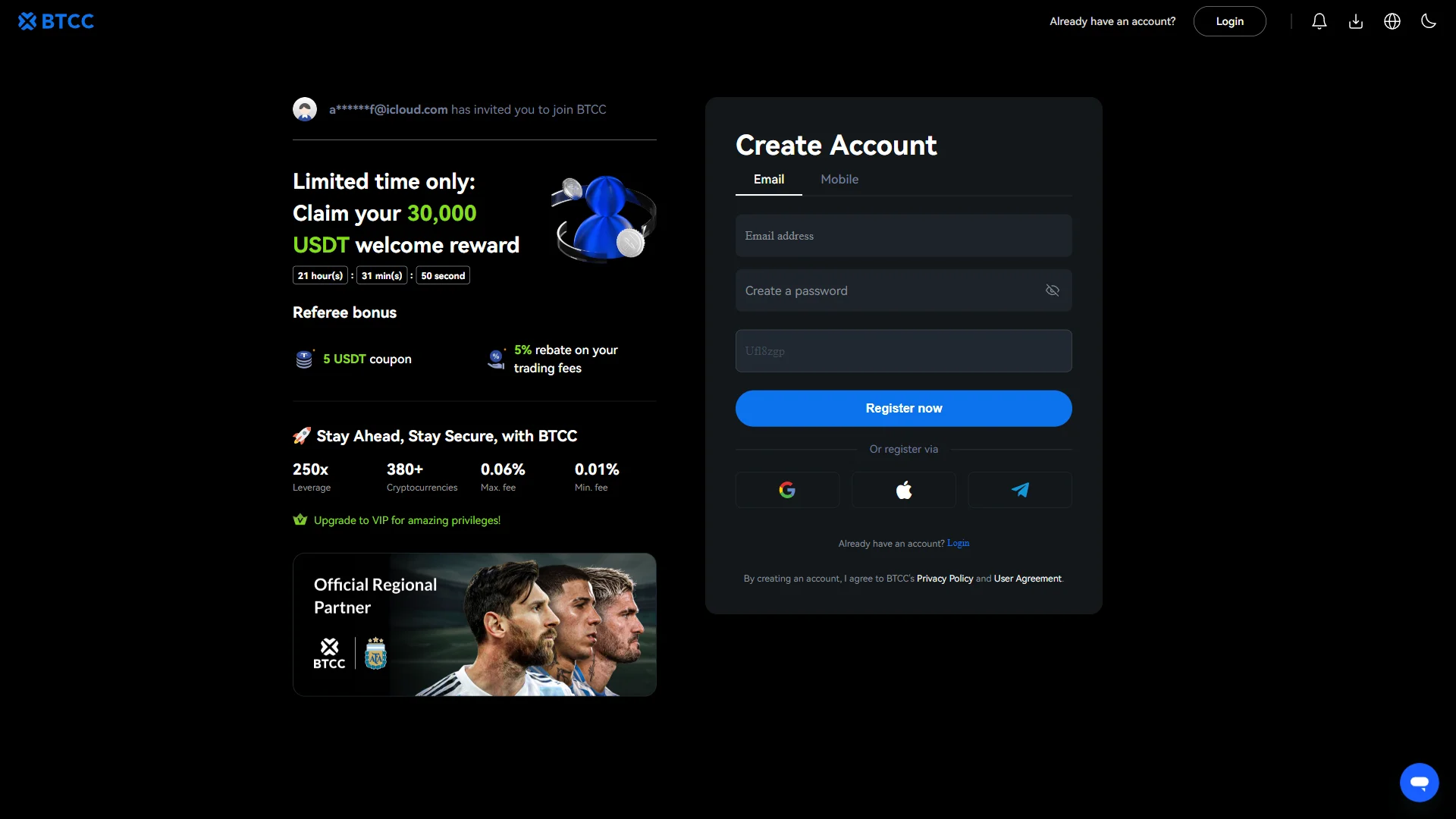
The screen shows “Ufl8zgp”, confirming that the referral code Ufl8zgp was correctly applied.
chainhelm continuously verifies the validity of the code and confirms it remains usable.
What the BTCC referral code “Ufl8zgp” gets you
Apply this code at sign-up to receive the following benefits on BTCC:
- Benefit: a bonus of up to 30,000 USD equivalent for new users, and a 5% discount on trading fees
- Expiration: None
- Eligibility: New users
To receive the benefits, you need to enter the code when you create your account. Be careful not to miss this step.
BTCC sign-up steps with the referral code
We cover the sign-up process separately for PC/browser and smartphone (mobile).
PC/browser sign-up steps
-
First, open the BTCC official sign-up page (the link applies the referral code). When you open it, you’ll see a screen like the one below.
-
Open the registration form from your invite
— Figure 2Invited registration form2026-07-11 The "Create Account" form opened from the invite, with the referral code "Ufl8zgp" pre-filled and the email and password fields still empty. Source: chainhelm editorial Follow the invite link to open BTCC’s “Create Account” form. At the top you can see the inviter’s masked address confirming the invitation was recognized, and the referral code field already holds “Ufl8zgp” — leave it untouched so the referral stays tied to your account.
Keep the “Email” tab selected (you could switch to “Mobile”, but this walkthrough uses email) and get ready to fill in the “Email address” and “Create a password” fields below.
-
Enter your details and register
— Figure 3Details entered, ready to submit2026-07-11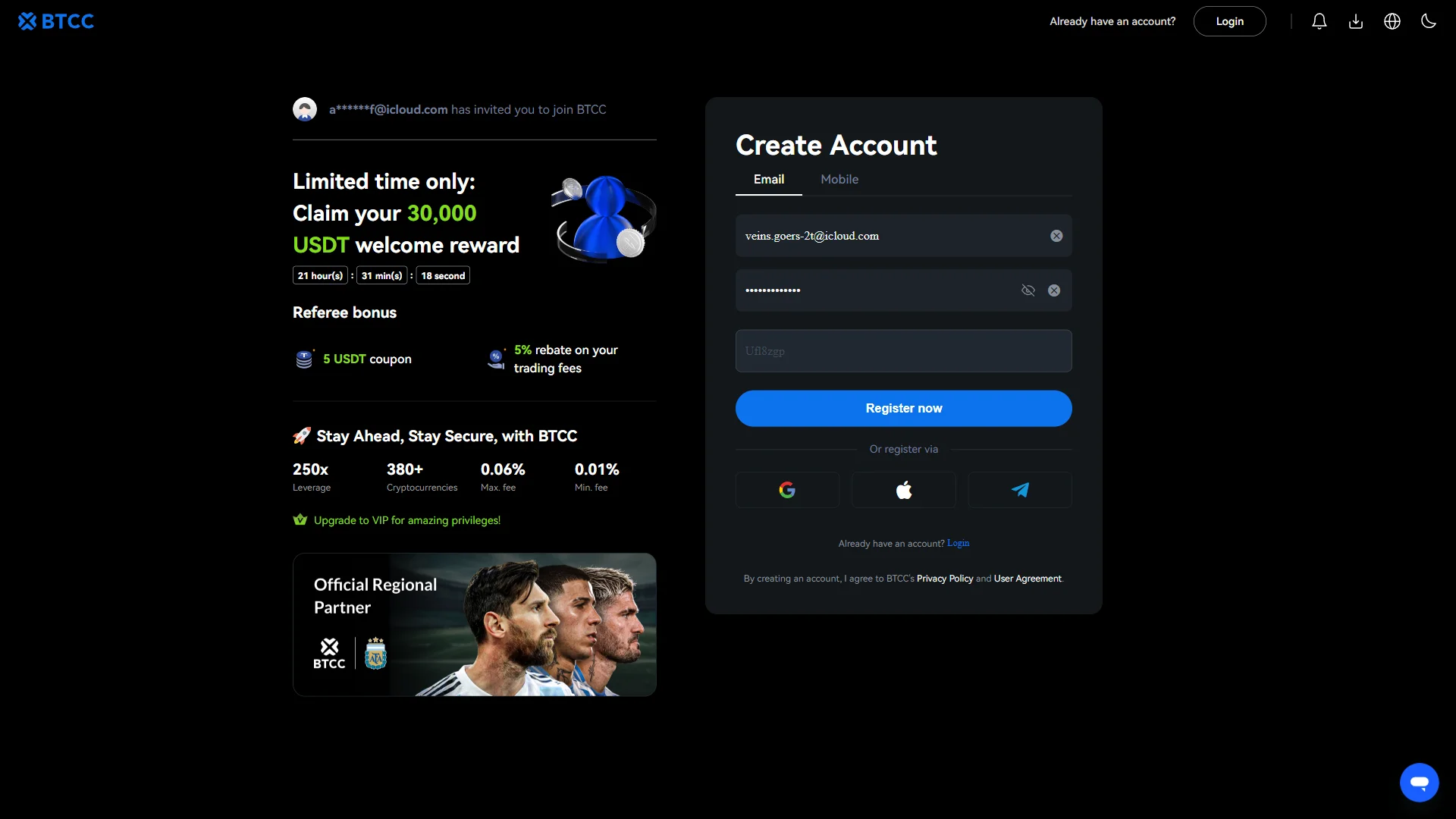
The form with the email address and password filled in and the "Ufl8zgp" referral code retained, ready for "Register now". Source: chainhelm editorial Type your address into the “Email address” field and set a login password in “Create a password”, leaving the pre-filled “Ufl8zgp” referral code in place.
Note the fine print at the bottom of the form: creating an account means you agree to BTCC’s “Privacy Policy” and “User Agreement”. Once your details are in, click “Register now” to submit. (The “Or register via” buttons for Google, Apple, and Telegram are an alternative, but the email path keeps the referral straightforward.) Submitting brings up a short verification check next.
-
Clear the slider verification
— Figure 4Slider puzzle check2026-07-11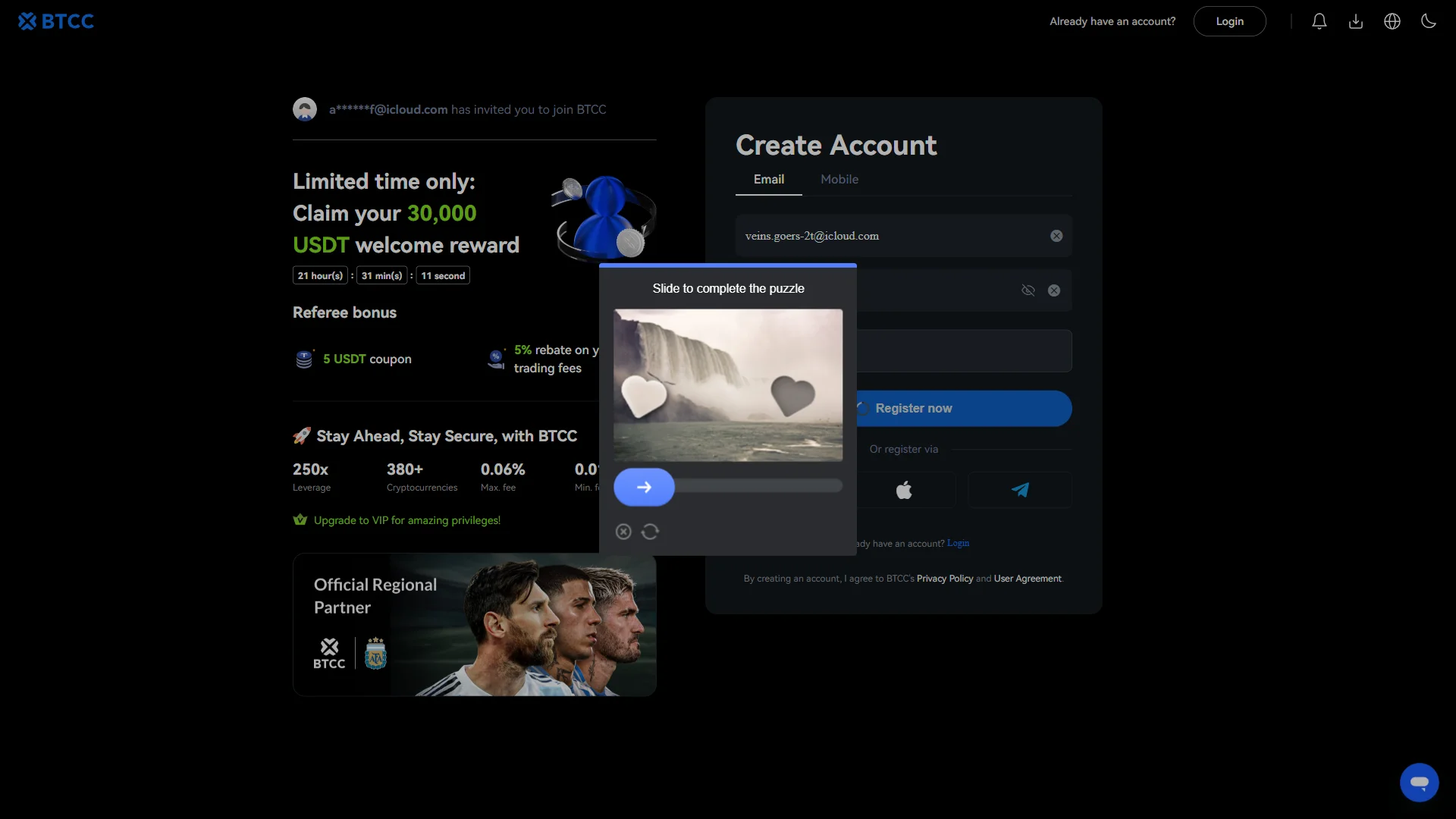
The "Slide to complete the puzzle" overlay shown after submitting, waiting for you to drag the slider across. Source: chainhelm editorial After you submit, a “Slide to complete the puzzle” check appears over the form. Drag the slider handle to the right until the puzzle piece drops into the picture.
Clearing the slider confirms you are a real person and moves you on to email verification.
-
Enter the email verification code
— Figure 5Email verification code entry2026-07-11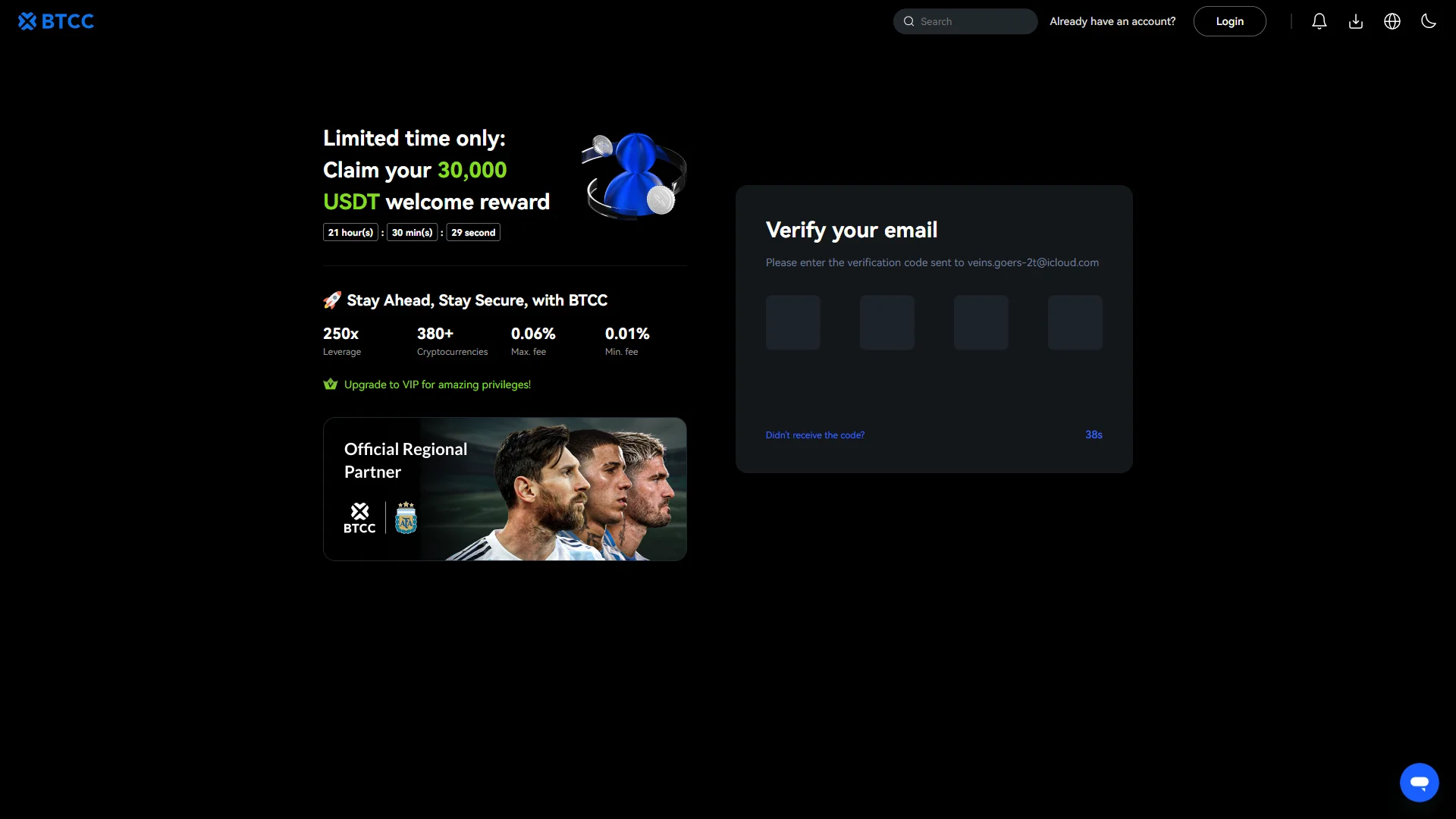
The "Verify your email" screen with four empty code boxes and a resend timer, awaiting the code sent to your address. Source: chainhelm editorial BTCC sends a verification code to the address you registered. Open your inbox to read it, then type the code into the four boxes on the “Verify your email” screen.
If nothing arrives, use “Didn’t receive the code?” once the resend timer runs down, then check your inbox again. Entering the correct code takes you on to the final residence step.
-
Find the activation code in your inbox
— Figure 6Activation code email2026-07-11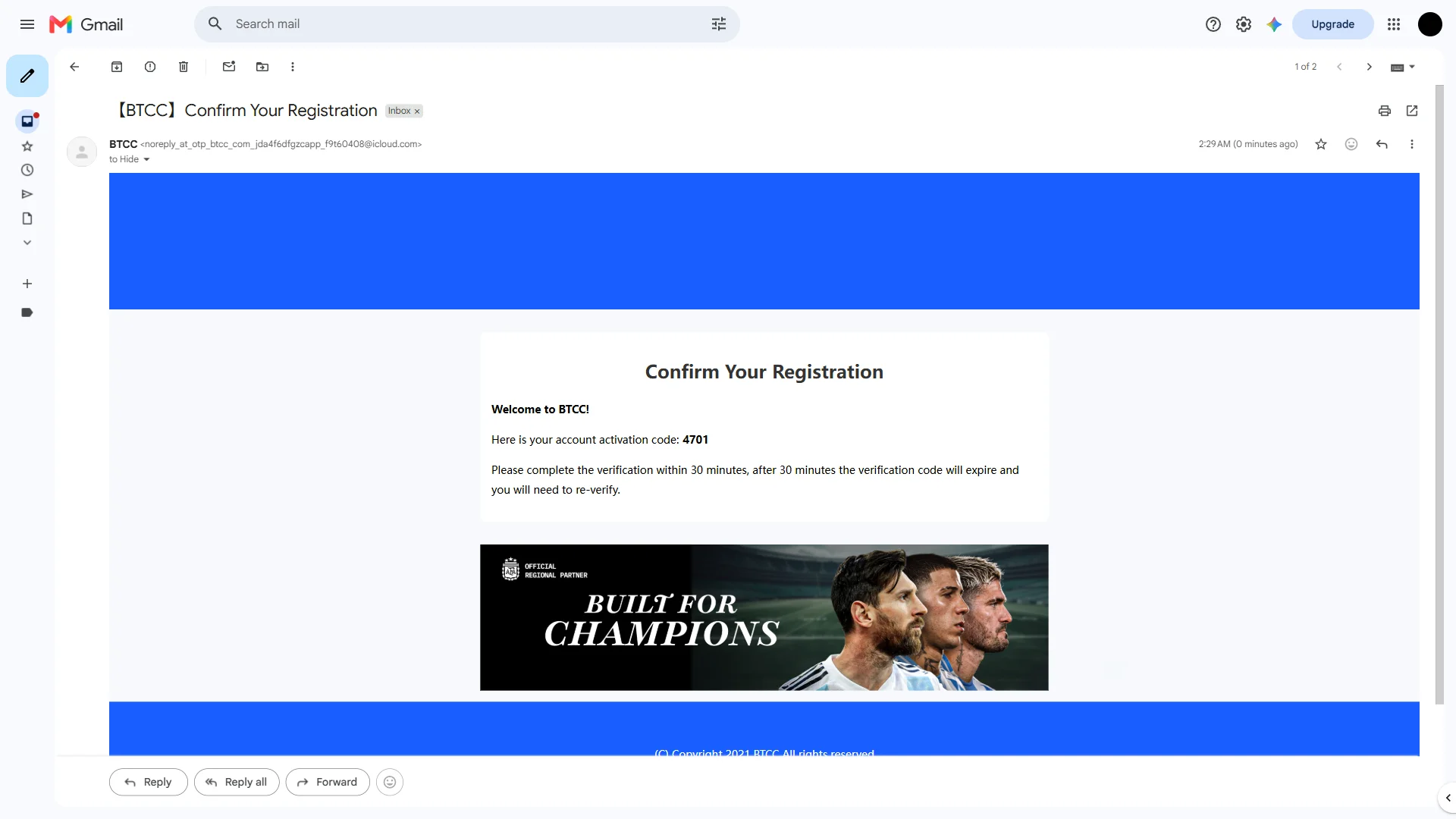
The "Confirm Your Registration" email showing a per-user activation code and a 30-minute expiry notice. Source: chainhelm editorial Open the “Confirm Your Registration” email from BTCC in your inbox. It reads “Welcome to BTCC!” and gives your account activation code — a four-digit number unique to you (the 4701 shown here is only an example).
Enter that code back on the verification screen. The email also notes the code expires after 30 minutes, so verify promptly; if it lapses, request a new one and re-verify.
-
Confirm your country of residence
— Figure 7Country of residence confirmation2026-07-11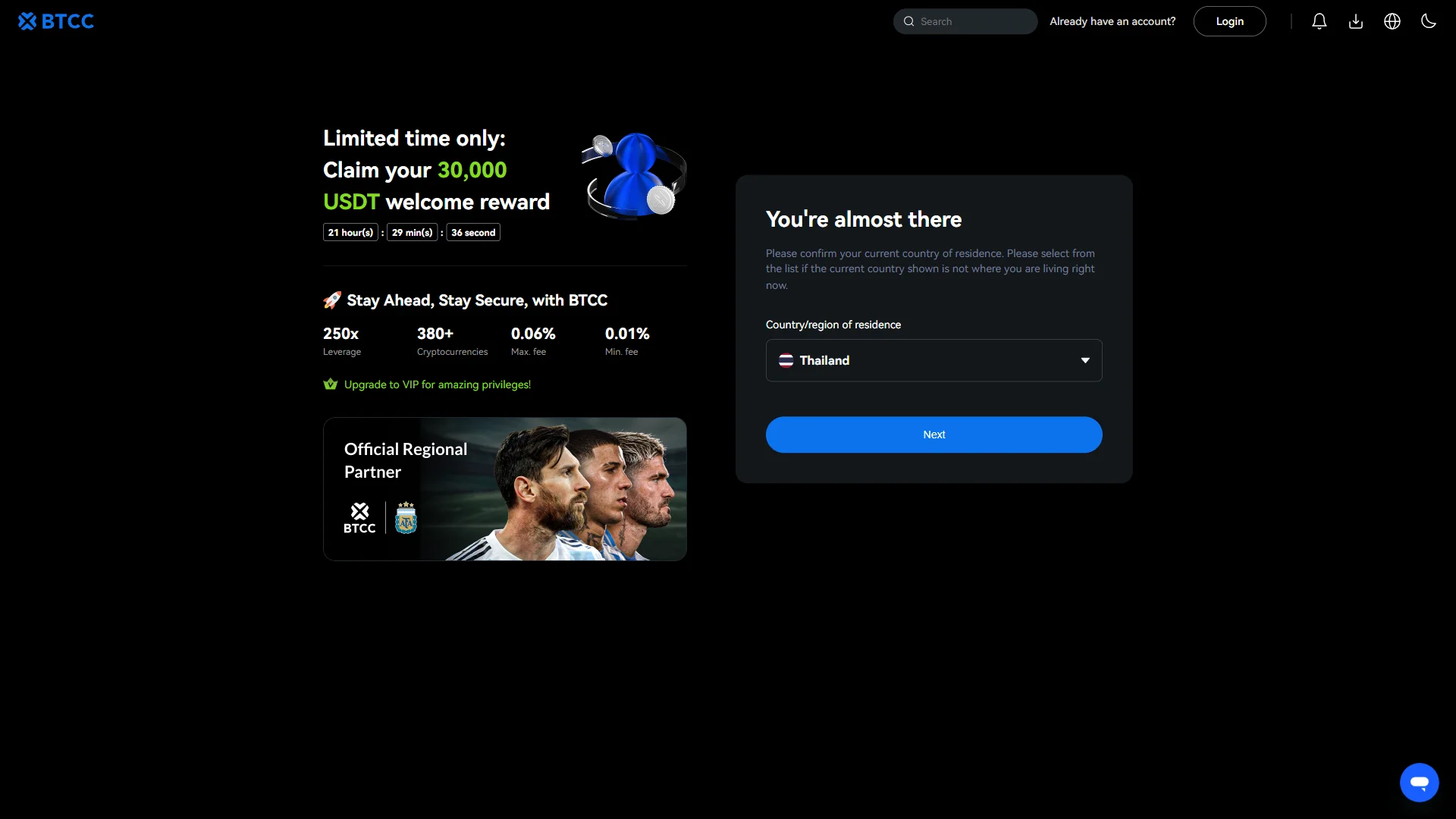
The "You're almost there" screen with the "Country/region of residence" dropdown set to an auto-detected country, ready for "Next". Source: chainhelm editorial On the “You’re almost there” screen, check the “Country/region of residence” dropdown. It shows an auto-detected country (Thailand in this example) — if that is not where you actually live, open the list and pick the correct one.
Once the country is right, click “Next” to finish sign-up and land on your account dashboard.
Smartphone (iOS / Android) sign-up steps
-
First, open the BTCC official sign-up page in the mobile app or browser (the link applies the referral code). When you open it, you’ll see a screen like the one below.
-
Open the registration form from your invite
— Figure 8Invited registration form2026-07-11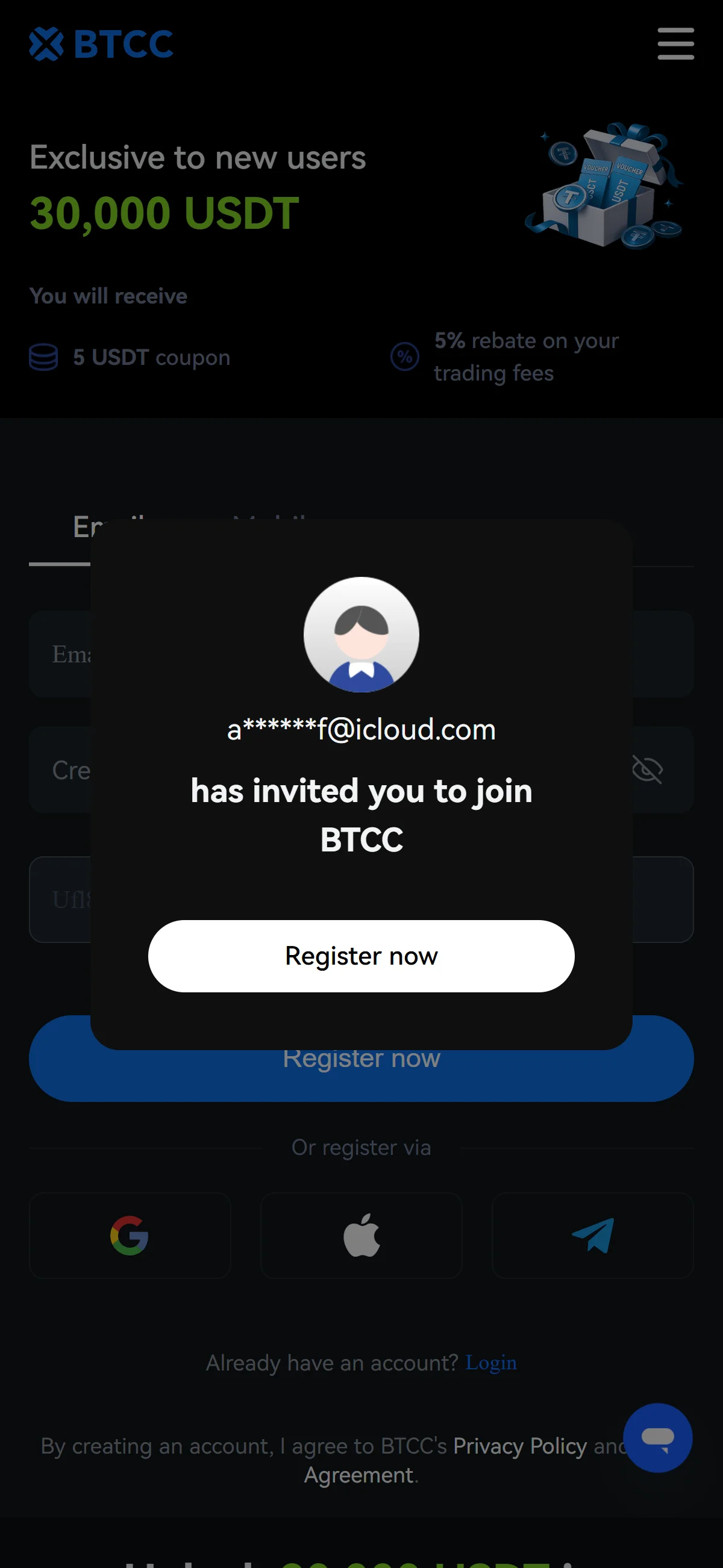
The "Create Account" form opened from the invite, with the referral code "Ufl8zgp" pre-filled and the email and password fields still empty. Source: chainhelm editorial Follow the invite link to open BTCC’s “Create Account” form. At the top you can see the inviter’s masked address confirming the invitation was recognized, and the referral code field already holds “Ufl8zgp” — leave it untouched so the referral stays tied to your account.
Keep the “Email” tab selected (you could switch to “Mobile”, but this walkthrough uses email) and get ready to fill in the “Email address” and “Create a password” fields below.
-
Enter your details and register
— Figure 9Details entered, ready to submit2026-07-11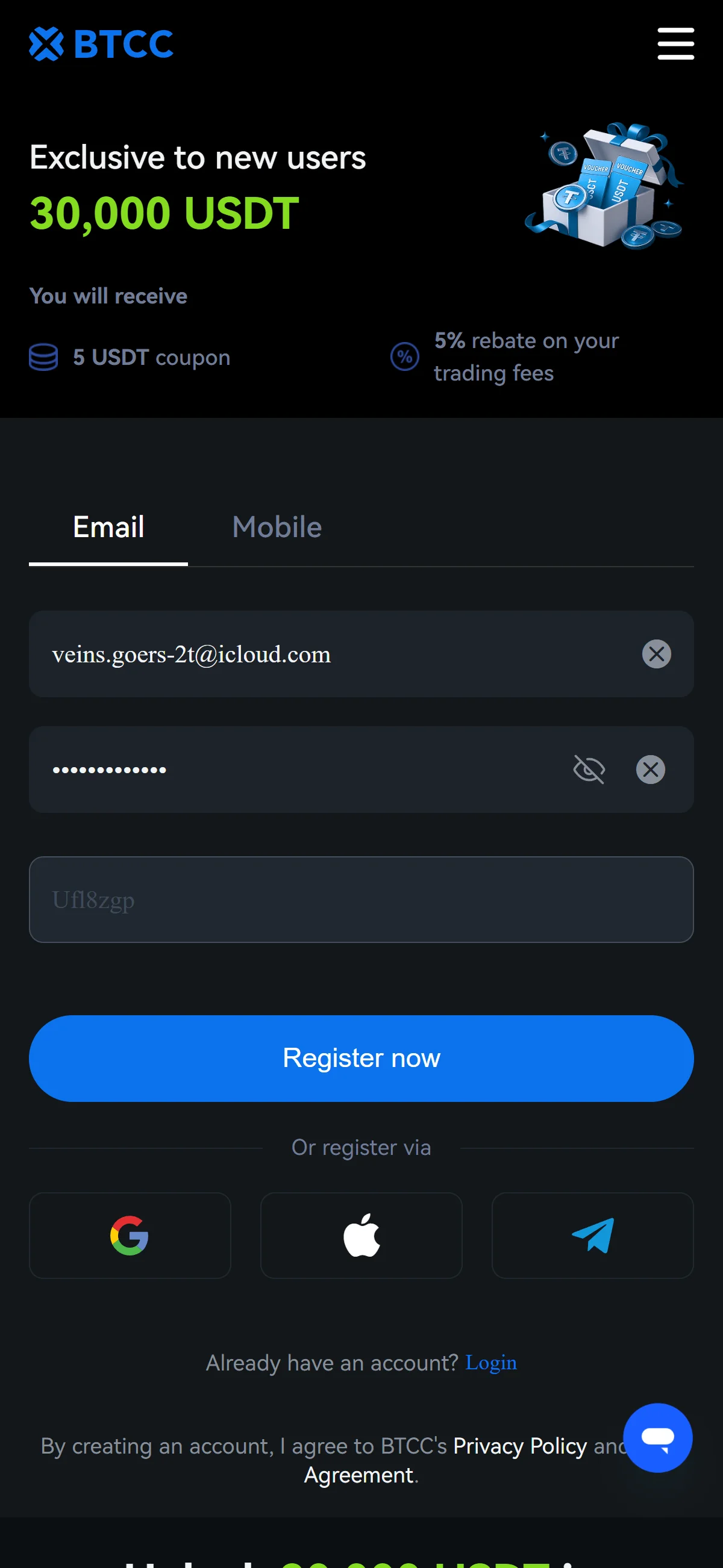
The form with the email address and password filled in and the "Ufl8zgp" referral code retained, ready for "Register now". Source: chainhelm editorial Type your address into the “Email address” field and set a login password in “Create a password”, leaving the pre-filled “Ufl8zgp” referral code in place.
Note the fine print at the bottom of the form: creating an account means you agree to BTCC’s “Privacy Policy” and “User Agreement”. Once your details are in, click “Register now” to submit. (The “Or register via” buttons for Google, Apple, and Telegram are an alternative, but the email path keeps the referral straightforward.) Submitting brings up a short verification check next.
-
Clear the slider verification
— Figure 10Slider puzzle check2026-07-11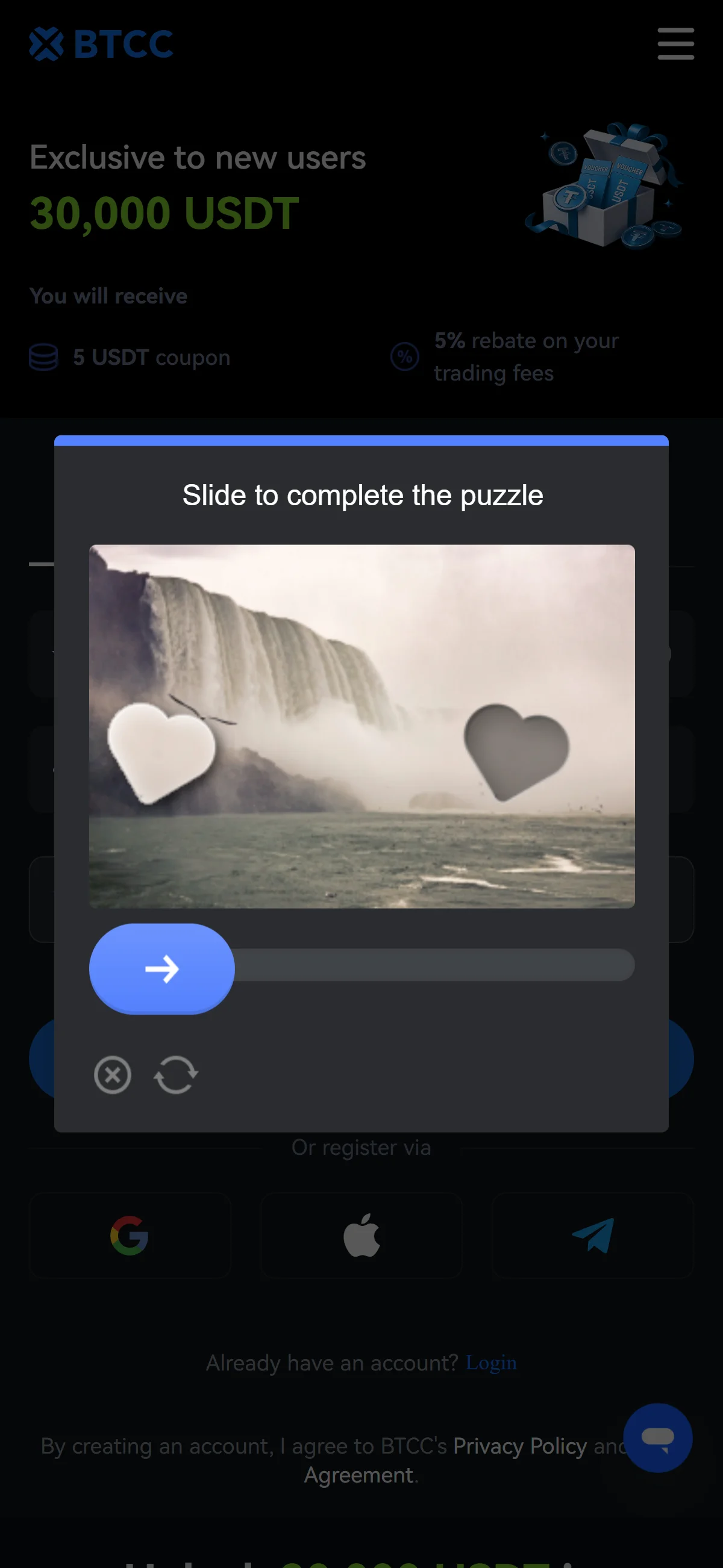
The "Slide to complete the puzzle" overlay shown after submitting, waiting for you to drag the slider across. Source: chainhelm editorial After you submit, a “Slide to complete the puzzle” check appears over the form. Drag the slider handle to the right until the puzzle piece drops into the picture.
Clearing the slider confirms you are a real person and moves you on to email verification.
-
Enter the email verification code
— Figure 11Email verification code entry2026-07-11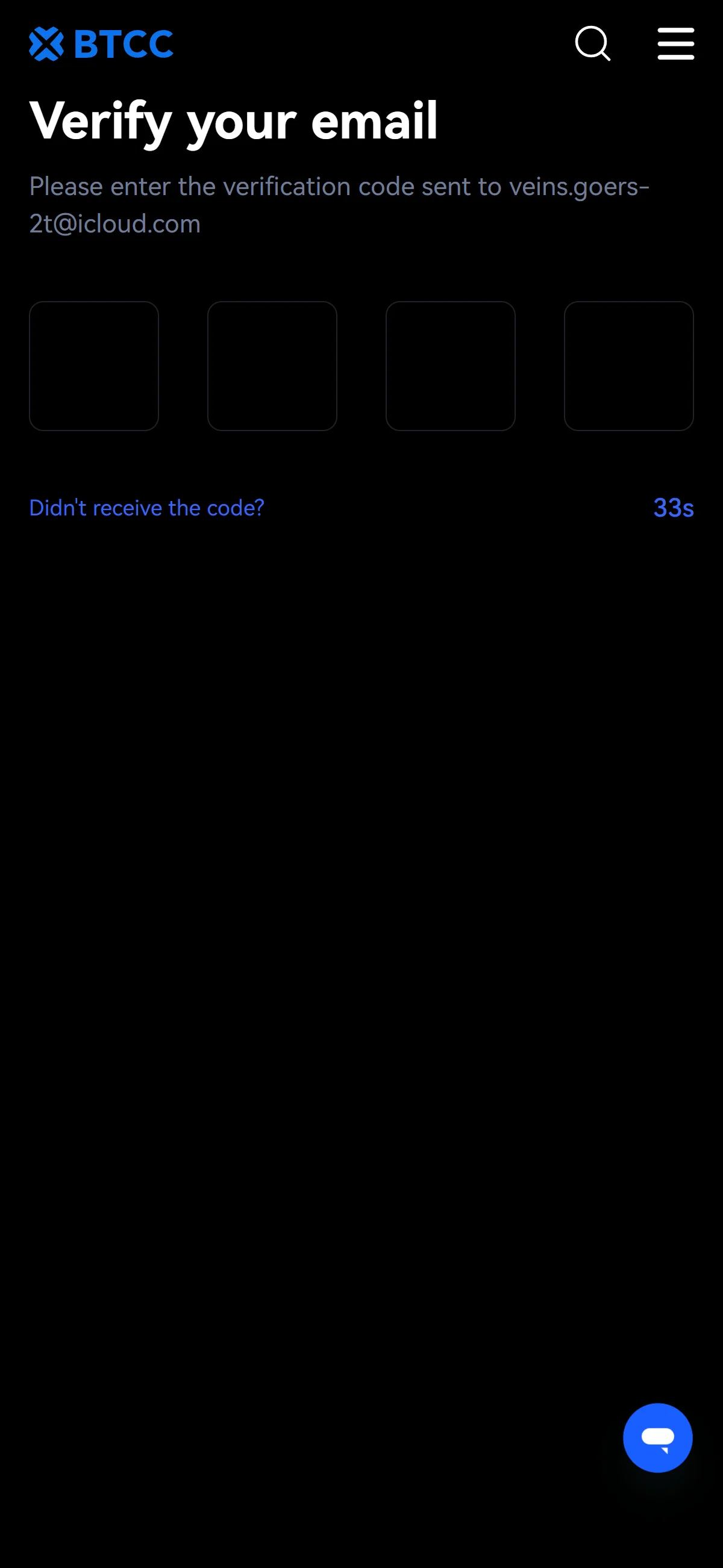
The "Verify your email" screen with four empty code boxes and a resend timer, awaiting the code sent to your address. Source: chainhelm editorial BTCC sends a verification code to the address you registered. Open your inbox to read it, then type the code into the four boxes on the “Verify your email” screen.
If nothing arrives, use “Didn’t receive the code?” once the resend timer runs down, then check your inbox again. Entering the correct code takes you on to the final residence step.
-
Find the activation code in your inbox
— Figure 12Activation code email2026-07-11
The "Confirm Your Registration" email showing a per-user activation code and a 30-minute expiry notice. Source: chainhelm editorial Open the “Confirm Your Registration” email from BTCC in your inbox. It reads “Welcome to BTCC!” and gives your account activation code — a four-digit number unique to you (the 4701 shown here is only an example).
Enter that code back on the verification screen. The email also notes the code expires after 30 minutes, so verify promptly; if it lapses, request a new one and re-verify.
-
Confirm your country of residence
— Figure 13Country of residence confirmation2026-07-11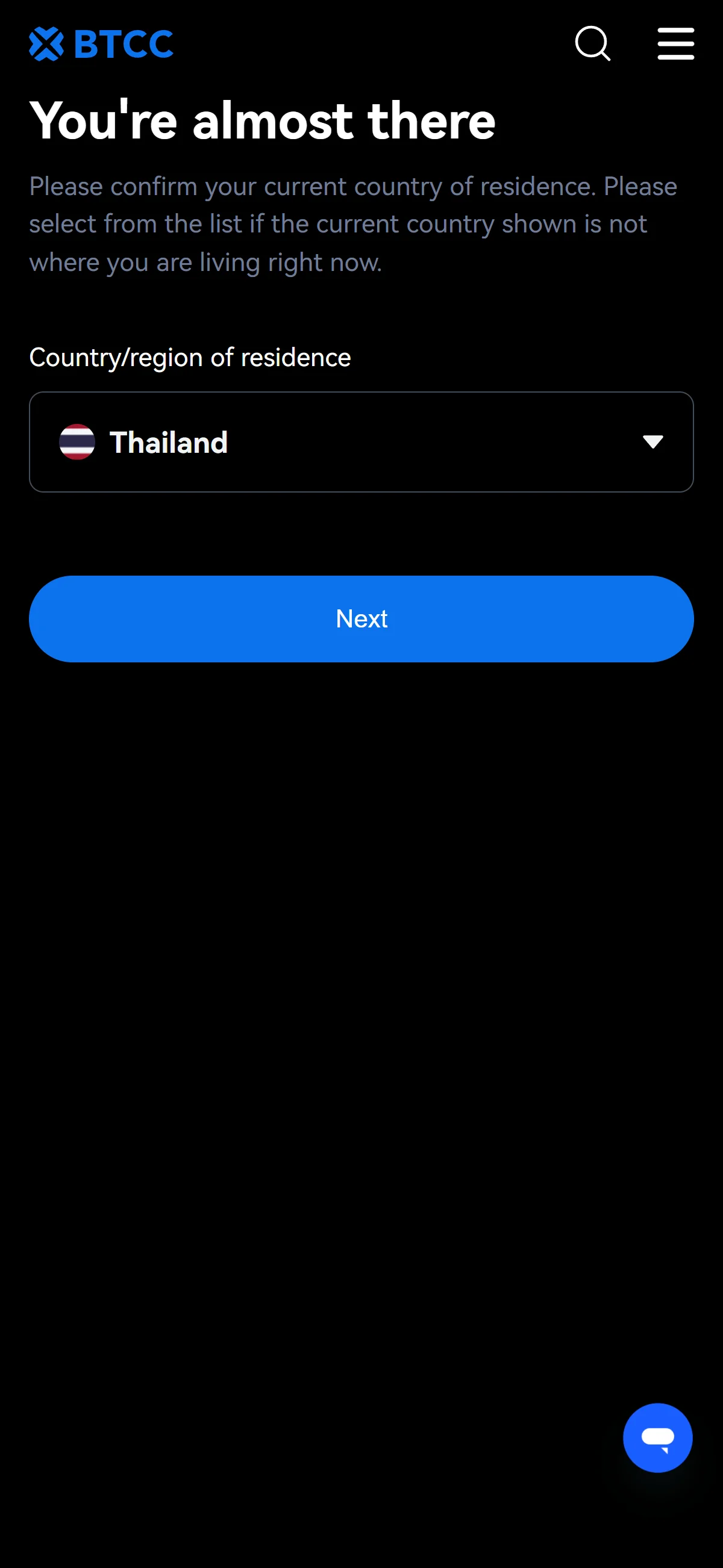
The "You're almost there" screen with the "Country/region of residence" dropdown set to an auto-detected country, ready for "Next". Source: chainhelm editorial On the “You’re almost there” screen, check the “Country/region of residence” dropdown. It shows an auto-detected country (Thailand in this example) — if that is not where you actually live, open the list and pick the correct one.
Once the country is right, click “Next” to finish sign-up and land on your account dashboard.
What to do after signing up at BTCC
We cover identity verification separately for PC/browser and smartphone (mobile).
PC/browser identity verification
Finishing sign-up lands you on the “Dashboard”, where a progress bar marks “Register” done and identity verification as your next step. The “ID not verified” badge on your account shows that trading and full limits are still locked.
Two actions are open to you here: click “Claim reward” on the “You registerd” card to collect your new-user reward, and click “Verify now” on the identity-verification card to begin KYC. Starting verification opens the identity-document screen.
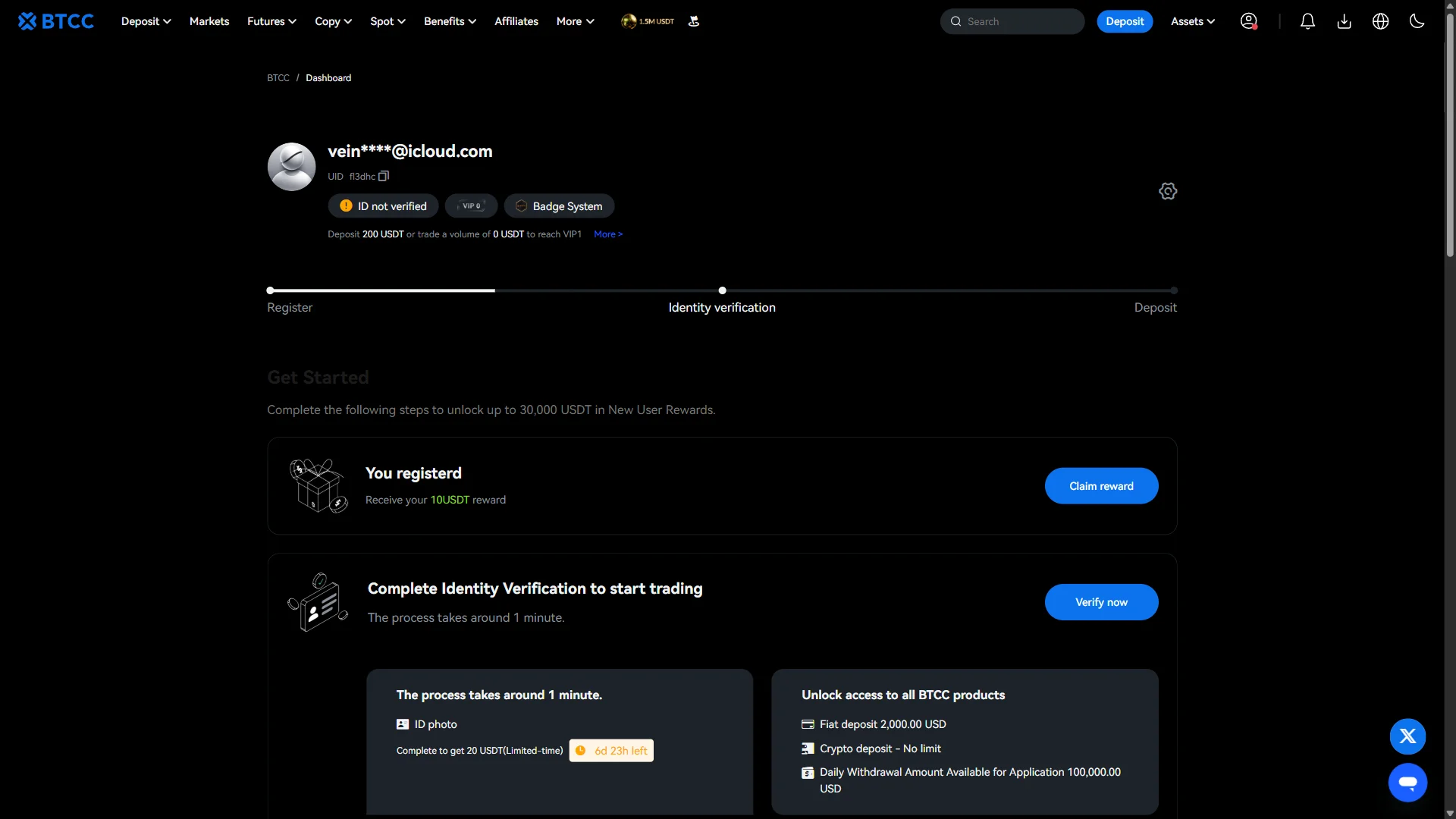
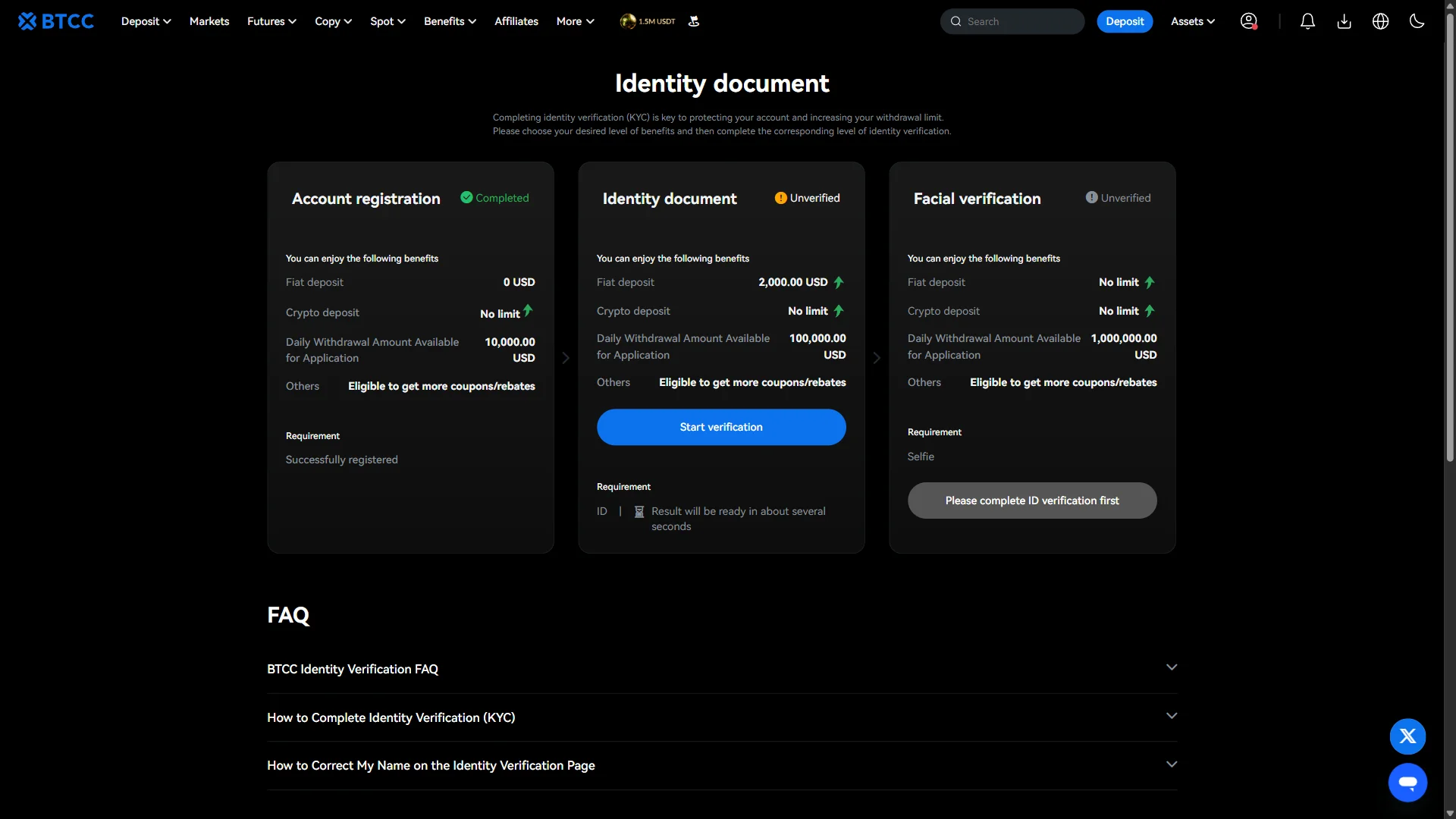
The “Identity document” screen lays out three tiers: “Account registration” already marked “Completed”, “Identity document” still “Unverified”, and “Facial verification” also “Unverified”. Each card lists the deposit and withdrawal limits that tier unlocks.
To raise your limits, click “Start verification” on the “Identity document” card. (“Facial verification” stays behind “Please complete ID verification first”, so the document step has to come first.) This opens the verification provider’s consent screen.
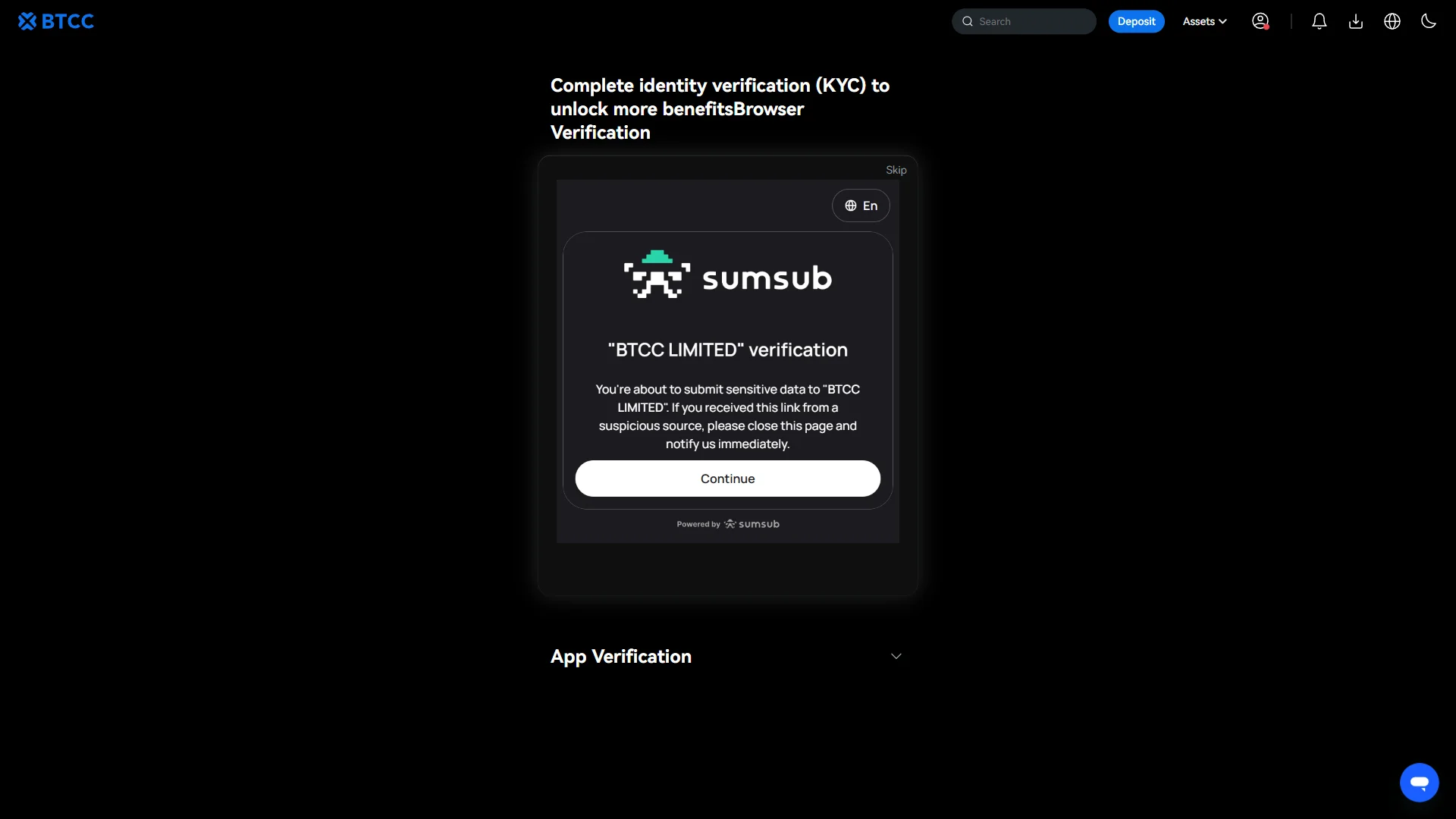
Identity verification is handled by sumsub, an outside provider. The consent card reads “BTCC LIMITED” verification and warns that you are about to submit sensitive data — a good moment to confirm you reached this from BTCC itself and not a suspicious link.
When you are ready, click “Continue” to proceed into the sumsub flow. (“App Verification” is offered as an alternative, and “Skip” lets you postpone.)
Smartphone (iOS / Android) identity verification
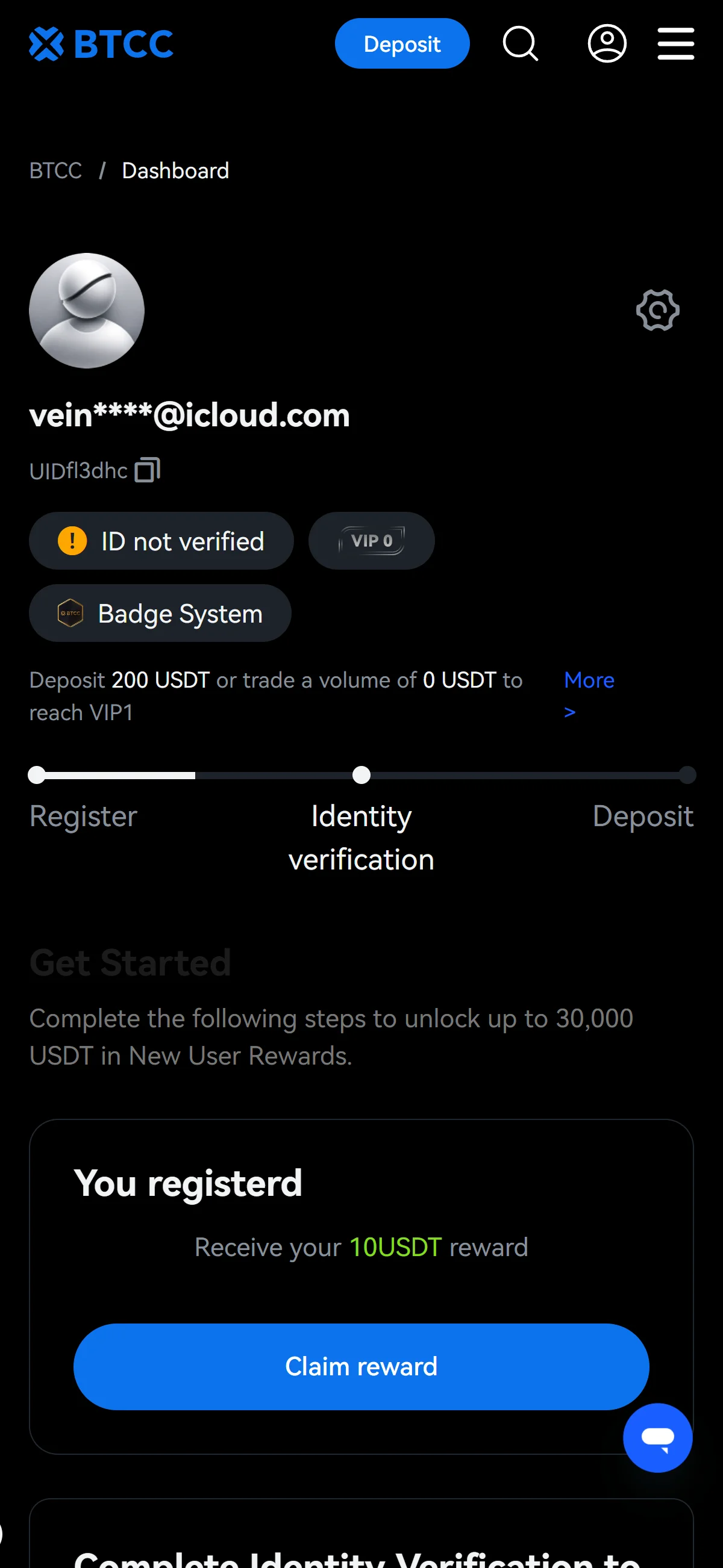
Finishing sign-up lands you on the “Dashboard”, where a progress bar marks “Register” done and identity verification as your next step. The “ID not verified” badge on your account shows that trading and full limits are still locked.
Two actions are open to you here: click “Claim reward” on the “You registerd” card to collect your new-user reward, and click “Verify now” on the identity-verification card to begin KYC. Starting verification opens the identity-document screen.
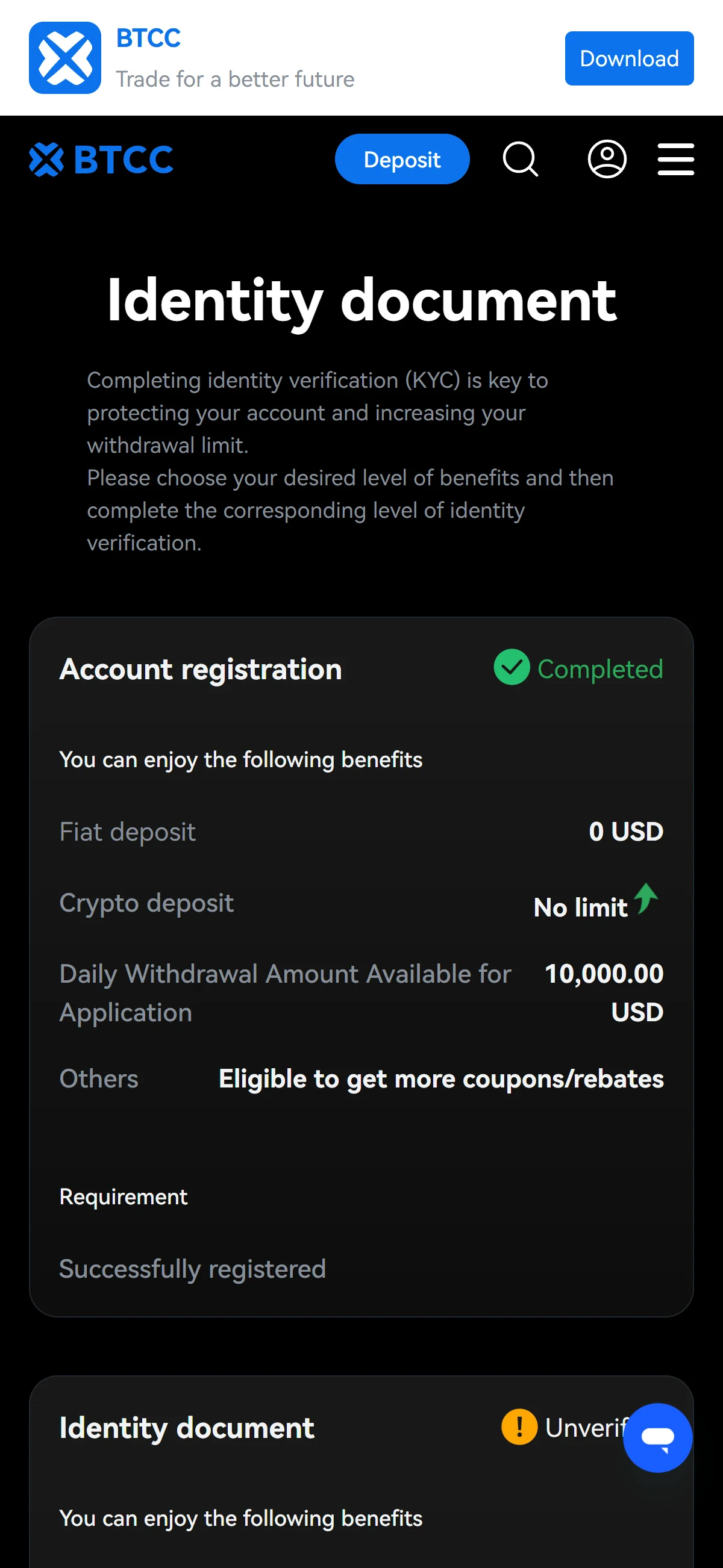
The “Identity document” screen lays out three tiers: “Account registration” already marked “Completed”, “Identity document” still “Unverified”, and “Facial verification” also “Unverified”. Each card lists the deposit and withdrawal limits that tier unlocks.
To raise your limits, click “Start verification” on the “Identity document” card. (“Facial verification” stays behind “Please complete ID verification first”, so the document step has to come first.) This opens the verification provider’s consent screen.
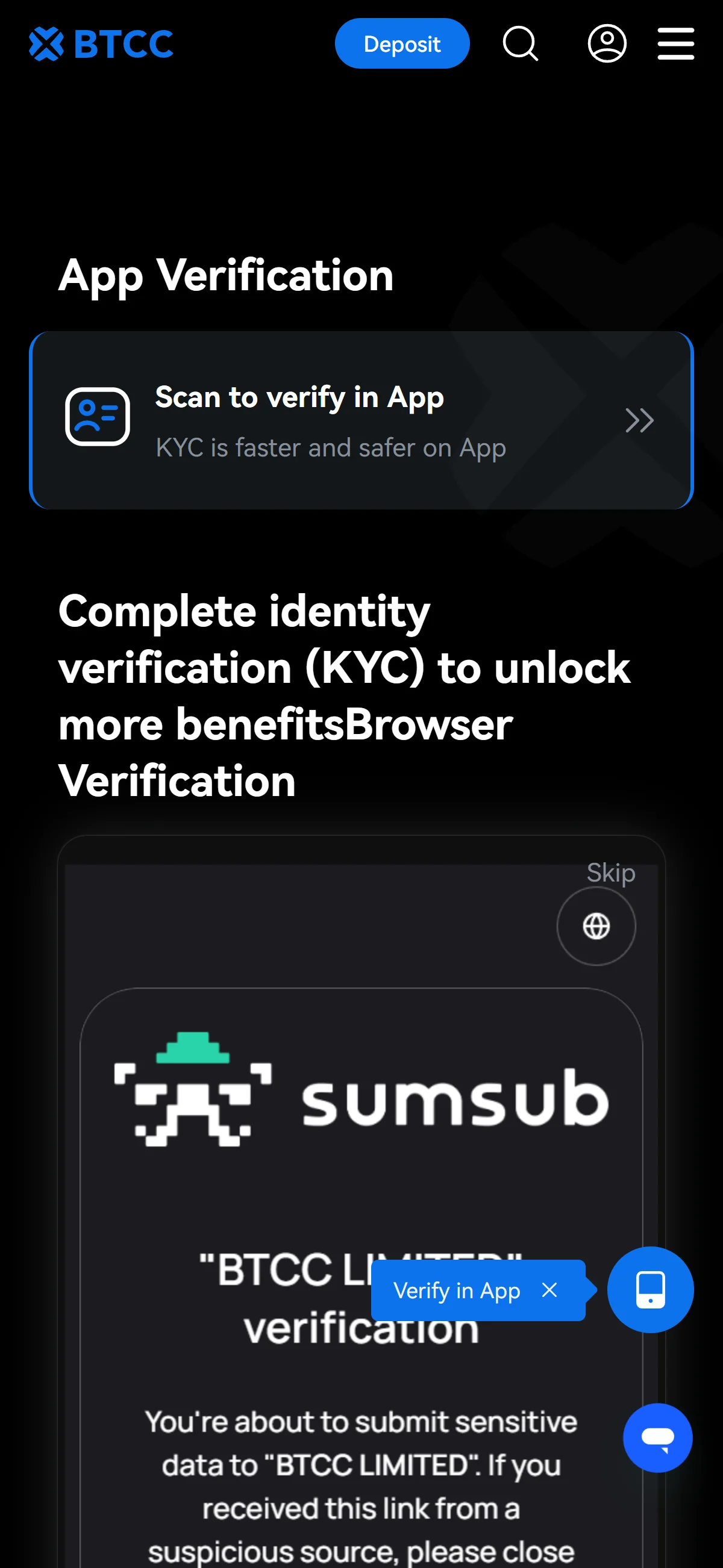
Identity verification is handled by sumsub, an outside provider. The consent card reads “BTCC LIMITED” verification and warns that you are about to submit sensitive data — a good moment to confirm you reached this from BTCC itself and not a suspicious link.
When you are ready, click “Continue” to proceed into the sumsub flow. (“App Verification” is offered as an alternative, and “Skip” lets you postpone.)
From the invite link through to the KYC entry point your BTCC account is now set up: the referral code was applied at sign-up, your new-user reward is ready to claim, and completing identity verification through sumsub is what unlocks trading and higher limits.
The BTCC referral code cannot be added after sign-up
The referral code can only be entered at sign-up — it cannot be added afterwards.
If you overlook this and complete registration without the code, there is no mechanism for linking it to that account after the fact.
If you have not yet completed KYC (identity verification), creating a fresh account is an option worth considering. Some exchanges, though, restrict opening more than one account in their terms of use.
- Does the sign-up screen show referral code Ufl8zgp as applied? (Going through the link applies it automatically; where the exchange provides a code field, check there as well.)
- Once registration is complete, open the Referral / Rewards page and confirm that the referral shows as linked to your account
What is BTCC
BTCC’s origins, scale and reported liquidity
BTCC began in June 2011 as BTC China — one of China’s first Bitcoin exchanges — and rebranded to BTCC, short for “BTC and Crypto”, in 2015. That gives it a roughly 15-year run in a sector where most venues are far younger. chainhelm treats that longevity as a track record worth noting, not as a guarantee of safety — the two are easy to conflate, and this chapter keeps them apart.
Its base has moved more than once. The company traces to Shanghai around 2013, later re-domiciled offshore, and since a January 2018 acquisition by an unnamed Hong Kong investment firm it now reports a headquarters in Poland (Lodz, per its 2026 press dateline), with the User Agreement governed by Polish law under KNF standards. This is an offshore, re-based lineage rather than a single-jurisdiction operator — a detail worth holding on to when we reach its regulatory standing below.
Those user and volume figures are the exchange’s own. The 11M+ registered-user count is self-reported — up from about 6.8M in December 2024 — and not independently audited, and the headline spot volume sits awkwardly against CoinGecko’s “Low” liquidity grade and 3/10 Trust Score. chainhelm’s reading is that the volume number is better treated as a ceiling than as proof of real depth, a distinction that matters most if you plan to trade size on the spot book.
Its product timeline has kept moving, too:
Trading fees and the native VIP discount
The real cost of trading BTCC is two things: the per-trade fee, which differs sharply between spot and futures, and the deposit and withdrawal costs around it. The figures below are current as of 2026-07-11.
- Spot (all VIP tiers)
- maker 0.20% / taker 0.30% — flat, with no tier relief
- Futures (VIP0 to VIP7)
- maker 0.030% / taker 0.048% at VIP0, down to 0.010% / 0.015% at VIP7
- Crypto deposits
- free of BTCC fees (network fees may still apply)
- On-chain withdrawals
- per-asset and dynamic
- Entry minimums
- ≈2 USDT minimum crypto deposit; 200 USDT minimum card purchase
Two things stand out. First, the VIP ladder only really moves futures pricing: a single VIP0-to-VIP7 structure — which you climb by account value, 30-day futures volume or 30-day spot volume — compresses futures maker and taker fees and layers on fee-coupon coverage of up to 35% and reduced withdrawal fees (10-60% lower), while spot stays pinned at 0.20% / 0.30% at every tier. A spot-only trader therefore gets no relief from climbing tiers. Second, there is no native exchange token: reductions come from tiers and coupons, not from holding a coin. One caveat for fee-checkers — a 0.06% futures-taker figure still floating on BTCC’s academy pages is superseded by the live fee page.
What makes BTCC distinct
BTCC’s differentiators: TradFi breadth, high leverage, copy-trading scale
If BTCC has one genuine edge, it is breadth on the TradFi side. Through its tokenized-futures product it offers USDT-settled contracts on gold, silver, WTI oil, forex, indices and tokenized equities — including SpaceX SPCX in pre-market form, SK Hynix and an MSCI Korea ETF — at up to 150x, all inside a single crypto account. That is wider TradFi coverage than most pure-crypto derivatives venues put in one place, and for a trader who wants commodities and equities exposure without leaving a USDT wallet, it is the main reason to look at BTCC at all.
That leverage headline is a product fact, not an endorsement — the risk it carries belongs in the risks chapter, not here. Behind the numbers above sits real scale on the social side: BTCC runs a native futures copy-trading marketplace, one of the larger ones by lifetime participant count, which is what makes its lead-trader and copy-trader totals notable rather than the raw figures alone. The platform also leans on longevity — operating since June 2011, publishing monthly Merkle-tree Proof of Reserves, and keeping the entry bar low, with a minimum deposit of about 2 USDT and VIP1 reachable from a 200 USDT balance. One caveat travels with all of it: the zero-breach record BTCC cites is self-attested and has not been independently certified, which is exactly what the next section pushes on.
The readers better served by another venue
No exchange fits everyone, and BTCC has clear cases where another venue is the better call.
US and Ontario/Quebec residents
Anyone needing independently verified controls
Traders needing deep, high-trust spot books
On raw spot fees BTCC is not the cheapest, either: its VIP0 spot rate of 0.20% maker / 0.30% taker sits above what some local order-book venues charge — Binance Turkey’s TRY pairs, for instance, run closer to 0.10% / 0.15%. BTCC’s relative edge is leverage and product breadth, not spot cost. Put plainly: BTCC suits traders who specifically want its high-leverage perpetuals, tokenized-TradFi range or copy-trading depth and can accept its security and liquidity trade-offs. Anyone whose priority is regulated custody, deep spot liquidity or the lowest spot fees should weigh a venue built for that instead.
BTCC regulatory landscape
BTCC’s license footprint, restricted and banned markets
BTCC’s regulatory base is best read as a patchwork of anti-money-laundering registrations rather than a set of market authorizations. It runs on a Polish VASP framework — its User Agreement is governed by Polish law under KNF standards — alongside a Lithuanian crypto-exchange and wallet VASP registration held by BTCC Lithuania Limited UAB (reg. 305950582, FCIS-supervised), and it still carries a historical US FinCEN MSB and a Canada FINTRAC MSB. chainhelm’s reading, which matches BTCC’s own framing, is that those MSB filings are AML registrations — not permission to serve customers in the United States or Canada.
The exclusions are spelled out in the terms. The User Agreement (§2.3) lists the United States, including its territories, as a Prohibited Country, bars the sanctioned jurisdictions of Cuba, Iran, North Korea and Syria, and separately prohibits the Canadian provinces of Ontario and Quebec. Inside the EU the picture is unsettled rather than closed: BTCC operates on a legacy Polish and Lithuanian VASP framework with no publicly confirmed MiCA CASP authorization ahead of the 1 July 2026 MiCA transitional cut-off, and Poland closed its transition window early — so continuity of EU service is a genuine open question rather than a settled matter.
For readers in the United Kingdom specifically, the standing is sharper. BTCC is not FCA-authorized, and ‘BTCC Global Limited’ (www.btcc.com and btcc-mall.com) sits on the FCA’s warning list — first published on 2023-10-26 and last updated 2024-02-06 — for providing or promoting financial services without FCA permission and possibly targeting UK consumers, which means UK users have no recourse to the Financial Ombudsman Service or the FSCS. On top of that, since 2021-01-06 the FCA has banned the sale, marketing and distribution of crypto-derivatives (CFDs, options and futures) and crypto ETNs to UK retail consumers — so BTCC’s flagship high-leverage perpetual futures cannot lawfully be offered to UK retail at all. One guard against a common mix-up: ‘BTCC UK Limited’ (Companies House no. 10846180) is a software-publishing company registration, not an FCA authorization — incorporation is not the same as being authorized.
Further afield, South Korea’s FSC and its financial-intelligence unit KoFIU flagged BTCC as an unregistered foreign VASP back in August 2022 and moved to block domestic website access and card payments — the earliest of the state-level actions this guide returns to when it looks at access risk.
Singapore and Australia sit differently again. BTCC is reachable and localized for readers in both, but nothing in the license footprint above amounts to a Singapore- or Australia-specific authorization, and each market runs its own crypto licensing and promotion regime that a local reader should weigh before signing up. That is a landscape note, not a blanket verdict — which is why neither market gets the dedicated availability treatment the United States and India do below.
A narrowing footprint and the related BTCC entities
Step back and a pattern shows through the individual facts. BTCC was forced out of its home market when China banned ICOs and exchanges in 2017 — the shove that catalyzed its pivot offshore into derivatives — and it was later named and access-restricted in South Korea in 2022. Set against the unresolved EU MiCA cut-off and the fresh exclusion of the United States, Ontario and Quebec, the direction of travel is mixed at best: a company that re-based offshore, pursued AML-focused EU registrations, and is now watching its map of lawful markets contract even as its product range expands into TradFi and Earn.
A net narrowing of the markets BTCC can lawfully address — even as its product range keeps expanding.
A closing word on identity, to head off a common confusion: several BTCC-named companies exist as registration or trust facts, not as separate consumer exchanges. BTCC Lithuania Limited UAB is the Lithuanian VASP registrant, and BTCC Poland Limited is the entity that actually contracts with users through the User Agreement — both are back-office registrations rather than alternative places to trade. Two same-name companies add noise without substance: BTCC UK Limited and BTCC Pty Ltd in Australia show no evidence of being the exchange itself, and are worth knowing about only so they are not mistaken for it.
BTCC availability across major jurisdictions
Global reach is not the same as being usable everywhere. For two of the markets this guide covers, the reader-optimal move is not BTCC at all — so this chapter routes those readers to venues that can actually serve them, rather than pushing a sign-up.
United States: prohibited under BTCC’s own terms
There is no gray area here. BTCC’s own User Agreement (§2.3) lists the United States, including its territories, as a Prohibited Country, so a US resident cannot use the platform under its governing terms. The FinCEN MSB registration that gets cited as if it were a green light is an AML filing, not authorization to serve US users. The reader-optimal path is a US-regulated venue — and there are strong ones, each with its own trade-offs rather than a single best answer.
Coinbase
Kraken
Gemini
India: named by FIU-IND, with FIU-registered alternatives
India is a naming-and-blocking case rather than a clean contractual ban. FIU-IND named BTCC in its Section 13 PMLA compliance notices in October 2025 as a non-compliant, unregistered VDA service provider and ordered app and URL takedowns; enforcement on the ground stays porous, but the fact that matters is simple — BTCC holds no FIU registration. Indian readers have a genuine domestic bench to choose from instead, each registered with FIU-IND and each with something to weigh:
Delta Exchange India
CoinDCX
CoinSwitch
WazirX
Risks to acknowledge before using BTCC
Counterparty soundness and custody disclosure gaps
The risk that matters most here is not market volatility — it is whether the platform holding your money can be trusted to keep it and hand it back. BTCC’s headline answer is a zero-breach record stretching back to 2011, but that claim is self-attested and has not been independently certified, and the independent read is a good deal less reassuring.
Reserves tell a similar story of self-verification. BTCC publishes Proof of Reserves through its own Merkle-tree tool with no named independent auditor; as of 2026-06-15 the per-asset ratios all sit above 100% — BTC at 125%, ETH at 149%, USDT at 162% — and a Risk Reserve Fund is reported at over 23M USD as of Q1 2026. Those are reassuring numbers, but a self-published reserve snapshot is a disclosure, not an audit. The custody picture is thinner still: BTCC states that user assets are held 1:1 segregated, yet it names no custodian and does not publicly disclose its hot and cold wallet split, any third-party custody, its multi-sig configuration or wallet insurance. For a user, that is a lot of trust extended on the exchange’s word alone.
Regulatory and access risk in a narrowing footprint
The regulatory history from the previous chapter reads differently when you turn it forward. A forced China exit in 2017, a naming-and-blocking in South Korea in 2022, an EU MiCA cut-off on 1 July 2026 reached without a confirmed CASP license, and the new exclusion of the United States, Ontario and Quebec are not just backstory — together they are a track record of markets closing, and any one of them repeating in your market could strand your access to the platform and the funds on it.
That exposure sharpens wherever BTCC has already been named or blocked. In jurisdictions such as South Korea, India and Turkey, reaching the platform through workarounds adds a legal-gray layer on top of ordinary counterparty risk — and the Korean reporting is the most concrete warning of all, documenting deposits routed through disguised, personal-name bank accounts and a run of frozen-withdrawal complaints. Where the state has already stepped in, the quiet path back out is the one most likely to close.