— Contents 12 sections
- 01 Is the ApeX referral code “0KNJQKCQ” still active?
- 02 What the ApeX referral code “0KNJQKCQ” gets you
- 03 ApeX sign-up steps with the referral code
- 04 What to do after connecting to ApeX
- 05 The ApeX referral code cannot be added after sign-up
- 06 ApeX Social is the live points program, Ape Season 1 has ended
- 07 ApeX Omni is an order book perp DEX settling on a zkLink rollup
- 08 Third by 24h volume, tenth by open interest
- 09 ApeX holds no license anywhere, and screens by country rather than by identity
- 10 ApeX excludes the United States, but not the UK, Singapore, Australia or India
- 11 Self-custody with no exit window, and shortfalls absorbed by other traders
- 12 The code binds once, and your country is the first gate
chainhelm’s exclusive ApeX referral code is .
As of 2026-08-03, we connected a new wallet and confirmed that the referral code was applied.
Apply the code when you connect your wallet to receive a 5% discount on trading fees as a referred user. We recommend taking care of it right then and there.
This article covers the sign-up process (wallet connection) with the ApeX referral code, ApeX’s distinguishing features, availability in the United States, the United Kingdom, Singapore, Australia and India, and the risks to acknowledge — with the connection flow and code application verified first-hand by chainhelm’s editorial team.
Is the ApeX referral code “0KNJQKCQ” still active?
The chainhelm editorial team connected to ApeX with a fresh wallet on 2026-08-03 and confirmed that the referral code “0KNJQKCQ” is still active.
Here is the actual screen captured during verification.

The screen shows “Bind a Friend”, confirming that the referral code 0KNJQKCQ was correctly applied.
chainhelm continuously verifies the validity of the code and confirms it remains usable.
Once the account exists, an invitation that has been applied can be looked up again at any time on the logged-in referral page, under the “I’m Invited” tab.
What the ApeX referral code “0KNJQKCQ” gets you
Apply this code when you connect to receive the following benefits on ApeX:
Benefit / Expiration / Eligibility
| Benefit | a 5% discount on trading fees as a referred user |
| Expiration | None |
| Eligibility | New users |
To receive the benefits, you need to apply the code when you connect your wallet. Be careful not to miss this step.
ApeX sign-up steps with the referral code
We cover the connection process separately for PC/browser and smartphone (mobile).
PC/browser connection steps
- First, open the ApeX official page (the link applies the referral code). When you open it, you’ll see a screen like the one below.
2. Click “Log in” on the referral page

Open the referral link and click “Log in” on the referral landing page, either the yellow button under the “Invite, Share, and Earn” line or the smaller one at the top right of the navigation bar. You are still logged out at this point, and the click brings up the login options.
3. Pick your wallet in the login dialog
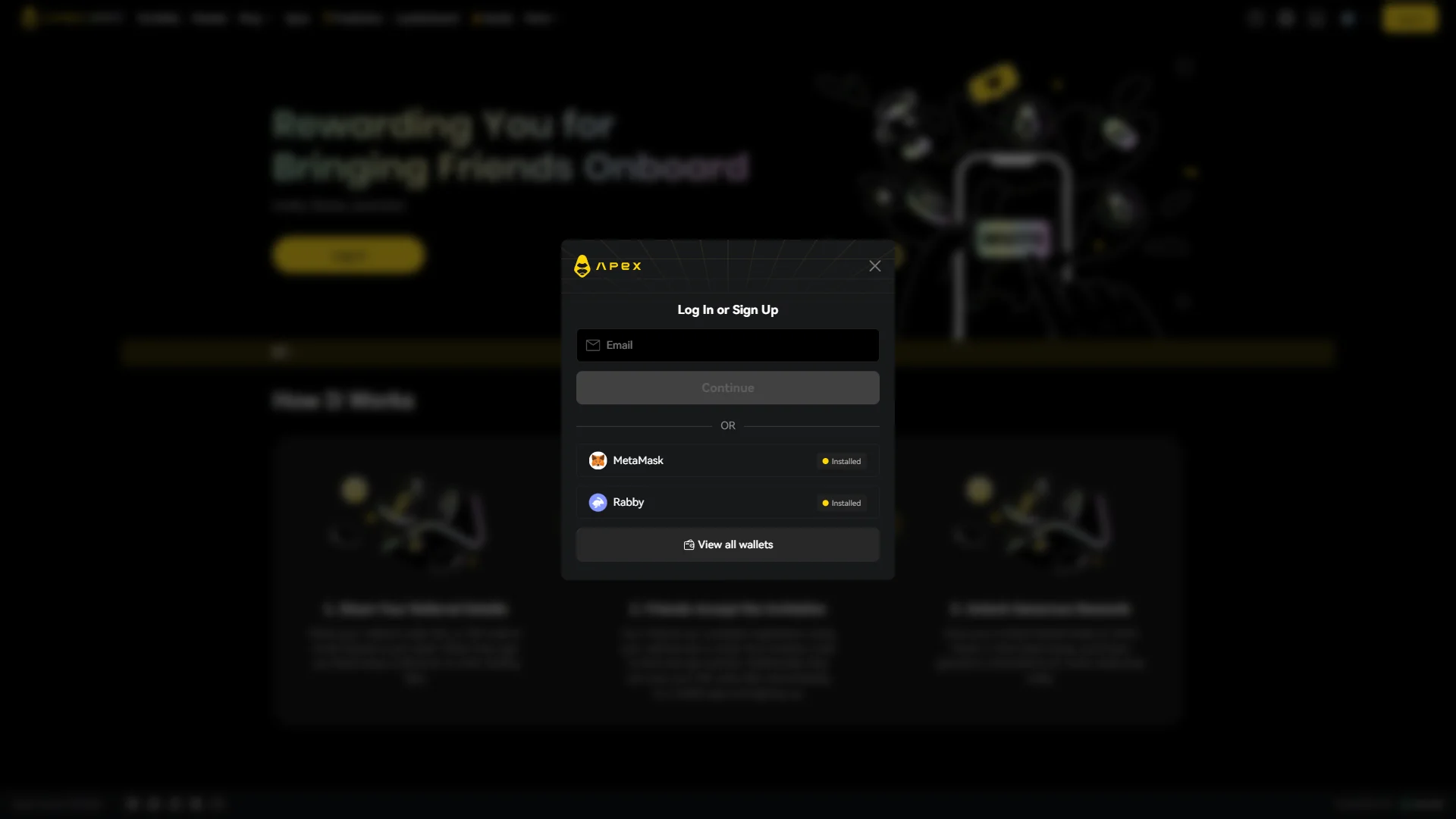
In the “Log In or Sign Up” dialog, select the wallet you want to use: “MetaMask” and “Rabby” are both listed as installed in this browser, and “View all wallets” opens the full list. Selecting a wallet starts the connection; the “Email” field and “Continue” above the list are the alternative if you would rather sign in with an email address.
4. Approve the connection in Rabby
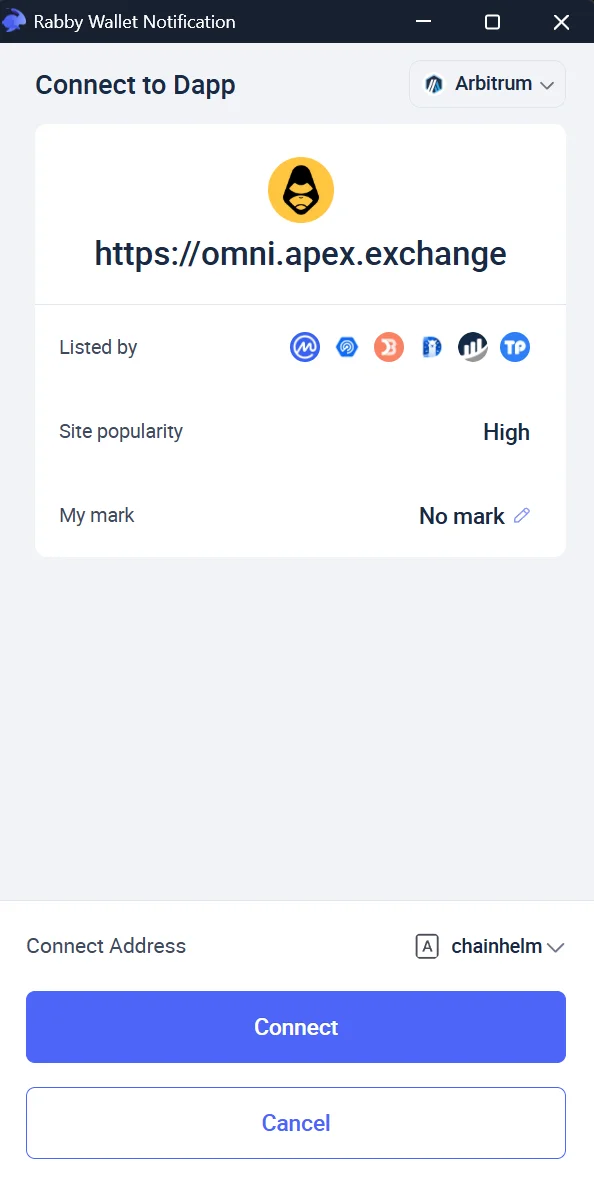
Rabby opens a “Connect to Dapp” window: check that the site is https://omni.apex.exchange and that “Connect Address” points to the account you want to use, then click “Connect”.
The network selector at the top right reads “Arbitrum”, which is the chain this connection will use.
5. Send the two signature requests
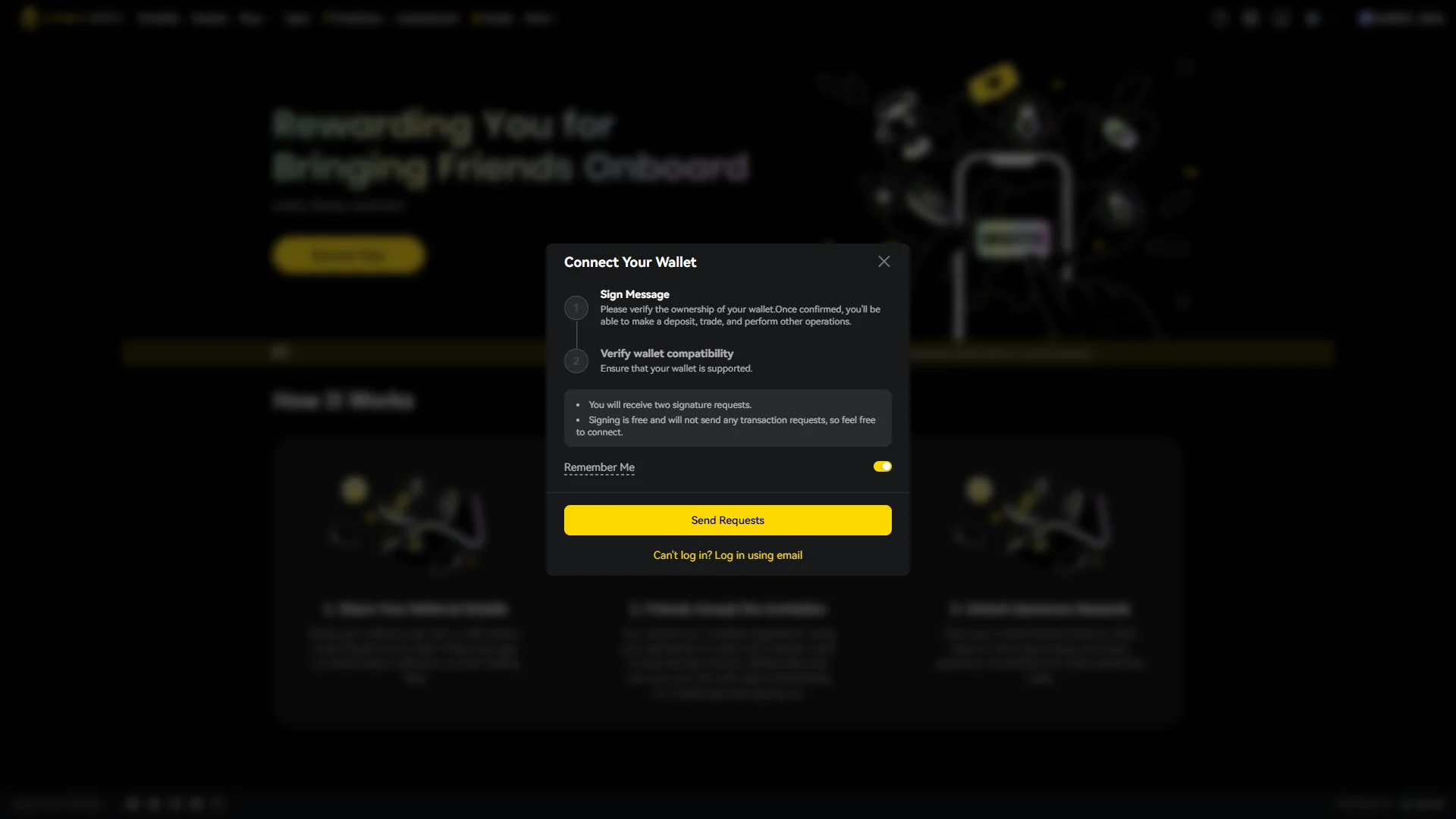
Back on the ApeX page, click “Send Requests” in the “Connect Your Wallet” dialog to start the two steps it lists, “Sign Message” and “Verify wallet compatibility”. The dialog states up front that you will receive two signature requests and that signing is free and sends no transaction requests, and the first request opens in Rabby right after the click.
6. Sign the onboarding message
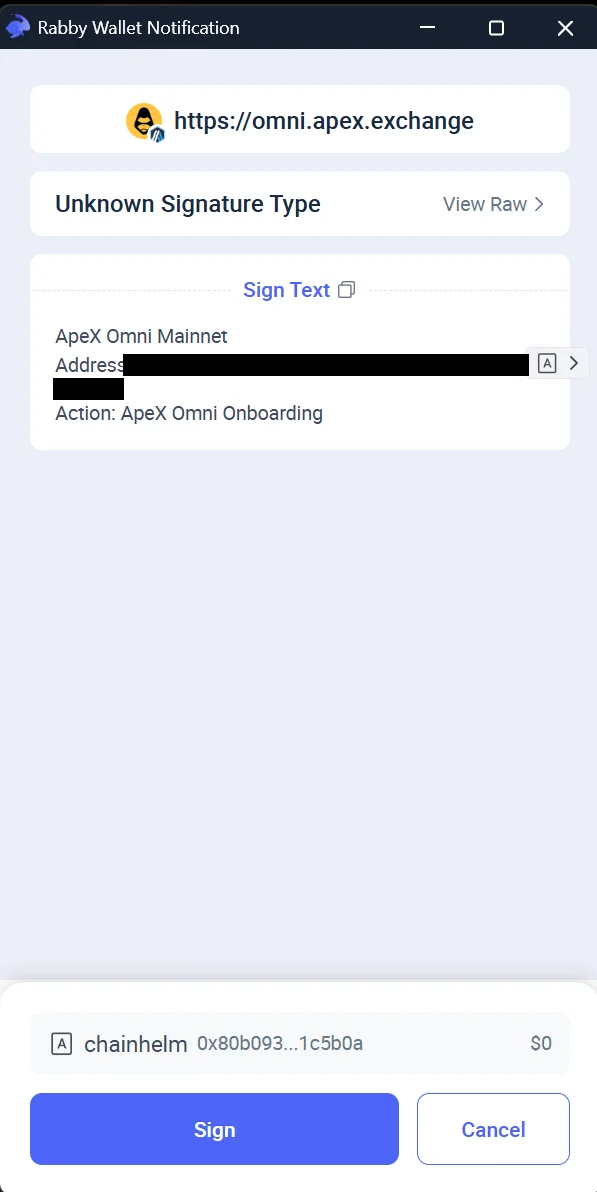
Rabby presents the first request as “Sign Text”, where “ApeX Omni Mainnet” and “Action: ApeX Omni Onboarding” tell you what the message covers, so read it and click “Sign”. The body also carries the address the message is tied to, which should be the account you just connected.
7. Confirm the first signature
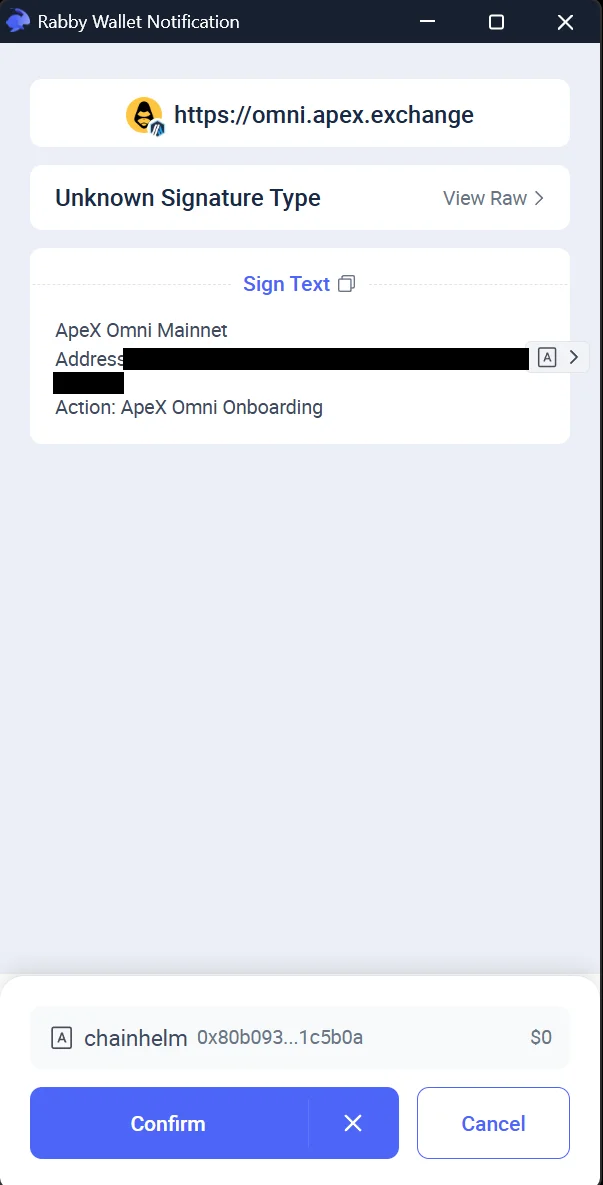
After the first click the sign button changes to “Confirm”, so click it again to complete the signature. The message body is unchanged from the previous screen, giving you one more look at the onboarding text before it goes through.
8. Wait for the compatibility check
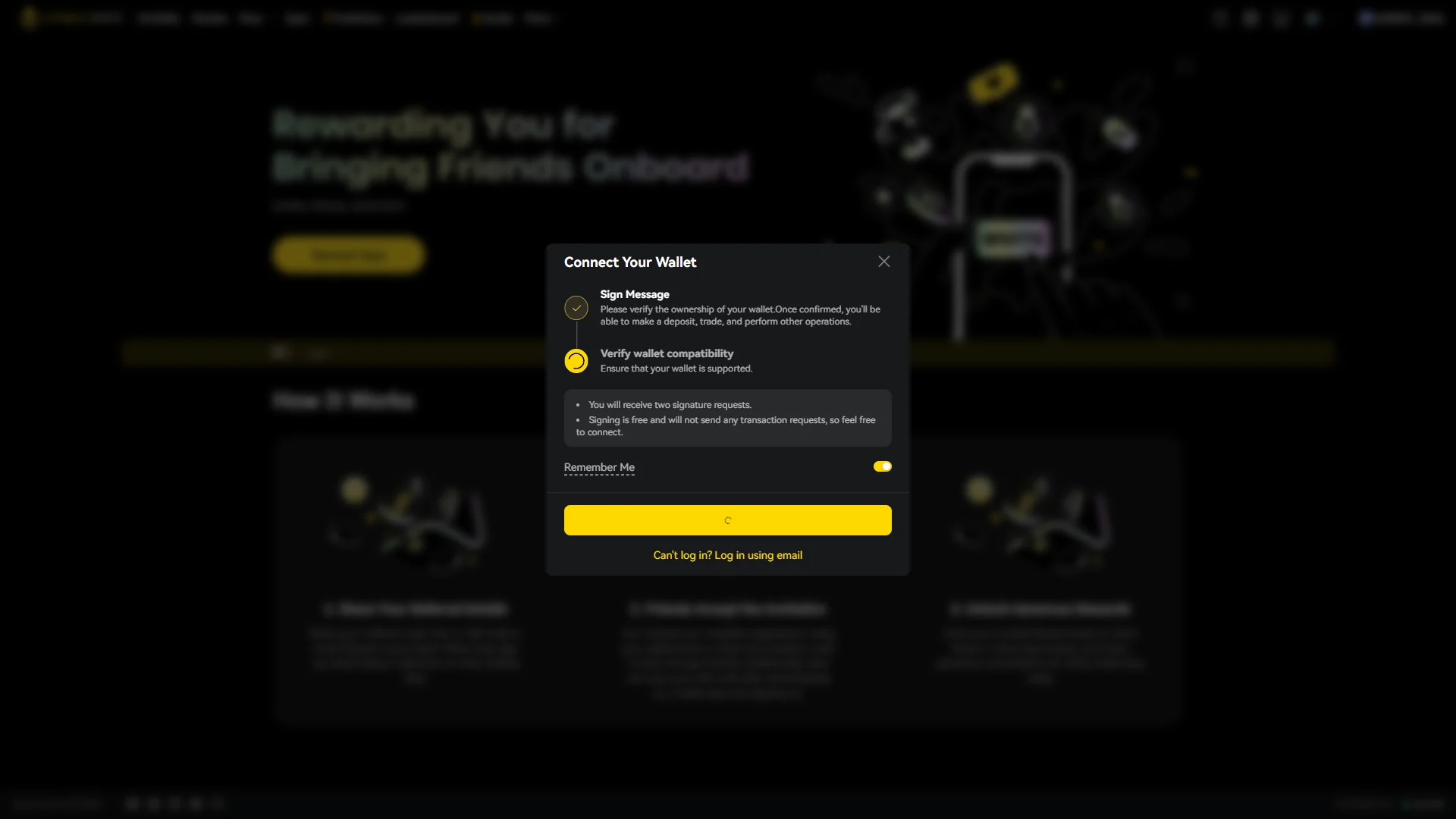
Leave the dialog open while the check runs: “Sign Message” now carries a check mark and “Verify wallet compatibility” is still spinning. The second signature request reaches your wallet on its own once the check finishes, so there is nothing to click here.
9. Sign the second request
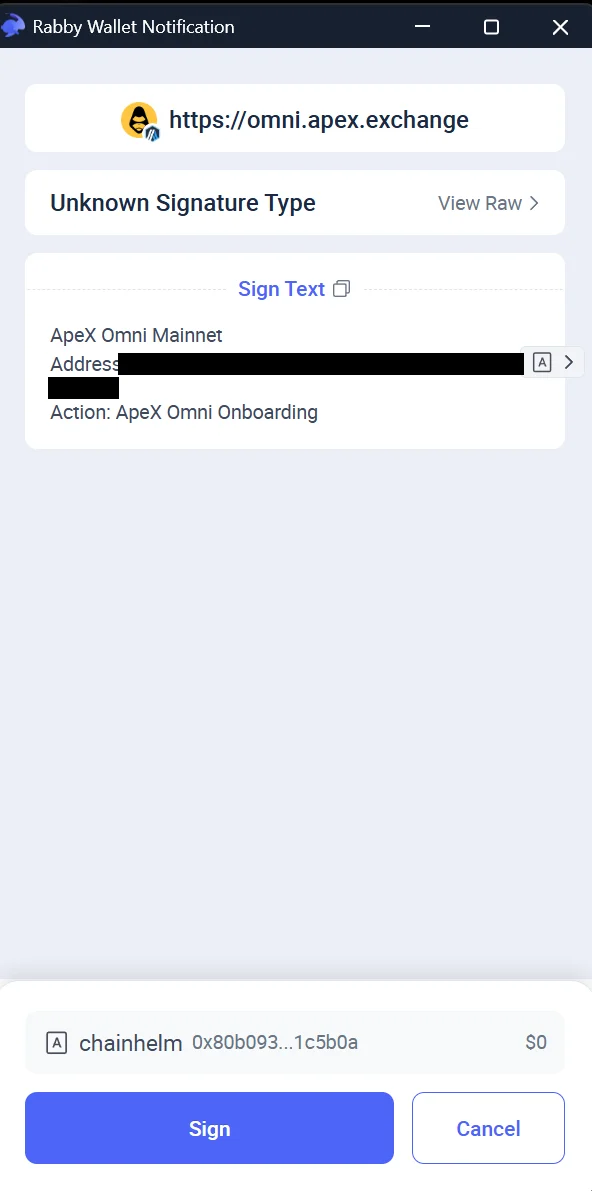
Rabby opens the second “Sign Text” request with the same onboarding body, so click “Sign” again to complete the pair the site announced. The account row shows $0 for this request, matching the note that signing costs nothing.
10. Create your Omni account
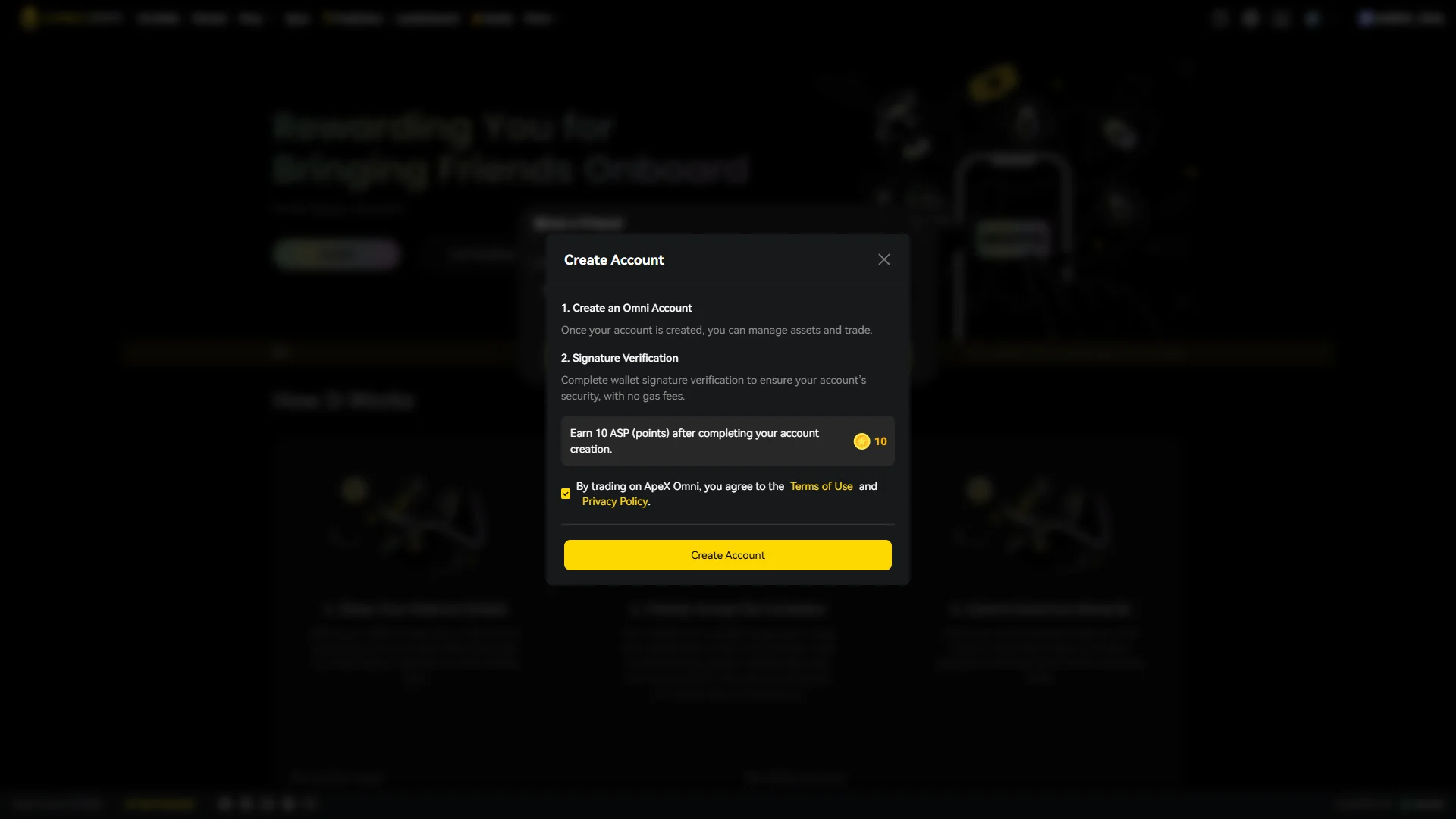
Read the two parts the “Create Account” dialog sets out, “Create an Omni Account” for managing assets and trading and “Signature Verification” as a wallet signature with no gas fee, then click “Create Account”. The box agreeing to the “Terms of Use” and “Privacy Policy” is already checked on this screen, so open both links first if you want to read them.
11. Sign the account key request
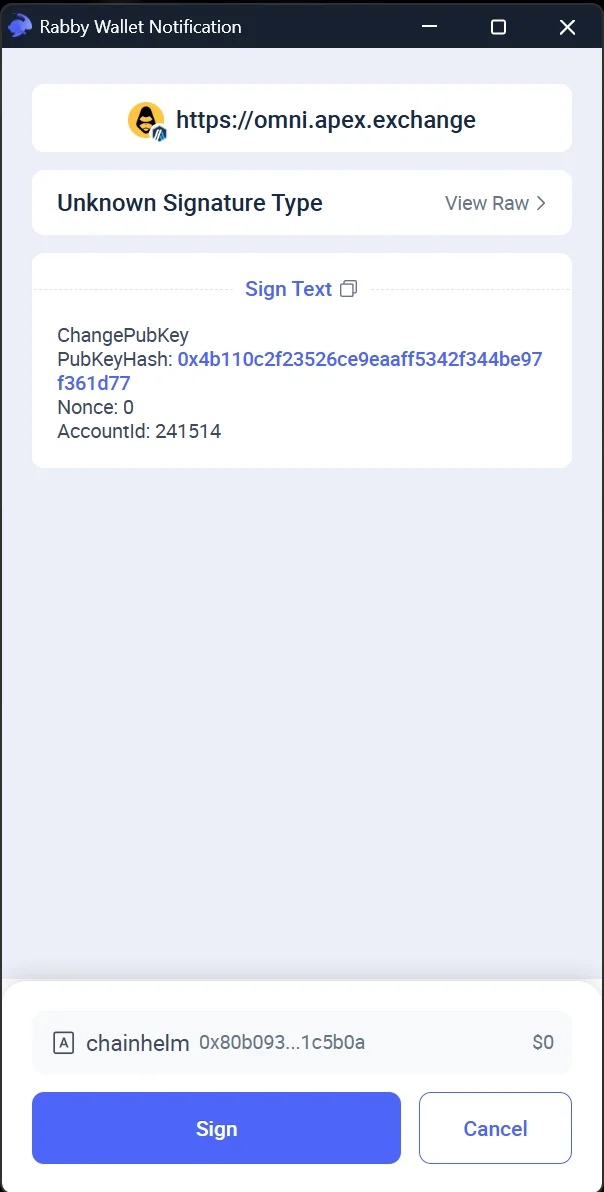
Rabby opens one more “Sign Text” request, this time with “ChangePubKey” at the top of the body, so click “Sign” to approve it. The body lists the public key hash, the nonce and the account ID this signature applies to, which sets it apart from the two onboarding signatures.
12. Confirm the account key signature
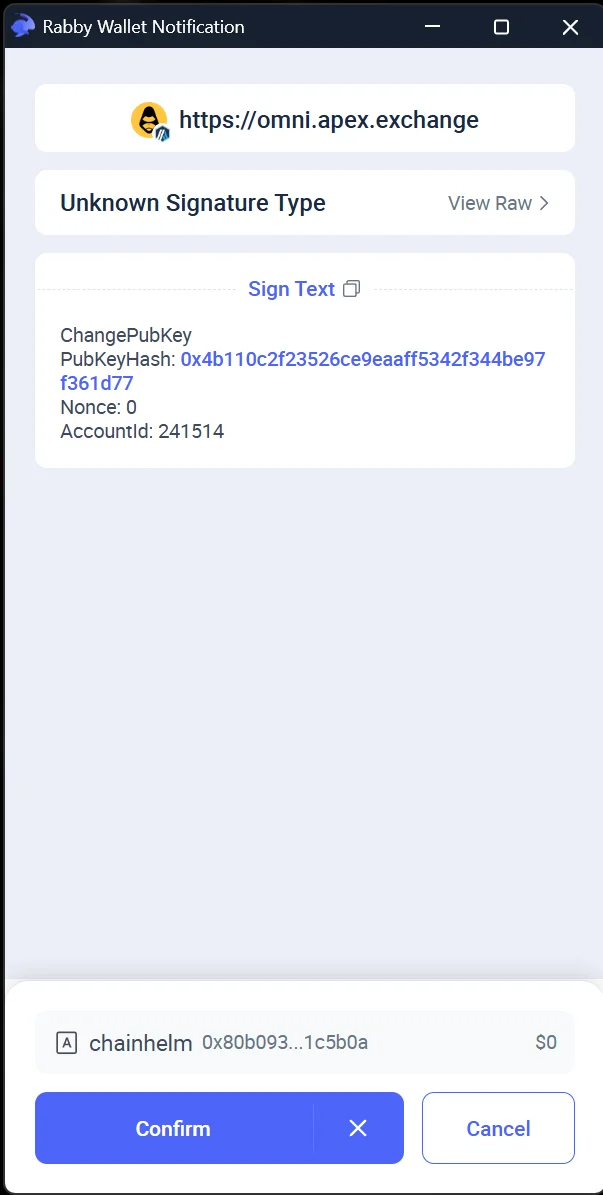
The button changes to “Confirm” again, so click it to send the signature. The request body is the same “ChangePubKey” text as before, and confirming it hands the flow back to the ApeX page.
13. Close the welcome dialog
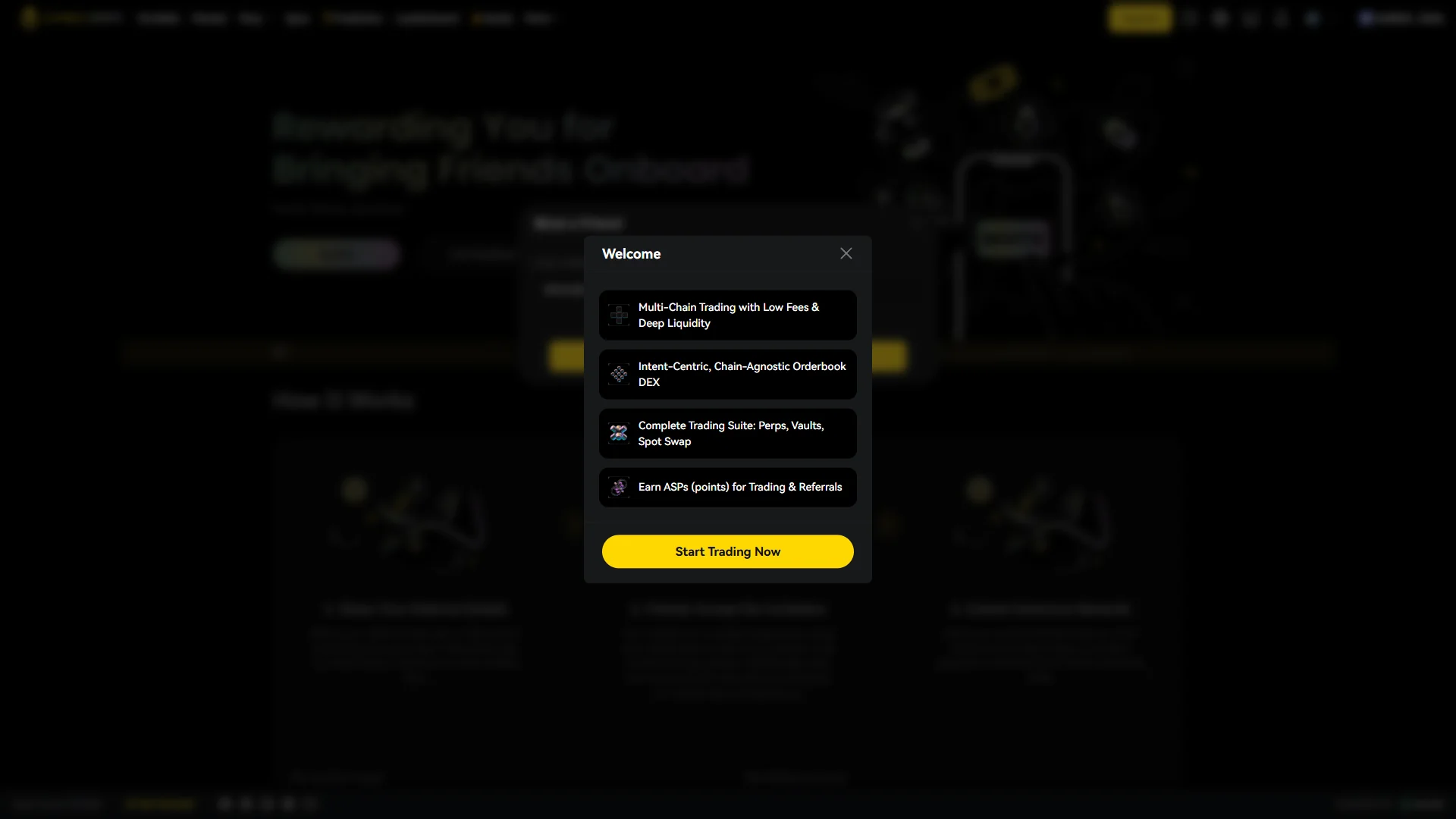
Click “Start Trading Now” to close the “Welcome” dialog that appears once the account is created. The four rows above the button are the platform’s own summary of what the account covers, from multi-chain trading to “Earn ASPs (points) for Trading & Referrals”.
14. Confirm the invitation code
Check that the field under “Enter Invitation Details” in the “Bind a Friend” dialog reads “0KNJQKCQ”, then click “Confirm Details”. The code arrives already filled in because the flow started from the referral link, and this dialog is where it is attached to the new account.
Those are the two ways an invitation reaches an ApeX account, and this screen is where both of them land: the referral link fills the field for you, and the same field accepts a code entered by hand at this moment in the flow.
15. Check the connected referral page

Check the header to confirm the account is live: your wallet address is at the top right, and a yellow “Deposit” button has appeared to the left of the header icons. The page itself now offers the “Invite” and “I’m Invited” tabs under the headline, with “My Invite Code” and “My Referral Link” further down.
Smartphone (iOS / Android) connection steps
- First, open the ApeX official page in your mobile browser or your wallet app’s in-app browser (the link applies the referral code). When you open it, you’ll see a screen like the one below.
2. Tap “Log in” on the referral page
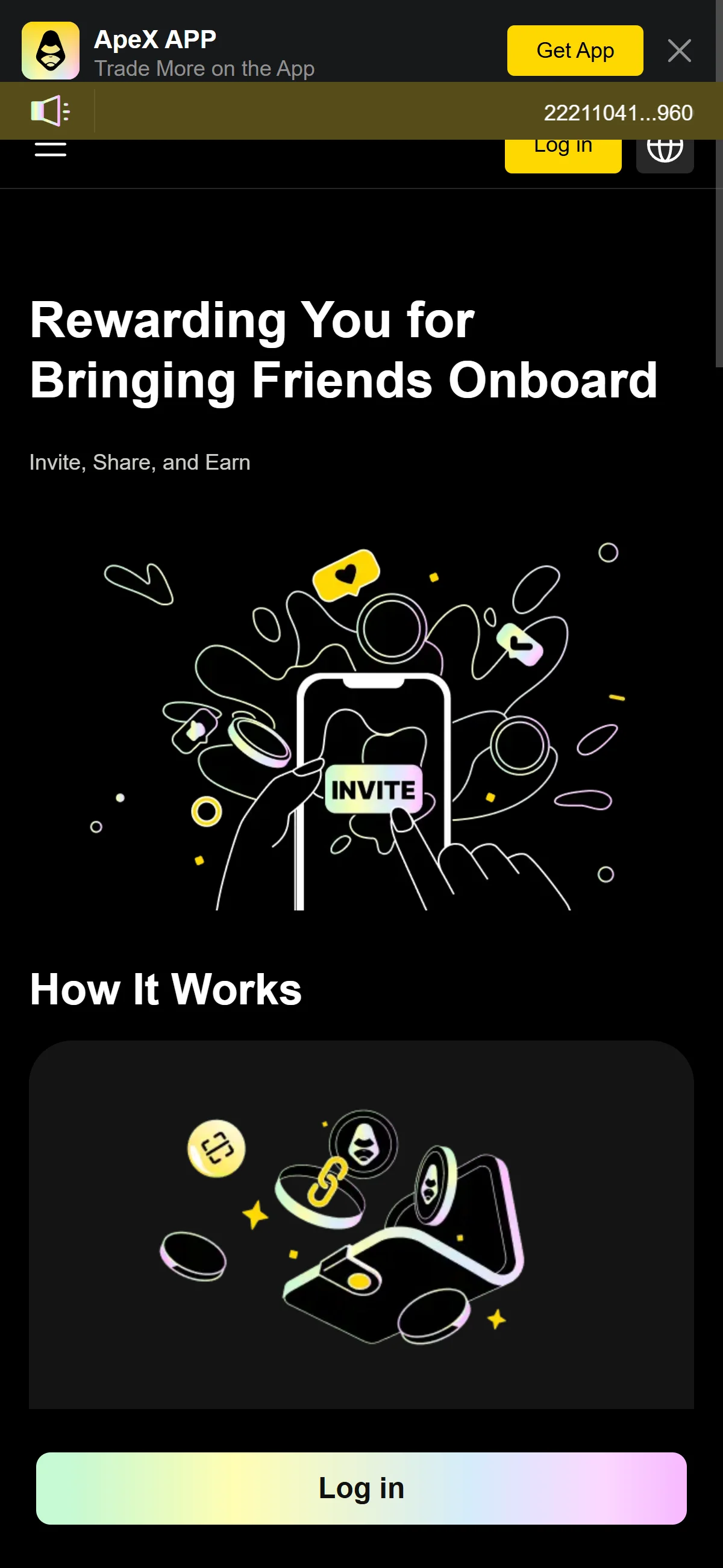
Open the referral link in your phone browser and tap the wide “Log in” button pinned at the bottom of the referral page. The same “Log in” also sits in the header, and either one opens the login options while you are still logged out.
3. Pick your wallet on the login screen
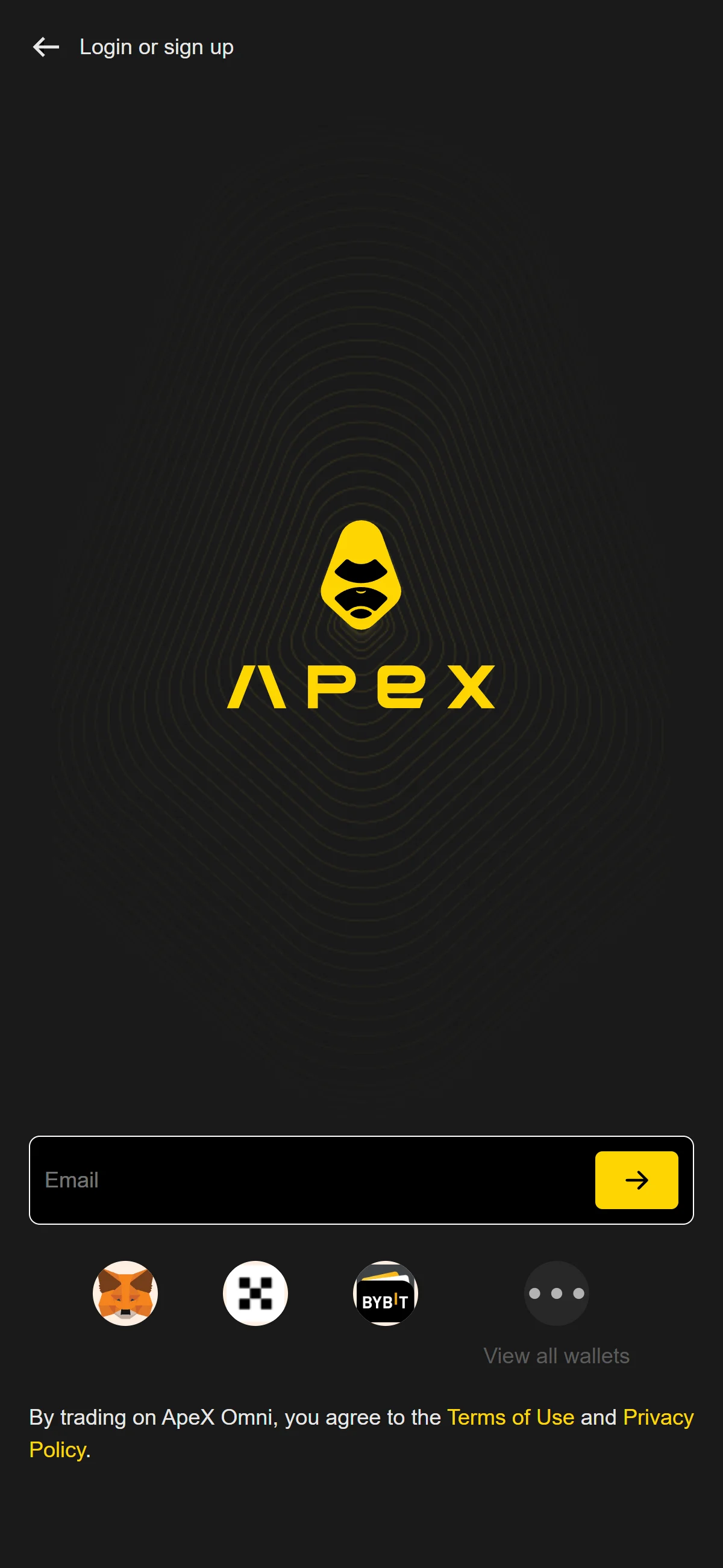
On the “Login or sign up” screen, tap the icon of the wallet app you use from the row above the terms line, or open “View all wallets” for the ones that are not shown. “MetaMask” leads the row; the “Email” field just above it is the alternative if you would rather sign up with an email address.
4. Select the chain and wallet
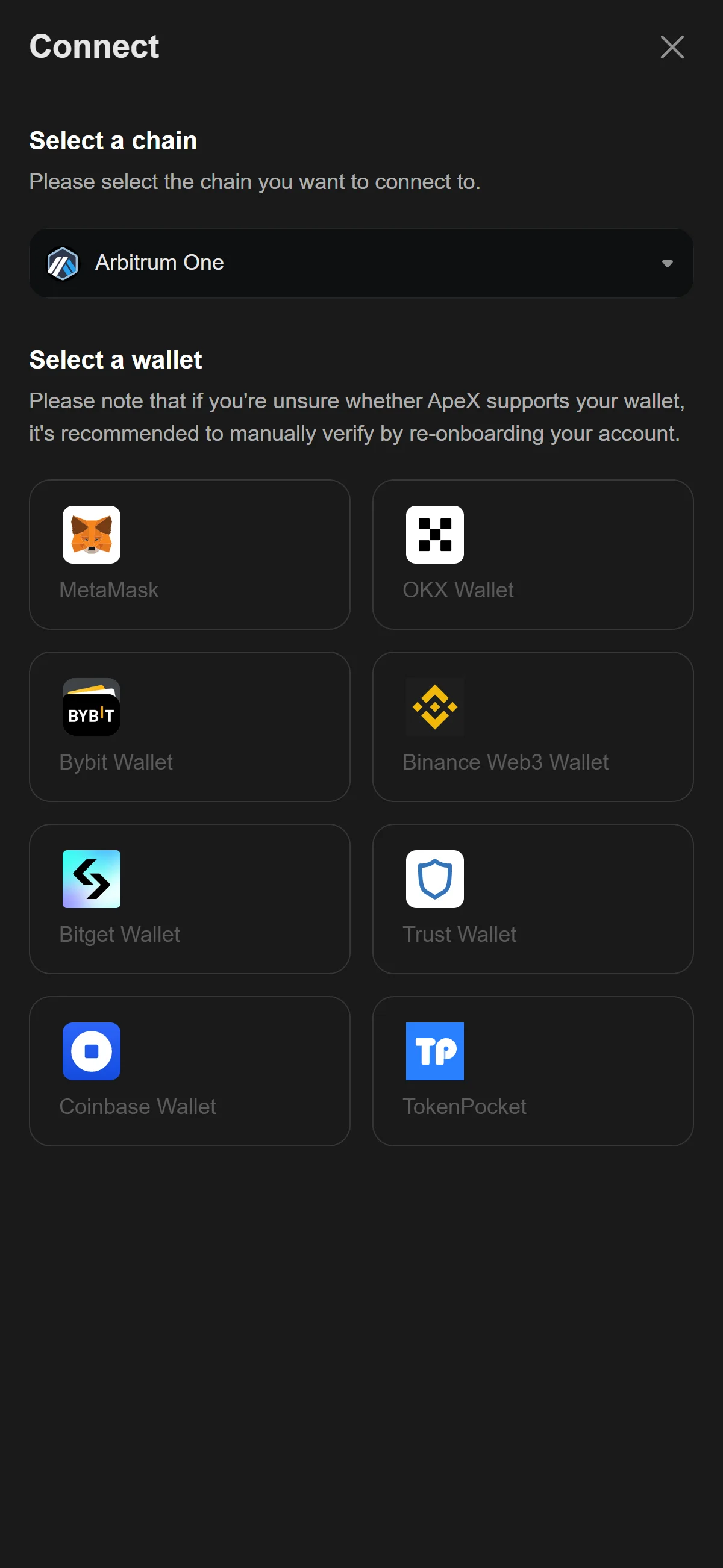
On the “Connect” sheet, keep “Select a chain” set to “Arbitrum One”, then tap your wallet in the “Select a wallet” grid. If you are unsure whether ApeX supports the wallet you use, the sheet suggests confirming it manually by re-onboarding the account.
5. Send the requests to your wallet app
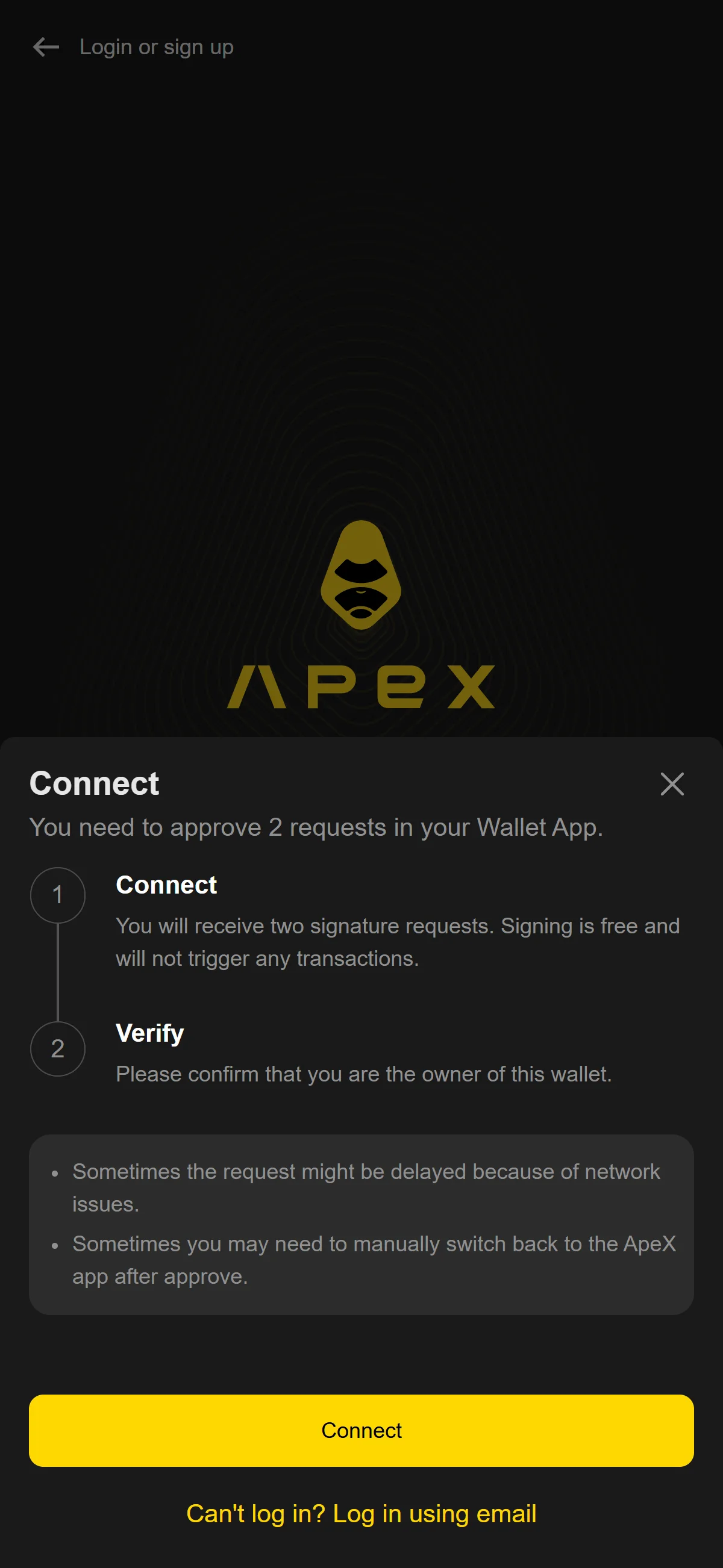
Tap “Connect” at the bottom of the sheet to send the two approvals listed on it to your wallet app: the “Connect” step covers the two free signatures, which trigger no transactions, and “Verify” confirms that you own the wallet. The sheet also warns that a request can be delayed by network issues and that you may have to switch back to the ApeX app manually after approving.
chainhelm’s mobile capture set ends here, where the approvals move into the wallet app. From that point the screens follow the desktop sequence, so read on from the PC/browser connection steps above.
What to do after connecting to ApeX
Funding an ApeX Omni account starts with the “Deposit” button, and the first thing to settle is which chain your money is already on. Deposits and withdrawals are documented for five: Ethereum, Arbitrum One, BNB Chain, Base and Mantle. One carve-out is worth checking before you move anything, because it is easy to miss — USDT (Bridged) deposits and withdrawals on Mantle have been suspended since 2026-06-09, with guidance published for balances caught by it.
Then there is the question of what the account will hold. USDT is the settlement and margin currency, and eight further assets are accepted as cross-collateral at documented collateral ratios: USDC, WBTC, WETH, ETH, cmETH, mETH, cbBTC and USDe. ApeX attaches its own warning to that flexibility, and it deserves more attention than the asset list itself. Non-stablecoin collateral is subject to market volatility, and because it is valued into the same margin pool that backs your positions, a move in the collateral can materially affect margin while a trade is open. Funding an account with WBTC or ETH rather than USDT means the denominator of your margin calculation moves with the market, which is a different risk profile from a stablecoin-funded account holding the same position.
The mechanism behind the deposit is the genuinely unusual part. ApeX operates no standalone bridge product. Deposits route through zkLink X multichain aggregation, and an in-app Multichain Swap converts the asset you hold on the source chain into a supported collateral asset as part of the deposit itself — so the separate bridging step most perpetual DEXs push onto the user before they can trade is folded into the flow. The cost side of that is small but real: trading on ApeX is gasless, and the user pays source-chain gas from their own wallet only on the deposit transaction.
There is also a card route, with a limit that matters to anyone who followed the wallet flow above. Card and wallet fiat deposits through Alchemy Pay — Visa, Mastercard, Apple Pay and Google Pay — went live on 2026-07-04, but they are available only to email-registered Privy Wallet accounts, not to third-party wallet accounts. A reader who connected MetaMask or Rabby in the steps above is on the account type that cannot use it. Note also that Alchemy Pay may require its own identity and facial verification for first-time users; that check is performed by Alchemy Pay, not by ApeX, which asks for no identity verification of its own at any point.
One number is missing, and it is missing rather than hidden: no protocol-level minimum deposit is documented anywhere in the onboarding or deposit documentation. The effective floor is set by whatever the source-chain gas costs on the day, and, on the card route, by Alchemy Pay’s own limits.
With the wallet connected and the invitation code bound, the account is ready to fund, and “Deposit” in the site header is where that starts.
The ApeX referral code cannot be added after sign-up
The referral code can only be applied when you connect your wallet — it cannot be added afterwards.
If you overlook this and complete the connection without the code, there is no mechanism for linking it to that wallet after the fact.
Registering again with a fresh wallet is an option worth considering.
- Is the referral code 0KNJQKCQ shown as applied when you connect your wallet? (check any on-screen notice that appears when you arrive via the referral link, and the code field where the venue provides one)
- After connecting, open the Referral / Rewards page and check that the referral is reflected there — referral-linked displays such as the commission rate appear only once a wallet is connected
The reason the window is so narrow is structural rather than a matter of policy: binding happens inside the account-creation flow and nowhere else. The “Bind a Friend” dialog at step 14 above is the single moment at which the wallet and the invitation are joined, and once the account exists that join is settled.
◆ ◇ ◆
ApeX Social is the live points program, Ape Season 1 has ended
ApeX Social is active; Ape Season 1 ran for twelve weeks and closed
The word “active” does a lot of work on pages about ApeX points, so start by separating the two programs it can refer to. ApeX Social — ApeX Social Points, or ASP — is the standing rewards hub, and it is running. Ape Season 1 was something else: a distinct twelve-week points farm that ran from 2025-10-06 to 2025-12-28 with a 69,000,000 Ape Point pool, and it has ended. Official copy says Ape Season 2 is coming soon, with no announced date attached to it. That is the state of the announcement, and there is nothing further to read into it.
Points accrue at 40 percent of trading fees, capped at 300 per epoch
The live program is also the only part of this chapter a reader can act on.
Points already earned stay valid indefinitely; it is only the per-epoch accrual that is capped. A Trading Streak model replaced the old daily check-in on 2025-01-09, and a seven-day streak unlocks a multiplier on top of the rates above.
The prerequisite is the sentence most pages leave out, and it is the one that decides whether any of this happens at all. A user has to mint ApeSoul, a soulbound token representing a decentralized identity, before points begin accruing. Sign up, trade, and skip that step, and the trading generates nothing.
Accumulated ASPs open Mystery Boxes at 20, 35 or 50 points — Rare, Epic and Legendary — which contain USDT trading bonuses, ASP bonuses, token airdrops or physical prizes, with the top tier split into fragments that all have to be collected before it pays out. That is the mechanism as documented; what any given box is worth is not something ApeX publishes or that this article will estimate.
Ape Season 1 accrued differently, and the detail is now historical: volume across perpetuals, prediction markets and the Grid Bot, plus boosters for Mantle-network deposits, APEX staking, early participation, account balance, prior trading history on other perpetual DEXs, and team volume.
The APEX token event was 2022, and no points-to-token conversion is stated
The token generation event is finished and dated. APEX launched on 2022-04-27 through Bybit Launchpad 2.0, as the first project on the revamped Launchpad: 10,000,000 tokens at 0.05 USDT, split 8,000,000 by subscription and 2,000,000 by lottery. The distribution rounds that followed all ran on the now-discontinued ApeX Pro — Trade-to-Earn Round 1 at 25,000,000 APEX and Round 2 at 10,000,000, an XP Campaign at 25,000,000, and roughly 1,041,666 tokens each to twenty OG NFT holders, locked for six months and then released monthly as esAPEX — and the official tokenomics post attaches no dates to them. It is context for where the token came from, not an input to a decision made today.
The load-bearing fact here is a negative one. ApeX has never published whether or how Ape Points or ApeX Social points convert into APEX or into any future token, and the Ape Season 1 terms state that the weighting and formulas behind the points are confidential. No conversion rate, ratio or timing exists to report, because none has been stated. A completed token event in 2022 is not a signal about a future one, and this article draws no line between them.
Eligibility is one account per user, and the terms are the operator’s to change
The published program rules are narrow and worth knowing before farming anything. One account per user; multi-account farming, bot usage and fraudulent behavior are prohibited; wash trading, manipulation or any exploitative activity means immediate disqualification. Only positive trading fees generated during the program qualify. Market makers enrolled in the ApeX Market Maker Program are excluded from Ape Point boosters, and Grid Bot and Vault volume is excluded from team-based calculations.
Alongside those sit the terms a participant is accepting. The weighting and formulas are confidential; rewards are subject to verification and transparency audits conducted by ApeX itself; ApeX reserves the right to amend, suspend or cancel the program at its sole discretion and holds final interpretation rights over it; and the per-epoch cap may be changed, with any change announced on official channels. Those are the terms as written, and a reader should price them in as terms rather than as a complaint.
ApeX Omni is an order book perp DEX settling on a zkLink rollup
ApeX Pro launched in 2022 and was replaced by ApeX Omni in 2024
The succession matters for a practical reason: a good share of the ApeX material a reader will find online describes a product that no longer exists.
On scale, the venue’s own counters report 628.45B USD of cumulative trading volume and 1.20B cumulative trades on the official homepage. Those are self-reported figures published by the operator; the independently sourced numbers come later in this article.
Three official surfaces name three different entities, and no individual anywhere
Ask who exactly you are dealing with, and the answer depends on which official surface you look at.
APEX DAO Inc.
APEX DAO LLC
Saint Vincent and the Grenadines
No official source reconciles those three, and no corporate registry filing was located for any of them. That is the finding, and it should not be smoothed into a single headquarters jurisdiction, because the sources do not support one.
Around the entities sit three further parties, each with a different evidentiary weight. Official documentation states that ApeX Protocol is fully owned and governed by the ApeX DAO, with APEX holders holding governance rights over protocol parameters. Davion Labs is reported as the incubator and described as backed by Bybit — that comes from secondary reporting and is not confirmed on any ApeX property, so it is worth carrying as reported rather than as established. zkLink is the third-party infrastructure provider, credited in the trading app footer and deferred to in ApeX’s own audit FAQ.
As for who runs it, the answer is that nobody is named. No founder, CEO or core-team member is identified on the official site, in the documentation, on the blog or in the Terms of Use. The docs say only that the protocol is governed by the DAO, and the token distribution documents refer to an unnamed core team and advisors allocation. For a venue holding user collateral, the absence of any named individual is itself the finding.
Orders match off-chain and settle through zkLink X on Arbitrum One
The architecture is an application-specific ZK rollup built on zkLink X, which L2BEAT records as settling on Arbitrum One — making ApeX Omni an L3, with state differences published on Arbitrum One. The documented flow runs an app-rollup that batches transactions to the L2, which batches again and eventually settles to Ethereum.
The matching model is a central limit order book with off-chain matching and zero-knowledge proof settlement, not an automated market maker. Order execution uses Last Price, and the venue advertises CEX-style order types and depth. For a trader, the practical translation is that the order book behaves like a centralized venue — the same order types, the same depth display, the same latency expectations — and what differs is the settlement layer underneath it. What that off-chain concentration costs in trust terms is a separate question, and this article takes it up in the risks chapter.
Perpetuals, TradFi perps and prediction markets stay; spot closes on 2026-08-05
The product surface is wider than the perpetual-DEX label suggests, and a new account touches all of it. Crypto perpetuals at up to 100x on selected major pairs are the core. TradFi and stock perpetuals at up to 50x, priced from Chainlink RWA feeds, launched on 2025-11-04 with TSLA, META, NVDA, QQQ and SPY, and expanded through 2026; they trade during regular U.S. market hours only, and no funding accrues while the underlying market is closed. Prediction Spot, live since 2026-06-08, sources Polymarket order books inside the app. Vaults, a Grid Bot and APEX staking sit alongside them.
Spot is the exception, and the date on it matters. Omni Spot Swap closes on 2026-08-05 at 10:00 UTC — two days after this article’s verification date — and all spot entry points are disabled from that moment. Perpetuals, TradFi perpetuals, prediction markets, the Grid Bot and vaults are unaffected. Balances come back by three different routes: USDT moves to the Funding Account automatically; Ethereum, BSC and Base tokens are airdropped to the L1 wallet within five to seven business days; and Solana tokens require a support ticket. A reader arriving at the venue after that date needs to know the product is gone rather than broken.
Maker 0.020 percent, taker 0.050 percent, and a seven-level VIP ladder
The unified VIP schedule took effect on 2025-10-01 and runs seven levels. A tier is set by whichever is better of two measures — 14-day rolling Omni Perps volume, or combined staked APEX plus esAPEX — with levels 1 to 4 reachable on either metric and levels 5 to 7 on volume only. Tiers recalculate daily from a 07:00 UTC snapshot and apply by 08:00 UTC. Grid Bot and Vault transactions are excluded from the volume that counts, and always pay standard rates.
The staking route deserves a concrete look, because it is the only lever a small account has. A combined 25,000 APEX plus esAPEX reaches level 2, 100,000 reaches level 3, and 250,000 reaches level 4 — which is worth a maker rate of 0.005 percent and a taker rate of 0.035 percent. Those thresholds were cut roughly tenfold on 2025-05-14, which is why older write-ups quote figures an order of magnitude higher.
Then the honest ceiling. This is not a zero-fee venue. The maker floor in the panel above is reached only from level 5, which takes 500 million USD of 14-day volume, and the taker fee bottoms out at level 7 without ever reaching zero. One further rule is published and worth knowing: VIP discounts do not stack with referral or affiliate discounts, and the single most favorable rate applies automatically.
Funding settles hourly within a 0.05 percent band, and trading costs no gas
Funding settles every hour on the hour, UTC, and the rate is capped at plus or minus 0.05% per hour. The shape of the mechanism is a premium index measured against the index price and then clamped to that band, with the documentation stating that any amount beyond the band is absorbed by the platform rather than passed to users. Only traders holding a position at the exact settlement timestamp pay or receive — which makes the hourly cadence, rather than the eight-hour cadence common elsewhere, the thing to internalize.
Gas is fully subsidized on the trading side: placing, modifying and canceling orders costs no network fee. The one place a user does pay is the deposit transaction, in source-chain gas from their own wallet, as set out in the funding chapter above.
Third by 24h volume, tenth by open interest
The volume figure lands between 1.469 and 1.539 billion depending on the aggregator
As of 2026-07-29, ApeX sits third by normalized 24h perpetual volume on the DeFi Llama perpetuals ranking — behind Hyperliquid and Aster, ahead of Lighter and edgeX. That is the standing; the rest of this chapter is about how much weight it can carry.
Against the 21,522,000,000 USD of all-protocol perpetual volume on the same page snapshot, ApeX’s reported 24h figure works out at 6.92% of the market. That percentage was computed by this research from the snapshot; it is not a figure DeFi Llama publishes.
The spread above is the reason the same venue carries different numbers on different pages, and it is worth being able to read. Three independent sources agree within roughly 3.4 percent, which for perpetual DEX volume is close agreement rather than a discrepancy. DeFi Llama publishes two series: a reported figure and a lower normalized one, the normalized series being its wash-adjusted view. Which of those a page is quoting is rarely stated, so if you find a number for ApeX that does not match another, the aggregator and the series are the first two things to check.
Open interest is about 8 percent of 24h volume, lower than the venues above it
Open interest is 118,470,000 USD on DeFi Llama, corroborated within roughly 1.4 percent by CoinGecko, CoinMarketCap and ApeX’s own homepage — four sources, close agreement, no real ambiguity. Ordering the open-interest column of the same DeFi Llama snapshot puts ApeX tenth, behind Hyperliquid, Aster, Variational, Lighter, edgeX, Grvt, GMTrade, Antarctic and Extended. That ordering was derived by this research from the snapshot rather than published as a rank, and it covers only the protocols visible in it.
The gap between third by volume and tenth by open interest is the interesting part. Open interest here is roughly 8 percent of 24h volume, a materially lower ratio than the leading venues on the same snapshot carry. What that describes is a venue whose turnover is heavy relative to the positions actually held on it. Why the ratio sits where it does is not something this research established, and it is not worth guessing at.
Realized protocol fees imply a take rate near 0.002 percent against a 0.05 percent headline
31,068 USD of protocol fees over 24 hours implies a realized take rate near 0.002% — roughly one twenty-fifth of the 0.05% headline taker fee.DeFi Llama, 2026-07-29
The longer series tells the same story: 96,495 USD over 7 days, 595,366 USD over 30 days, and 40.3M USD cumulative, read against roughly 1.489 billion USD of daily volume.
The honest thing to do with that gap is to state it and refuse to close it. There are several plausible contributors — the zero-maker and reduced-taker tiers at VIP levels 5 to 7, market maker rebates, incentive-driven volume, and DeFi Llama’s own fee attribution methodology — and this research did not establish which of them dominates. What follows for a reader is a reading instruction rather than a conclusion: the volume rank on this venue should be read together with this figure, not on its own.
Multichain deposits, TradFi perps and a card on-ramp set it apart from wallet-only venues
Four things genuinely separate ApeX Omni from the rest of the field, and each is a structural difference rather than a claim about quality.
The first is chain-agnostic deposits aggregated through zkLink X, with the bridging step folded into the deposit across five chains — against a field in which most perpetual DEXs settle on one chain and require the user to bridge in first. The second is a tokenized-equity and pre-IPO surface broader than most crypto-only venues carry, with a named institutional oracle on the RWA leg. The third is prediction markets sourced from Polymarket order books inside the app, which supplies liquidity the venue would otherwise have had to bootstrap itself. The fourth is the pair of onboarding paths: a third-party wallet, or an email account backed by a Privy embedded wallet with private-key export — a CEX-like entry point, complete with the fiat card route, that most non-custodial venues do not offer at all.
The collateral set belongs on the same list with its price attached. Nine assets usable simultaneously in one cross-margin account is wider than the USDC-only venues allow, and it comes at the cost of isolated margin, which ApeX does not offer at all. What that trade-off means when a position moves against you is developed in the risks chapter below.
This venue fits multichain perp traders and not readers who need recourse
Putting the chapter together: liquidity deep enough to matter, a genuinely unusual multichain deposit path, a product surface that reaches well beyond crypto perpetuals, and a headline fee schedule that a small account cannot move much without staking a meaningful position in the venue’s own token.
That describes a fit. The trader this venue suits already holds assets across several chains, wants one account for crypto perpetuals, equity perpetuals and event markets rather than three, and watches positions closely enough to live with cross margin as the only option.
It does not suit a reader who needs a licensed counterparty, a documented insurance backstop, or a route to complain to someone — because, as the next two chapters set out, none of those exists here. That is not a reason to look elsewhere so much as a specification: if those are requirements, this venue does not meet them.
◆ ◇ ◆
ApeX holds no license anywhere, and screens by country rather than by identity
The Terms of Use name nine excluded countries and regions, and leave the list open
Section 3 of the Terms of Use, last updated 2026-07-27, defines Restricted Persons, and the named set is short:
United States Iran Cuba North Korea Syria Myanmar Crimea Donetsk Luhansk
The United States is listed in its own category — persons or entities resident in, located in, incorporated in, with a registered office in, or operated or controlled from it — and the notice attached to the clause states that there are no exceptions.
The clause does not stop at that list, and that is the part a reader should carry forward. It extends to any other country or region under comprehensive US economic sanctions, to any person on a prohibited or restricted party list including OFAC’s, and to any person whose use would be contrary to applicable law. In form it is open-ended rather than closed, which means the absence of your own country from the named nine is not a permission ApeX has granted. What it is instead is the start of a second question, about your own law, which the next chapter takes country by country.
Eligibility rests on your own attestation, because there is no identity check
Eligibility here is established contractually, not technically. Each time a user accesses the software, they confirm that they are not a Restricted Person. The interface does screen at the country level, and US access is officially geo-blocked. Beyond that gate, though, registration requires no identity verification at all — no documents, no name, nothing beyond a wallet — so nothing in the onboarding flow tests that confirmation against the person making it.
Stated neutrally, the restriction is a promise the user makes on their own behalf, and beyond the country gate the venue’s own documents describe no mechanism that verifies it. What that means in practice is an allocation of responsibility: eligibility is an obligation the reader takes on personally, not a check the venue performs on their behalf.
The entity behind the Terms disclaims operating the site you trade on
This is the paragraph most pages about ApeX never write, and it is the one that decides what happens if something goes wrong.
Section 4 of the Terms states that APEX DAO Inc. does not deploy APEX Software for public use or operate any infrastructure or website interface for any public deployments. It then defines the third parties who do run public front-ends as “Deployers”, and makes them responsible for excluding Restricted Persons. In plain terms: the entity that publishes the Terms disclaims operating the site the reader actually trades on. This two-layer separation between a protocol and an independently operated interface is standard across perpetual DEXs, so it is not an ApeX peculiarity — but standard does not mean immaterial.
- Governing law
- Republic of Panama
- Dispute route
- Binding individual arbitration
- Class actions
- Waived
- Jury trial
- Waived
Set that against the unresolved entity identity from the previous chapter and the practical question answers itself. A reader who wanted to bring a claim would have to identify the counterparty before anything else — and the three official surfaces do not agree on who that is. This is a structural observation about how the documents are drawn, not an accusation about how the venue behaves.
No license and no located regulator action, which is not the same as a clean record
ApeX claims no financial-services license, registration or authorization in any jurisdiction, and none was located in a regulatory database search. That is worth framing correctly: it is the normal posture for a non-custodial perpetual DEX operating on a geo-exclusion model rather than a licensing model. It is a fact about the structure the venue has chosen, not an allegation that it has failed to do something.
On enforcement, an active search for actions, warnings and sanctions naming ApeX Protocol, ApeX Omni, ApeX Pro or its named entities located nothing anywhere outside South Korea as of 2026-07-29. The exception is Korean, and it is worth naming: the ApeX Android app has been blocked from Google Play Korea at KoFIU’s request since 2025-03-25, KoFIU re-listed Apex Pro among unregistered operators referred to investigative agencies on 2026-06-24, and Korean registered exchanges have restricted transfers to and from it since 2023-07-19.
The caveat that makes that sentence honest has to be explicit, because absence findings are the easiest thing in this field to misread. Nothing located is not an affirmative finding of a clean record. Every absence in this chapter should be read as “none located as of 2026-07-29” — the product of searches that returned nothing, not of any authority having reviewed this venue and cleared it.
The product line has moved toward securities-facing markets, still without identity checks
Trace the direction of travel over the twelve months to 2026-07-29. ApeX went from crypto-only perpetuals, to perpetuals referencing U.S. equities and ETFs from 2025-11, to fractional tokenized U.S. stocks issued through third parties, pre-IPO exposure, and Polymarket-sourced event and prediction markets from 2026-06. Each of those categories touches securities and event-contract regulation more directly than crypto perpetuals do, and all of them are offered without identity verification.
The operator’s stated mitigation is the categorical exclusion of U.S. persons in the Terms, refreshed on 2026-07-27. Working against that mitigation is the finding this chapter has already established: eligibility is contractual attestation, with no identity verification standing behind it.
The boundary the research drew is worth holding to here. This is an assessment of exposure, not a record of events. Tokenized stock issuance is delegated to Backed Finance and MyStonks, and ApeX’s own stock documentation flags counterparty risk around the issuer’s custody and redemption process. No regulator has published an action against ApeX that this research could locate.
◆ ◇ ◆
ApeX excludes the United States, but not the UK, Singapore, Australia or India
”Can I use it from here” is really two questions, and they do not have the same answer anywhere. The first is whether ApeX’s own Terms exclude your country. The second is whether your own law or regulator says anything about using a venue like this one. This chapter answers both, in that order, for the five markets this article covers.
Keep the previous chapter’s catch-all in view while reading: absence from the named restricted list is not a permission ApeX has granted, because the clause reaches beyond the names in it.
United States: excluded by the Terms of Use, so the code cannot be bound
If you are reading this from the United States, the answer arrives before the analysis: the United States is listed among Restricted Persons in the ApeX Terms of Use and US access is officially geo-blocked, so a US reader cannot register or bind a referral code. Everything in the first half of this article describes a flow that is not open to you.
Where that exclusion comes from is the useful part, because it is not where most readers assume. No US statute prohibits an individual resident from trading on an offshore non-custodial perpetuals DEX as such. The Commodity Exchange Act places the registration obligation on the venue and on intermediaries, and every CFTC action reviewed in this research — against DeFi protocol operators, against an offshore intermediary routing US customers, against a front-end operator — was brought against operators or intermediaries rather than against retail users. The bar in front of a US reader here is ApeX’s own contractual position, not a prohibition aimed at them.
That has to be balanced immediately, because it is easy to misread as encouragement. The question of user-side legality is unsettled rather than settled favorably, and the Terms exclude US persons with no exceptions — so a US person accessing ApeX is in breach of contract with the operator regardless of where the public-law question lands. That is the position, and this article leaves it there: no route around the exclusion, and no substitute venue named for a US reader.
On official statements, the CFTC guidance reviewed here addresses venues and intermediaries as a category. No US authority statement, warning or enforcement action naming ApeX was located as of 2026-07-29.
United Kingdom: usable, with no FCA registration behind it
The United Kingdom is not listed among Restricted Persons in the ApeX Terms of Use, and no UK geo-block is documented anywhere. That is a documentary finding — a UK-IP check was not possible in this research — so the honest way to put it is that nothing in the Terms or the documentation excludes the UK, rather than that the front end was confirmed reachable from Britain.
Then the duty allocation, which is what a UK reader is usually asking about underneath the availability question. The general prohibition in section 19 of FSMA 2000 binds the person carrying on the regulated activity, not the consumer using the service. The same allocation runs through the rest of the framework: the retail crypto-derivatives prohibition binds firms acting in or from the UK, and the financial-promotions offence binds whoever communicates the promotion. No UK provision was identified that prohibits a resident from using an overseas non-custodial derivatives protocol.
The consequence is the paragraph most UK coverage never writes. ApeX does not appear on the FCA’s register of cryptoasset firms — this research checked the register directly, across both registered and formerly registered entries, and found no ApeX entity. A UK user of an unauthorized, unregistered venue has no recourse to the Financial Ombudsman Service and no Financial Services Compensation Scheme protection. Put at its sharpest: the leverage available here is leverage on a product class that UK-regulated firms are prohibited from selling to retail consumers, offered without the conduct protections that prohibition exists to provide.
What is not settled should be left unsettled. Whether ApeX falls inside the incoming UK regime is undetermined — the FCA applies its rules to DeFi where there is a clear controlling person, and will consult separately on indicators of decentralization. No UK regulator has ever named ApeX, so none of the FCA material above may be read as a statement about this venue in particular.
Singapore: not restricted, and outside the MAS perimeter
The status comes with its verification limit attached: available per the Terms of Use, since Singapore is not listed among Restricted Persons, with reachability not verified from a Singapore IP address.
MAS’s framing is jurisdictional rather than prohibitory, and that distinction is the substance of this section. MAS regulates crypto-derivative products listed and traded on Approved Exchanges, and has said it does not extend that regulation beyond them. Overseas online trading platforms sit outside MAS’s regulatory oversight, and MAS’s retail protective measures do not apply to entities it does not regulate. No Singapore law or MAS rule was identified that prohibits a resident from trading on an offshore, MAS-unregulated derivatives platform. What follows for the reader is the absence of MAS investor protection and recourse — not illegality of their own conduct.
On the register, no MAS license, registration, recognition or authorization held by ApeX was found, verified against the MAS Financial Institutions Directory. One point is worth adding carefully here, because a Singapore reader who checks the directory themselves will run straight into it: the entities that match on name in Singapore searches are unrelated companies, and none of their standing attaches to ApeX Protocol.
The leverage picture is a scope gap rather than a breach. Singapore’s retail margin friction binds Approved Exchanges and licensed intermediaries; ApeX is neither, and it offers up to 100x to the same individuals with no Singapore-specific cap. Two regimes that do not meet, which is exactly what the research found.
Australia: open to residents, with no Australian license and no 2:1 cap
Australia is not listed among Restricted Persons in the ApeX Terms of Use, and no Australia-specific block was found in any ApeX document or front-end asset. As with the other countries here, that is a documentary finding rather than an observed Australian-IP session.
ASIC’s position is best stated at the right altitude. Its guidance lists perpetual futures among the products likely to be derivatives; it says Australian laws apply where services are provided in Australia, including from offshore; and it says that offshore or decentralized structures do not put obligations out of reach. In the same document, ASIC expressly declines to say when a DeFi arrangement requires a license. So: the obligations are framed on the provider, the DeFi question is left open, and no Australian law or ASIC statement was identified that prohibits a resident from using an offshore non-custodial perpetuals DEX.
On registration, no Australian Financial Services license, market license or other authorization was identified for ApeX, and no Australian entity, ABN or local representative appears anywhere in its documentation. ApeX is not on ASIC’s investor alert list either — though ASIC says that list is not exhaustive, so its absence from it is evidence of no public flagging rather than proof that there is nothing to flag.
The concrete number an Australian reader can hold onto is the leverage gap. ASIC’s product intervention order caps retail crypto CFD leverage at 2:1 and runs to 2027-05-23, but it binds CFD issuers and distributors serving Australian retail clients — not end users, and not a venue ASIC has never determined to be issuing CFDs. ApeX offers up to 100x with no Australian tier. The practical position is that an Australian user is not protected by the 2:1 cap, and whether that gap ever closes is unresolved.
India: reachable and taxed, but outside every Indian register
India is not named in the restricted-persons clause, ApeX is not named in any FIU-IND or MeitY takedown order, and the Android listing is reachable with the India store parameter. Documentary finding again, with no live render from an Indian IP behind it.
Use is not prohibited in India, but it sits outside Indian regulation entirely. Virtual digital assets are recognized in tax law under section 2(47A) of the Income-tax Act. They are not legal tender. No Indian statute authorizes crypto derivatives trading — which means there is no Indian regulator standing behind a product like this one, not that the product is banned.
On registration and enforcement, the applicable regime is registration with FIU-IND as a reporting entity under the PMLA, and ApeX holds none. Because FIU-IND publishes no public register, that finding is evidenced indirectly: ApeX is absent from both published enforcement rounds — the notices to nine offshore providers on 2023-12-28 and to twenty-five on 2025-10-01 — and from the compliance-orders index. The pattern those rounds establish matters more to a reader than the absence itself. The obligation is activity-based and not contingent on physical presence in India; the burden falls on the provider rather than the user; and the remedy exercised to date has been URL and app blocking rather than action against users. The practical consequence is worth stating plainly: the venue could be made inaccessible by a blocking order, without notice, while you hold a position on it.
Tax is the part a resident carries regardless of where the venue sits. Income from the transfer of a virtual digital asset is taxed at a flat 30 percent plus surcharge and cess under section 115BBH, with no deduction other than cost of acquisition, no set-off of losses against other income and no carry-forward; 1 percent TDS applies under section 194S, and transactions are reported in Schedule VDA. None of that reaches ApeX operationally. It performs no identity verification, holds no Indian registration and is not a prescribed reporting entity, so it issues no Indian tax documents and deducts no TDS. Cost basis and gains have to be reconstructed by the user from their own wallet and trade records.
Self-custody with no exit window, and shortfalls absorbed by other traders
L2BEAT places ApeX Omni below Stage 0, with no exit window before upgrades
ApeX markets ApeX Omni as non-custodial, with traders retaining full self-custody, secured by zero-knowledge proofs. That is the claim. Set the independent findings beside it and hold both at once.
- Stage
- Below Stage 0. L2BEAT states there is no available node software that can reconstruct the state from L1 data.
- Sequencer and proposer
- A single externally owned account holds both roles across all chains, with exclusive block-commitment rights.
- State roots
- Only whitelisted proposers may publish them.
- Sequencer failure
- No fallback mechanism.
- Upgrades
- The UpgradeGatekeeper can upgrade code with no delay, which L2BEAT flags as CRITICAL.
- Exit window
- None before an upgrade takes effect.
- Admin control
- A 4-of-6 Gnosis Safe controls token management and critical parameters.
The most concrete of the findings concerns deposits themselves. L2BEAT warns that the proof system does not authenticate deposits made on external chains, so users additionally trust a 2-of-2 validator set and the LayerZero bridge not to forge deposits that never happened — a gap L2BEAT describes as a material escrow-drainage risk.
Whether any of this can be checked independently is bounded by what is published. ApeX’s GitHub carries API SDKs and connectors and some Solidity repositories, but the matching engine and the Omni application layer are not open source. Coverage is partial.
Self-custody describes who holds the keys, and these findings describe who can change the system those keys operate in. Both are true at the same time, and a reader is better served holding them together than picking one.
Force Withdrawal is documented, and so is a state in which withdrawal stops
ApeX documents a Force Withdrawal mechanism for users to exit. L2BEAT records no exit window, and a proposer-failure state in which users cannot withdraw, because only whitelisted proposers may publish state roots.
Those two sit side by side in the source material, and no official source located by this research reconciles them. This article is not going to resolve the contradiction on ApeX’s behalf, and not against them either. Both statements are on the record; nothing joins them.
The audits on record cover zkLink infrastructure, not the ApeX Omni application layer
The audit position only makes sense with the dates laid out.
No audit of the ApeX Omni application layer by a named auditor was located. ApeX’s own answer to whether its contracts are audited points entirely to zkLink’s infrastructure audits, and the one ApeX-specific audit on record — by BlockSec — covers the original ApeX Protocol and the discontinued ApeX Pro, and carries no stated date at all.
In one sentence: assurance here is inherited from the infrastructure rather than performed on the application layer the reader actually trades through. A secondary source attributes further audits to other firms; this research found no corroboration on any primary source, so those are not recorded as facts.
The bug bounty is in a similar state. There is no confirmed live program. The official FAQ says only that ApeX is planning to support a bug bounty campaign, and no scope, reward table or submission channel was located. Announced, but unconfirmed.
Cross margin only, and Auto-Deleveraging in place of an insurance fund
This is where a reader’s money is most directly at stake, and every element of it is specific to this venue rather than generic to perpetual trading.
Start with the design constraint. ApeX Omni runs cross margin exclusively, portfolio-wide; it does not offer isolated margin at all. Every position shares one margin pool backed by total account equity, and the official documentation carries its own contagion warning about what that means — a large loss in one position reduces margin across the whole portfolio, and can accelerate liquidations on all open positions. The operator saying so is the point; there is no need to editorialize on top of it.
The trigger is a margin ratio. Liquidation comes when the margin ratio reaches or exceeds 100%, computed on Mark Price rather than Last Price, where Mark Price is the median of three inputs. Maintenance margin always exceeds initial margin and rises with position size under per-pair Risk Limits, so a larger position is liquidated earlier in percentage terms than a small one. Once the trigger fires, the clearing engine takes control and closes positions in order of risk severity at the best available market price. The documentation describes no partial-liquidation tier and no explicit liquidation penalty rate.
Two details make that box livable rather than merely alarming. A trader’s own ADL ranking is exposed as a live indicator on the Positions tab, so the exposure is visible before it matters. And the absence of an insurance fund is recorded here as unknown rather than as established: this research searched the margin, liquidation, ADL, protocol vault and fee documentation and found none described, which is not the same as proving none exists. Worth noting alongside it, Protocol Vaults are documented as yielding from real protocol liquidation fees — which indicates that liquidation proceeds accrue to a vault product rather than to a trader-protection reserve.
Liquidations are computed on an oracle, so the construction of that oracle is the last piece. Crypto perpetuals use an internally computed Index Price: a weighted average of spot prices from multiple external exchanges, with Binance, Bybit, Coinbase and Kraken named as examples, and no third-party oracle provider named for the crypto leg. TradFi and RWA perpetuals use Chainlink RWA feeds instead. Mark Price is a median construction the documentation describes as the defense against a single outlier or a temporary spike. A trader running both legs is trading against two different pricing regimes, which is the kind of asymmetry that is easy to miss until it matters.
Retirements have been announced with deadlines, and the counterparty is still unnamed
Product retirements are the only observable track record a venue has for moving user balances under change, which makes them worth a close look. The ApeX Pro sunset ran from 2024-10 through 2025-04 as a planned, phased wind-down with published withdrawal and migration deadlines, not a failure event. USDT (Bridged) deposits and withdrawals on Mantle were suspended from 2026-06-09, with guidance published for affected balances. All Prediction Contract pairs were delisted on 2026-06-01 with open positions auto-settled. The spot closure returns balances by three separate routes depending on the chain, one of which requires opening a support ticket.
The pattern, without overclaiming it: retirements have been announced with deadlines, and balances have been returned. Alongside that, this research located no exploit, oracle manipulation, governance attack, depeg, front-end compromise or chain halt across the venue’s full history, including the ApeX Pro era. The standard qualifier applies — absence of a located incident is not proof that none occurred.
Which leaves recourse, and it ties back to the chapter before this one. The entity identity is genuinely unresolved across three official surfaces, no corporate registry filing was located for any of them, and the Terms disclaim that the publishing entity operates the front end. For a reader deciding how much to fund, that is the last item on the list: if something goes wrong, the first problem is not the loss, it is identifying who to raise it with.
◆ ◇ ◆
The code binds once, and your country is the first gate
Referral code 0KNJQKCQ, opened through the referral link, arrives pre-filled in the “Bind a Friend” dialog and is confirmed with “Confirm Details” while the account is being created. It carries a 5% discount on trading fees as a referred user, available to new accounts only. There is one window for that and it does not reopen — which is why this article put the flow ahead of the analysis rather than the other way around.
The country gate is the thing to settle first, not last. A US reader cannot use the venue at all. A reader in the UK, Singapore, Australia or India can, on ApeX’s side of the question — while in none of those four places does a license, a register entry or a compensation scheme stand behind the venue they would be using.
On standing, the venue is real and mid-sized: third by 24h perpetual volume, tenth by open interest on the same snapshot, and realized protocol fees that imply a take rate far below the headline taker fee — a gap this article named and deliberately did not explain away.
The items that bear on funding an account are short enough to hold in one place. Self-custody is marketed alongside no exit window and a single account holding sequencer and proposer rights. Audits are inherited from infrastructure, with none located on the application layer. No insurance fund is documented, and Auto-Deleveraging socializes shortfalls onto profitable traders. Cross margin is the only option, with the operator’s own contagion warning attached to it. And three official surfaces do not agree on which entity is behind any of it.
So it comes back to fit. This suits a trader already operating across several chains who watches positions closely and knows what they are accepting in exchange for the product surface. It does not suit a reader who needs a counterparty they can name and hold to account.