— Contents 12 sections
- 01 Is the Extended referral code “CHAINHELM” still active?
- 02 What the Extended referral code “CHAINHELM” gets you
- 03 Extended sign-up steps with the referral code
- 04 What to do after connecting to Extended
- 05 The Extended referral code cannot be added after sign-up
- 06 The points program pays out weekly, and Extended has confirmed no token
- 07 Extended in outline: a Starknet-settled perpetual DEX run by X10 Ltd
- 08 Tenth by reported 24-hour volume: where Extended sits, and who it suits
- 09 Twelve territories excluded, no license anywhere, and no regulator has acted
- 10 Extended is blocked in the United States and the United Kingdom, and reachable in Singapore, Australia and India
- 11 The risks Extended carries specifically: a trusted operator, upstream-only audits and two settlement halts
- 12 What the referral code settles, and what the decision still turns on
chainhelm’s exclusive Extended referral code is .
As of 2026-08-06, we connected a new wallet and confirmed that the referral code was applied.
Apply the code when you connect your wallet to receive a 10% discount on trading fees. We recommend taking care of it right then and there.
This article covers the sign-up process (wallet connection) with the Extended referral code, Extended’s distinguishing features, availability in the United States, the United Kingdom, Singapore, Australia and India, and the risks to acknowledge — with the connection flow and code application verified first-hand by chainhelm’s editorial team.
Is the Extended referral code “CHAINHELM” still active?
The chainhelm editorial team connected to Extended with a fresh wallet on 2026-08-06 and confirmed that the referral code “CHAINHELM” is still active.
Here is the actual screen captured during verification.
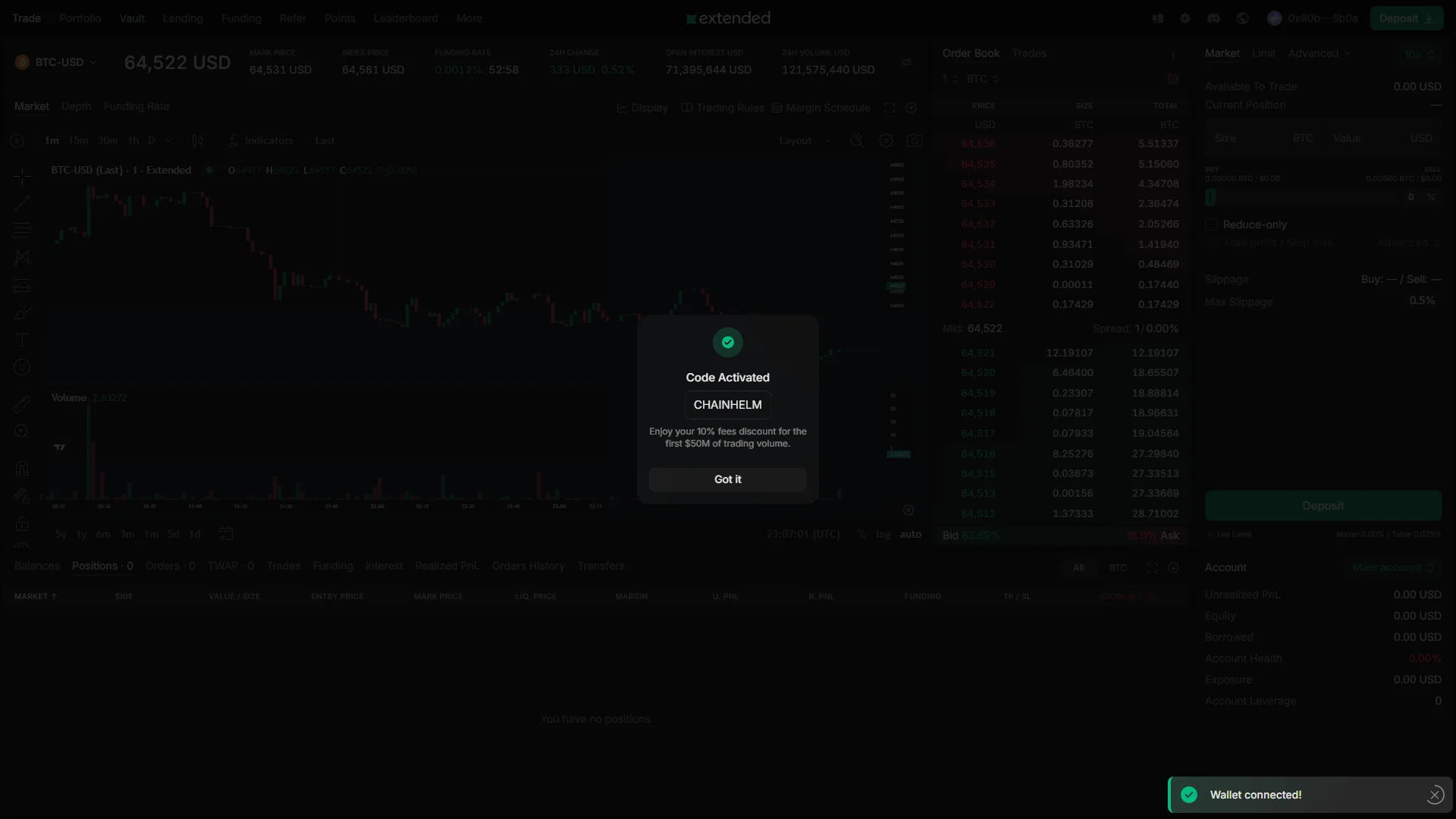
The screen shows “Enjoy your 10% fees discount for the first $50M of trading volume”, confirming that the referral code CHAINHELM was correctly applied.
chainhelm continuously verifies the validity of the code and confirms it remains usable.
The applied code also stays on show after the connection is finished: the Refer page carries a ”✓ Referral Code Applied” chip, and the account menu reads “REFERRAL CODE: CHAINHELM ✓ Applied”.
What the Extended referral code “CHAINHELM” gets you
Apply this code when you connect to receive the following benefits on Extended:
Expiration: None
Eligibility: New users
To receive the benefits, you need to apply the code when you connect your wallet. Be careful not to miss this step.
Extended sign-up steps with the referral code
We cover the connection process separately for PC/browser and smartphone (mobile).
PC/browser connection steps
1. First, open the Extended official page (the link applies the referral code). When you open it, you’ll see a screen like the one below.
2. Connect from the referral invitation
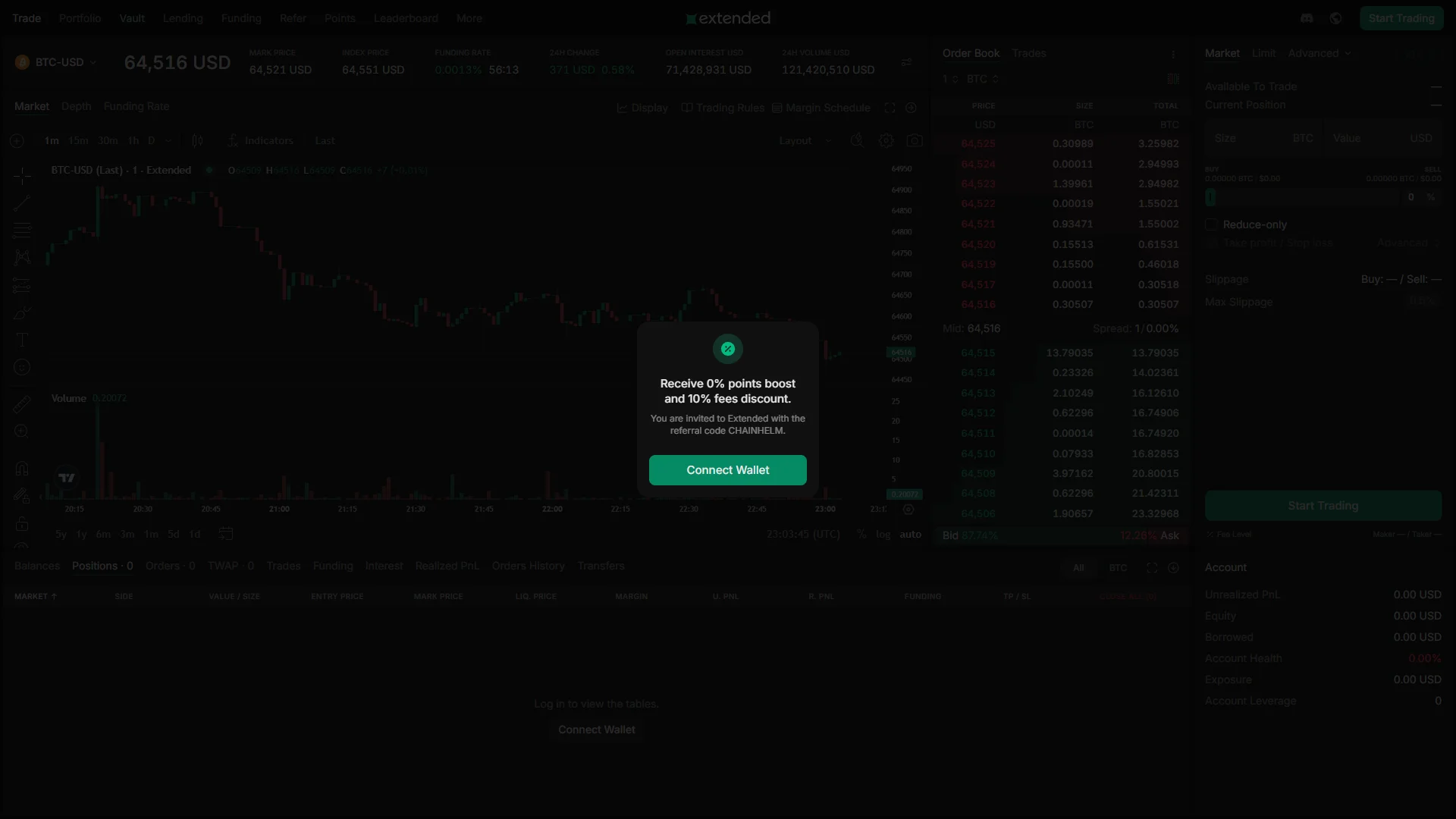
Click “Connect Wallet” in the invitation modal that opens over the trade page. The modal leads with “Receive 0% points boost and 10% fees discount.” and names the code underneath in “You are invited to Extended with the referral code CHAINHELM.” — confirm it reads CHAINHELM before you go on.
3. Choose how you connect
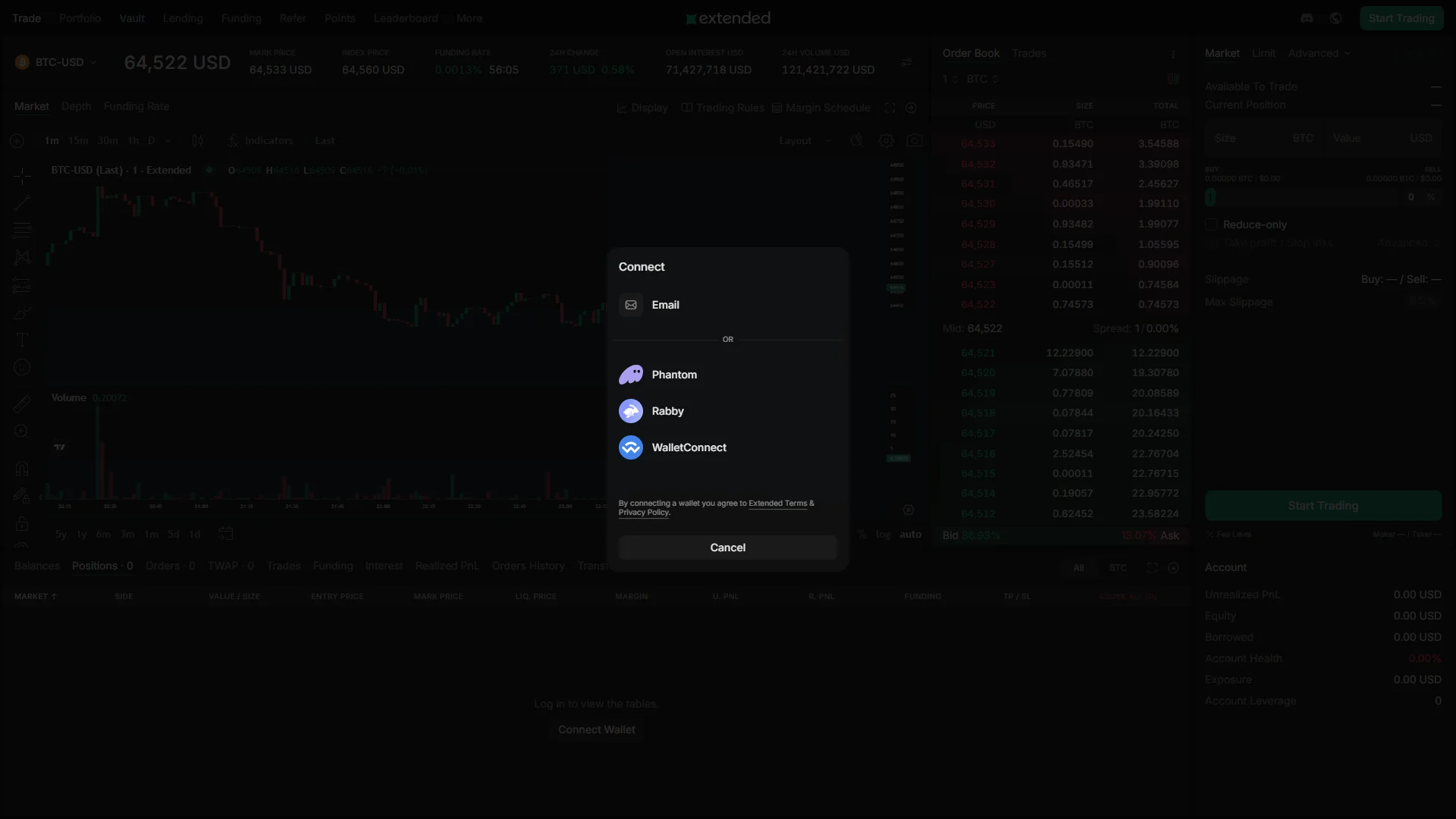
Pick your method in the “Connect” modal: “Email” signs you in with an email address, while “Phantom”, “Rabby” and “WalletConnect” hand off to a wallet. The note under the list says that connecting a wallet means accepting Extended’s terms and privacy policy, so open those links first if you want to read them.
4. Approve the connection in your wallet
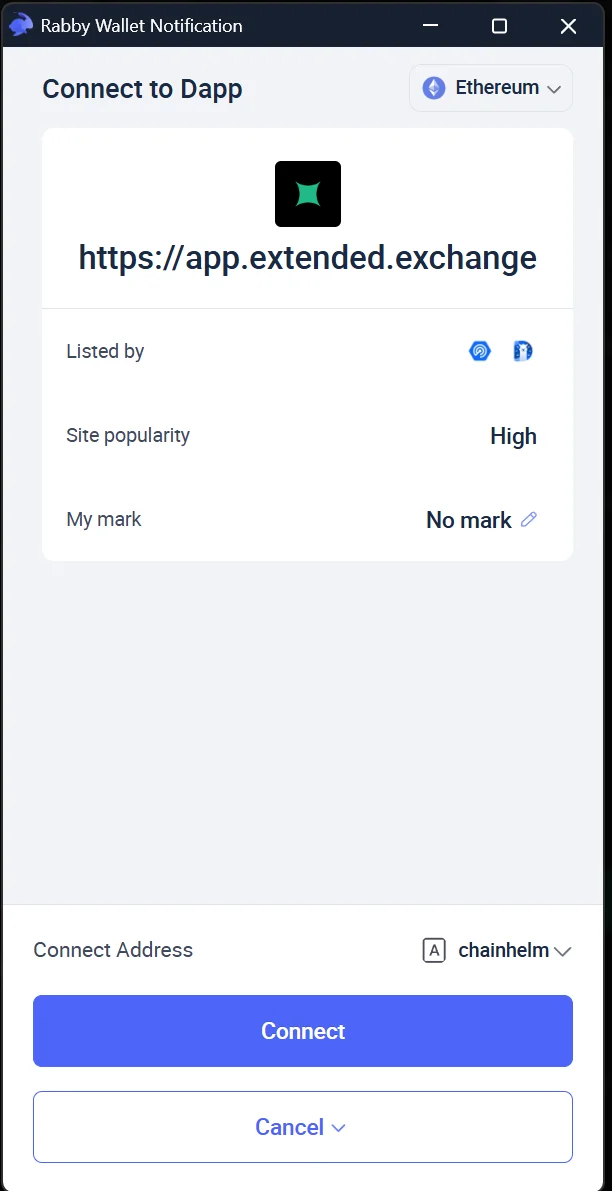
Click “Connect” in the “Connect to Dapp” window your wallet opens, after checking that the site it names is https://app.extended.exchange. Approving here is what links the wallet to Extended, so cancel instead if the window names any other site.
5. Send the two signature requests
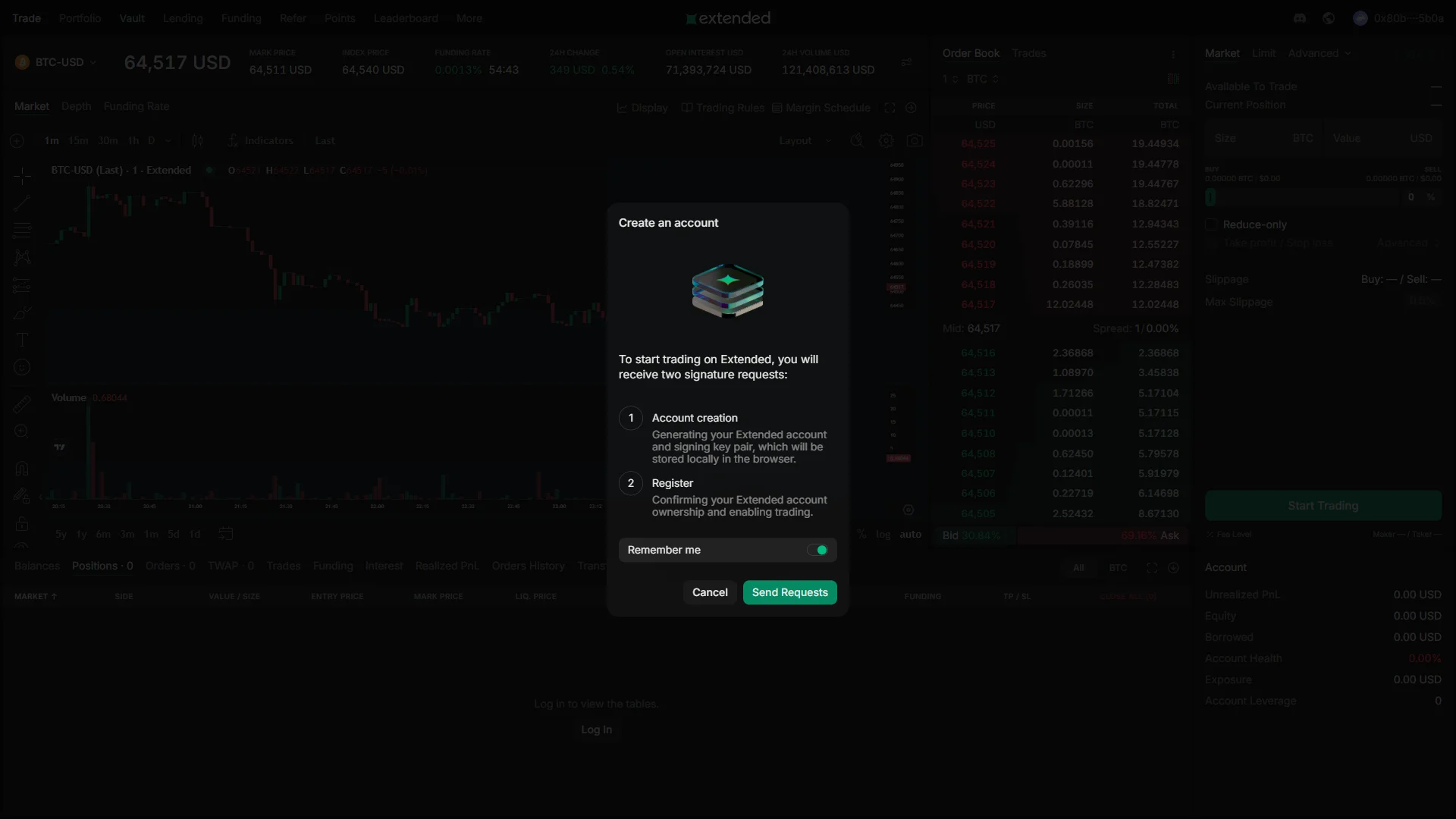
Click “Send Requests” in the “Create an account” dialog to trigger the two signatures it describes: “Account creation” generates your Extended account and a signing key pair kept locally in the browser, and “Register” confirms ownership of that account and enables trading.
Turn “Remember me” off before you send if you would rather not stay signed in, then keep the wallet in reach — each request has to be approved there.
6. Sign the account creation request
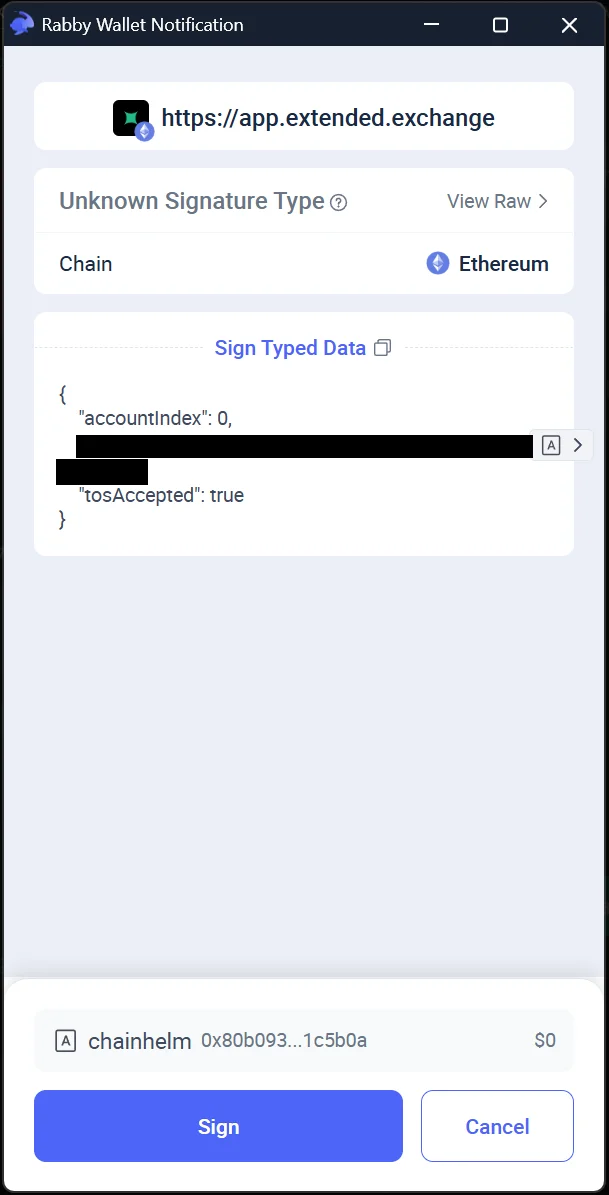
Click “Sign” in the wallet window that shows the “Sign Typed Data” payload for the first request. Read the payload before you press: it is account data with “tosAccepted” set to true, with no amount and no fee attached.
7. Confirm the first signature
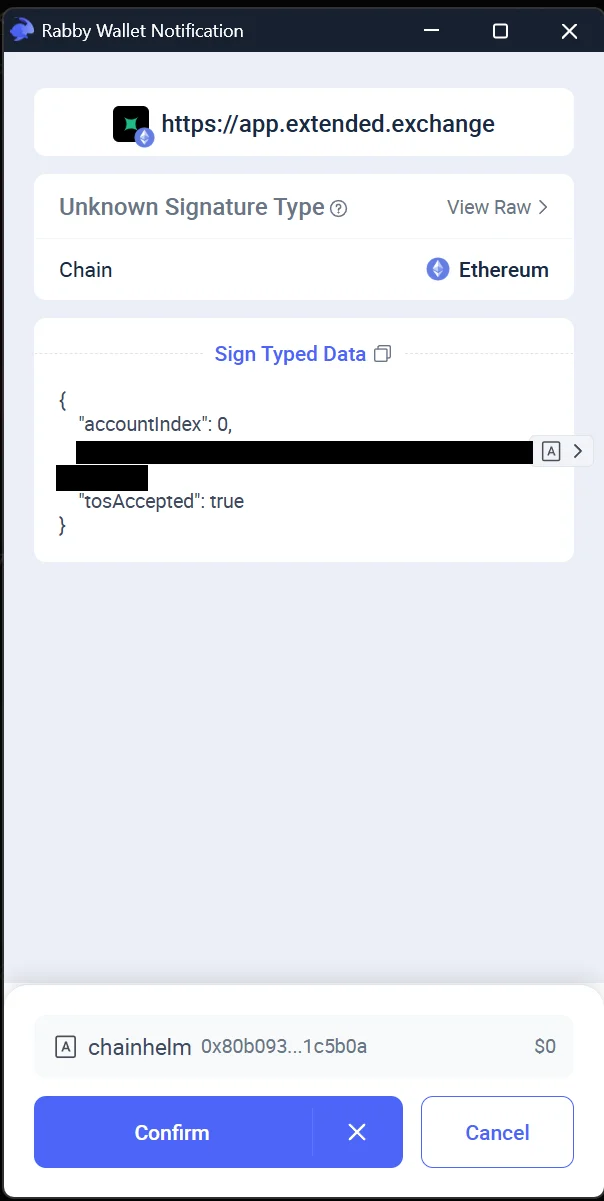
Click “Confirm” once the wallet swaps that button in for “Sign”. Nothing in the payload changes at this stage, so give it a last read — this press is what releases the signature.
8. Sign the register request
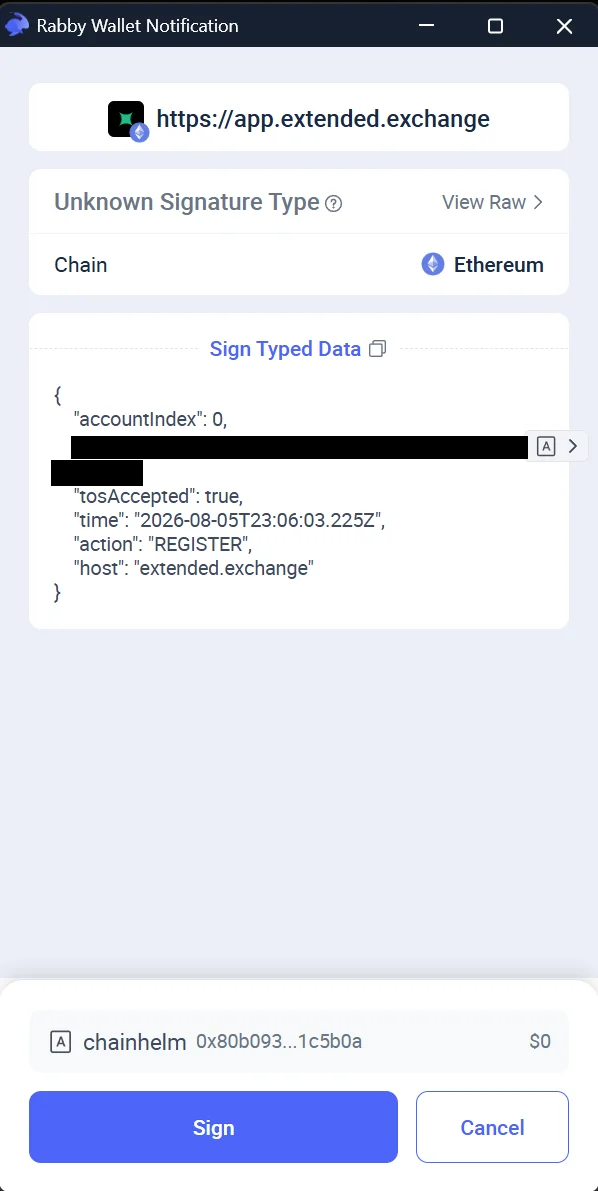
Click “Sign” on the second request, whose payload reads “action”: “REGISTER”. Check that the host in the payload is extended.exchange before you press, since this signature is what registers the account.
9. Confirm the register signature
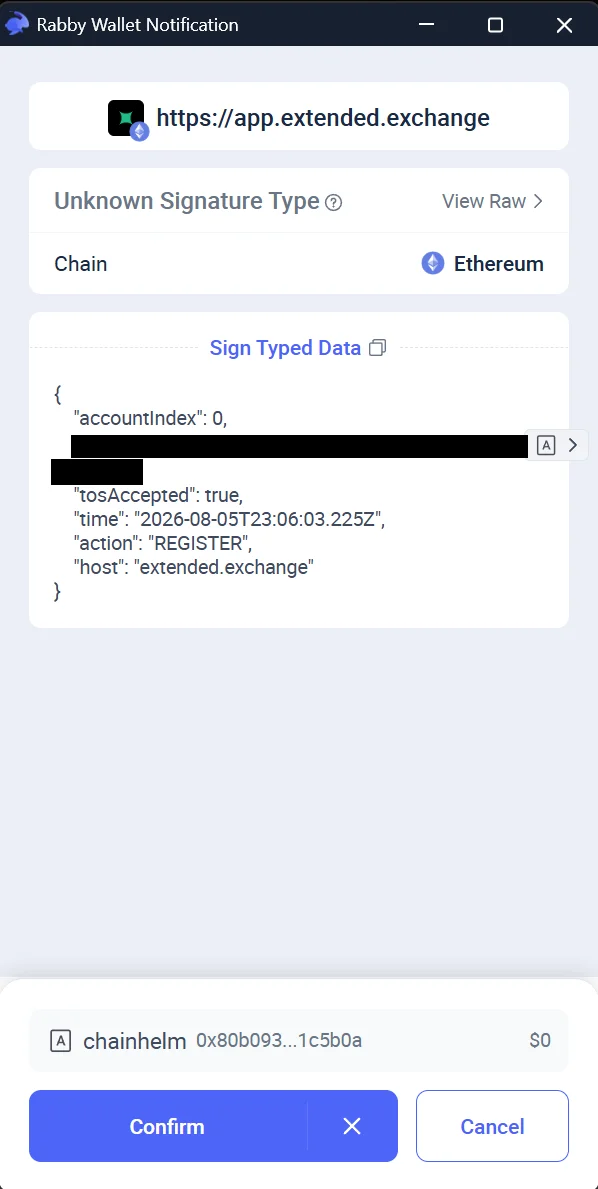
Click “Confirm” to release the second signature. The “REGISTER” payload is unchanged from the sign stage, so this press only sends what you already checked.
10. Wait for the second signature to clear
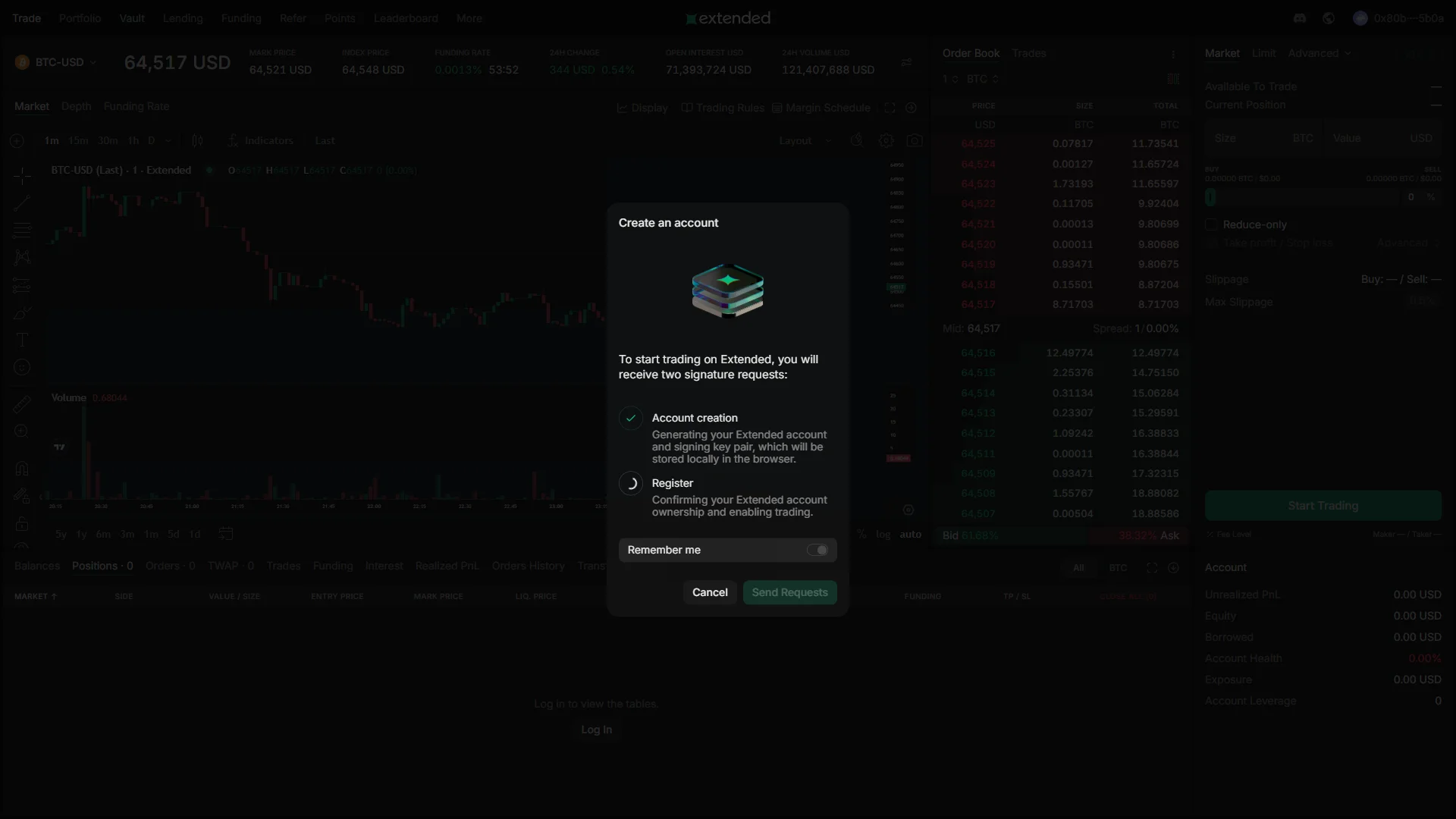
Watch the “Create an account” dialog while the wallet works: “Account creation” already carries a check mark and “Register” is still running. Leave the page as it is until the second request clears — there is nothing to click here.
11. Confirm the referral code is active
Click “Got it” to close the “Code Activated” modal once you have read what it shows: the code chip “CHAINHELM” and the line “Enjoy your 10% fees discount for the first $50M of trading volume.” Look for the “Wallet connected!” toast in the corner as well, which confirms the wallet is now tied to the account.
Smartphone (iOS / Android) connection steps
1. First, open the Extended official page in your mobile browser or your wallet app’s in-app browser (the link applies the referral code). When you open it, you’ll see a screen like the one below.
2. Connect from the referral invitation
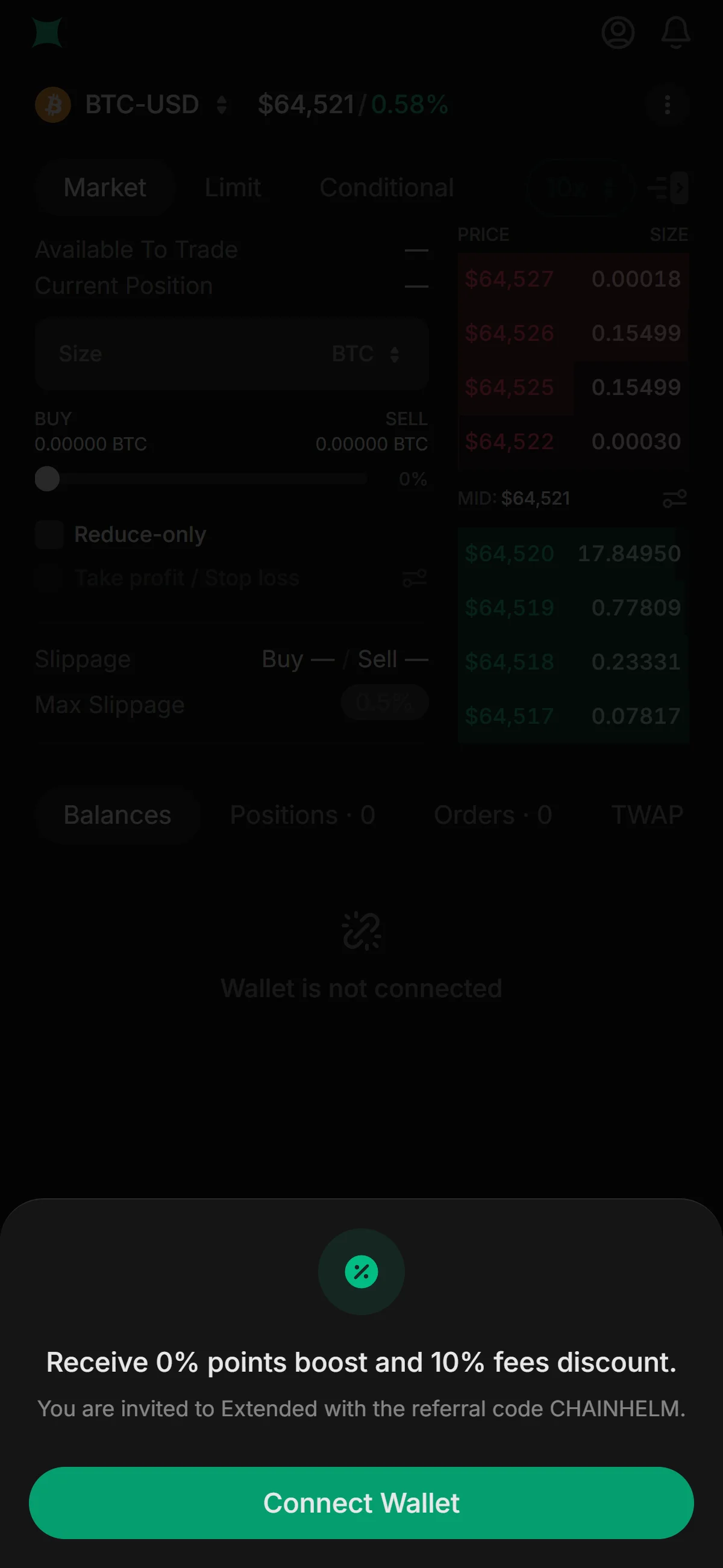
Tap “Connect Wallet” at the foot of the invitation sheet that slides up over the trade screen. The sheet reads “You are invited to Extended with the referral code CHAINHELM.” under “Receive 0% points boost and 10% fees discount.” — check the code before you tap.
3. Choose how you connect
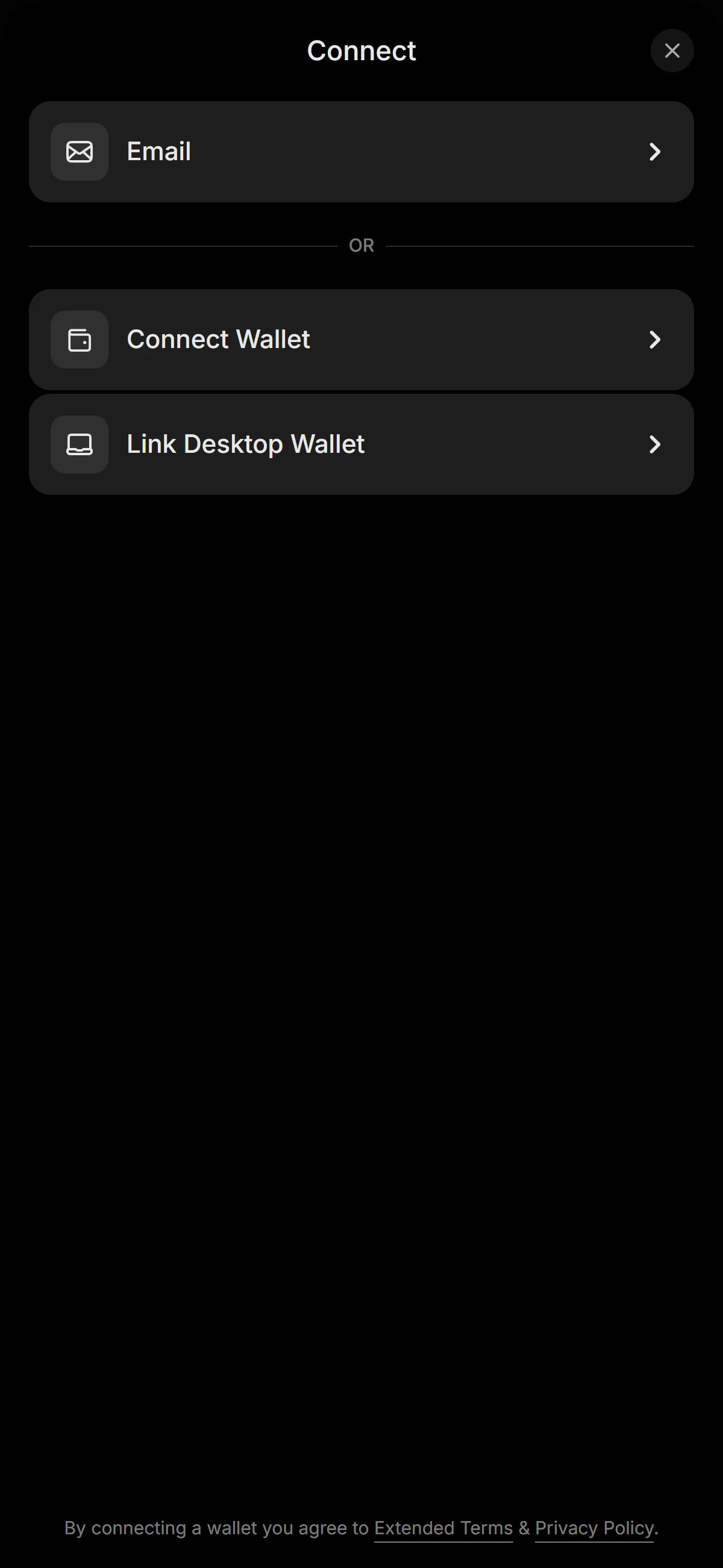
Tap “Connect Wallet” on the “Connect” sheet to reach the wallet list; “Email” signs you in with an email address instead, and “Link Desktop Wallet” pairs a wallet you already use on a computer. The line at the bottom of the sheet says that connecting a wallet means accepting Extended’s terms and privacy policy, so read those before you choose.
4. Pick your wallet from the list
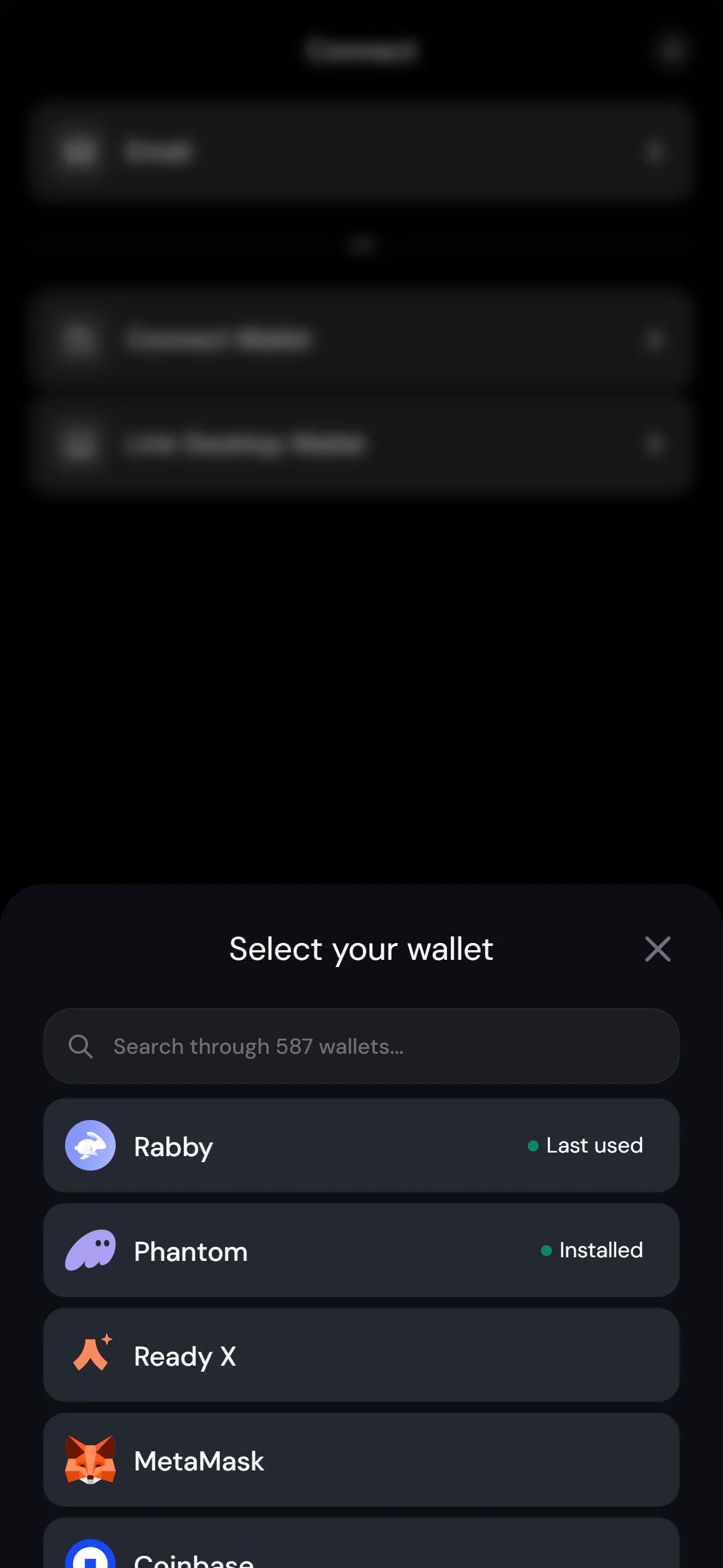
Tap “Rabby” in the “Select your wallet” list, or type into “Search through 587 wallets…” to find a different one. Look for the “Last used” marker to land straight on the wallet you connected before.
5. Hand off to the wallet app
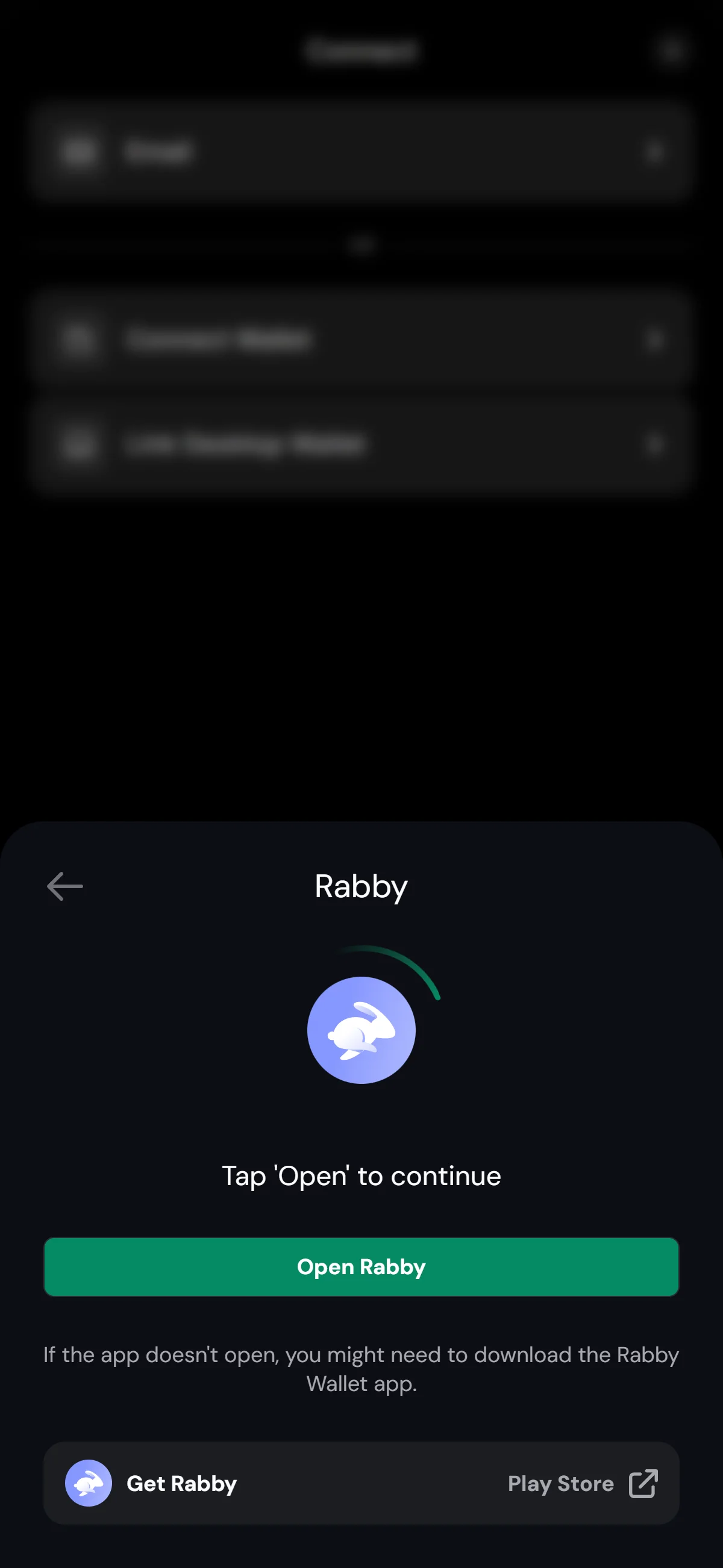
Tap “Open Rabby” on the sheet that reads “Tap ‘Open’ to continue”, then approve the connection in the wallet app that comes up. If nothing opens, use the “Get Rabby” row underneath, which points to the Play Store when the wallet app is not installed yet.
6. Send the two signature requests
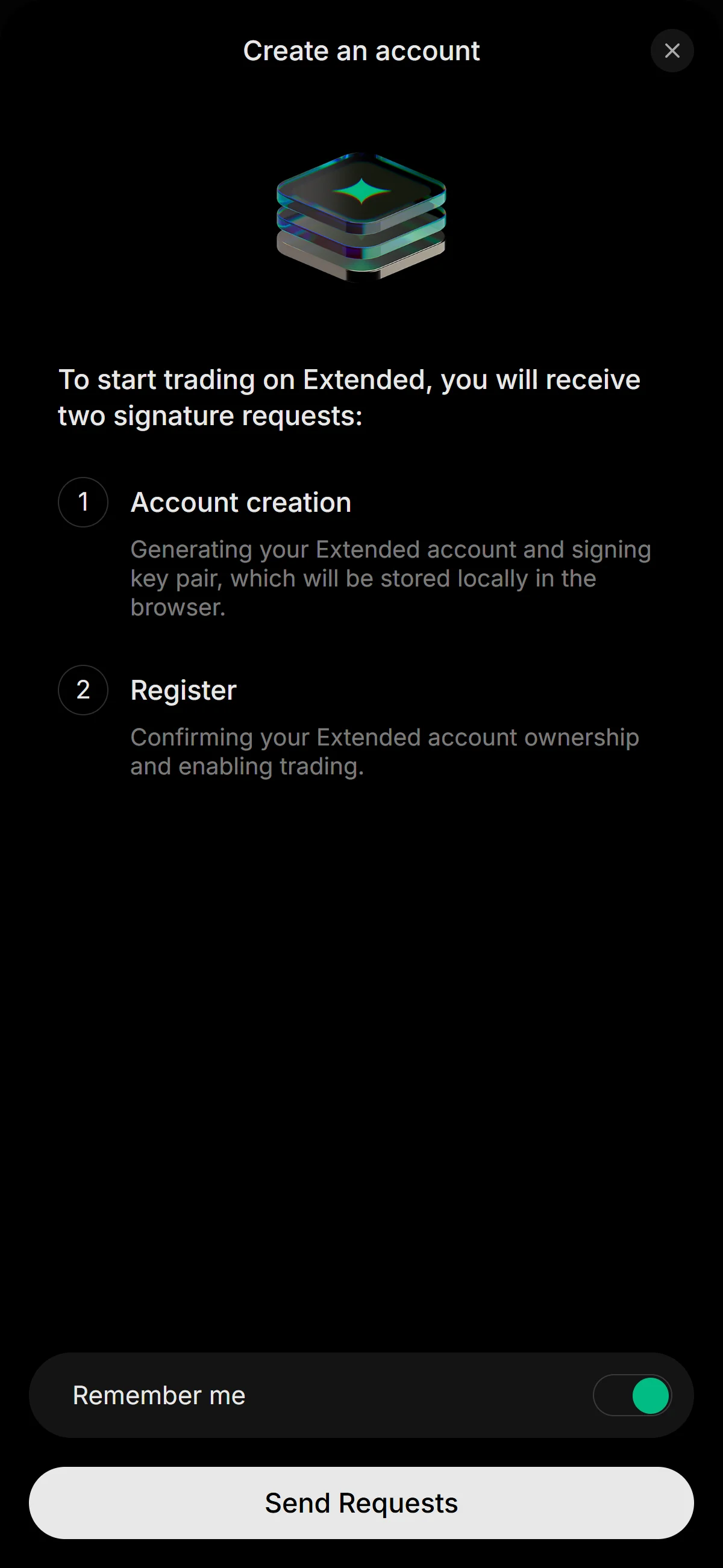
Tap “Send Requests” on the “Create an account” screen to trigger the two signatures it describes: “Account creation” generates your Extended account and a signing key pair kept locally in the browser, and “Register” confirms ownership of that account and enables trading.
Switch “Remember me” off first if you would rather not stay signed in, then approve each request in the wallet app as it comes up.
7. Wait for the second signature to clear
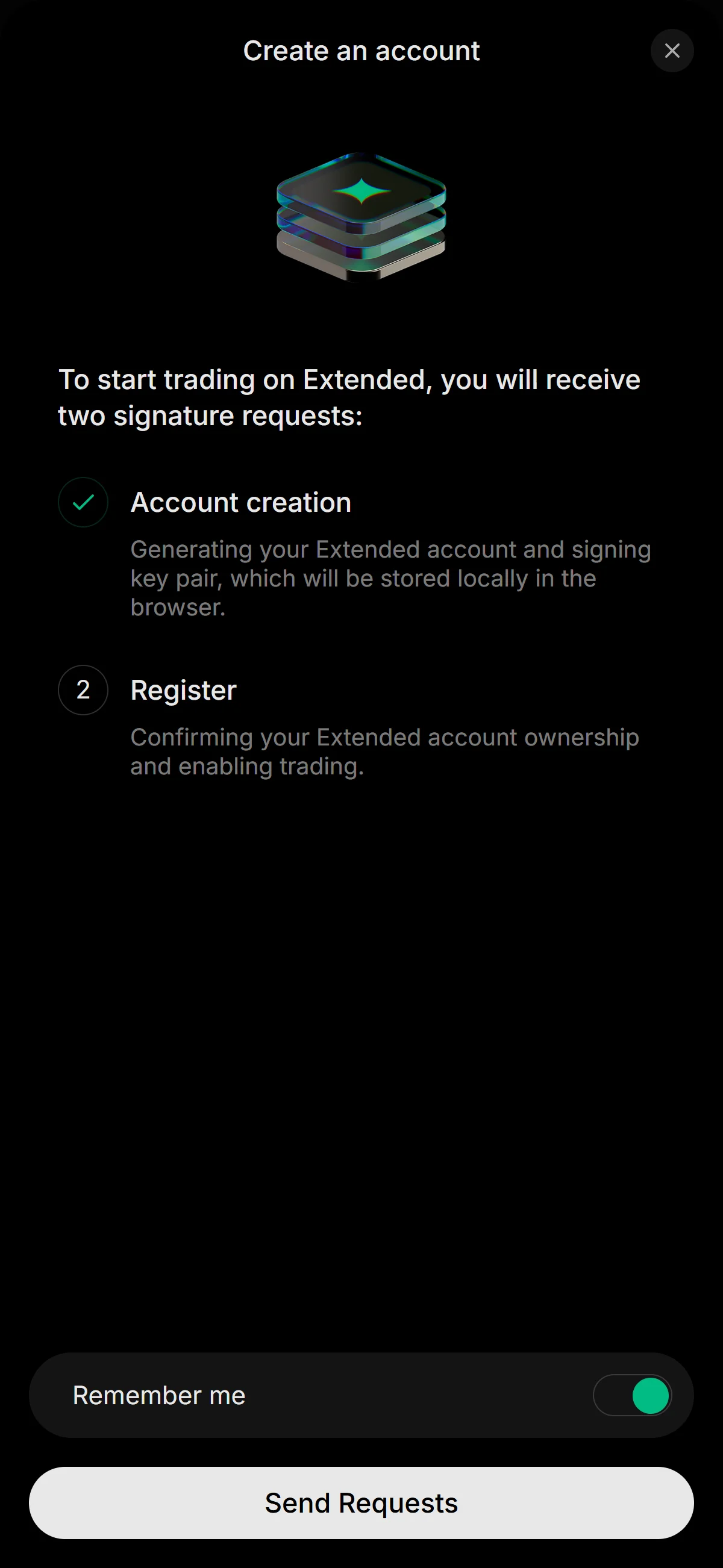
Keep the “Create an account” screen open while the wallet works: “Account creation” now carries a check mark and “Register” is still pending. There is nothing to tap until the second request clears.
8. Confirm the referral code is active
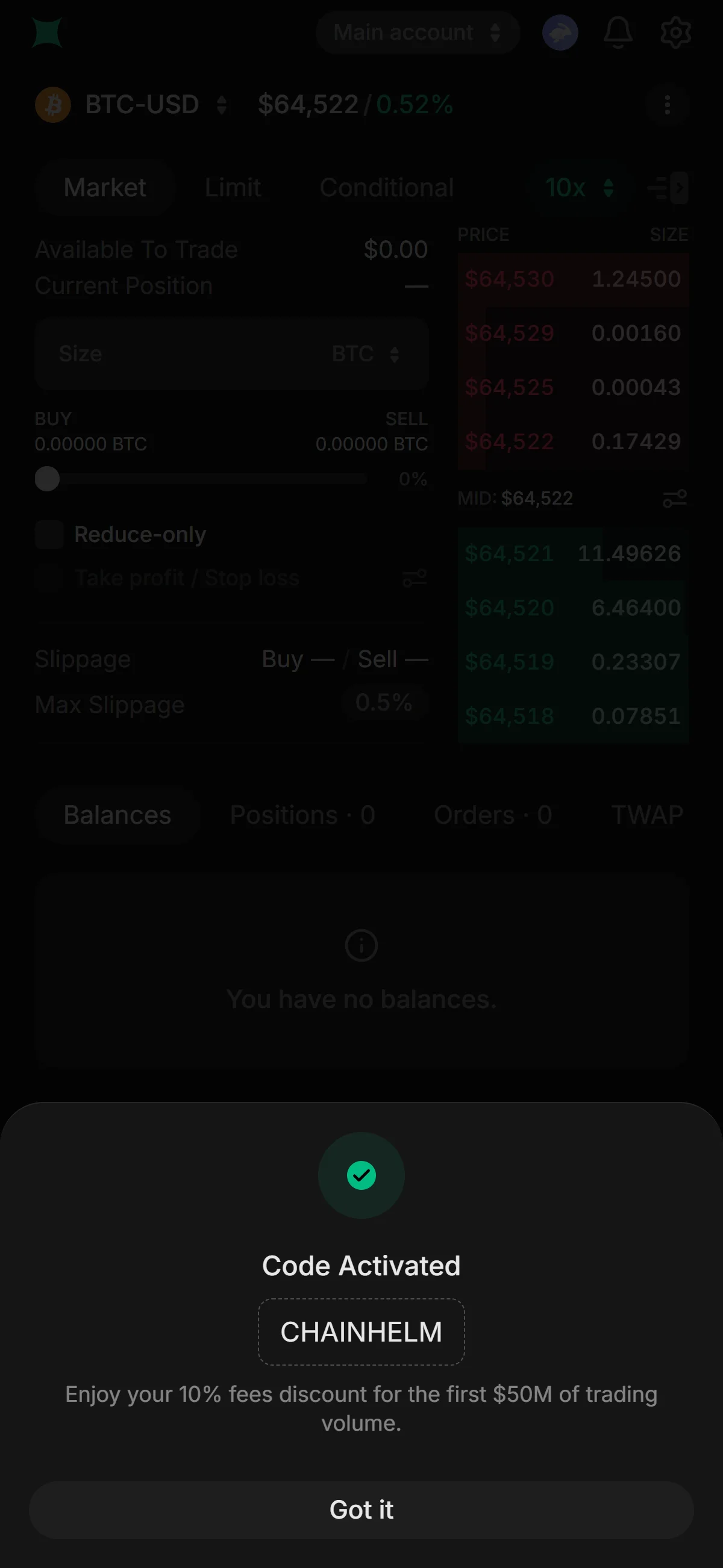
Tap “Got it” to close the “Code Activated” sheet after reading it: the chip reads “CHAINHELM” and the line under it reads “Enjoy your 10% fees discount for the first $50M of trading volume.” Check the top of the screen too, where the account switcher now reads “Main account” with the connected wallet beside it.
What to do after connecting to Extended
We cover the deposit process separately for PC/browser and smartphone (mobile).
PC/browser deposit steps
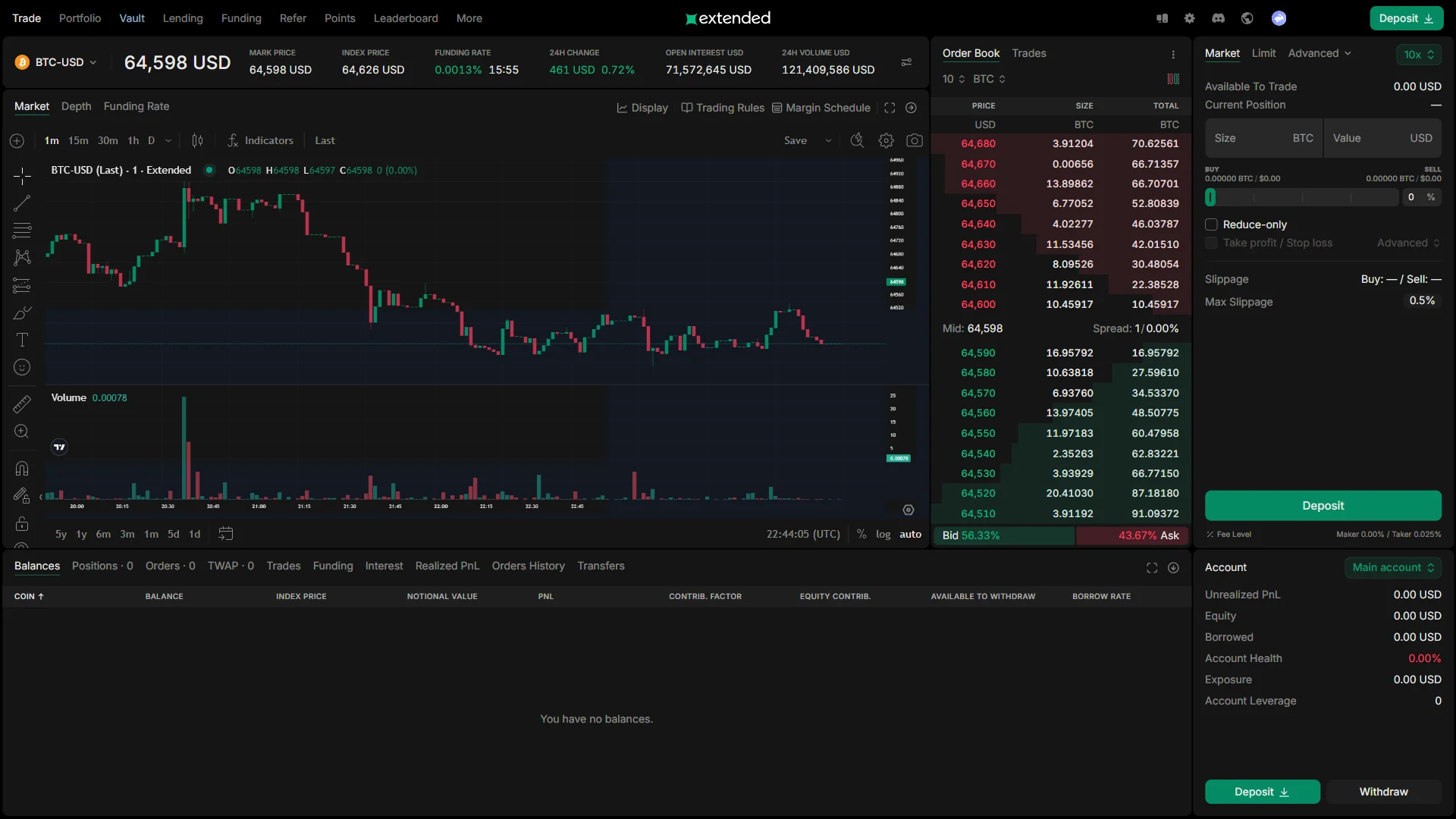
Click “Deposit” on the trade page to open the deposit form. Expect the “Balances” tab to read “You have no balances.” until this first deposit lands.
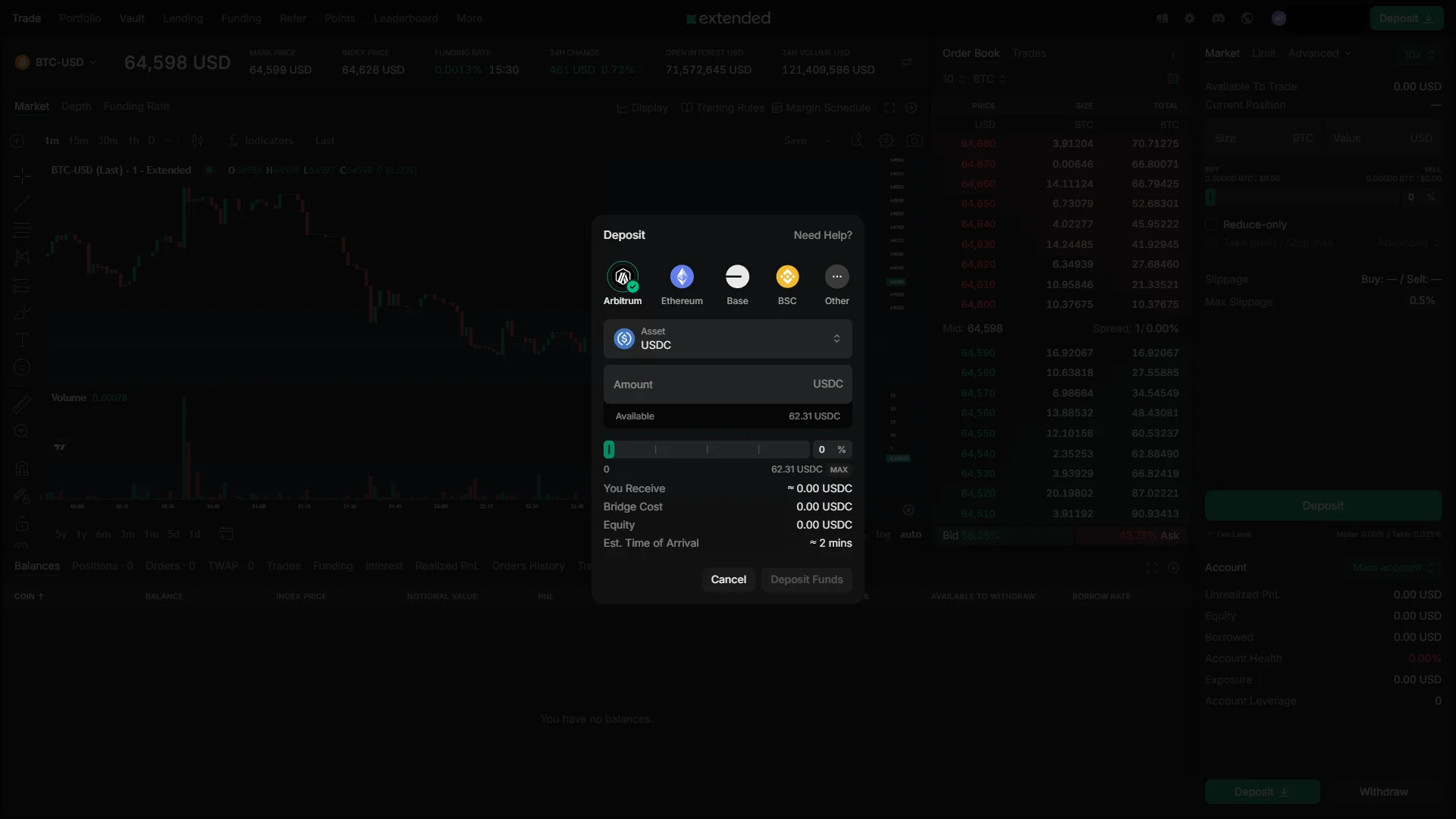
In the “Deposit” form, pick the chain your funds are on — “Arbitrum” comes preselected, with “Ethereum”, “Base”, “BSC” and “Other” beside it — and leave “Asset” on “USDC”. Check “Available” for what the connected wallet holds on that chain; “You Receive” and “Bridge Cost” stay at zero until you fill in “Amount”, while “Est. Time of Arrival” already puts the bridge at about two minutes.
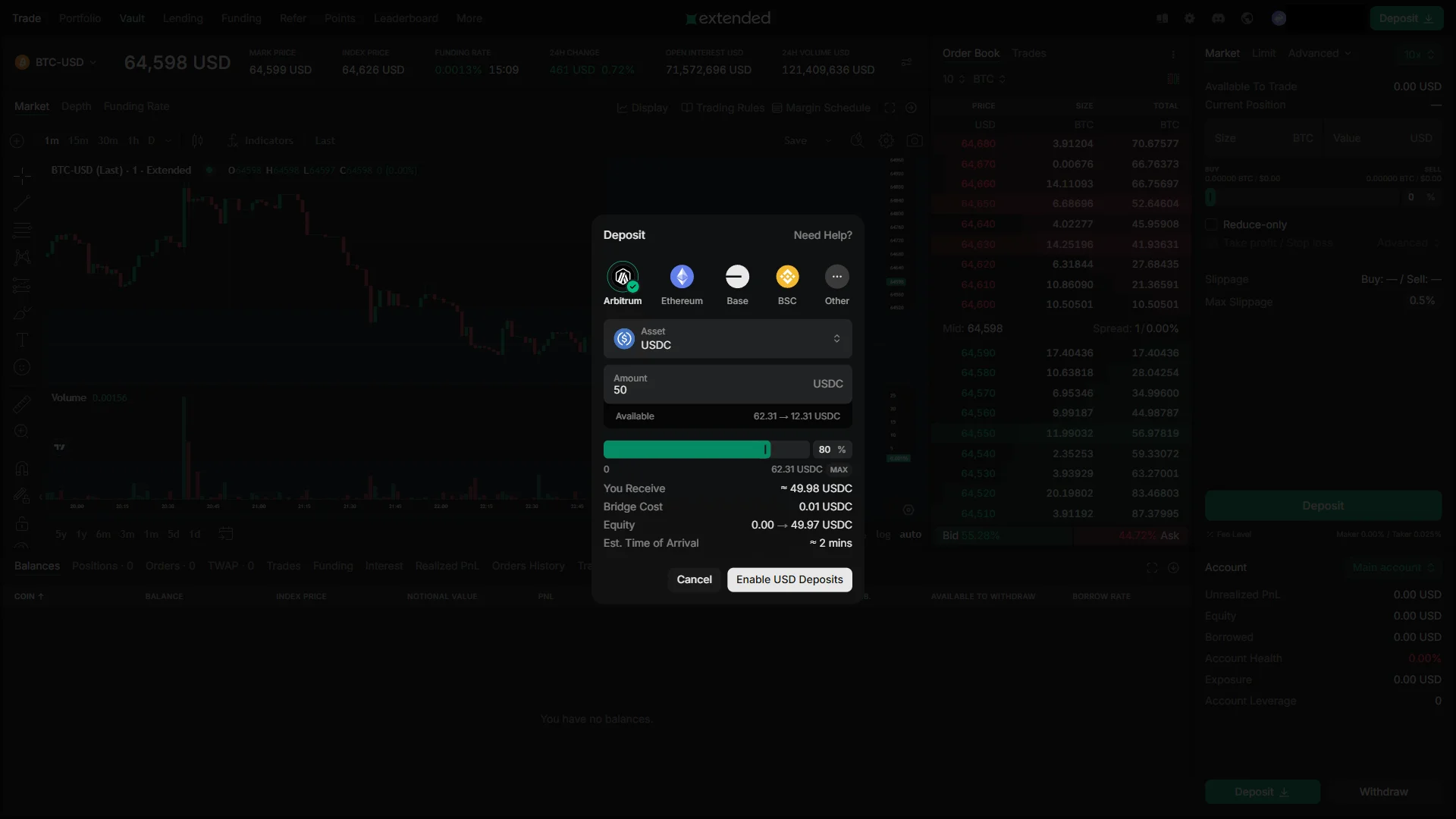
Type the figure into “Amount” — 50 USDC here — or drag the percentage slider, then click “Enable USD Deposits”. Check “You Receive” and “Equity” first, since they show what actually reaches the account once “Bridge Cost” is taken off.
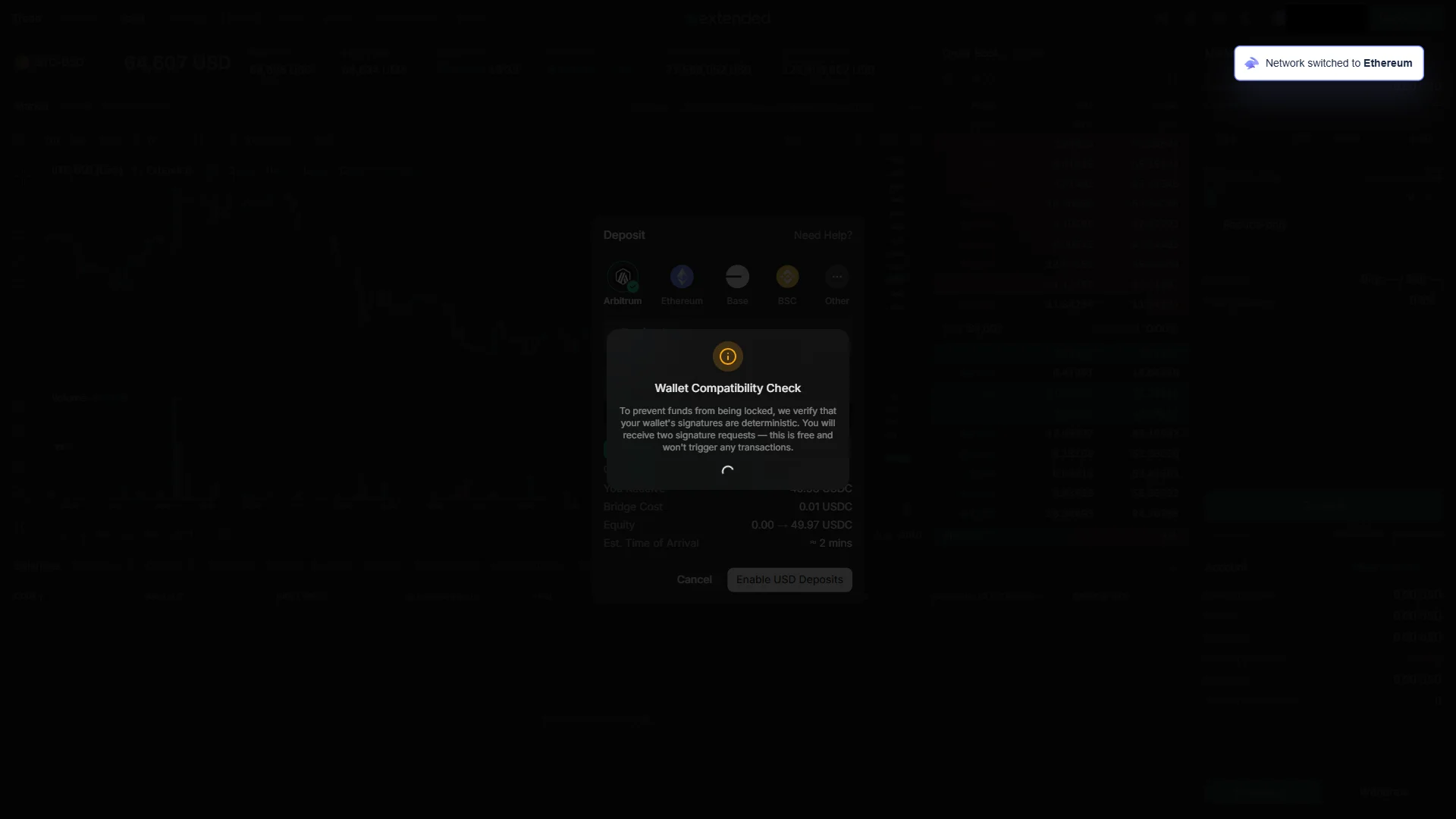
Leave the “Wallet Compatibility Check” notice to load and keep your wallet in reach. It explains that Extended verifies your wallet’s signatures are deterministic so funds cannot end up locked, and that the two requests it sends are free and trigger no transactions.
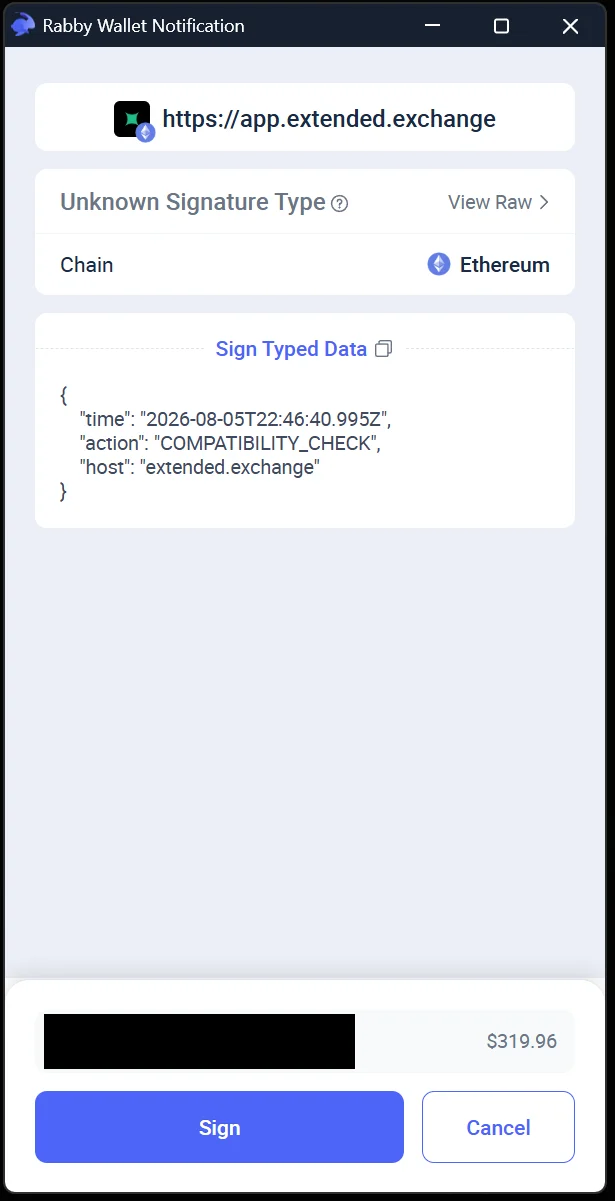
Click “Sign” on the first of those two requests, whose payload reads “action”: “COMPATIBILITY_CHECK”. Read it before you press: a timestamp and the host extended.exchange, with no amount and no contract call.
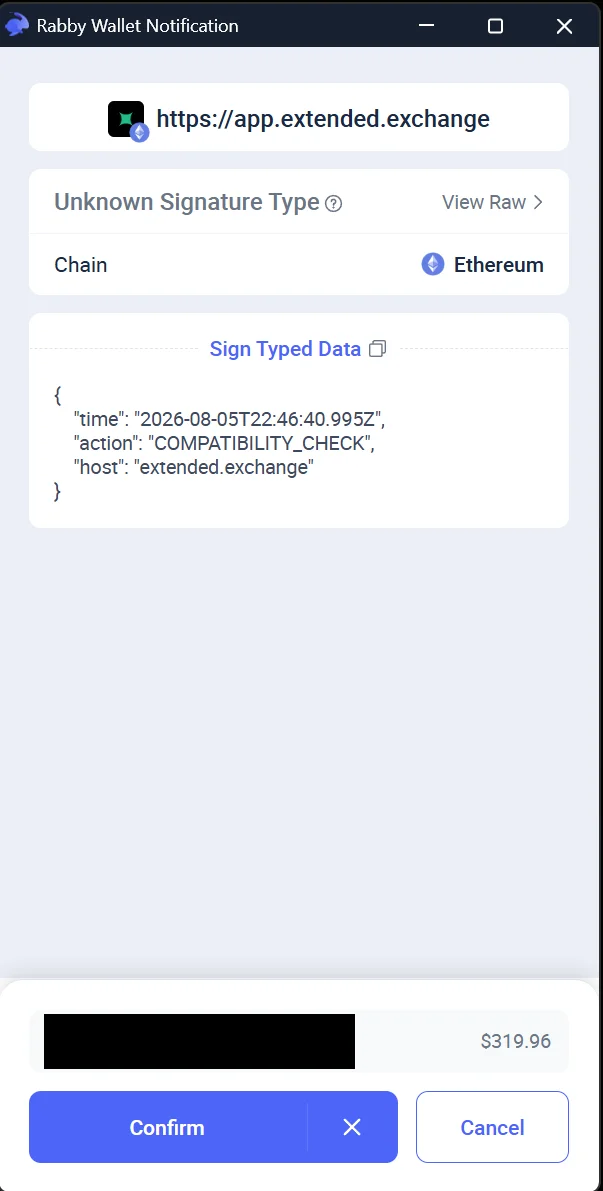
Click “Confirm” to release that signature. The payload is unchanged from the sign stage, so this press only sends what you already checked.
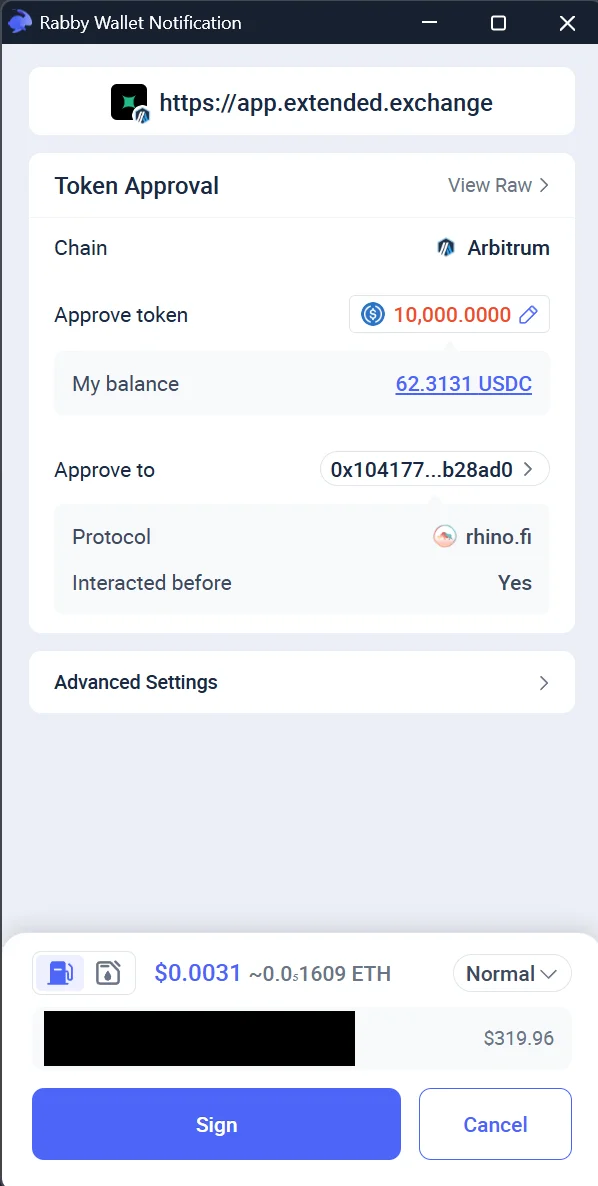
Click “Sign” on the “Token Approval” request that lets the bridge move your USDC. Check where it points before you press: “Approve to” resolves to the “rhino.fi” protocol, “My balance” shows your current USDC, and the “Approve token” figure is the allowance you grant — edit it down if you want a tighter limit.
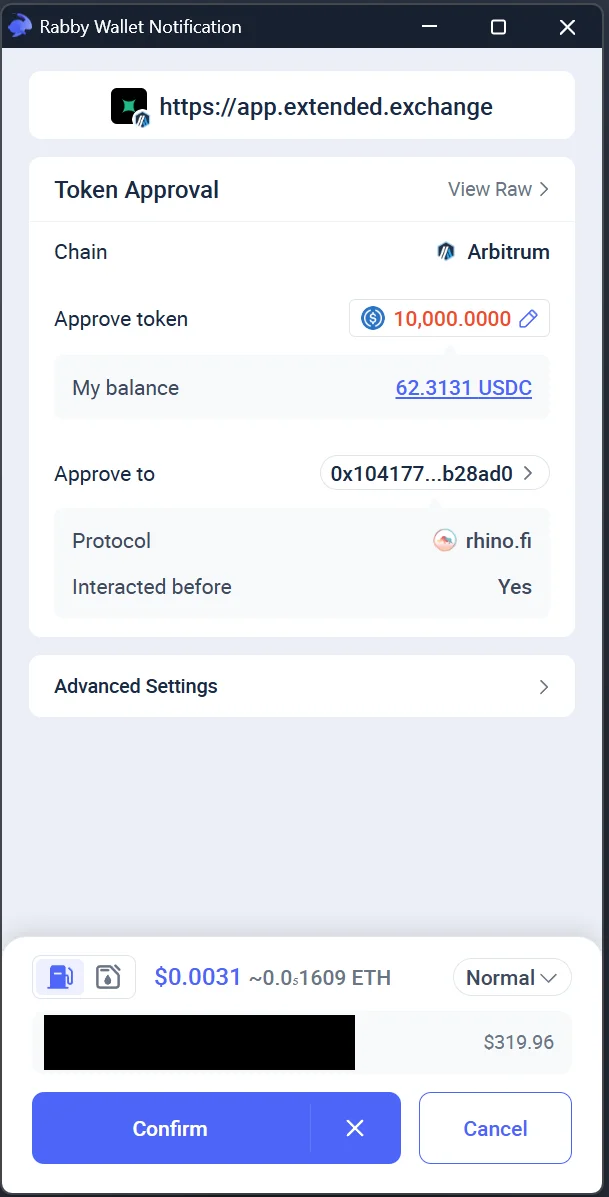
Click “Confirm” to send the approval. This one is an on-chain transaction, so check the gas estimate the wallet shows above the buttons before you press.
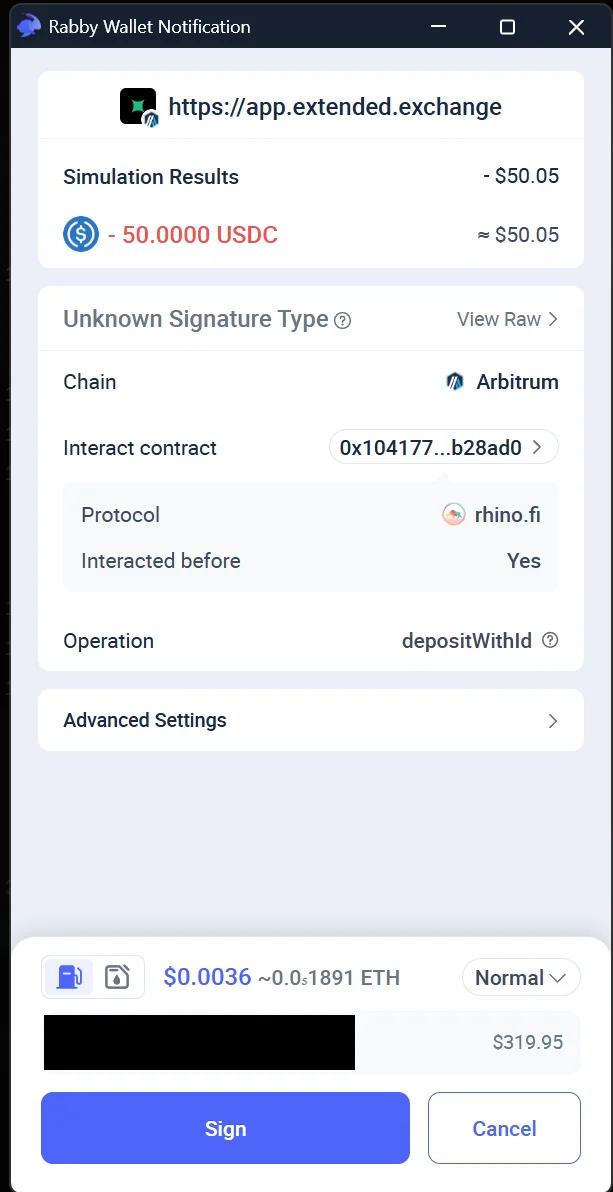
Click “Sign” on the deposit transaction itself. Compare “Simulation Results” at the top with the amount you entered first — it previews 50.0000 USDC leaving the wallet through the “depositWithId” call.
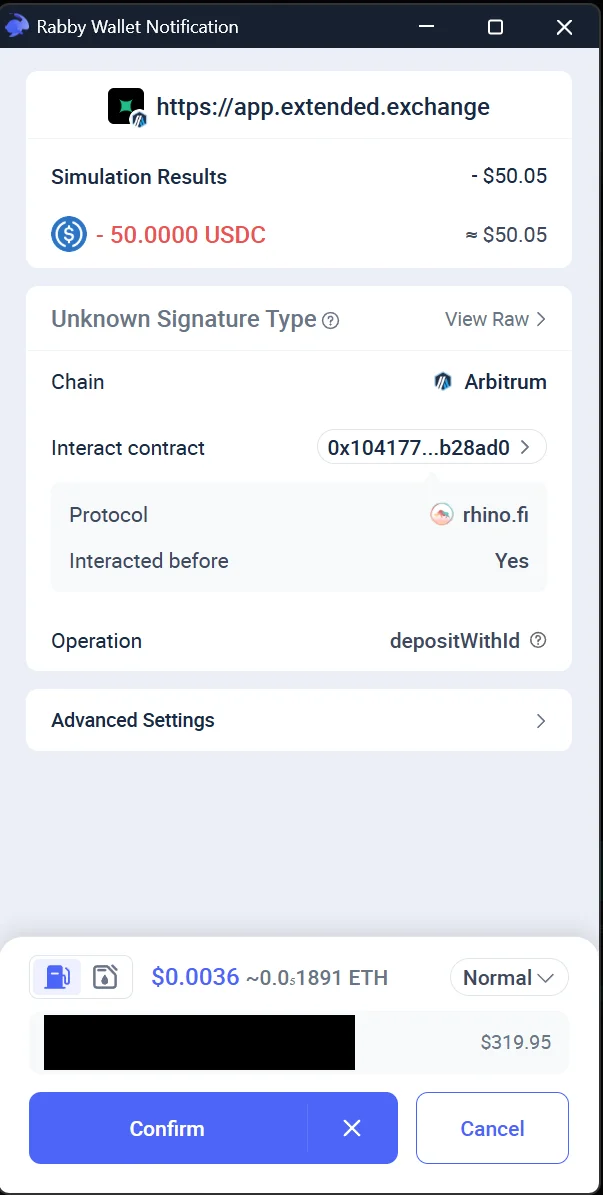
Click “Confirm” to broadcast the deposit. Take a last look at the simulation and the gas estimate here, because after this press the transaction is on its way.
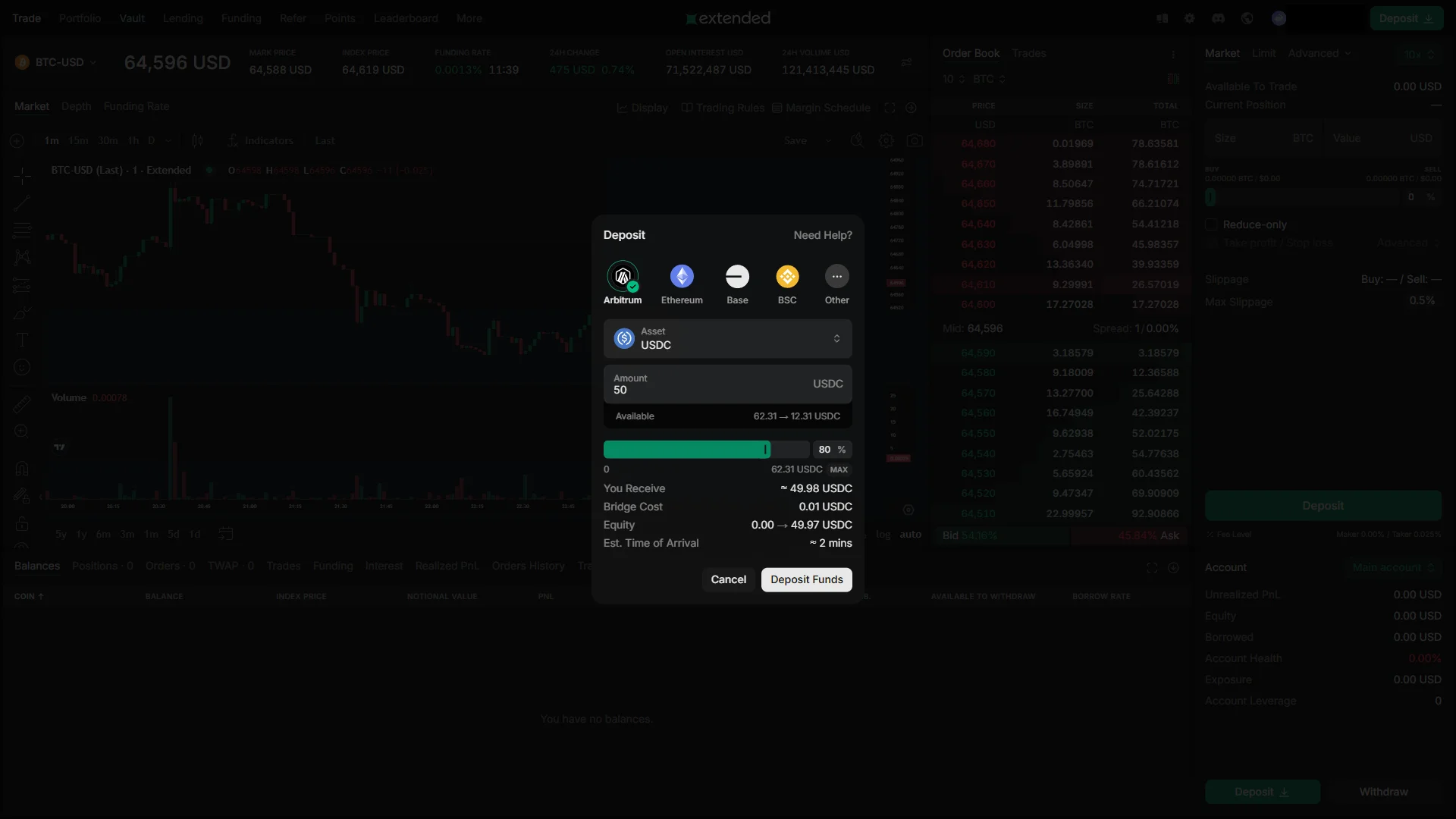
Back on the deposit form, click “Deposit Funds” — the button is active now that the approval has gone through. The amount and the “You Receive” figure are unchanged from what you entered, so the deposit goes out exactly as reviewed.
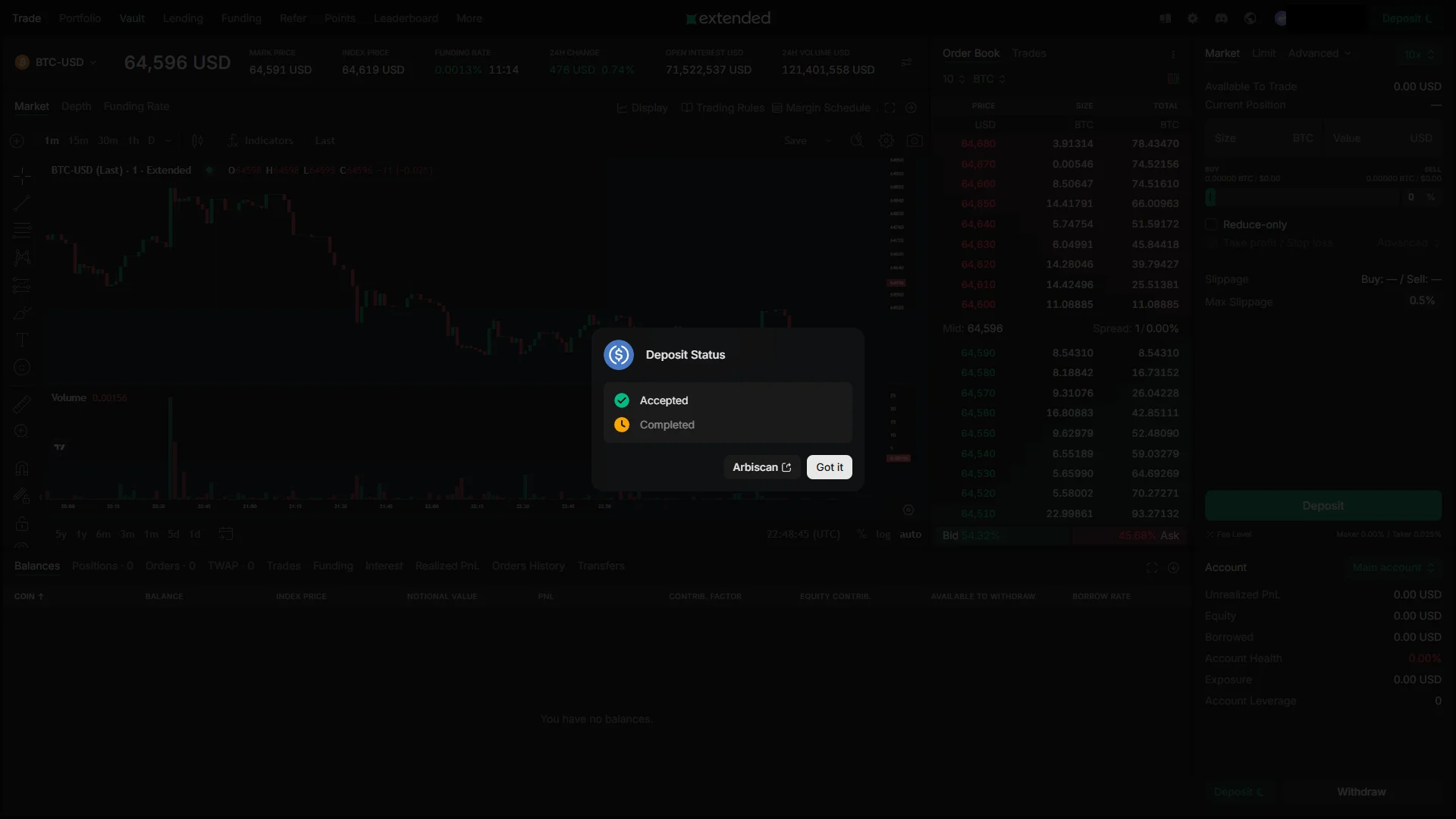
Leave the “Deposit Status” window open and wait: “Accepted” is ticked while “Completed” still shows a clock. Click “Arbiscan” if you want to follow the transaction in the block explorer, or “Got it” to close the window — neither changes a deposit already on its way.
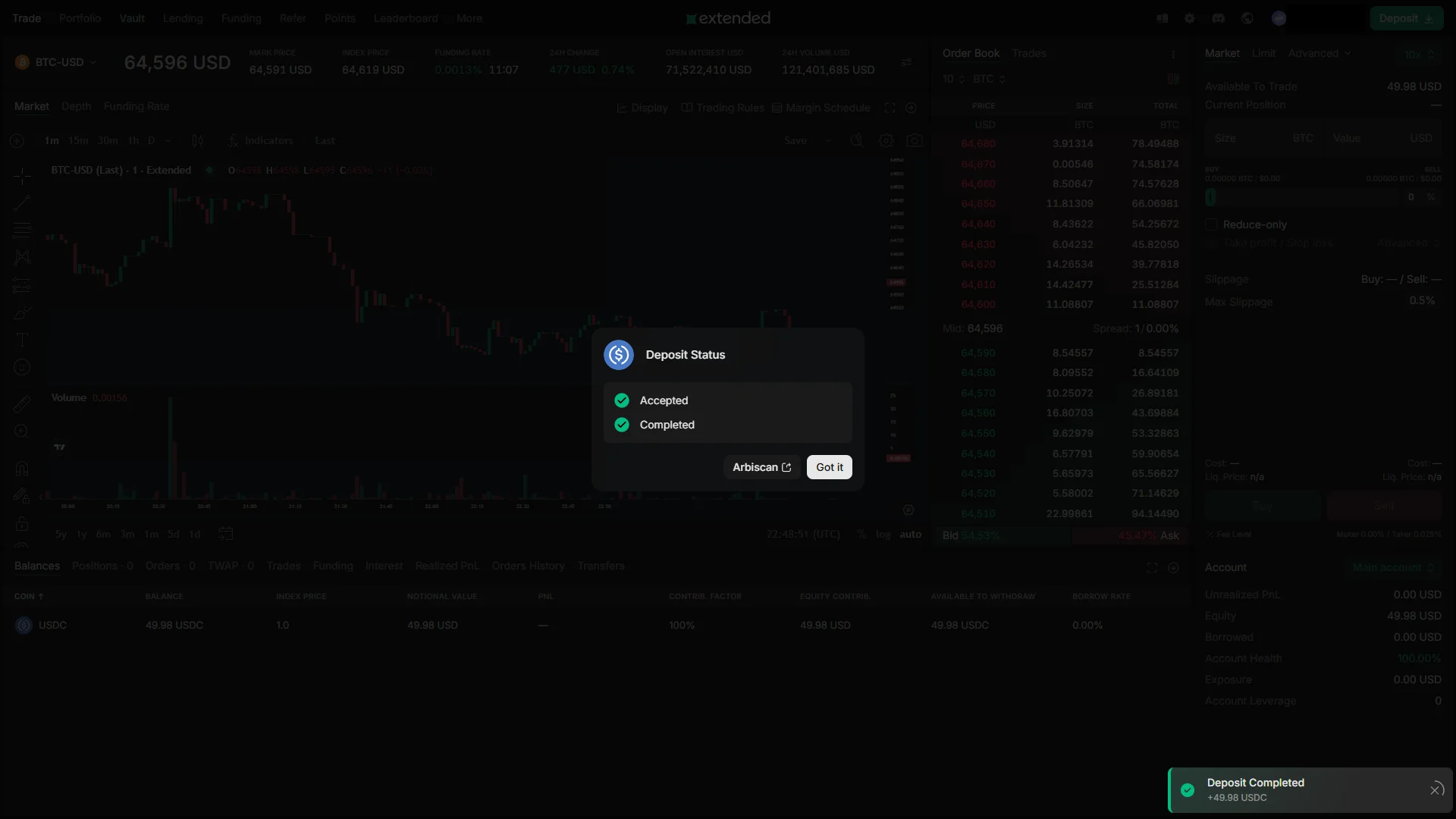
Close the “Deposit Status” window with “Got it” once “Completed” is ticked alongside “Accepted”. Read the “Deposit Completed” toast for the credited amount, which the account balance picks up at the same time.
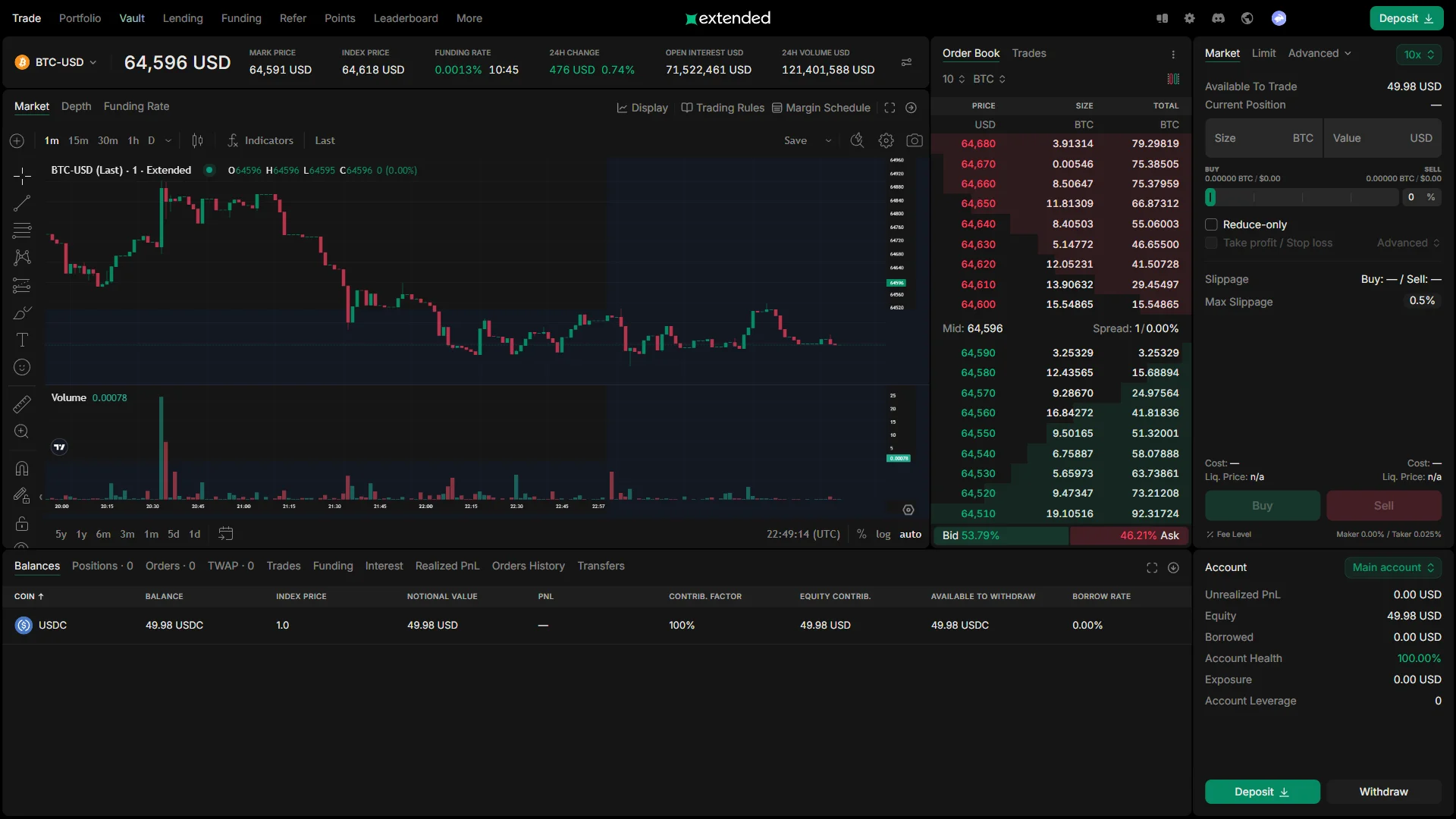
Check the “Balances” tab on the trade page: the “USDC” row now carries the deposited amount, and “Available To Trade” in the order panel reads the same figure. That figure is the margin the account can use.
Smartphone (iOS / Android) deposit steps
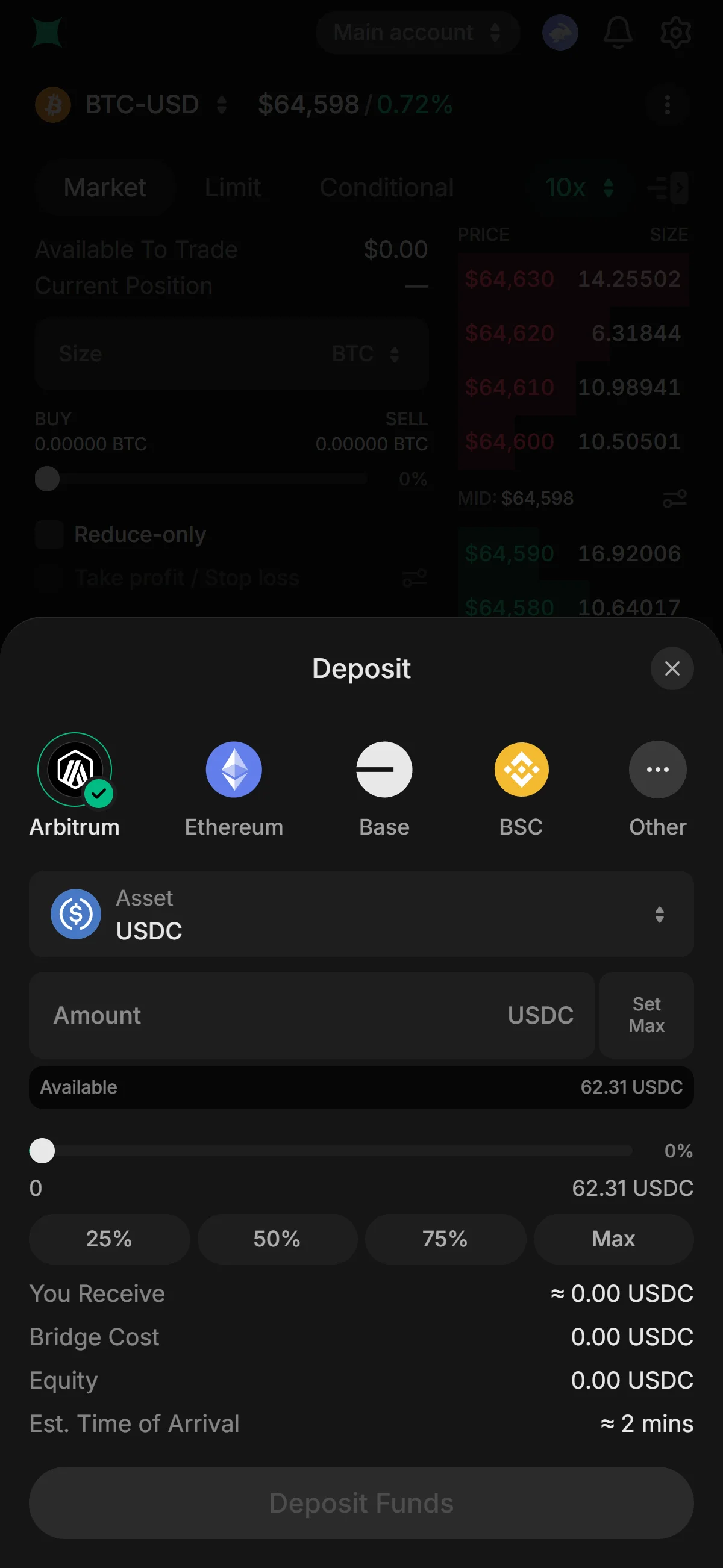
On the “Deposit” sheet, tap the chain your funds are on — “Arbitrum” comes preselected, with “Ethereum”, “Base”, “BSC” and “Other” beside it — and leave “Asset” on “USDC”. Check “Available” for what the connected wallet holds on that chain; “You Receive” and “Bridge Cost” stay at zero until “Amount” is filled in, while “Est. Time of Arrival” already puts the bridge at about two minutes.
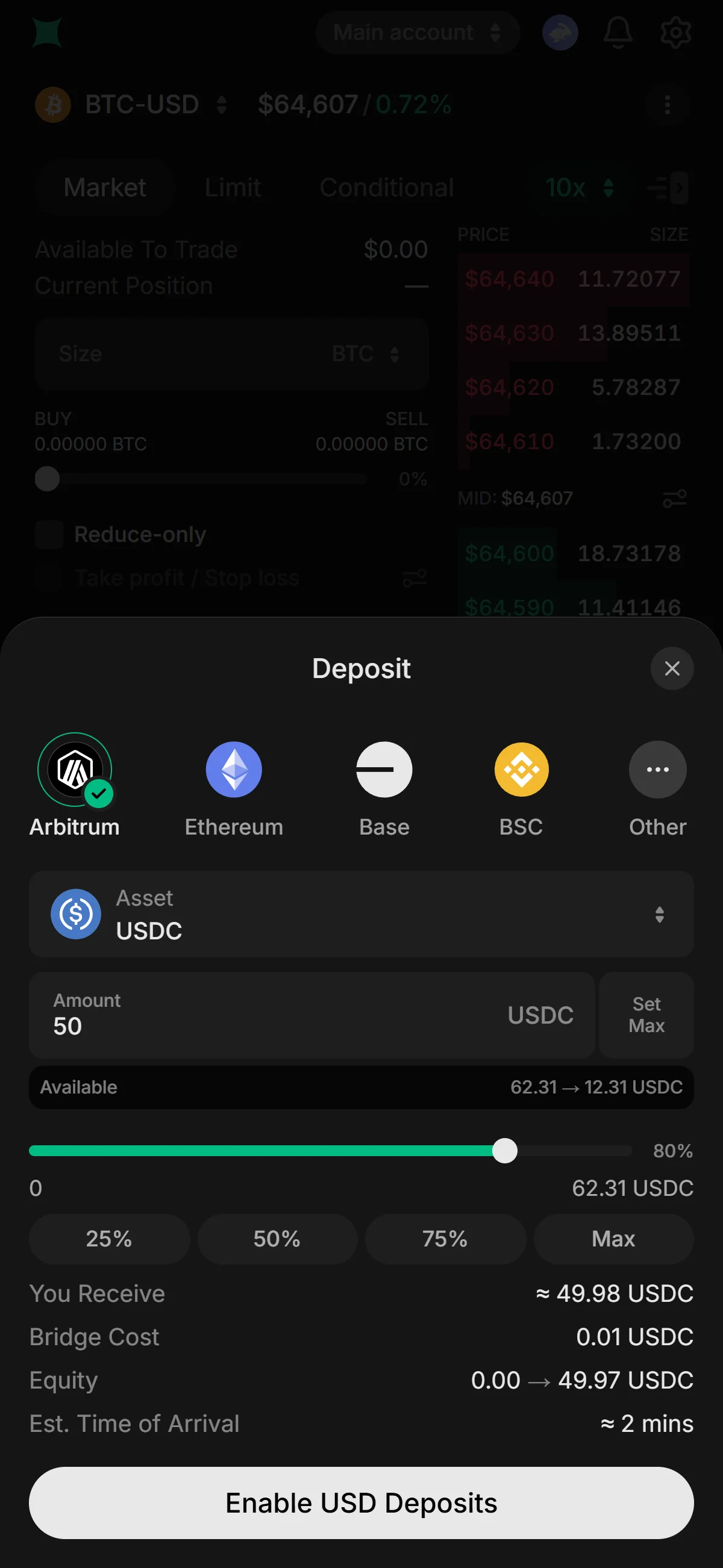
Enter the figure in “Amount” — 50 USDC here — or tap one of the “25%”, “50%”, “75%” and “Max” chips, then tap “Enable USD Deposits”. Check “You Receive” and “Equity” first, since they show what actually reaches the account once “Bridge Cost” is taken off.
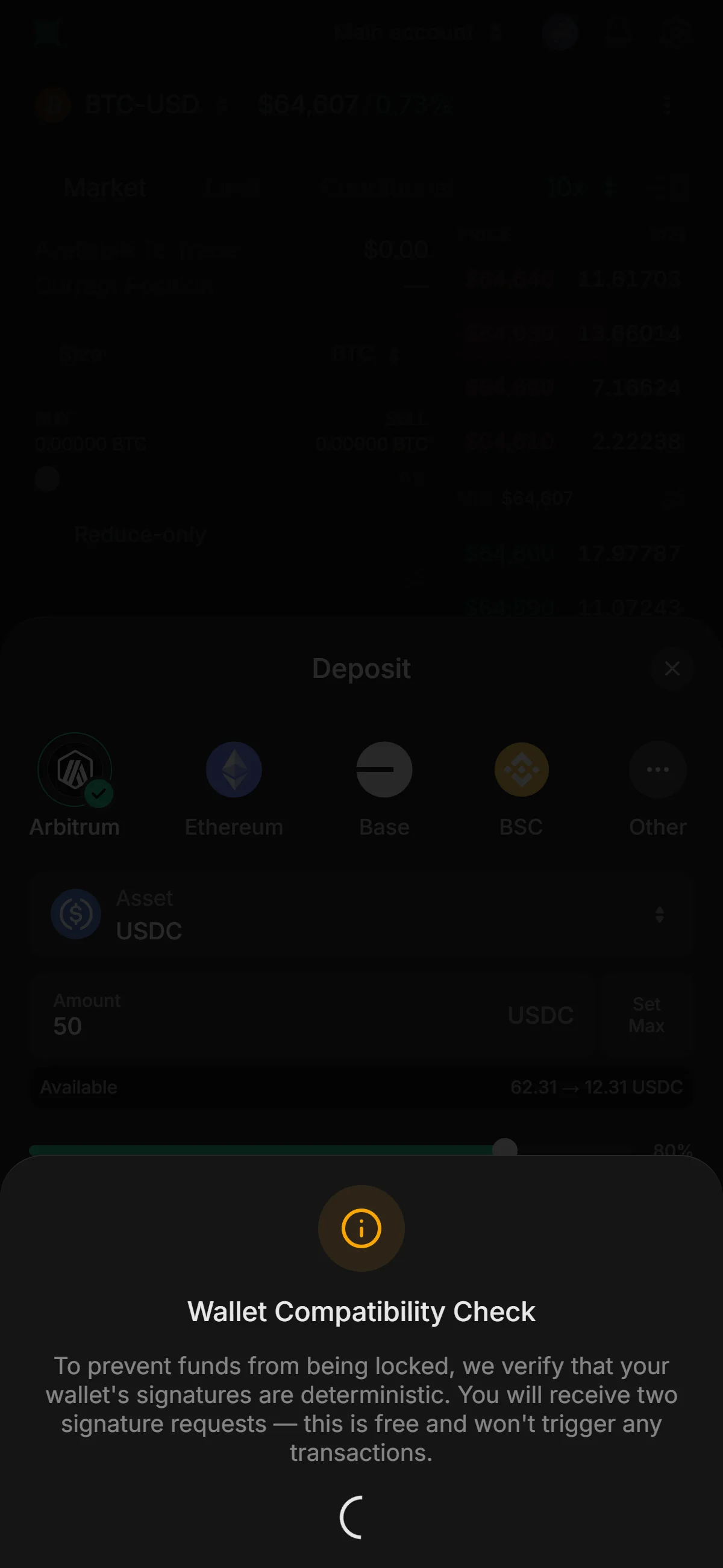
Keep the “Wallet Compatibility Check” sheet open while the spinner runs. It explains that Extended verifies your wallet’s signatures are deterministic so funds cannot end up locked, and that the two requests it sends are free and trigger no transactions.
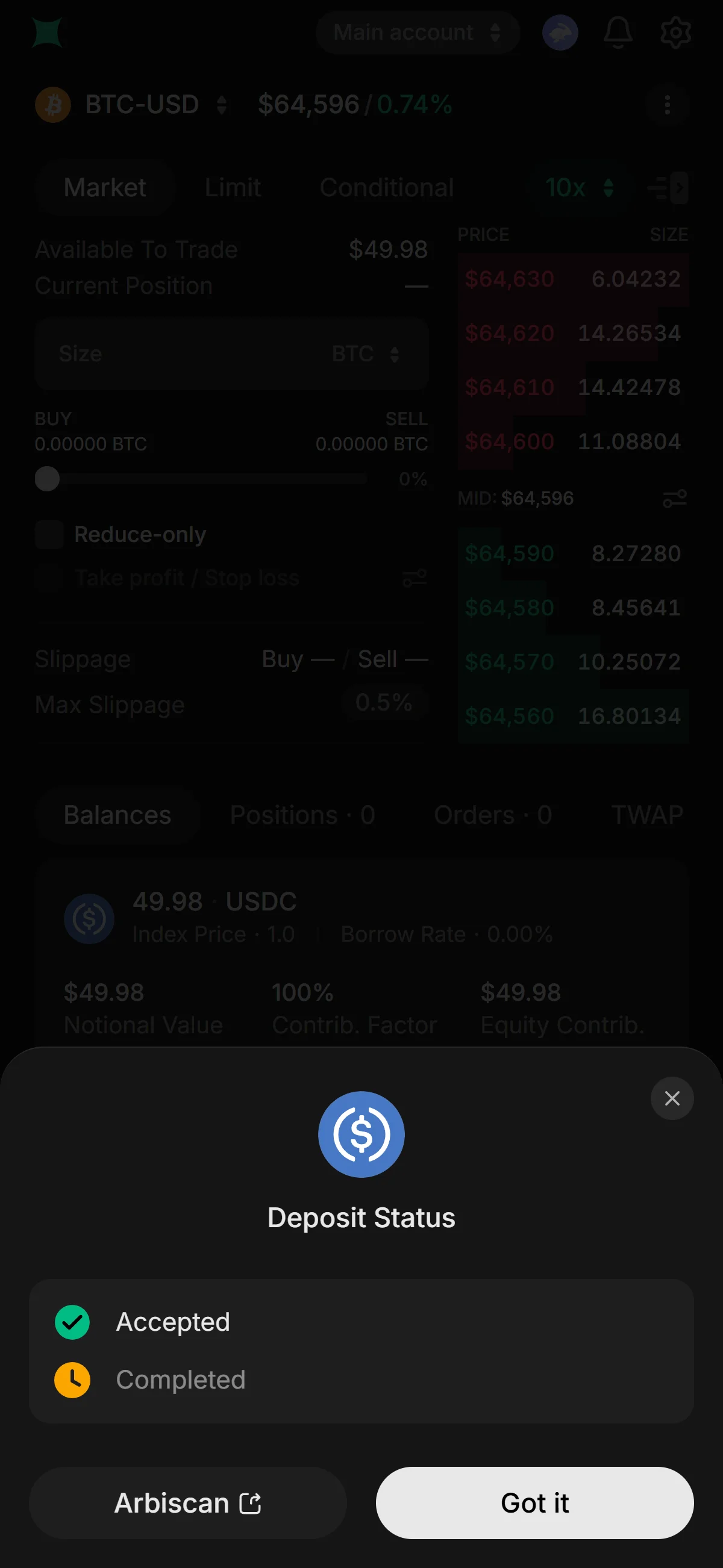
Keep the “Deposit Status” sheet open and wait: “Accepted” is ticked while “Completed” still shows a clock. Tap “Arbiscan” to follow the transaction in the block explorer, or “Got it” to close the sheet — neither changes a deposit already on its way.
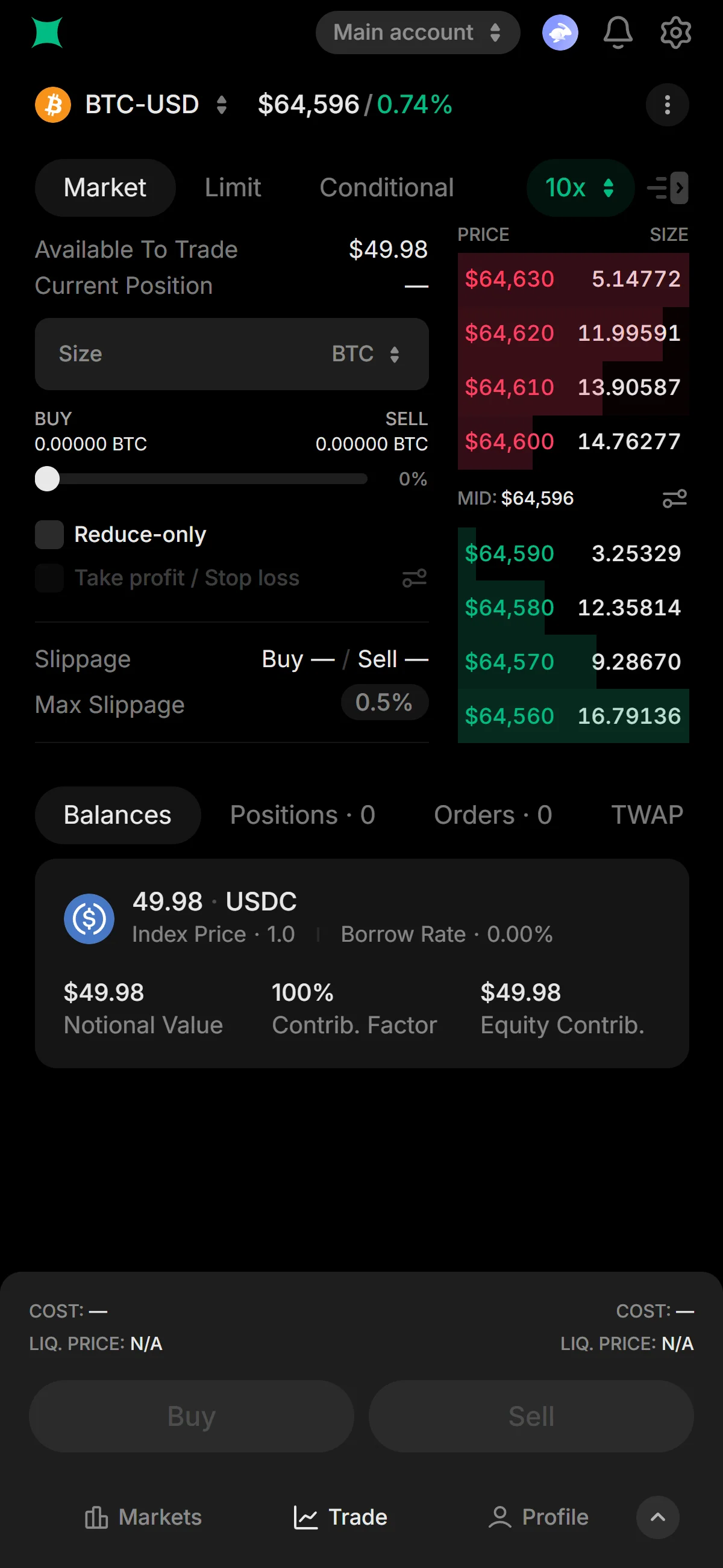
Check the “Balances” tab on the trade screen: the “USDC” card now shows the deposited amount with its notional value, and “Available To Trade” near the top reads the same figure. That figure is the margin the account can use.
With the deposit credited and showing as available to trade, the account is funded and ready for its first order.
The Extended referral code cannot be added after sign-up
The referral code can only be applied once — the first time you connect your wallet.
If you complete the connection without the code applied, there is no way to link it to that wallet afterwards, and the only route left is to start over with a new wallet.
- Is referral code CHAINHELM shown as applied when you connect your wallet? (check the notice that appears when you arrive via the link)
- After connecting, open the referral page and check that the referral is reflected there
The mechanism behind that is worth understanding, because it explains why the order of operations matters so much. The join link the buttons on this page point to carries the code through wallet connect and registration on its own. chainhelm’s walkthrough on 2026-08-05 found no code-entry field anywhere in the connect flow, which means there is no manual fallback: arriving through the link is the whole of the mechanism, and signing up first and adding the code later is not a thing the interface can do.
Afterwards, two places keep the answer. The Refer page carries a ”✓ Referral Code Applied” chip, and the account menu shows the applied referral code with an “Applied” marker beside it. Both are visible any time after wallet connect, which the “Code Activated” modal is not — that one appears once at registration and then it is gone.
◆ ◇ ◆
The points program pays out weekly, and Extended has confirmed no token
How points accrue: a weekly ceiling, seven activity categories and no published formula
The Extended Points Program is live and distributes weekly. Three figures describe it, and the first of them is governed by a word that does a lot of work: the weekly number is a ceiling, not an amount anyone is promised.
Points are awarded for qualifying trading activity, liquidity-related activity, referral and affiliate activity, product testing, bug reporting, user feedback and exceptional user-impact events. What is not published is how any of that converts: there is no formula, no weighting between categories and no per-category allocation. The absence is itself the fact. A reader cannot work out what a given trade or bug report earns, and no third-party estimate is used here to fill the space.
One boundary worth marking, because the space around this topic is crowded: third-party farming guides describe a dated “Season 1” with a different weekly cap, and none of that appears in Extended’s own documentation, which names no season at all. This article follows the official page only.
What Extended has committed to, and who is shut out of the program
Extended’s own wording about where points might lead is deliberately non-committal, and it is worth reading in full rather than in summary.
The token position is easier to state, because it is empty. No token has been issued, no ticker has been announced and there is no distribution history — a record confirmed by the absence of any token identifier for this protocol in third-party data. Extended has neither promised a token nor ruled one out, and that is the entirety of what can be said about it.
Eligibility sets the outer limit. Participation requires compliance with the Terms of Use and excludes restricted jurisdictions, so the same country list that decides whether the venue is reachable also decides whether points accrue at all. Prohibited conduct is listed as wash trading, self-referrals, coordinated referral abuse, multiple-account manipulation, bots and fraud.
Extended in outline: a Starknet-settled perpetual DEX run by X10 Ltd
From X10 to Extended: the rebrand, the Starknet move and who is behind it
This venue has launched twice, not once, and the distinction matters for anyone reading a “since 2024” claim about it somewhere else.
The counterparty behind all of that is X10 Ltd, registered in Seychelles. It is the entity named in the Terms of Use and identified as data controller in the Privacy Policy, and disputes are assigned to the courts of England and Wales. Its own Statement of Risk says it is “not authorized or regulated by the Seychelles Financial Services Authority or any other financial regulator”. The company registration number is disclosed in neither document.
The team came out of Revolut’s crypto operation. Press coverage names Ruslan Fakhrutdinov as chief executive and Dmitrii Krasovskikh as chief technology officer, while Extended’s own team page identifies its people only by social handles and the chief business officer’s legal name is published nowhere.
Off-chain matching, on-chain settlement: how the exchange actually runs
Extended runs a hybrid order book, and the clearest description of it comes from the audited contract specification rather than from Extended’s own product pages. Traders sign orders, an off-chain matching engine pairs them, and a privileged operator role then pushes the matched orders on-chain for validation and settlement.
Settlement happens on Starknet mainnet, a validity rollup on Ethereum that Extended’s docs classify as a Stage 1 rollup, with confirmation cited at roughly two seconds. A purpose-built “Extended Chain” for matching appears in the same docs as work in progress, which is to say it has not shipped.
What the settlement layer guarantees
What still needs someone to act
The second column is what decides how much the first is worth, which is why a reader weighing whether to connect a wallet needs both of them. The risk chapter takes that dependency apart in detail.
98 active markets across crypto and TradFi, held against one collateral pool
Market breadth is this venue’s most distinctive product fact. Extended’s own API returns 98 active perpetual markets against 99 rows in the docs trading-rules table, so 98 to 99 is the defensible figure. The marketing line about “100+ markets” is not an active count, and a third-party listing showing 107 most likely counts contracts the API marks as pre-listed rather than tradable.
The mix is what stands out. Alongside crypto, 106 TradFi-category contracts reference equities such as Apple, Nvidia and Tesla, equity indices, foreign exchange, commodities and one pre-IPO name. These are cash-settled synthetic perpetuals: per the audited specification, a synthetic asset tracks an external price through a combination of oracles and cannot be acquired or held outside the platform.
Collateral all sits in one place. Extended runs unified cross-margin on a single account with USDC as base collateral, and wBTC, ETH, USDT and XVS also count, at documented haircuts — 90% of value for BTC, ETH and XVS, 95% for USDT — with EURC listed as coming soon. A native money market lends USDC against that collateral but restricts it to on-platform use, so borrowed USDC cannot be withdrawn. One trading account is created per connected wallet, up to ten per wallet.
One note on the current state, which will not stay true for long: spot trading has been paused platform-wide since 2026-07-24 at 12:00 UTC per an in-app notice, with balances, deposits, withdrawals and multi-asset collateral unaffected and restoration intended. No jurisdiction is named. The pause is global.
0.000% maker and 0.025% taker, plus the costs that sit around that schedule
The schedule is flat: 0.000% maker and 0.025% taker, the same on perpetuals and spot, with no volume ladder on the fee itself. That makes Extended zero-fee on one side only. Takers pay, and the venue’s economics run on them.
The maker rebate ladder deserves a look of its own, because its qualifying bar is unusual. It is keyed to a maker’s share of total exchange maker volume over the trailing 30 days, not to that trader’s own volume.
Because the bar moves with total venue activity, a trader cannot work out eligibility from their own numbers alone. There is no enrollment: rebates accrue automatically and pay out daily at 00:00 UTC, subject to a minimum of USD 10.
Funding is charged hourly on open positions but quoted on an eight-hour basis, built from a time-weighted premium index plus a fixed interest component, with hourly caps that vary by market group. The full formula is not what a reader needs in order to decide. The cadence and the existence of caps are.
Traders pay no per-trade gas, because matching happens off-chain and the operator submits settlement, though users still bear network fees on the source chain when bridging in or out. And there is no native token, so no token-holding or token-staking fee discount exists anywhere on the venue. That absence is worth naming, because readers arriving from elsewhere will look for one.
Connecting a wallet takes two signatures and no identity check
Extended is compatible with EVM and Starknet wallets. Onboarding is two signatures — one generating the trading account and a local signing key pair, one confirming ownership and enabling trading — and there is no KYC mandate anywhere in the Terms of Use or the account-creation documentation. The connection chapter above showed that happening on screen; this is the policy underneath it.
One consequence is rarely stated: the signing key lives in browser storage, so clearing browser data or moving to another browser means re-deriving it by signature.
Deposits arrive natively on Starknet, or from Ethereum, Arbitrum, Base, Polygon, Avalanche and BNB Chain routed through the third-party Rhino.fi bridge rather than a proprietary one, with indicative timing of about two minutes for USDC under USD 1M. Extended publishes no minimum deposit; the practical entry floor is set per market by minimum order size and works out at roughly USD 6 to USD 20 on the majors. It also publishes no deposit or withdrawal fee schedule, which leaves the bridge leg unquantified from primary sources.
Tenth by reported 24-hour volume: where Extended sits, and who it suits
The volume figure depends on who is counting; open interest does not
On a single day, 2026-07-29, four sources produced four different readings of Extended’s 24-hour perpetual volume.
Two of those readings are not independent of each other. CoinGecko’s figure comes from the venue itself, so its close agreement with Extended’s own API confirms nothing the API had not already said. DeFi Llama is the genuinely separate measurement, taken from the chain rather than from the venue. A same-day cross-check favors the higher band: DeFi Llama’s own 24-hour protocol fee figure is arithmetically consistent with roughly USD 570M of volume at the published schedule, which suggests its volume figures are mid-day partials rather than that the venue figure is inflated. Where one number is needed, USD 0.5-0.6B per day is the defensible range.
Open interest is the figure to trust. Extended’s API puts it at USD 185,153,177, DeFi Llama at USD 185,630,000 and CoinGecko at USD 185,237,000 — three sources agreeing within 0.3%, which makes it the highest-confidence scale figure available for this venue.
Protocol fee revenue ran USD 71,191 over 24 hours and USD 1,657,254 over 30 days on DeFi Llama’s reconstruction from on-chain events. Two qualifications belong with those numbers. They are trader-paid fees rather than profit — DeFi Llama declines to report a revenue figure at all, because maker rebates cannot be separated from public on-chain data. And the cross-protocol fee ranking could not be obtained, because that page sits behind bot verification. That is a gap in this article’s reporting.
Rank 10 on DeFi Llama, and what that ranking does and does not measure
Extended sat tenth by reported 24-hour volume on DeFi Llama’s perps table on 2026-07-29, with about 1.29% of segment volume on the same-source ratio. The rank is less solid than a number implies: sorting the same capture by normalized volume would place Extended around eighth, and the venues immediately around it change position frequently.
One clarification heads off a common misreading. A listing position of 49 out of 135 derivatives exchanges on CoinGecko pools centralized and decentralized venues together. It is not a perp-DEX rank and should not be set against the DeFi Llama figure.
The rank is context rather than a verdict.
One margin account across crypto and TradFi, and collateral that earns while it backs positions
The genuine differentiator is breadth of asset class inside a single margin account rather than depth in crypto perpetuals. TradFi contracts make up roughly a third of the configured market list, and several assets count as collateral at documented haircuts against one pool. That comes from market-level counts in Extended’s own API rather than from a marketing claim, which is worth saying because the marketing claim exists.
Yield-bearing collateral has two sides, and they belong together. Depositing USDC into the Extended Vault returns XVS, which earns yield and at the same time counts for 90% of value toward equity and available balance, with no borrow interest when used as collateral. The same vault is the protocol’s insurance fund and the recipient of the 1% healthy-liquidation fee, so vault depositors are underwriting liquidation risk in exchange for that yield. The documentation states that vault allocations are not deposits, are not protected by any deposit insurance scheme, and that losses are not compensated.
On the distribution side, eToro led a USD 12.5M strategic round announced 2026-07-02 alongside Jump Crypto and Alber Blanc, with Extended’s perpetuals engine slated for integration into Zengo, the self-custody wallet eToro acquired in April 2026. Treat that as announced intent: nothing had shipped as of 2026-07-29. Builder codes are the distribution-layer mechanism that makes such an integration possible, which is the extent of their relevance to a trader.
Who Extended suits, and who it does not
Put those figures together and a shape appears. Extended suits a trader who wants crypto and TradFi exposure inside one margin account, is comfortable holding collateral on a Stage 1 rollup, and reads the points program as a possibility rather than a plan.
It does not suit three kinds of reader. Anyone who needs a regulated counterparty, a compensation scheme or a route to dispute a loss. Anyone who needs to be able to exit without depending on an operator to act. And anyone choosing a venue mainly on the expectation of a token. The mechanics behind each of those sit in the risk chapter.
It comes down to this. The code is a small, verifiable fact that takes one screen to settle. The venue is the actual decision.
◆ ◇ ◆
Twelve territories excluded, no license anywhere, and no regulator has acted
The territories Extended names, and how that list has been rewritten
Extended states the restriction in its own words, and the wording carries the scope. Access to the Extended Protocol website, API and services “is not available to Restricted Persons”, meaning anyone residing in, located in, incorporated in or with a registered office in a listed jurisdiction: “Afghanistan, Canada, China (Hong Kong), Cuba, Iran, North Korea, Russia, Syria, Seychelles, Ukraine (Crimea, Donetsk and Luhansk Regions), the United Kingdom and the United States of America”, plus a catch-all covering anyone whose access would be contrary to applicable law. That is the list as of 2026-07-29.
Three things in it are easy to misread. Ukraine is a partial exclusion covering Crimea, Donetsk and Luhansk rather than the whole country. “China (Hong Kong)” is ambiguous in the source text and is quoted here rather than decoded. And Seychelles, the operator’s own place of incorporation, is on it — a familiar pattern among offshore-incorporated venues.
The list is also edited, and its history is worth having in full.
Extended states that the page is updated regularly, and the conclusion follows from that directly: a country’s status here is a fact with a date attached rather than a standing guarantee, and that holds in both directions.
The block runs at the interface and the API, and it is enforced by IP
The enforcement stack is documented, and it is worth setting out precisely. Users reaching the domain from a restricted territory are presented with a prompt directing them to the Terms of Use and blocked from the website and services. The shipped production frontend carries a region-block dialog reading “Extended is not available in your region”, a server-returned API error code GLOBAL.NOT_AVAILABLE_IN_YOUR_REGION, and a geo probe whose response decides which branch the app takes.
The account layer adds nothing to that. There is no wallet screening, no on-chain address screening, no attestation requirement and no identity gate anywhere in the flow.
On top of the technical layer sits a contractual one. The Terms of Use state in capitalized text that the interface is not accessible to persons residing in, located in, incorporated in or with a registered office in any restricted jurisdiction, that no exceptions are made, and that users must represent they are not in one. As written, the prohibition is absolute.
One note on where all of this comes from: chainhelm’s research reads it from Extended’s published pages and from its shipped frontend code, not from a render observed inside a blocked country — no request could be issued from one.
Where the interface ends and the settlement contracts begin
Extended sets out a two-layer structure in its own terms. Section 12.1 says Extended “develops software but does not operate a Digital Asset or derivatives exchange platform” and that transactions occur peer-to-peer through a smart contract; section 7.4 says the services are non-custodial. On that description, the restriction attaches to the interface and API layer, while the Starknet settlement contracts are permissionless at the protocol layer.
The distinction is narrower in practice than it sounds. Matching happens off-chain, a privileged operator role is required for forward progress including withdrawal finalization, and the same contracts carry a fully trusted upgrade governor and a pause capability. The settlement layer is not usable on its own.
No regulatory action on record anywhere, and the limits of that finding
No litigation, settlement, sanction or regulatory action against Extended, X10 Ltd or its founders was found in any jurisdiction as of 2026-07-29. That was actively searched rather than assumed, which is what makes it worth reporting — and it comes with one gap. The FCA warning-list search page returned an access error to automated retrieval, so the absence of an entry there is inferred from press coverage rather than confirmed at source.
Extended holds no license in any jurisdiction, which for a perpetual DEX is the normal state rather than a deficiency. Its own Statement of Risk says it is not authorized or regulated by any financial regulator and that its instruments “fall outside the scope of specific European regulatory frameworks such as MiFID or MiCA”. The sharpest sentence Extended has written about itself is the one that comes next.
Users of Extended’s trading services do not receive the protections typically available to clients of regulated investment services, including access to investor compensation schemes.Extended, Statement of Risk
Direction of travel is something to read from adjacent supervision rather than to predict. Extended’s list already excludes the jurisdictions where synthetic equity and leveraged crypto derivatives face the most direct licensing exposure, despite no action having been taken against it. The UK FCA issued a warning about another perpetuals venue in May and added 143 entities to its warning list. Regulated perpetual structures emerged during 2026 as a licensed route to similar exposure. And Extended’s own surface is widening, with 106 TradFi-category markets outside the crypto-native perimeter and a NASDAQ-listed broker now in its distribution path. That is a read of direction, not a forecast about Extended.
Extended is blocked in the United States and the United Kingdom, and reachable in Singapore, Australia and India
The answer differs by country, and for two of the five covered here it is a flat no. Every status below is dated 2026-07-29, because the list that decides it is edited rather than fixed.
United States: excluded since before the rebrand, with no compliant route in
The enumeration is flat. “the United States of America” is named on Extended’s Restricted Countries page, and access “is not available to Restricted Persons”. The Terms of Use repeat the bar in capitalized text and make no exceptions. This has been continuous: the earliest archived copy of the restricted-countries page, from 2024-05-28 under the X10 branding, already lists the United States, so there is no observed period of US availability at all.
A US visitor meets the server-side region gate described above — the region dialog and the API error code — and there is no identity step anywhere in the flow that could produce a different outcome. The honest limit on that description: chainhelm’s research could not issue a request from a US address, so it is read from the protocol’s own pages and its shipped frontend code.
There is no compliant route for a US-based reader to register on Extended or to apply a referral code.
Where US regulation actually sits answers the question a US reader asks next. The CFTC’s actions in this line have run against operators and interfaces rather than retail users: the Ooki DAO judgment in June 2023, the settled orders against Opyn, Deridex and ZeroEx in September 2023 — the Deridex order stating that perpetual contracts are swaps and leveraged retail commodity transactions offerable to retail users only on a registered exchange — and the Uniswap Labs order in September 2024. No US source was located stating that a resident commits a violation by accessing a non-US unregistered perpetuals protocol. That is an absence of a found source rather than permission, and it is not legal advice.
United Kingdom: excluded, with the FCA’s retail derivatives ban still in force
The United Kingdom is enumerated on the Restricted Countries page and the Terms of Use agree, as of 2026-07-29. As with the United States, the exclusion dates from the beginning rather than from a later revision: present in the earliest archived copy from 2024-05-28, retained when the list expanded to around 30 entries in February 2025, and retained again when it was narrowed to 12.
The reason is clearer in the UK than anywhere else covered here. The FCA prohibited the sale, marketing and distribution to retail consumers of derivatives referencing unregulated transferable cryptoassets, effective 2021-01-06, and that prohibition binds firms acting in or from the UK. It was expressly retained when the FCA opened retail access to crypto exchange-traded notes from 2025-10-08. X10 Ltd is Seychelles-incorporated, holds no UK authorization, and excludes the United Kingdom instead of seeking one.
One UK rule reaches offshore firms regardless of where they sit. The cryptoasset financial promotions regime, in force since 2023-10-08, applies to all firms marketing cryptoassets to UK consumers wherever they are based, and breach is a criminal offense. The FCA’s action against HTX in February 2026 was its first enforcement of that against a crypto firm. It explains why exclusion is the cheaper option for a venue like this one.
The user side needs stating exactly. What is documented is that the platform contractually bars UK residents. Whether a UK resident personally commits an offense by accessing an offshore perpetuals venue is not established by any source located, and none was found either asserting or excluding it. This article does not say that it is legal for UK residents.
Two things remain. No UK regulatory action naming Extended or X10 was found, subject to the same warning-list retrieval gap flagged above. And by way of direction only: the new UK cryptoasset regime was made on 2026-02-04 with final rules on 2026-06-30, an authorization gateway opening 2026-09-30 and commencement on 2027-10-25. That changes the perimeter a UK-facing firm would have to enter. It does not change Extended’s current position.
Singapore: taken off the restricted list some time between January and April 2026
The change matters more here than the status, because it is the most perishable fact in this chapter and because statements written before 2026 that Extended excludes Singapore were correct when they were written. Singapore appears on every archived snapshot of the restricted list from 2025-02-07 through 2026-01-22, and is absent from the 2026-04-11 snapshot and from the live page on 2026-07-29. The removal was made by editing the docs page, and no announcement of it was located anywhere. So the current answer is that Singapore is not restricted, as of 2026-07-29, with that date carried.
What the Singapore perimeter actually does is worth stating precisely. MAS’s consumer-protection guidelines bar retail credit for buying digital payment tokens and bar leveraged transactions in those tokens with retail customers — but they apply to MAS licensees such as banks, finance companies and payment institutions, so they do not reach an unlicensed offshore protocol. MAS has said as much directly: those measures “do not apply to entities which are not regulated by MAS”. The consequence cuts both ways. No MAS leverage cap stands between a Singapore retail user and this venue, and no MAS protection does either.
On legality: no prohibition on residents was identified in primary sources as of 2026-07-29. MAS frames residents of such platforms as people who need to exercise caution, not as offenders.
The exposure that matters more than the legality question is what happens when MAS and the police do act against an unlicensed offshore venue. They act on the platform and block it at Singapore ISP level, as happened to two leveraged foreign exchange and CFD platforms from 2025-06-20, cutting off existing account holders in the process. Extended is not on the MAS Investor Alert List as of 2026-07-29, though another perpetuals DEX was added on 2026-06-26 and a large offshore exchange on 2026-06-17. MAS’s own caveat belongs alongside that: non-listing does not mean an entity is safe to deal with.
On tax: Singapore has no capital gains tax, but whether disposal gains are taxable turns on whether they are revenue or capital in nature on the facts, and IRAS has published nothing addressing perpetual futures specifically. Extended issues no tax documentation and, holding no identity data, structurally cannot — none of which adds up to trading here being tax-free in Singapore.
Australia: reachable, with no Australian license behind it
Australia is not on the restricted list as of 2026-07-29, and it appears in none of the five archived snapshots sampled between February 2025 and April 2026 either. This is a steady absence rather than a recent change.
The obligation sits with the provider. ASIC’s updated INFO 225, released 2025-10-29, classifies as derivatives any contracts for difference, options, forwards or futures referencing digital assets, expressly including perpetual futures, and states that Australian law applies where such services are provided in Australia including from offshore, with an Australian financial services license required of the issuer. Extended’s core product is perpetual futures, and Extended states it holds no license from any regulator. That is the whole of the fact.
The consequence for a reader is concrete: with no licensed counterparty, the Australian statutory protections and dispute-resolution routes that attach to licensed providers are not available. ASIC’s consumer-facing position on unlicensed platforms is a warning — it reports Australians experiencing significant losses through excessive leverage, platform outages and unfair liquidations — not a prohibition on the user.
The leverage point needs care, because it is where an Australian reader is most likely to draw the wrong conclusion. ASIC’s retail product intervention order caps leverage on crypto-asset contracts for difference at 2:1 and runs to 2027-05-23, which contrasts sharply with what this venue advertises. But no located ASIC source applies that cap to perpetual futures on an offshore non-custodial venue, and ASIC’s own June 2026 landscape report flags perpetual futures offered to Australians through offshore venues as products that may sit outside existing perimeters and warrant closer attention. The cap is a real Australian rule whose reach here is not established, and this article does not assert that it applies.
Reporting falls entirely on the user, because Extended issues no tax documentation and holds no identity data, and the ATO’s crypto data-matching program collects from designated domestic providers rather than from offshore non-custodial protocols. The nearest ATO instrument, its 2005 ruling on contracts for difference, predates crypto perpetuals and is not guidance on them.
India: reachable and unregulated, with a flat 30% on gains
India is not on the restricted list as of 2026-07-29, and no India-specific access event in either direction was found at any point in the venue’s history.
Use by a resident is not prohibited, but it sits entirely outside Indian regulation. The FIU-IND registration duty under the anti-money-laundering framework is written to reach providers “functioning from outside India but providing services to persons in India”, and the government’s own position, stated in Parliament in February 2026, is that virtual digital assets are unregulated and are not legal tender. So there is no licensing route for the venue to take, and no investor-protection, compensation or grievance-redressal regime for the reader to fall back on.
The enforcement pattern is a risk to continued access rather than a sanction on the reader. India’s demonstrated response to unregistered offshore platforms is compliance notices plus URL and app blocking, with nine platforms named in December 2023 and 25 in October 2025, all of them custodial exchanges. Neither wave names Extended, and no perpetuals DEX has been named in a published wave — a point-in-time absence rather than an assurance.
Tax is the biggest cash-flow item for an Indian reader. Income from the transfer of a virtual digital asset is taxed at a flat 30% plus surcharge and cess, with only cost of acquisition deductible and no set-off of losses against other income, reported through Schedule VDA. A 1% withholding applies on consideration for a transfer, carried into the restructured Income-tax Act from 2026-04-01. Because Extended is offshore, non-custodial and identity-free, there is no Indian deductor anywhere in the chain, so the Indian user discharges that obligation directly, and Extended supplies no Indian tax documentation of any kind.
One question stays open. Whether gains on crypto perpetual futures fall under the flat 30% regime as a transfer of a virtual digital asset, or under ordinary or speculative business income at slab rates, is not settled by any circular, and Indian professional commentary documents both readings. That is a question for a qualified Indian tax adviser, and this article picks neither.
One last point on funding, and it is unsettled. The RBI’s Liberalised Remittance Scheme FAQ lists remittance for margins to overseas exchanges among transactions for which remittance is not available, but it addresses fiat moving through the banking channel, and no published clarification addresses on-chain transfer of self-custodied collateral. It is unresolved in either direction rather than a rule that does or does not bite.
◆ ◇ ◆
The risks Extended carries specifically: a trusted operator, upstream-only audits and two settlement halts
A single operator role that the audit calls fully trusted
This is the risk a reader is least likely to have priced, and the one everything else turns on. One operator role pushes matched trades on-chain, processes deposits, finalizes withdrawals and transfers, and submits price and funding ticks. The audit of the contracts Extended deploys classifies that role as “fully trusted” and notes that it “guarantees the forward progress of the system”.
The practical consequence is worth spelling out. Funds sit in on-chain contracts under the user’s own key, so self-custody protects against misappropriation. But withdrawals require operator finalization, which means it does not protect against operator liveness failure. Self-custody here does not mean the ability to exit unilaterally.
On sequencing: Extended’s docs state that the sequencer is currently centralized and that the protocol is “progressing toward full decentralisation of sequencing”, and Starknet’s own sequencer set moved from one to three in September 2025.
An upgradeable contract, a pause that stops withdrawals, and two numbers nobody publishes
The settlement contract is upgradeable. An upgrade governor proposes an implementation, a delay runs, and the change can then be executed within a two-week window. The audit states the risk more bluntly than any paraphrase would.
The upgrade governor can upgrade to a malicious implementation and steal everybody’s money if the upgrade is not dropped during the upgrade delay.ChainSecurity, on the contracts Extended deploys
Two disclosure gaps sit on top of that. The delay’s duration is a deployment parameter published nowhere, so the number of days a user would have to react is not publicly verifiable. And whether Extended’s live deployment assigns its privileged roles to individual keys, to multisigs or to a threshold scheme is published nowhere either — while the audited trust model records that on deployment the governance admin and the security admin are granted to the same address.
Pausing carries a consequence that deserves stating in full. A security agent can pause the system, and while it is paused, deposits, withdrawals, transfers, trading, liquidation, deleveraging and price and funding ticks are all blocked. A pause halts withdrawals, not only trading. The audit notes that the same role can temporarily deny service by pausing and thereby cause losses to users in volatile markets.
Two real audits, both scoped to somebody else’s codebase
Both audits Extended lists are real and substantive.
- ChainSecurity, 2025-09-15
- Code assessment of the Starknet Perpetual smart contracts. No critical findings; one high, since corrected; two medium; eight low.
- Code4rena, from 2025-03-19
- Public audit competition across 39 Cairo contracts. Two high-risk findings, three medium-risk, and 14 low or non-critical.
Then the scoping fact, and it qualifies all of that. Both were commissioned for and performed on StarkWare’s upstream codebase: ChainSecurity’s client is StarkWare, and Code4rena’s scope is the StarkWare repository. Extended deploys a fork of that codebase, but no audit of Extended’s own deployment, of its modifications, or of its off-chain matching engine and operator infrastructure is published. ChainSecurity also placed the configuration and parameterization of the system out of scope, which is exactly where Extended’s role assignments and upgrade delay live.
Extended should not be described as audited without that qualification, and this article does not describe it that way.
One oracle provider, and pre-market contracts priced against themselves
One named provider, Stork, supplies both mark and index prices from five nodes, with no secondary or fallback provider named — a single point of dependency for the standard markets. On-chain, a quorum of signed prices is required and the asset price is set to the median of them, and liquidations may only be triggered by external oracle prices.
Pre-market listings behave differently. Pricing there is self-referential, built from a moving average of historical mark prices with no external reference, until reliable external pricing exists. A reader who trades those markets is trading against a price the venue derives from itself.
An insurance fund that is the vault, and depositors who are the backstop
The insurance fund is the Extended Vault itself, a shared fund across all markets, which means the depositors earning vault yield are the backstop capital. It is funded by the 1% fee on healthy liquidations plus maker rebates and money market interest, and its exposure is bounded by a 5% daily global cap, per-market-group budgets and per-trade maximums.
What happens when that is not enough is worth following step by step. If the fund cannot cover losses, or a position cannot be liquidated within 5% of its bankruptcy price, auto-deleveraging matches profitable traders against liquidated positions. For spot, a final backstop socializes losses across USDC depositors at bankruptcy pricing. The audit raised “Insurance Fund Cannot Always Be the Deleverager” as a medium-severity finding, and the vault documentation states that losses are not compensated.
The mechanics themselves are compact: liquidation triggers when the margin ratio exceeds 100%, runs in up to five partial steps, and stops as soon as the ratio returns below the threshold.
Two settlement halts, and no incident history to read them against
Two outages sit on the record, both of them dated. On 2025-09-02 Starknet halted block production for roughly nine hours after a network upgrade, requiring two chain reorganizations that rolled back about an hour of activity. On 2026-01-05 it was unavailable for about four and a half hours, and 18 minutes of transactions were reverted. Neither was an Extended failure. But both halted Extended’s settlement and withdrawal path, and Extended had launched on Starknet only three weeks before the first. Extended published no impact statement for either.
That pairs with a visibility gap, and the two facts only mean something together.
Leverage that steps down, and collateral the contract assumes holds its peg
Two figures that readers most often carry in from marketing need correcting. On leverage: the headline 100x is reachable on exactly one market, EUR-USD. Crypto majors including BTC and ETH cap at 50x, and available leverage steps down as position size rises, reaching 1x in the lower market groups and a fixed 3x on pre-market contracts. 100x is not generally available.
On collateral: non-USDC collateral counts at a haircut, and the audited contract assumes the collateral token is always pegged to one US dollar, treating it as fully trusted and out of scope. Depeg risk is therefore borne by the user and is not mitigated at the protocol level.
What the referral code settles, and what the decision still turns on
One question is closed. The referral code applies through the join link while the wallet is connecting, the screen confirms it at registration, and the account keeps showing it afterwards. It is worth a 10% discount on trading fees, for new users. And it cannot be attached to a wallet that has already signed up.
The venue is the part that stays open. Extended sits tenth by reported 24-hour volume, with open interest around USD 185M as the figure independent sources actually agree on. It runs one margin account spanning crypto and TradFi markets, with collateral that earns while it backs positions. Trading costs 0.025% as a taker and nothing as a maker.
The points program is live and distributes weekly, and Extended has confirmed no token, no allocation method, no conversion and no date, neither promising one nor ruling one out. Anyone weighing Extended mainly on that expectation is weighing something the venue has not stated.
As of 2026-07-29, Extended excludes the United States and the United Kingdom outright and is reachable from Singapore, Australia and India. Where it is reachable it is also unlicensed, so none of the local protections that attach to licensed providers apply. The list is edited, which makes the status worth rechecking rather than remembering.
That leaves fit rather than a recommendation. This suits a trader who wants that market breadth and can carry operator dependency, an audit scope that stops upstream of this deployment, and a settlement layer that has halted twice. It does not suit a reader who needs a regulated counterparty, a compensation scheme, or certainty about a token.