— Contents 12 sections
- 01 Is the Ondo Perps referral code “8SEGN3” still active?
- 02 What the Ondo Perps referral code “8SEGN3” gets you
- 03 Ondo Perps sign-up steps with the referral code
- 04 What to do after connecting to Ondo Perps
- 05 The Ondo Perps referral code cannot be added after sign-up
- 06 Ondo Points pays 5,000,000 points a week, and promises nothing beyond that
- 07 A Panama operator matching equity and commodity perpetuals off-chain
- 08 Rank 12 by perp volume, on a collateral model built out of tokenized stocks
- 09 The venue excludes its own home jurisdiction, and holds no license anywhere
- 10 The United States is excluded by name; the UK, Singapore, Australia and India are not
- 11 No audit of the engine, collateral in an omnibus account, and an insurance fund of undisclosed size
- 12 The code, the discount, and the one moment it applies
chainhelm’s exclusive Ondo Perps referral code is .
As of 2026-08-10, we connected a new wallet and confirmed that the referral code was applied.
Connect your wallet using this code to receive an ongoing 5% discount on trading fees that applies for the duration of the program, not just once. The code takes effect only on that first connection — that step happens once, the discount that follows does not.
This article covers the sign-up process (wallet connection) with the Ondo Perps referral code, Ondo Perps’s distinguishing features, availability in the United States, the United Kingdom, Singapore, Australia and India, and the risks to acknowledge — with the connection flow and code application verified first-hand by chainhelm’s editorial team.
Is the Ondo Perps referral code “8SEGN3” still active?
The chainhelm editorial team connected to Ondo Perps with a fresh wallet on 2026-08-10 and confirmed that the referral code “8SEGN3” is still active.
Here is the actual screen captured during verification.
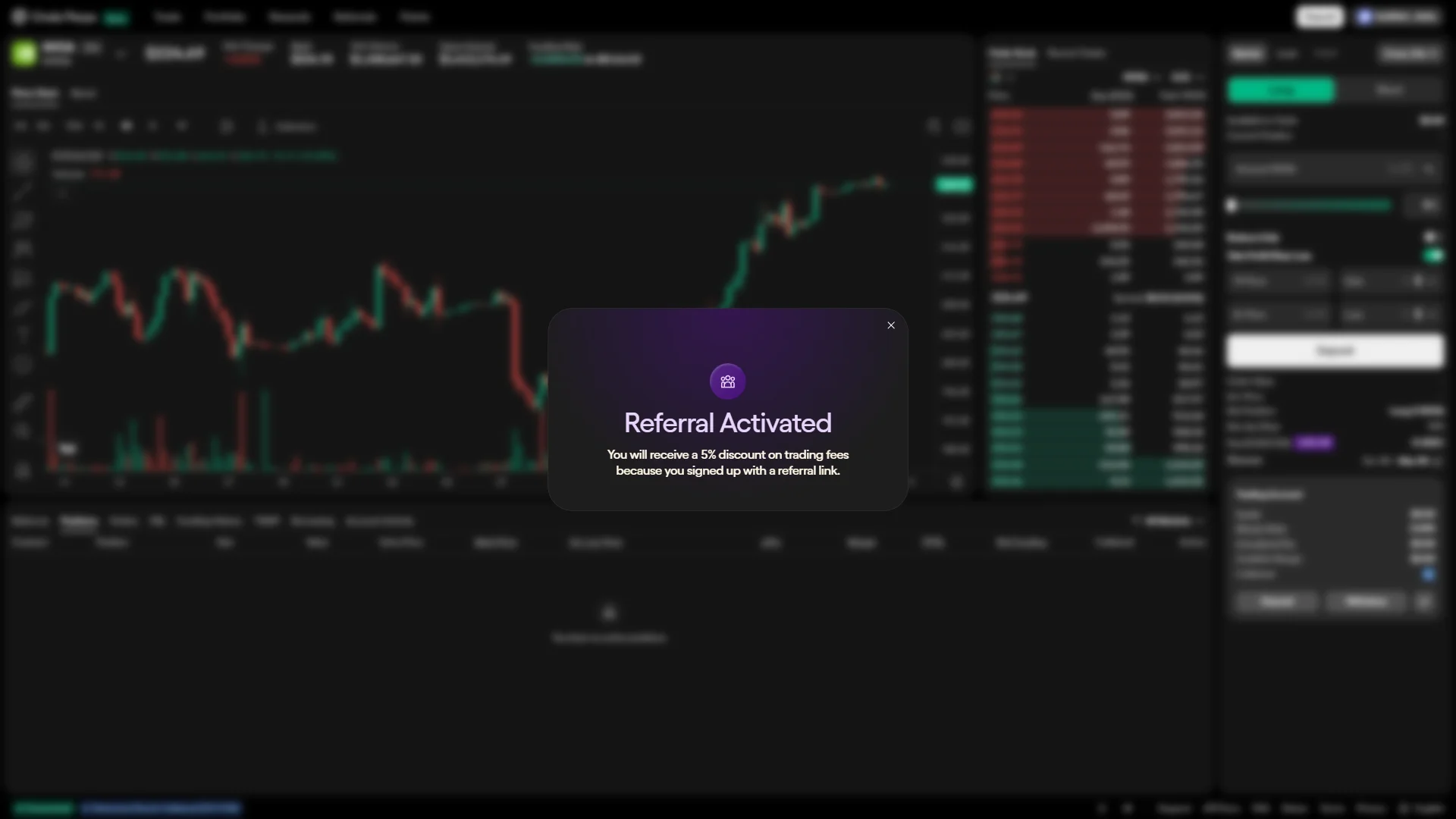
The screen shows “Referral Activated”, confirming that referral code 8SEGN3 was retained from the link and applied as soon as you finished signing in.
chainhelm continuously verifies the validity of the code and confirms it remains usable.
What the Ondo Perps referral code “8SEGN3” gets you
Connect your wallet using this code to receive the following benefits on Ondo Perps:
- Benefit
- an ongoing 5% discount on trading fees that applies for the duration of the program, not just once
- Expiration
- None
- Eligibility
- New users
You only receive these benefits when you connect your wallet using the code. Connect without it and you won’t be able to get them afterward.
Ondo Perps sign-up steps with the referral code
We cover the connection process separately for PC/browser and smartphone (mobile).
PC/browser connection steps
1. First, open the Ondo Perps official page (the link applies the referral code). When you open it, you’ll see a screen like the one below.
2. Click “Sign In” on the trade screen
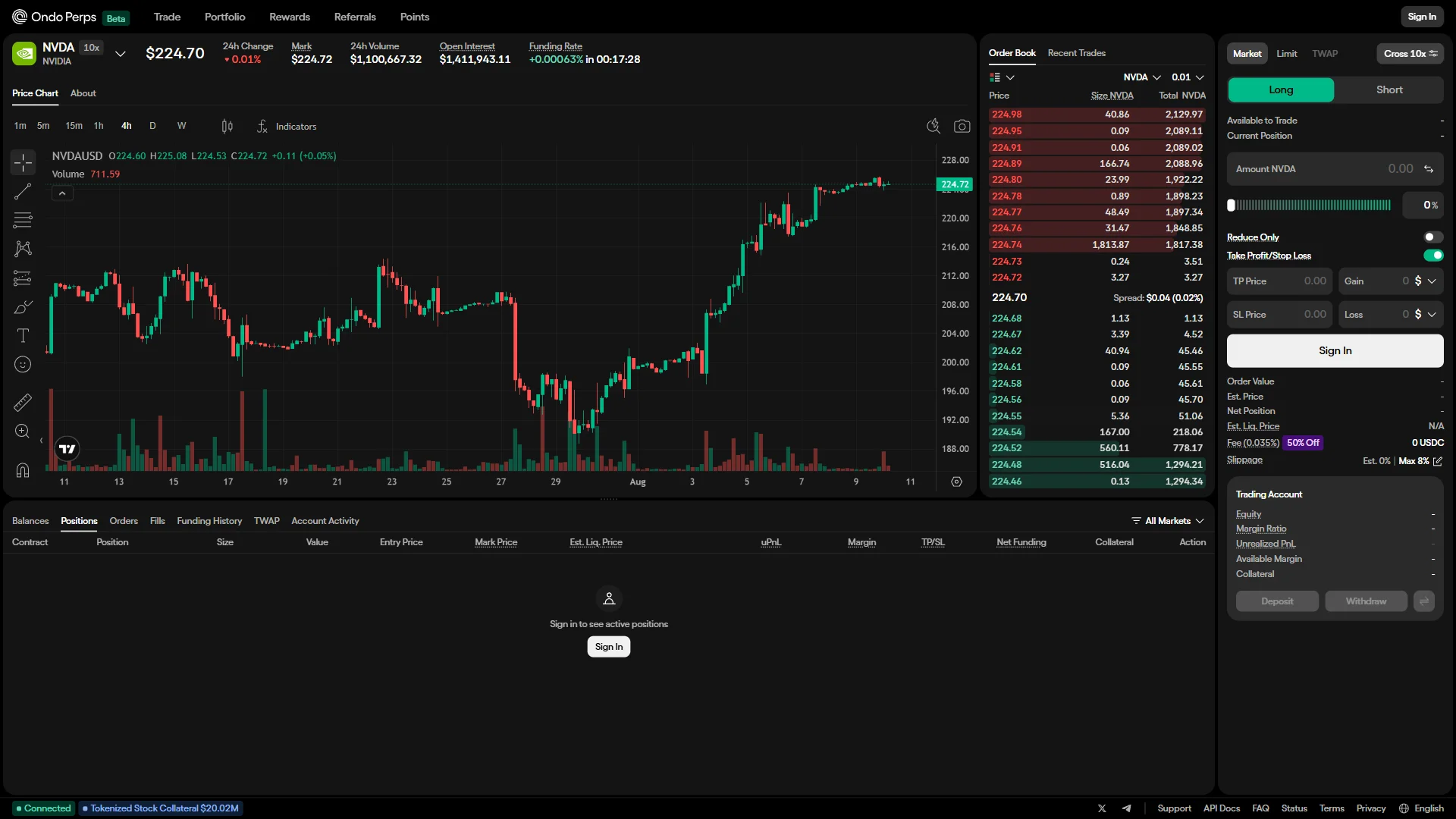
Open the referral link and you land on this trade screen; click “Sign In” at the top right to open the sign-in dialog. Until you sign in, “Available to Trade” and “Current Position” in the order panel stay at ”-”, and that panel carries the same “Sign In” button.
3. Choose your wallet in the sign-in dialog
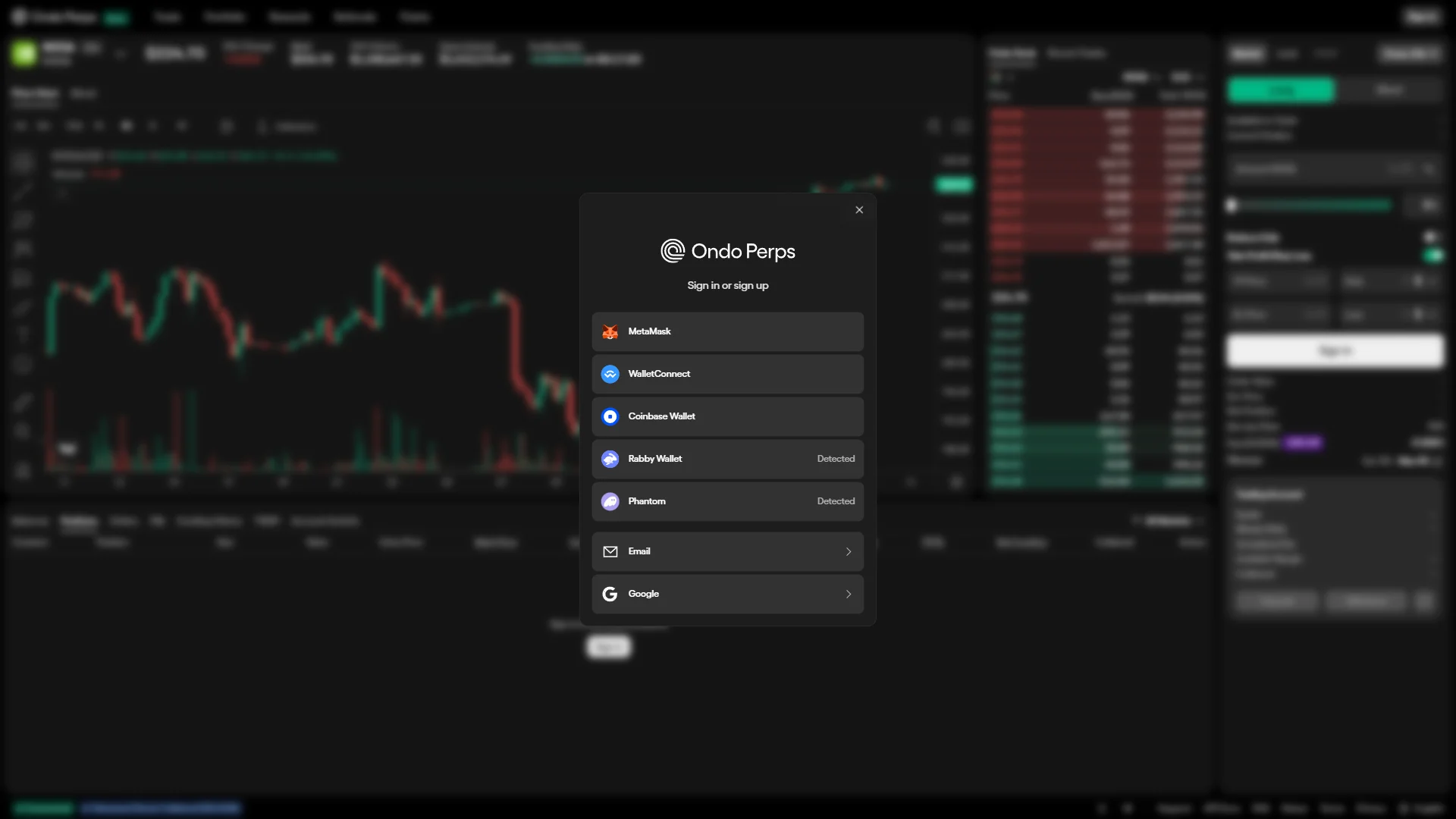
In the “Sign in or sign up” dialog, click the wallet you want to sign in with — this walkthrough continues with “Rabby Wallet”, marked “Detected” because its extension is already installed in this browser.
“MetaMask”, “WalletConnect”, “Coinbase Wallet” and “Phantom” go through the same connection flow, and “Email” or “Google” at the bottom start an account without a wallet extension.
4. Approve the connection in your wallet
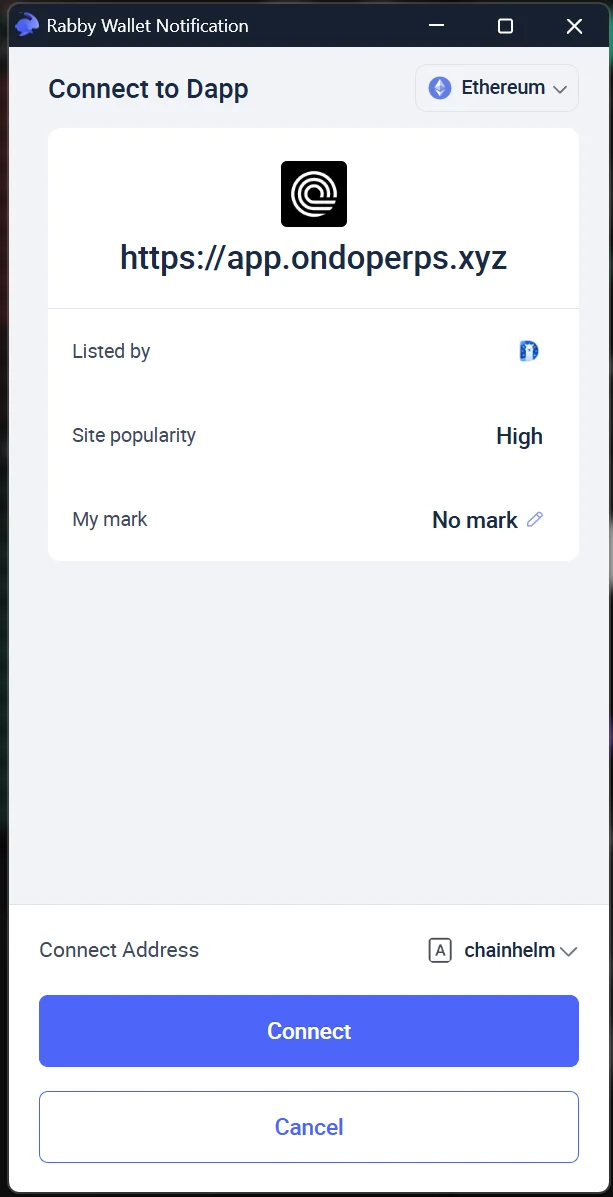
Check that the wallet window names https://app.ondoperps.xyz as the site and that “Connect Address” shows the account you want to use, then click “Connect”. The network selector at the top is set to “Ethereum”, and “Cancel” closes the request without connecting anything.
5. Retry after a rejected connection
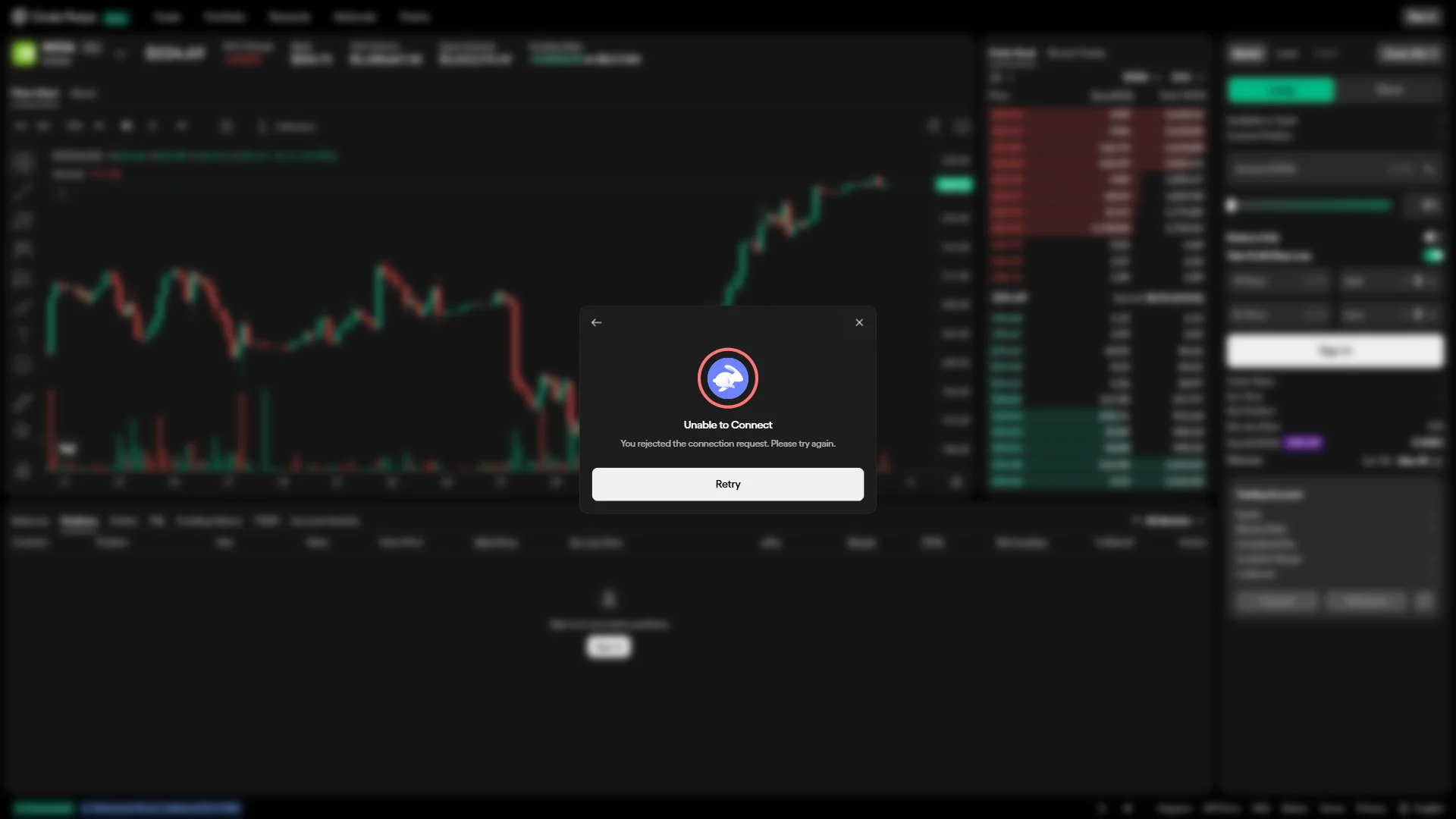
If you turned down the request in the wallet window, the site shows “Unable to Connect” — click “Retry” to send the connection request again. The wallet’s “Connect to Dapp” approval comes back, and the flow picks up from there.
6. Move to your wallet to sign
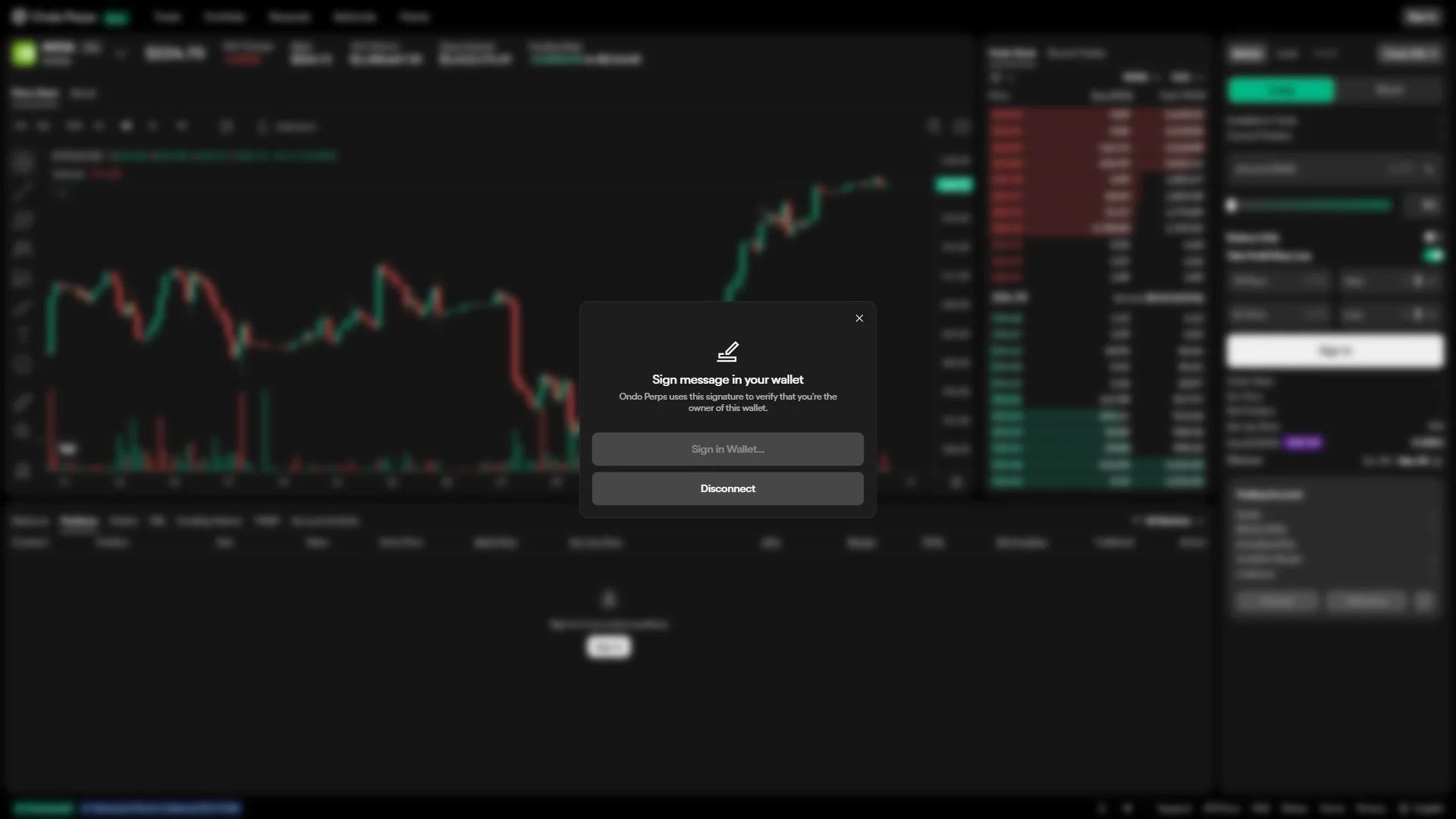
Approve the signature request in the wallet window that opens; the site holds at “Sign message in your wallet” with “Sign in Wallet…” grayed out until you do. That signature is what proves you own the connected wallet, and “Disconnect” drops the connection if you would rather use a different account.
7. Sign the address verification message
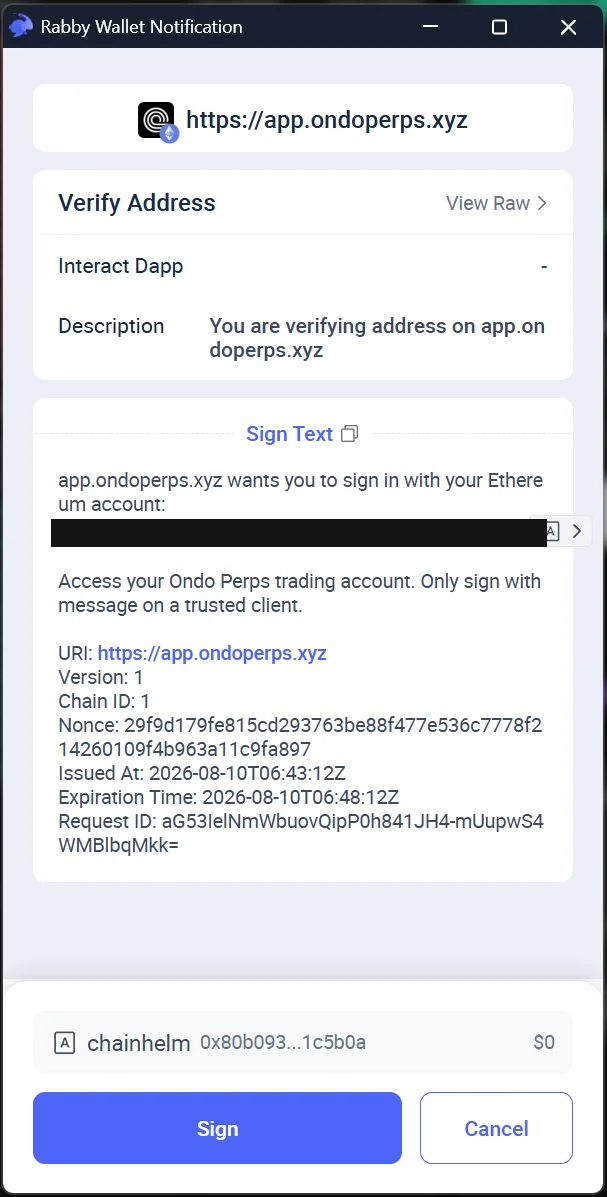
Read the “Sign Text” block — it names app.ondoperps.xyz as the site asking you to sign in with your Ethereum account — and click “Sign”. The request is a “Verify Address” message carrying a nonce and an expiration time, so approve it while it is fresh; “Cancel” rejects it.
8. Confirm the signature to finish
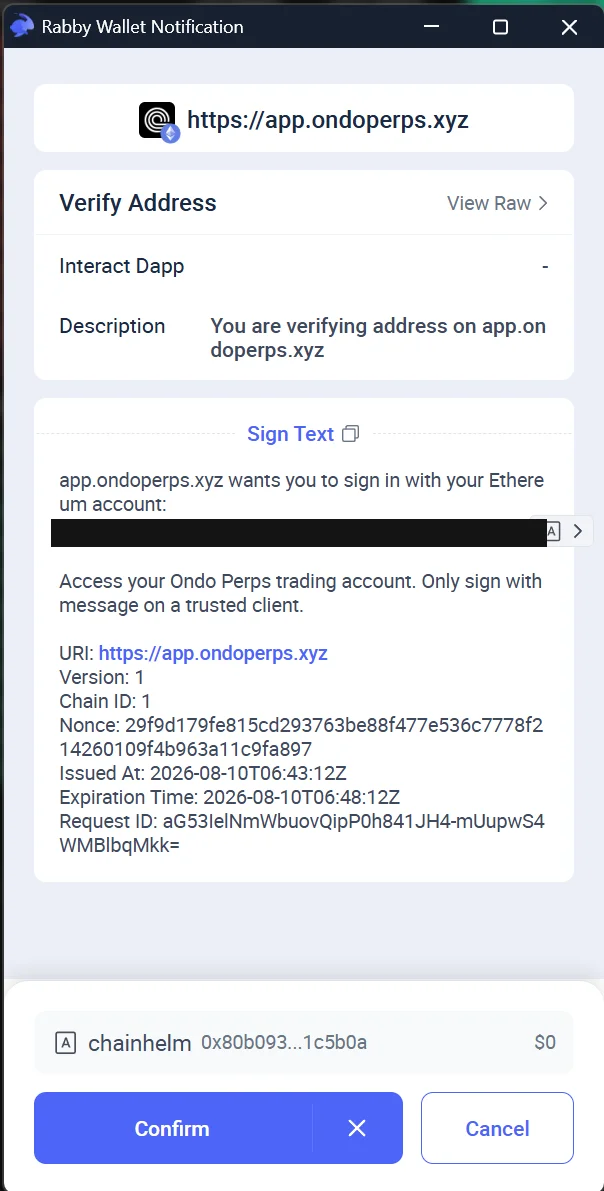
Click “Confirm” — the wallet asks a second time before it releases the signature. The “Verify Address” and “Sign Text” contents are unchanged from the previous screen, so check them once more and use “Cancel” if anything reads differently.
9. Check the referral confirmation
Check that “Referral Activated” appears once the signature goes through: the dialog states, “You will receive a 5% discount on trading fees because you signed up with a referral link.” Close it with the X in the corner after you have read it.
Smartphone (iOS / Android) connection steps
1. First, open the Ondo Perps official page in your mobile browser or your wallet app’s in-app browser (the link applies the referral code). When you open it, you’ll see a screen like the one below.
2. Tap “Sign In” in the header
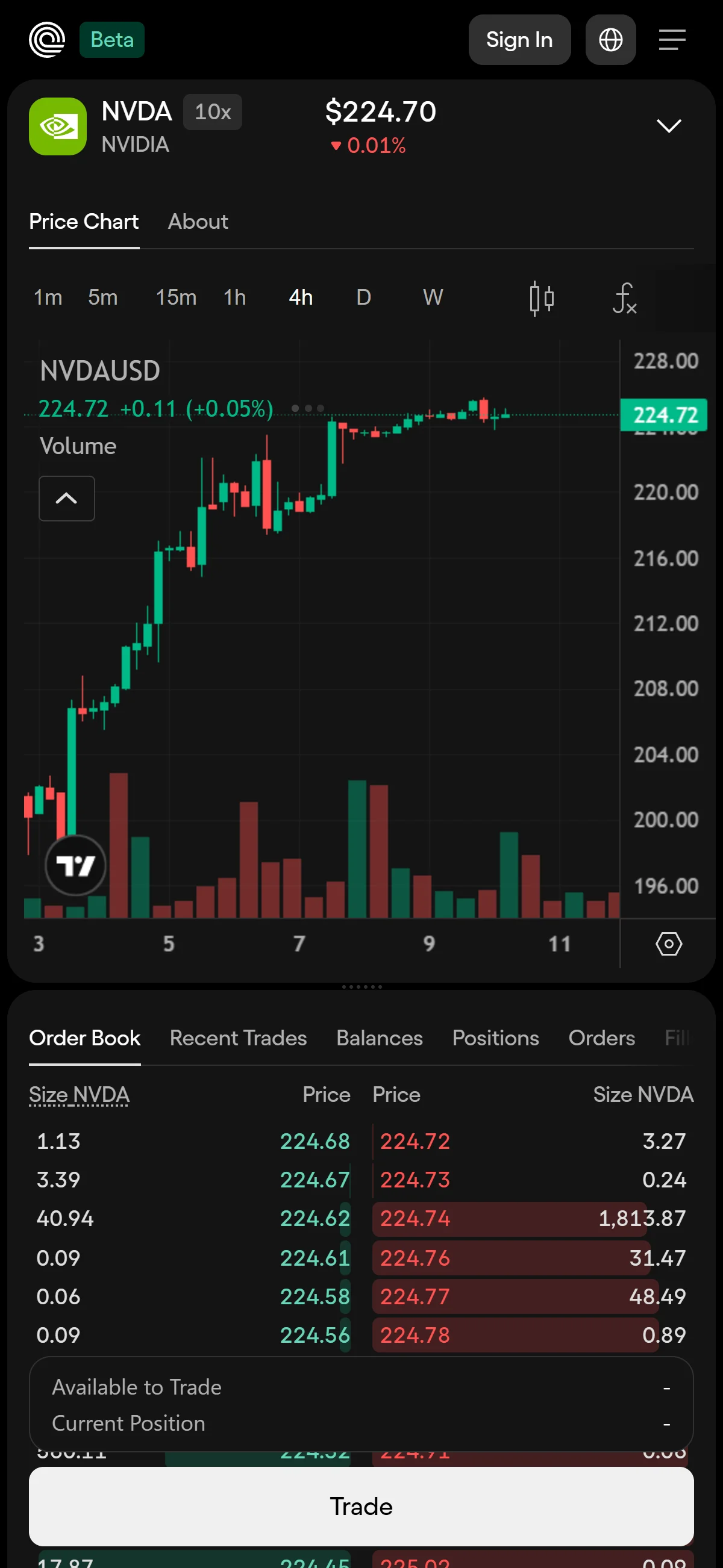
Open the referral link and you land on this trade screen; tap “Sign In” in the header to open the sign-in sheet. Until you sign in, “Available to Trade” below the order book stays at ”-”.
3. Choose your wallet in the sign-in sheet
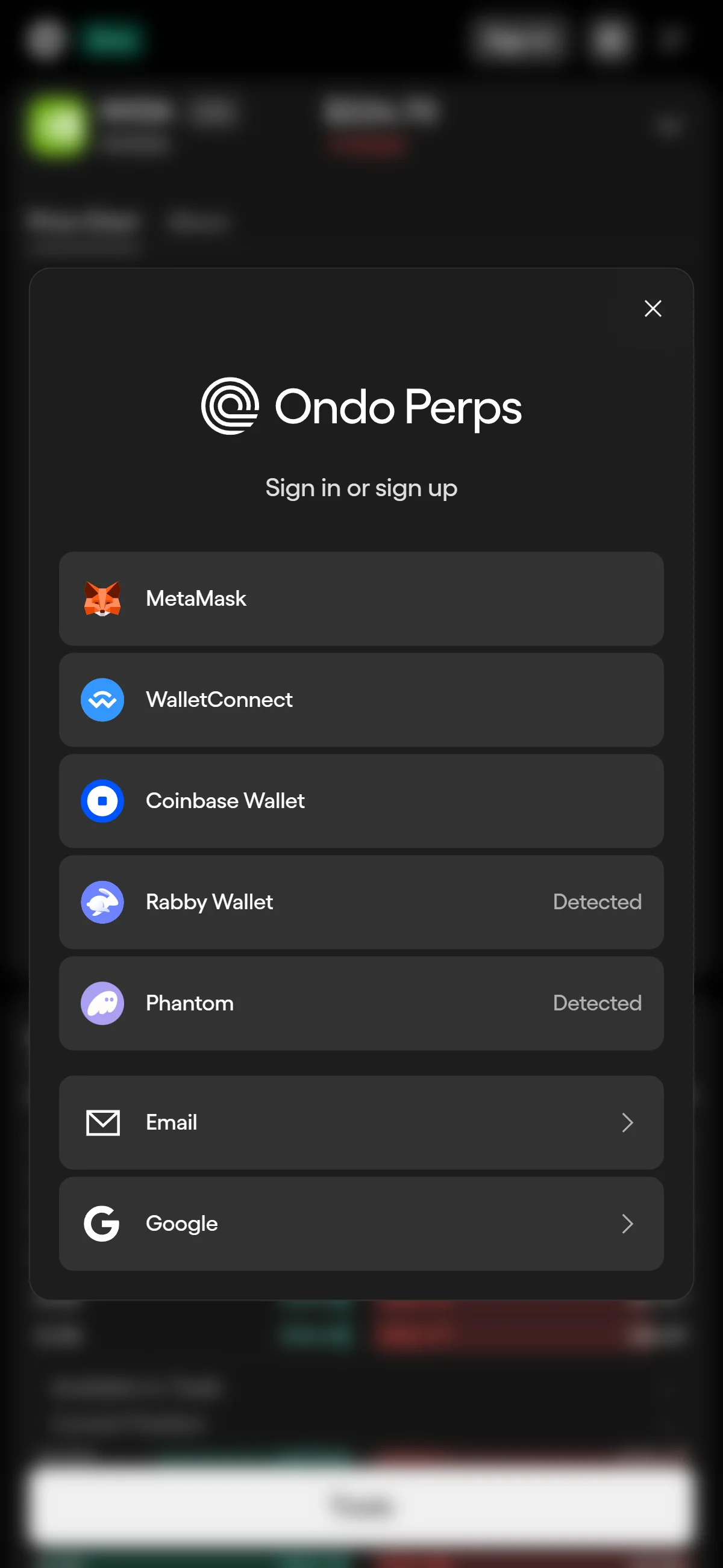
In the “Sign in or sign up” sheet, tap the wallet you want to sign in with — this walkthrough continues with “Rabby Wallet”, listed as “Detected” because that wallet is already available on the device.
“MetaMask”, “WalletConnect”, “Coinbase Wallet” and “Phantom” go through the same connection flow, and “Email” or “Google” at the bottom start an account without a wallet.
4. Approve the connection in your wallet app
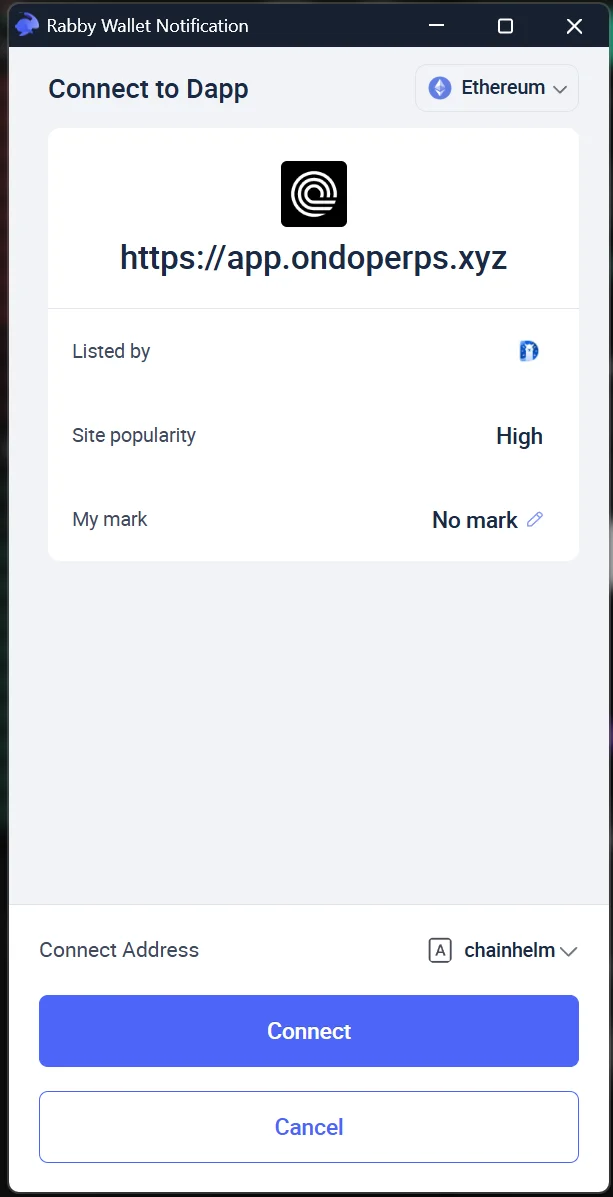
In the connection request that opens in your wallet app, check that the site reads https://app.ondoperps.xyz and that “Connect Address” shows the account you want to use, then tap “Connect”. The network at the top is set to “Ethereum”, and “Cancel” dismisses the request without connecting.
5. Retry a rejected connection
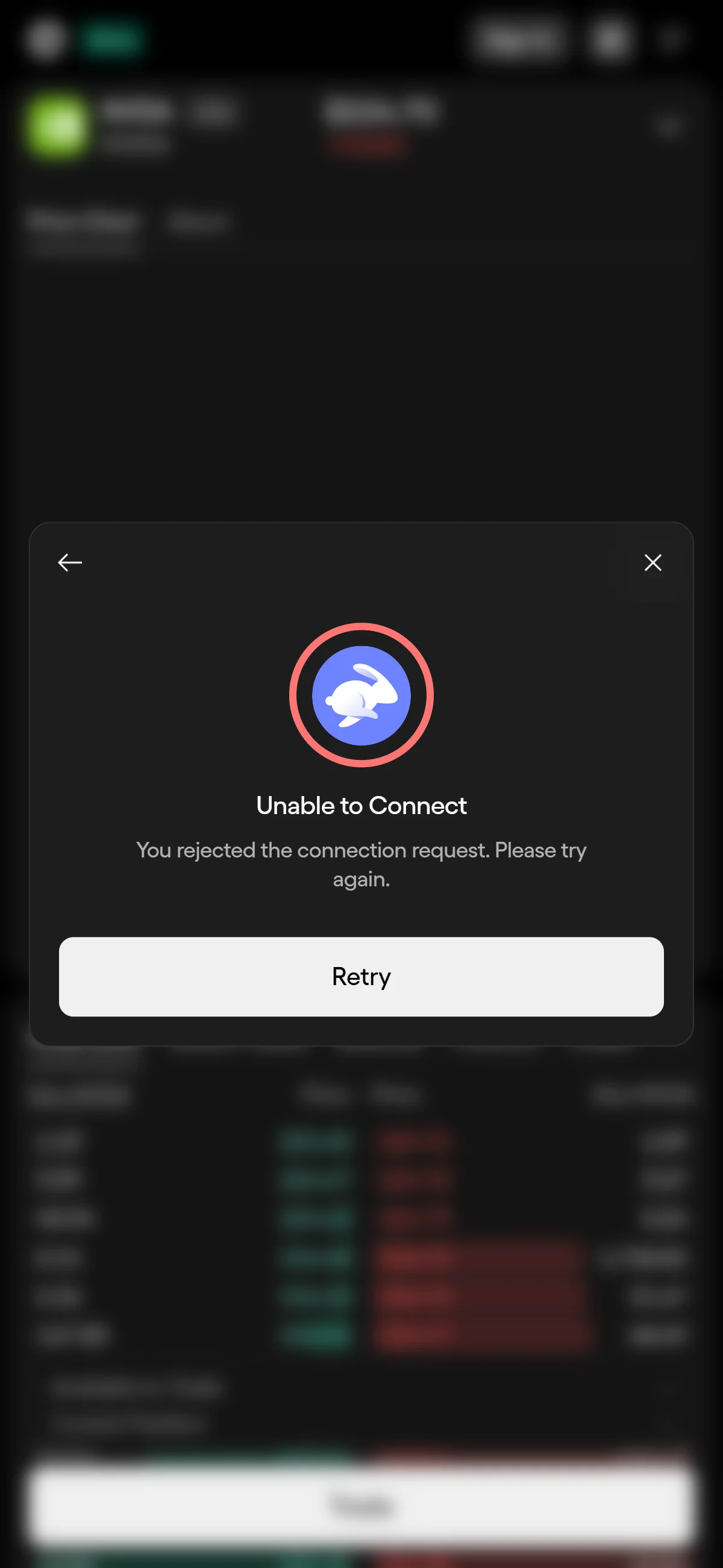
If you turned down the request in your wallet app, the sheet shows “Unable to Connect” — tap “Retry” to send the connection request again. The wallet’s connection approval comes back, and the flow picks up from there.
6. Switch to your wallet to sign
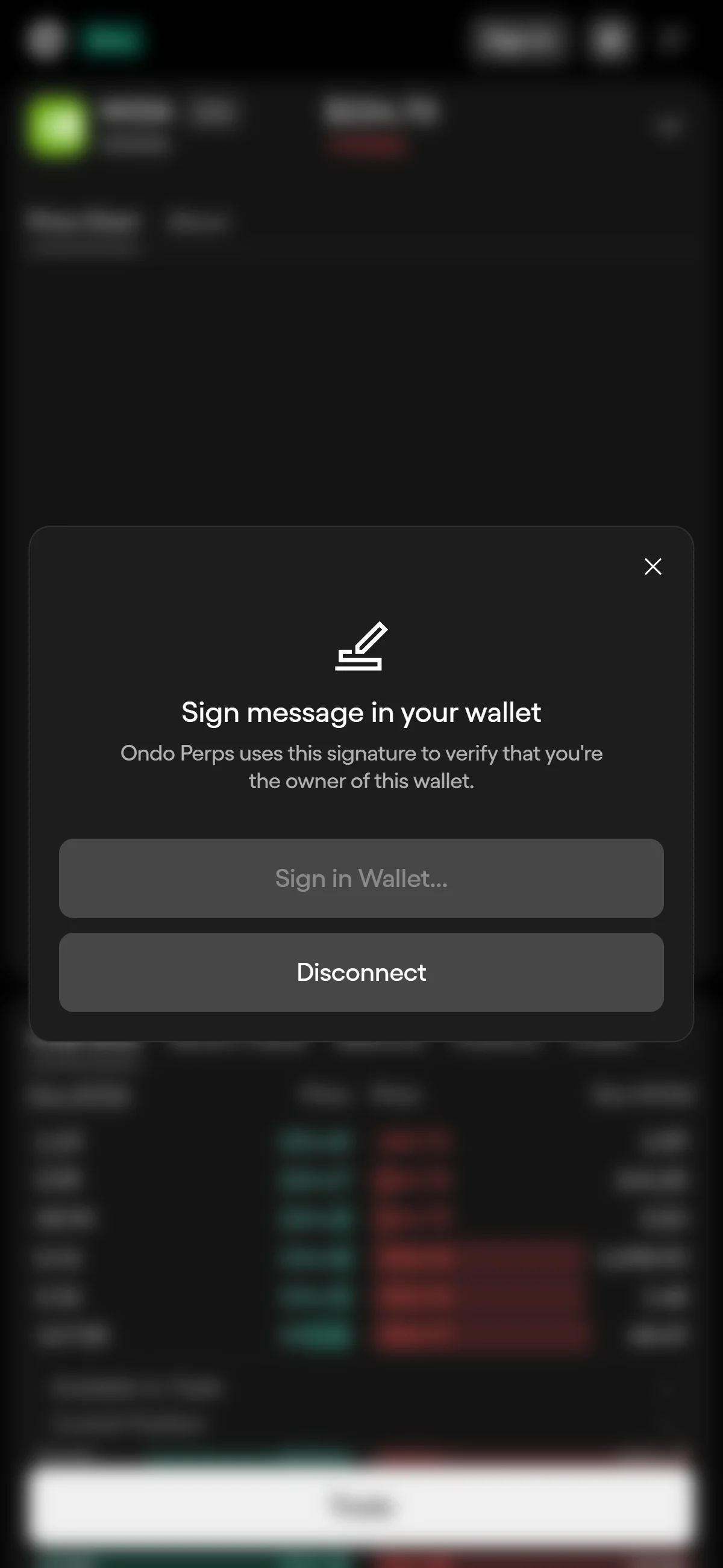
Switch to your wallet app and approve the signature request there; the sheet holds at “Sign message in your wallet” with “Sign in Wallet…” grayed out until you do. That signature is what proves you own the connected wallet, and “Disconnect” drops the connection if you would rather use a different account.
7. Sign the address verification message
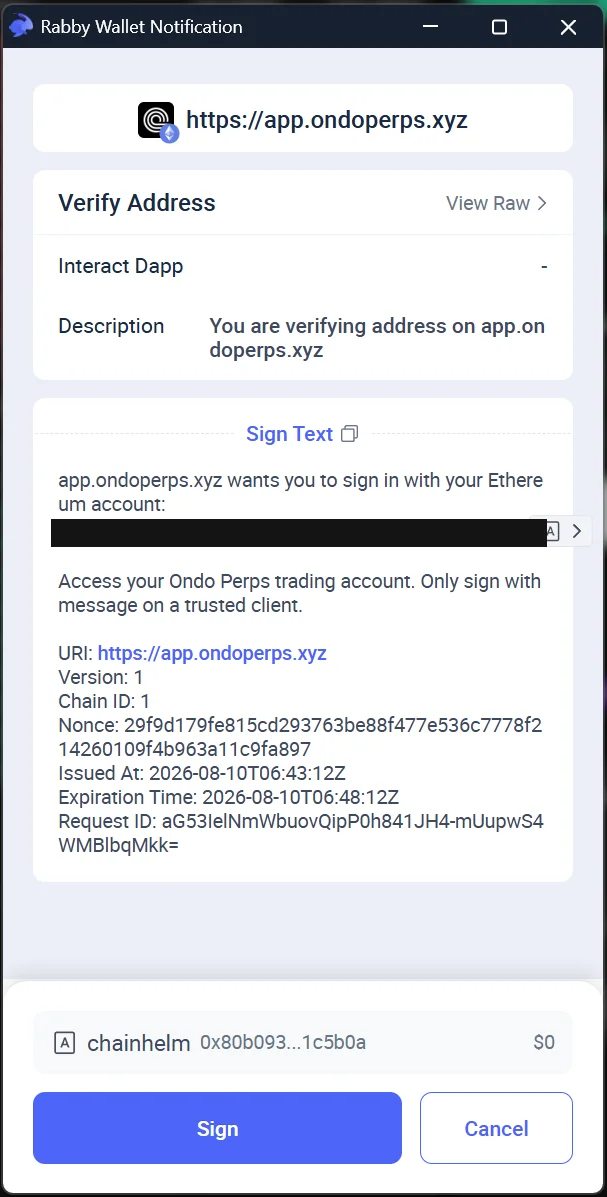
Read the “Sign Text” block — it names app.ondoperps.xyz as the site asking you to sign in with your Ethereum account — and tap “Sign”. The request is a “Verify Address” message carrying a nonce and an expiration time, so approve it while it is fresh; “Cancel” rejects it.
8. Confirm the signature to finish
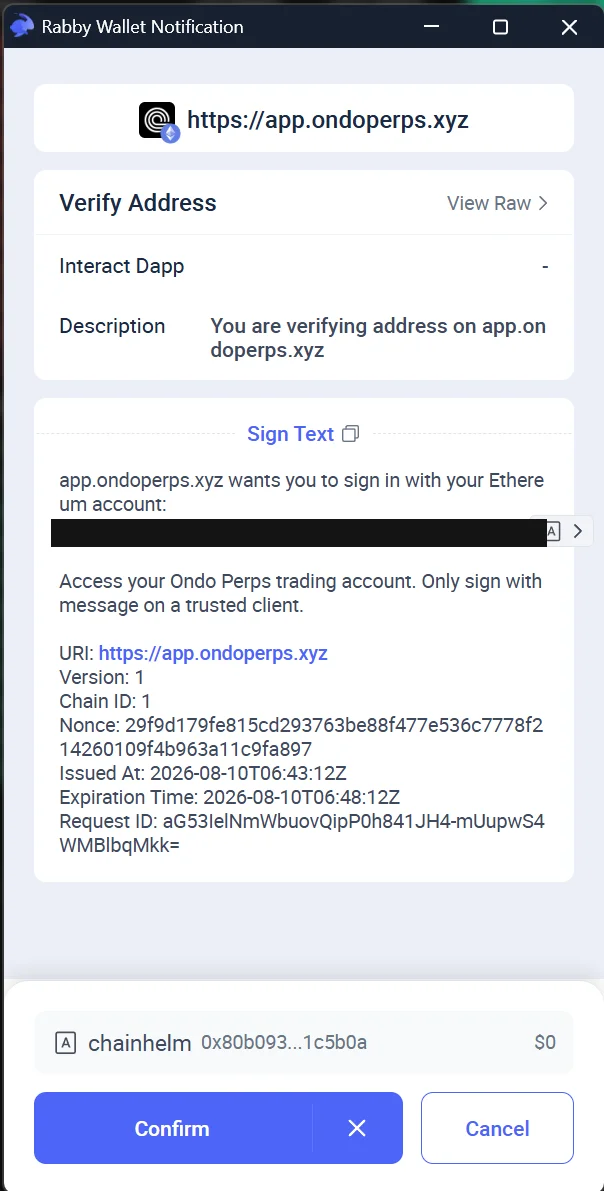
Tap “Confirm” — the wallet asks a second time before it releases the signature. The “Verify Address” and “Sign Text” contents are unchanged from the previous screen, so check them once more and use “Cancel” if anything reads differently.
9. Check the referral confirmation
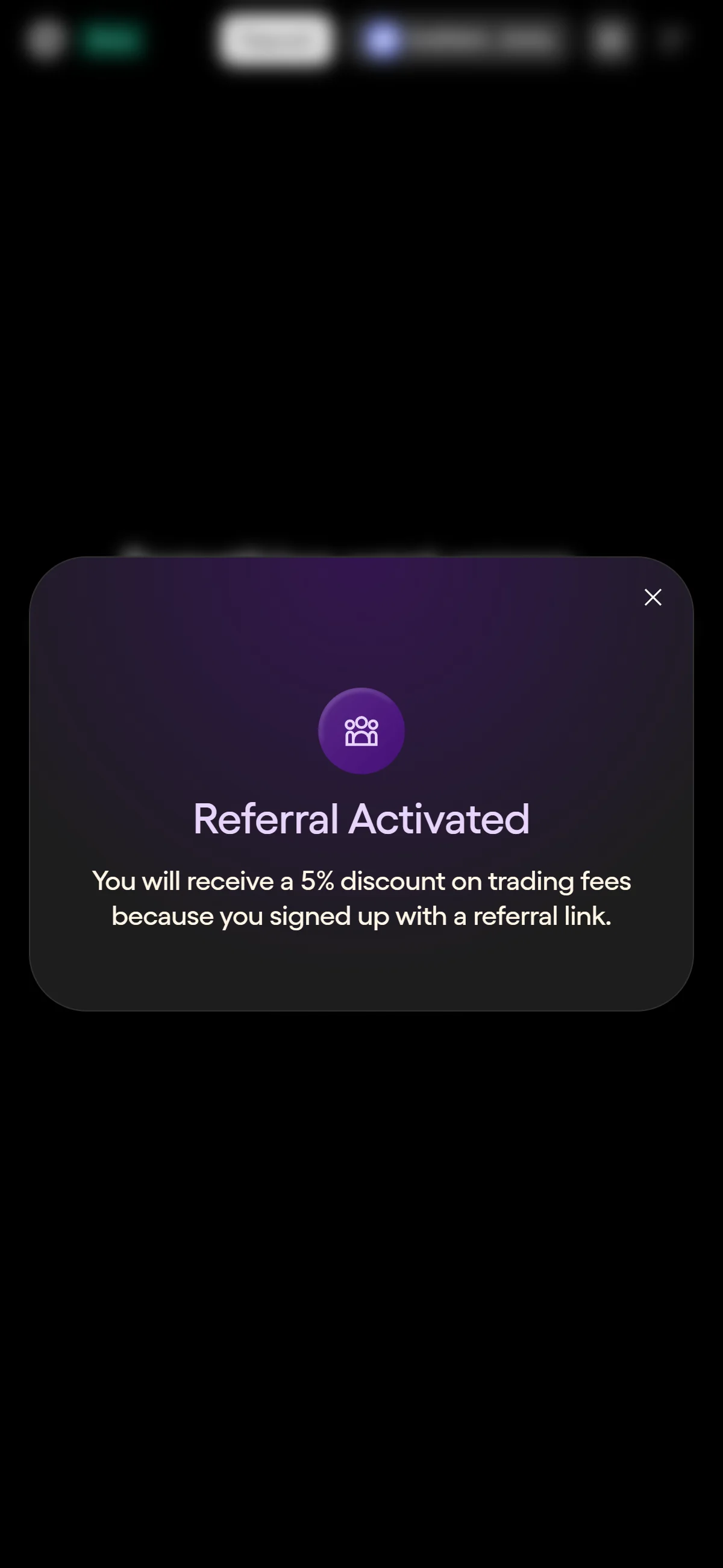
Check that “Referral Activated” appears once the signature goes through: the dialog states, “You will receive a 5% discount on trading fees because you signed up with a referral link.” Tap the X in the corner to close it after you have read it.
What to do after connecting to Ondo Perps
We cover the deposit process separately for PC/browser and smartphone (mobile).
PC/browser deposit steps
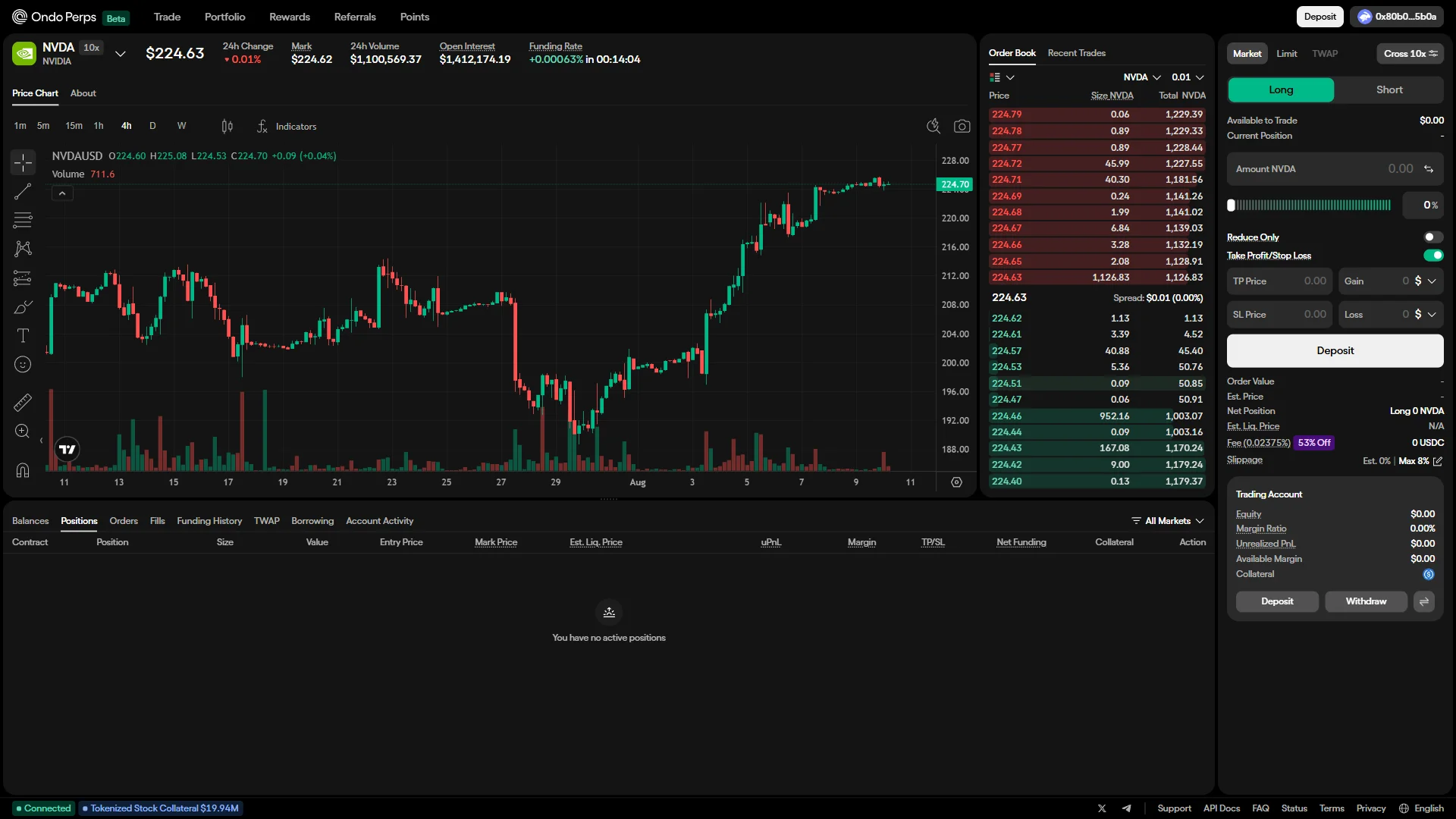
With the wallet connected, click “Deposit” in the header to start funding the trading account. The shortened address beside it shows which wallet the account is tied to, and the trading account panel reads $0.00 until a deposit lands.
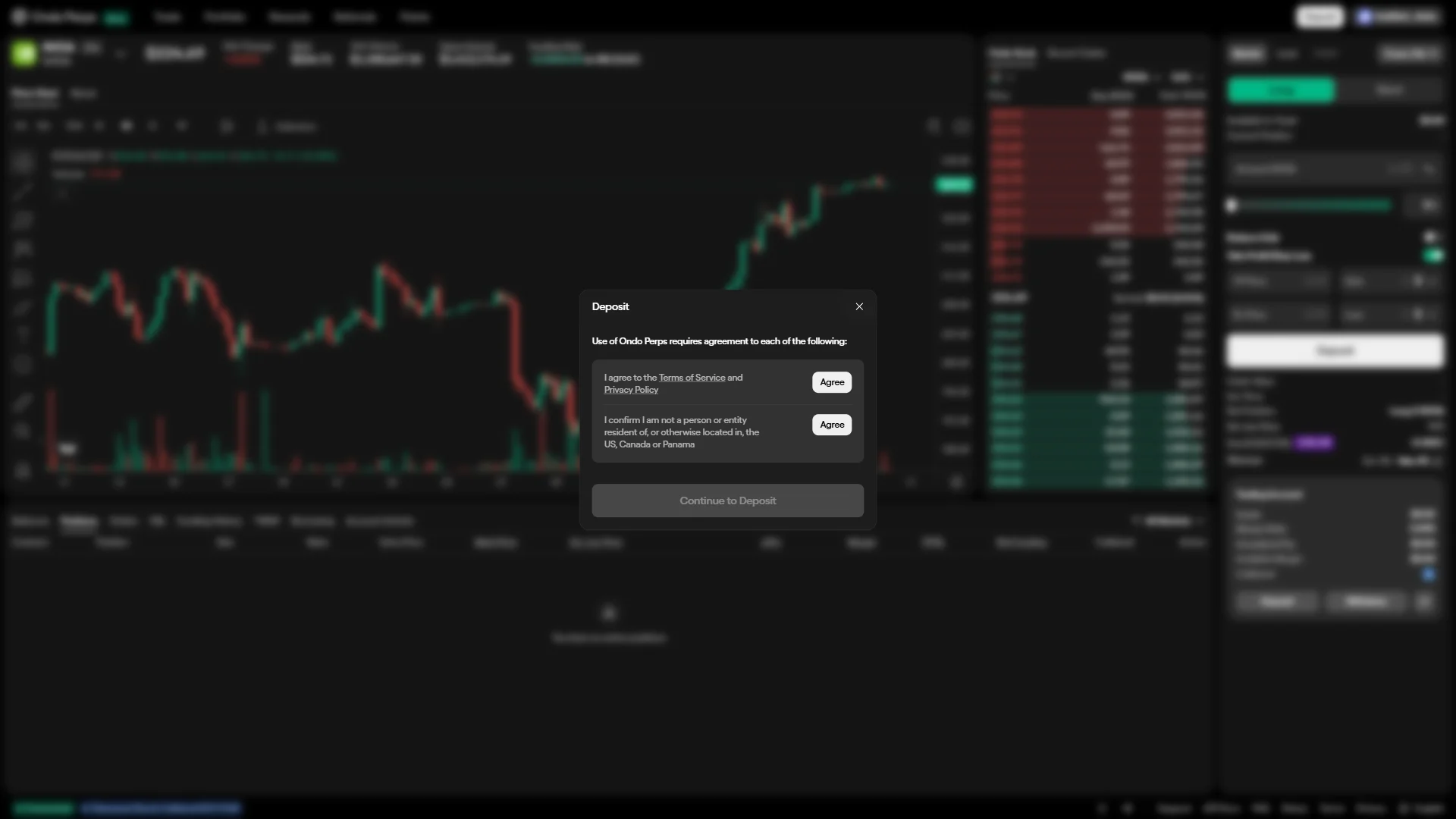
Click “Agree” on both rows of the “Deposit” dialog — one covers the terms of service and privacy policy, the other confirms you are not resident in or otherwise located in the US, Canada or Panama. “Continue to Deposit” stays grayed out until both rows are agreed.
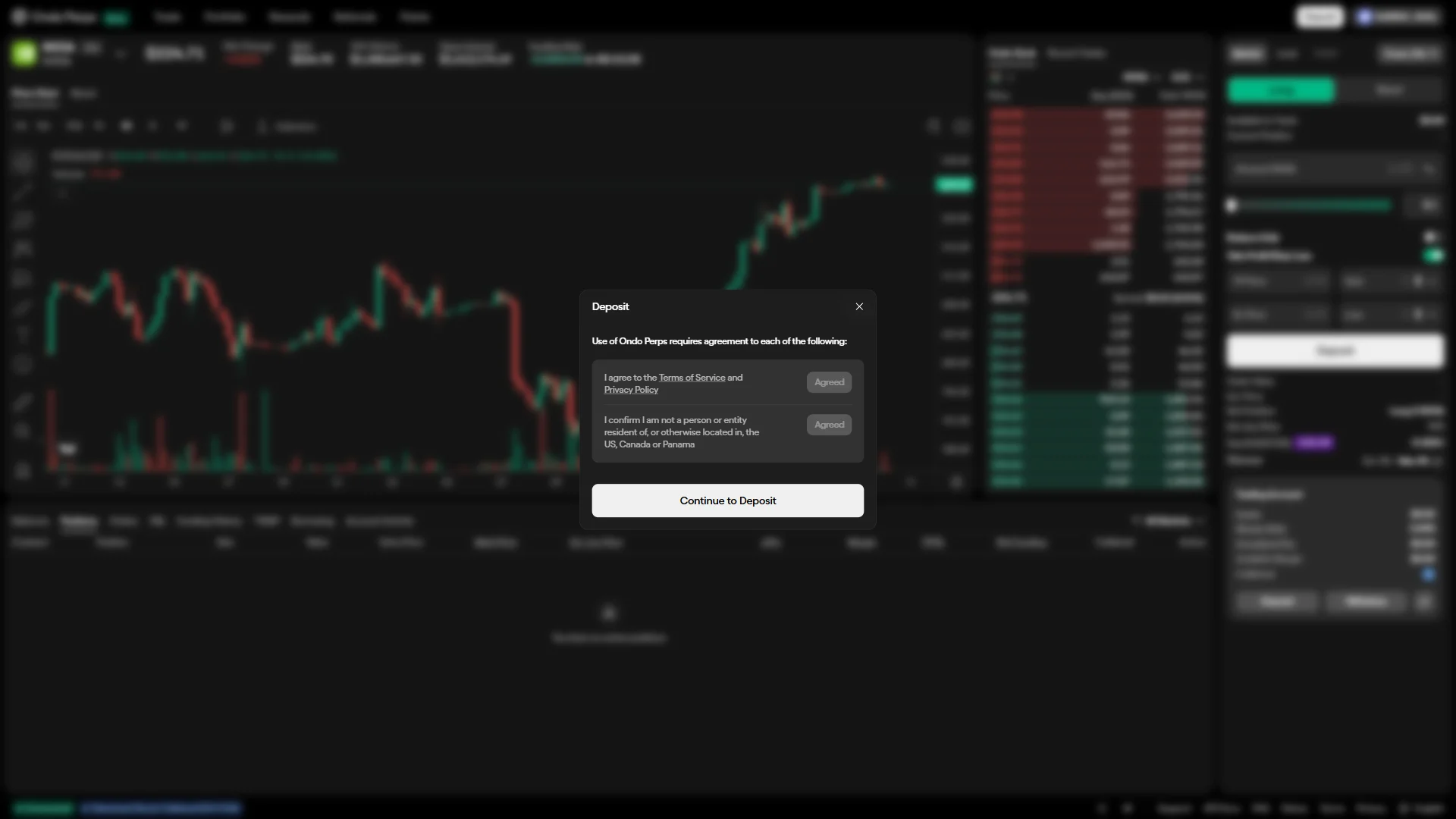
Click “Continue to Deposit”, which turns active once both rows read “Agreed”. If either row still shows “Agree”, the button stays disabled and the deposit form will not open.
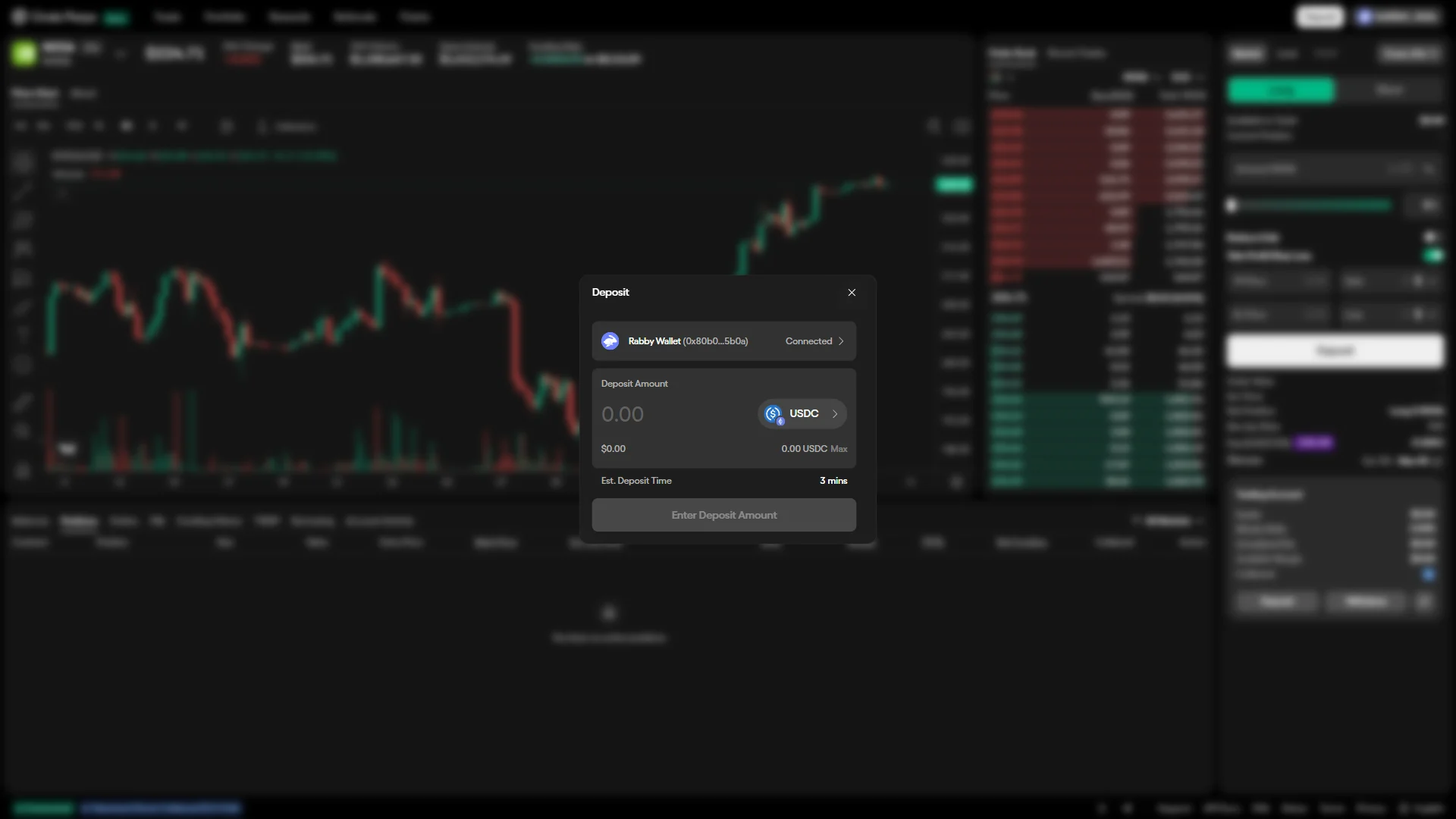
Enter how much you want to move in “Deposit Amount” — “Max” fills in the balance shown beside it, and the button stays at “Enter Deposit Amount” until a figure is in the field.
The funds come from the “Rabby Wallet” address marked “Connected” at the top, the asset is preset to “USDC”, and “Est. Deposit Time” reads “3 mins”; click the “USDC” selector to deposit something else.
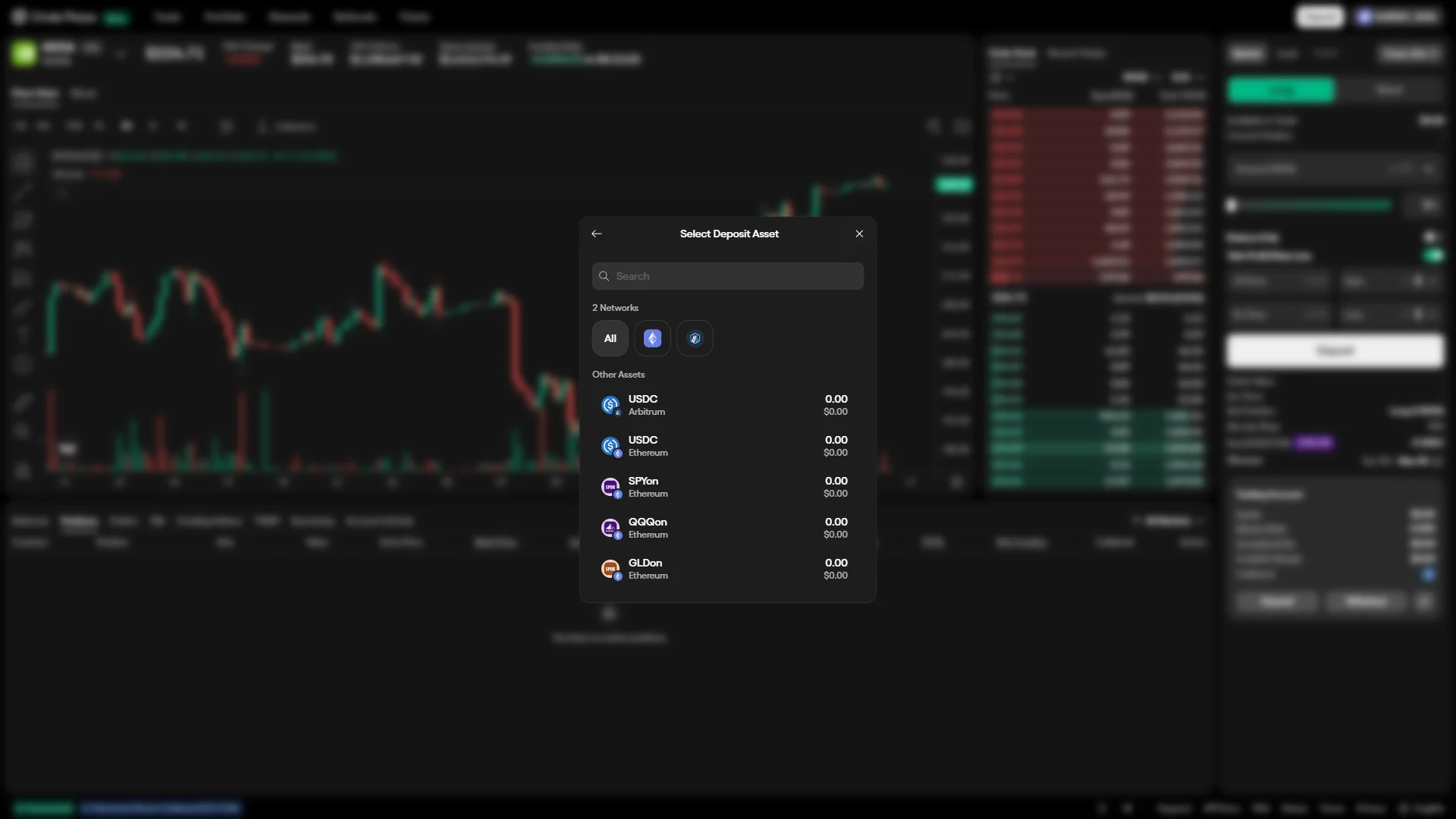
Click the asset you are sending, on the network you hold it on — “USDC” is listed once for “Arbitrum” and once for “Ethereum”, with “SPYon”, “QQQon” and “GLDon” on Ethereum below it. The chain buttons under “2 Networks” narrow the list to one network, and your choice returns you to the deposit form with that asset set.
Smartphone (iOS / Android) deposit steps
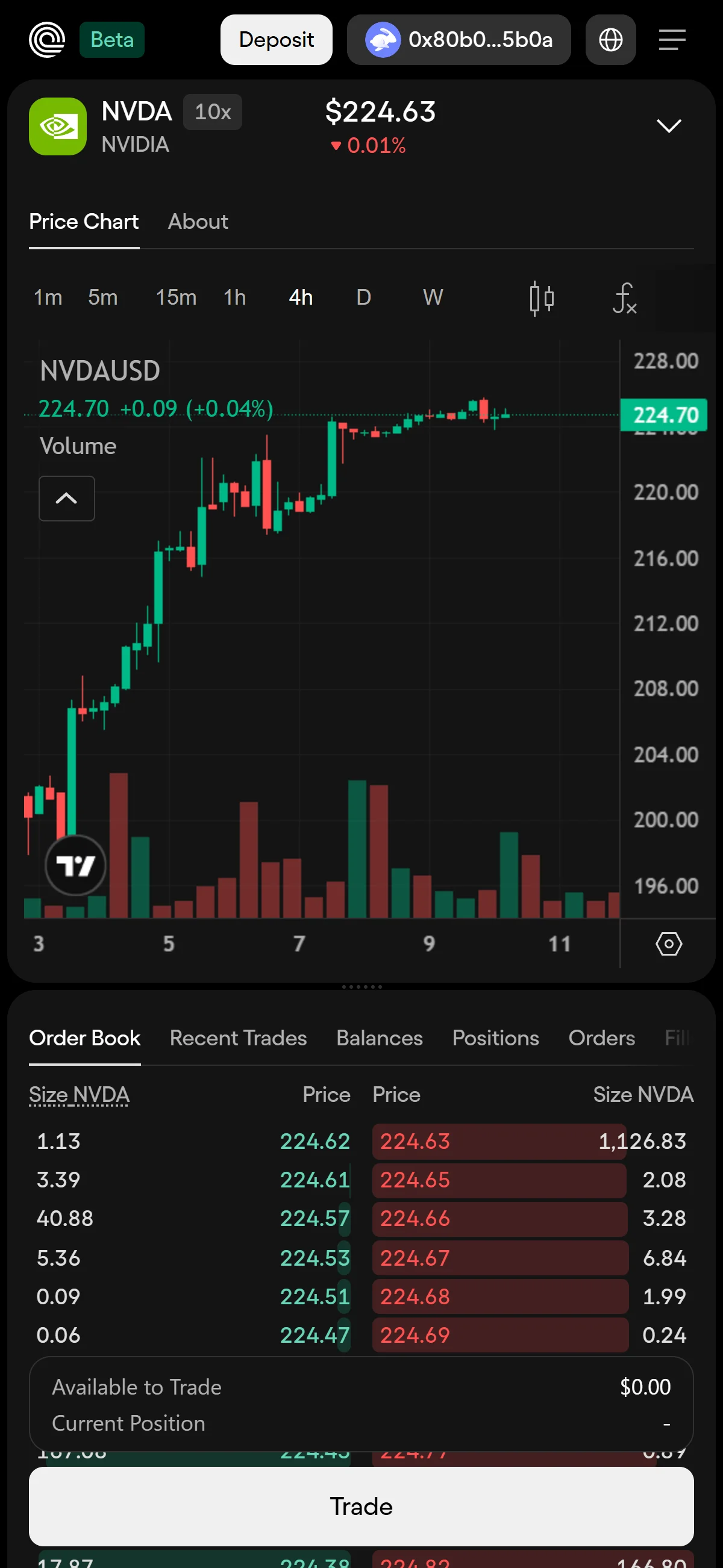
With the wallet connected, tap “Deposit” in the header to start funding the trading account. The shortened address beside it shows which wallet the account is tied to, and “Available to Trade” reads $0.00 until a deposit lands.
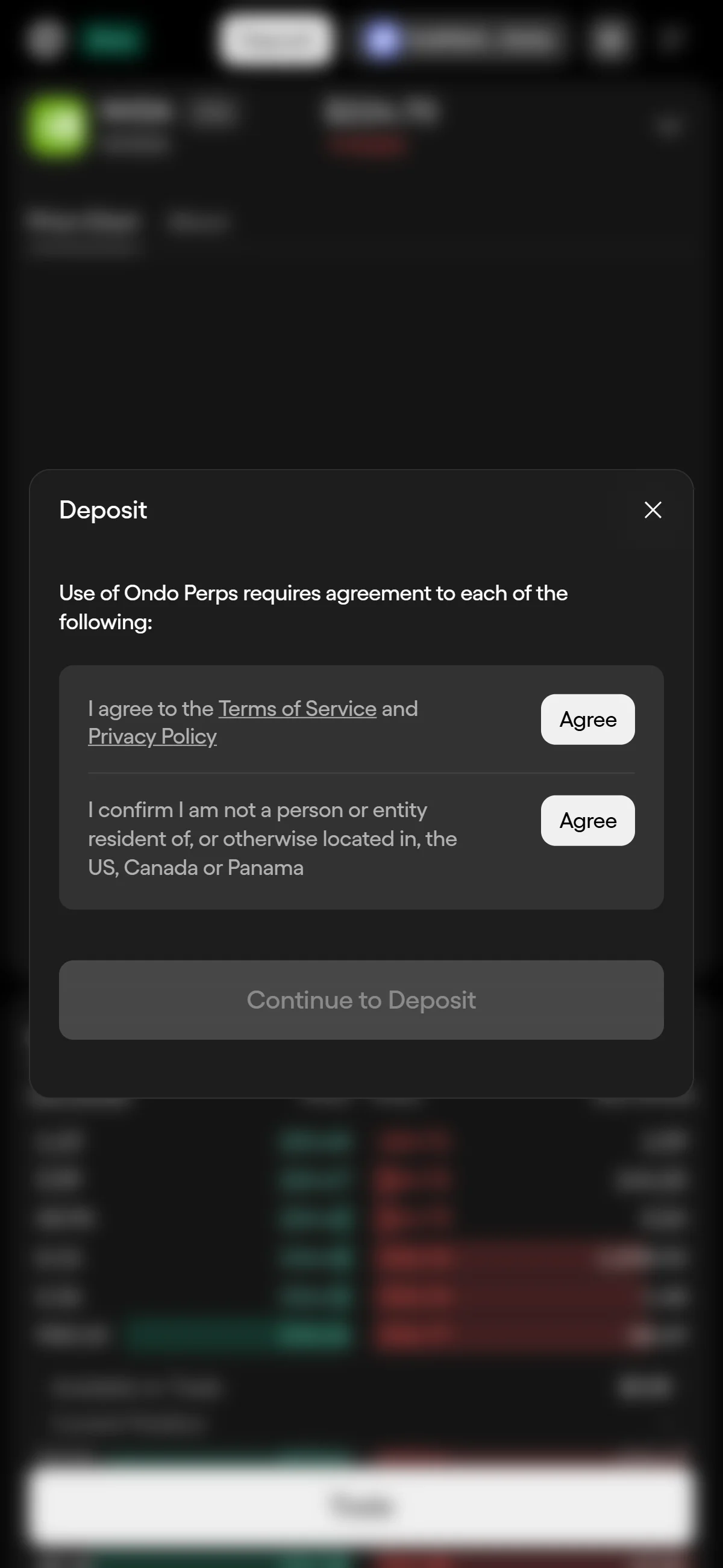
Tap “Agree” on both rows of the “Deposit” sheet — one covers the terms of service and privacy policy, the other confirms you are not resident in or otherwise located in the US, Canada or Panama. “Continue to Deposit” stays grayed out until both rows are agreed.
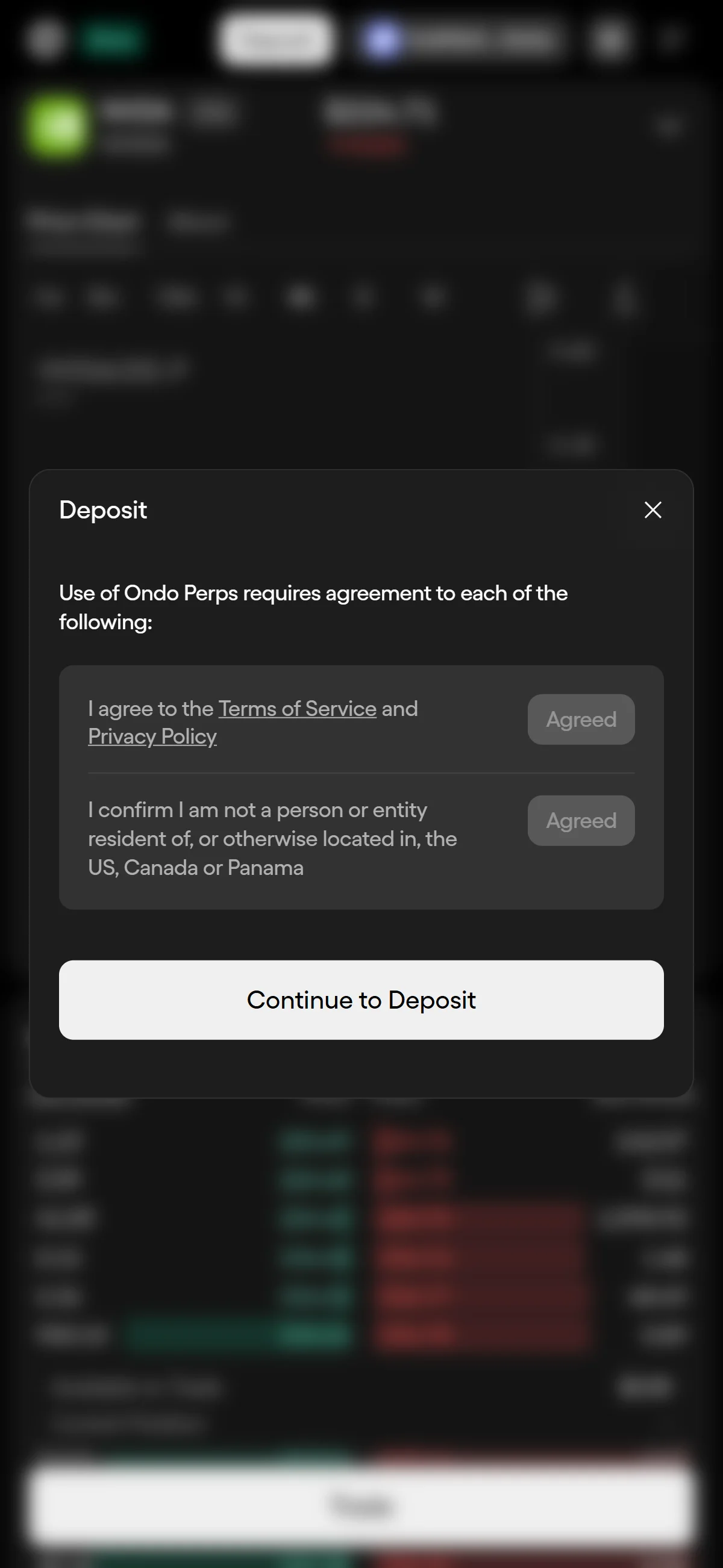
Tap “Continue to Deposit”, which turns active once both rows read “Agreed”. If either row still shows “Agree”, the button stays disabled and the deposit form will not open.
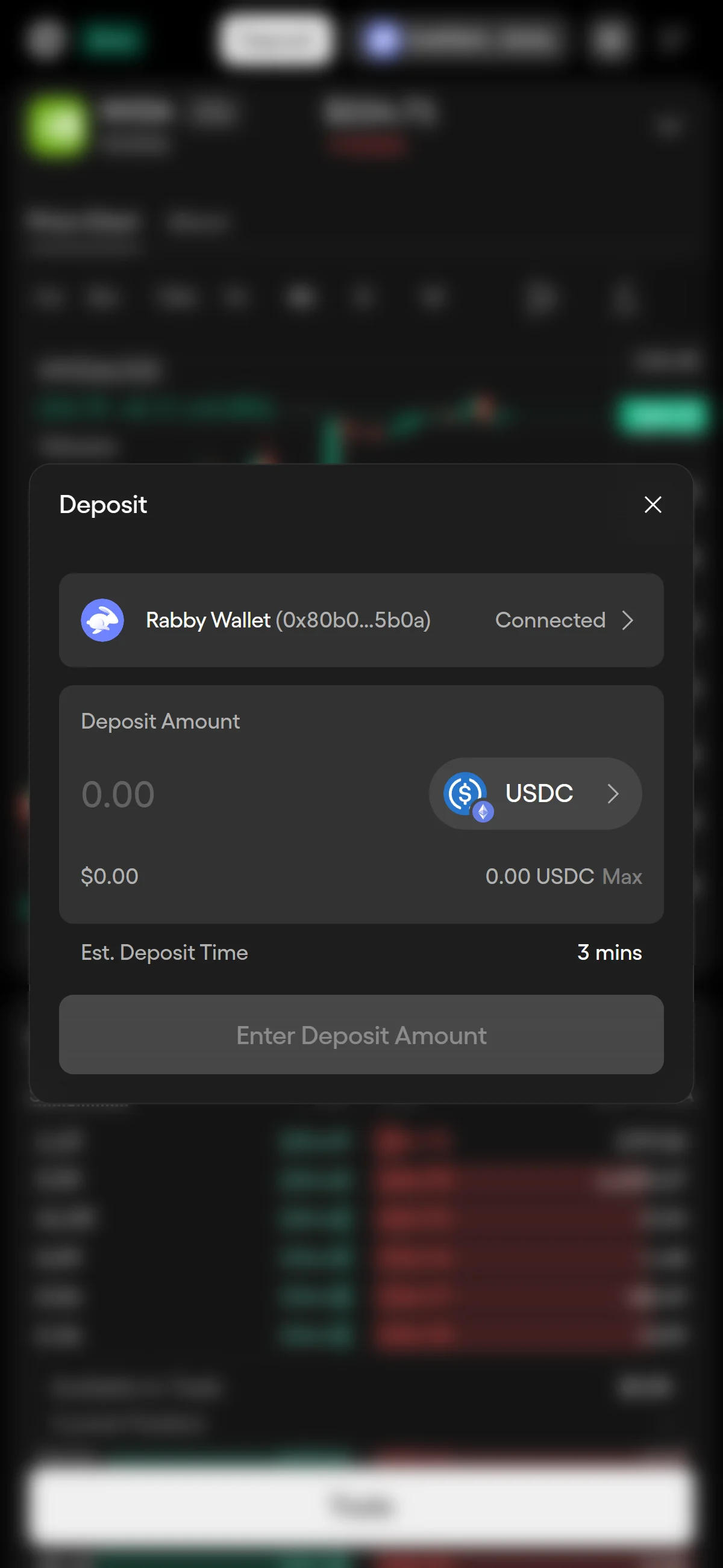
Enter how much you want to move in “Deposit Amount” — “Max” fills in the balance shown beside it, and the button stays at “Enter Deposit Amount” until a figure is in the field.
The funds come from the “Rabby Wallet” address marked “Connected” at the top, the asset is preset to “USDC”, and “Est. Deposit Time” reads “3 mins”; tap the “USDC” selector to deposit something else.
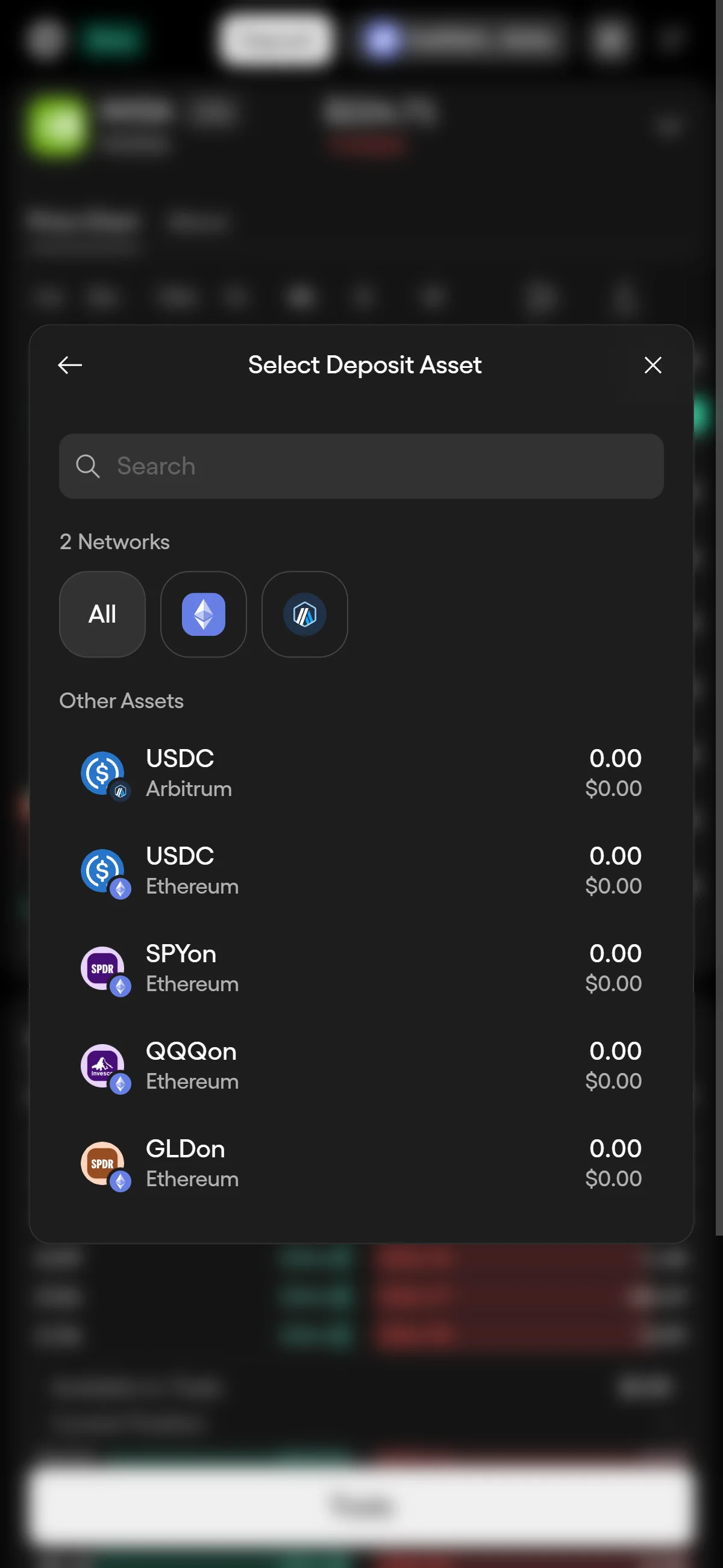
Tap the asset you are sending, on the network you hold it on — “USDC” is listed once for “Arbitrum” and once for “Ethereum”, with “SPYon”, “QQQon” and “GLDon” on Ethereum below it. The chain buttons under “2 Networks” narrow the list to one network, and your choice returns you to the deposit form with that asset set.
Once the deposit lands in the trading account, the balance is available and you can place your first order.
The Ondo Perps referral code cannot be added after sign-up
The referral code can only be applied once — the first time you connect your wallet.
If you complete the connection without the code applied, there is no way to link it to that wallet afterwards, and the only route left is to start over with a new wallet.
- Is referral code 8SEGN3 shown as applied when you connect your wallet? (check the notice that appears once you finish signing in)
- The only confirmation is the notice that appears as you connect. There is no page to check afterwards, so take care not to miss it
The reason there is no second chance is that the referral travels in the link rather than in a field. Nowhere in the sign-up sequence we walked through on 2026-08-10 was there a box to type a code into: you open the referral link, connect a wallet, sign twice, and the attribution is already decided. The confirmation is a modal that appears once as you sign in, so there is no page you can go back to and check. A Referrals tab does exist in the app navigation, but what we verified there was the referrer’s side of the feature — the surface where an existing account holder copies their own code to share. Treat it as that, not as somewhere a referred trader can look up whether a discount was attached.
◆ ◇ ◆
Ondo Points pays 5,000,000 points a week, and promises nothing beyond that
Almost every reader who arrives at a perp DEX from points coverage brings the same mental model: trade now, accumulate points, wait for a token. That model does not describe what is happening here, and the gap between the model and the facts is the most useful thing this section can give you.
How the weekly allocation is scored
Ondo Points is not a new perps program. It is a pre-existing loyalty program run by the Ondo Foundation — a different body from Ondo Global (Panama) Inc., which operates the trading venue — and what was added for Ondo Perps traders is a weekly allocation stream inside it.
What decides your share of that weekly pool is narrow: a score-weighted share of your trading volume and your open interest over the week — how much you traded, and how much you left open. Those are the only two things Ondo publishes as counting toward the perps allocation. The wider Ondo Points program does recognize other ecosystem activity — holding or minting USDY, providing liquidity with Ondo ecosystem assets, participating in Flux Finance, voting or delegating in the DAO — but none of that is part of the perps calculation. Balances show up in your account inside the app, and Ondo states that the specific mechanics may evolve in future weeks, so the scoring described here is the current design rather than a commitment.
The token already exists, so there is no pending distribution to anticipate
This is where the usual points story breaks. ONDO is not a future token. It already exists, and it has been freely transferable since transfer restrictions were lifted by a DAO vote on 2024-01-18, with an initial supply of 10,000,000,000 and no scheduled inflation. There is no token launch ahead of you to accumulate toward.
That is the whole of the published position, and this article will not go past it. There is no conversion rate to quote, no distribution date to anticipate and no way to put a number on what a point is worth, because Ondo has published none of those things. The program is documented as a loyalty program designed to reward eligible traders, and that is the level at which it should be judged.
Who the points program leaves out
Ondo states that points are not available to persons located in the US, Panama or other non-eligible jurisdictions. That is the same exclusion perimeter as the venue itself, applied to the rewards layer rather than to trading.
Beyond that jurisdictional bar, the conditions are simply not published. Ondo’s materials contain no anti-sybil rule against multiple accounts, no per-account cap and no similar condition specific to the perps allocation — which is not the same as saying none exists.
A Panama operator matching equity and commodity perpetuals off-chain
Who operates it, under whose law, and for how long
The counterparty you contract with is Ondo Global (Panama) Inc., a corporation of the Republic of Panama, and the Terms of Use are governed by Panamanian law. Ondo Finance Inc. is named separately as the technology provider, supplying the same infrastructure that sits behind Ondo Global Markets, and no incorporation jurisdiction is stated for it anywhere in the Ondo Perps legal or documentation pages. The Ondo Foundation, a third body, runs the points program.
One consequence of that split is worth stating plainly: the disclosed leadership sits with the technology provider, not with the entity you are contracting with. No officers are published for Ondo Global (Panama) Inc.
One consequence carries through the rest of this article: every number below describes a venue that has been open to the public since 2026-06-09.
Orders match off-chain inside a hardware enclave, and only transfers touch a chain
If you have used an on-chain DEX, the mental picture is that your trade is a transaction: you sign it, it goes to a blockchain, and anyone can inspect the result. That is not how this venue works, and the difference matters more than any label attached to it.
Ondo Perps runs a central limit order book — the same bids-and-asks structure a centralized exchange uses — with a matching engine that is entirely off-chain. The application logic runs inside Intel SGX hardware enclaves, a class of processor feature that isolates code so that the machine’s operating system and the cloud provider hosting it cannot read what is running there. A decentralized attestor set checks cryptographically that only approved code runs inside. Blockchains enter the picture only at the edges: the on-chain component processes deposits and withdrawals, and nothing else.
The custody consequence follows from that design rather than from any label. The on-chain component manages an omnibus account that holds collateral, and individual balances are tracked off-chain by the exchange engine. Ondo markets the venue as non-custodial and permissionless in design, while its own architecture documentation describes exactly that omnibus account and that off-chain balance record. The label matters less than the mechanism: while you are trading, what you own is an entry in the operator’s off-chain ledger against a pooled on-chain balance.
Ondo does document counterweights, and they are not nothing. The enclave publishes a reproducible-build attestation — a cryptographic fingerprint of the exact binary in use, so that a changed byte is rejected. The attestors hold split shares of the keys required to move user funds, and a quorum is needed both to move those funds and to change the enclave code. Ondo describes the attestor set as a fixed quorum today, with plans to expand it.
What is listed, and how much leverage each class carries
Two official sources disagreed about the market list on the same day. We have not picked between them; here is what each said.
27 contracts, 20x maximum
37 markets, 25x on some
Neither the contract count nor the leverage ceiling is settled, so treat any single number you see elsewhere — including in this venue’s own documentation — as one source’s reading on one date rather than as the settled fact.
The leverage rules underneath are documented consistently. Leverage is set per market, to any integer up to that market’s maximum, and margin is cross only: one collateral pool backs every position, with no isolated-margin option to ring-fence a single trade. Initial margin is 5.0% at 20x and 10.0% at 10x. The default maximum position size is 1,000,000 USD per market per account.
What matters more than the exact count is what the list is made of. These are perpetuals on equities, indices, ETFs and commodities — reference assets that close on Friday afternoon and reopen on Monday — rather than the crypto pairs that most perp DEX volume trades in.
What a trade costs before the discount
A 5% discount is only as interesting as the number it comes off, so this is where the referral becomes measurable.
Both trading rates are charged on filled notional, and both are described by Ondo itself as a temporary 50% reduction. The official fee page adds that actual fees may be lower depending on 14-day rolling volume or on individual account arrangements, but it publishes no threshold and no rate table, so there is no way to tell from the outside what a higher-volume account pays.
Funding is the other running cost, and if you have not traded perpetuals before it works like this. A perpetual has no expiry, so something has to keep its price tethered to the underlying; that something is a payment that flows between longs and shorts. Here it settles every hour on UTC hour boundaries. The engine samples the premium index once a minute and divides the hourly mean by eight, which means a sustained premium transfers across roughly eight hours rather than all at once. A fixed interest component of 0.03% per day sits inside the formula, and the rate is capped at 1% per hour in either direction. Equity perpetuals apply a 0.5x dampening multiplier while the underlying markets are closed, which lowers the baseline from about 11% to about 5.5% annualized over those hours.
There is no gas cost per trade because order placement, matching, margin computation and liquidation all happen off-chain; the network fees you do pay are Ethereum or Arbitrum fees. And there is no native-token route to a cheaper trade: no ONDO-based fee discount and no staking tier are documented on the fee page. If you were expecting to hold the governance token for a rebate, that mechanism does not exist here.
Which chains and assets fund an account, and how money comes back out
Deposits arrive on Ethereum and, since an official blog post dated 2026-08-04, on Arbitrum as well, where the only accepted asset is USDC. The documentation page still said Ethereum only when checked on 2026-08-06; the blog post is the more recent statement, so read the current state as Ethereum plus Arbitrum.
- USDC
- Accepted with no haircut and no cap.
- SPYon
- 10% haircut, capped at 146 tokens.
- QQQon
- 10% haircut, capped at 166 tokens.
- GLDon and SLVon
- Tokenized gold and silver, added 2026-08-05. Haircut and cap parameters were not published as of 2026-08-06.
Tokenized collateral is credited at quantity times mark price times one minus the haircut, so a haircut is a discount on how much margin your holding buys rather than a fee. No bridge is involved in getting any of it there: each account receives a permanent on-chain deposit address, and the documentation states that depositing requires no interaction with a smart-contract bridge.
The withdrawal rules are the part readers tend to discover too late, so read them before you fund an account rather than after. Assets return to the chain they came from, and the asset you withdraw must be the asset you deposited. Unrealized profit cannot be withdrawn until the position closes. Unrealized loss reduces the withdrawable amount dollar for dollar. And a negative USDC balance blocks USDC withdrawals outright.
◆ ◇ ◆
Rank 12 by perp volume, on a collateral model built out of tokenized stocks
Where it sits by volume and open interest, and the fee ranking that does not exist
Those ranks come from one platform on one day, and the underlying figures behind them are less firm than the ranks are. On that same date DeFi Llama, CoinGecko and CoinMarketCap reported roughly 196M to 241M USD of 24-hour volume and roughly 49.6M to 69.5M USD of open interest — a spread of about a quarter on volume and nearly a third on open interest. Read that as a range, not as a number waiting to be averaged.
The third ranking you would normally expect, fee revenue, genuinely does not exist for this venue. No perpetual fee revenue for Ondo Perps is published by anyone. There is a DeFi Llama fees entry under the name Ondo Finance, but its methodology measures the daily yield earned by holders of the group’s real-world-asset tokens, not trading fees on perpetuals; treating it as this venue’s revenue would misstate the business entirely.
One practical note if you go looking at those tables: DeFi Llama lists this venue under the parent name Ondo Finance rather than Ondo Perps, which is why searching the ranking page for the venue name returns nothing.
Posting tokenized stocks and metals as margin
This is the mechanism the venue is built around, and it is the one thing here you will not find on a mainstream perp DEX. Instead of posting stablecoins, you can post tokenized equities and commodities directly as margin. The holding keeps its price exposure while it sits there — it is only converted if the venue’s Auto-Exchange mechanism or a liquidation takes it — so you can take leverage without selling what you already hold.
The bounds are what make it a capped mechanism rather than an open-ended one. The 10% haircuts and per-asset caps listed earlier are the first limit; the gold and silver added on 2026-08-05 had no published parameters as of 2026-08-06, which is the second. The third is a hard ceiling on how much borrowing that collateral supports.
Non-USDC collateral can back a USDC debt of at most 30% of its margin value or 100,000 USD, whichever is lower.Ondo Perps documentation, 2026-08-06
Ondo describes this arrangement as a first for perpetual futures. What can be said independently is narrower and still meaningful: perp venues as a category accept stablecoins or major crypto assets as collateral, so posting a tokenized share as margin is not an option the category generally offers. Note also that in some countries the collateral side carries its own eligibility gate even where the venue itself is open — the country-by-country section below covers where that bites.
Markets that never close, priced against ones that do
There is a structural tension in a perpetual on a stock: the contract never closes, and the thing it references does. US equity markets stop at 16:00 ET on Friday, while the perpetuals keep trading through the night and across the weekend.
The venue’s answer is to put bounds on weekend price discovery. The bounds are set at the Friday close multiplied by one plus or minus the reciprocal of maximum leverage — about 5% either way in a 20x market. Orders that would execute outside that range are rejected, and once a bound is reached no further discovery happens at all. The premium index is zeroed when order book data is insufficient, and funding runs under the 0.5x dampening multiplier described earlier.
None of this has a counterpart on crypto-only venues, for the simple reason that their reference markets never close. It is a category-specific piece of machinery, and it is the price of listing an instrument whose underlying keeps office hours.
Hardware attestation offered in place of on-chain verifiability
Stripped to its essentials, the trade-off on offer here is centralized-exchange latency with hardware attestation substituted for on-chain verifiability. That is a different bargain from the one you usually weigh on a DEX, where settlement itself is the thing you can verify. What you give up in exchange is self-custody while trading: your balance is a record kept off-chain against collateral pooled in an operator-controlled account.
One signal that this was built to be integrated rather than merely used: the venue documents a builder-code program for third-party frontends and runs a public sandbox environment with demo funding.
◆ ◇ ◆
The venue excludes its own home jurisdiction, and holds no license anywhere
The most telling line in the Terms of Use is not the exclusion of the United States, which anyone would predict. It is the exclusion of Panama — the jurisdiction the operator is incorporated in. A venue that will not serve customers in its own home country is telling you something about how it manages regulatory exposure, and the rest of this section is that story in detail.
The exclusion list, and the two clauses that extend it without naming anyone
The Terms of Use, last updated 2026-06-08, name as Designated Restricted Territories the United States including its territories, possessions and districts, the Republic of Panama, Russia, Iran, Ukraine, North Korea, Venezuela, Afghanistan, Cuba, Somalia, Sudan, South Sudan, Canada, the Crimea, DNR, LNR, Kherson and Zaporizhzhia regions and the city of Sevastopol, Libya, Myanmar and Belarus, together with sanctions-listed countries.
That enumerated list is not the whole of the exclusion, and the two clauses that extend it matter as much as the names, because they operate by reference to local law rather than by enumeration.
Wherever the offering would be unlawful or require a permission
Wherever this product class is restricted
Both are self-executing and unenumerated: no list is published of the countries they capture, and no determination is published for any particular country.
Enforcement, in the order the operator documents it, runs from paper to code. First, when you accept the Terms you represent that you are not a restricted person. Second, the operator reserves the right to blacklist connected wallets, block wallet addresses from using the site and freeze the associated digital assets. Third, it may apply further access controls in restricted territories. The Terms also require you to provide information and documentation on request for anti-money-laundering, counter-terrorist-financing and sanctions compliance, and set a minimum age of 18.
Why a block here is not the website-level block a DEX reader expects
If you have used perp DEXs before, you carry an assumption from them that does not hold at this venue, and no other structural difference here matters more.
The familiar picture is two layers: a frontend that can be geo-blocked, sitting over an on-chain protocol that anyone can reach. Here there is no second layer. Matching, margin computation and liquidation all run inside an operator-run off-chain enclave. Collateral sits in an on-chain omnibus account controlled by the operator, and individual balances live off-chain. There is no pooled smart contract governing user funds and no public contract interface. Deposits go to an address the operator provisions for your account, and the published API exposes no unauthenticated trading path.
No license anywhere, one closed investigation, and an unsettled question about securities
Ondo Perps holds no license for the perps venue in any jurisdiction. The venue’s own disclaimer is blunt about it: neither the platform nor the perpetual futures contracts traded on it are registered with Panama’s securities regulator, the US Securities and Exchange Commission, the US Commodity Futures Trading Commission, or any other regulator anywhere.
There has been exactly one regulatory proceeding involving the group, and its scope is worth stating precisely because it is easy to misread. The SEC opened an investigation into Ondo Finance — the start date is given as around 2023-10 by media coverage and as 2024 by Ondo itself, so treat it as unsettled — and closed it in 2025-11 with no charges, no enforcement action and no settlement. Its subject was the tokenization of US Treasury products and the classification of the ONDO token. It predates the perps venue and was not directed at it.
The unsettled part is elsewhere. The reference assets are US-listed equities, ETFs and indices, which are securities in their home jurisdiction, and the collateral this venue accepts includes tokenized equity and commodity products. Ondo Finance filed a no-action request with the SEC on 2026-04-13 concerning Ondo Global Markets — a different product from Ondo Perps — and no outcome was published as of 2026-08-06.
Put those together and the direction of travel is clear enough. The venue’s answer to securities exposure is jurisdictional exclusion rather than authorization. It is available by exclusion, not by license, and that distinction shapes every country answer below.
The United States is excluded by name; the UK, Singapore, Australia and India are not
One mechanism produces all five answers below: a server-side check on the connecting IP address, whose country list the operator does not publish, sitting on top of the named exclusion list from the Terms of Use. Because the list behind that check is not public, a country’s absence from the written exclusions is evidence about the documents, not a guarantee about the gate. Every status below is dated 2026-08-06, the date of the documentary checks; the code verification on 2026-08-10 is a separate exercise and covers only the sign-up flow.
The United States is barred by status as well as by location
The Terms of Use name the United States — including its territories, possessions and districts — as a Designated Restricted Territory, the site carries an explicit no-access disclaimer for the US, and the documentation states that persons and residents of the US are not eligible to use the platform. There is no hedge to add to that.
The definition is the part readers miss. A US person is defined by reference to Regulation S, the Commodity Exchange Act and the Internal Revenue Code, which makes the exclusion status-based: it attaches to the person and follows them wherever they are, on top of the separate bar on anyone located in, resident in, organized in or placing orders from the US.
Connect that to the structural point above and the practical meaning becomes sharper. Because there is no permissionless contract layer underneath this venue, an exclusion here closes the venue itself rather than merely a website.
On the question a US reader actually wants answered, the honest position has two halves and both need stating. US registration duties for this product class attach to the platform operator, not to an individual retail trader, and no primary source imposes a penalty on a US resident merely for trading on an unregistered offshore perpetual futures venue. That is not the same as a clearance. It would be wrong to say that US users commit an offense, and equally wrong to say that it is lawful for them; what is established is that the venue does not accept them.
There is a second closed door as well. The tokenized stocks accepted as margin are separately closed to US persons by their issuer, Ondo Global Markets (BVI) Limited, so a US person is excluded at the venue layer and again at the collateral layer.
For regulatory backdrop: the CFTC’s policy statement of 2026-05-29 directs that perpetuals referencing equity securities or narrow-based security indexes go through review by the Commission alongside the SEC. For perpetuals of that kind — the class this venue trades — that means no approved onshore US route existed as of that date, even though the Commission approved a bitcoin perpetual for listing by a US designated contract market on the same day.
One limit on that verification: chainhelm did not observe this venue’s behavior from a US IP address. The determination above rests on the operator’s own documents, not on a block we watched happen.
The United Kingdom is not on the exclusion list, and the UK rules that exist bind firms
The United Kingdom is not named in Designated Restricted Territories, verified by a full-text scan of the Terms of Use that returned zero occurrences, and Ondo’s own materials describe availability as global outside the US, Panama and other prohibited jurisdictions. The limit on that finding is the gate: it was not exercised from a UK IP address in our research. No evidence of a block — and no positive confirmation either.
On where the obligations sit, no UK provision was found that makes it an offense for a UK resident to trade perpetual futures on an offshore, non-UK-authorized venue. The general prohibition in section 19 of the Financial Services and Markets Act 2000 operates on the firm side, and the conduct rules that follow bind firms marketing, distributing or selling to retail clients.
The gap a UK reader should see is easiest to read in numbers. FCA retail leverage caps set minimum initial margin at 20% for individual equities and 5% for major stock indices and gold. Against that, the venue’s own API on 2026-08-06 recorded up to 20x on single stocks and 25x on the indices and on gold. The retail protections that travel with those caps — margin close-out and negative balance protection — are not entitlements here, and the Terms expressly disclaim liability for changes to margin requirements, leverage limits, position-size caps, funding rates, fee schedules or liquidation parameters.
A separate UK rule is worth keeping distinct from the leverage caps: the FCA’s retail prohibition on cryptoasset derivatives. It is relevant because that same live API call on 2026-08-06 returned two crypto markets that the documentation page omitted on the same date. Each observation comes with its own source and date; neither settles what the market list is.
No UK authorization was found for any Ondo entity, and no FCA statement names this venue. One caution, because a search of the FCA Warning List is easy to misread: three brand-similar entries there reference neither this venue nor Ondo Finance. No FCA warning names Ondo Perps.
The consumer consequence is the one the FCA states itself. Dealing with an unauthorized firm means no access to the Financial Ombudsman Service and no FSCS protection.
Singapore reaches the venue, but not the tokenized-stock collateral
A full-text scan of the Terms of Use returns no occurrence of Singapore, so it is not among the Designated Restricted Territories, and a session that loaded the app produced the complete trading interface, with no restriction screen in the way. The limit matters just as much: that session came from an IP address outside Singapore, so what it shows is the absence of an exclusion in the documents, not that a connection from Singapore gets through.
Obligations here sit on the provider side, not the user’s. MAS directs licensing duties at service providers, and no Singapore provision was identified that makes it an offense for a resident to open or hold an account on an unlicensed offshore derivatives venue.
The closest thing to a precedent is a standing posture rather than a finding. In 2025-06 MAS and the police ordered ISP-level blocking of two unregulated overseas leveraged-trading platforms under the capital markets licensing regime, and existing account holders lost access when it took effect. The profile here — leveraged perpetuals on equities, indices and commodities, offered by an unlicensed offshore operator — matches the fact pattern MAS described in that release. MAS has made no finding on this venue.
Register checks come back empty in both directions, and neither absence proves as much as it looks: the operator is not in the MAS financial institutions directory and not on the Investor Alert List, but MAS states that the alert list is not exhaustive, and not being listed is not authorization.
Then there is the fact that makes Singapore different from the other four countries here. The perps venue is open to Singapore; the tokenized stocks that are its headline collateral are not. Singapore residents must qualify as accredited or institutional investors under the Securities and Futures Act to hold them, with documented evidence of eligibility and full identity verification at that layer — a materially heavier gate than the venue itself applies. A non-accredited Singapore resident can still trade, using USDC collateral, which carries no haircut and no cap. That is a description of who can hold what here, not a suggestion to pursue accreditation.
Australia is absent from the list, and the licensing duty sits with the provider
Australia is not named in Designated Restricted Territories, confirmed by a full-text scan of the Terms of Use. As with the UK and Singapore, no session from an Australian IP address was observed, so nothing here tests the server-side gate itself.
No Australian law was identified that prohibits a resident from trading on an offshore perpetual futures platform. ASIC frames the duty at the provider: an entity providing financial services in relation to financial products offered in Australia needs a license. Its updated guidance of 2025-10-29 classifies futures referencing digital assets, including perpetual futures, as derivatives requiring an Australian financial services license with the right authorizations, and states that Australian law applies where services are provided in Australia, including from offshore.
ASIC’s standing warning about unlicensed entities is framed as lost protection rather than personal illegality: using an unlicensed entity means going without the investor protections a licensed provider must give. In practice that means no external dispute resolution scheme, no statutory client-money protection and no local recourse.
This operator holds no Australian license, and no Australian action names it. A name search of the AFS licensee dataset returned no record for any Ondo entity, and no ASIC or AUSTRAC alert, media release or notice names the venue.
One question is better left open than resolved. Australia caps retail leverage on contracts for difference — 20% initial margin on single equities, 5% on major indices and gold, 10% on other commodities — through a legislative instrument whose application provision can reach an offshore issuer. But whether these equity perpetuals are contracts for difference under that instrument turns on a definition that generally excludes futures with fixed termination dates, which a perpetual by construction does not have. No Australian authority has determined it, so the elements are here and the conclusion is not.
India is named in no exclusion list, which is not the same as being cleared
Two halves make up the Indian status, and only the two together are accurate. First: India is not named in Designated Restricted Territories, and it appears in none of the operator’s other exclusion lists either — not the documentation eligibility statement, and not the separate prohibited and conditional-eligibility lists for the tokenized collateral. That was verified by full-text scan, with zero occurrences. Second: the operator nowhere affirms India as an eligible jurisdiction, and the two self-executing clauses described earlier reach jurisdictions by reference to local law rather than by name. Take the first half on its own and it overstates eligibility.
The obligations that do exist sit with service providers. India’s financial intelligence unit takes the position that registration duties for virtual digital asset service providers are activity-based and not contingent on physical presence in India, and its enforcement pattern against offshore venues serving Indian users has been notices followed by URL blocking, with a monetary penalty in one case. No Indian authority has named this venue.
For the individual, the treatment is unaddressed rather than permitted, and that distinction is the whole point. The government’s stated position is that crypto-assets are presently unregulated in India except for taxation, anti-money-laundering and reporting. Whether an equity perpetual referencing a US-listed share, settled in stablecoin on an offshore venue, is a derivative contract over securities under Indian securities law has never been determined by the regulator or by any court. It is genuinely open, in both directions.
Tax is where an Indian reader gets the most to work with, and it comes as two facts and one gap. Virtual digital asset income is taxed at a flat 30%, with no deduction other than cost of acquisition and no set-off or carry-forward of losses. Withholding of 1% applies, and holdings and gains are reported through the dedicated schedule in the return. The gap: whether profit and loss on a perpetual futures position falls under that regime, or is instead business or speculative income at slab rates, has not been clarified — and the two produce materially different outcomes on the same trading record.
There is also nothing from the platform to reconcile a return against. The venue performs no identity verification and issues no Indian tax documentation, so reporting is entirely self-assessed. The liability itself is unaffected by the absence of reporting.
◆ ◇ ◆
No audit of the engine, collateral in an omnibus account, and an insurance fund of undisclosed size
No independent audit covers the exchange engine
No published security audit covers the Ondo Perps exchange engine, and that is a checked absence rather than an assumed one. The parent company’s audit index is not a substitute: the reports in it come from well-known firms, but every one is scoped to other Ondo products — the tokenized securities contracts, the funds — rather than to the perps matching engine, the on-chain component or the enclave.
Two things compound that gap. There is no public repository for the engine, and because matching and margin run inside a closed enclave, there is no on-chain code for a third party to read either. Whatever assurance exists here does not come from anyone outside having looked at the code.
What does exist is that bug bounty, alongside the enclave attestation and attestor quorum described earlier. It carries conditions worth knowing before you read the headline reward: participation requires a 20 USD deposit and identity verification. None of it amounts to an audit of the venue.
Collateral sits in an operator-controlled account
Collateral is held in an operator-controlled omnibus account, with individual balances recorded off-chain. While you have a position open, you are not holding it in self-custody — you hold a claim recorded on the operator’s ledger.
Who can change what runs inside the enclave is a quorum question. The enclave binary can only be changed with approval from a quorum of the attestor set, and attestors hold split shares of the keys required to move user funds, described as divided so that no single attestor can reconstruct a key, and neither can Ondo on its own. The limits of that assurance are equally documented: the number and identity of current attestors are not published, the set is described as a fixed quorum today, and no timelock duration — how long a change must wait before it takes effect — is published for this system.
Read that alongside the Terms and the exposure becomes concrete. The operator reserves the right to blacklist wallets and freeze the associated assets, and because collateral sits in that omnibus account, a frozen account has no contract layer for the user to fall back on.
What happens when a position goes wrong
The venue’s liquidation design is published in detail, which makes it possible to say exactly what happens rather than gesture at risk. Liquidation triggers when margin balance falls below total maintenance margin, and the maintenance margin rate is fixed at half the initial rate.
- Maintenance margin
- 2.5% in 20x markets, 5.0% in 10x markets.
- Partial liquidation
- Positions above 1,000 USD notional are liquidated in chunks of roughly 10% at five-second intervals; positions at or below that are closed in full.
- Liquidation fee
- 1.5% of filled notional, paid to the insurance fund. It may be reduced or waived where charging it would push the account below maintenance margin.
- Auto-deleveraging trigger
- When mark price crosses the bankruptcy price, or when more than two minutes have passed since liquidation began and the insurance fund balance is under 100 USD.
The insurance fund exists, but its size is not published anywhere. That 100 USD figure in the last row is the only quantitative reference available, and it is a failure threshold rather than a balance — the point at which the fund stops absorbing losses and auto-deleveraging takes over. Knowing the threshold without knowing the balance is the actual state of the disclosure.
Prices come from outside rather than from a proprietary feed: two third-party oracle networks supply them, averaged when both respond and falling back to one if the other is unavailable. Index prices are synthesized from futures using a cost-of-carry method, and the oil contract is rolled monthly on a fixed schedule. Funding payments use the oracle price rather than the mid price, which means your funding cost tracks those external feeds rather than the order book in front of you.
Beta-stage caps, the outage record, and a record that begins on 2026-06-09
Several documented caps are still in place from the beta: 1,000,000 USD maximum position per market per account, per-asset caps on tokenized collateral, and USDC debt capped at 30% of non-USDC margin value and at 100,000 USD per account. Ondo states these parameters may be adjusted, so they are a snapshot of current settings rather than a permanent design.
The weekend bounds described earlier are an execution risk as well as a feature: orders outside the band are rejected, so a position cannot always be exited at the price you expect while the underlying market is closed.
Those entries come from the operator’s own status page, which also publishes uptime of 99.747% over the window from 2026-05-08 to 2026-08-05. One of them bears directly on the subject of this article: the degradation on 2026-06-08 hit referral code links, which is exactly the mechanism this article verifies. Referral attribution during that window is not something anyone can vouch for after the fact.
Which brings back the point that governs every number above. This venue has been open to the public since 2026-06-09. There is no long record behind any number in this article, because there is no long record.
The code, the discount, and the one moment it applies
Referral code 8SEGN3 was live when chainhelm connected a fresh wallet and checked it on 2026-08-10. What it attaches is an ongoing 5% discount on trading fees that applies for the duration of the program, not just once.
The condition is what decides everything else. It applies at one moment — the first wallet connection made through the referral link — and there is no second chance on the same wallet. If you connect without it, the discount is gone for that wallet, and a fresh wallet through the link is the only route left.
One venue-side fact changes what that discount is worth in absolute terms. The maker and taker rates it comes off are themselves on an explicitly limited-time 50% reduction from the base rates. A percentage off is measured against a rate the operator has already said is temporary.