— Contents 11 sections
- 01 Is the Lighter referral code “CHAINHELM” still active?
- 02 Lighter sign-up steps with the referral code
- 03 What to do after connecting to Lighter
- 04 The Lighter referral code cannot be added after sign-up
- 05 Season 2 points are still accruing, and the LIT airdrop has already been paid
- 06 Zero-fee order books on an Ethereum rollup, operated by a single US company
- 07 Fourth by volume and by open interest, and well down from its December peak
- 08 Fourteen excluded jurisdictions, no license anywhere, and nothing on the enforcement record
- 09 Lighter excludes the US and the UK, and serves Singapore, Australia and India
- 10 Contracts that can change with no delay, one sequencer, and a track record that starts in October 2025
- 11 The code attaches only at first connect — the rest is a decision about the venue
chainhelm’s exclusive Lighter referral code is .
As of 2026-07-28, we connected a new wallet and confirmed that the referral code was applied.
The referral code can only be applied when you first connect your wallet, so we recommend taking care of it then.
This article covers the sign-up process (wallet connection) with the Lighter referral code, Lighter’s distinguishing features, availability in the United States, the United Kingdom, Singapore, Australia and India, and the risks to acknowledge — with the connection flow and code application verified first-hand by chainhelm’s editorial team.
Is the Lighter referral code “CHAINHELM” still active?
The chainhelm editorial team connected to Lighter with a fresh wallet on 2026-07-28 and confirmed that the referral code “CHAINHELM” is still active.
The code is carried by one link, https://app.lighter.xyz/?referral=CHAINHELM, and that link is its only carrier. It is applied by URL parameter (?referral=CHAINHELM) at login, and no code entry field exists anywhere in the connect flow — there is nowhere to type it in, on either desktop or mobile.
Here is the actual screen captured during verification.
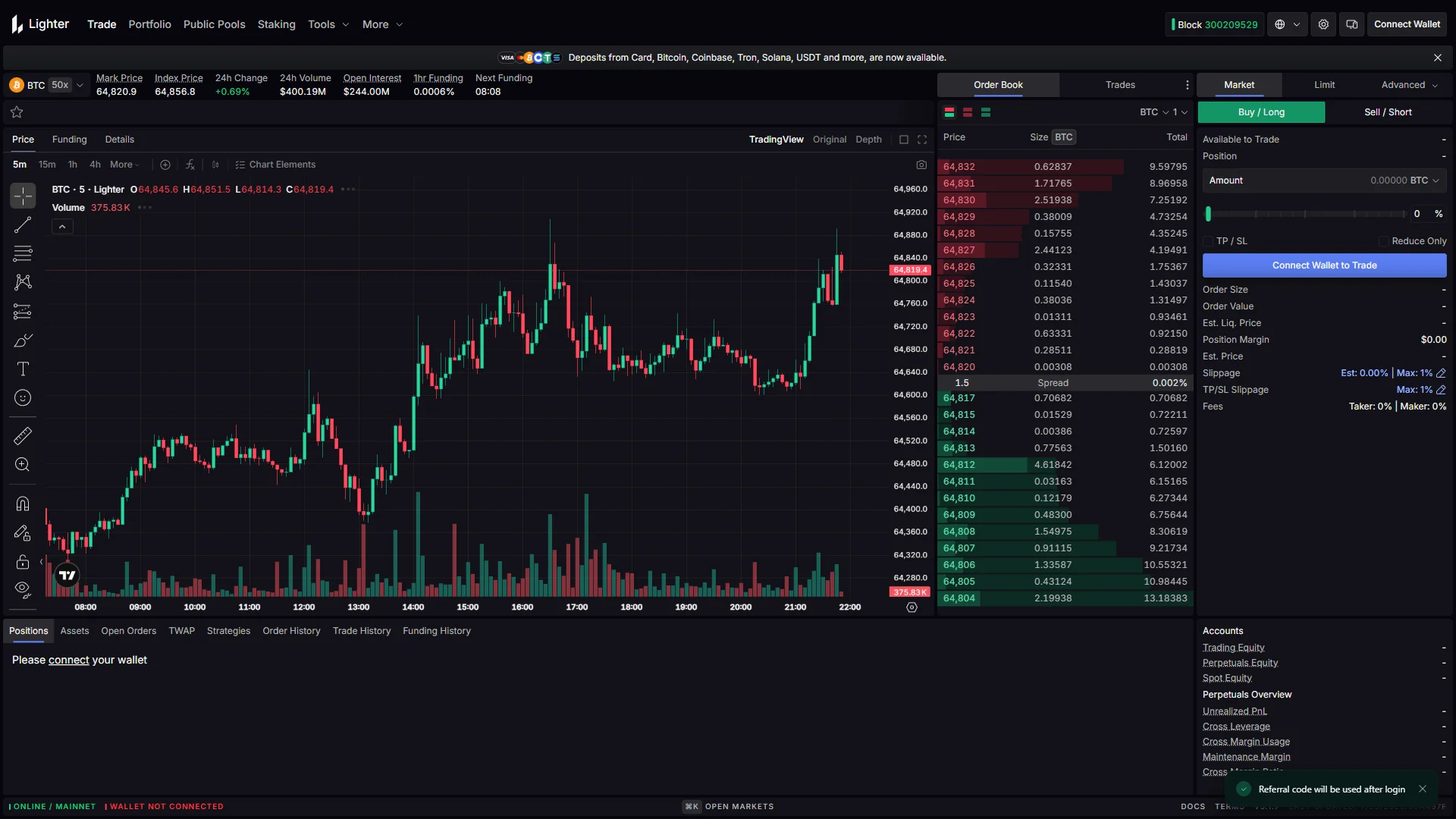
The screen shows “Referral code will be used after login” — the code arrived with the link and is held, ready to be applied when you log in.
On a phone the same notice appears across the top of the trade screen rather than at the bottom, so a mobile reader sees identical confirmation before connecting anything.
It is worth knowing where that confirmation lives and where it does not. The evidence is the login-time notice, which shows both on the referral landing before the wallet connects and again once it is connected, together with the referralCode value the site keeps in the browser’s local storage (verified 2026-07-28). No permanent referral status display was found anywhere in the connect flow. Treat the notice as the confirmation rather than going looking for a badge that stays on screen.
The code is for a wallet that has never connected to Lighter before, which is why everything below treats the first connection as the moment that matters. chainhelm continuously verifies the validity of the code and confirms it remains usable.
Lighter sign-up steps with the referral code
We cover the connection process separately for PC/browser and smartphone (mobile).
PC/browser connection steps
1. First, open the Lighter official page (the link applies the referral code). When you open it, you’ll see a screen like the one below.
2. Open the referral link and connect your wallet
The referral link opens Lighter’s BTC trade screen with your wallet still disconnected, so click “Connect Wallet” at the top right to begin. The green notice at the bottom, “Referral code will be used after login”, confirms the code you arrived with is already held and will be applied once you log in.
Two things about the account model are worth fixing in place before you go any further, because they hold for the whole sequence. An account is created by connecting a third-party non-custodial wallet, which is the only route Lighter documents. And there is no identity verification gate anywhere in this flow: access control is self-certification plus IP logging, not KYC.
3. Pick your wallet in “Log in or sign up”
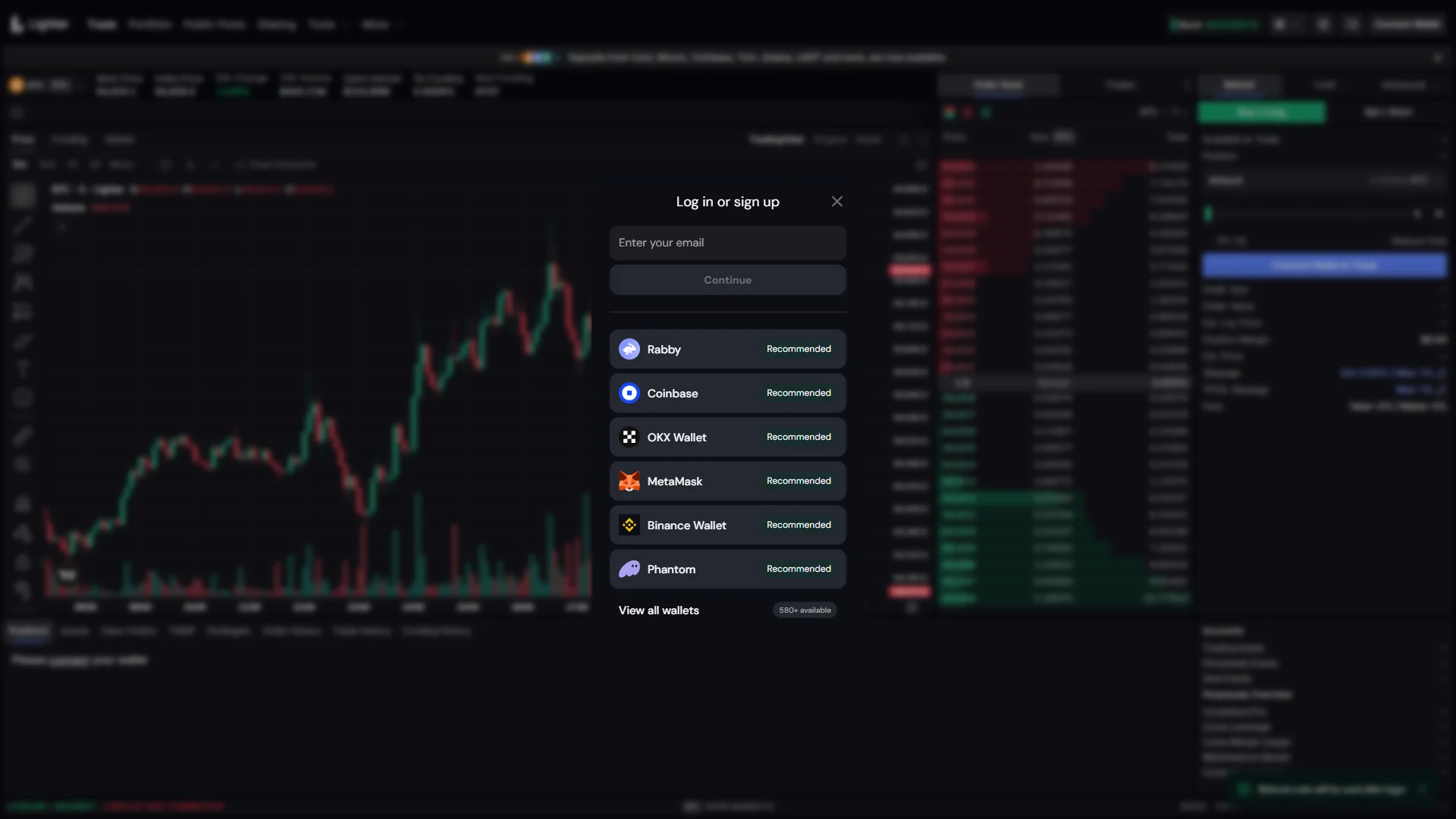
In the “Log in or sign up” window, click “Rabby” in the wallet list to connect a browser wallet; “View all wallets” opens the full list if you use a different one. The email box at the top, “Enter your email” followed by “Continue”, is the alternative route, but this walkthrough carries on with the wallet.
That choice is deliberate: Lighter documents no email or embedded-wallet onboarding path anywhere, so the wallet route is the one the operator actually describes.
4. Approve the connection in Rabby
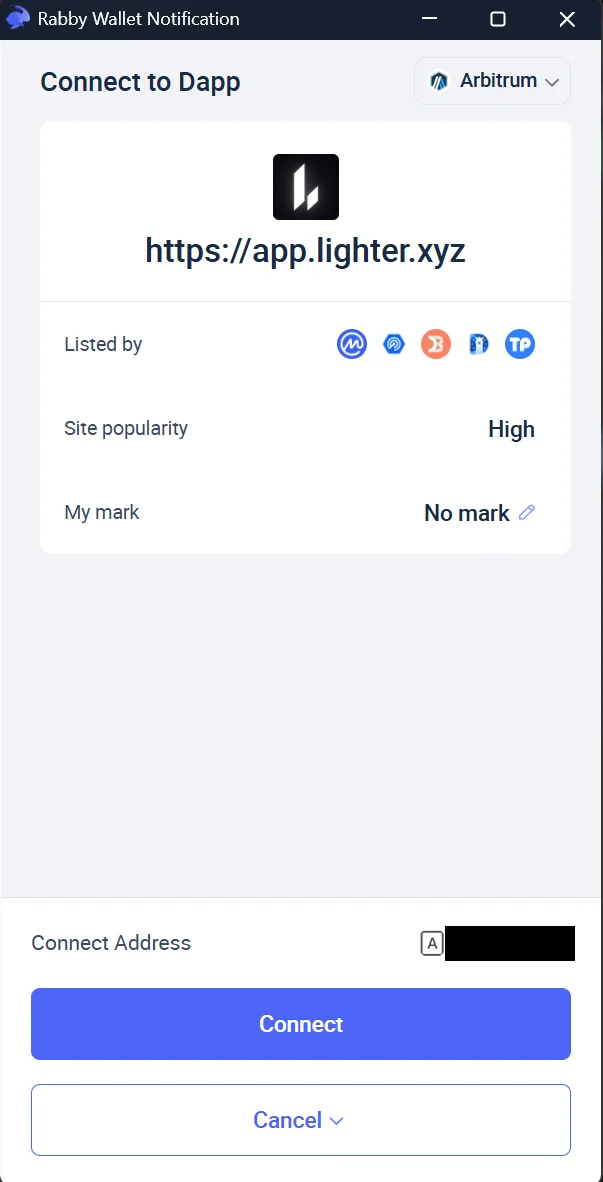
Rabby opens a separate “Connect to Dapp” window, so check that the site reads https://app.lighter.xyz and that the network selector shows “Arbitrum” before you click “Connect”. If the origin is anything else, click “Cancel” instead, since this approval is what links the wallet to Lighter.
5. Confirm the connection and open the deposit window
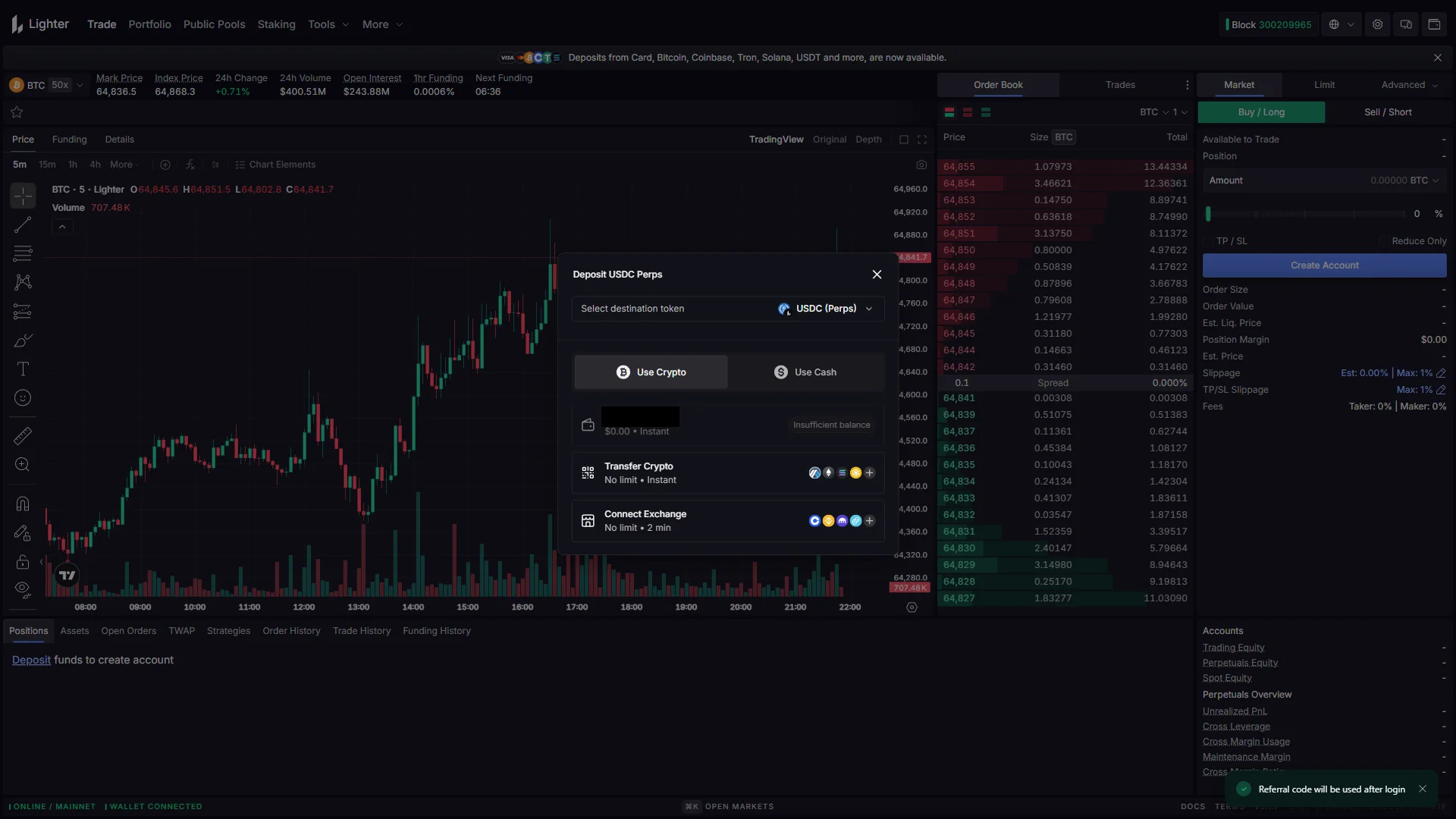
With the wallet connected, the order panel now offers “Create Account”, and clicking it opens “Deposit USDC Perps”, since funding the account is what creates it. The wallet row under “Use Crypto” is marked “Insufficient balance” here, so move funds into the wallet before you continue; the “Referral code will be used after login” notice is still up, so the code is still attached.
That last detail is the one to register: the code survives the connection and is still attached at the moment the account is created.
Smartphone (iOS / Android) connection steps
1. First, open the Lighter official page in your mobile browser or your wallet app’s in-app browser (the link applies the referral code). When you open it, you’ll see a screen like the one below.
2. Open the referral link and connect your wallet
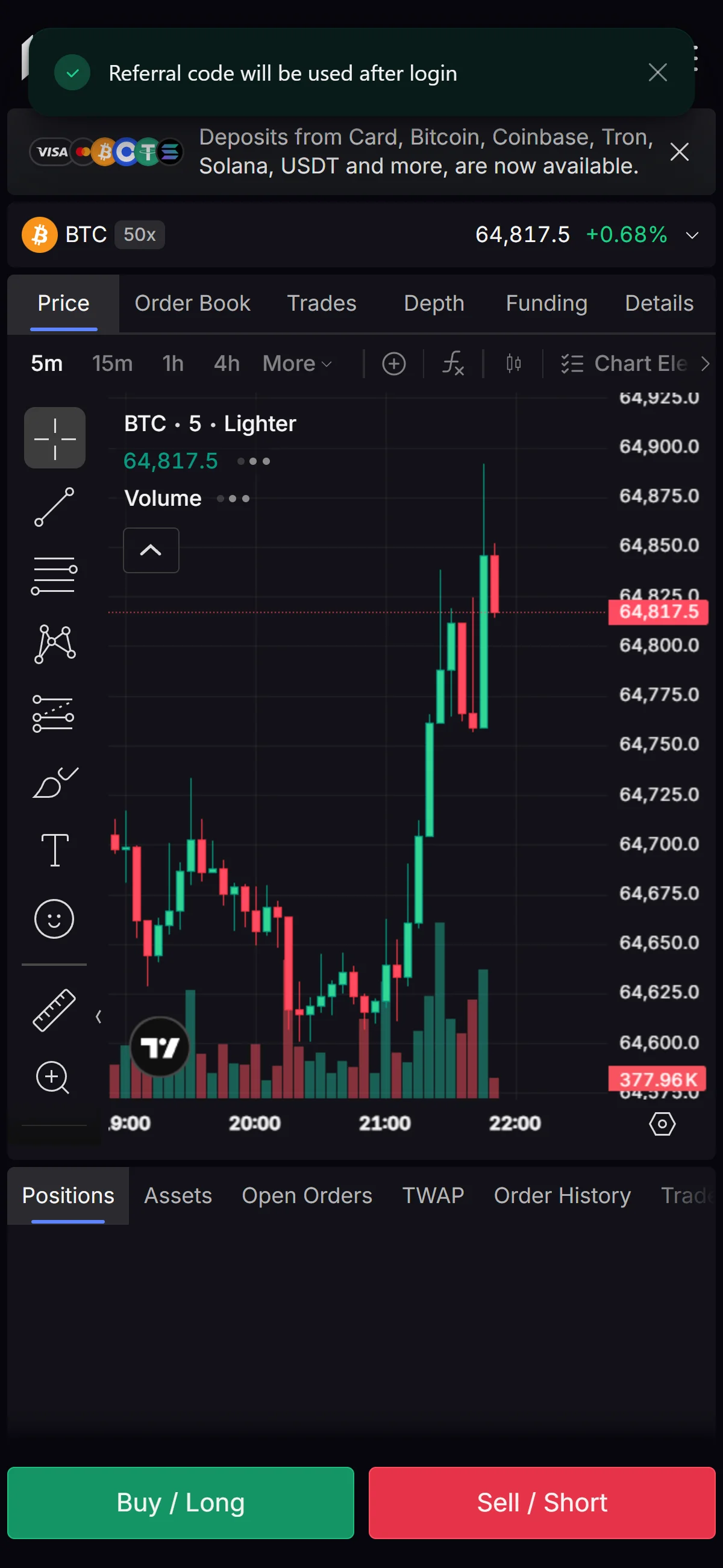
The referral link opens Lighter’s BTC trade screen with no wallet connected yet, so close the green notice across the top and tap “Connect Wallet” in the header behind it. That notice, “Referral code will be used after login”, confirms the code you arrived with is already held and will be applied once you log in.
3. Pick your wallet in “Log in or sign up”
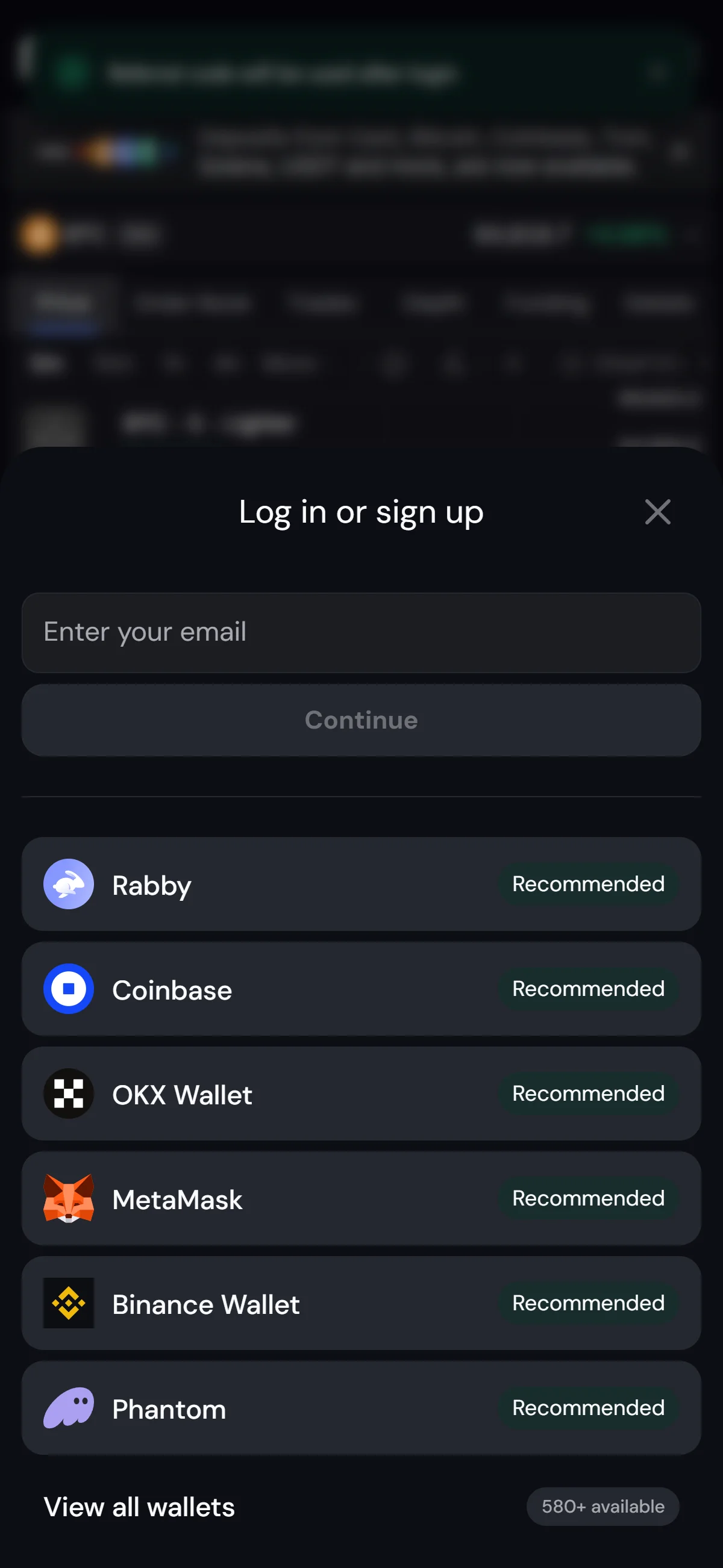
In the “Log in or sign up” sheet, tap “Rabby” in the wallet list to hand off to your wallet app; “View all wallets” opens the full list if you use a different one. The email box at the top, “Enter your email” followed by “Continue”, is the alternative route, but this walkthrough carries on with the wallet.
The approval itself happens inside the wallet app rather than on a Lighter screen, so there is no separate Lighter capture for it. Approve the connection there, then come back to the browser.
4. Confirm the connection and open the deposit sheet
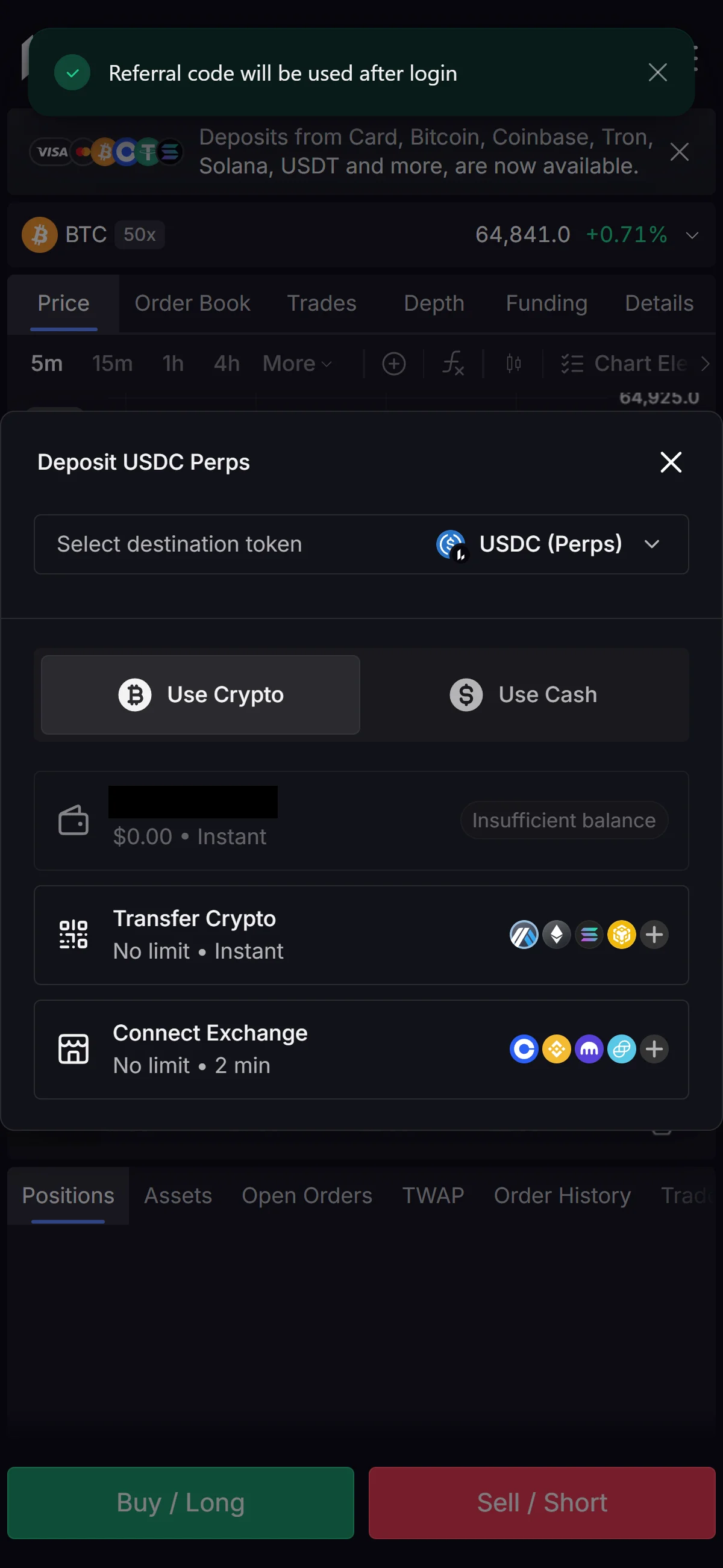
Once the wallet is connected, opening the deposit flow brings up the “Deposit USDC Perps” sheet with “USDC (Perps)” already set as the destination token. The wallet row under “Use Crypto” is marked “Insufficient balance” here, so move funds into the wallet first; the “Referral code will be used after login” notice at the top shows the code is still attached.
The code has survived the whole hand-off, and it is still attached at the moment the account is created.
What to do after connecting to Lighter
We cover the deposit process separately for PC/browser and smartphone (mobile).
The run captured below moved USDT from Arbitrum and finished in 2 min 2 s, so what follows is one real deposit rather than a generic sequence.
PC/browser deposit steps
1. Choose how to deposit
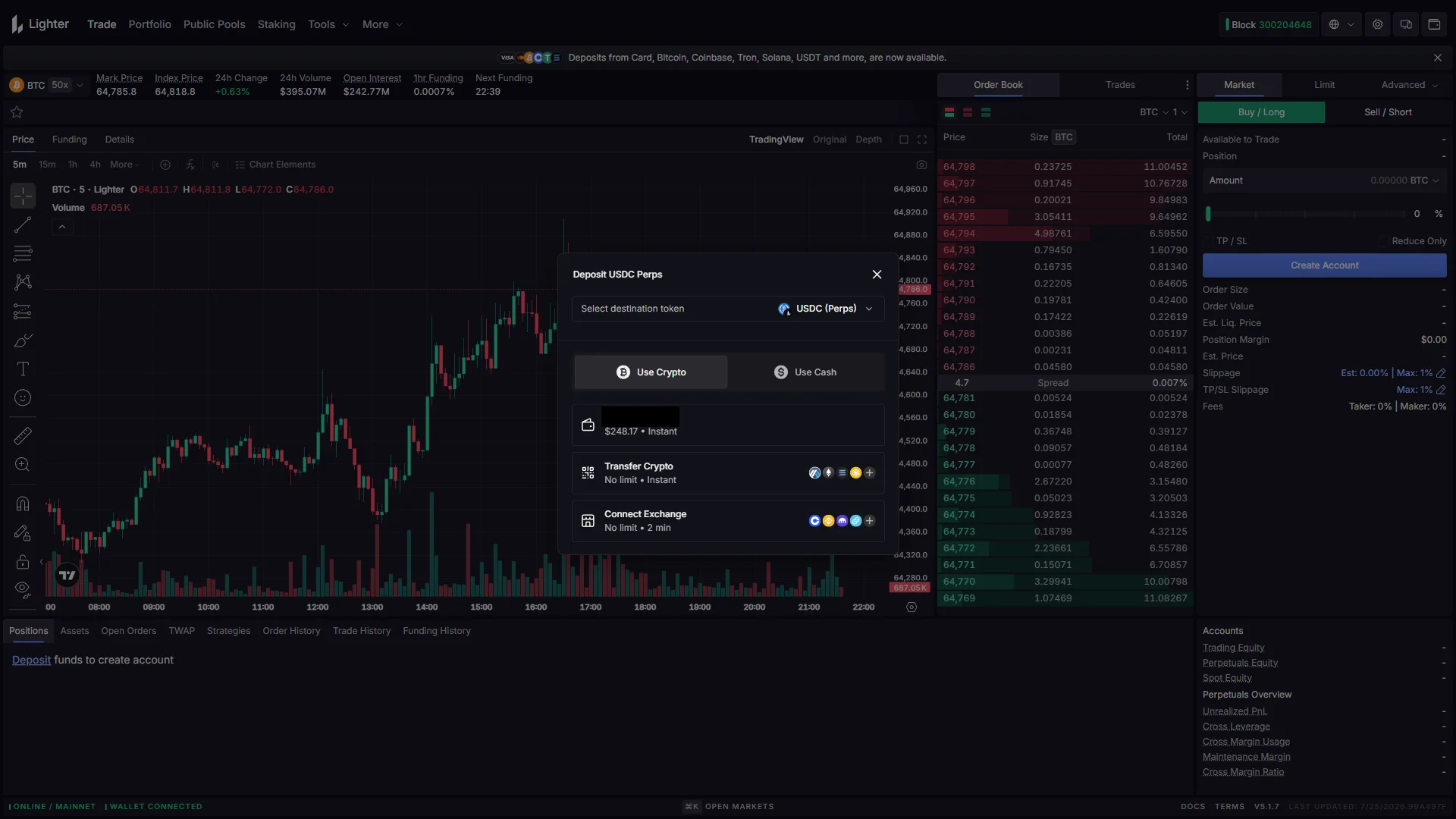
With the wallet funded, open “Deposit USDC Perps” again, leave “Select destination token” on “USDC (Perps)”, and click the wallet row under “Use Crypto” to deposit straight from the connected wallet. If your funds sit elsewhere, “Transfer Crypto” takes them from another chain or wallet and “Connect Exchange” pulls them from an exchange account, both marked “No limit”.
Which chain the money starts on decides the mechanism. Deposits from Ethereum mainnet arrive as native smart-contract deposits, while Arbitrum, Base and Avalanche are supported for USDC over Circle’s CCTP.
2. Pick the token to send
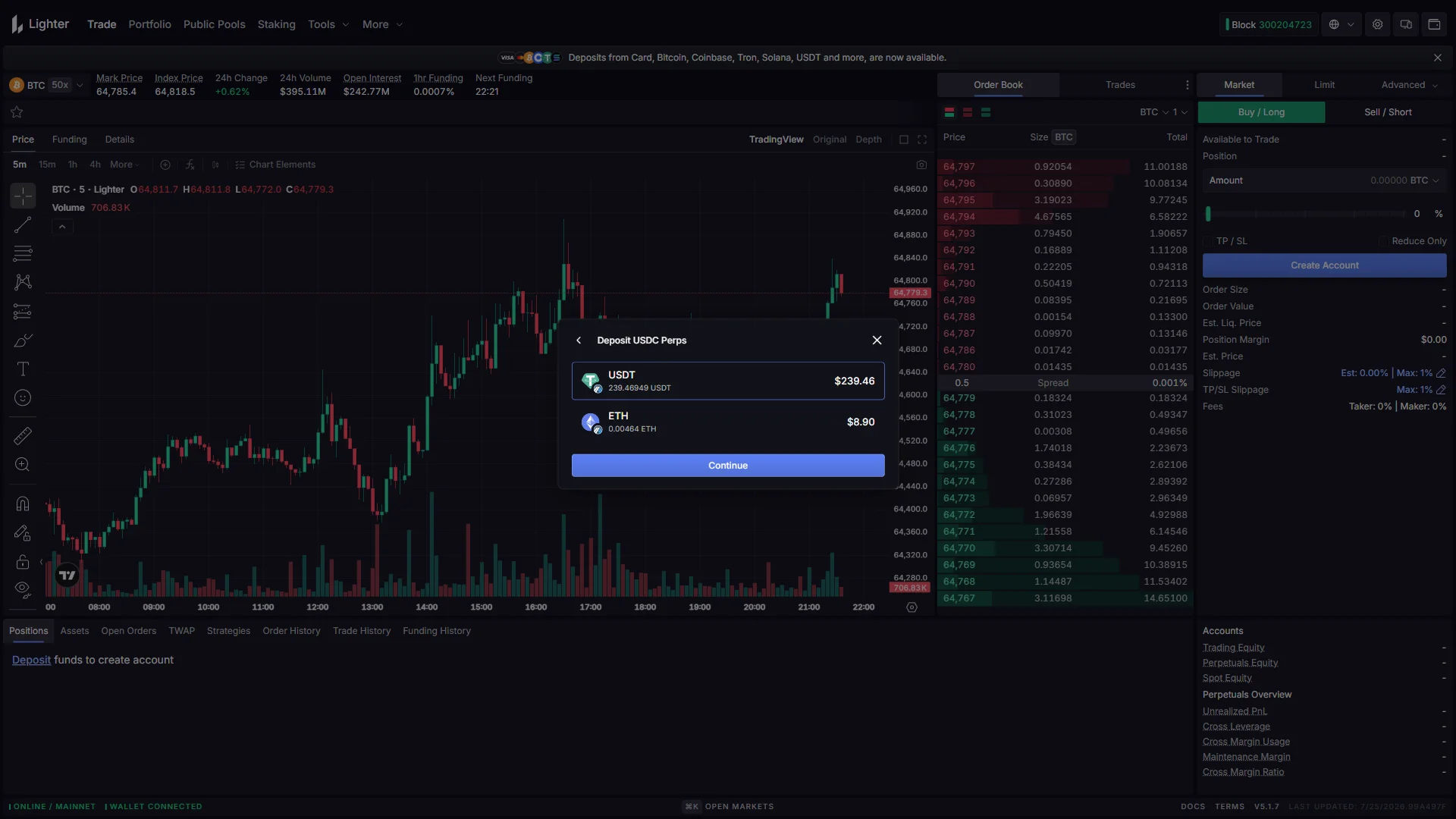
The window switches to the tokens your wallet holds, each with its balance and dollar value, so click “USDT” to highlight its row and then click “Continue”. “ETH” sits just below it if you would rather send that instead.
What you send is not always what it is worth as margin. USDC is the base collateral and counts at full value; ETH is accepted as multi-asset margin at a 50% haircut.
3. Enter the amount
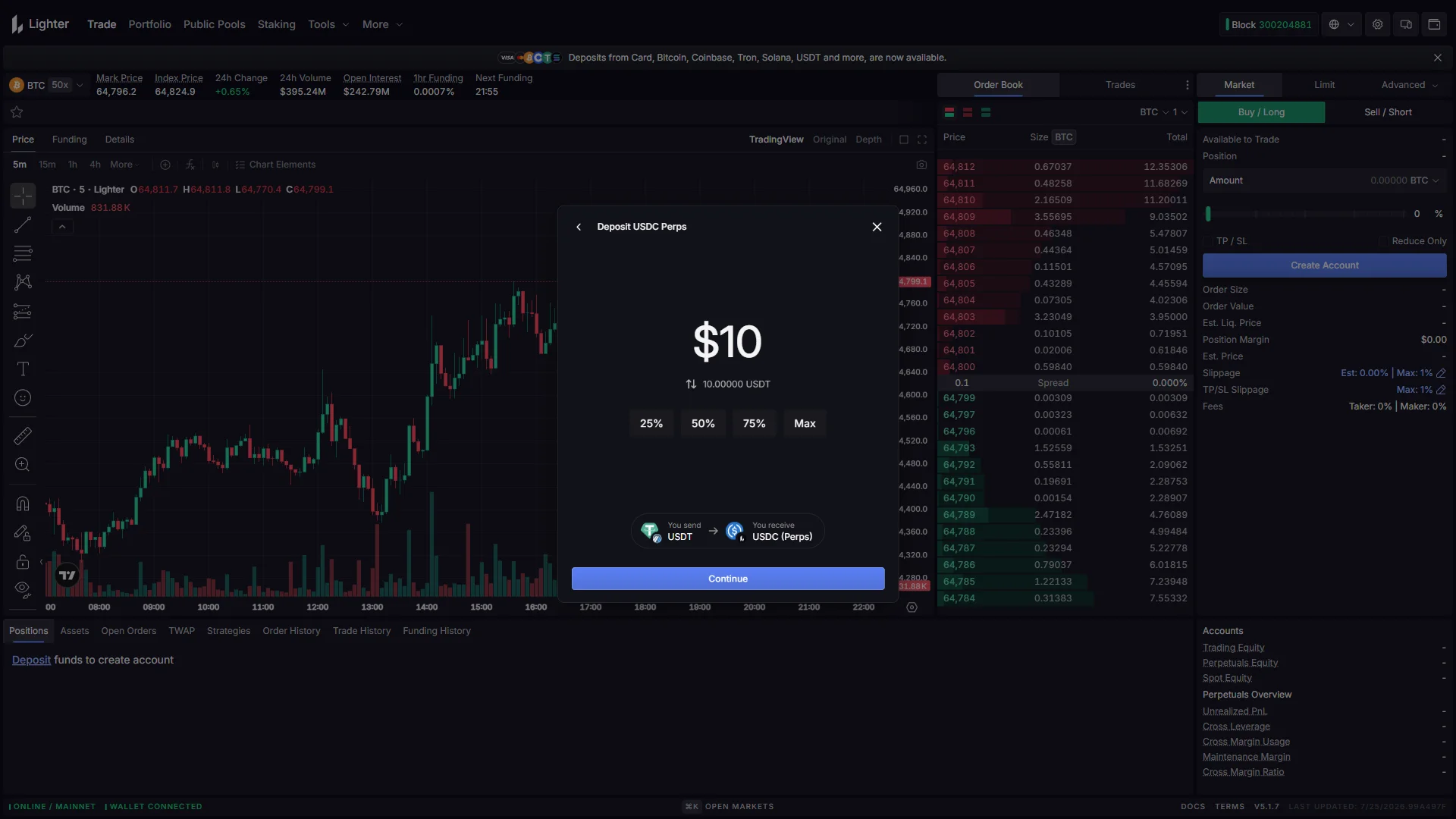
Type the amount you want to deposit, or use “25%”, “50%”, “75%”, or “Max” to fill it from the balance; this run uses $10, and the line under it repeats the amount in USDT. Check the “You send” and “You receive” pair at the bottom, which shows USDT going out against “USDC (Perps)” arriving, then click “Continue”.
The floor differs by route: 1 USDC or equivalent per deposit on Ethereum mainnet, and a 5 USDC minimum for CCTP deposits from Arbitrum, Base or Avalanche.
4. Check the order summary
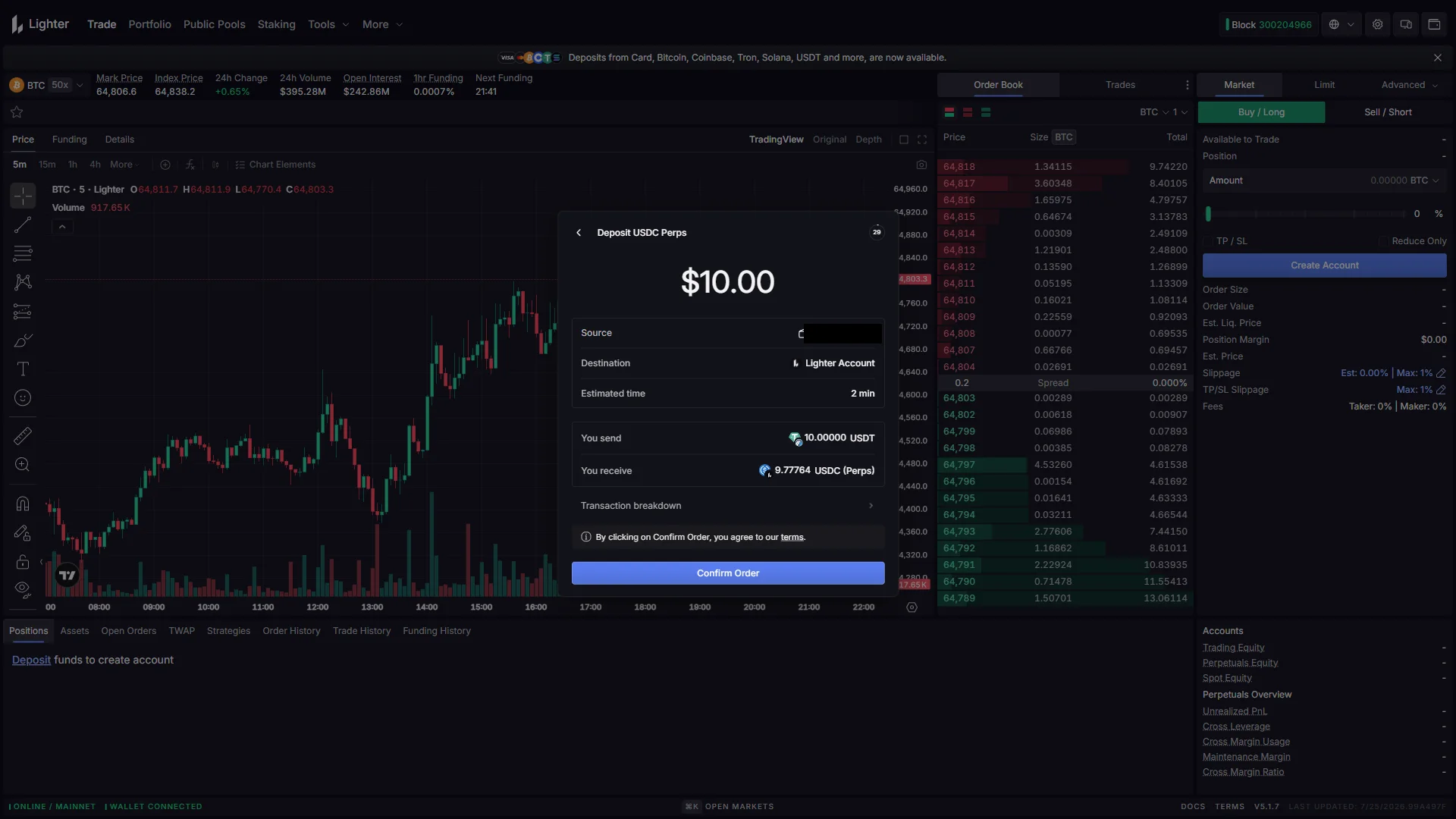
Check the summary before you commit: “Source” is your wallet, “Destination” is “Lighter Account”, “Estimated time” reads 2 min, and “You send” and “You receive” put the USDT leaving against the USDC (Perps) arriving. “Transaction breakdown” opens the detail behind that difference; click “Confirm Order” once the numbers look right.
5. Sign the token approval in Rabby
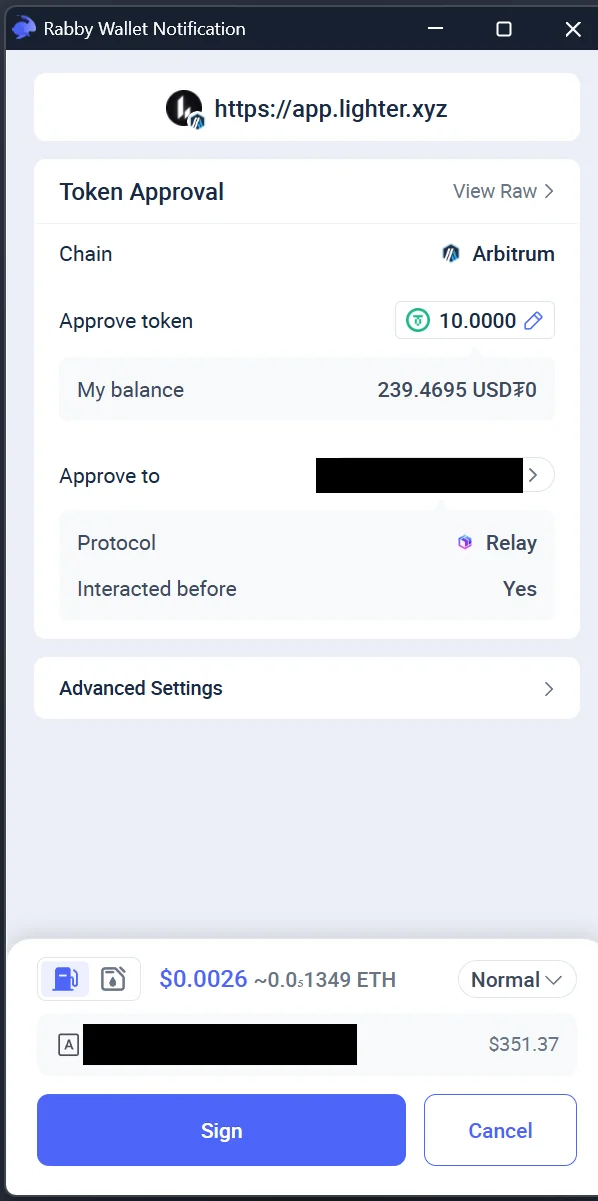
Rabby comes up with a “Token Approval” request, so check that “Chain” is “Arbitrum”, that “Approve token” is set to the 10 USDT you are depositing, and that “Approve to” runs under the “Relay” protocol. Click “Sign” when it all matches, or “Cancel” if it does not.
6. Confirm the approval
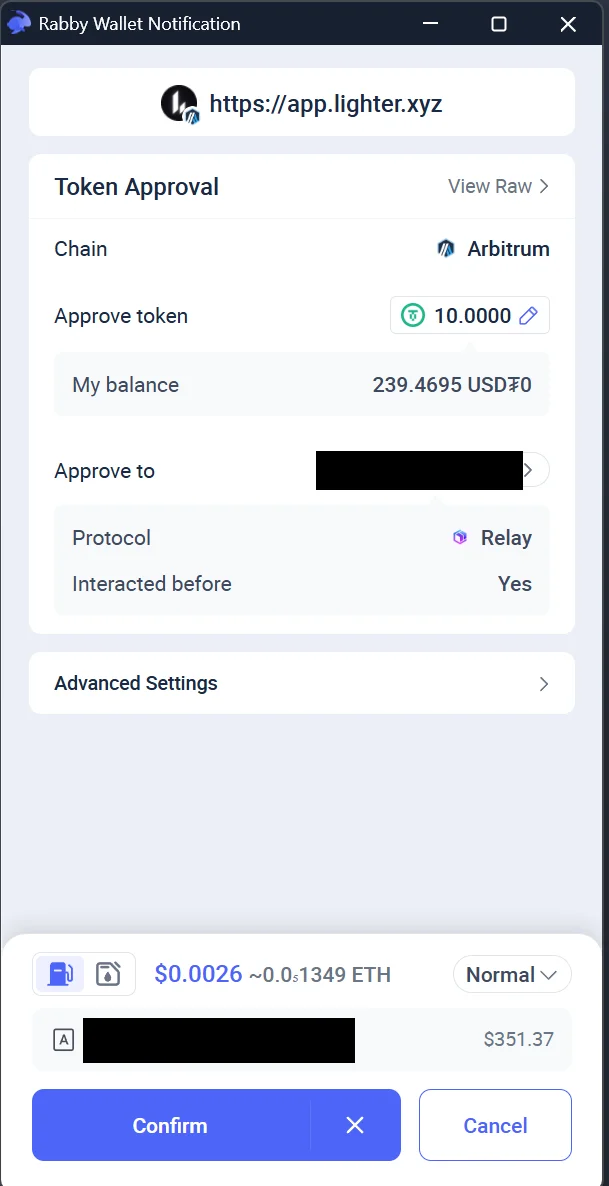
The same window stays open with the approval details unchanged and the button switched to “Confirm”, so click it to send the approval through. “Cancel” is still there if you would rather back out first.
7. Sign the bridge transaction
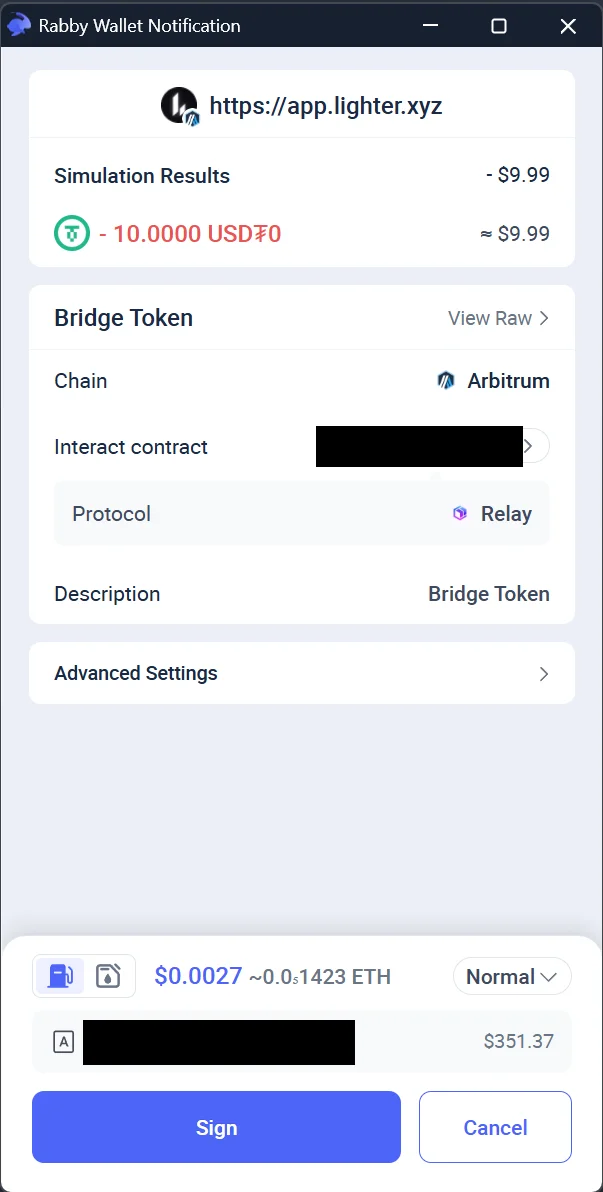
The second request is the deposit itself, so read “Simulation Results” to see the 10 USDT leaving the wallet, then check that “Chain” is “Arbitrum”, “Description” reads “Bridge Token”, and “Interact contract” runs under the “Relay” protocol. Click “Sign” to approve the transfer.
8. Confirm the bridge transaction
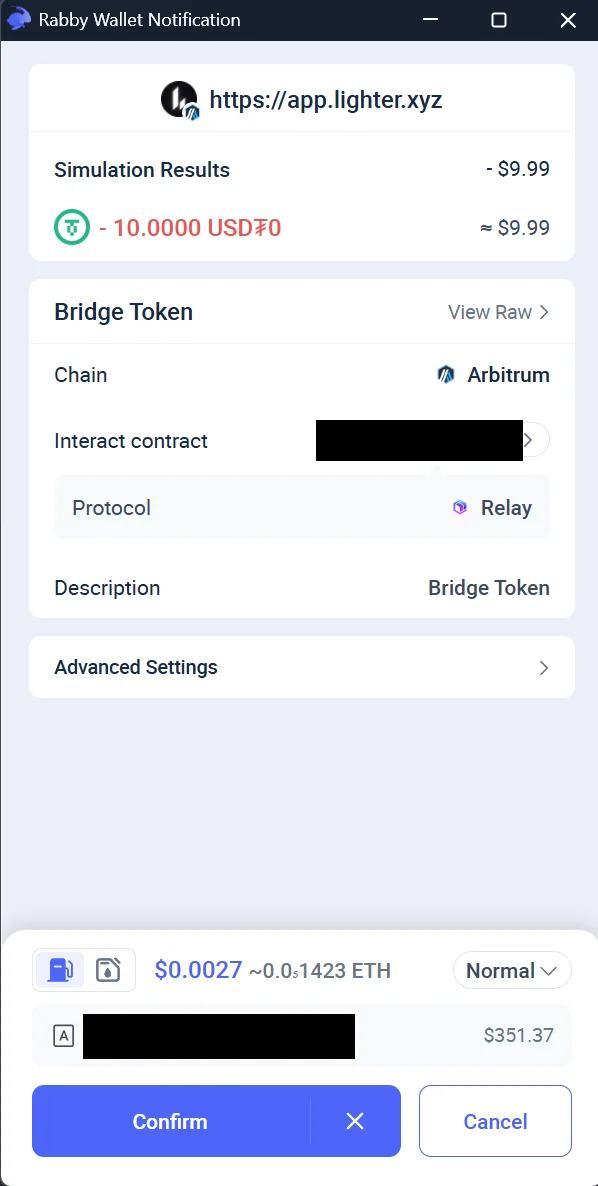
The window keeps the same simulation and contract details and swaps the button to “Confirm”, so click it to broadcast the transfer. Once it goes through, the transaction is submitted and tracking moves back to the Lighter deposit window.
9. Wait while the deposit fills
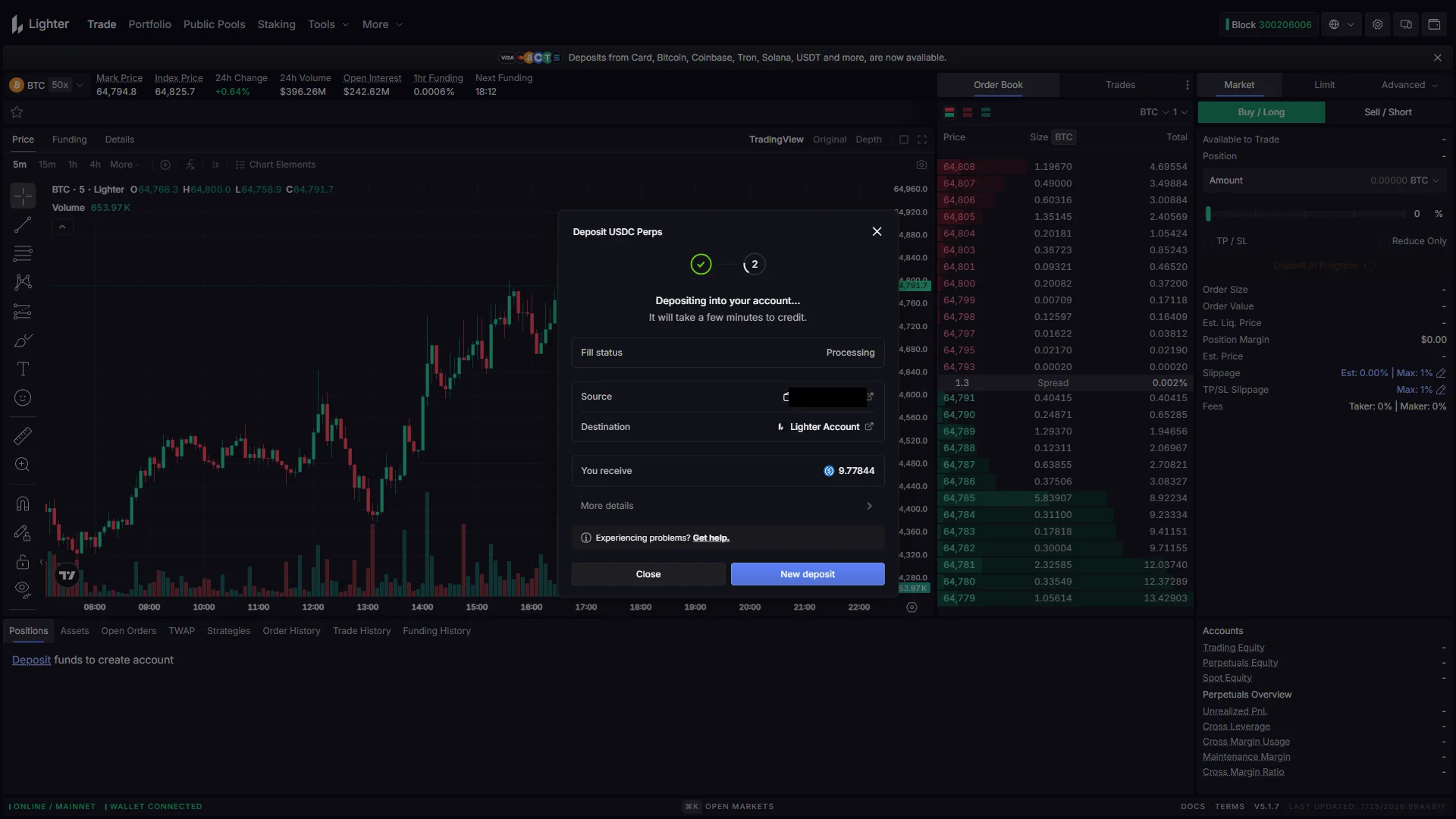
Leave the window open while the deposit runs: “Fill status” sits at “Processing”, and the second stage, “Depositing into your account…”, notes that it takes a few minutes to credit. The “Source” and “Destination” rows let you follow the transfer from your wallet into the “Lighter Account” while you wait.
10. Authenticate the account
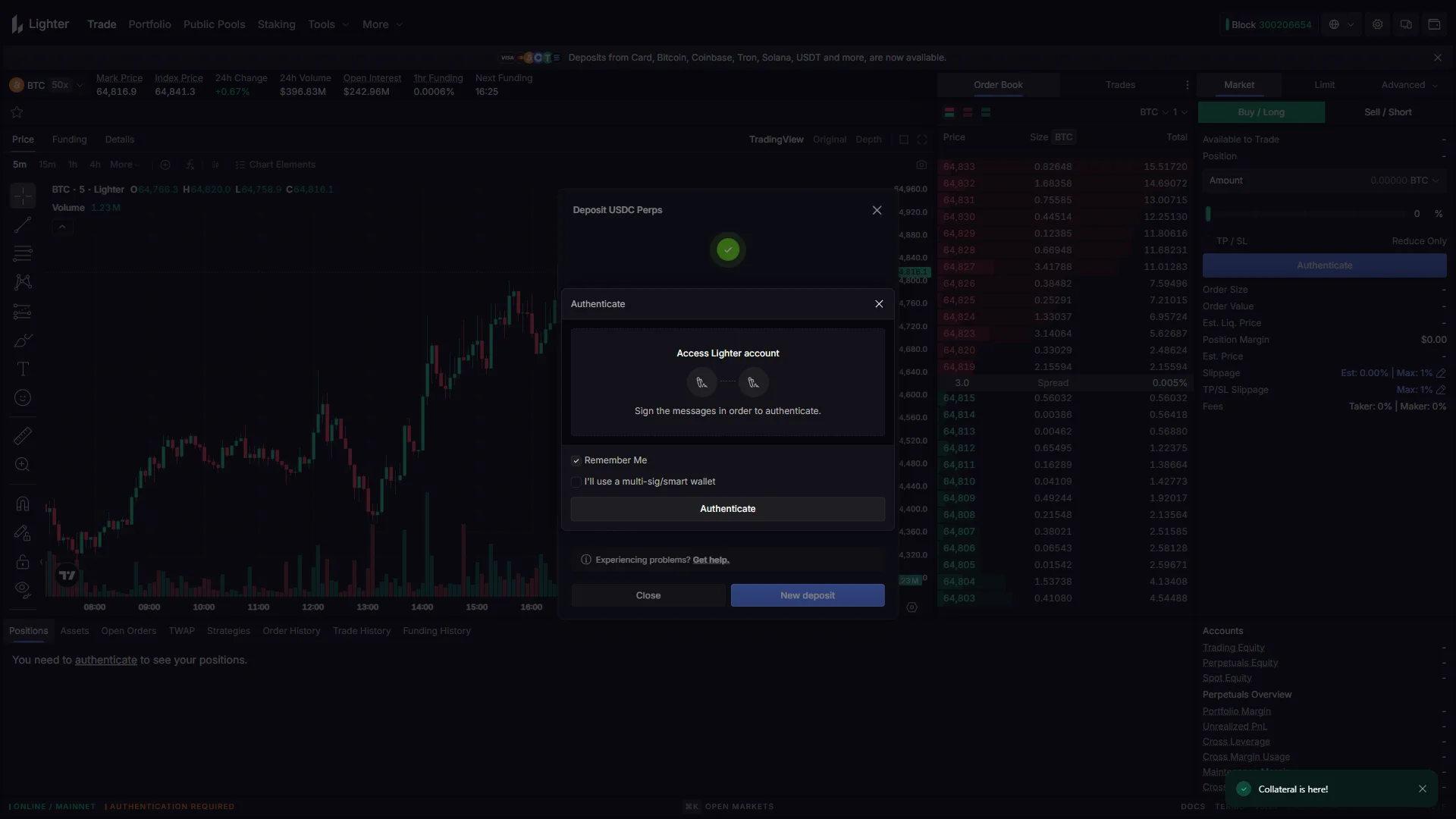
The “Collateral is here!” notice confirms the funds arrived, so move on to the “Authenticate” panel: leave “Remember Me” checked and click “Authenticate”. Both signature icons under “Access Lighter account” are still gray, so expect to sign two messages in Rabby, in order.
11. Sign the second message
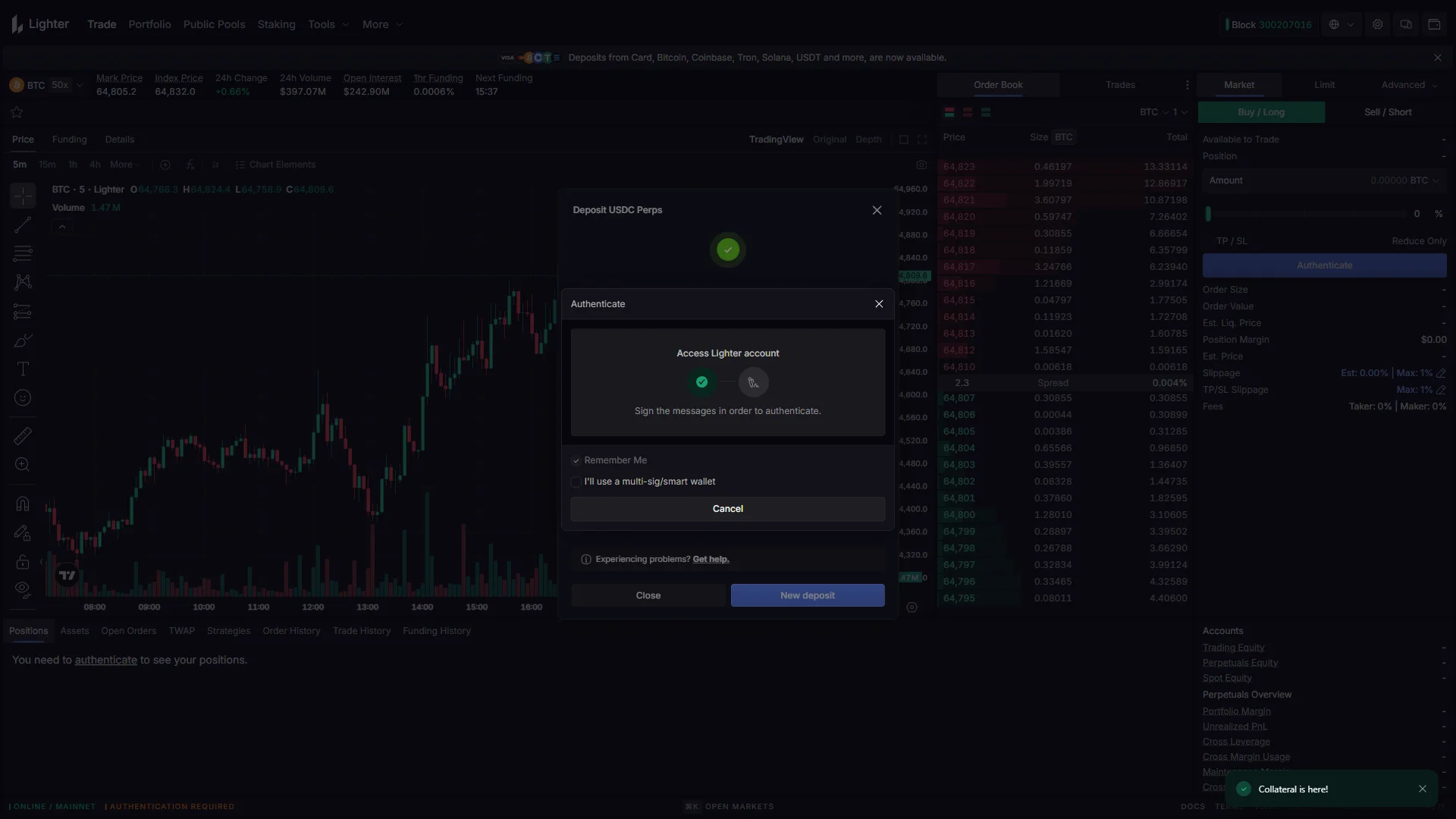
The first icon under “Access Lighter account” turns green once you sign, so switch back to Rabby and sign the second message the same way. The button underneath now reads “Cancel”, which drops the run half-signed, so leave it alone unless you want to start over.
12. Accept the updated terms
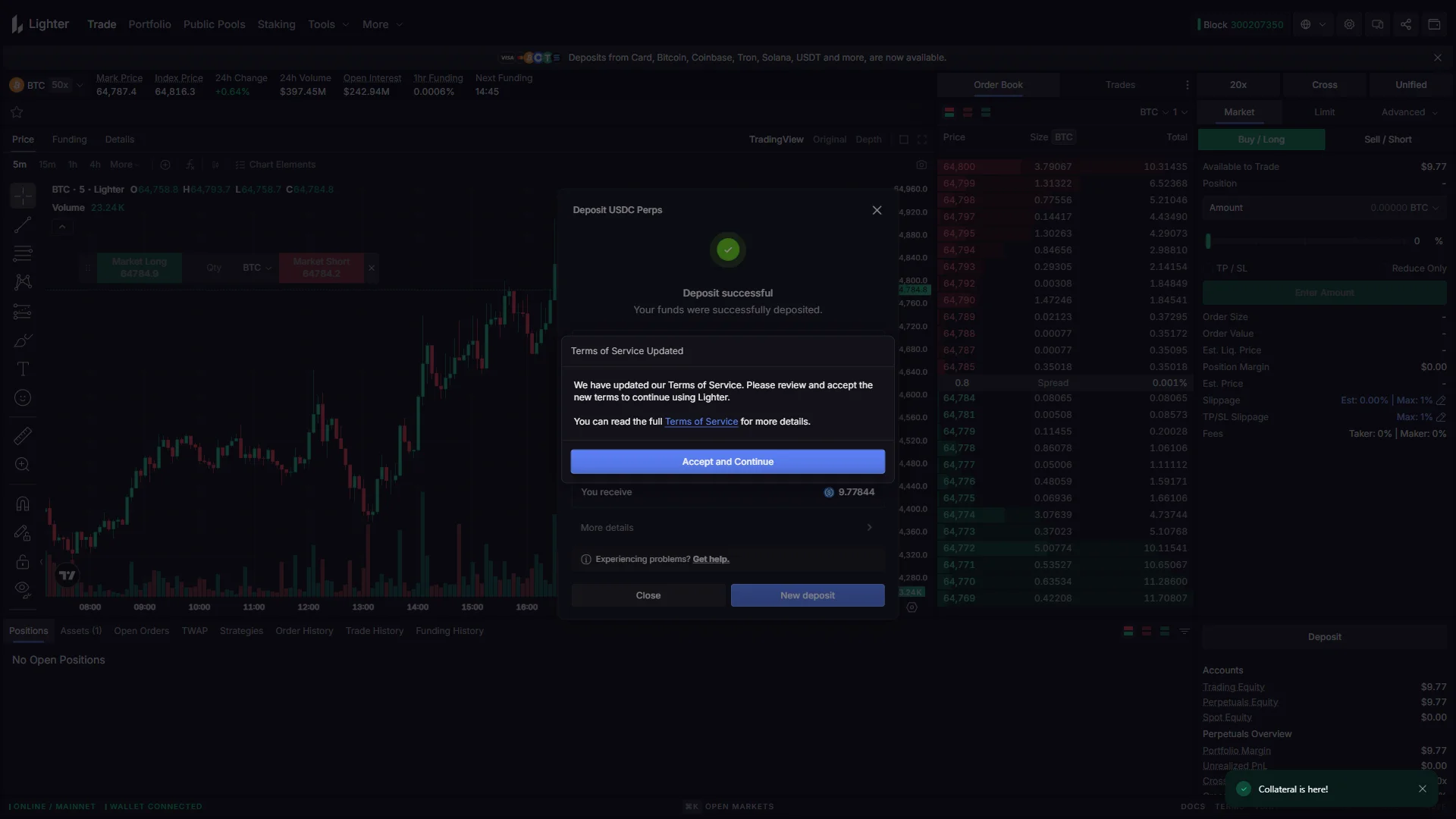
A “Terms of Service Updated” notice follows the signatures and asks you to accept the new terms before you carry on using Lighter. Open the “Terms of Service” link to read them in full, then click “Accept and Continue”.
This is the one dialog in the run that repays opening the link. These are the terms that carry the excluded-jurisdiction list and the airdrop clause dealt with later in this article.
13. Choose an account type
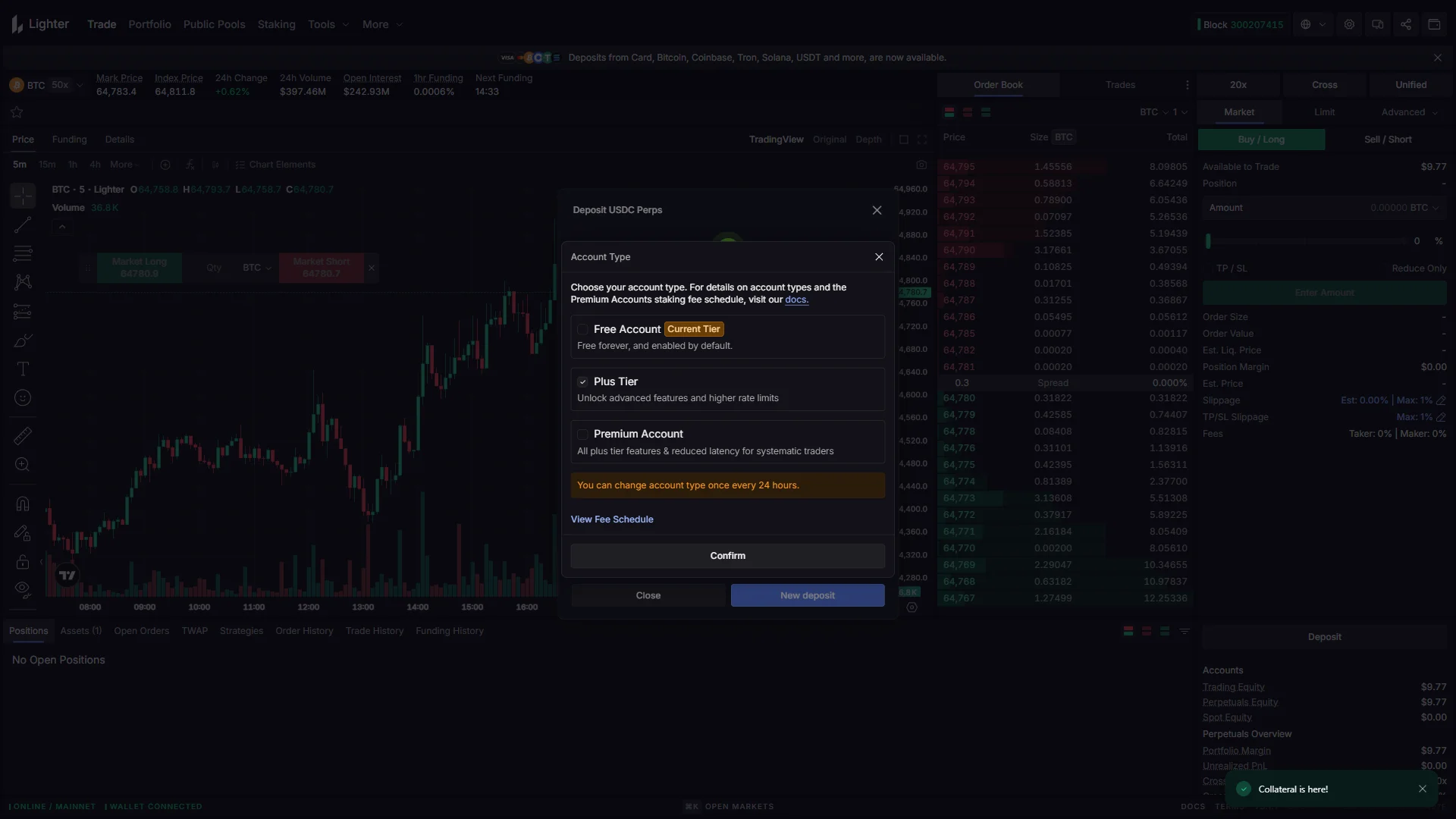
Pick the tier you want in “Account Type”: “Free Account” is flagged “Current Tier”, while “Plus Tier” and “Premium Account” each list what they add, and “View Fee Schedule” opens the fee details. Note the warning that you can change account type once every 24 hours, then click “Confirm”.
14. Confirm the deposit completed
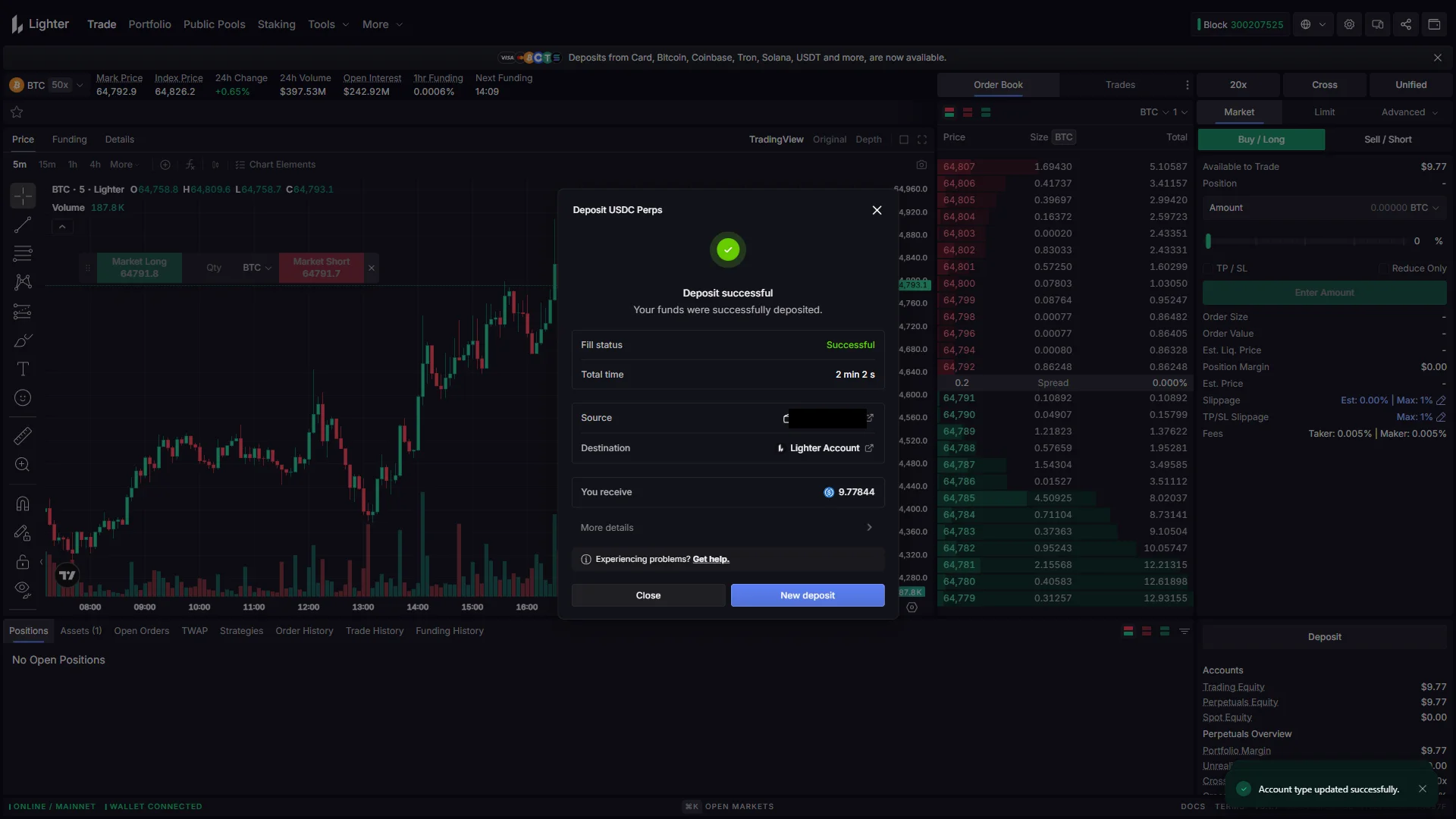
The run ends on “Deposit successful”: “Fill status” reads “Successful”, “Total time” came to 2 min 2 s, and the “Account type updated successfully.” notice confirms the tier change went through. Click “Close” to dismiss the window, with the deposit now credited to your account and “New deposit” ready if you want to add more.
Smartphone (iOS / Android) deposit steps
1. Choose how to deposit
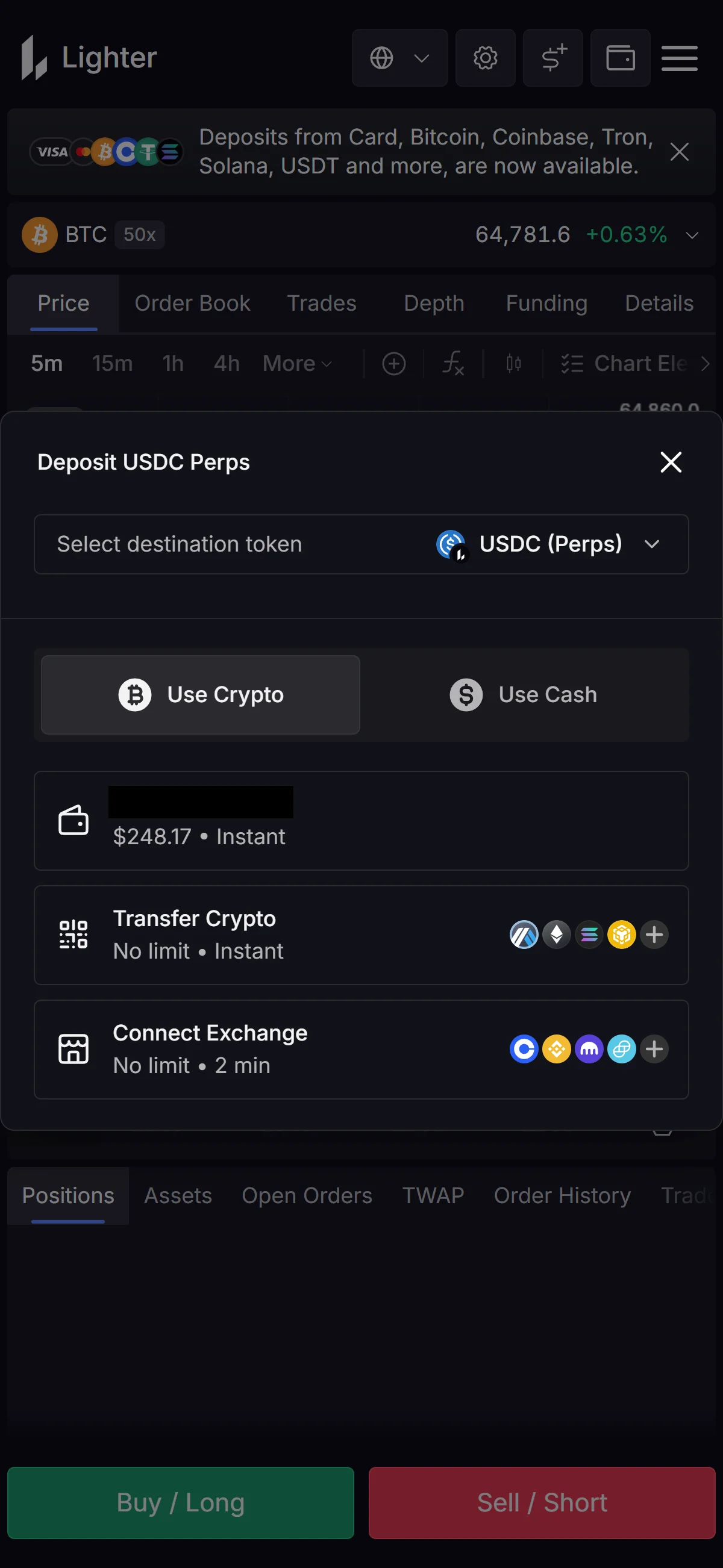
With the wallet funded, open the “Deposit USDC Perps” sheet, leave “Select destination token” on “USDC (Perps)”, and tap the wallet row under “Use Crypto” to deposit straight from the connected wallet. If your funds sit elsewhere, “Transfer Crypto” takes them from another chain or wallet and “Connect Exchange” pulls them from an exchange account, both marked “No limit”.
2. Pick the token to send
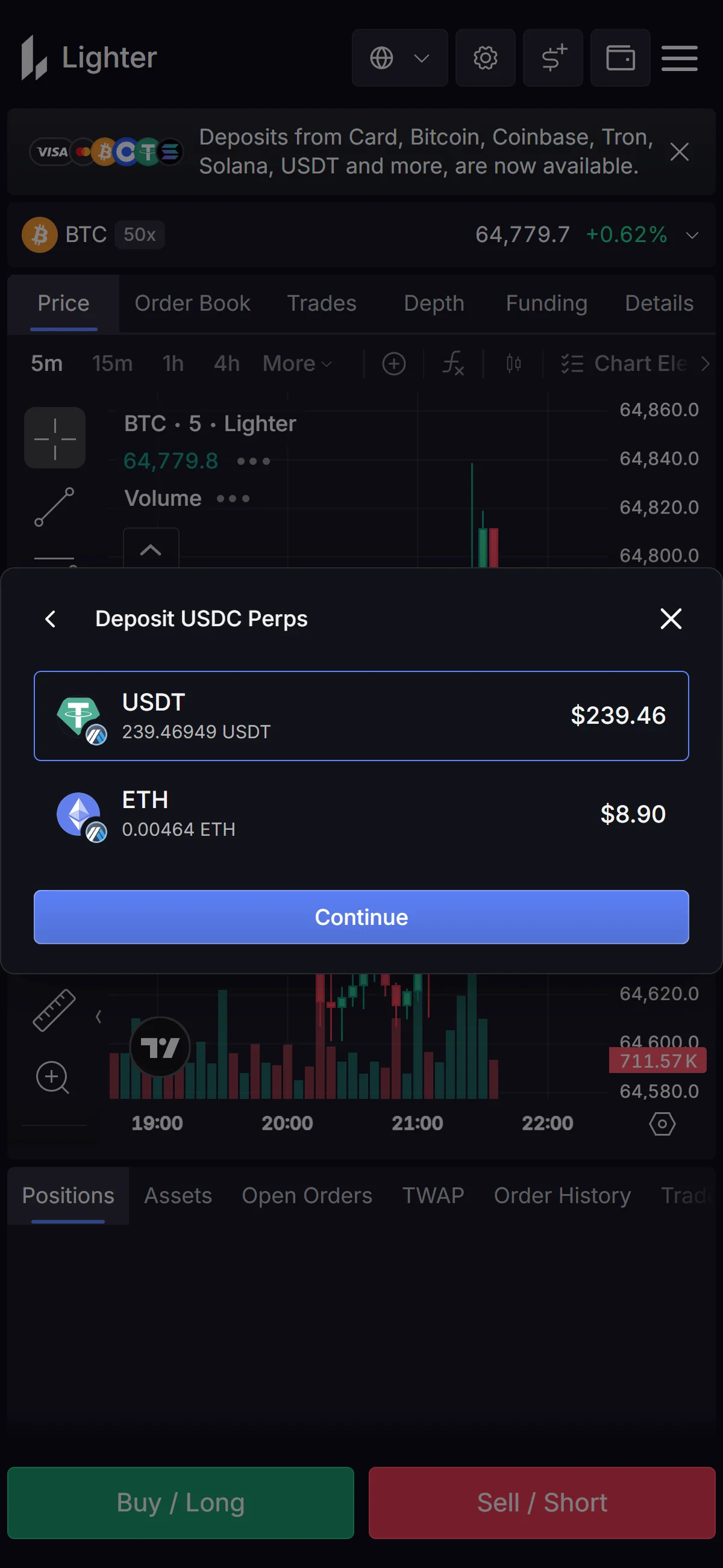
The sheet switches to the tokens your wallet holds, each with its balance and dollar value, so tap “USDT” to highlight its row and then tap “Continue”. “ETH” sits just below it if you would rather send that instead.
3. Enter the amount
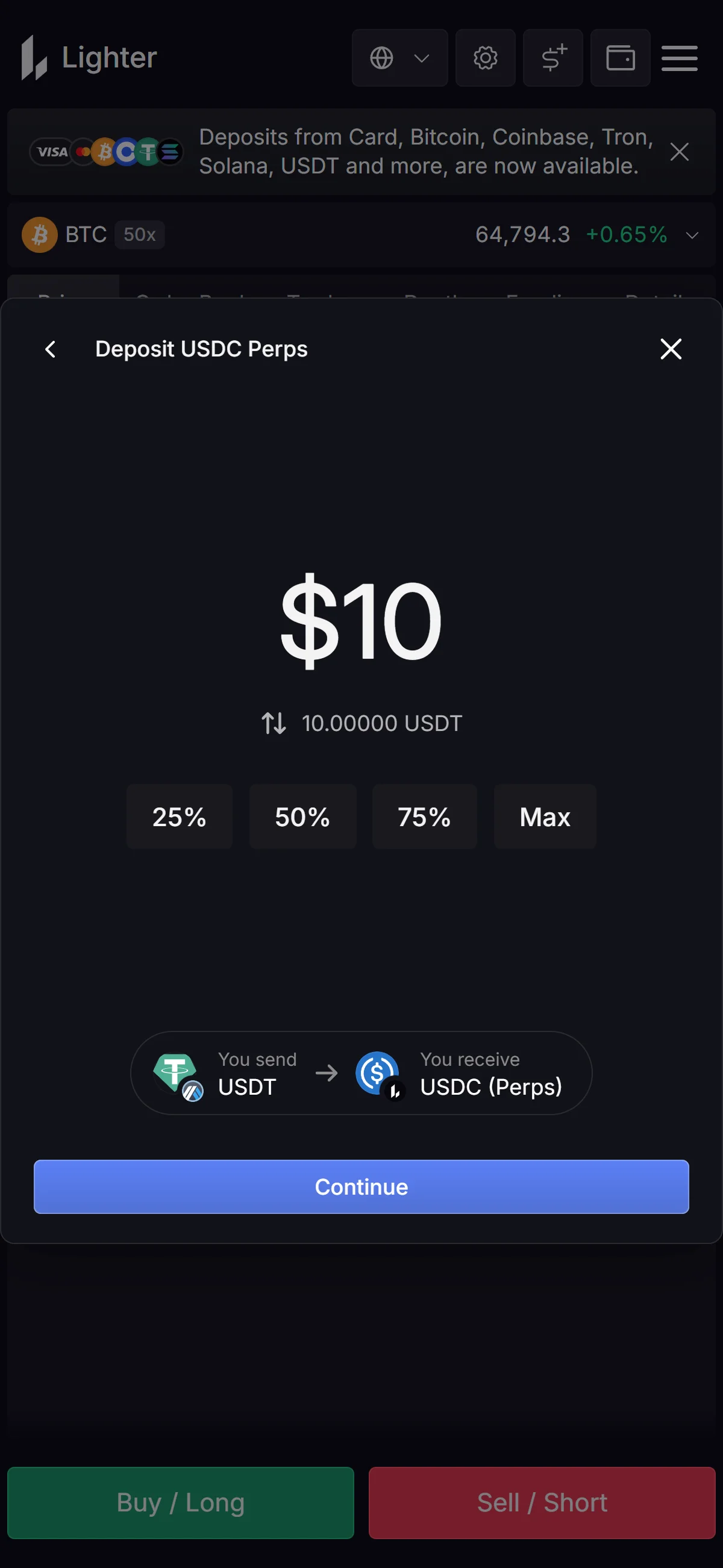
Type the amount you want to deposit, or use “25%”, “50%”, “75%”, or “Max” to fill it from the balance; this run uses $10, and the line under it repeats the amount in USDT. Check the “You send” and “You receive” pair at the bottom, which shows USDT going out against “USDC (Perps)” arriving, then tap “Continue”.
4. Check the order summary
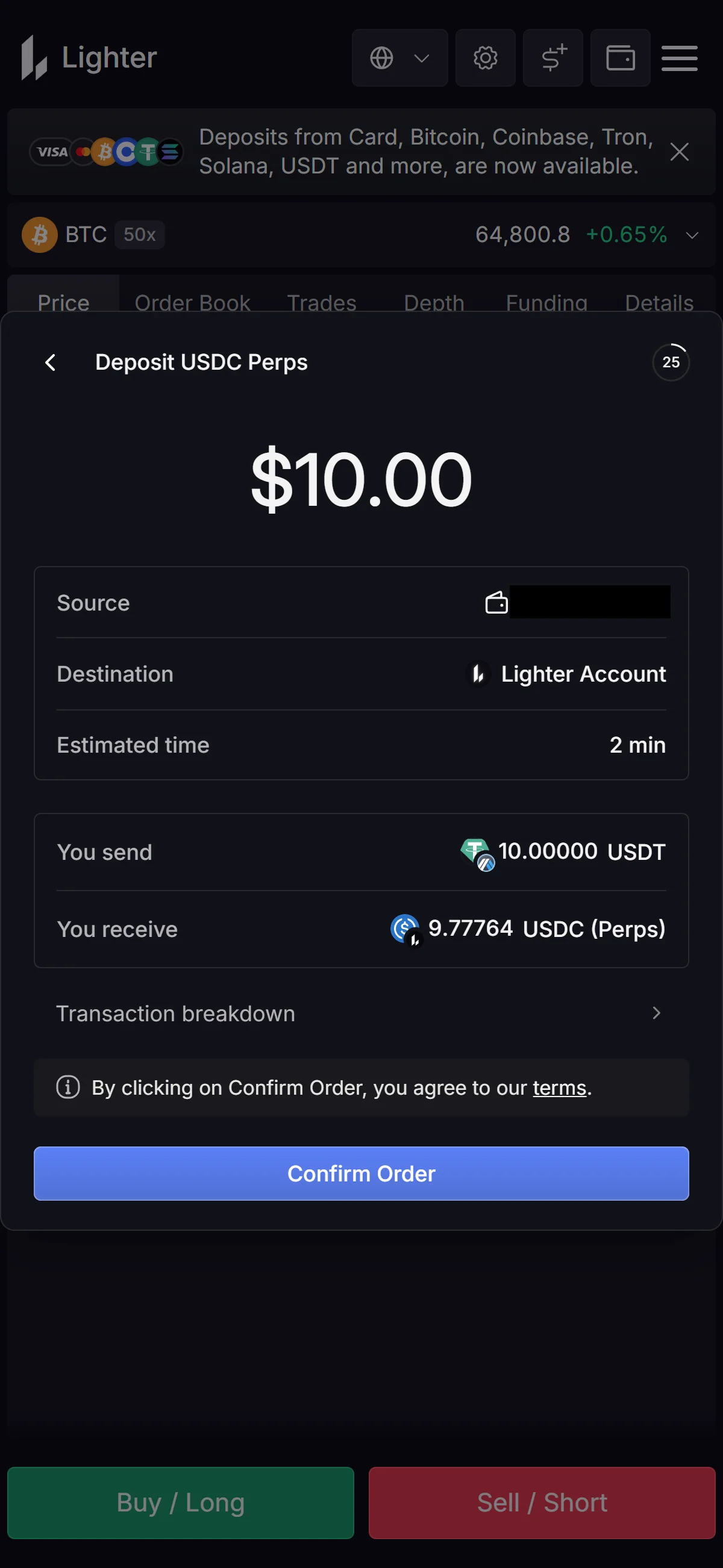
Check the summary before you commit: “Source” is your wallet, “Destination” is “Lighter Account”, “Estimated time” reads 2 min, and “You send” and “You receive” put the USDT leaving against the USDC (Perps) arriving. “Transaction breakdown” opens the detail behind that difference; tap “Confirm Order” once the numbers look right.
The token approval and the bridge transaction are both signed inside your wallet app rather than on a Lighter sheet, so there are no Lighter screens for them. Approve both there, then return here.
5. Wait while the deposit fills
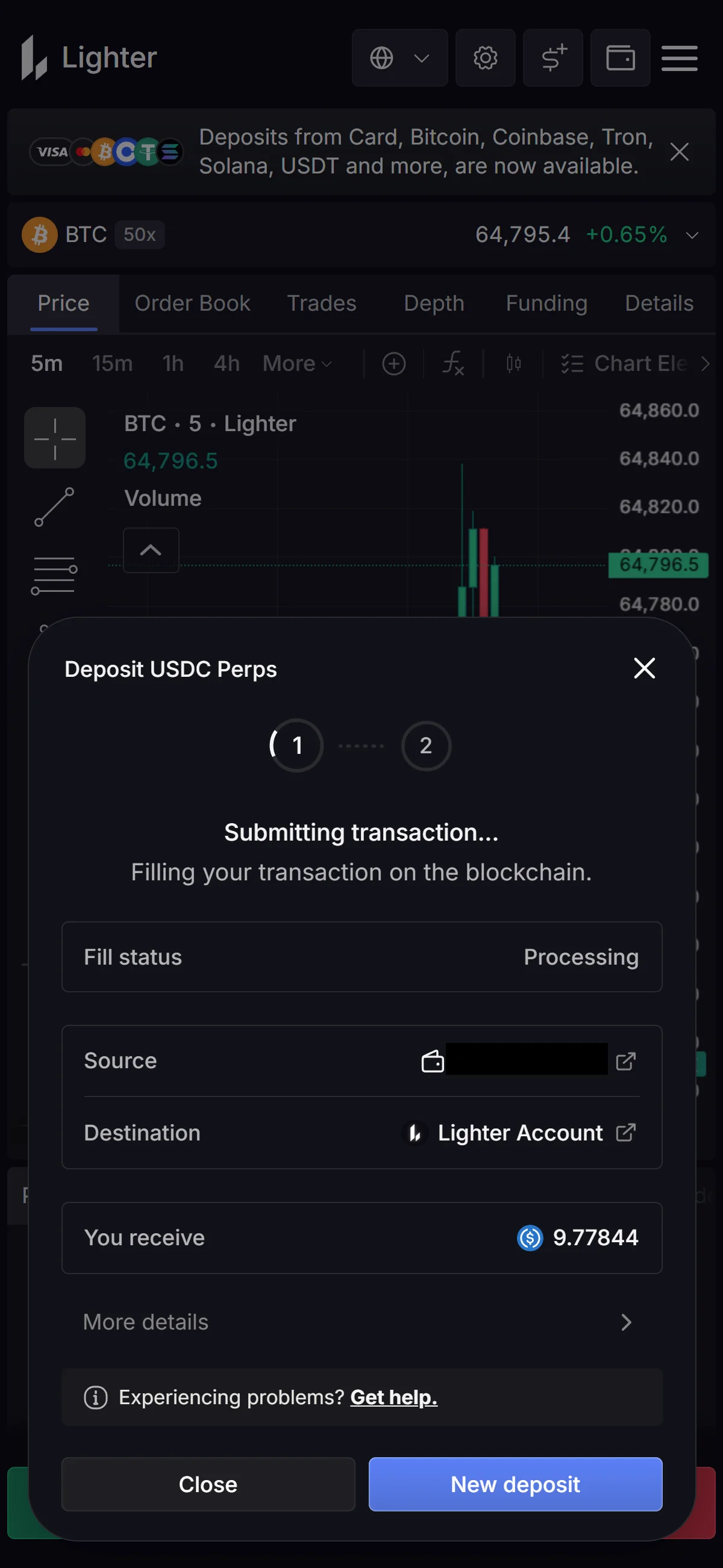
Keep the sheet open while the deposit runs: “Submitting transaction…” marks the first of the two stages and “Fill status” reads “Processing”. The “Source” and “Destination” rows let you follow the transfer from your wallet into the “Lighter Account” while it fills on the blockchain.
6. Authenticate the account
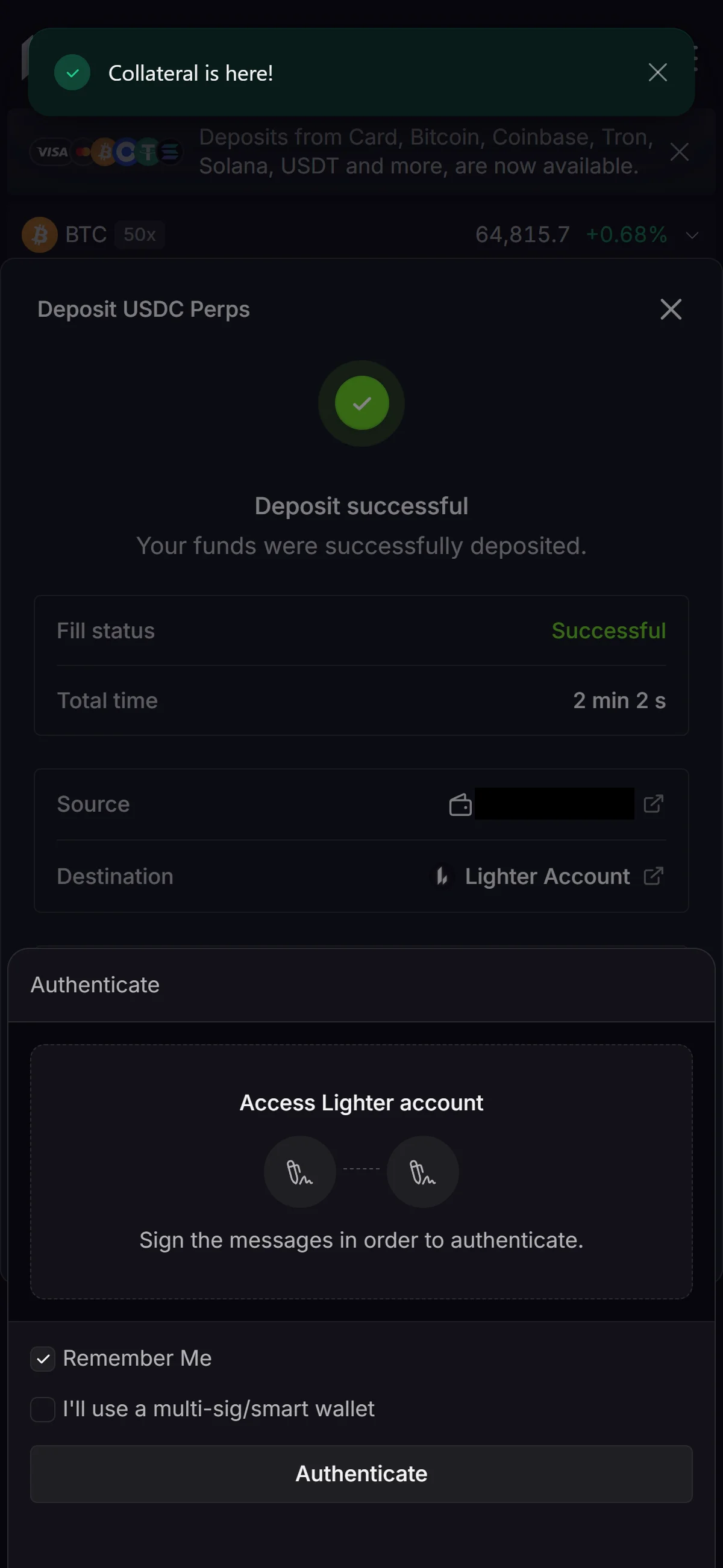
The “Collateral is here!” notice and the successful deposit on the sheet both confirm the funds arrived, so move on to the “Authenticate” section: leave “Remember Me” checked and tap “Authenticate”. Both signature icons under “Access Lighter account” are still gray, so expect to sign two messages in your wallet app, in order.
7. Sign the second message
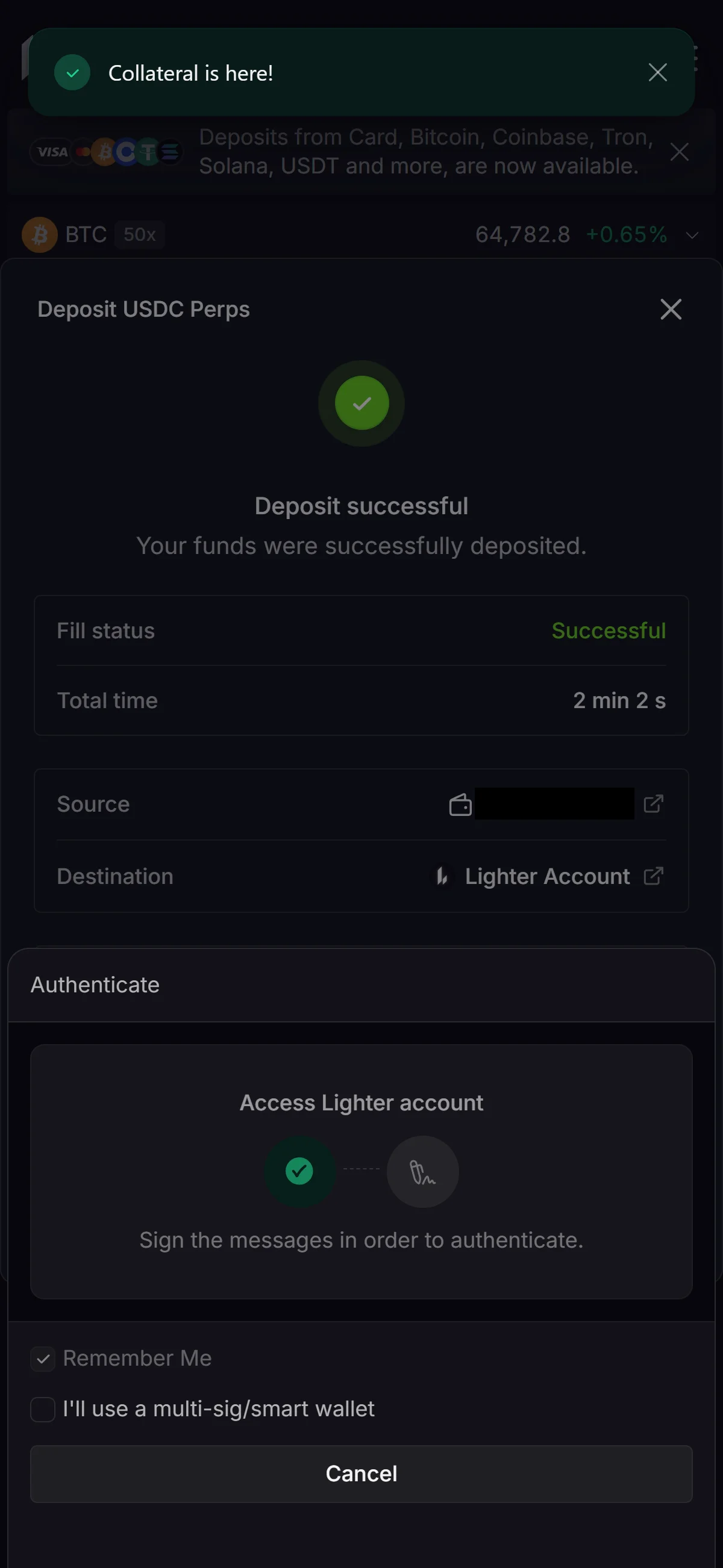
The first icon under “Access Lighter account” turns green once you sign, so return to your wallet app and sign the second message the same way. The button underneath now reads “Cancel”, which drops the run half-signed, so leave it alone unless you want to start over.
8. Accept the updated terms
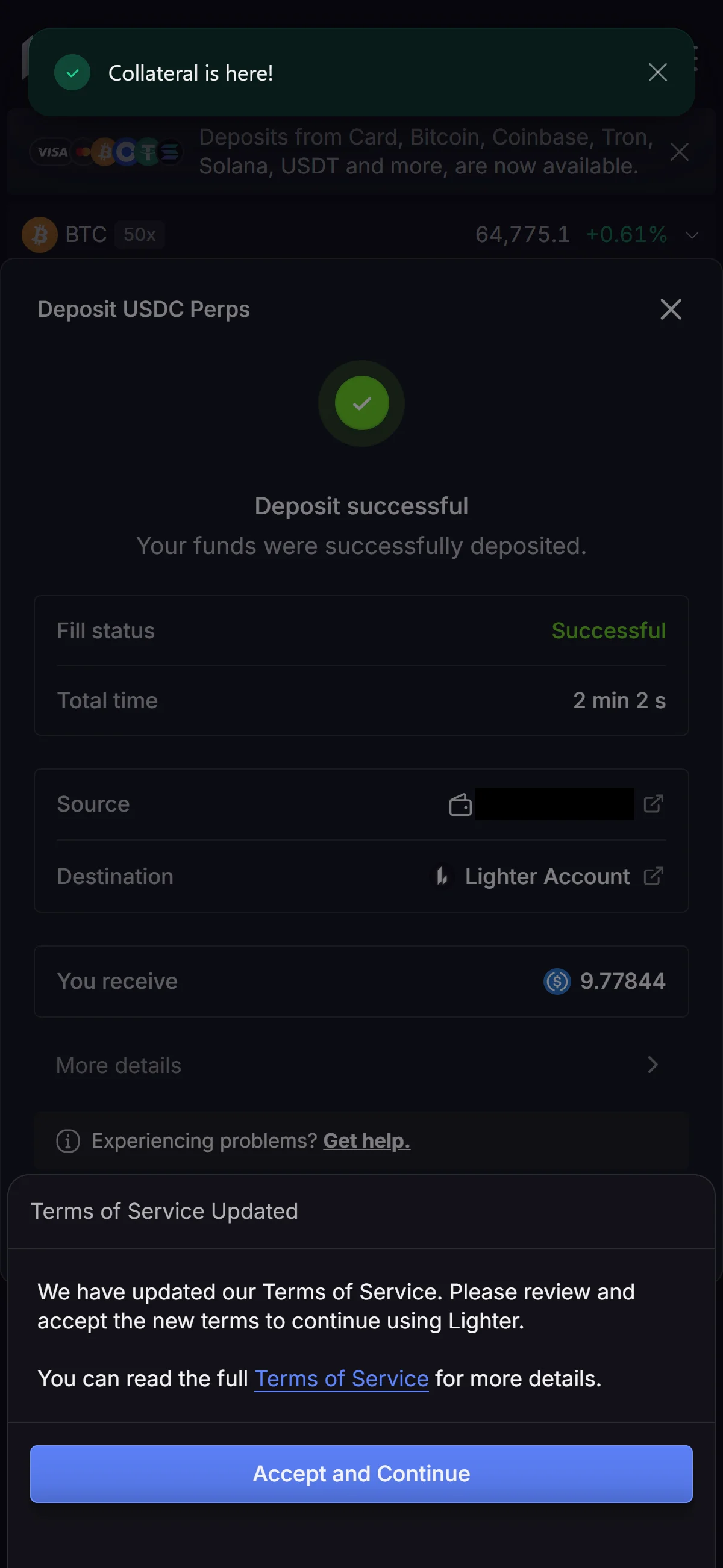
A “Terms of Service Updated” notice follows the signatures and asks you to accept the new terms before you carry on using Lighter. Open the “Terms of Service” link to read them in full, then tap “Accept and Continue”.
9. Choose an account type
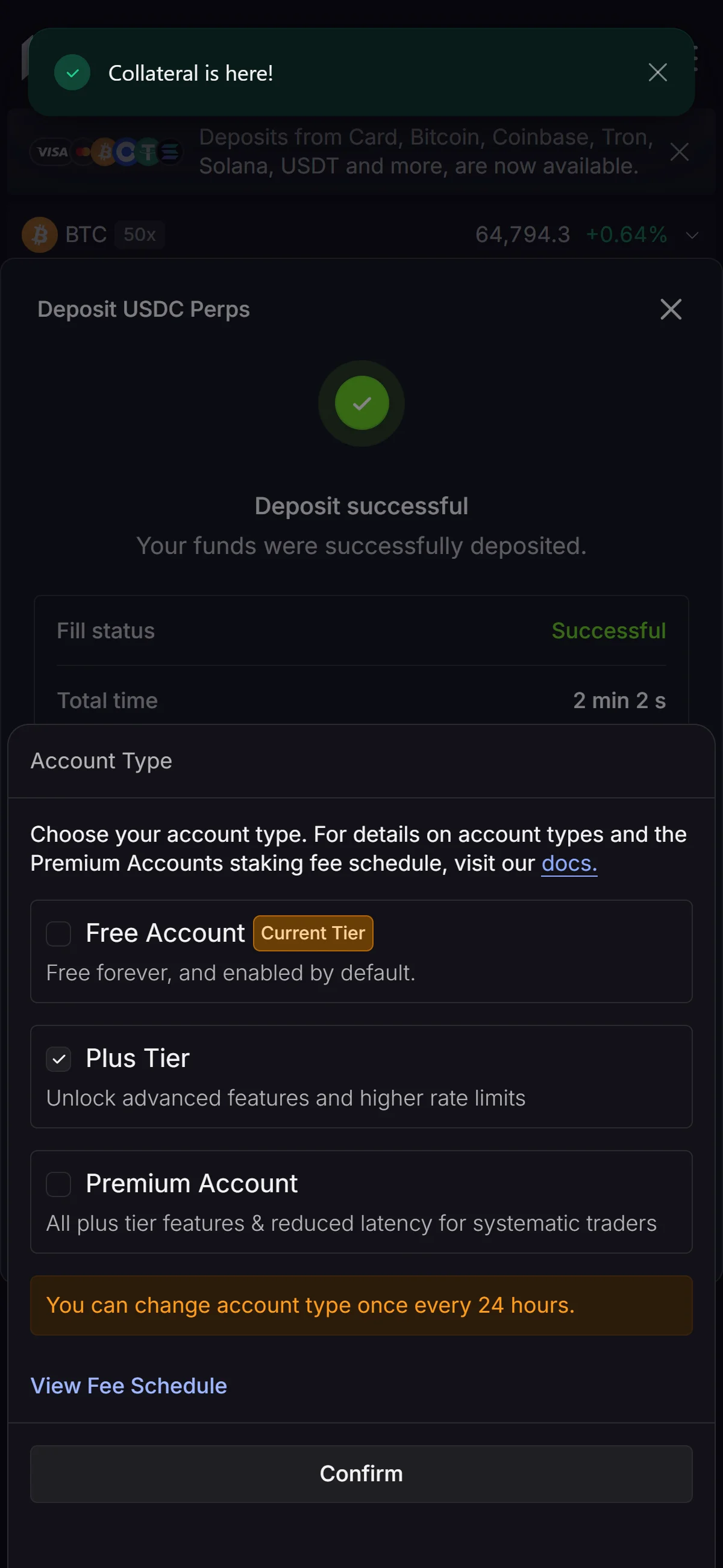
Pick the tier you want in “Account Type”: “Free Account” is flagged “Current Tier”, while “Plus Tier” and “Premium Account” each list what they add, and “View Fee Schedule” opens the fee details. Note the warning that you can change account type once every 24 hours, then tap “Confirm”.
10. Confirm the deposit completed
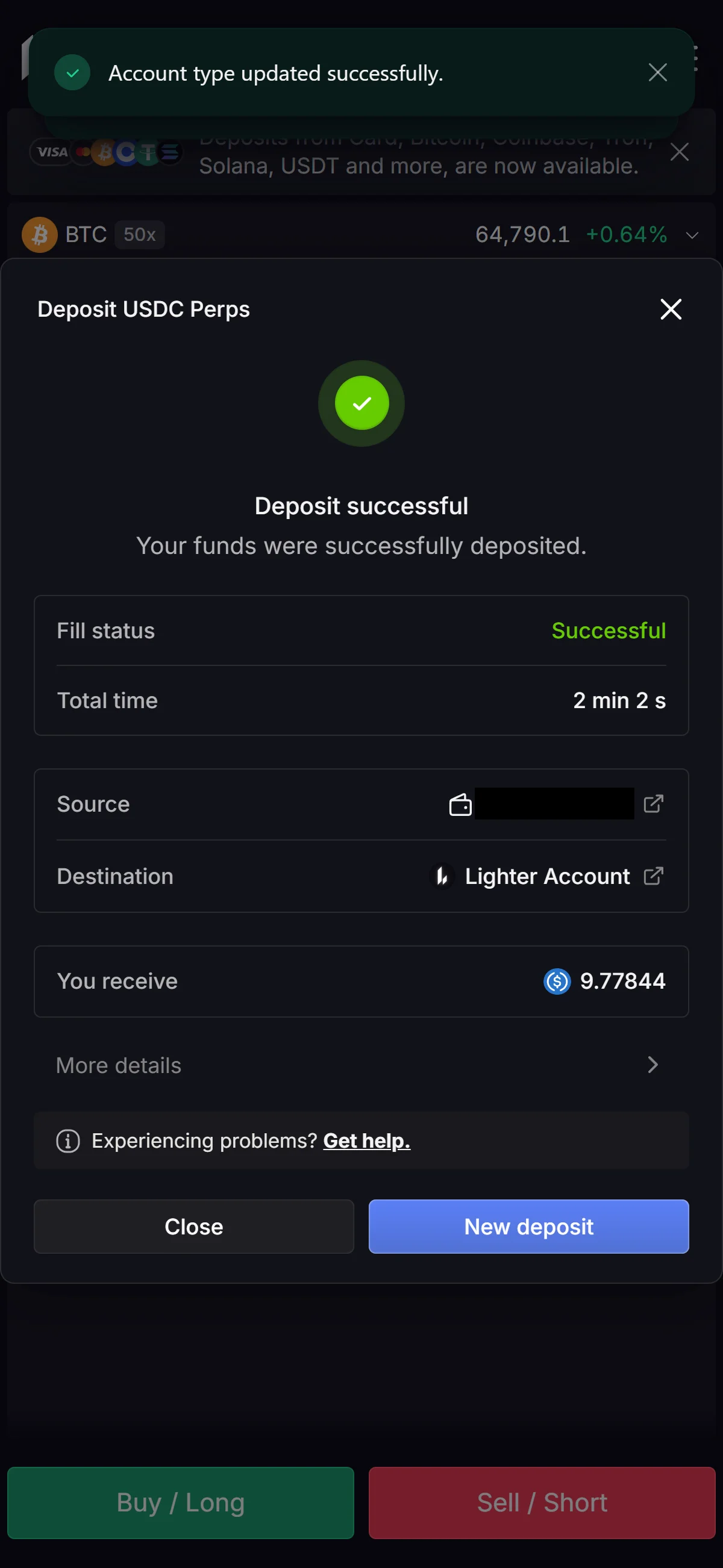
The run ends on “Deposit successful”: “Fill status” reads “Successful”, “Total time” came to 2 min 2 s, and the “Account type updated successfully.” notice at the top confirms the tier change went through. Tap “Close” to dismiss the sheet, with the funds now credited to the “Lighter Account” and “New deposit” ready if you want to add more.
One first-order fact applies to a funded account whichever device you used: each market sets its own minimum order size, around 10 USDC on the markets we sampled, so a small first deposit still has to clear that floor before it can trade.
With the deposit credited, the account authenticated, and the account type confirmed, the balance is live and you are ready to trade.
The Lighter referral code cannot be added after sign-up
The referral code can only be applied when you connect your wallet — it cannot be added afterwards.
If you overlook this and complete the connection without the code, there is no mechanism for linking it to that wallet after the fact.
On Lighter this is not a policy choice so much as a consequence of how the code travels. The URL parameter is the only path that carries it, and no code entry field exists anywhere in the connect flow, so there is simply nothing to go back and fill in later.
Registering again with a fresh wallet is an option worth considering.
- Is the referral code CHAINHELM shown as applied when you connect your wallet? (check any on-screen notice that appears when you arrive via the referral link)
Season 2 points are still accruing, and the LIT airdrop has already been paid
Much of what is written about Lighter still reads as though the token launch were ahead of it. It is not. The LIT token generation event happened on 2025-12-30, and the program running now is Season 2 of the Points Program, with no published end date, after Season 1 closed with its final Private Beta distribution on 2025-09-30.
What Season 2 pays out, and on what schedule
How that pool is divided is described in outline rather than in full. Retail scoring runs across volume, open interest, funding, liquidations and deleverages, and PnL, with scaling factors that favor higher trading quality. Lighter states plainly that the result is non-linear — twice the volume does not produce twice the points — and market-weighted, so equal notional on two different markets earns differently. Some categories are evaluated daily and others weekly. The exact formulas and weights are not disclosed, and saying so is more useful than reverse-engineering a model that nobody outside the operator can check.
Trading through the API accrues points on the same basis as the interface, and a separate track exists for market makers.
One channel difference has been reported officially: trading Lighter perps inside Robinhood Wallet was reported at 2x points against 1x on Lighter’s own web app. That is the only officially reported multiplier on the record.
The December 2025 distribution and what LIT does now
The airdrop that accompanied the 2025-12-30 token generation event went to Season 1 points holders and was credited directly to their Lighter accounts with no claim process; the operator’s own terms confirm that eligible users needed to take no action to receive it. The reported allocation figures are a different matter. They come from secondary reporting rather than an official tokenomics page, and the reported absolute token count does not reconcile with the circulating and maximum supply on record — so the mechanism and the date are established, and the size is not.
- Staking
- Targets a 6% annualized yield, with a 3-day lockup on unstaking.
- Liquidity pool access
- Staked LIT gates deposits into the Lighter Liquidity Pool at a ratio of 1 LIT per 10 USDC of deposit.
- Fee and latency tiers
- Staked LIT, or fee credits bought with LIT, move an account up the Premium ladder covered later in this article.
A tokenomics change announced on 2026-06-30 is worth recording as a mechanism rather than as a forecast. Roughly 15.5m LIT, about 6.3% of circulating supply, repurchased with exchange revenue since the token launch is to be permanently burned rather than held in treasury, with the first burn scheduled for the weeks after the end of Q2 2026. Staking rewards move to being funded from remaining ecosystem tokens against the same 6% target. That is what was announced, and this article stops there.
What the terms reserve, and what earns nothing
The same section places tax responsibility on the user. That matters more here than it would elsewhere, because the venue issues no tax documents at all — a point the country-by-country section below picks up for readers who have filing obligations attached to it.
Eligibility is fenced in two directions. Prohibited Persons under the access and restrictions definitions are ineligible, as are users in breach of the terms. And some activity simply earns nothing: Sybil activity and self-trading do not accrue points, up to 10 accounts are permitted without penalty, and Lighter applies Sybil detection it does not describe.
Zero-fee order books on an Ethereum rollup, operated by a single US company
Lighter is young enough that its whole public history fits on one screen, and specific enough that the pieces matter: an order book proven by zero-knowledge circuits, run by a company incorporated in the United States, on a rollup that settles to Ethereum.
Who runs it and what it runs on
Behind that record sits a conventional corporate structure. The interface and the API are operated by Elliot Technologies, Inc., a US-incorporated company, while the protocol is described in the terms as autonomous software on an Ethereum Layer 2. Vladimir Novakovski is founder and chief executive. Funding runs to roughly USD 90m cumulative, including a USD 68m round on 2025-11-11 co-led by Founders Fund and Ribbit Capital, with Haun Ventures and Robinhood participating, at an approximately USD 1.5bn valuation. Keep the incorporation in mind: it is the hinge on which both of the regulatory sections below turn.
The architecture is an application-specific validity rollup. Execution runs on Lighter’s own L2, while settlement and data availability sit on Ethereum, where custom Plonky2 circuits prove the exchange’s state transitions, and account deltas are published to Ethereum as blobs. Matching is a central limit order book run off-chain by a sequencer that provides ordering and soft finality — but the correctness of that matching, and of liquidations, is enforced by validity proofs rather than asserted by the operator.
What you can trade, and on what margin
Those markets span more than crypto: tokenized equities such as AAPL, AMD and MSFT, commodities including XAU and WTI, FX pairs and pre-IPO names all trade as perpetuals alongside the usual majors. A caveat on the counting — the official contract-specifications page is labeled a test network and lists far fewer pairs, so the market count above comes from the live API rather than the documentation.
Leverage is set per market and expressed through the initial margin requirement: the 50x ceiling applies to BTC and ETH, 25x to SOL and FX pairs, and the smallest markets step down to 3x. Those per-market tiers are published nowhere but that same contract-specifications page, so they carry its staleness with them.
The margin model is cross-margin with multi-asset collateral in a unified trading account. USDC is the base collateral, valued at 100% with no liquidation fee and no supply cap; ETH is accepted at a 50% haircut. Public Pools do not support isolated positions.
Three products sit beside the perpetuals. Public Pools let participants pool funds under a whitelisted operator who trades through a sub-account, with no lockup. The Lighter Liquidity Pool doubles as the venue’s insurance fund and is gated by LIT staking. And the LIT staking pool is separate from both. That dual role is what makes the pool a risk item, and the section on risk below takes it up.
Protocol TVL
Total value secured
Those two numbers are not a discrepancy to be reconciled. They count different things — one measures the protocol, the other measures everything secured on the rollup — and a reader who sees only one of them will form the wrong impression of the other.
What trading actually costs, and who pays for it
The first two numbers belong together, because one is the price of the other. Standard accounts are the retail default and pay nothing; what they trade away is speed. That latency floor is the structural counterpart of the zero fee, not an incidental limitation, and it is the reason the arrangement can persist rather than expire like a promotion.
Speed is what Lighter actually sells. Premium tiers run from 0 to 500,000 staked LIT, reaching a 30% fee discount and 140ms taker latency at the top, and a flat Plus tier charges 0.5bps on both sides. The ladder is priced by staked LIT rather than by trading volume, discounts attach at the L1 address level, and LIT fee credits let an account count toward a tier without staking the full principal.
Funding is hourly and capped at both ends, as the third of those numbers records. Gas is not charged per trade at all: trades are signed on Lighter’s L2, and the operator carries the Ethereum data and verification costs rather than passing them on.
There is one concrete gap in the published numbers, and it is worth stating rather than glossing over. Withdrawal minimums are documented — 1 USDC for a Secure Withdrawal, 4 USDC for a Fast Withdrawal — but no fee schedule is published anywhere. The June 2026 announcement that staking at least 100 LIT removes withdrawal and transfer fees implies a non-zero default for everyone who has not staked, and that default amount is not disclosed. The risk section below returns to it.
A reader will reasonably ask how a venue that charges retail nothing pays for itself. The documented answer is three-part: opt-in Premium and Plus fees aimed at latency-sensitive traders, liquidation fees of up to 1% routed into the LLP insurance fund, and third-party integrator fees under the Partner Attribution Program of up to 10bps on perpetuals and up to 1% on spot. That fee revenue funds daily LIT buybacks, and the founder described the business as already profitable in November 2025.
Fourth by volume and by open interest, and well down from its December peak
Scale is the one thing about Lighter that different sources cannot agree on, so it is worth being careful about which number is being quoted and by whom. The ranking is stable; the absolute volume figure is not.
Where it sits among perpetuals venues
That board is DefiLlama’s, as of 2026-07-28, and it puts Lighter 4th by 24h perpetual volume among the 122 protocols reporting volume — close enough to third that the gap is a rounding difference. Lighter ranks 4th by open interest on the same board.
The reason to lead with the ranking rather than the number is that the number moves by source. DefiLlama puts 24h perpetual volume at USD 955,064,638, Lighter’s own public API at USD 1,607,662,665, and CoinGecko at USD 1,591,028,624 — a spread of roughly 1.7x, driven by different normalization and snapshot timing. Open interest is the better-corroborated measure: DefiLlama records USD 836,598,528 and CoinGecko USD 832,664,845, agreeing within 0.5%. Where this article gives a volume figure, it names the source.
A third placement belongs here for completeness. On CoinGecko’s derivatives board Lighter sits 32nd of the 100 exchanges indexed. That is a combined centralized and decentralized list, so it answers a different question from the DEX ranking above and should not be read as a demotion.
30-day volume of USD 34.06 billion, down 42.8% month-on-month, against a peak near USD 232 billion around the token launchDefiLlama, 2026-07-28
Against the prior 30 days the same measure is down 27.4%, while 7-day volume is up 31.5%. Lighter’s share of DefiLlama’s all-perpetuals 24h total is 8.5%, computed on DefiLlama’s own basis. The shape a reader should take from this is neither decline nor recovery but both at once: a venue well past a launch-driven peak, and still among the largest in its category.
The four things this venue does that its peers do not
Zero-fee retail is the first thing anyone notices, but it is a pricing structure rather than a capability, and it has already been accounted for above — the cost comes back from latency tiers, liquidation fees and integrator fees rather than from retail flow. The four properties below are the ones that are actually hard to find elsewhere.
The first is that matching is proven rather than asserted. Order matching and liquidations are proven with custom Plonky2 circuits and verified on Ethereum. Most peers either run an off-chain matching engine whose fairness cannot be checked cryptographically, or an on-chain book that gives up latency to avoid the question. This is a narrower claim than general rollup validity, and it is worth stating precisely: what is proven is the engine itself.
The second is the breadth of what the perpetuals reference. Tokenized US equities, equity indices, ETFs, commodities, FX and pre-IPO names all trade alongside crypto, with 24/5 equity hours since January 2026 and a perpRFQ block facility for large RWA positions since May 2026. That is a materially wider non-crypto set than most perpetual DEXs carry.
The third is a distribution channel no other perpetual DEX holds. Lighter has been the perpetual futures provider for Robinhood Chain since its 2026-07-01 mainnet launch, trading inside Robinhood Wallet with USDG as collateral and reported at up to 10x leverage, under a broader exclusion list than Lighter’s own. The terms differ by access channel, and the two sets should not be read as one. The contribution is small so far: about USD 1.16m of 24h volume on that deployment.
The fourth is the exit route, which is the counterweight to a single-operator design. Users can force transactions through L1, and if operators censor or fail, the system can be frozen into desert mode, where users exit by reconstructing state and submitting a proof of their own balance. The exit hatch was separately audited. It is a real guarantee about custody, and it is not a guarantee about the upgrade risk recorded in the risk section below — those are different failures, and the exit route only answers one of them.
Who this venue fits, and who it does not
The honest summary of everything above is a fit judgment rather than a verdict, and it cuts in both directions.
A self-custody trader with no need for a perimeter
Anyone who needs speed, recourse or certainty
Each of those is a property of this venue and this reader, not a ranking against some other venue. A reader who lands on the “Does not fit” side should read that as a reason to stop, not as a prompt to go looking elsewhere.
Fourteen excluded jurisdictions, no license anywhere, and nothing on the enforcement record
Lighter’s regulatory position is unusual mainly in what is missing from it. There is no authorization anywhere, there is no enforcement history anywhere, and the only hard perimeter is one the operator drew itself — in a document that has quietly changed more than once.
The exclusion list, and the fact that there are two of them
The Terms of Service last updated 2025-12-29 have to be read as the union of the two lists they contain, which comes to 14 jurisdictions: the United States, Canada, the United Kingdom, China, North Korea, Russia, Ukraine, Cuba, Iran, Venezuela, Sudan, Belarus, Myanmar and Syria. The reason is that the opening all-caps availability notice carries all 14 while the operative Prohibited Person definition carries 11, omitting Sudan, Belarus and Myanmar. Neither list can be presented alone as definitive, and the discrepancy sits inside one document under one date.
That last line is the checkable part. A reader who wants to know whether their own country has been added cannot use the date stamp as a change indicator, because the list has already grown once beneath a stamp that did not move.
Enforcement of the exclusion takes remarkably little data. The terms state that the operator may log IP addresses through the interface in order to enforce access restrictions, and that no other personal data is collected there, with interaction occurring through the wallet address alone. There is no identity verification, and no wallet-screening or attestation mechanism is described anywhere in the documentation: access control is self-certification plus IP logging. A visitor from a restricted jurisdiction lands in a withdrawal-only state, and the API returns error 20558.
Which layer the restriction actually sits on
The two-layer structure is stated explicitly in the terms. Elliot Technologies, Inc. provides the website-hosted interface and the related API, while the Lighter Protocol is described as autonomous software running on an Ethereum Layer 2. The geo-block and the terms attach to the interface and services layer.
The separation is weaker here than that phrasing suggests, and that is the analytical point. The L2 is run by a single centralized sequencer under the same operator, and the contracts are upgradeable by operator-controlled multisigs. A reader excluded from the frontend does not have the kind of independent path to the venue that a fully permissionless protocol would leave open. That is an architectural fact and it is where this section stops: this article describes no route around any restriction, in either direction.
No authorization held, no action taken, and the exposure that remains open
Both of those are states, and neither is approval. Operating without authorization is the normal posture for a non-custodial perpetual DEX that excludes regulated retail markets by contract rather than operating under a license. And the absence of a located enforcement action is exactly that — an absence of a located action, not proof that none exists, and certainly not clearance.
What remains open is easier to name than to resolve. Lighter lists perpetual futures referencing tokenized US equities, equity indices, ETFs and pre-IPO names alongside crypto, commodities and FX. Those are derivatives on securities-linked underlyings, offered to retail without KYC, by an operator that is a US-incorporated corporation whose own interface excludes US persons. That combination is the central regulatory question hanging over the venue.
The direction of travel, stated without predicting an outcome, is unresolved and structurally exposed rather than tightening or loosening from a settled base. The venue blocks the major regulated retail derivatives markets by its terms while its operator is a Delaware corporation headquartered in Florida. The July 2026 Robinhood partnership increases entanglement with a US-listed brokerage while keeping the same exclusions. And the addition of equity, index and pre-IPO perpetuals since January 2026 raises rather than lowers the ceiling of potential attention. No directional enforcement event has occurred to date.
Lighter excludes the US and the UK, and serves Singapore, Australia and India
Where a reader sits decides which half of what follows they need. Two of the five countries covered here are excluded by the operator’s own terms; the other three are served without restriction, and carry a different set of obligations entirely.
United States: excluded since the earliest terms, withdrawals only
The exclusion is not recent. The United States has been an excluded jurisdiction since the earliest archived Terms of Service of 2025-01-20, where “Blocked Persons” covered the US, the UK and Canada, and the version in force since 2025-12-29 keeps it in both the availability notice and the Prohibited Person definition. A US visitor reaches a restricted-jurisdiction state that permits withdrawals only: the interface reads “Only withdrawals are available” and the API returns error 20558. Trading is fully disabled, while assets already deposited can still be recovered.
That is established from three checkable places rather than from a US-side test: the operator’s own terms, the geo-block strings and error code shipped in Lighter’s production frontend bundle, and Robinhood’s official 2026-07-01 statement that perpetuals are not available to US residents. It was not observed from a US connection, and nothing here should be read as though it were.
Why the block exists is the part most pages skip. No US federal statute prohibits a resident, as such, from trading crypto perpetual contracts. The CFTC’s registration enforcement in this area has run against operators and facilitators — the 2023 orders against Opyn, Deridex and ZeroEx, and the 2024 orders against Uniswap Labs and Falcon Labs. None of those name Lighter, and none of them may be read as action against it. The bar facing a US reader is contractual and technical, set by Lighter, not a rule aimed at the reader.
There is an asymmetry here that most excluded markets do not have. Unlike venues that shut out the US from offshore, Lighter’s operator is itself a US company: Elliot Technologies, Inc., Delaware-incorporated, with the terms governed by Florida law and Miami-Dade County named as the forum. The company sits inside US jurisdiction while contractually excluding US users.
One clarification prevents a predictable misreading. The Lighter Mobile iOS app is downloadable from the US App Store, published by Elliot Technologies, Inc., but in non-supported regions it is a market-information client rather than a trading client. App-store availability is not trading availability.
And the state of the enforcement record: no US authority has named Lighter or Elliot Technologies, Inc. in any statement, order or advisory located as of 2026-07-28.
United Kingdom: excluded in two clauses, with the frontend geo-blocked
UK persons have been excluded since the earliest archived terms of 2025-01-20, and the version in force since 2025-12-29 keeps the exclusion in two separate places — the all-caps availability disclaimer and the Prohibited Person eligibility clause. The frontend runs a live server-side gate on top of that: the app polls a geolocation endpoint every 30 seconds and treats error code 20558 as a jurisdiction block. As with the US, the mechanism is verified and the UK-specific outcome was not observed from a UK connection.
What the operator says to UK readers is only what those clauses say. No blog post, announcement or support article addressing UK users or the FCA was found; the exclusion has been carried silently through every revision of the terms.
The bar is contractual rather than statutory. No identified UK law makes it an offense for a resident to use an offshore non-custodial trading protocol. The FCA’s prohibitions run to firms: PS20/10, in force since 2021-01-06, bars firms acting in or from the UK from selling crypto derivatives to retail clients, and the FCA confirmed in 2025 that this prohibition stays in place even as crypto ETNs opened to retail. Section 21 of FSMA restricts persons communicating financial promotions in the course of business. The perimeter runs against operators.
A UK reader will want the direction of travel, and it now has dates attached. The FCA published the core final rules for the mandatory cryptoasset regime on 2026-06-30, with the authorization gateway opening 2026-09-30 and the regime in force from 2027-10-25, and its finalized guidance FG26/7 states it will generally expect an international cryptoasset firm to have a UK legal entity. Lighter’s posture — contractual exclusion plus a server-side gate — is that of a firm outside the perimeter, and no statement of intent about UK authorization was found.
The practical consequence is one the FCA itself names: where a firm is not FCA-authorized or registered, UK consumers are unlikely to have Financial Ombudsman Service or Financial Services Compensation Scheme protection. And the state of the record: no FCA or other UK authority action, warning or alert names Lighter, and nothing above should be read as one.
Singapore: never restricted, and outside the MAS-licensed perimeter
Singapore has never appeared in any version of the exclusion list, from the January 2025 terms through the version live on 2026-07-28, and the interface is served without restriction. The check on the live interface ran from a Japanese egress IP rather than a Singapore one, so the finding rests on the terms plus the absence of any Singapore entry in the restriction material.
The obligations sit with the provider, not the reader. Licensing duties under the Payment Services Act and the Financial Services and Markets Act 2022 attach to the service provider. MAS’s 2025-06-06 clarification of the Part 9 digital token service provider regime targets persons in Singapore providing services to customers abroad, and does not, on its face, reach a foreign-incorporated operator with no Singapore establishment. No Singapore law identified prohibits a resident from accessing an offshore platform.
There is an open question here, and it should be read as open. MAS’s own criterion, set out in its 2022 statement after the FTX collapse, is solicitation: Binance was placed on the Investor Alert List because it solicited Singapore users without a license, while FTX was accessible but not soliciting. Whether Lighter’s posture amounts to soliciting Singapore users has not been addressed publicly by MAS. That is neither compliance nor breach; it is unadjudicated.
The negative finding comes with a shelf life attached. MAS’s Investor Alert List and Financial Institutions Directory both returned zero matches for Lighter on 2026-07-28. MAS has added unlicensed perpetual-futures DEX platforms to that list during 2026, so this is a point-in-time result rather than a standing position.
What it means for a Singapore reader is best put in MAS’s own framing: the consequence of using an unlicensed offshore venue is the absence of statutory protection and of recourse — MAS cannot ringfence or protect local users’ assets at a venue it does not license — rather than personal illegality.
Australia: never on the list, with a large gap to the local leverage cap
Australia has never been named in any version of the exclusion list — not in the three-country January 2025 terms, not in the eleven-country December 2025 expansion, and not in the fourteen-country list live on 2026-07-28 — and no geo-block applies. A render with Australian locale and timezone loaded the full trading interface, though from a Japanese egress IP, so the conclusion rests primarily on the operator’s own exclusion list, which the app’s own block banner cites as the authoritative source.
No ASIC instrument identified prohibits an individual from using an offshore perpetual DEX. ASIC’s published posture is caution and loss of protection rather than prohibition on the user: its warnings note that investors on unlicensed platforms cannot access rights and protections available under Australian financial services law, and its licensing language addresses the platform, not the customer.
What is unresolved concerns the venue, not the reader, and the two should be kept apart. ASIC’s INFO 225, updated 2025-10-29, expressly names perpetual futures among arrangements meeting the derivative definition, and states that Australian law applies where services are provided in Australia including from offshore — while equally expressly declining to rule on when a DeFi arrangement needs a license. The Corporations Amendment (Digital Assets Framework) Act 2026, assented 2026-04-08 with commencement 2027-04-09, draws its perimeter around operators holding digital tokens for a client, so a genuinely non-custodial venue is less likely to be captured; that is fact-sensitive rather than a categorical exemption. The accurate reading is: not prohibited for the user, unresolved for the venue.
The most consequential Australian-specific fact is a gap, and its size is the point.
CFD product intervention order, extended to 2027-05-23
What the venue offers in the same underlying classes
ASIC’s REP 835 of 2026-06-30 records that CFD rules may apply where products marketed as perpetual futures fall within existing intervention measures, which is why this is a live regulatory question rather than a settled feature.
The record as it stands: no ASIC, AUSTRAC or court action against Lighter, its operator or its founder was found in any Australian primary source, and Lighter is named nowhere in REP 835. Where ASIC’s concerns about this product class touch this venue, they are category-level and never target-specific.
India: in neither version of the exclusion clause, with the tax burden on you
India appears in neither of the two lists the live Terms of Service carry — not in the fourteen-jurisdiction header clause and not in the eleven-jurisdiction eligibility representation — and in no archived version back to January 2025. The full interface is served, verified by a render with Indian locale and timezone, though from a Japanese egress IP rather than an Indian one.
No Indian law makes it an offense for a resident to hold or transfer virtual digital assets or to use a non-custodial DEX. The PMLA VDA regime attaches to service providers carrying on notified activities on behalf of another person in the course of business, and FIU-IND’s guidelines updated 2026-01-08 state those obligations are activity-based and apply irrespective of physical presence in India, with automation by smart contract not relieving controlling parties of responsibility. Whether the operator of a non-custodial perpetual protocol is a VDA service provider has not been adjudicated by any Indian authority. FIU-IND’s named notice lists — nine offshore providers in December 2023 and twenty-five in October 2025 — contain only centralized custodial exchanges, and Lighter is on neither.
The reader’s own duties are where the substance sits for India, and they do not depend on the venue at all.
From 2026-04-01, prescribed reporting entities must furnish crypto-asset statements under section 509 and Form 167 — a duty on providers, not on investors. Since Lighter runs no KYC and issues no tax documents of any kind, no such statement will reach an Indian user from this venue, and the record-keeping falls entirely on the reader.
Two points are recorded here as unresolved rather than answered. Whether funding an offshore non-custodial derivatives protocol engages FEMA or the Liberalised Remittance Scheme is not addressed by the RBI’s LRS FAQ, which lists virtual digital assets in neither the permitted nor the prohibited column. And the widely repeated claim that offshore crypto derivatives trading is illegal under FEMA could not be traced to any RBI notification, circular or FAQ, so this article does not repeat it. Note also that no Indian leverage cap or derivatives-conduct rule applying to crypto perpetuals was located, and the Standing Committee on Finance was still recommending that a framework be created as of 2026-07-23.
The record as it stands: no Indian regulatory action naming Lighter, Elliot Technologies or lighter.xyz exists on the public record as of 2026-07-28.
Contracts that can change with no delay, one sequencer, and a track record that starts in October 2025
Everything in this section is specific to this venue. The ordinary hazards of perpetual trading — leverage, funding, liquidation as such — are taken as read, so that what remains is the exposure that comes from choosing Lighter in particular.
Who can change the system, and how fast
Every core contract is upgradeable: the main rollup and escrow contract, Governance and the verifier, administered by an UpgradeGatekeeper and ultimately by a 3-of-5 network governor multisig operating under a nominal delay. The critical part is what sits above that. A 4-of-7 multisig acting as security council can shorten that delay at will, which is why L2BEAT records the risk that funds can be stolen through a malicious code upgrade with no delay on upgrades, rates it critical, and assigns an exit window of None. The distinction between the nominal delay and the effective one is the whole of the point.
Upgrades are not a theoretical power, in other words: they are exercised. The governor multisig can also manage validators, change the insurance fund manager and treasury addresses, and add or update markets and assets. Three externally owned accounts act as validators, able to commit, verify and execute batches, and to revert batches that have been committed but not yet executed.
That Stage 0 classification follows from the venue running on a single sequencer, which also means MEV can be extracted if the operator front-runs user transactions.
What has actually happened, with dates
The October 2025 event is the one real stress test on the record. Reported contributing causes were the single sequencer, proof-generation bottlenecks and a delayed database upgrade acknowledged by the chief executive. Figures circulating for user losses and points compensation vary between accounts, could not be reconciled against any official postmortem, and are named here as unverified rather than repeated; no official postmortem was located on any Lighter channel.
The July 2026 entries are easy to misread in either direction. They are L2BEAT’s measurements of L1 proof and state-update cadence. Lighter’s own status page simultaneously reports 100% uptime over 90 days with no incidents in May, June or July 2026 — a measurement of user-facing service availability. A proof gap is not a trading outage, and the uptime claim does not cover settlement. Both readings can be true because they are readings of different layers.
Behind all of it is a short record: public mainnet has run only since 2025-10-02. No smart contract exploit, oracle manipulation incident, governance attack or frontend compromise has been publicly reported, and the honest reading of that is that it reflects a nine-month history at least as much as it reflects security.
Audit coverage is the counterweight, with its own caveat. Nine published reports from three independent firms span 2025-08-04 to 2026-06-11: zkSecurity on the ZK circuits, Nethermind on the core and bridge contracts, Zellic on the EVM contracts, covering between them the prover circuits, the block and delta layers, wrapper circuits, the exit hatch, spot and multi-asset support, the deposit bridge and the EVM migration. The first auditors reported the codebase well-structured and tested, while noting that the documentation and whitepaper were outdated against the code.
What the venue does not publish
Each item below is a specific gap a reader can verify is missing.
- The size of the insurance fund
- The LLP mechanism is documented, but no fund size is published or exposed through the public API. The same pool doubles as the liquidity pool and absorbed a loss of about 5.35% in October 2025, so it is not loss-proof.
- Most of the stack
- The prover repository with the circuits and the official Python and Go SDKs are public, and L2BEAT has reproduced deployed verifiers from source on some upgrades. But at least one verifier deployment on 2026-07-13 had no sources published at the time, and the sequencer and matching engine implementations are not published at all.
- What a vulnerability report is worth
- A vulnerability disclosure policy is published; a reward schedule or tiers are not, and no third-party bug bounty program was verified.
- The default withdrawal fee
- Staking at least 100 LIT was announced as removing withdrawal and transfer fees, which implies a non-zero default for unstaked users. That amount is published nowhere.
- How points are scored, and whether they pay
- The exact scoring formulas and weights are not disclosed, and the terms state that users are not entitled to any set number or amount of tokens and that distribution may be restricted or limited at the Company’s sole discretion.
- Who holds the keys
- The admin-key and upgrade-governance facts set out earlier in this section are documented only by a third party. Lighter publishes no equivalent disclosure of its own.
What a position is exposed to when it goes wrong
Liquidation runs as a waterfall with named stages. An account is healthy, then pre-liquidation, where increases to the position are restricted. Then partial liquidation, where orders are canceled and positions are closed through zero-price limit orders. Then full liquidation, where the LLP takes over all of the account’s positions in ascending order of unrealized PnL, provided the LLP itself stays above its own initial margin requirement. Auto-deleveraging activates only when an account has negative value and the LLP lacks the capital to cover the loss. Up to 1% of liquidation proceeds is routed to the LLP.
The code attaches only at first connect — the rest is a decision about the venue
One thing in this article cannot be revisited later, so it goes first. The code travels on the referral link and is applied at login, which means it attaches at the first connection of a wallet that has never connected to Lighter before. There is no field to fill in afterwards and no way to attach it to a wallet that has already connected; a fresh wallet through the link is the only remaining route. Everything else below can be reconsidered at leisure. This cannot.
Where a reader sits decides the rest. In Singapore, Australia or India the venue is reachable and no identified local law prohibits an individual from using it — while the reader carries their own tax and record-keeping duties, and no local protection travels with them. In the United States or the United Kingdom the reader is excluded by the operator’s own terms, which is a decision Lighter made rather than a rule aimed at them.
Funding an account means accepting a specific set of exposures, all of them argued above and none of them worth re-arguing here: contracts upgradeable with no effective delay, a single sequencer, a nine-month public track record with one multi-hour outage in it, an insurance pool of undisclosed size that has already taken a loss, and points and any future distribution held at the operator’s discretion.
◆ ◇ ◆
What that adds up to is a fit rather than an endorsement. Lighter suits a self-custody trader who wants zero-fee order-book depth across crypto and equity-referencing perpetuals and can live with a 300ms latency floor and no regulated recourse. A reader who cannot live with either of those last two should not be here — and the honest version of that sentence ends there, without a second address to try.