— Contents 11 sections
- 01 Is the GMX referral code “chainhelm” still active?
- 02 What the GMX referral code “chainhelm” gets you
- 03 GMX sign-up steps with the referral code
- 04 What to do after connecting to GMX
- 05 The GMX referral code cannot be added after sign-up
- 06 GMX runs perpetuals from pooled liquidity on Arbitrum, with no account to open
- 07 GMX ranks 21st among perp protocols by daily volume and 7th by derivatives fee revenue
- 08 GMX holds no license anywhere, and no regulator has yet named it
- 09 GMX is closed to U.S. Persons, and unregulated for readers in the UK, Singapore, Australia and India
- 10 GMX runs no insurance fund, and auto-deleveraging can close a position that is winning
- 11 Where this leaves you: a 5% fee cut, applied once, on an unlicensed venue
chainhelm’s exclusive GMX referral code is .
As of 2026-08-13, we connected a new wallet and confirmed that the referral code was applied.
Connect your wallet using this code to receive a 5% discount on trading fees. The code has to take effect before that wallet’s first trade — a one-time window.
This article covers the sign-up process (wallet connection) with the GMX referral code, GMX’s distinguishing features, availability in the United States, the United Kingdom, Singapore, Australia and India, and the risks to acknowledge — with the connection flow and code application verified first-hand by chainhelm’s editorial team.
Is the GMX referral code “chainhelm” still active?
The chainhelm editorial team connected to GMX with a fresh wallet on 2026-08-13 and confirmed that the referral code “chainhelm” is still active.
Here is the actual screen captured during verification.
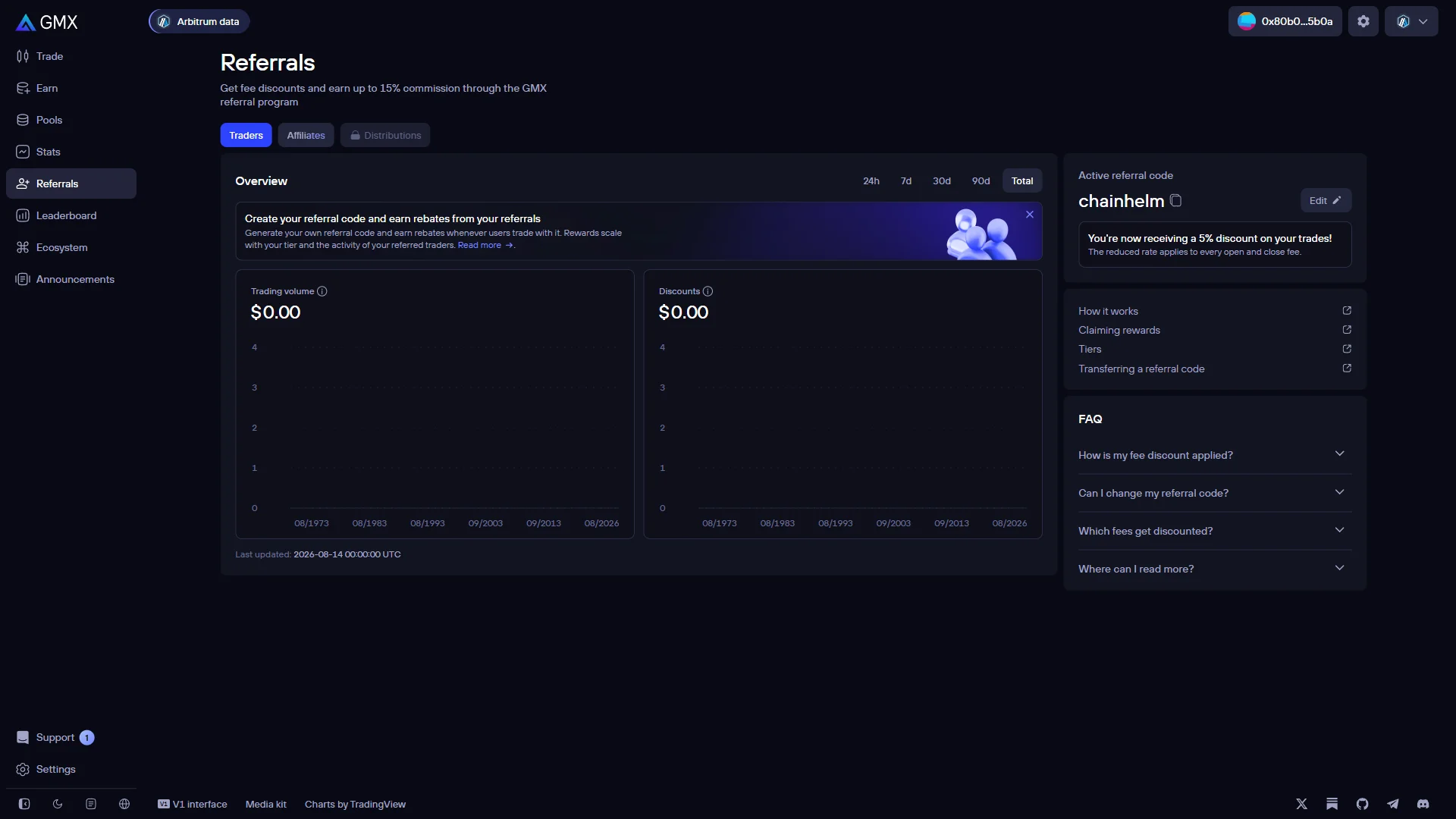
The screen shows “You’re now receiving a 5% discount on your trades!”, confirming that the referral code chainhelm was correctly applied.
chainhelm continuously verifies the validity of the code and confirms it remains usable.
That panel is not buried anywhere: it is the Referrals page, Traders tab, under the heading “Active referral code”, and it stays there for as long as the wallet is connected.
One boundary worth stating up front. What we checked ourselves is the wallet-connect flow and the code applying to a new wallet on 2026-08-13. Everything further down about regulation, country availability and risk comes from documentary sources, not from our own testing, and it is dated the same day.
What the GMX referral code “chainhelm” gets you
Connect your wallet using this code to receive the following benefits on GMX:
- Benefit
- a 5% discount on trading fees
- Expiration
- None
- Eligibility
- New users
You only receive these benefits when the code is active on the wallet before its first trade. Once that wallet has traded without it, you won’t be able to get them afterward.
GMX sign-up steps with the referral code
There is no account to open here. Connecting a wallet is what replaces registration: no email address, no password, no identity check, and no deposit before you can trade.
We cover the connection process separately for PC/browser and smartphone (mobile).
PC/browser connection steps
- First, open the GMX official page (the link applies the referral code). When you open it, you’ll see a screen like the one below.
2. Connect your wallet from the trade page
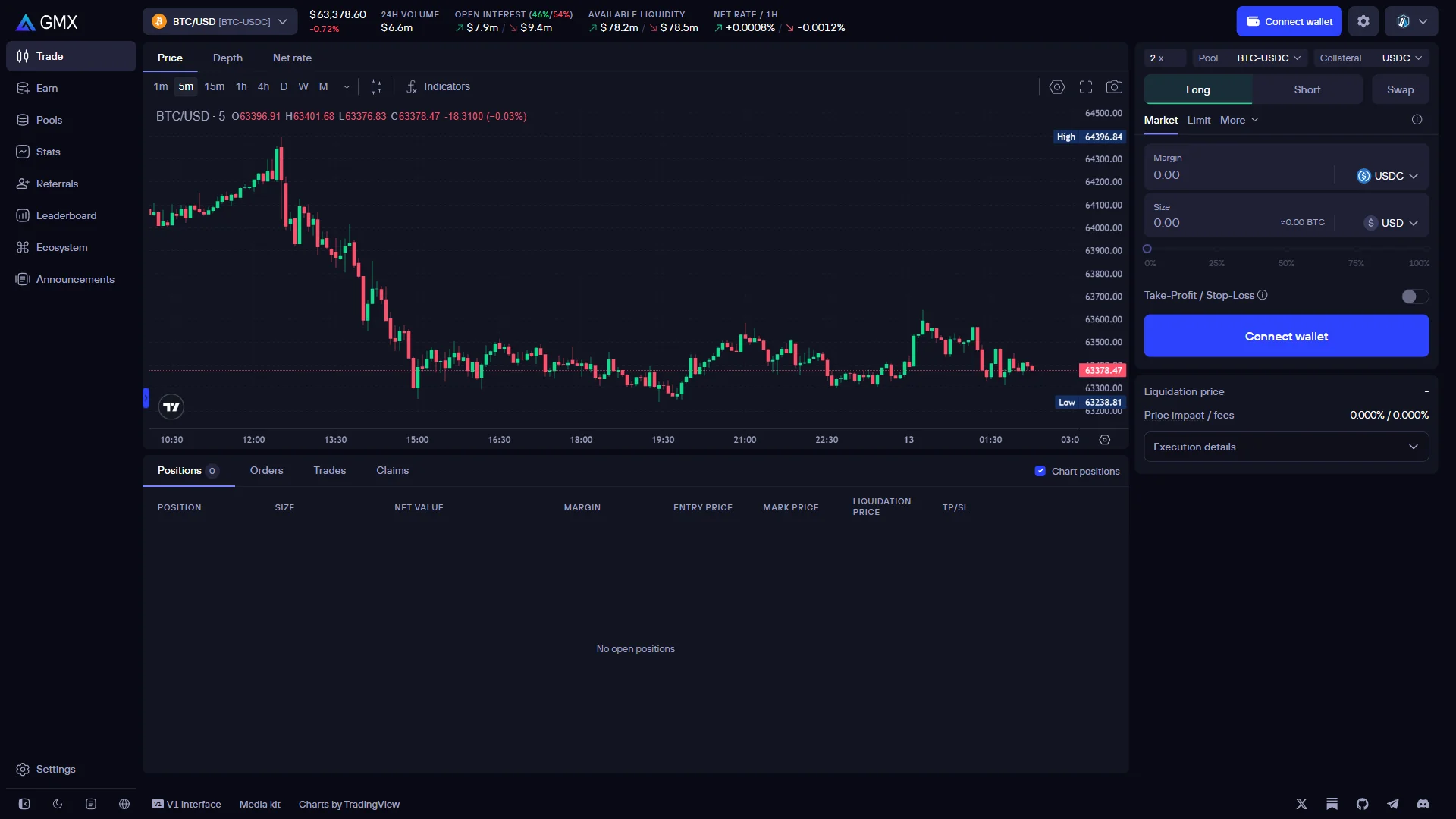
The referral link lands you on the GMX “Trade” page with the BTC/USD chart loaded and no wallet attached, so click “Connect wallet” at the top right to open the wallet picker.
The same button also sits in the order panel on the right, and while the header still shows “Connect wallet” instead of an address, nothing is connected yet.
3. Choose your wallet in the sign-up modal
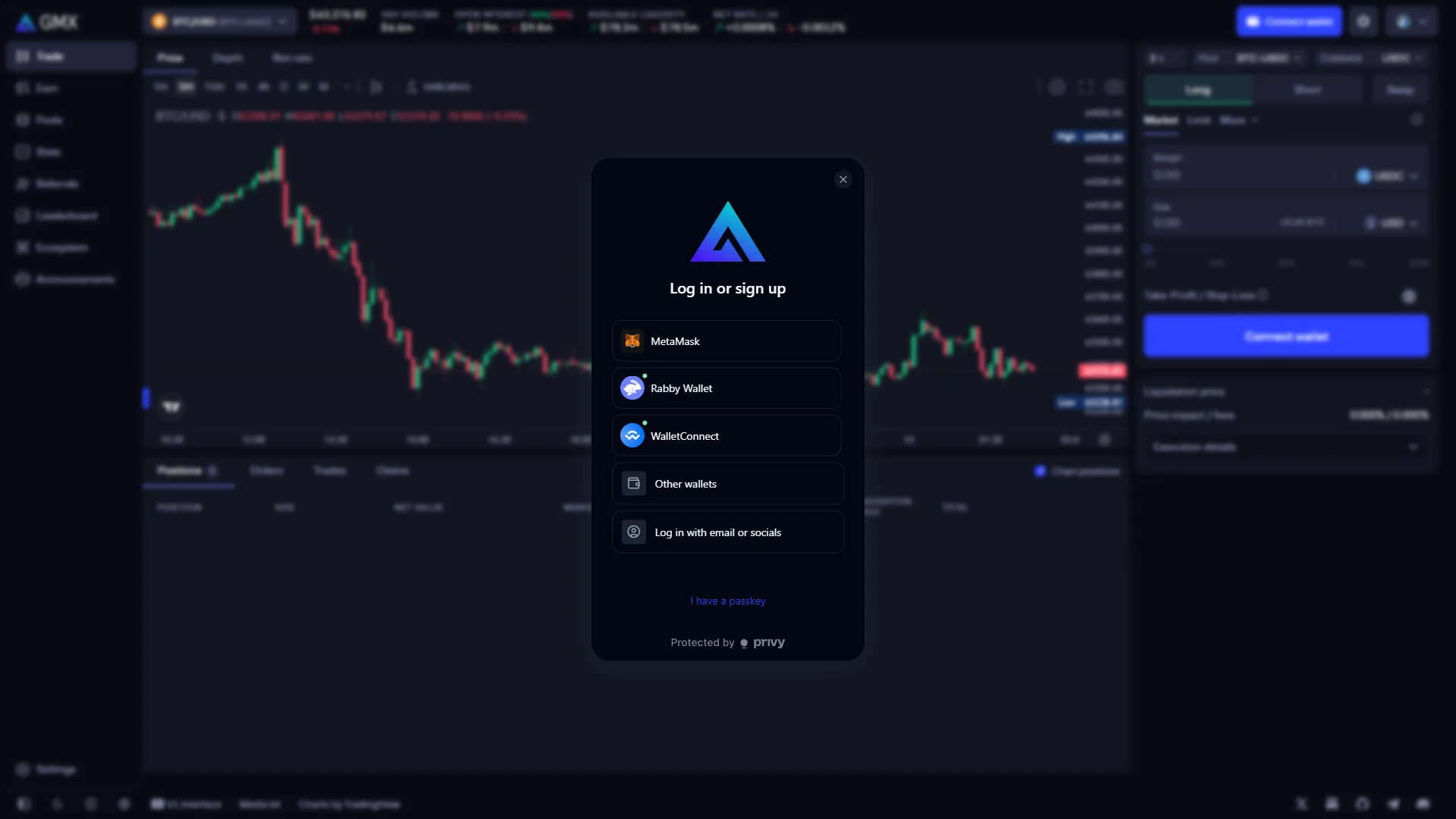
In the “Log in or sign up” modal, click the wallet you use — “MetaMask”, “Rabby Wallet”, or “WalletConnect” if your wallet lives on your phone — and that wallet opens its own approval window.
If your wallet is not on the list, “Other wallets” opens the wider picker, and “Log in with email or socials” starts an account with no wallet at all.
4. Approve the connection in your wallet
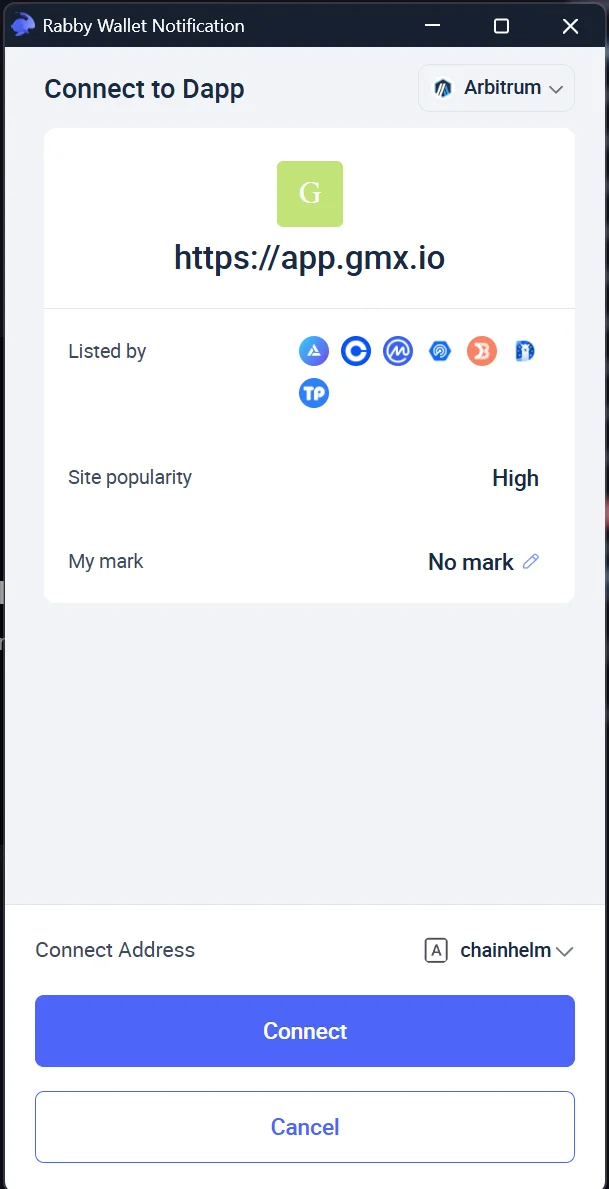
Your wallet opens its own approval window — the example here is Rabby Wallet’s “Connect to Dapp” window — where “Connect” links the wallet to GMX and “Cancel” backs out without connecting.
Before you approve, check that the site reads https://app.gmx.io, that the network at the top right reads “Arbitrum”, and that the account next to “Connect Address” is the wallet you mean to trade with; approving closes the window with the wallet connected.
5. Check the code on the Referrals page
With the wallet connected, click “Referrals” in the left menu and stay on the “Traders” tab. The panel on the right gives “Active referral code” as chainhelm, with the notes “You’re now receiving a 5% discount on your trades!” and “The reduced rate applies to every open and close fee.” underneath.
If that panel is blank or shows a different code, “Edit” lets you enter chainhelm yourself.
Smartphone (iOS / Android) connection steps
- First, open the GMX official page in your mobile browser or your wallet app’s in-app browser (the link applies the referral code). When you open it, you’ll see a screen like the one below.
2. Tap “Connect wallet” on the trade screen
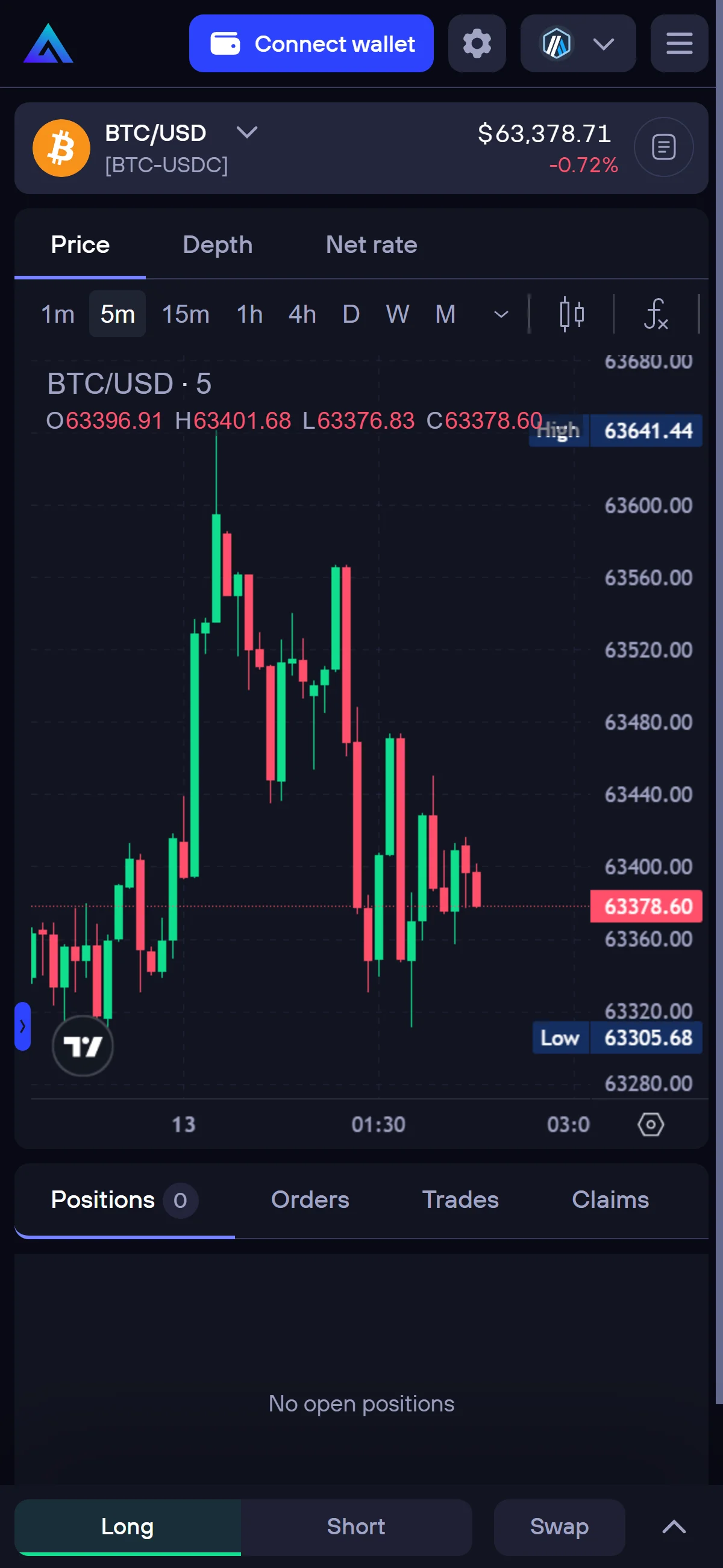
Opening the referral link brings up the GMX trade screen with the BTC/USD chart loaded and no wallet attached, so tap “Connect wallet” at the top of the screen.
As long as that button reads “Connect wallet” rather than an address, nothing is connected yet, and tapping it slides the wallet selection sheet up from the bottom.
3. Pick your wallet in the sign-up sheet
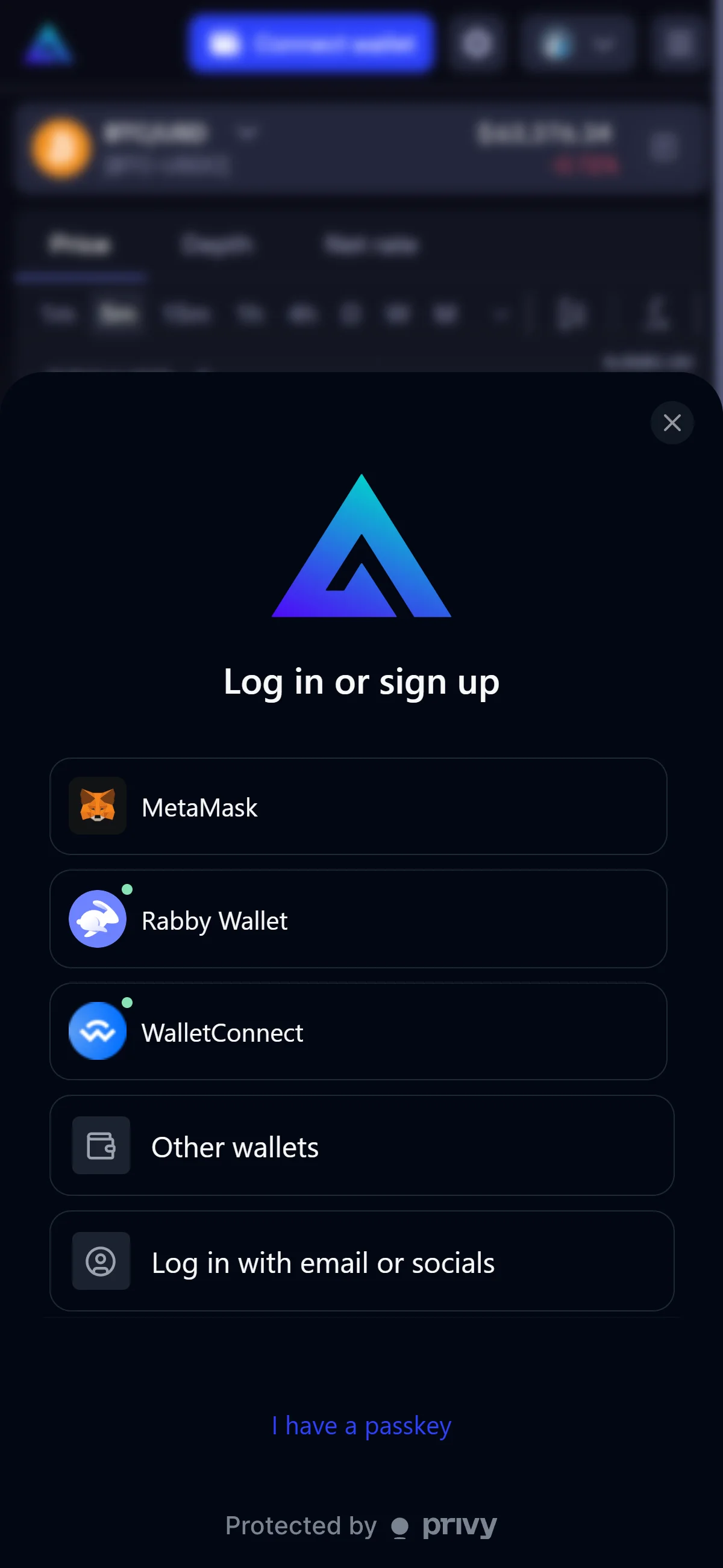
In the “Log in or sign up” sheet, tap the wallet you use — “MetaMask” or “Rabby Wallet” when the app is on this phone, or “WalletConnect” to hand the request over to another wallet app — and that app takes over to ask for your approval.
If your wallet is not among them, “Other wallets” opens the longer list, and “Log in with email or socials” starts an account without a wallet.
4. Confirm the code on the Referrals screen
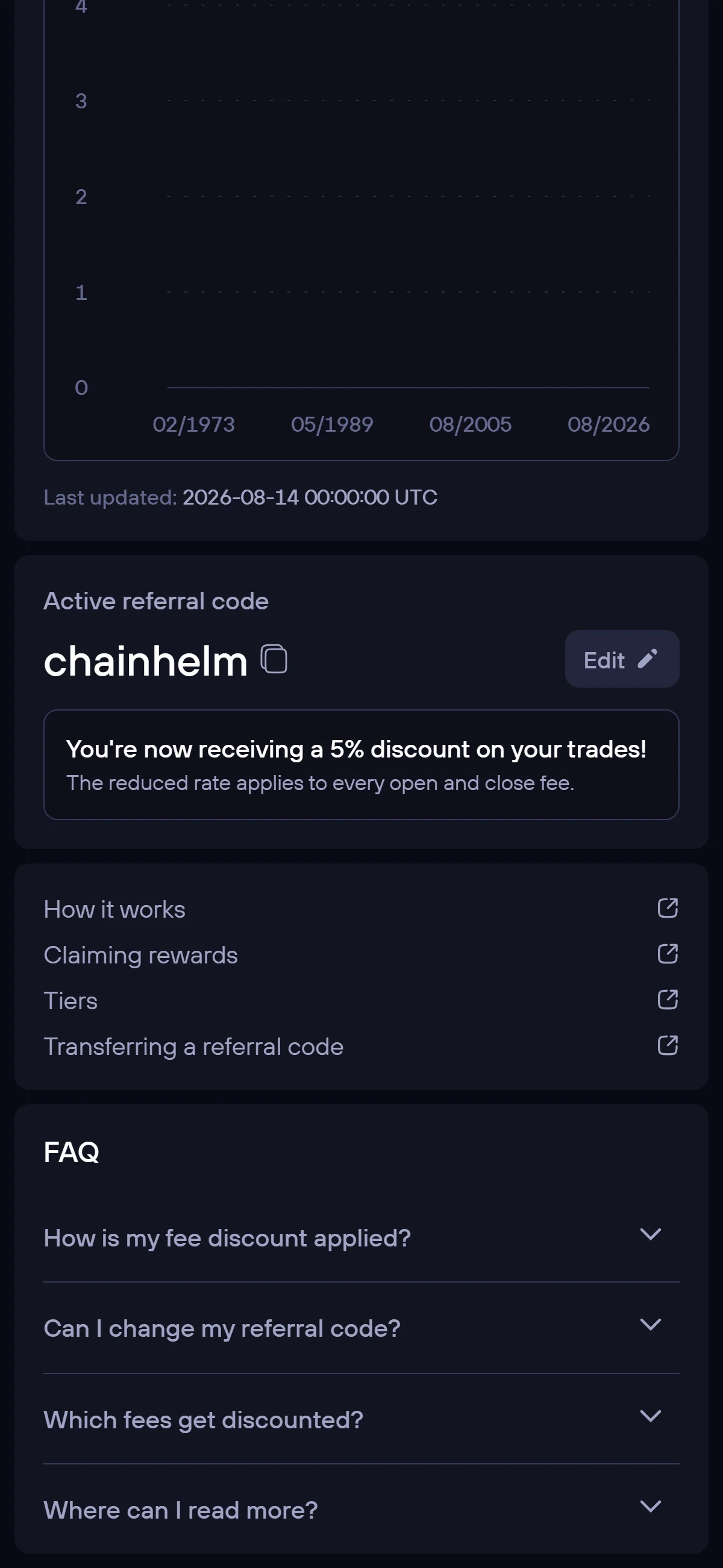
Once the wallet is connected, open “Referrals” from the menu at the top right and scroll the “Traders” view down to the “Active referral code” card. Check that it gives chainhelm, with the notes “You’re now receiving a 5% discount on your trades!” and “The reduced rate applies to every open and close fee.” directly beneath.
If the card is empty or shows another code, tap “Edit” and enter chainhelm.
What to do after connecting to GMX
A connected wallet can already trade from its own balance. The sequence below does something different: it moves funds into a GMX Account, a trading balance that lives on Arbitrum and can be funded from several chains.
We cover the deposit process separately for PC/browser and smartphone (mobile).
PC/browser deposit steps
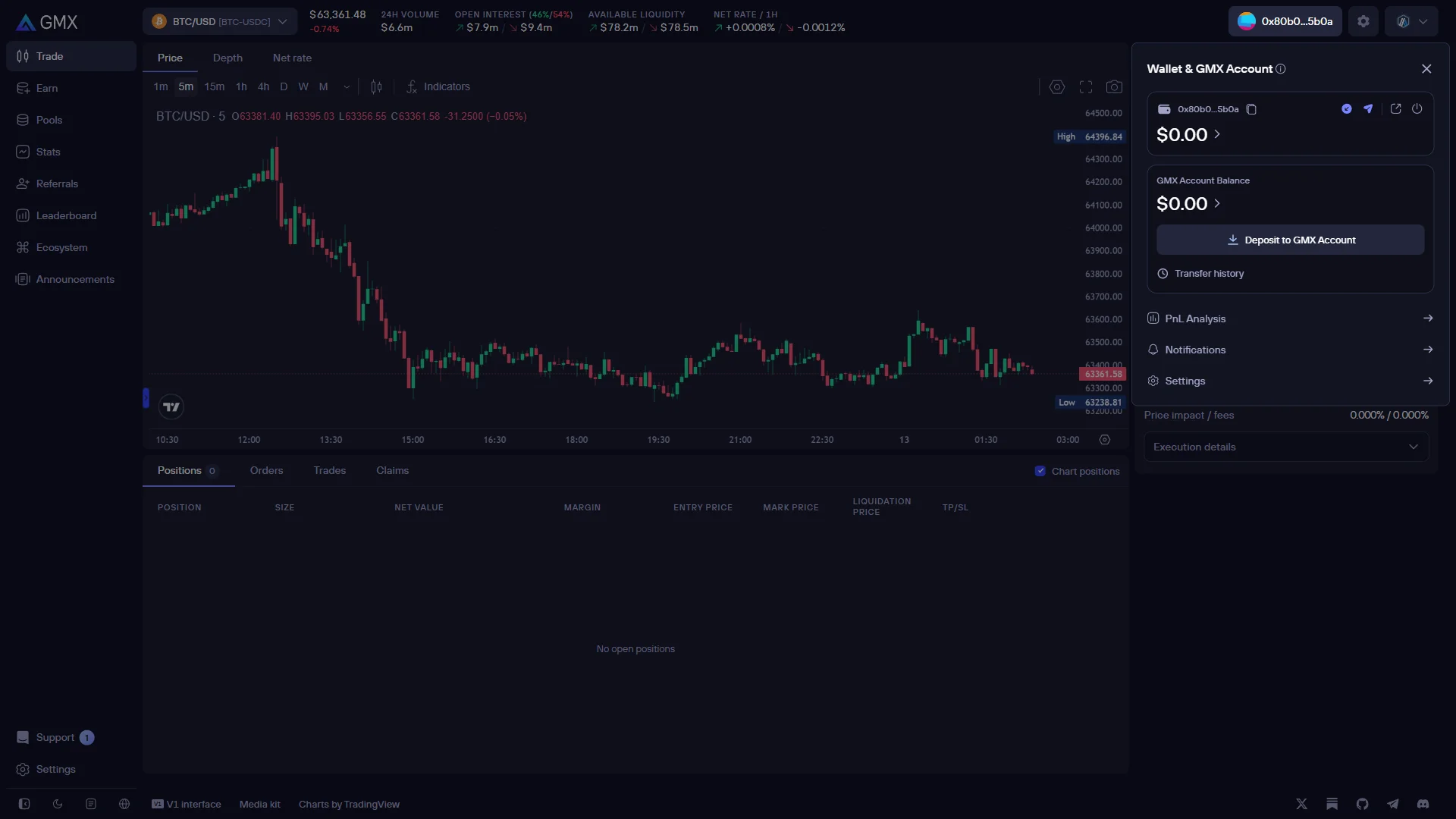
Click your wallet address at the top right to slide out the “Wallet & GMX Account” panel, which stacks your wallet balance above “GMX Account Balance”.
Click “Deposit to GMX Account” to open the deposit modal; “Transfer history” just below it keeps the log of past transfers between the two.
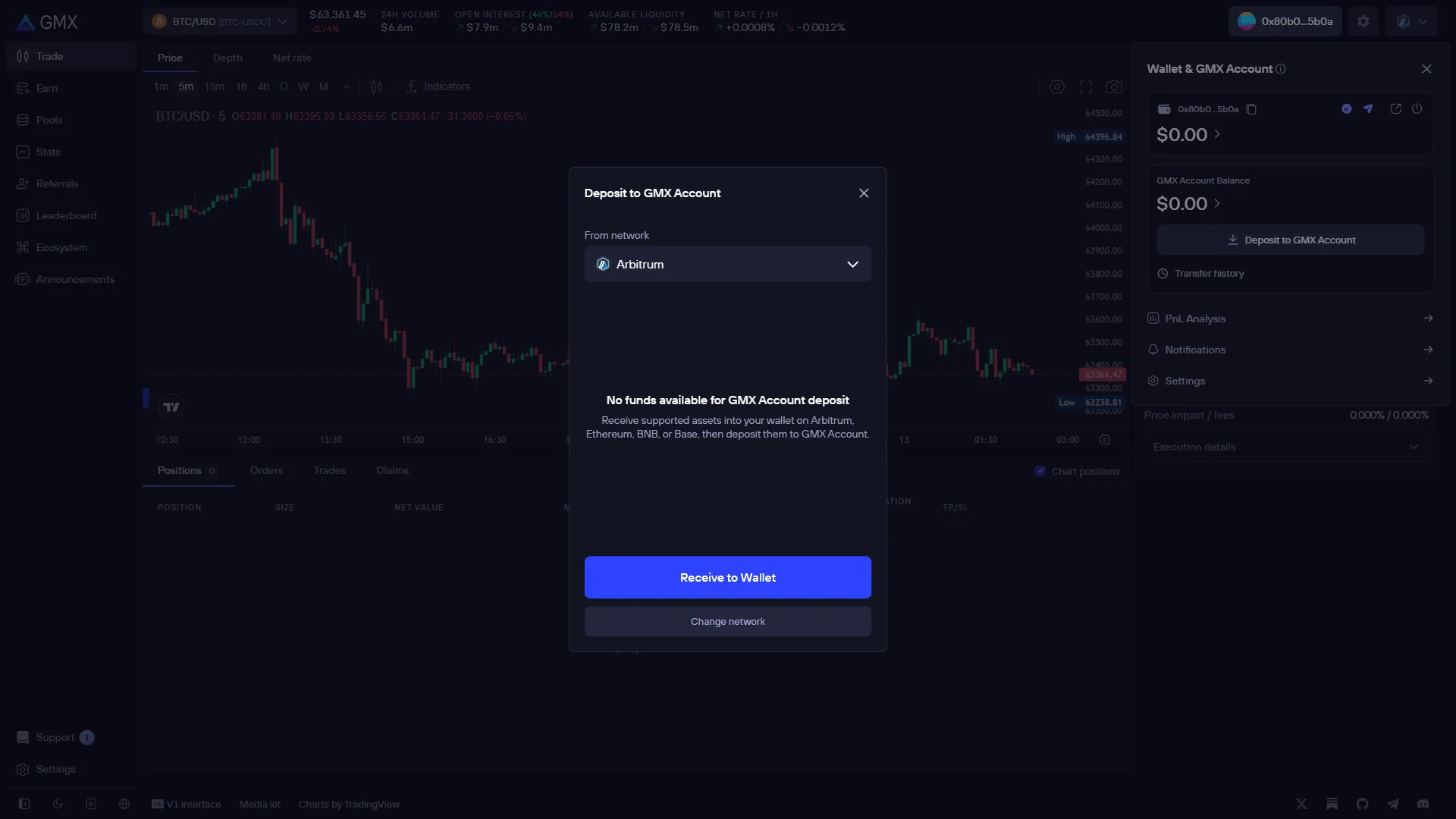
In the “Deposit to GMX Account” modal, set “From network” to the chain your funds are sitting on; it opens on “Arbitrum”, and “Change network” at the bottom switches the network you are connected to.
With nothing in the wallet yet, the modal reads “No funds available for GMX Account deposit” and asks you to receive supported assets on Arbitrum, Ethereum, BNB, or Base first, which is what “Receive to Wallet” is for.
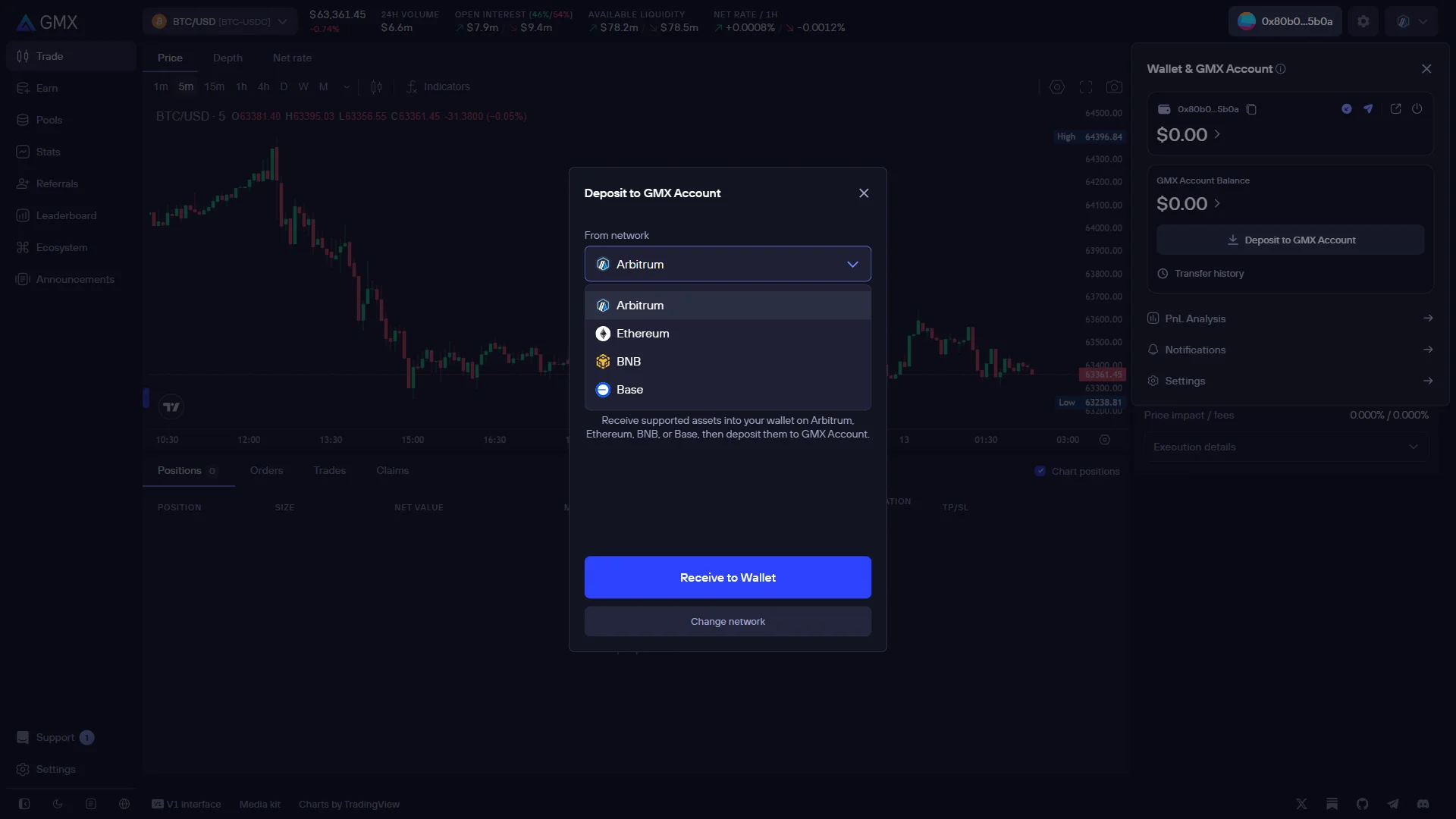
Click the “From network” selector to drop down the four chains GMX takes deposits from — “Arbitrum”, “Ethereum”, “BNB”, and “Base” — and choose the one your funds already sit on.
That choice fixes the source chain for the deposit, so if your coins are anywhere else, bring them onto one of these four before you go further.
Smartphone (iOS / Android) deposit steps
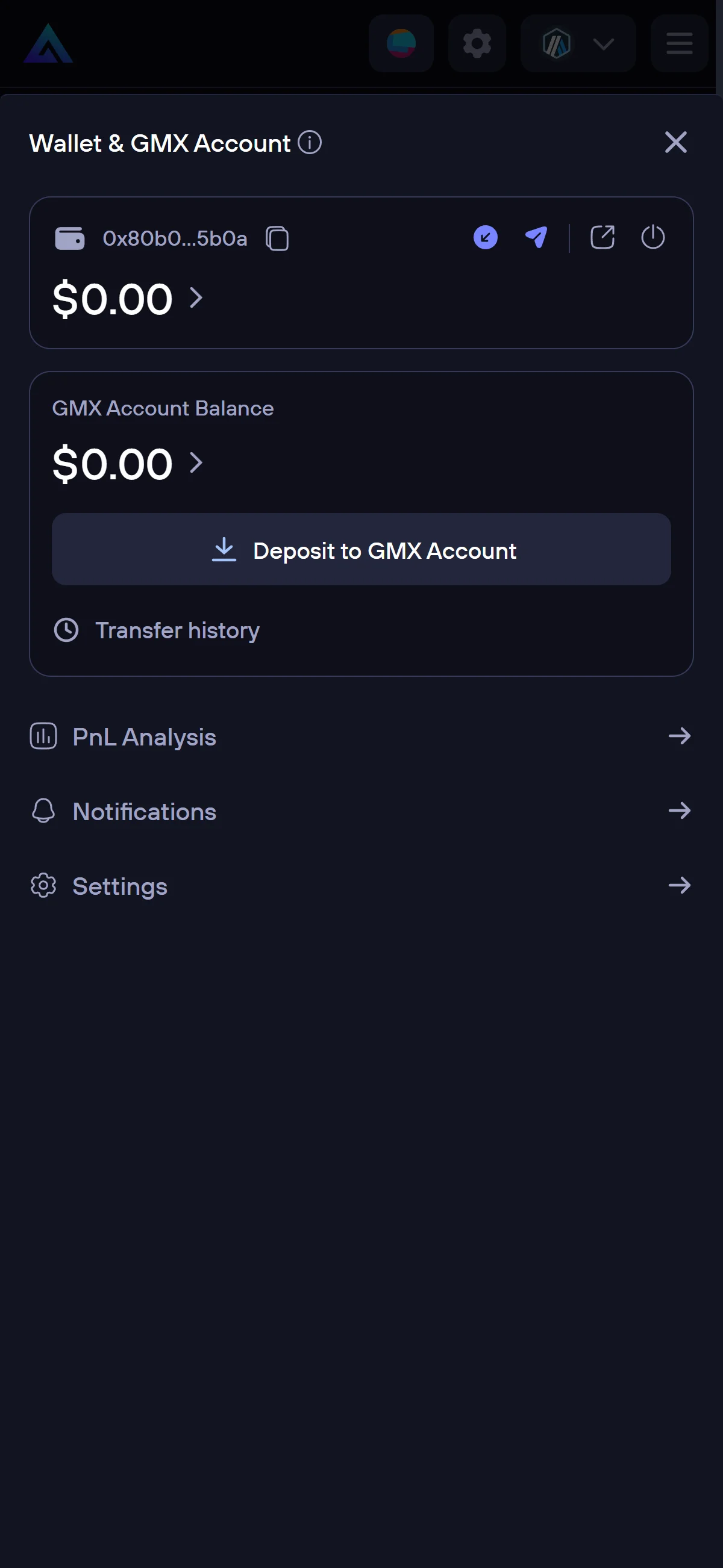
Tap the account button in the top bar to bring up the “Wallet & GMX Account” screen, where your wallet balance sits above “GMX Account Balance”.
Tap “Deposit to GMX Account” to open the deposit screen; “Transfer history” underneath keeps the log of your earlier transfers.
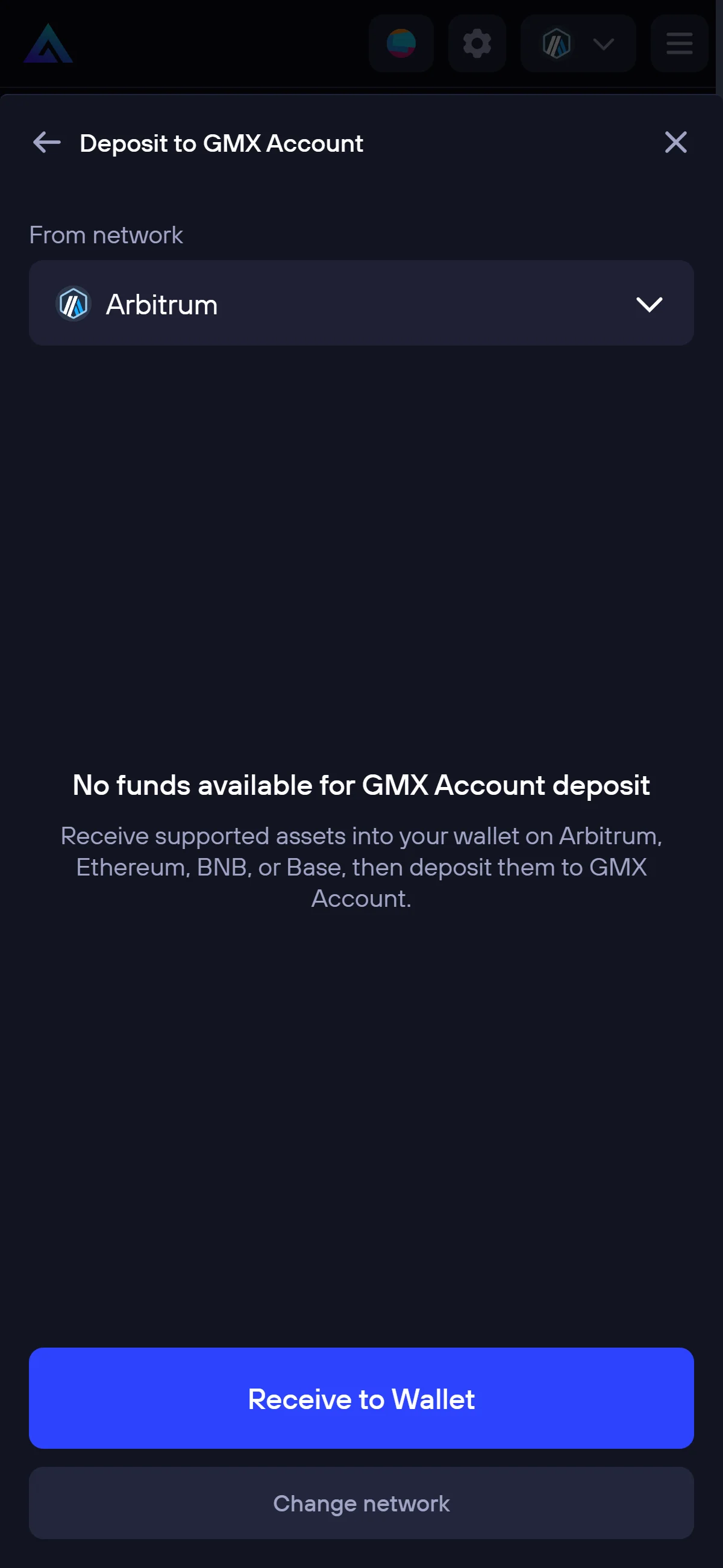
On the “Deposit to GMX Account” screen, tap the “From network” selector — it opens on “Arbitrum” — to choose the chain your funds are on, and “Change network” at the bottom switches the network you are connected to.
While the wallet is empty the screen reads “No funds available for GMX Account deposit” and asks you to receive supported assets on Arbitrum, Ethereum, BNB, or Base first, which is what “Receive to Wallet” is for.
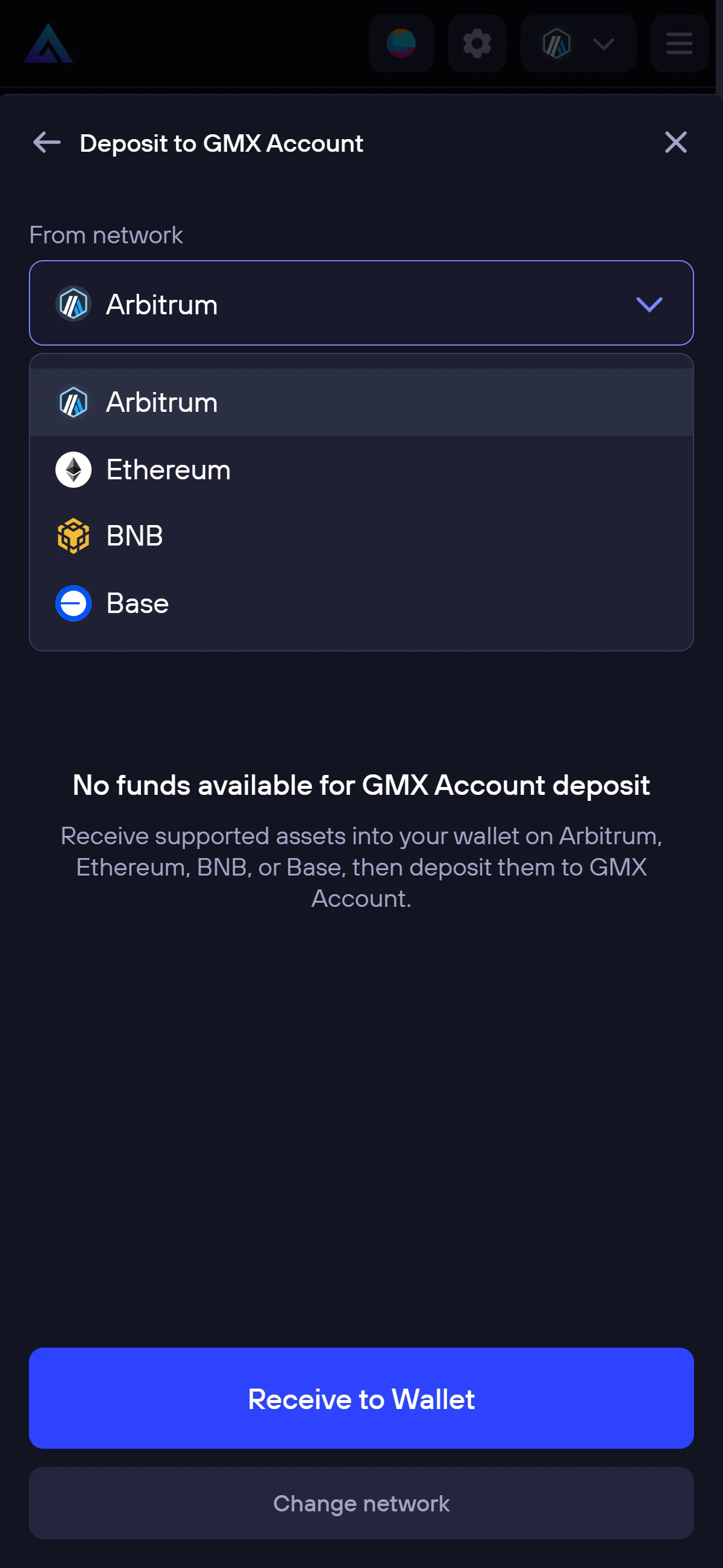
Tap the “From network” selector and the four chains GMX takes deposits from open up — “Arbitrum”, “Ethereum”, “BNB”, and “Base” — so tap whichever one holds your funds.
That choice fixes the source chain for the deposit, so coins parked on any other chain need to come across to one of these four first.
Funding costs something, but not to GMX. There is no deposit or withdrawal fee, because the protocol never holds the money in the first place. What you pay is chain gas, and for a cross-chain deposit into a GMX Account, the bridging cost of the Stargate and LayerZero route it runs on, which is also subject to Stargate’s liquidity caps. Buying or selling GM and GLV liquidity tokens can carry a spread on top, wherever the underlying long and short tokens have one.
One constraint decides whether the sequence above is usable at all today: deposits into a GMX Account come from Arbitrum, Ethereum, BNB or Base only, so coins sitting on any other chain have to be brought onto one of those four first.
Once your wallet holds funds on Arbitrum, Ethereum, BNB, or Base, come back to “Deposit to GMX Account” and move them over to finish funding the account.
The GMX referral code cannot be added after sign-up
The referral code can only be applied once, and the window closes the first time that wallet trades.
If that wallet starts trading without the code applied, there is no way to link it to that wallet afterwards, and the only route left is to start over with a new wallet.
- Is referral code chainhelm shown on the Referrals page? (the “Traders” tab carries an “Active referral code” card, with the 5% discount banner alongside it, and the card stays there to be checked at any time)
- After connecting, open the referral page and check that the referral is reflected there
The mechanism behind that rule is worth knowing, because it explains why there is no appeal. Clicking a referral link stores the code in your browser, and the code is written on-chain to the wallet with that wallet’s first order. Once the wallet has traded without a code, the record is settled, and a fresh wallet is the only route left.
The place to check is the one you saw in step 5 of the connection sequence: Referrals, Traders tab, the “Active referral code” panel. Before that wallet has traded, a blank panel or a different code can still be edited there. After it has traded without one, there is nothing on that wallet left to change.
◆ ◇ ◆
GMX runs perpetuals from pooled liquidity on Arbitrum, with no account to open
A 2021 Arbitrum protocol governed by a DAO, with a pseudonymous Labs team
GMX is not a new venue, and the timeline below shows it. What the timeline leaves out is the handover: holders of the older XVIX and Gambit tokens migrated into GMX over the two years after launch, and the DAO formally closed that migration window on 2023-11-24.
Two bodies decide things. The GMX DAO votes, off-chain on Snapshot and on-chain through Tally where a DAO transaction is needed. GMX Labs, created by DAO proposal as an independent development and marketing entity, does the building. What GMX Labs is in legal terms — its corporate form, its country of incorporation — is not disclosed in the founding proposal or anywhere else. The pseudonymous CEO in the timeline above is not an exception either: the interim committee that ran things before that appointment went by pseudonyms as well.
Which chains GMX runs on sounds like a technical detail, and it is not: it decides where your money has to sit. Live markets run on Arbitrum One, Avalanche C-Chain and MegaETH. The Botanix deployment is withdraw-only. Ethereum, Base and BNB Chain are source chains for funding a GMX Account, and every trade made from that balance settles on Arbitrum.
The GMX token does two things. It carries governance votes, and it is bought back with 27% of the fees from leverage trading, liquidations, borrowing fees and swaps. Distribution of those repurchased tokens to stakers is suspended at the moment: they accumulate in the Treasury, and the published rule is that distribution resumes when GMX reaches USD 90. That is the rule as written; whether or when that price is reached is not something this article predicts.
Oracle pricing and pooled liquidity in place of an orderbook
If you have traded perpetuals on a centralized exchange, the mental model you brought with you does not fit this venue, so it is worth a moment on how this one actually works.
There is no orderbook on GMX. Your trade runs against a GM pool — a GMX Market pool, each one defined by an index price feed plus a long token and a short token — and on top of those sit GLV vaults, which spread liquidity across several GM markets at once. The price you get comes from oracle feeds, Chainlink Data Streams being the primary provider, rather than from being matched against somebody’s resting order.
That single design choice changes what a fill depends on. Book depth is not part of the calculation, so there is no orderbook slippage to model. What replaces it is price impact: a separate charge that reflects how far your trade pushes the pool’s long and short exposure apart, capped per market and tighter on deep markets than on thin ones. It can also run in your favor, up to its own cap, when your trade brings the pool closer to balance. The caps themselves sit in the cost breakdown further down.
Execution itself happens in two phases, run by keepers — the automated executors GMX relies on — rather than by you. Your intent is committed on-chain first, and only then are oracle prices attached to it. GMX states that this ordering is what mitigates front-running.
No maker, no taker Because there is no orderbook, GMX has no maker or taker side and no maker/taker fee schedule at all. Its two headline rates are set by what a trade does to the pool’s balance, not by whether it rested on a book. A page presenting GMX fees as maker/taker is describing a different model.
746,000 cumulative traders, 129 markets and two TVL figures that disagree
Read the trader figure for what it is. It counts every wallet that has ever traded, not who is trading this week, and GMX’s own site separately shows 93,971 users earning yield as liquidity providers.
The two liquidity figures are not a contradiction to be resolved, and neither one is wrong. As the notes under them say, the two counters draw different perimeters. Roughly 17% separates the totals, and that gap is the scope, not an error.
The market count only means something with its method attached. It comes from GMX’s own markets API, summing unique index pairs per chain, so BTC/USD counts once on each chain that lists it. A deduplicated cross-chain count would come out lower.
The leverage ceiling applies to crypto markets only, and the commodity markets move it around by session. Gold, silver, WTI and Brent drop from 100x to 25x off-hours, NATGAS/USD runs 40x on-hours and 20x off, and SPCX/USD stays at 10x in both. That switching mechanism is itself a risk, and it comes back near the end of this article.
Getting started takes one thing: connect a self-custody wallet. There is no KYC and no minimum deposit, and the documented minimum sits at around USD 1 at the position level.
The full cost of a position: fees on both sides, funding, borrow rate, price impact and gas
This is the part the offer at the top of this page has to be measured against. A 5% discount applies to one line in a stack of five.
- Position fee
- 0.04% of position size where the trade reduces the gap between long and short open interest, 0.06% where it widens that gap. Charged when opening, closing, increasing and partially decreasing. Per-market variants exist: gold and silver run 0.01% / 0.02% during market hours, SPCX/USD off-hours runs 0.06% / 0.08%.
- Funding
- Continuous, accruing every second rather than at a discrete stamp, and adaptive to the long and short imbalance with a configured floor and ceiling per market. GMX reduced funding costs on 2026-05-15.
- Borrow fee
- Separate from funding: position size in USD multiplied by the change in the cumulative borrowing factor. On crypto markets it runs roughly 45-55% annualized at optimal utilization and 100-130% at full utilization, scaling with how heavily the pool is being used.
- Price impact
- Charged against pool imbalance in place of orderbook slippage. Capped at 50 bps on major markets and 75-1000 bps on thinner ones, with positive impact capped at 40 bps.
- Swap fee
- 0.05% where a swap reduces USD imbalance and 0.07% where it increases it. Stablecoin swaps are far cheaper, at 0.005% or 0.02% on Arbitrum depending on direction.
Of those five, the borrow fee is the one most likely to make the fee discount look small. An annualized rate in the 45-130% band accrues for as long as the position is open, while the discount applies once on the way in and once on the way out. On an intraday trade the discount is the larger number. On a position held for days it very likely is not. That is a statement about arithmetic, not a recommendation in either direction.
Gas is yours to pay, in every mode. There is no gasless model. The network fee that covers keeper execution is charged up front at a maximum, with the unused portion refunded automatically, and it carries a 10% buffer when Express Trading is on. Trading fees themselves are identical across all three execution modes, so the choice between them is about convenience and which token pays the gas, not about cost.
One thing GMX does not have is a native-token discount. Holding or staking GMX gives you governance and a claim on buybacks; the tokenomics documentation records no trading fee reduction attached to it.
GMX ranks 21st among perp protocols by daily volume and 7th by derivatives fee revenue
Rank 21 on volume, rank 7 on fees, and the perimeter those ranks are drawn from
Every figure above is a single snapshot taken on 2026-08-13, and a single day sits a long way either side of a venue’s own trend. That is why the 30-day total is in the box alongside the 24-hour one: the daily average it implies runs below what the captured day shows, so the day we caught was a busier one than the month behind it, and the 30-day figure is the steadier basis if you want to characterize the venue rather than the afternoon. GMX publishes no 24-hour volume figure of its own, so there was no second source to check the daily number against.
The two open interest figures agree to within about 2%, which is what rounding and snapshot timing produce. What we are not giving you is an open interest rank. The leaderboard was captured sorted by volume, and re-sorting our own copy of those rows would not reproduce the site’s ranking, so asserting a position would be inventing one.
The fee rank sits fourteen places above the volume rank, and the reason matters: reported volume can be inflated by wash trading, whereas fee revenue has to be paid. A venue that ranks far better on fees than on volume is telling you its reported volume is comparatively real.
One boundary applies to all of these figures: they cover the GMX parent across its own deployments. GMTrade, the community-built GMX deployment on Solana, is tracked as a separate protocol, and none of its numbers are included above — on the same snapshot it ranked 5th with USD 918.05m of 24-hour volume and USD 143,385 of fees, both larger than the parent’s. GMX itself is not listed as a derivatives exchange on CoinGecko at all; the only GMX-related entry there is GMTrade. For scale, the volume leaders on that day were Hyperliquid, Aster and Lighter.
Pool-and-oracle execution in a market of orderbook venues
Central limit orderbook
Oracle price against a pool
What you get from that difference is size tolerance: GMX states that positions over USD 50m can be opened with reduced price impact, which is a claim an orderbook venue cannot make without deep resting liquidity behind it. What you give up is on the other side of the same design — the pool is your counterparty, and the risks section below takes up what that leads to.
The second half of the design is segmentation. Rather than one shared pool backing everything, liquidity sits in per-market GM pools, with GLV vaults moving it between markets according to utilization and Chaos Labs recommendations. Liquidity providers take 63% of collected fees on Arbitrum and Avalanche, with the remaining 37% going to the protocol. That is how the venue is built, not an invitation to supply liquidity.
Gold, oil and a pre-IPO SpaceX perp that trade around the clock
Six markets on GMX are not crypto at all, and they run 24/7 on-chain: GOLD/USD, SILVER/USD, WTIOIL/USD, BRENTOIL/USD, NATGAS/USD, and SPCX/USD — the last a synthetic perp tracking the market-implied share price of pre-IPO SpaceX, live since 2026-06-10. Weekend trading on a commodity is possible because the risk settings switch: each of these markets has an on-hours configuration and an off-hours one, tied to the CME Globex schedule and, for SPCX, to a US equity window, and the switch moves maximum leverage, open interest caps, price impact, position fees, borrow fees and liquidation factors together. That switch is convenient and it is also a trader risk, which is why it comes back below.
Funding from four chains, and two execution modes that drop the gas token
A GMX Account is a trading balance held on Arbitrum that you can fund from Ethereum, Base or BNB Chain, auto-bridged through Stargate with LayerZero carrying the messaging. Withdrawals can exit to any supported chain, regardless of which one the deposit came from. Positions belong to the connected wallet either way, whether the margin came from the wallet or from the GMX Account. Two constraints decide whether it is available to you at all: it does not exist on Avalanche or MegaETH, and smart contract wallets such as Safe cannot use it, because it depends on Express Trading.
- Classic Trading
- Every trade is signed on-chain through your own wallet’s RPC, and gas comes out of the chain’s native token: ETH on Arbitrum and MegaETH, AVAX on Avalanche. Smart contract wallets are limited to this mode.
- Express Trading
- Trades are signed off-chain and broadcast through Gelato Relay, which lets gas be paid in USDC or WETH on Arbitrum, USDC or WAVAX on Avalanche, USDM or WETH on MegaETH — so you no longer have to keep the native token on hand.
- Express + One-Click
- Adds automatic signing from a sub-account key stored locally on your device, which removes the per-trade confirmation popup entirely.
That locally stored key is a trade-off rather than a feature, and the risks section below treats it as one.
GMX holds no license anywhere, and no regulator has yet named it
One named exclusion in the Terms, and a sanctions clause with no country list
This section is about the protocol’s own standing. Where your own country stands comes next.
The Terms exclude one jurisdiction by name. Clause 1.1.3 requires that you are not a U.S. Person, and clause 8 states that as a result of restrictions under the Commodity Exchange Act and the regulations the CFTC has made under it, no U.S. Person may enter into Perpetual Contracts using the Interface. The United States is the only country that appears as an exclusion anywhere in the document.
Two further clauses widen the net without listing anyone. Clause 1.1.4 excludes residents, nationals and agents of any country that the United States, the United Kingdom or the European Union embargoes or similarly sanctions, and clause 1.1.5 excludes anyone on a US, UK, EU or UN sanctions list, including the OFAC SDN list. Both are defined by pointing at external sanctions regimes rather than by enumerating countries, so there is no list to reproduce.
Which leads to a fact that is rarely stated: GMX publishes no blocked-country list. Eligibility is a representation you make about yourself when you use the site, not a list the site checks you against.
An interface layer and a contract layer that carry different obligations
GMX’s own Terms split the system into layers, and the split decides what attaches to you. gmx.io is described as an informational resource and explicitly not an access point to the GMX Protocol; app.gmx.io is the Interface; and the operator states that it has no possession, custody or control over user funds, which stay with the user throughout.
What that means practically is that the restrictions you are under, and the contract you are under, are the operator’s. The operator reserves the right to disable or modify access to the site. The relationship is governed by the laws of the Bahamas, disputes go to arbitration under CIMA seated in Madrid, and aggregate liability is capped at 1,000 SGD. The two points that matter to you are where custody sits and how small the contractual remedy is.
No license held, and no enforcement action naming the protocol
GMX holds no license or registration in any jurisdiction, and it says so itself.
From GMX’s own Terms “You understand that GMX.io is not registered or licensed by any regulatory agency or authority. No such agency or authority has reviewed or approved the use of the Site or the Interface.”
On the enforcement side, no regulatory action naming GMX, GMX Labs or any of its contributors was located. Searches turned up sector-level developments in perpetual futures regulation and warnings about unrelated firms with similar names, and nothing else. The limit belongs alongside the finding: absence established by searching is weak evidence, and it is dated 2026-08-13 rather than permanent.
Not holding a license is the ordinary condition for a non-custodial protocol rather than a mark against this one. It is also not free. What it costs you depends on where you live, which is the next section.
Terms frozen since 2022, against a venue that now lists commodities and pre-IPO equity
Two pressures are working on GMX from outside, and they point in opposite directions. GMX’s own Terms treat perpetuals as futures under the US Commodity Exchange Act and exclude U.S. Persons on that basis. Meanwhile the US onshore perimeter has been moving the other way.
None of that has produced any action concerning GMX as of 2026-08-13.
The venue has been moving too, and in a direction that enlarges its regulatory surface rather than shrinking it. Commodity markets arrived from 2026-04 and the pre-IPO SpaceX synthetic perp from 2026-06, both of which touch traditional-asset regulation. No official statement addresses how those synthetic perps sit with securities law, and the Terms place responsibility for complying with applicable law on the user.
Which brings us to the cleanest single fact in this section. The Terms carry “Last modified: August 1st, 2022”. They predate MegaETH, Botanix, the Solana deployment, the whole GMX Account multichain stack, the Labs CEO structure, and every one of the traditional-asset markets. The geo-restriction facts in them are current as published. The document has simply not been revised for what the protocol has since become.
GMX is closed to U.S. Persons, and unregulated for readers in the UK, Singapore, Australia and India
Here is where the five countries this article covers stand, before the detail.
United States: the Terms bar U.S. Persons from perpetual contracts
GMX is not usable from the United States, and the code in this article is not available to a U.S. Person. If that is you, everything below is background rather than something you can act on.
The reason is GMX’s own contract rather than an order from outside. Clause 1.1.3 requires the user to represent that they are not a U.S. Person, and clause 8 states that as a result of restrictions under the Commodity Exchange Act and CFTC regulations, no U.S. Person may enter into Perpetual Contracts using the Interface. US access is restricted on that basis. The exclusion has been in the Terms since 2022-08-01, and that is still the current version.
The exclusion reaches spot swaps as well, through the general representation in clause 1.1.3, even though only the perpetuals prohibition cites a US statute. The asymmetry is easy to misreport, so it is worth stating plainly: one restriction is grounded in named US law, the other in the blanket representation.
For context on how US authorities have approached this class of protocol — and this is about other protocols, not GMX — CFTC enforcement has consistently targeted operators and their entities: bZeroX and the successor Ooki DAO on 2022-09-22, with default judgment following on 2023-06-09; Opyn, ZeroEx and Deridex on 2023-09-07; Uniswap Labs on 2024-09-04. The rule the CFTC states in those actions is a venue requirement addressed to the offeror: leveraged retail commodity transactions that do not settle by actual delivery within 28 days may be offered to non-eligible contract participants only on a contract market that the CFTC has designated or registered.
GMX itself holds no US registration. It says so in its Terms, and a CFTC site-wide search returns four results, none of which is the GMX protocol. GMX does not appear on the CFTC RED List either. No US regulatory action naming GMX, an affiliate or a founder was located as of 2026-08-13.
On the user side, and this is a finding rather than a permission: no US federal provision was located that penalizes a resident merely for trading on an unregistered DeFi perpetuals protocol, and every action located has targeted developers and operators rather than retail traders. That does not touch the contractual exclusion, which stands regardless. It also does not extend to governance: the Ooki DAO judgment held that DAO voters can constitute the membership of a liable unincorporated association, which is a materially different exposure from trading.
Tax runs on regardless. The IRS treats digital assets as property and requires every digital asset transaction to be reported whether or not it produced a gain. GMX issues no Form 1099-DA and never will — the DeFi broker reporting regulations were nullified under the Congressional Review Act on 2025-04-10 — so cost-basis tracking is entirely yours.
And the only US-directed official statement that exists at all is the 2022 Terms document itself. GMX has published no notice, service change or regulatory response addressed to US users in the four years since.
United Kingdom: usable, but entirely outside the FCA perimeter
GMX is usable from the United Kingdom: a UK resident can connect and trade, and GMX is not FCA-registered. The United Kingdom appears in GMX’s Terms only as one of the sanctions-issuing authorities whose lists define exclusion, never as an excluded territory.
The rule most UK readers will have heard of is real, and narrower than it sounds. The FCA’s ban on selling, marketing and distributing crypto-derivatives to retail consumers — PS20/10, published 2020-10-06, effective 2021-01-06, now sitting in the Handbook at COBS 22.6.5R — binds firms and TP firms. It does not, by its own terms, impose anything on a consumer. Its practical effect is on the supply side: a UK retail consumer cannot obtain this product class from an FCA-authorized firm, and GMX simply is not in the class of firms the rule reaches.
On registration the answer is negative: a search of the FCA Financial Services Register for GMX returns four unrelated firms and no GMX protocol entity. No FCA publication, consultation, policy statement or enforcement action naming GMX was located. One honest limit on that: the FCA Warning List pages were unreachable during our research, so a Warning List entry cannot be positively excluded.
What a UK reader gives up is the part that usually goes unmentioned. FCA consumer guidance updated 2026-01-29 states it is highly unlikely that crypto losses are covered by the Financial Services Compensation Scheme, and no UK statutory compensation route and no ombudsman route was located for a GMX user. There is no one to complain to.
What is coming has firm dates, and no prediction is offered beyond them. The Financial Services and Markets Act 2000 (Cryptoassets) Regulations 2026, made 2026-02-04 as SI 2026/102, bring cryptoassets into the FCA’s remit, with the authorization gateway opening 2026-09-30 and the regime commencing 2027-10-25. Derivatives sit outside that regime — COBS 22.6 continues to govern them — and whether a DeFi protocol falls inside the perimeter at all turns on the identifiable-controlling-entity test confirmed in PS26/11 chapter 9, with dedicated DeFi guidance to be consulted on late in 2026. No FCA determination about GMX exists.
Tax is more specific than the usual advice suggests. HMRC routes cryptoasset derivatives away from the ordinary cryptoasset pooling guidance: CRYPTO10150 points individuals to CFM50070 instead, so a UK reader cannot assume the familiar capital gains treatment applies to a perpetual position. Self-assessment is in sterling and GMX issues nothing to help. The Cryptoasset Reporting Framework took effect 2026-01-01 with first reports due in 2027, and whether GMX counts as a reporting cryptoasset service provider has not been determined by any source we located.
One boundary, and it is not a formality: what is recorded here is who the rules set out above actually bind. It is not an assurance that any particular use of GMX by a UK resident is lawful.
Singapore: no MAS license, and no rule addressed to the individual
GMX is usable from Singapore, and it is not licensed by MAS under the Payment Services Act. A search of the MAS Financial Institutions Directory returns no GMX entity, and GMX appears nowhere in MAS material of any kind.
MAS’s baseline is old, and it has not been reversed. In a parliamentary reply of 2018-02-05, MAS said there was “no strong case to ban cryptocurrency trading here”, directing its obligations at intermediaries instead. The 2025-03-05 reply keeps the same shape: consumers “should stay clear of cryptocurrencies”, while the prohibitions described are ones imposed on providers.
There is an asymmetry here that a Singapore reader should understand. MAS has prohibited digital payment token service providers from offering credit or leverage to retail customers, and that duty sits on the provider. The leverage available on GMX is not subject to that rule, because GMX is not in the class of duty-holders it addresses. That is a description of how far the rule reaches. It is not an advantage, and it is not a route to something Singapore has decided its residents should not have.
One detail is easy to misread in the other direction. GMX’s Terms cap liability at 1,000 SGD and the Referral Terms use 500 SGD, and neither figure creates a Singapore connection. The same Terms specify Bahamas law and CIMA arbitration in Madrid, and no Singapore incorporation or place of business is disclosed anywhere.
GMX is not on the MAS Investor Alert List. MAS itself states that the list is not exhaustive, so absence from it is not clearance, approval, or any finding that using GMX is lawful.
On tax, one widely repeated shorthand needs correcting. Singapore has no general capital gains tax, which is not the same as having no crypto tax. A disposal assessed as revenue in nature under the badges of trade is taxable as income, and frequent perpetual trading is exactly the fact pattern where that distinction bites. IRAS puts record-keeping on the taxpayer, and GMX, holding no identity data at all, can issue nothing.
The boundary here is wider than in the other countries: no Singapore primary source squarely addresses a resident’s use of an unlicensed offshore non-custodial protocol. What is set out above is the structure of the law, not a MAS ruling on this fact pattern, and it should not be read as a clearance.
Australia: no AFS license, so none of the AFS protections travel with the trade
GMX is usable from Australia, and it holds no AFS license, no market license and no clearing and settlement facility license. Australia appears nowhere in GMX’s Terms; the only geographic exclusion there is the sanctions-based one.
ASIC’s position sits closer to GMX’s product than most readers expect. INFO 225, as updated 2025-10-29, names perpetual futures among the derivatives that reference digital assets, names operators of decentralized finance platforms as falling within its scope, and states that “The use of offshore or decentralised structures does not mean that key obligations under Australian laws do not apply or can be ignored”. In the same document ASIC declines to say when a DeFi arrangement requires a license, calling it dependent on the facts of each arrangement and on each person’s role in it. Both halves are the finding: the reach, and the refusal to draw the line.
No Australian law prohibits a resident from using GMX. The AFS licensing obligation runs to the person carrying on a financial services business, and ASIC frames the consequence for a consumer dealing with an unlicensed provider as loss of protection rather than personal illegality.
What that loss consists of, concretely: no AFCA external dispute resolution, no client money protections, no design and distribution obligations, no product intervention protections, and no Australian compensation avenue of any kind.
The leverage contrast is stark, and it is a statement about regulatory reach rather than about who is offering the better deal. ASIC’s product intervention order caps retail leverage at 2:1 for CFDs referencing crypto-assets and requires negative balance protection from licensed issuers, and it runs to 2027-05-23. GMX advertises up to 100x and offers no negative balance protection. ASIC drew the same comparison itself in a 2025-07-28 investor alert about a different offshore venue — that alert is not about GMX and should not be read as one.
The reform ahead has dates, and one claim circulating about it is wrong. The Corporations Amendment (Digital Assets Framework) Act 2026 received assent on 2026-04-08 and commences 2027-04-08. It is custody-anchored: a digital asset platform is defined by an operator possessing tokens for another person, so on its face it does not reach a non-custodial protocol, and it leaves the separate derivative analysis for perpetual futures untouched. Commentary asserting that the Act exempts non-custodial DeFi from financial-product classification overstates it — the public digital token infrastructure exclusion applies only to the managed investment scheme definition.
Tax is self-assessed throughout. The ATO treats crypto assets as CGT assets, deposits into and withdrawals from a liquidity pool are each CGT events, and rewards are assessable at market value on receipt. Records have to be kept for five years, and GMX supplies none of them.
One limit worth stating: the AUSTRAC register was unreachable during our research, so we make no claim either way about GMX appearing on it.
India: unregistered with FIU-IND, and a 30% tax that follows the gain regardless
GMX is usable from India, it is not registered with FIU-IND, and no FIU-IND action naming GMX was located as of 2026-08-13.
The enforcement record explains itself once you look at who was targeted. FIU-IND has run two sweeps against offshore virtual digital asset service providers: nine platforms on 2023-12-28, and twenty-five more on 2025-10-01, the second round accompanied by app and URL takedowns under section 79(3)(b) of the IT Act. Every named target in both rounds is a centralized custodial exchange. No decentralized protocol appears in either. That is an observation dated 2026-08-13, not a guarantee about what comes next.
No Indian statute bars a resident from holding or trading virtual digital assets, or from using a non-custodial protocol. The PMLA registration duty created in March 2023 falls on persons carrying on VDA activities for or on behalf of others, which reaches service providers rather than individual traders. The Government’s own recorded position, from the Standing Committee on Finance report laid on 2026-07-23, is that crypto-assets are “presently unregulated in India, except for the limited purposes of taxation, prevention of money laundering and reporting”.
The Committee also named the consequence: a regulatory gray area, with no domestic recourse, no grievance redressal and no investor-protection mechanism for someone trading on an unregistered offshore venue.
Tax is where the arithmetic of a fee discount actually gets decided for an Indian reader. Income from the transfer of a VDA is taxed at a flat 30% under section 115BBH, with no deduction permitted other than cost of acquisition. Section 194S adds 1% TDS on consideration for a transfer to a resident, with thresholds of INR 50,000 per year for a specified person and INR 10,000 otherwise, rising to 20% where the recipient has no PAN. Budget 2026-27 left both unchanged. GMX issues no TDS certificate, no annual statement and no report to Indian authorities, so cost basis and gains have to be reconstructed from on-chain records by you.
UnresolvedTwo India-specific questions have no answer in any primary source. No RBI circular, FAQ or ruling addresses how FEMA treats the cross-border funding leg when a resident moves value to a foreign non-custodial protocol. And no CBDT circular addresses how section 194S applies to a wallet-to-contract swap where there is no resident payee at all. Commentary asserting a settled answer in either direction is opinion, and this is a question for a tax professional rather than a forum.
Finally, none of this is settled. The RBI told the Parliamentary Standing Committee on 2026-07-03 that VDAs should not be legalized at this stage, and the Committee recommended examining a statutory framework with an interim self-regulatory mechanism. What is described here is true as of 2026-08-13 and is not permanent.
GMX runs no insurance fund, and auto-deleveraging can close a position that is winning
No insurance fund, and auto-deleveraging in its place
The sharpest difference between GMX and a centralized perpetuals venue is one most readers will not expect: GMX operates no insurance fund. Neither of the two places that would name one — the liquidations and ADL documentation and the providing-liquidity documentation — mentions one at all, on a full-text search of both pages on 2026-08-13.
Auto-Deleveraging When a market’s pending profit grows too large relative to the value of the pool backing it, ADL closes profitable positions — partly or entirely — to restore the pool’s solvency. It affects synthetic markets most. The trigger is the size of the profit, not any mistake by the trader.
The reason it works that way follows from the execution design described earlier. The GM pool is your direct counterparty, so trader profits come out of pool value. GMX discloses that counterparty exposure to its liquidity providers explicitly rather than burying it.
Your fills follow from the same design. There is no orderbook slippage, because there is no orderbook — but price impact is charged against pool imbalance instead, capped at 50 bps on major markets and up to 1000 bps on thinner ones.
A liquidation threshold that small positions reach earlier than their leverage suggests
Liquidation triggers when remaining collateral — after unrealized losses, accrued fees and capped negative price impact — falls below the market’s minimum collateral threshold, which runs from 0.25% to 1% of position size depending on how the market is configured.
There is a trap in that sentence. An absolute floor, MIN_COLLATERAL_USD, applies alongside the percentage, and the effective threshold is whichever of the two is greater. On a very small position the absolute floor dominates, so the position liquidates much closer to entry than its nominal leverage would suggest.
The liquidation fee is charged on notional size — 0.20% on standard markets, 0.30% on single-token and synthetic markets, 0.45% on high-volatility new listings. It is not included in the check that decides whether you are liquidatable, and it is deducted only when the position closes.
Then there is a mechanism with no equivalent on a crypto-only venue.
Liquidation factor 0.5%
Liquidation factor 0.8%
The practical consequence is the one to hold on to: at the session boundary, your liquidation price can move against an open commodity position with no price movement whatsoever. These are configured design values rather than warnings, but this is the one most likely to catch a trader out.
Two incidents on the record, one of them still partly unrecovered
The 2025 exploit used a re-entrancy vulnerability in the pricing path for GLP, the token V1’s liquidity providers held, which let the attacker mint GLP without matching collateral. GMX disabled V1 trading and GLP minting and redemption, offered a white-hat bounty, and most of the funds came back over the following days. The reported figures differ across outlets, which is why the box above carries a range rather than a single tidy number.
The boundary cuts both ways. The exploited codebase was GMX V1, which has been phased out since July 2025; current GMX is V2 and was not affected, and that is a real mitigation. It also does not undo the roughly USD 5m that stayed with the attacker.
The 2022 incident is a different kind of event and arguably the more instructive one. The trader took that USD 565,000 out of the AVAX/USD market on Avalanche by cycling large positions while moving the spot price on outside venues. Nothing broke: this was an economic exploitation of zero-slippage oracle pricing working exactly as designed, and, as the box shows, the cost landed on the liquidity providers rather than on the protocol. GMX capped AVAX open interest in response, and the price impact charges and open interest caps described earlier in this article are the structural answer to that class of attack.
Upgradeable contracts, undisclosed delays and permissioned keepers
Audit coverage is substantial, and it has a stated limit. Guardian is the primary auditor for GMX Synthetics, which is V2, across eight engagements from 2022-10 through 2023-09 totaling 88 person-weeks and 365 findings remediated or acknowledged, with Certora, ABDK, Dedaub and Sherlock also engaged. That coverage is V2. The codebase exploited in July 2025 was V1, separately audited, and audit coverage did not prevent it.
The contracts are upgradeable by design. Logic contracts are stateless and can be replaced by deploying a new version and granting it roles in RoleStore, while the bank contracts and DataStore stay put — which is why protocol logic can change without any fund migration. RoleStore and DataStore are themselves immutable once deployed.
Access runs through role-based control in RoleStore. Parameter changes pass through a ConfigTimelockController that extends OpenZeppelin’s TimelockController, and risk parameters take a separate RiskOracleConfig path restricted to an approved allowlist of keys. On-chain DAO execution through Tally carries a 24-hour voting delay and a 24-hour execution delay. Two things are not published: the specific timelock delay durations for contract parameters, and the multisig signer set, threshold and addresses.
Two operational dependencies complete the picture. Execution depends on permissioned keeper infrastructure — oracle keepers, order keepers and frozen order keepers — and pricing depends on Chainlink Data Streams as the primary provider, with prices validated against reference feeds and rejected past a maximum deviation factor.
A pseudonymous operator, Bahamas law and a 1,000 SGD cap
Who you are dealing with is a matter of disclosure, and the disclosure is thin. GMX Labs was created by DAO proposal and discloses neither its legal form nor its country of incorporation. Its first CEO, appointed 2026-05-08, is identified only by the pseudonym Q, and the Interim Leadership Committee that preceded the appointment went by pseudonyms as well. Founder identities are not disclosed by any official source. That is a fact about what is published, and no inference about anyone’s conduct follows from it.
The Terms tell you what you can and cannot recover. The operator reserves the right to disable or modify access to the site, the agreement is governed by the laws of the Bahamas, disputes go to arbitration under CIMA in Madrid, and then there is this.
Aggregate liability under the GMX Terms is capped at 1,000 SGD.
Set that next to the position sizes this venue supports — GMX states that positions over USD 50m can be opened with reduced price impact — and the shape of the bargain is visible without anyone having to characterize it for you.
One more trade-off belongs here. One-Click Trading stores a sub-account signing key locally to remove the per-trade confirmation. What you gain is speed. What you accept is a signing key sitting on your device.
◆ ◇ ◆
Where this leaves you: a 5% fee cut, applied once, on an unlicensed venue
We checked the code on the live interface on 2026-08-13 using a fresh wallet, and it was applied. The place it shows is the Referrals page, Traders tab, where the panel gave chainhelm as the active referral code. That, and the connection sequence in this article, is the whole of what we verified ourselves.
What it gets you is a 5% discount on trading fees.
The condition is the part that is easy to miss, and it is the one irreversible step in all of this. The code has to be attached to a wallet before that wallet trades. A wallet that has already traded without one cannot be fixed afterwards, at any point, by any route.
One group cannot use any of this. GMX’s own Terms exclude U.S. Persons from perpetual contracts, so the code, and the venue behind it, are closed to them.
For everyone else, the honest summary is that the discount is real, and small next to everything above it. Five percent off one line in a cost stack that also carries funding, a borrow rate running 45-130% annualized at the extremes, price impact and gas — on a venue that holds no license anywhere, runs no insurance fund, can close a winning position to keep its pools solvent, and caps its own liability at 1,000 SGD. The code is worth having if you were going to trade here anyway. The decision that actually matters is the venue, not the code.