— Contents 11 sections
- 01 Is the GRVT referral code “L63XFCG” still active?
- 02 GRVT sign-up steps with the referral code
- 03 What to do after connecting to GRVT
- 04 The GRVT referral code cannot be added after sign-up
- 05 Both reward seasons closed into the July 2026 token event
- 06 GRVT runs an off-chain order book that settles on its own zero-knowledge chain
- 07 GRVT ranks fifth by open interest and seventh by 24-hour volume
- 08 GRVT bans 18 jurisdictions, and its API blocks a different set
- 09 The US and Singapore are banned outright; the UK, Australia and India are not
- 10 L2BEAT rates GRVT below Stage 0, and users cannot force transactions through
- 11 The code applies once, at wallet creation, and nowhere else
chainhelm’s exclusive GRVT referral code is .
As of 2026-08-10, we connected a new wallet and confirmed that the referral code was applied.
The referral code takes effect only on your first wallet connection — a one-time thing.
This article covers the sign-up process (wallet connection) with the GRVT referral code, GRVT’s distinguishing features, availability in the United States, the United Kingdom, Singapore, Australia and India, and the risks to acknowledge — with the connection flow and code application verified first-hand by chainhelm’s editorial team.
Is the GRVT referral code “L63XFCG” still active?
The chainhelm editorial team connected to GRVT with a fresh wallet on 2026-08-10 and confirmed that the referral code “L63XFCG” is still active.
Here is the actual screen captured during verification.
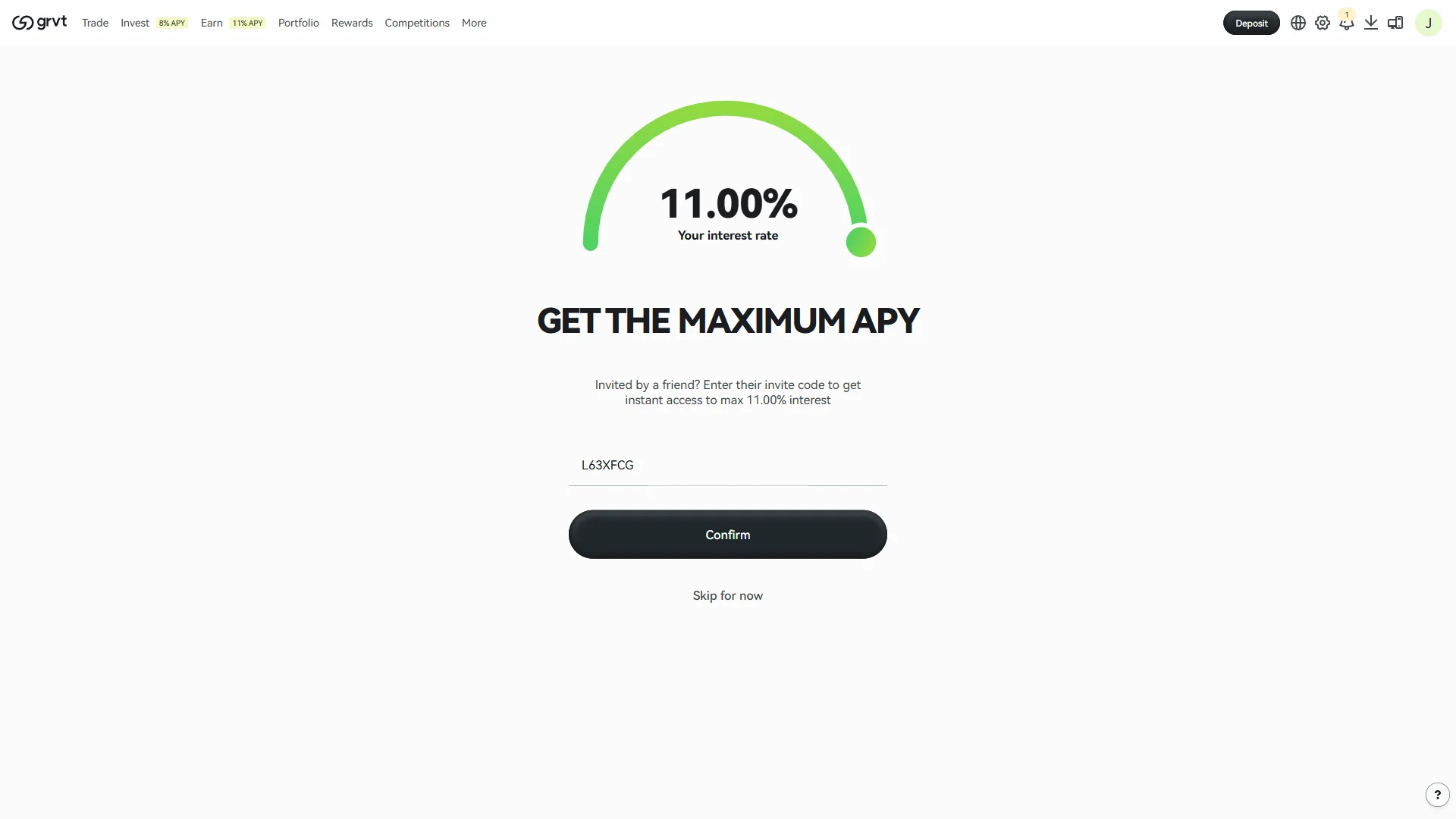
The invite code field on that screen already holds “L63XFCG”, carried in from the link — that pre-filled field is the evidence the link carried the code through, and the code is applied when you click “Confirm” on it, at the end of the sign-up after the wallet connection and both signatures (step 10 below).
One detail on the screenshot has since gone out of date: the “11.00%” dial belongs to the Earn on Equity terms that were superseded on 2026-08-11, and the default now is 3.5% APY — the rewards chapter below has the current terms.
chainhelm continuously verifies the validity of the code and confirms it remains usable.
Two things about that screen are worth knowing before you start. The code reaches the invite code field one of two ways: the sign-up link carries it in for you, or you type it into the same field yourself while you are connecting. And that screen is the only place the application is confirmed. GRVT does run a Referral Hub behind the login, under Reward > Referral Hub, but the documented role of that dashboard is the referring side of the relationship; no view is documented that lets a referred user go back afterwards and check what was applied. The confirmation is a moment, not a page.
What we checked first-hand was exactly that: a new wallet, the link, and the code arriving in the field on 2026-08-10. Everything further down this page about regulation, country availability and risk comes from documents and public data, not from our own observation, and it is labeled that way where it matters.
GRVT sign-up steps with the referral code
We cover the connection process separately for PC/browser and smartphone (mobile).
PC/browser connection steps
- First, open the GRVT official page (the link applies the referral code). When you open it, you’ll see a screen like the one below.
2. Choose how to sign up
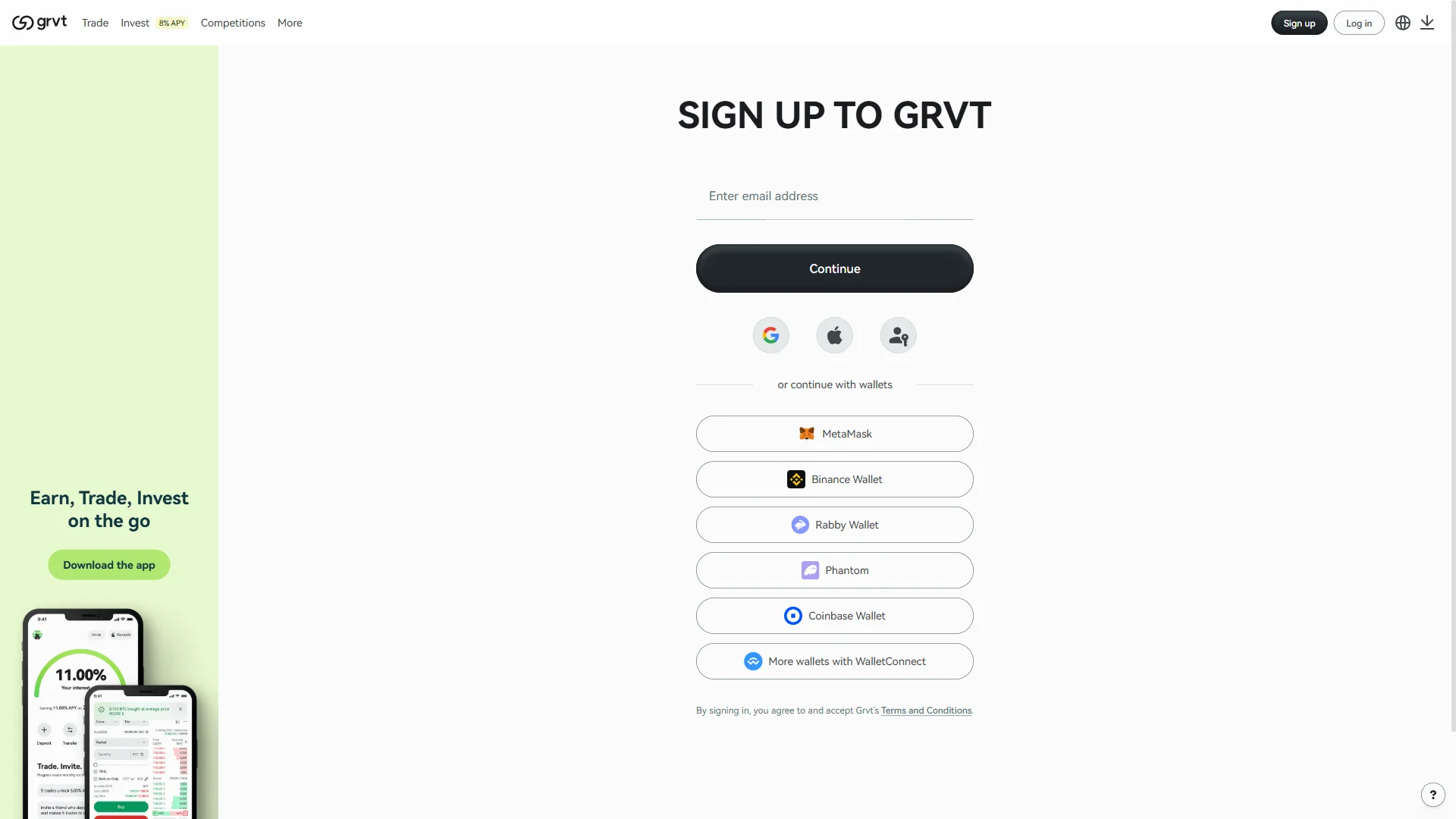
Open the referral link to land on the “SIGN UP TO GRVT” page, then click your wallet under “or continue with wallets” — this walkthrough uses “Rabby Wallet”.
“MetaMask”, “Binance Wallet”, “Rabby Wallet”, “Phantom” and “Coinbase Wallet” have their own buttons; connect anything else through “More wallets with WalletConnect”.
You can also register without a wallet: type an address into “Enter email address” and click “Continue”, or start from the Google, Apple or passkey buttons. Signing in accepts Grvt’s “Terms and Conditions”, linked under the form.
3. Approve the wallet connection
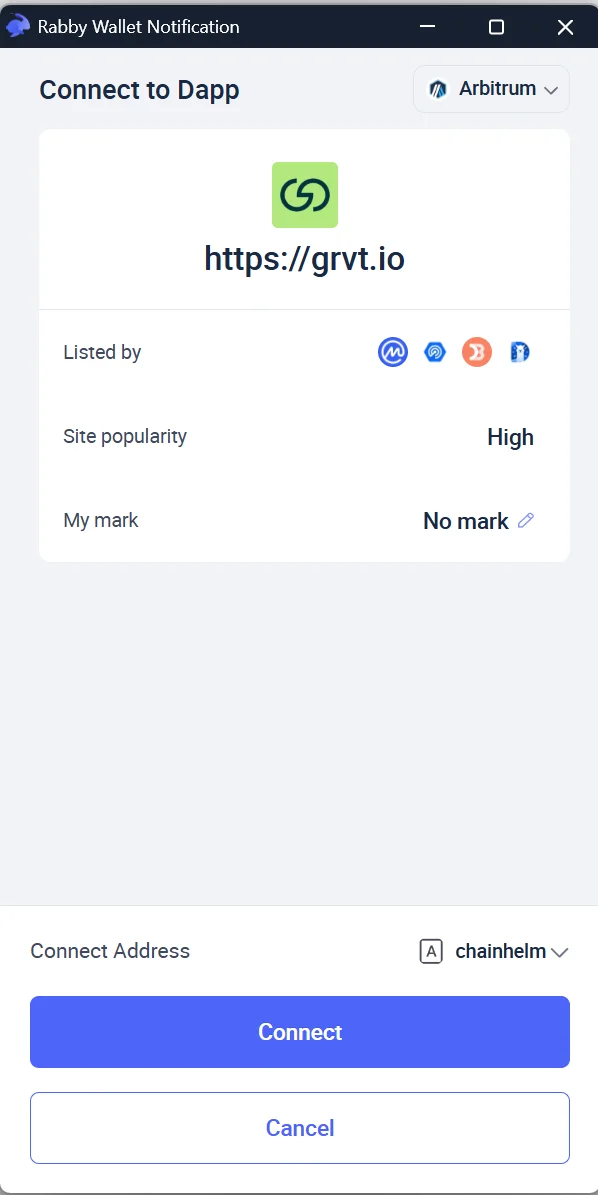
Rabby Wallet opens a “Connect to Dapp” window: confirm the site reads https://grvt.io, the network selector says “Arbitrum” and “Connect Address” points at the account you want to trade from, then click “Connect”.
If any of those three is wrong, click “Cancel” and start over from the wallet button instead of approving.
4. Register your email address
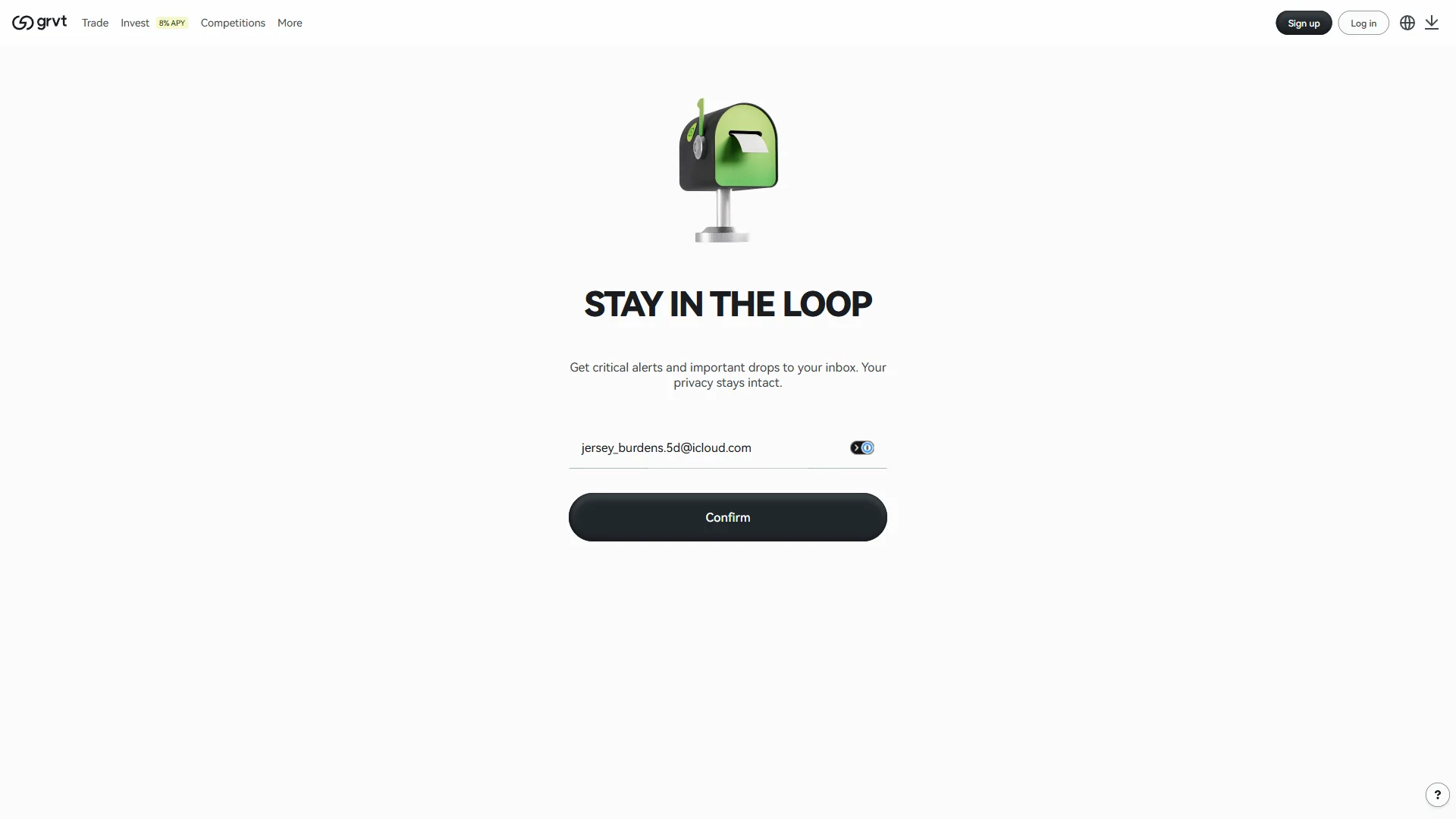
On the “STAY IN THE LOOP” screen, fill “Enter your email” with the address you want GRVT’s alerts and announcements sent to, then click “Confirm”.
The login code goes to the same inbox, so use one you can open right away.
5. Pick up the login code
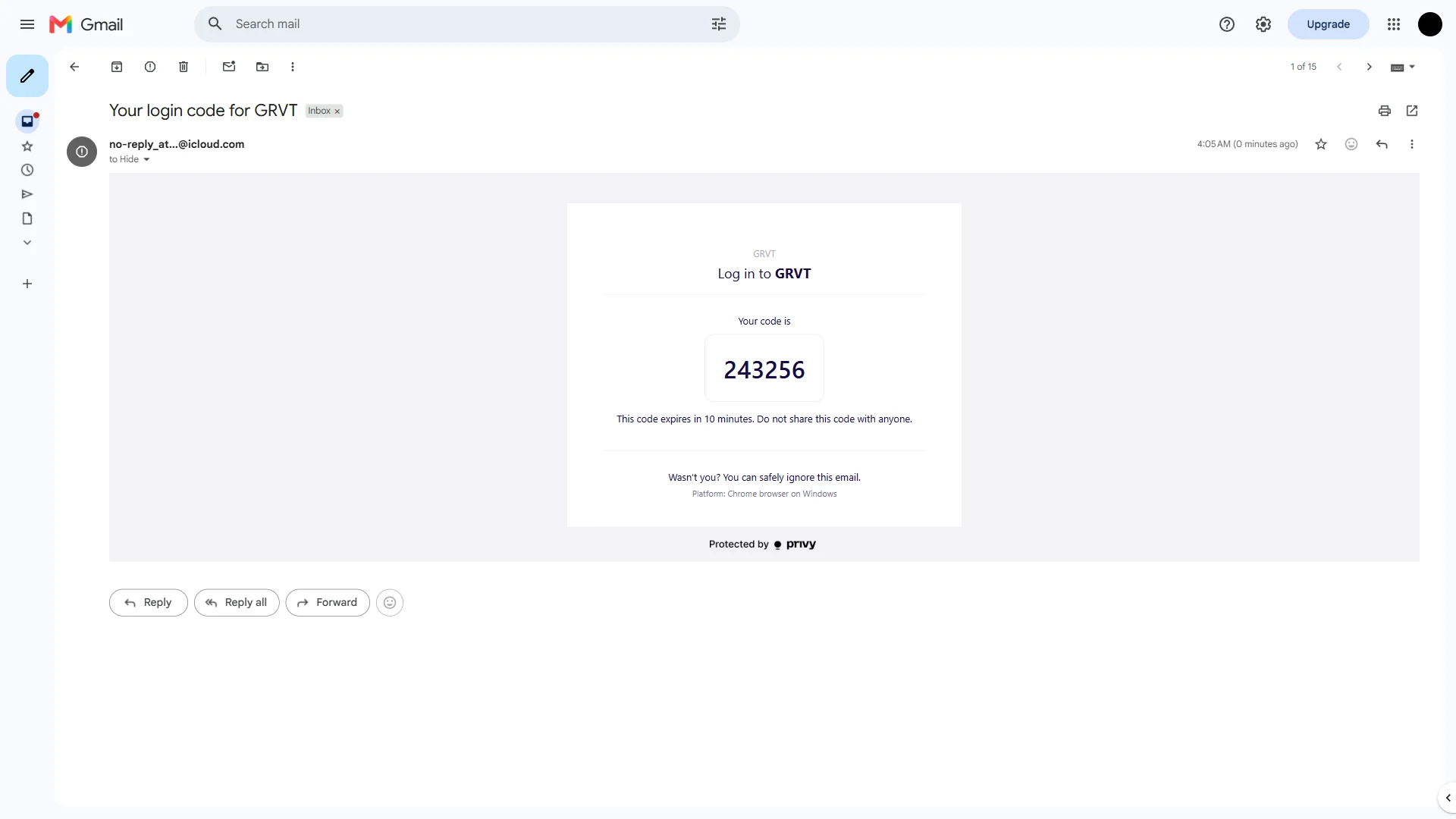
Open the “Your login code for GRVT” message in the inbox you just registered and read the six digits under “Your code is”.
The code expires in 10 minutes and is not to be shared, so fetch it right before you type it in.
6. Enter the verification code
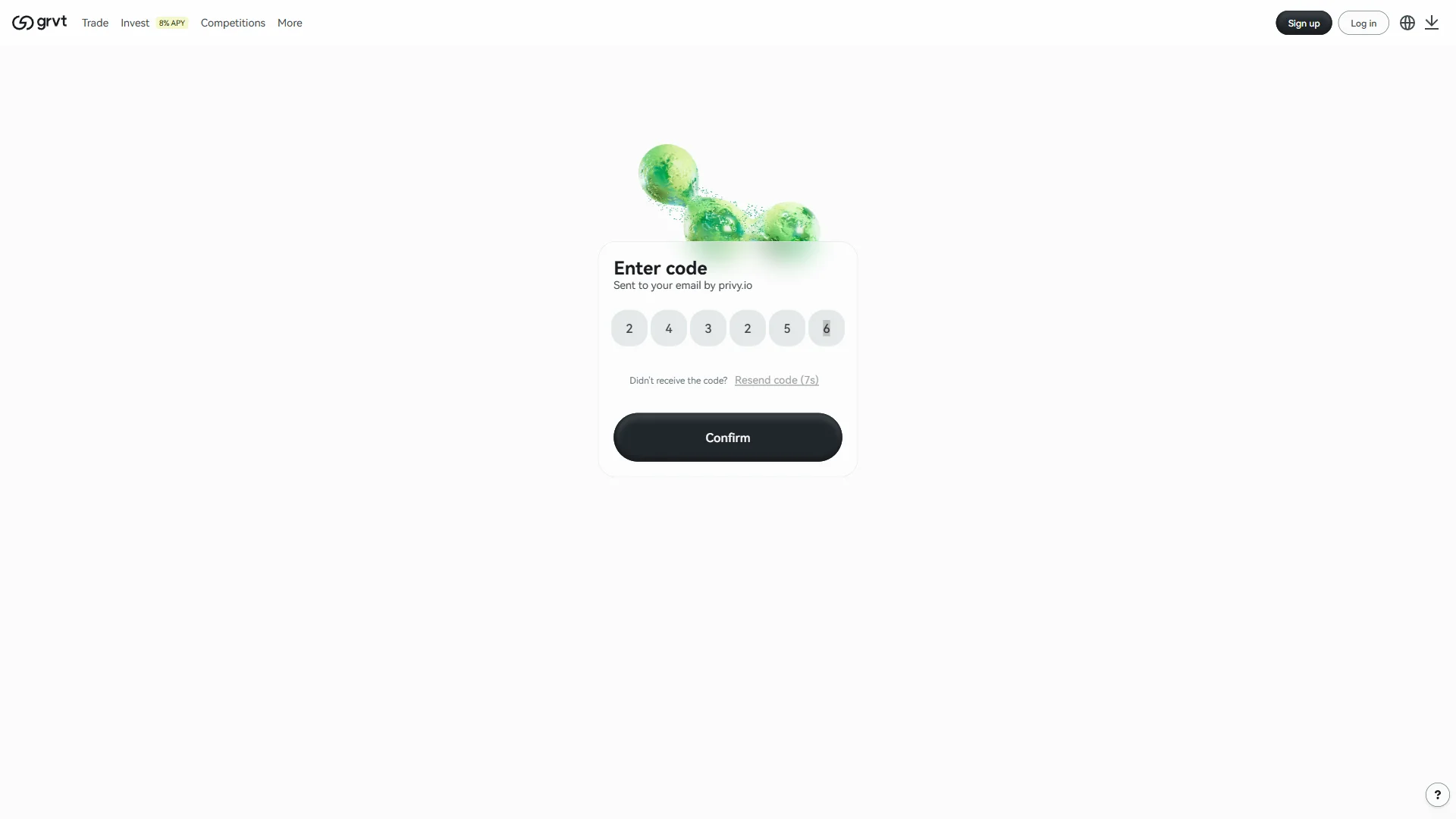
Type the six digits from the mail into the “Enter code” boxes — the panel confirms it was “Sent to your email by privy.io” — and click “Confirm”.
If nothing arrived, let the countdown beside “Didn’t receive the code?” run out and click “Resend code”.
7. Sign the account creation request
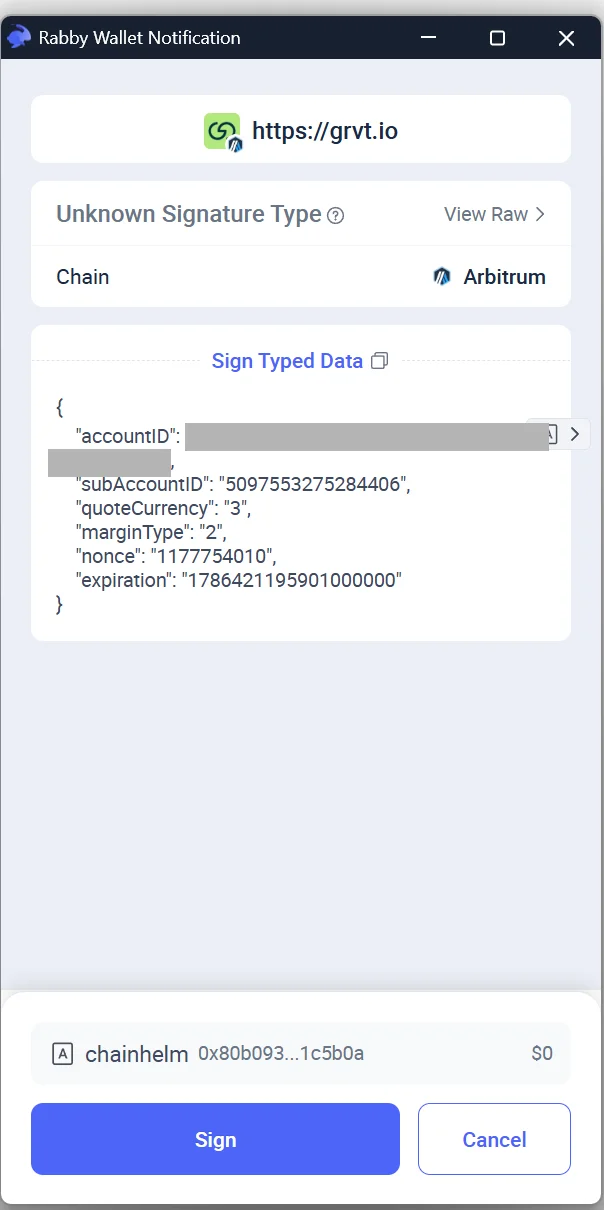
Rabby Wallet raises a “Sign Typed Data” request carrying the new account details: check the site is https://grvt.io and “Chain” reads “Arbitrum”, then click “Sign”.
GRVT waits for the wallet to answer, so let the page sit rather than reloading it.
8. When the wallet never pops up
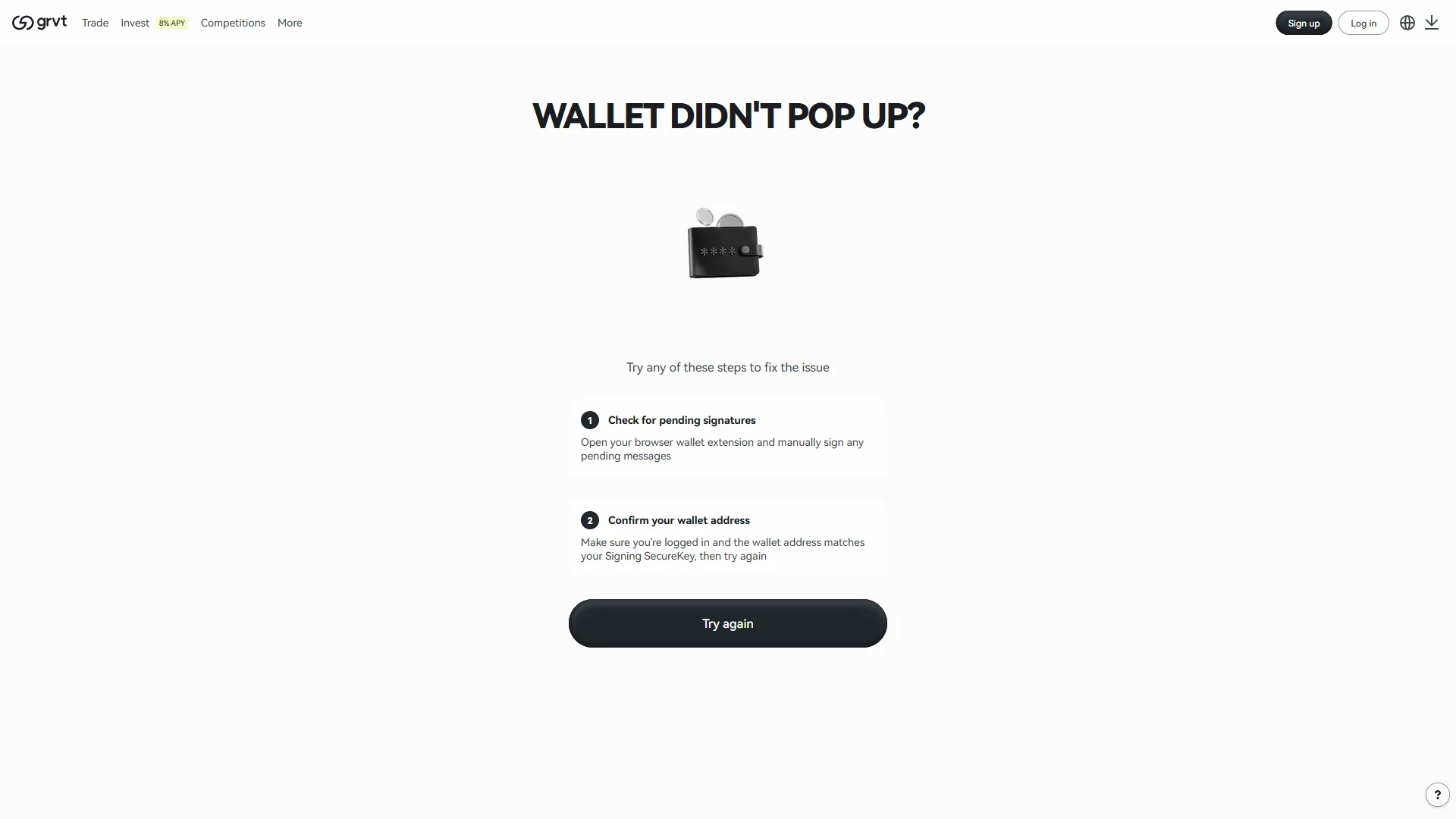
This screen only appears when the signature request never reaches your wallet. Open your wallet extension and sign whatever is queued there, as “Check for pending signatures” suggests, then work through “Confirm your wallet address” to make sure you are logged in with the address tied to your Signing SecureKey.
Click “Try again” to send the request once more and go back to waiting for the signature.
9. Sign the session key
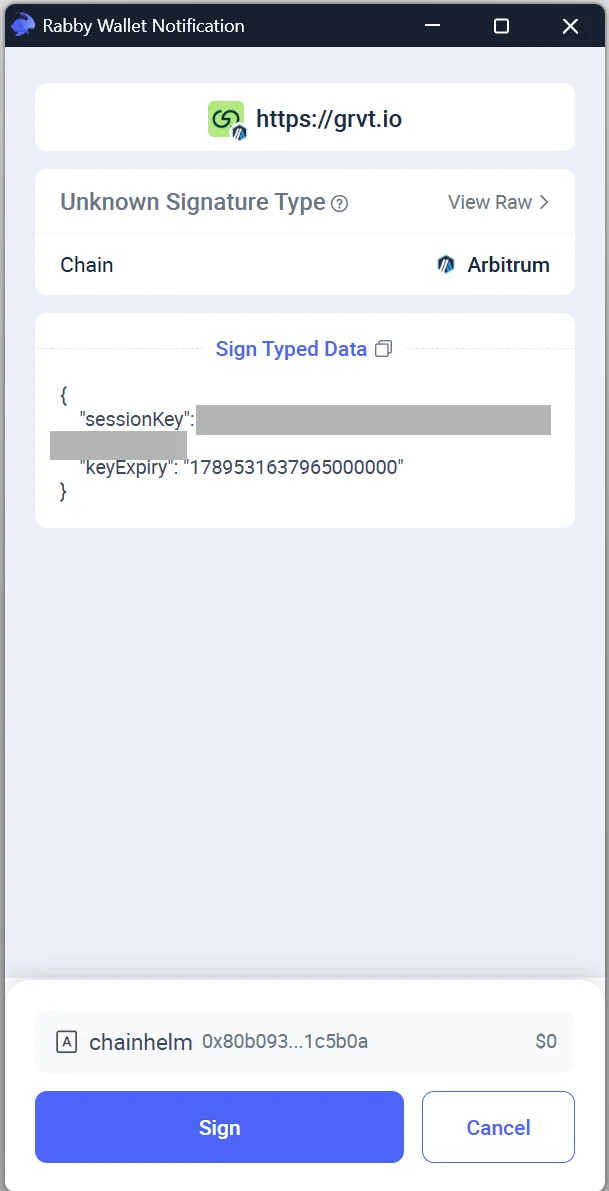
A second “Sign Typed Data” request follows, this one carrying “sessionKey” and its “keyExpiry”: check the site once more and click “Sign”.
This is the last signature of the signup, and the invite code screen follows as soon as the wallet returns it.
10. Confirm the invite code
Check that the invite code field already holds “L63XFCG”, carried over from the referral link, then click “Confirm” to apply it.
“Skip for now” under the button moves on without applying the code.
Smartphone (iOS / Android) connection steps
- First, open the GRVT official page in your mobile browser or your wallet app’s in-app browser (the link applies the referral code). When you open it, you’ll see a screen like the one below.
2. Choose how to sign up
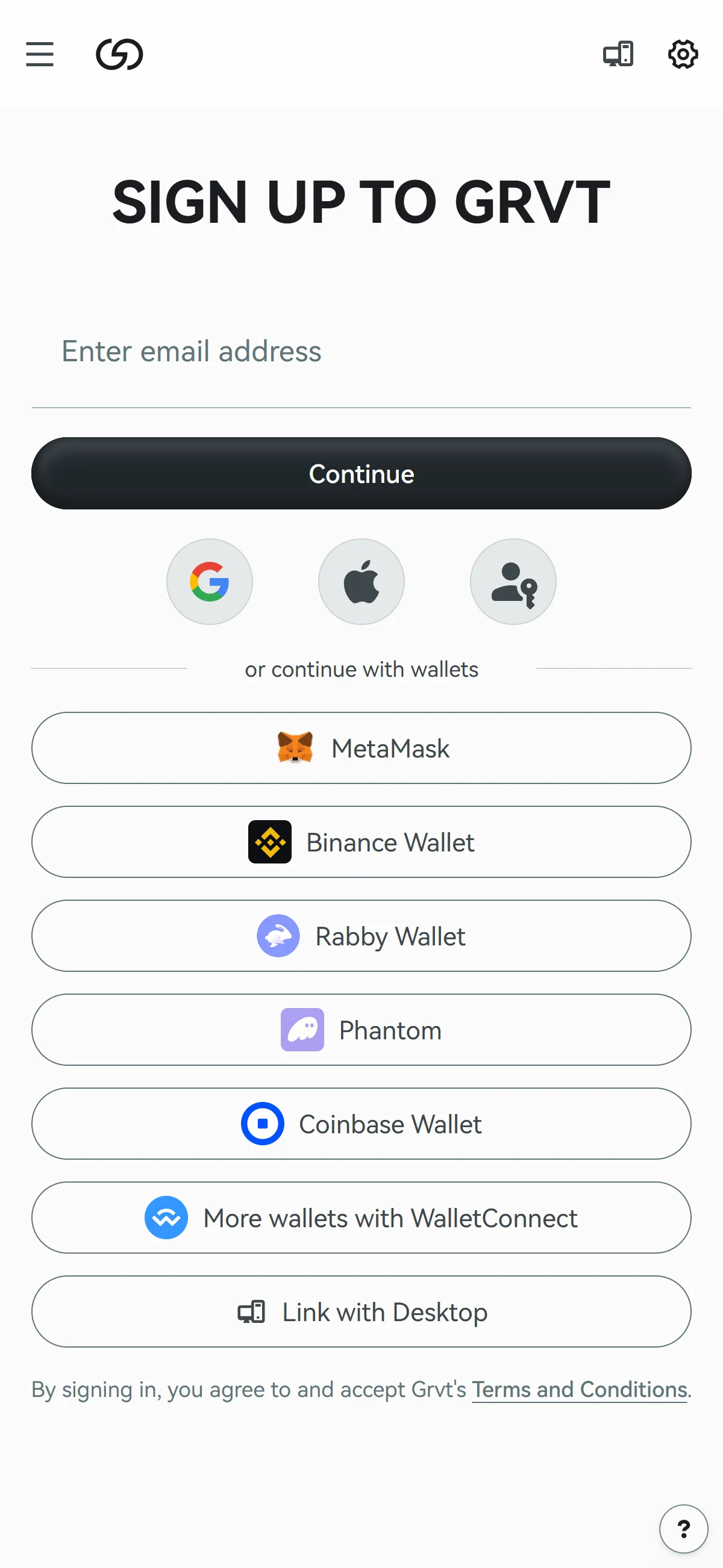
Open the referral link and scroll the “SIGN UP TO GRVT” page down to “or continue with wallets”, then tap the wallet that holds your funds — this walkthrough uses “Rabby Wallet”.
“MetaMask”, “Binance Wallet”, “Rabby Wallet”, “Phantom” and “Coinbase Wallet” have their own buttons; connect anything else through “More wallets with WalletConnect”.
To register without a wallet, type an address into “Enter email address” and tap “Continue”, or start from the Google, Apple or passkey buttons. Signing in accepts Grvt’s “Terms and Conditions”, linked at the bottom of the page.
3. Register your email address
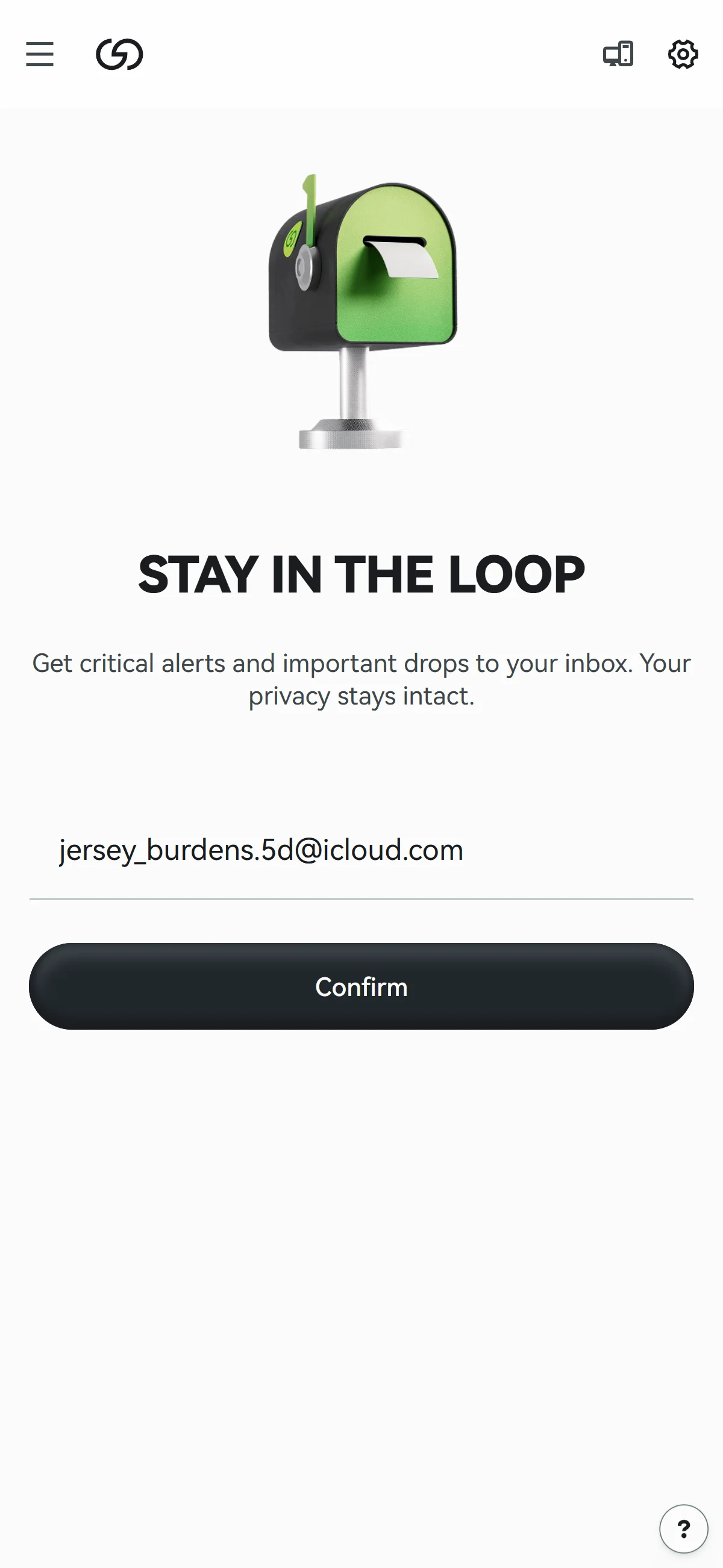
On the “STAY IN THE LOOP” screen, fill “Enter your email” with the address you want GRVT’s alerts and announcements sent to, then tap “Confirm”.
The login code goes to the same inbox, so use one you can open on this phone.
4. Pick up the login code
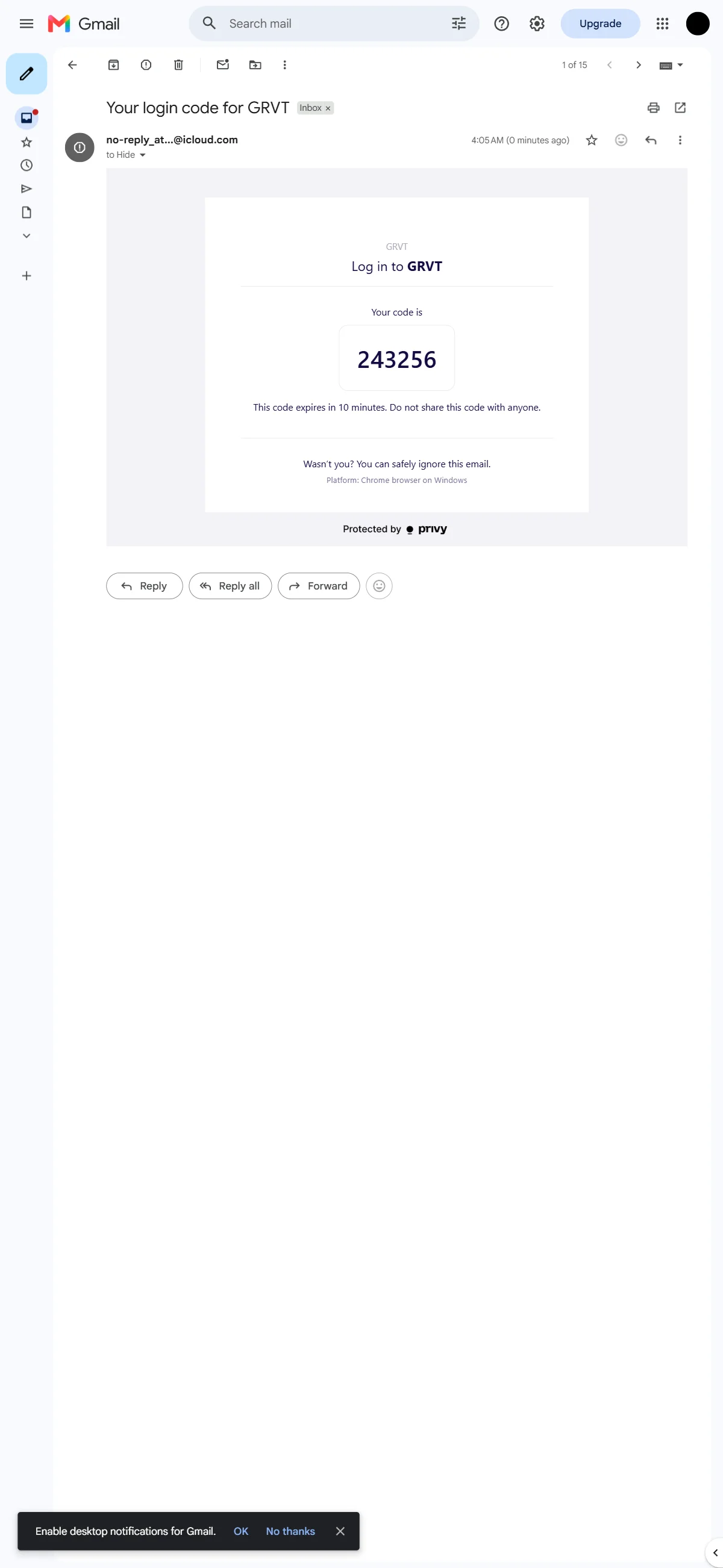
Open the “Your login code for GRVT” message in the inbox you just registered and read the six digits under “Your code is”.
The code expires in 10 minutes and is not to be shared, so read it and go straight back to GRVT to enter it.
5. Enter the verification code
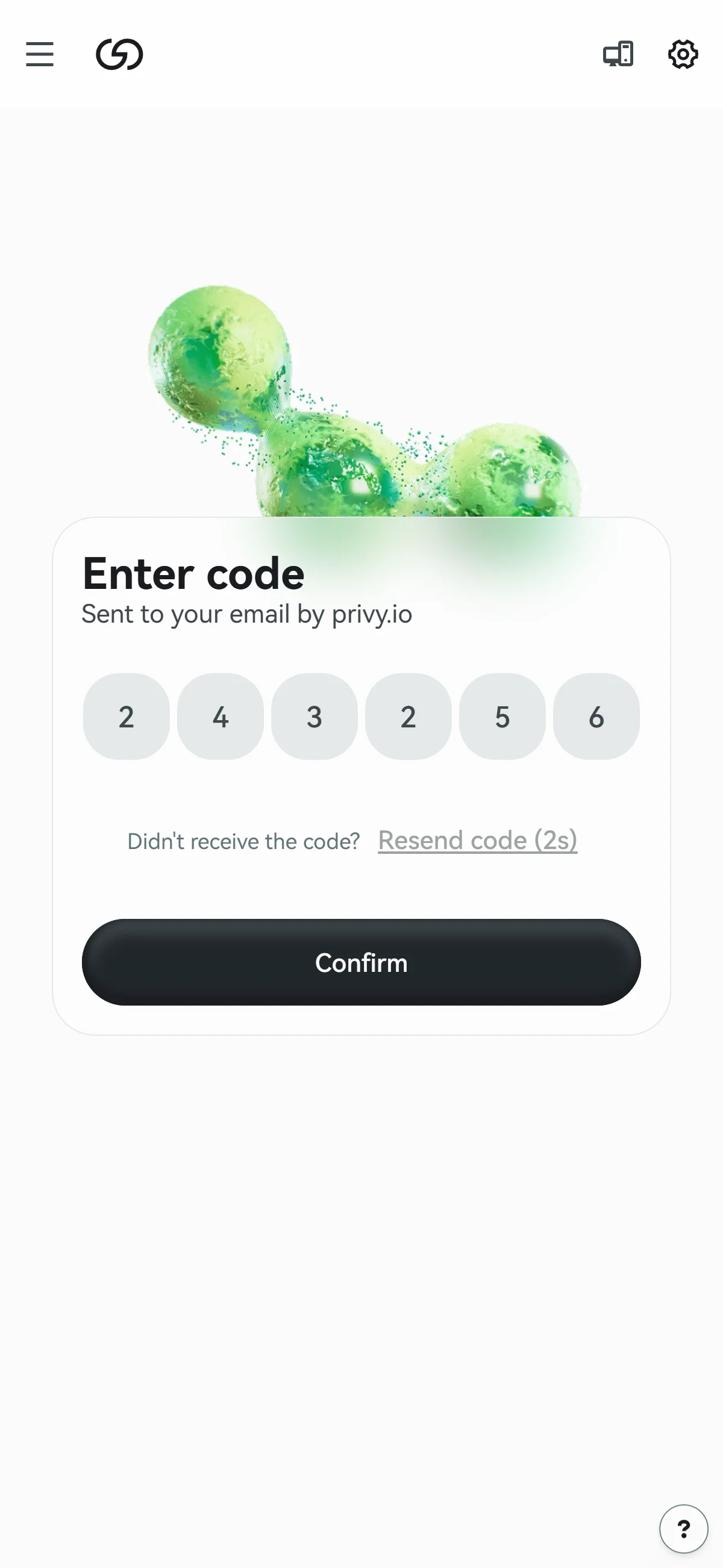
Type the six digits from the mail into the “Enter code” boxes — the panel confirms it was “Sent to your email by privy.io” — and tap “Confirm”.
If nothing arrived, let the countdown beside “Didn’t receive the code?” run out and tap “Resend code”.
6. Sign the account creation request
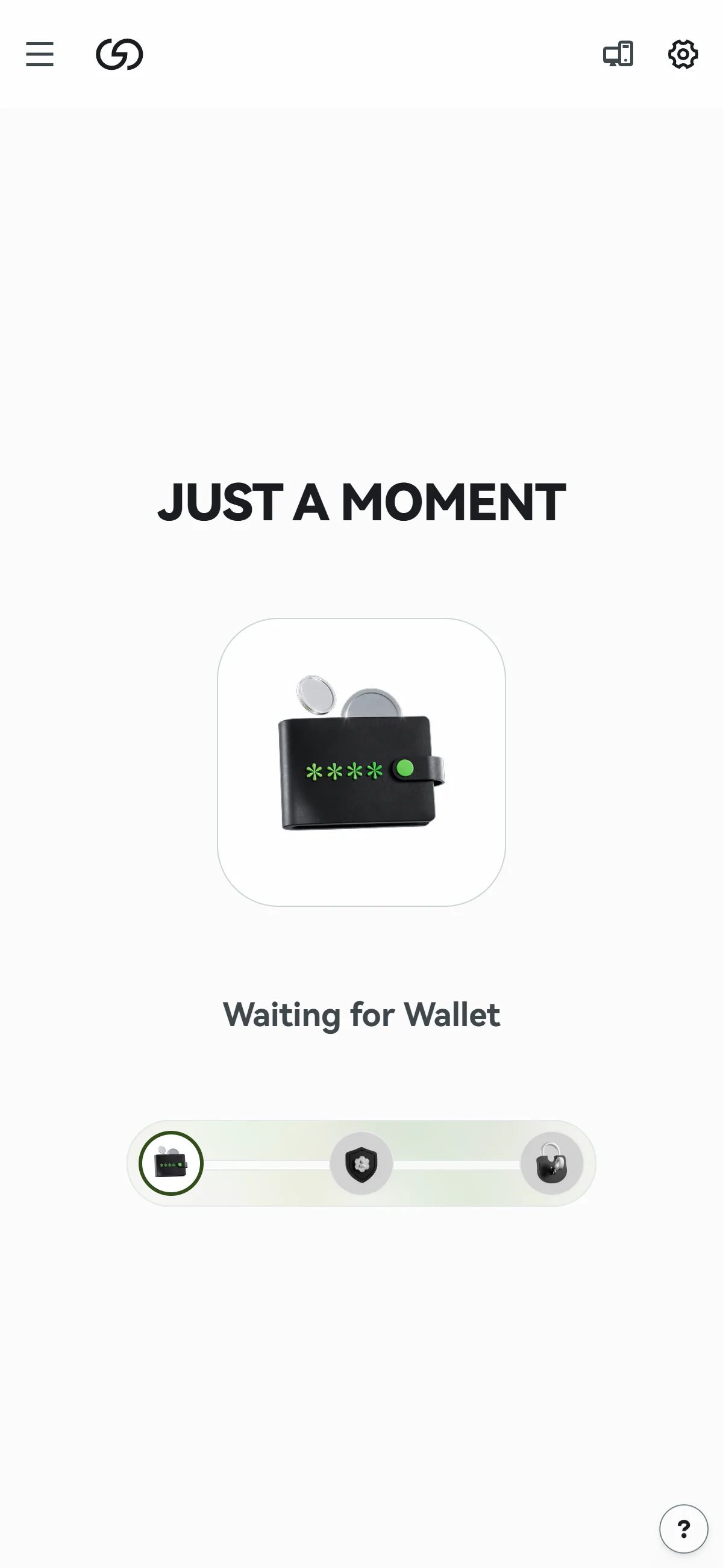
Switch to your wallet, check the signature request comes from grvt.io on Arbitrum, and approve it there.
GRVT holds on “JUST A MOMENT” with “Waiting for Wallet” until the signature comes back, so let the screen sit rather than reloading it.
7. When the wallet never opens
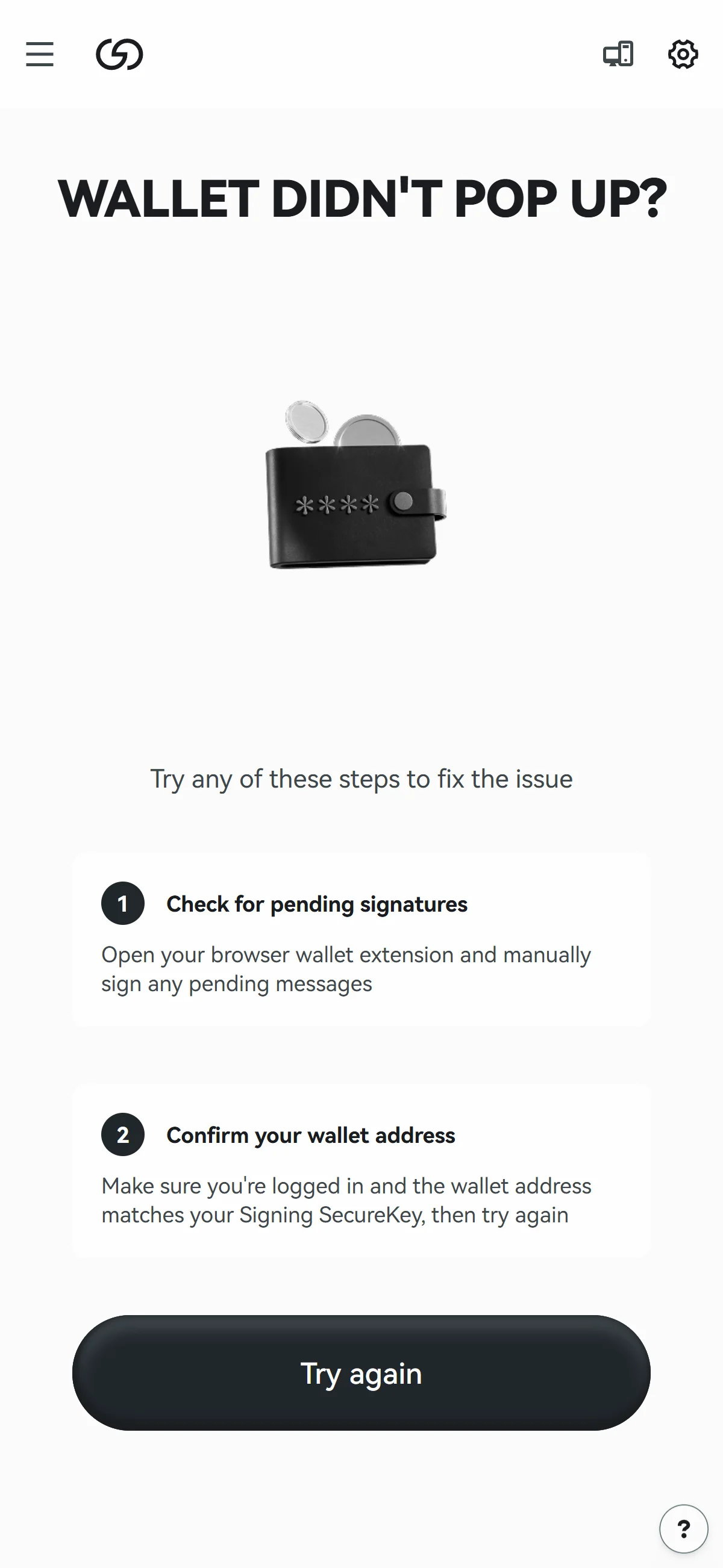
This screen only appears when the signature request never reaches your wallet. Open your wallet and sign whatever is queued there, as “Check for pending signatures” suggests, then work through “Confirm your wallet address” to make sure you are signed in with the address tied to your Signing SecureKey.
Tap “Try again” to send the request once more and go back to waiting for the signature.
8. Confirm the invite code
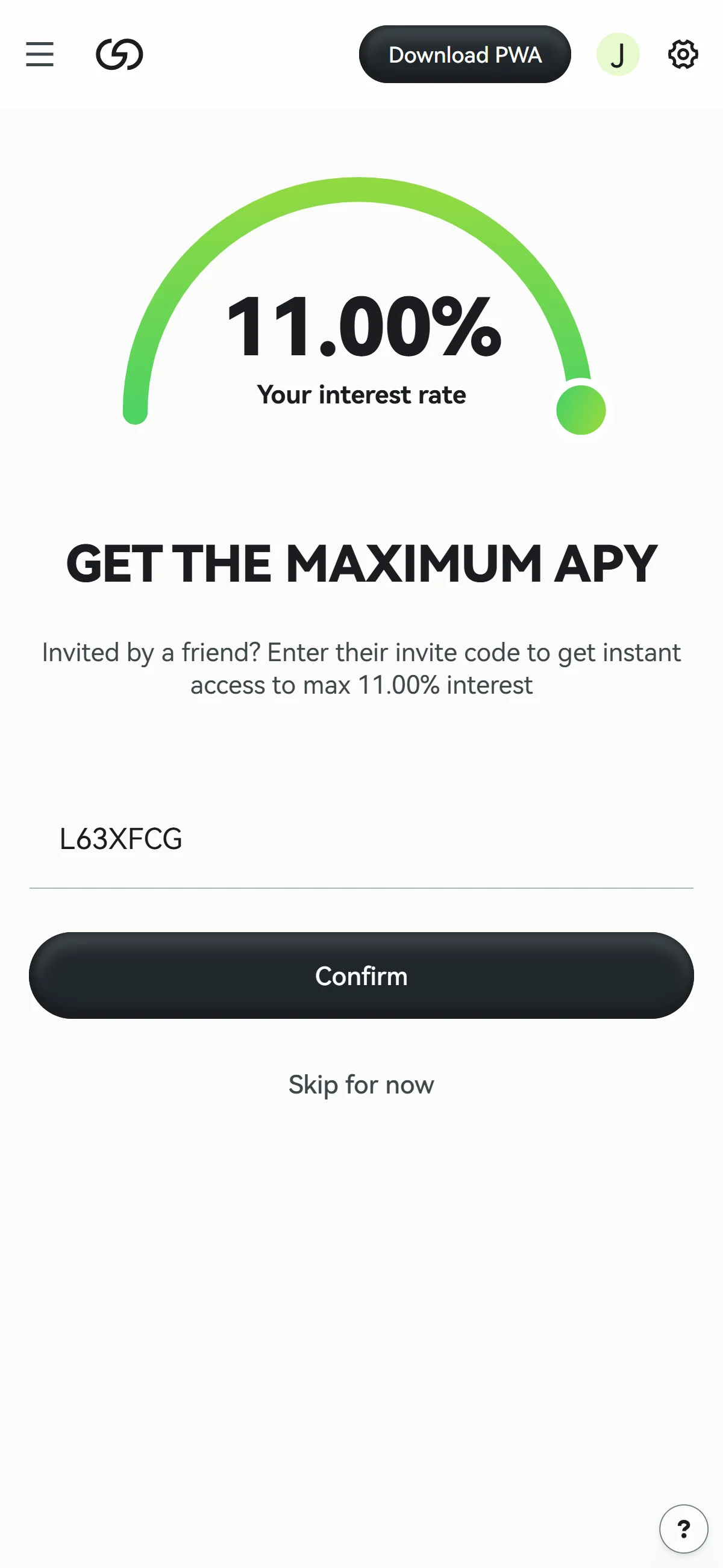
Check that the invite code field already holds “L63XFCG”, carried over from the referral link, then tap “Confirm” to apply it.
“Skip for now” under the button moves on without applying the code.
What to do after connecting to GRVT
We cover the deposit process separately for PC/browser and smartphone (mobile).
PC/browser deposit steps
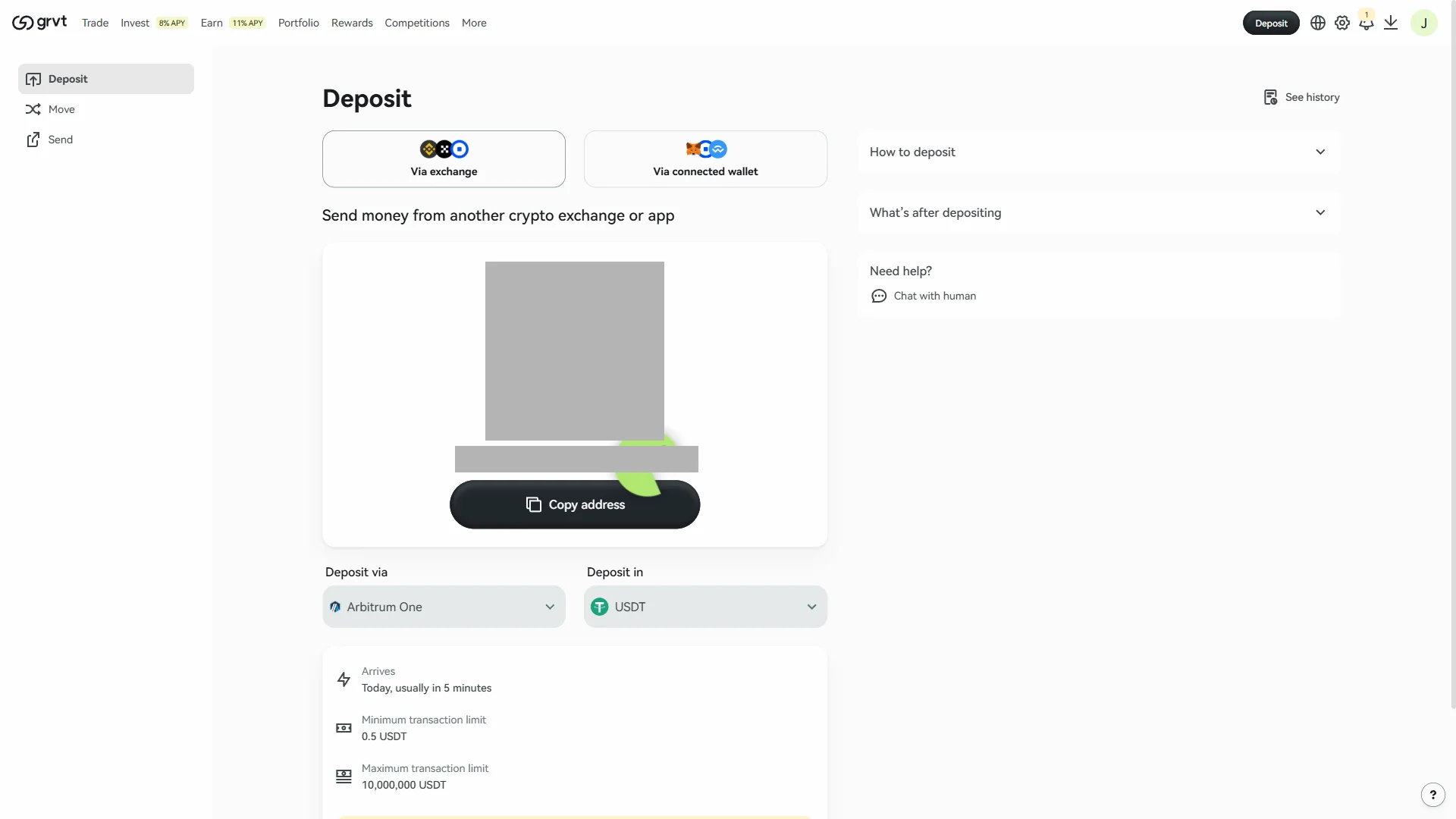
Open “Deposit” and stay on “Via exchange” to move money in from another crypto exchange or app: set “Deposit via” to “Arbitrum One” and “Deposit in” to “USDT”, then click “Copy address” or scan the QR code above it.
Withdraw to that address on the same network you picked here. The panel underneath puts “Arrives” at “Today, usually in 5 minutes”, with a “Minimum transaction limit” of “0.5 USDT” and a “Maximum transaction limit” of “10,000,000 USDT”.
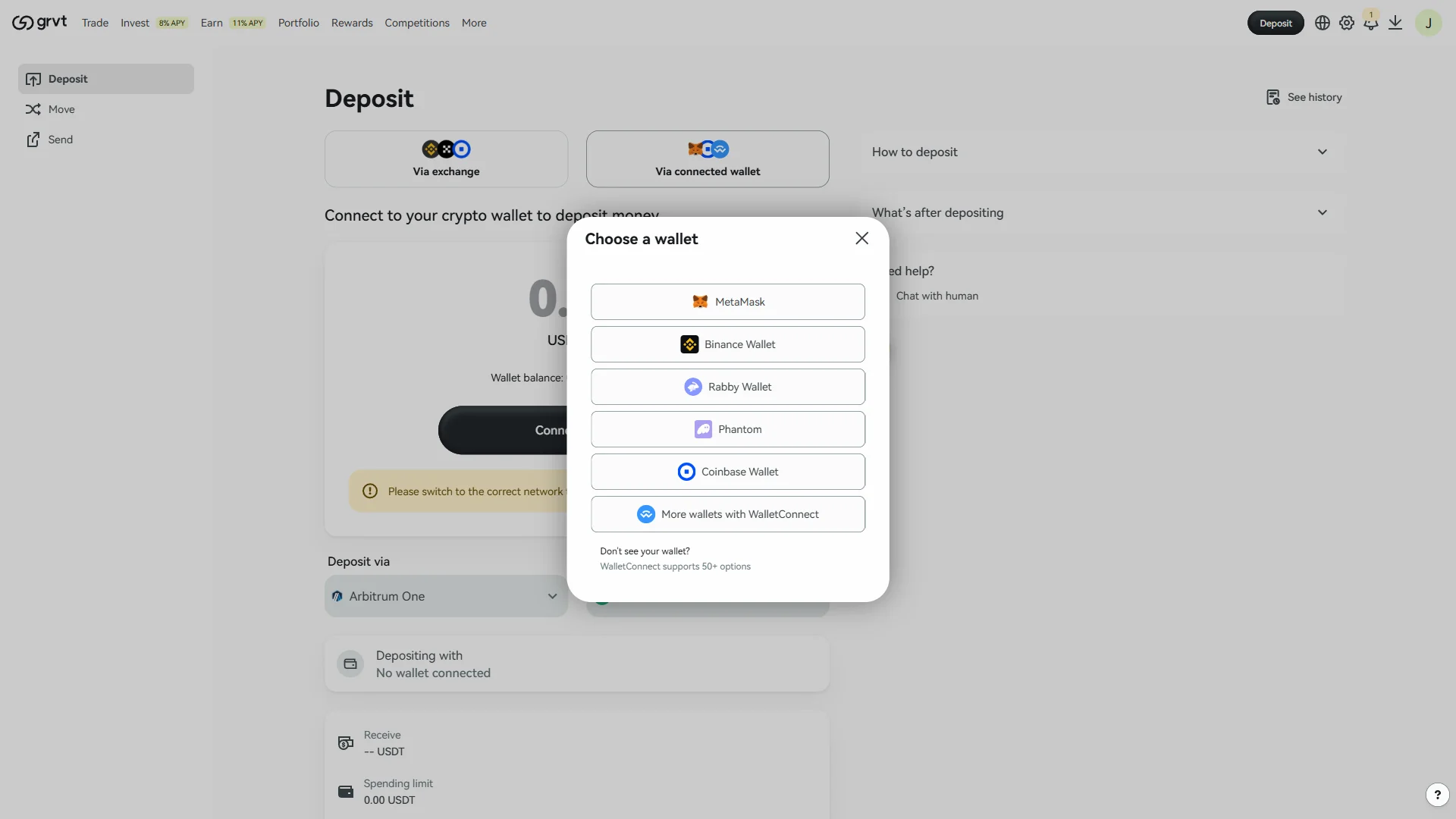
If the money already sits in a wallet, switch to “Via connected wallet” and choose it in the “Choose a wallet” dialog — “MetaMask”, “Binance Wallet”, “Rabby Wallet”, “Phantom” and “Coinbase Wallet” each have a button.
For anything else, click “More wallets with WalletConnect”; the note under it reads “Don’t see your wallet? WalletConnect supports 50+ options”.
Smartphone (iOS / Android) deposit steps
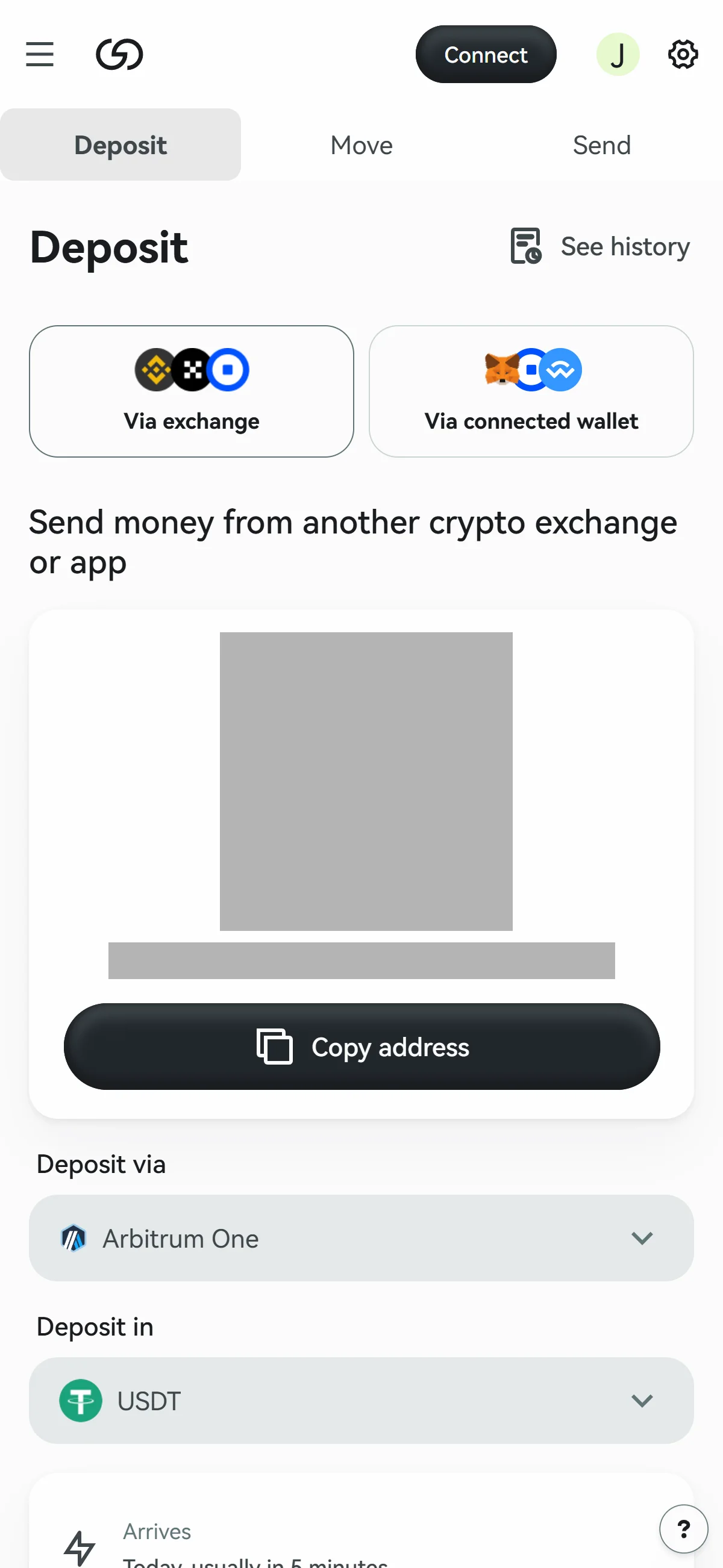
Open “Deposit”, stay on “Via exchange” to move money in from another crypto exchange or app, and set “Deposit via” to “Arbitrum One” and “Deposit in” to “USDT” before you tap “Copy address”.
Paste that address into the withdrawal form on the sending side and send on the same network. Scrolling on past the selectors, “Arrives” reads “Today, usually in 5 minutes”, with limits running from “0.5 USDT” to “10,000,000 USDT” per transaction.
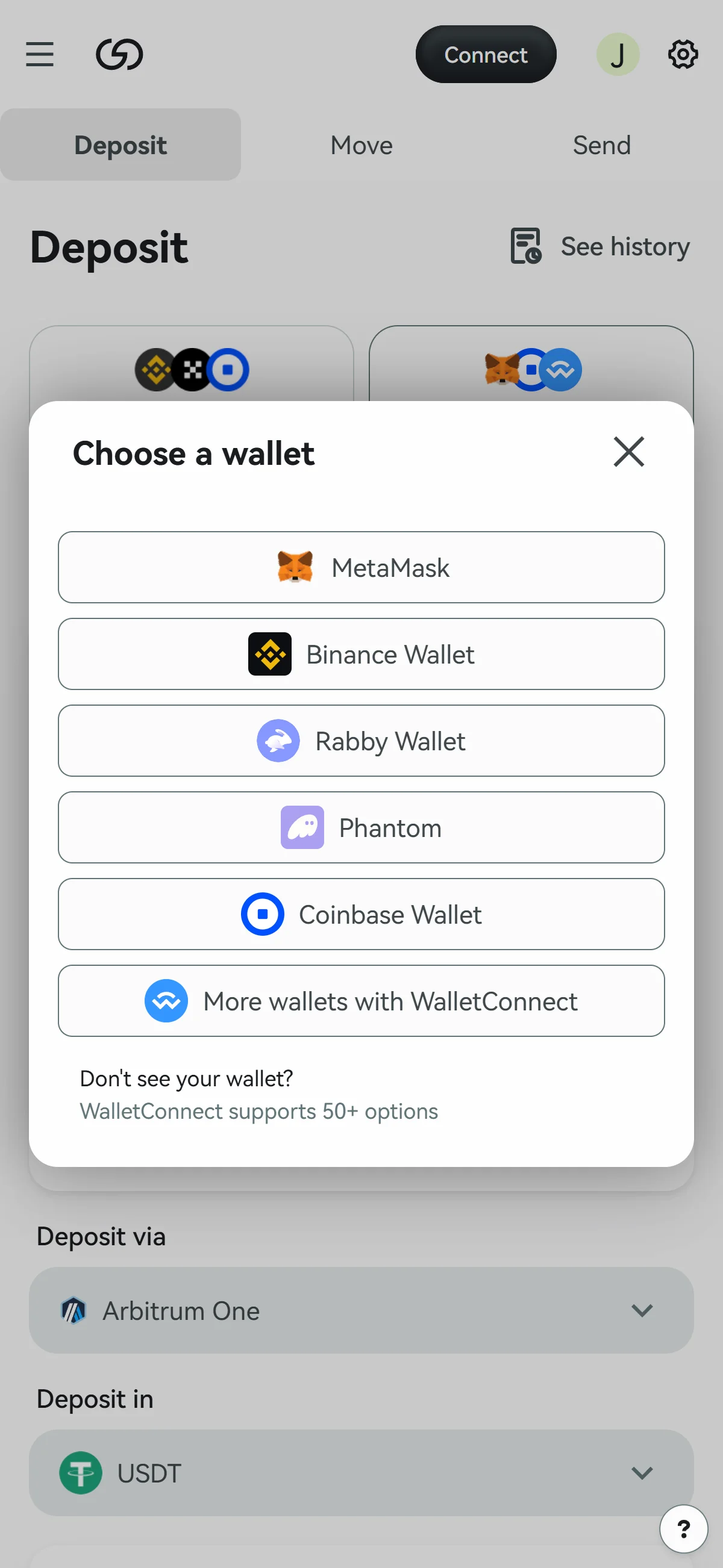
If the money already sits in a wallet, switch to “Via connected wallet” and tap it in the “Choose a wallet” panel — “MetaMask”, “Binance Wallet”, “Rabby Wallet”, “Phantom” and “Coinbase Wallet” each have a button.
For anything else, tap “More wallets with WalletConnect”; the note under it reads “Don’t see your wallet? WalletConnect supports 50+ options”.
Whichever route you take — a transfer in from another exchange or a deposit straight from a connected wallet — match the network and asset to the “Arbitrum One” and “USDT” selected on the deposit screen, and the balance is ready to trade once it arrives.
The GRVT referral code cannot be added after sign-up
The referral code can only be applied once — the first time you connect your wallet.
If you complete the connection without the code applied, there is no way to link it to that wallet afterwards, and the only route left is to start over with a new wallet.
- Does the invite code field on the final sign-up screen already hold L63XFCG before you click “Confirm”? That pre-filled field is what shows the code came through the link
- That screen is the only place the application is confirmed. There is no page to check afterwards, so take care not to miss it
Two practical notes follow from that. If the field arrives empty — you opened the site directly, say, and came back to the link later — the same invite code field accepts the code typed in by hand before you confirm. And because the confirmation is transient, the check is worth making deliberately rather than clicking straight through. On a venue that gives you a settings page to inspect later, a missed code is an annoyance you can fix; here, the invite code screen is the whole opportunity.
◆ ◇ ◆
Both reward seasons closed into the July 2026 token event
Both reward seasons are closed, and no successor has been announced
If you are opening an account now, you are not joining a points season. Rewards Season 1.0 closed on 2025-09-22, Season 2.0 ran to the token generation event, and as of 2026-08-09 no successor season had been announced. That matters more than any detail of how the seasons worked, because most of what is still written about GRVT online was written while they were running.
The reward portal itself is still there, so do not be confused when you find it: airdrop claims, the referral program, Earn on Equity and trading competitions all still live behind it. What is gone is the points accrual that fed the two seasons.
The mechanics are worth one pass, mainly so you can read older material accurately. Season 2 emitted points weekly, every Tuesday, with the weekly pool scaling to exchange volume — roughly 100K points distributed in a week with 2B USD of exchange volume, roughly 125K at 4B USD. Points were weighted by trading volume 50%, open interest 15%, direct referral activity 20%, liquidity provision 5%, liquidations 5%, and TVL held in the account or in Strategies 5%. Altcoin activity carried a 2x multiplier, so 1,000 USD of altcoin volume counted like 2,000 USD of major-pair volume. Spot trades never counted at all.
The July 2026 token event distributed 280 million GRVT to past participants
The token generation event (TGE) happened on 2026-07-30 at 13:00 UTC. The community airdrop pool was 280,000,000 GRVT, which is 28% of the fixed 1,000,000,000 supply, split into 100,000,000 for Season 1 and 180,000,000 for Season 2. Post-multiplier shares across all participants added up to 444,700,000. When the event was rescheduled, GRVT raised the community allocation from 22% to 28%, with Season 2’s share going from 12% to 18%.
Allocations vest over 12 months. The standard schedule releases 40% at the event and 20% each at months 4, 8 and 12. An optional Multiplier Plan let people defer the first tranche instead — 2x if taken at month 4, 4x if taken at month 8.
Two different registration deadlines appear in the company’s own help center
Receiving anything required registering inside a window, and unregistered allocations were forfeited. The problem is that three official help center articles publish two different deadlines.
The later of the two dates appears in two of the three articles, including the TGE overview, which makes it the more likely operative one — but that is a probability, not a resolved fact, and GRVT has not reconciled the pages. If you are reading this because you had an allocation, assume the earlier deadline was the one that applied to you, and check your own account rather than either article.
Two further conditions are worth knowing because they are unusually strict. Distribution had to go to a self-custodial wallet — a GRVT account, or a BSC or Ethereum address — and not to a centralized exchange deposit address. And each unlocked tranche carries a 30-day claim window, after which that tranche cannot be claimed at all, with no exceptions.
The company’s own words on how it handled all this tell you something about the operator. GRVT said it reviewed accounts and adjusted release timing “where patterns suggested activity engineered to maximize allocation”, and that the forfeiture rule “applies uniformly across all users and cannot be overridden”. Read those together: this is an operator that will act unilaterally on its own reading of your behavior, and that does not make exceptions when its own deadline passes.
Membership tiers and interest on trading balances are what remain
For someone opening an account today, this is the part that actually applies. Two things replaced the seasons.
The first is a membership program keyed to locking the GRVT token, which upgrades the fee tier applied to your trading on both perpetuals and spot, and unlocks a share of your equity for the GLP market-making vault.
- Basic — 1 GRVT locked, 1 week minimum
- Fee tier 1, and no GLP access.
- Silver — 2,500 GRVT, 1 month
- Fee tier 2, and 25% of aggregated account equity investable in GLP.
- Gold — 10,000 GRVT, 3 months
- Fee tier 3, and 50% GLP access.
- Platinum — 50,000 GRVT, 6 months
- Fee tier 4, and 100% GLP access.
The conditions around those tiers are tighter than the headline suggests: one active subscription per account, no early unlock, and upgrading restarts the lock period from zero rather than topping it up. After you do unlock, a 7-day cooldown applies.
The second is Earn on Equity, on the terms in force from 2026-08-11. It pays 3.5% APY by default on stablecoin balances, with no activation task, no tier to reach and no cap on the equity that earns it — and those balances go on serving as your trading margin at the same time, which is genuinely unusual among perpetual venues.
That yield carries GRVT’s own risk warning, and the company states it plainly. Its disclaimers say it does not offer financial, investment or advisory services, that strategies are developed and managed independently by third-party providers, and that users bear the full principal risk of the underlying protocols — including smart contract failure, exploit, insolvency and depeg. The yield comes from somewhere, and the somewhere is external protocols and short-term credit instruments, not GRVT’s balance sheet.
GRVT runs an off-chain order book that settles on its own zero-knowledge chain
Three founders launched GRVT to mainnet in December 2024
The company was co-founded in 2022 by Hong Yea, Aaron Ong and Matthew Quek. Yea is CEO and came from more than a decade in traditional finance, as an Executive Director at Goldman Sachs and a trader at Credit Suisse; Ong is CTO and was previously a tech lead at Meta working on data privacy frameworks; Quek is COO and previously led the blockchain and payments team at DBS Bank in Singapore. Mainnet alpha opened to all users on 2024-12-20, so the venue has a little over eighteen months of live trading behind it.
On money: GRVT states it has raised 34,000,000 USD in total at a 540M USD valuation, of which the Series A closed on 2025-09-18 at 19,000,000 USD, co-led by ZKsync, Further Ventures, EigenCloud and 500 Global. Neither figure has audited or regulator-filed confirmation behind it — they are the company’s own numbers.
The User Agreement names a Panama company as the operator you contract with
Signing up means entering a User Agreement, and the agreement in force says whose it is: Albatross Group Overseas S.A., incorporated in Panama and named as the sole operating company since the novation that took effect on 2025-08-28. Two other names travel with GRVT in public sources, and it is worth being clear that they answer different questions.
Albatross Group Overseas S.A.
GRVT International Limited
British Virgin Islands
Governing law under the agreement is Singapore, and disputes go to arbitration seated in Singapore under SIAC rules — so a dispute is heard there rather than where you live. The agreement also says that different entities and third parties are responsible for different functions depending on where you are, and the complete terms are distributed only as a downloadable PDF.
The three names are not three answers to one question. One is the company the User Agreement puts on the other side of your contract, one is the entity that holds the Bermuda license, and one is the country field on a public tracker’s listing — and only the first binds you. Read plainly, that means your counterparty is a Panama company that declares in your own contract that no Panamanian authority regulates it. That is a fact worth having before you agree to the terms, not a mystery.
Orders are matched off-chain and settled on GRVT’s own zero-knowledge chain
If you have only used centralized exchanges, the architecture here is worth a minute, because two later sections — the privacy feature and the most serious risk on this venue — both follow from it.
- Central limit order book
- Orders rest in a book of bids and offers and are matched against each other, the way a conventional exchange works. This is not the automated-market-maker pool model that many decentralized venues use, and it is why the order types and the fee structure look familiar.
- Off-chain matching, on-chain settlement
- The matching engine runs on GRVT’s servers. Matched trades, liquidations, account actions and transfers are then pushed on-chain and published as zero-knowledge proofs that Ethereum verifies.
- Validium
- GRVT’s own application-specific layer 2, built on the ZKsync ZK Stack. Proofs go to Ethereum; the underlying transaction data does not. EigenDA is named by the company as the data availability layer.
That last line is the one to hold on to. “Proofs on Ethereum, data kept off it” is what makes the privacy property possible, and it is also the source of the single risk that L2BEAT rates critical on this chain.
Custody sits on the user’s side, with a boundary. Withdrawals are authorized by a signature from a key only you hold, and the contract sends funds to your own wallet, so GRVT states it cannot move, redirect or spend user funds, and cannot invent balances. But matching and sequencing stay off-chain and under GRVT’s control, so you still depend on the operator for fair sequencing and for the venue continuing to run. What that dependency costs is the subject of the risk section further down.
The market list runs from BTC to gold to tokenized US equities
The 171 perpetual pairs above are every perpetual across asset classes; the company said 43 of its perpetual pairs were equity perpetuals as of 2026-05-28. The two numbers measure different things and are not in conflict — the second is the tokenized-equity slice. Alongside crypto there are commodity perpetuals on gold, silver and oil, and the equity list.
Spot trading arrived on 2026-06-25, starting with USDC. It supports no leverage, takes a minimum order size of 1 USDC and a minimum order value of 5 USDT, and settles instantly into the funding account. Spot volume counts toward your fee tier, but spot trades earned no points while the seasons ran and are excluded from the profit split.
Leverage is configurable up to 50x, and the margin table decides what that means
You set leverage per instrument, and only while you have no open position in that instrument. Maximum configurable leverage per pair was adjusted with effect from 2026-07-01.
The qualification matters more than the headline. The initial margin rate table constrains effective position size on top of your leverage setting, so 50x is not attainable at every position size — the number on the slider is a ceiling, not a promise. Both cross and isolated margin are supported. Collateral and settlement are in USDT, with USDC also accepted as an eligible balance asset.
Takers pay 0.045% at the entry tier, and makers are paid a rebate at every tier
The maker number is negative on purpose, and it is the venue’s most concrete cost differentiator, so it is worth being precise: a negative maker fee means GRVT pays you for the order, rather than charging you less. Misread it as a discount and you will misprice the venue.
The schedule runs to nine levels, so eight tiers sit above the entry level, qualified by 30-day futures volume alone and updated daily at 08:00 UTC. At the top, level 9 at 1,000,000,000 USD of 30-day volume, the taker fee is 0.024% and the maker rebate is -0.003%. That is the whole shape: taker cost falls by about half across the range, while the rebate grows thirtyfold. You can also reach a better fee tier by locking GRVT through the membership program described earlier, rather than by trading your way there.
Funding runs on a 1h, 4h or 8h interval depending on the market, and a market switches automatically to 1h if premiums exceed the caps over a longer interval. The rate is built from a premium index — the gap between a fair price and the index price, with the fair price recomputed every five seconds as the median of best bid, best ask and last trade. The result is then clamped: pulled toward +1 basis point and bounded within plus or minus 5 basis points. The mechanism has been in force since 2025-10-15.
Deposits arrive from seven networks, and there is no per-trade gas
Ethereum, Arbitrum One, BNB Smart Chain, Solana, Tron, Base and Kaia are all supported; the native bridge covers the first three for USDT, and the rest appear in the official minimum-deposit and withdrawal-fee tables. Collateral assets are USDT and USDC. The minimum deposit is 1 USDT or USDC on most networks and 5 USDT on TRC20 — and deposits below the network threshold are not processed and may be permanently lost, which is the kind of sentence worth rereading before a first transfer.
You do not pay blockchain gas per trade. Matching and sequencing happen off-chain, and GRVT pushes batches on-chain itself. The cost surfaces instead as flat withdrawal fees, which GRVT states cover the on-chain gas: 2 USDT on Ethereum, 1.01 USDT on Arbitrum One and on BNB Smart Chain, 1.5 USDT on Solana, 1.4 USDT on Tron. No deposit fee is documented.
Sign-up takes a wallet or an email, and what identity checks apply is not documented
There are two ways in. Connect a wallet, or register with an email — in which case an embedded wallet powered by Privy is created for you, and you can export its private key at any time into a wallet of your own. Either way every user ends up holding both — one email and one wallet per user — and every action that affects ownership of assets has to be signed by a registered wallet.
What identity verification applies is genuinely unresolved on the public record, and it would be dishonest to write it any other way. On one side: GRVT publishes no article stating that documentary verification is mandatory for a retail sign-up, and its API documentation describes registration by email or by wallet with no verification step in between. On the other: the User Agreement requires you to declare truthfully where you live, states that identity verification must be completed before an account can be opened, and GRVT runs an AML and anti-terrorist-financing program with sanctions screening and transaction monitoring, under which a wallet compliance review can permanently block an account. The full agreement is distributed only as a downloadable PDF and has not been parsed.
So do not believe an unqualified “no KYC” claim about GRVT from anywhere, including the review sites that make it. GRVT’s own compliance documentation contradicts that framing, and our own walkthrough covered the sign-up and the code only — it is not evidence about the identity policy either way.
GRVT ranks fifth by open interest and seventh by 24-hour volume
Where GRVT sits among perpetual venues, by the numbers that exist
Every reading here is dated 2026-08-09. On DeFiLlama, GRVT ranked 7th by 24-hour reported perpetual volume among perp protocols, and 5th by 30-day volume at 27.758B USD. By open interest it ranked 5th at 354,700,000 USD, behind Hyperliquid, Aster, Variational and Lighter. Its share of the 14.829B USD of 24-hour volume across tracked protocols was 3.27%.
On CoinGecko — the tracker GRVT’s own help center points users to for public metrics — the picture looks very different: GRVT is one of 128 derivatives venues and ranks 43rd by 24-hour volume in BTC terms. The gap is not a contradiction. CoinGecko’s comparison set includes centralized exchanges, and against Binance, OKX and the rest a venue this size sits much further down.
The two public volume trackers disagree by roughly 1.6x
CoinGecko reports in BTC; the figure above is its 4,584.96 BTC converted at the 65,056.7 BTC-USDT mark observed on GRVT’s book at the same moment. The two trackers use different snapshot windows and cover different instruments — GRVT lists equity and commodity perpetuals that a tracker may include or exclude — so neither is wrong exactly.
The takeaway is a method rather than a number. Trust the order of magnitude of the volume figure and not the figure itself. Open interest, where the two sources land within about 1 percent of each other, is the size metric to lean on when you want to compare this venue with another.
No protocol fee revenue figure is published for GRVT at all
The ranking you would normally put beside those two — what the protocol earns in fees — cannot be given, and the absence is itself the finding. GRVT does not appear in the DeFiLlama fees dataset as of 2026-08-09 — a full scan of the 2,541 protocols in it returned no GRVT entry. There is no proxy worth substituting here, so the honest answer is that how much the protocol earns is not public.
Four things distinguish GRVT, and each comes with a qualification
The claims below are real. So are the qualifications, and the qualifications are the part other pages leave out.
A maker rebate at every tier. From -0.0001% at level 1 to -0.003% at level 9, paid to anyone posting a resting order rather than reserved for designated market makers, which the company describes as an industry first for the -1 basis point level. The qualification: it is a rebate on maker flow only, and if you trade by hitting the book rather than resting on it, the taker fee is where you actually live.
Yield on collateral that is still doing its job. Stablecoin balances serving as trading margin earn interest, sourced from external protocols such as Aave and from short-term credit instruments. The terms in force from 2026-08-11 pay 3.5% APY by default, with no task and no cap, and the principal-risk disclaimer described earlier applies to all of it.
Privacy by validium. Transaction data is not published on-chain and positions are not publicly visible, while validity proofs are verified on Ethereum. On a transparent perpetual venue, anyone can watch a large position and see where it liquidates; here they cannot. The qualification is the load-bearing one: the same design choice is the source of the critical data availability risk set out in the risk section below.
A licensed entity, of a kind. GRVT International Limited holds a Bermuda Class M license and the company said it was pursuing a full Class F. The qualification: the licensed entity was announced as not yet operational and intended for selected corporate customers, and GRVT’s own disclaimer states that it is not a regulated entity and that funds are not subject to regulatory protection. The “world’s first regulated DEX” positioning should never be carried without that.
Beyond those four, the breadth of the market list is a genuine difference in itself — crypto, commodities, 43 equity pairs, and curated tokenized real-world-asset vaults accessible from 1 USD whose vault tokens can be used as trading collateral.
GRVT bans 18 jurisdictions, and its API blocks a different set
Eighteen entries name the countries and regions GRVT bans
This section is about what GRVT does globally. What is true where you are comes next, and the two are not the same question.
GRVT’s Restricted Jurisdictions article — which the company itself frames as “Which countries are banned from accessing GRVT” — bans access for any person residing, located, incorporated or otherwise established in the places below.
United States Republic of Singapore Hong Kong SAR Canada Russia Belarus North Korea Iran Cuba Syria Myanmar Afghanistan Libya Somalia South Sudan Sudan Crimea, Donetsk, Luhansk, Kherson, Zaporizhzhia City of Sevastopol
The United States entry spells out every territory rather than leaving it implied: Puerto Rico, American Samoa, Guam, the Northern Mariana Islands and the US Virgin Islands. The sub-national entries at the end are unusual for a venue of this size, and so is the overall shape of the list — Singapore, Hong Kong and Canada are not places most perpetual venues exclude.
One more property matters as much as the contents: GRVT reserves the right to amend, supplement or replace the list “in the sole and absolute discretion of the Company”. The list describes where things stand today, not a commitment to keep them that way. The page was last modified on 2026-08-03.
The ban runs on a declaration you make, plus an IP block on the API
There are two layers, and they do different work. The contractual layer is the User Agreement. It defines a “Banned Person” by reference to the linked list, and requires you to represent that you are not one and that you are not habitually residing in a Restricted Jurisdiction. Where that declaration turns out to be false or misleading, GRVT reserves immediate rejection of an application, denial of service including withdrawal of funds, or other immediate action without notice.
The technical layer is narrower than most readers assume. GRVT states that its APIs cannot be accessed from IP addresses located in the United States, the United Kingdom or China. Behind both sits wallet compliance screening and withdrawal address review.
The two published lists do not name the same places
Restricted Jurisdictions, 18 entries
API IP block, three countries
GRVT does not reconcile the two publicly, and the practical consequence is worth stating outright: neither list can be presented as the single authoritative statement of where GRVT is unavailable. It is also the reason the United Kingdom ends up in the strange position described in the next section.
There is no route to the contracts that skips the operated frontend
If you carry the usual assumption about decentralized exchanges — that the frontend is a convenience and the contracts stay reachable regardless — you will draw the wrong conclusion from everything above, so it is worth correcting directly.
GRVT is not a permissionless contract-only protocol. Registration is required, every user holds both web credentials and a wallet, and matching, risk and account management run off-chain under the operator’s control. On the chain side, the operator runs a TransactionFilterer that whitelists which accounts may force transactions from layer 1. There is therefore no unrestricted protocol-layer route around the frontend and the geographic restrictions attached to it. That is a statement about how the system is built, and nothing more.
No regulator anywhere has named GRVT, which is not the same as being cleared
As of 2026-08-09, no regulatory warning, restriction, lawsuit, settlement or sanction against GRVT by any authority anywhere had been located, and the country-by-country checks repeat the same negative for all five countries covered below — including verified nil results on the MAS Investor Alert List and the FCA Financial Services Register.
Read that precisely. It is an absence of evidence from targeted searching, not a confirmed clean record, and two checks could not be completed at all: the FCA Warning List returned an HTTP 403 behind a bot challenge, and the CFTC RED List could not be exhaustively enumerated. Where a check could not be run, the limit is part of the finding.
The Bermuda license is real, and every part of it is qualified
The license itself: a Class M (Modified) Digital Asset Business License as a digital asset derivative exchange provider, issued by the Bermuda Monetary Authority under the Digital Asset Business Act, announced 2024-12-06, held by GRVT International Limited.
Now the qualifications, none of which can be left out. At announcement the license was conditional: the entity had not commenced operations, had pre-operational conditions still to satisfy with the regulator, and was to serve selected corporate customers initially. The company stated an intention to secure a full Class F license by mid-2025, and no primary source confirms that it did. The help center article describing the license now returns HTTP 404. And the company’s own disclaimer says this:
Grvt is not a regulated entity and your funds are not subject to regulatory protectionGRVT blog disclaimer
One more thing needs stating precisely. The license claim was not verified against the issuing authority’s own register, and a later check found no GRVT entity in the Bermuda Monetary Authority’s register of currently licensed entities. No source states that anything was revoked, so what is written here is the absence of a register entry, not a revocation — the distinction is not a technicality.
Read the whole picture as a direction rather than a verdict. GRVT pursued a license before it launched, runs an AML program, maintains an unusually broad restricted list, and is expanding into tokenized equities and real-world assets, all of which point toward more regulatory engagement rather than less. At the same time the licensed entity was announced as non-operational for retail and the company disclaims being regulated at all. The compliance posture runs ahead of the compliance substance.
◆ ◇ ◆
The US and Singapore are banned outright; the UK, Australia and India are not
The previous section described what GRVT does everywhere. This one describes what is true where you are — and among these five countries the answers differ enough that the rest of this article means different things depending on which one applies to you. Readers in two of the five cannot open an account under the venue’s own terms at all.
United States: the venue bans you outright
The operative fact needs no hedging: GRVT excludes US readers itself. The Restricted Jurisdictions list bans access for persons residing, located, incorporated or otherwise established in the United States, and names every territory explicitly — Puerto Rico, American Samoa, Guam, the Northern Mariana Islands and the US Virgin Islands.
This is not new and it was not announced. The ban predates the earliest archived capture of the list, taken 2025-04-29, and was present in every archived snapshot checked through 2026-07-01. No commencement date has ever been published, and there is no US-directed announcement or wind-down notice.
On authorization, GRVT holds no US registration of any class. No designated contract market, swap execution facility, futures commission merchant, foreign board of trade, broker-dealer or money services business registration was located, and SEC EDGAR returns no registrant. The limits of that check should be stated: NFA BASIC and the CFTC RED List could not be exhaustively queried, so non-registration rests on the EDGAR nil result plus GRVT’s own statements rather than on a complete sweep of every register.
Where does the duty sit? The registration obligations located in US primary sources attach to the venue and its intermediaries, not to the retail user — section 4(a) of the Commodity Exchange Act governs where futures may be traded, and the CFTC’s 2023 orders against three DeFi protocols charged the operators, not their users. But no US source establishing individual user liability was found, and none affirming that such use is lawful either. That question is unresolved, and nothing here settles it either way.
The binding constraint for a US reader is the contract, and it goes further than the ban. The User Agreement forbids masking or altering the geographic location from which a user appears to access the platform, and reserves immediate rejection, denial of service including withdrawal of funds, or other immediate action where a residence declaration is false. One further note on evidence: no first-hand US-origin access test was performed for this article, so nothing here is a report of what a US visitor sees.
United Kingdom: you can register, and GRVT says the platform is not for you
This is the longest of the five because it is the only genuinely ambiguous one, and because the two halves have to be read together — either on its own would materially mislead you.
The first half: the United Kingdom is not on the Restricted Jurisdictions list. The eligibility declaration in the User Agreement covers only the listed Restricted Jurisdictions, so a UK resident who registers makes no false declaration, and registration technically works.
The second half: GRVT’s own Risk Disclosure, at clause 6.6 and last updated 2025-11-17, states that the company is not licensed or regulated by the FCA in any capacity, that the platform and services “are not intended to be accessed by persons in the United Kingdom”, that no marketing is targeted at UK residents, and that neither the company nor cryptoasset investments are covered by the Financial Ombudsman Service or the Financial Services Compensation Scheme.
The kind of document matters, and this is the trap in the pair: clause 6.6 is a non-solicitation disclaimer. It disclaims targeting, not access. It is a different kind of document from a banned-jurisdiction list, and treating the two as equivalent is how people end up with the wrong picture in both directions.
On the UK rules themselves: the FCA’s PS20/10 ban on selling, marketing and distributing crypto derivatives to retail clients, implemented in COBS 22.6, binds firms acting in or from the UK, and its application provision reaches MiFID investment firms, branches of third country investment firms and TP firms. GRVT holds no FCA authorization, no permission and no UK branch, so it sits outside the rule’s addressee set rather than in breach of it.
What does not follow is the inference you might be tempted to draw. “The rule binds firms, not users” is not the same statement as “it is legal for UK users”, and no UK primary source was found either prohibiting or permitting the conduct at the individual level. What is on the record is the FCA’s own consumer guidance that crypto activity is not yet regulated in the UK and that there is no safety net if things go wrong.
The net position, in one line: access works, no FCA-authorized route to this product exists, and proceeding means sitting entirely outside the UK protection perimeter — no FCA conduct protection, no complaint route to the Financial Ombudsman Service, no compensation scheme cover, and, for symmetry, no FCA-imposed leverage ceiling either.
One forward-looking note, and the dates are all that can be stated. The FCA finalized its cryptoassets regime on 2026-06-30; the authorization window opens on 2026-09-30, and the full scope of regulated activities applies from 2027-10-25, with the perimeter expressly drawn to include overseas firms serving UK consumers. How a hybrid venue like GRVT is treated under it is not resolved on the public record.
Singapore: named on the banned list, with no product left open
The operative fact matches the US position: the Republic of Singapore is named on the Restricted Jurisdictions list, under the same clause covering anyone residing, located, incorporated or otherwise established there. The venue’s own terms bar access.
The exclusion is platform-wide with no product-level carve-out. Perpetual futures, strategies and vaults, spot, and everything else are equally out of reach under those terms.
On authorization, the strongest source is GRVT itself. Inside its 2024-12-06 Bermuda license announcement — datelined Singapore — the company published a Singapore-addressed disclaimer stating that GRVT is not licensed, approved, authorized, designated, recognized, registered or otherwise regulated under any legislation administered by MAS, and that users would not have the benefit of any regulatory safeguards imposed by MAS.
Where the duty sits is the same shape as elsewhere: the digital token service provider (DTSP) regime and the Payment Services Act impose licensing obligations on providers, not on individual users, and no Singapore provision prohibiting a resident from accessing an offshore platform was identified. That is not the same thing as “legal for Singapore residents”. The accurate framing is that GRVT’s terms prohibit it and no user-side statutory prohibition was found.
Two points of precision. Singapore was absent from the archived list captured 2025-04-29 and present by 2025-11-22, so the addition falls somewhere inside that window; no exact date is published, and nothing in any source connects the addition to the MAS DTSP regime that commenced 2025-06-30. And two Singapore-incorporated companies carrying the GRVT name remain live on the ACRA register — corporate registration in Singapore is a separate matter from permission to serve Singapore users, and is not evidence of availability.
Australia: open access, and none of the protections a license brings
Australia is not named in the Restricted Jurisdictions list, and because that page was last modified on 2026-08-03, the absence is current rather than an unmaintained omission. Access is open under the venue’s terms.
GRVT claims no Australian authorization anywhere in its official material — no AFS license number, no AUSTRAC registration, no Australian Market License — and its only publicized authorization is Bermudian, which confers nothing here. One honest limit: direct register queries against AUSTRAC and ASIC could not be completed, so this reads as no evidence of Australian authorization from the operator’s own disclosures, not as a completed register check.
No Australian law was identified that prohibits a resident from opening an account with, or trading on, an offshore platform. ASIC’s published formulation in comparable alerts addresses the unlicensed provider’s conduct — that such an entity “is not permitted to promote or encourage Australian investors to invest in its financial products” — rather than the investor’s. ASIC frames the consumer-side consequence as loss of protections rather than illegality.
That consequence is worth making concrete, because it is the part that actually reaches you: no external dispute resolution through AFCA, no client money protections, no design and distribution obligations, and no compensation arrangements. If something goes wrong, the avenues an Australian retail client would normally have are not there.
There is also a leverage gap. ASIC’s product intervention order caps retail leverage at 2:1 for certain crypto asset derivative products, while GRVT advertises up to 50x. Whether GRVT’s perpetuals fall legally within that order, and whether the order reaches an offshore issuer with no Australian presence, is unresolved by any source — ASIC’s own landscape review of 2026-06-30 notes that perpetual futures “may sit outside existing perimeters”. The factual gap is certain; the legal characterization is not, and is not asserted here.
No Australian authority has named GRVT in any warning, alert, action or guidance, verified against ASIC media releases, investor alerts and the Moneysmart investor alert list. That is not the same as ASIC having assessed or cleared it. Finally, the forthcoming digital asset framework received assent on 2026-04-08 and does not commence until 2027-04-09; whether GRVT falls within it is undetermined.
India: never restricted, never authorized either
India has never appeared on the Restricted Jurisdictions list since the platform became generally accessible, and it is absent from the API IP-block as well.
One point of precision here, because this is where other pages overclaim. The sign-up flow renders with no geo-block modal and no country selector, which shows that jurisdiction restriction is enforced contractually, through the declaration in the User Agreement and at later compliance stages, rather than by blocking addresses at page load. That is a fact about the enforcement mechanism, not evidence about access from India, and no India-origin access test was performed.
On authorization there is no public record of GRVT registering with FIU-IND as a reporting entity, and GRVT is not among the publicly identified offshore registrants. Note the nature of that evidence: FIU-IND publishes no enumerated public registry, so this is an absence of record rather than an official determination.
The duty again sits with providers. The PMLA framework places obligations on service providers rather than individual users, and FIU-IND has stated that the registration obligation is activity-based and not contingent on physical presence in India. India has not prohibited residents from acquiring, holding or transferring virtual digital assets, and no provision prohibiting the use of a non-registered offshore platform was located. Equally, no positive authorization exists — the absence of a prohibition is not approval.
The consequence an Indian reader should actually weigh is availability rather than personal legality. FIU-IND has issued non-compliance notices to offshore providers and invoked section 79(3)(b) of the IT Act to have applications and URLs removed, and a 2025 penalty against a derivatives-led offshore venue came with website blocking alongside it. GRVT has never been named in either published notice list, and sits in neither the registered set nor the enforced-against set. That is how India has treated unregistered offshore venues as a category, not a prediction about GRVT.
◆ ◇ ◆
L2BEAT rates GRVT below Stage 0, and users cannot force transactions through
Data availability is rated critical, and there is no forced exit
This is the risk with no analogue on a centralized exchange, and if that is where you have traded until now, it is the one you are least likely to have priced. The independent chain-analysis site L2BEAT publishes the following about GRVT’s layer 2.
- Stage rating
- ”not even Stage 0”, and listed under “others” because there is no data availability bridge.
- Data availability
- Transaction data is stored off-chain with only hashes posted on-chain by the centralized sequencer, so funds can be lost if external data becomes unavailable. L2BEAT rates this CRITICAL.
- Forced inclusion
- No mechanism exists for users to force a transaction in if the sequencer is down or censoring, and the operator’s TransactionFilterer requires accounts that enqueue forced transactions from layer 1 to be whitelisted. Only whitelisted proposers can publish state roots.
- Upgrade delay
- 4 days 3 hours to 8 days 3 hours on the ordinary path — and none at all through the EmergencyUpgradeBoard, which makes the contracts effectively instantly upgradeable through that route. L2BEAT states funds can be stolen if a contract receives a malicious code upgrade.
- Exit window
- ”None (emergency upgrade path)”, with 4 days 3 hours on the regular path.
Put in plain terms: there is no window in which you could see an unwanted upgrade coming and get your money out first, and the central operator can censor withdrawal transactions through the same filter with no delay at all.
That leaves you holding a tension from earlier in this article. The self-custody claim is true at the signature level — GRVT cannot produce the withdrawal signature, and so cannot move, redirect or spend your funds. And it does not, by itself, guarantee your ability to get out if the operator stops cooperating. Both are true, and the second is the one that has no equivalent at a custodial exchange with a functioning support desk.
Liquidation takes the whole position, and the buffer behind it is undisclosed
These are risks specific to how this venue is built. The ordinary risks of trading perpetuals with leverage are yours to know already and are not the subject here.
The Insurance Fund’s balance is not published anywhere in GRVT’s public documentation, so the buffer standing behind that mechanism cannot be sized by anyone outside the company.
Pricing rests on a single named provider. Block Scholes supplies the oracle price, and a legacy Block Scholes mark price is one of the three inputs whose median becomes the mark price. No independent decentralized oracle network such as Chainlink or Pyth is named anywhere in the design. That concentration in one provider is the point.
And the numbers that decide your liquidation are not on a web page. Numeric maintenance margin rates and any liquidation penalty percentage are published only inside downloadable contract-specification PDFs, so you cannot see the thresholds that govern your position without opening those files.
Audit partners are named without reports, and proof submission has stalled for hours
GRVT names Spearbit DAO and NCC Group as audit and penetration-testing partners. It publishes no audit dates, no scope definitions and no downloadable reports. That is materially weaker disclosure than venues that link full reports, and it means you cannot verify what was audited or when. Nothing here should be read as implying that public audit reports exist.
On the settlement layer, L2BEAT recorded repeated multi-hour gaps in proof submission against a typical submission interval of about 4 minutes 43 seconds.
The qualifications matter as much as the pattern: these are settlement-layer proof delays rather than confirmed trading outages, no user impact was disclosed, and L2BEAT rated past-30-day uptime at 97% normal. What they show is that the pipeline between the exchange and Ethereum is not always prompt.
Separately, and worth saying plainly: no smart contract exploit, oracle manipulation, governance attack, depeg or frontend compromise affecting GRVT was located across the whole period from the 2024-12-20 mainnet alpha to 2026-08-09. That is an absence-of-evidence finding from targeted searching, not a guarantee.
A compliance review can reach the account, and equity perpetuals get delisted
The AML program described earlier has teeth that touch ordinary use. GRVT’s digital wallet compliance reviews can restrict or permanently block an account’s ability to access, transfer, trade or withdraw, with the company stating it will endeavor to give users an opportunity before a permanent block. Withdrawal addresses may be placed under review. This is where the self-custody discussion meets daily life: your keys authorize the withdrawal, and the account that lets you reach the venue is still administered by someone else.
Equity perpetuals bring a category of risk that crypto-only traders have not met before. Instruments get delisted and corporate actions force adjustments: the SpaceX perpetual was delisted on 2026-06-10 and scheduled for relisting under a new symbol, and stock split adjustments apply, as they did to CRWD on 2026-07-02. GRVT maintains a standing delistings policy article, which tells you this is routine rather than exceptional.
The code applies once, at wallet creation, and nowhere else
The referral code is L63XFCG, and chainhelm’s editorial team confirmed on 2026-08-10 that it applies at sign-up, on a fresh wallet, through the link.
The conditions, in the order that matters if you are about to act: it applies only while the account is being created, once per wallet, with no way to attach it afterwards; it is open to new users only; and the confirmation is transient, so the invite code screen is where it has to be checked.
The larger decision is not really about the code, though. It is about whether to open an account here at all, and the things to carry into that are all above: whether GRVT admits your country in the first place, that no points season is running and the token event has already happened, that the chain is rated below Stage 0 with no route to force your own transaction through, and that the company you would be contracting with is a Panama entity that declares itself regulated by no Panamanian authority, with disputes heard in Singapore.
That is the whole picture as the documents have it. What to do with it is yours.