— Contents 11 sections
- 01 Is the Hyperliquid referral code “CHAINHELM” still active?
- 02 What the Hyperliquid referral code “CHAINHELM” gets you
- 03 Hyperliquid sign-up steps with the referral code
- 04 What to do after connecting to Hyperliquid
- 05 The Hyperliquid referral code cannot be added after sign-up
- 06 Hyperliquid points program and airdrop
- 07 What is Hyperliquid
- 08 What makes Hyperliquid distinct
- 09 Hyperliquid regulatory landscape
- 10 Hyperliquid availability across major jurisdictions
- 11 Risks to acknowledge before using Hyperliquid
chainhelm’s exclusive Hyperliquid referral code is .
As of 2026-07-25, we connected a new wallet and confirmed that the referral code was applied.
Apply the code when you connect your wallet to receive a 4% discount on trading fees. We recommend taking care of it right then and there.
This article covers the sign-up process (wallet connection) with the Hyperliquid referral code, Hyperliquid’s distinguishing features, availability in major jurisdictions, and the risks to acknowledge — with the connection flow and code application verified first-hand by chainhelm’s editorial team.
Is the Hyperliquid referral code “CHAINHELM” still active?
The chainhelm editorial team connected to Hyperliquid with a fresh wallet on 2026-07-25 and confirmed that the referral code “CHAINHELM” is still active.
Here is the actual screen captured during verification.
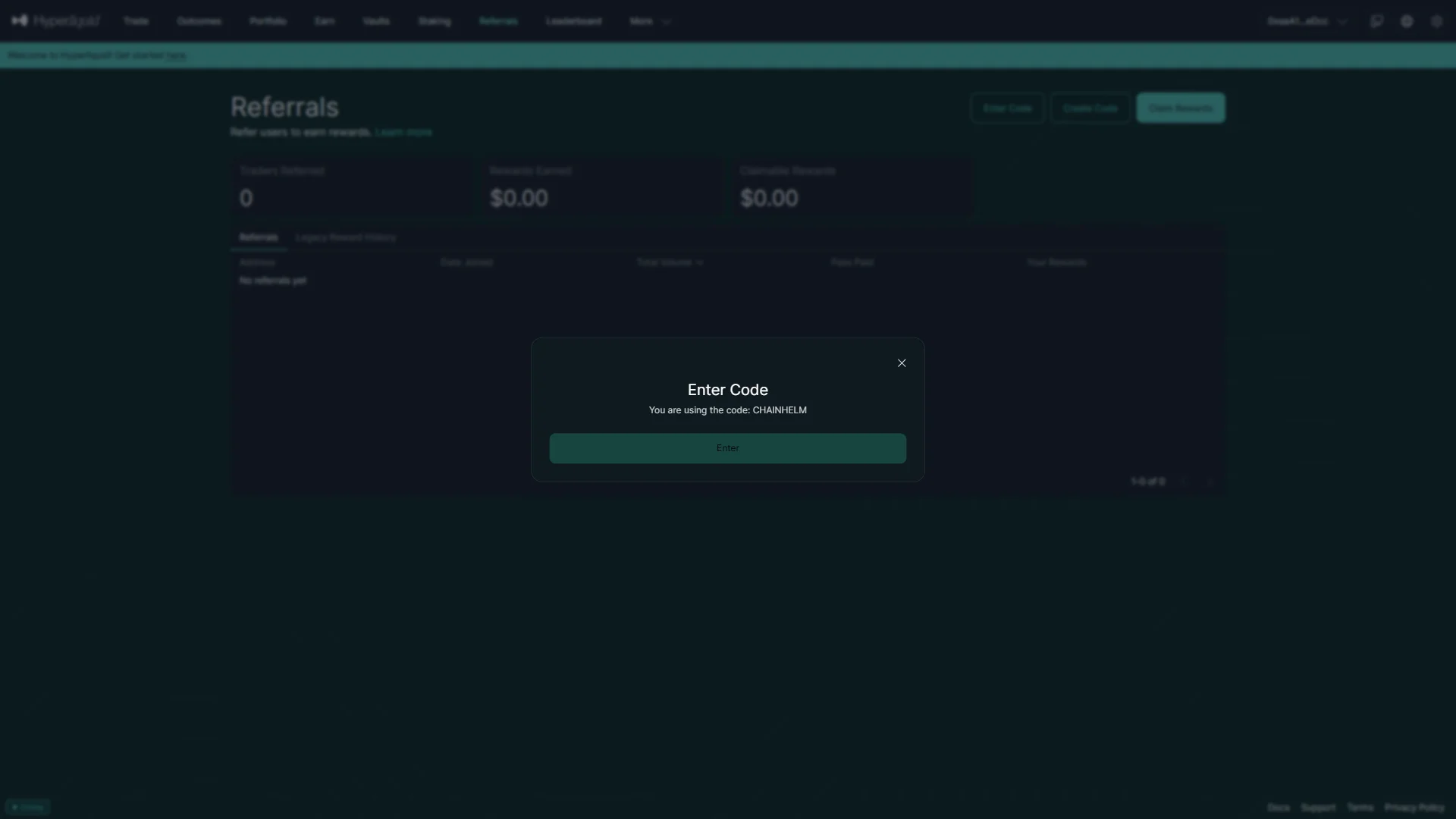
The screen shows “You are using the code: CHAINHELM”, confirming that the referral code CHAINHELM was correctly applied. There is no entry field on that panel and the Enter button stays inactive, because the code arrived with the join link and is already recorded against the account — the panel confirms that the code took effect rather than offering a second chance to type one.
chainhelm continuously verifies the validity of the code and confirms it remains usable.
What the Hyperliquid referral code “CHAINHELM” gets you
Apply this code when you connect to receive the following benefits on Hyperliquid:
- Benefit: a 4% discount on trading fees
- Expiration: None
- Eligibility: New users
To receive the benefits, you need to apply the code when you connect your wallet. Be careful not to miss this step.
Hyperliquid sign-up steps with the referral code
We cover the connection process separately for PC/browser and smartphone (mobile).
PC/browser connection steps
-
First, open the Hyperliquid official page (the link applies the referral code). When you open it, you’ll see a screen like the one below.
-
Open the invite link and select Connect
— Figure 2Invite panel with the code2026-07-25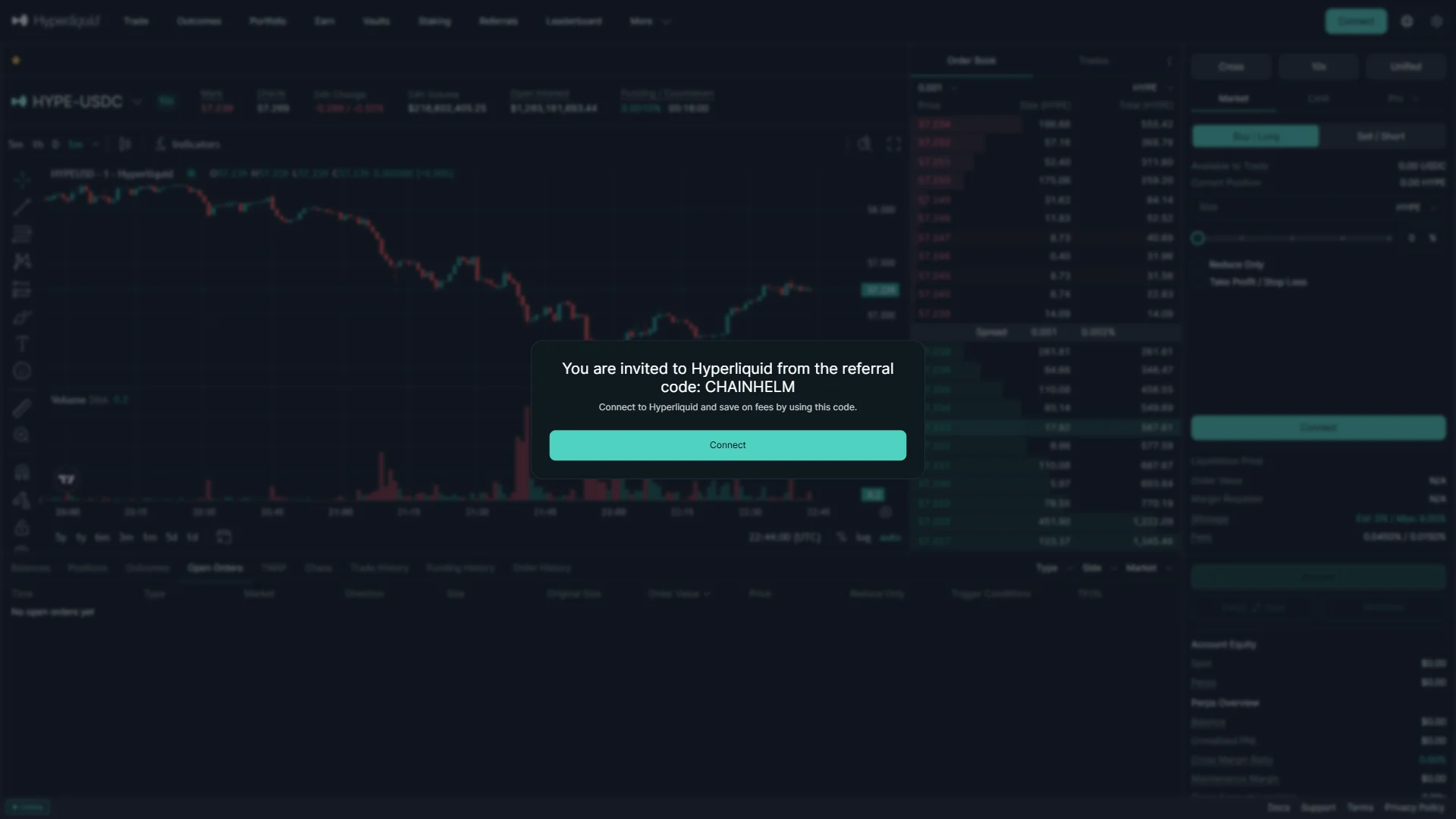
The invite panel names the referral code CHAINHELM above a single "Connect" button, while the header still reads "Connect". Source: chainhelm editorial Open the join link that carries the referral code. Before going any further, check that the panel names the code you expect: it reads “You are invited to Hyperliquid from the referral code: CHAINHELM”, with the line “Connect to Hyperliquid and save on fees by using this code.” underneath. The code travels with the link, so there is nothing to type at this point. The header still shows “Connect”, which tells you no wallet is attached yet.
Select “Connect” to move on to the wallet selection panel.
-
Choose the wallet you want to connect
— Figure 3Wallet options under Connect2026-07-25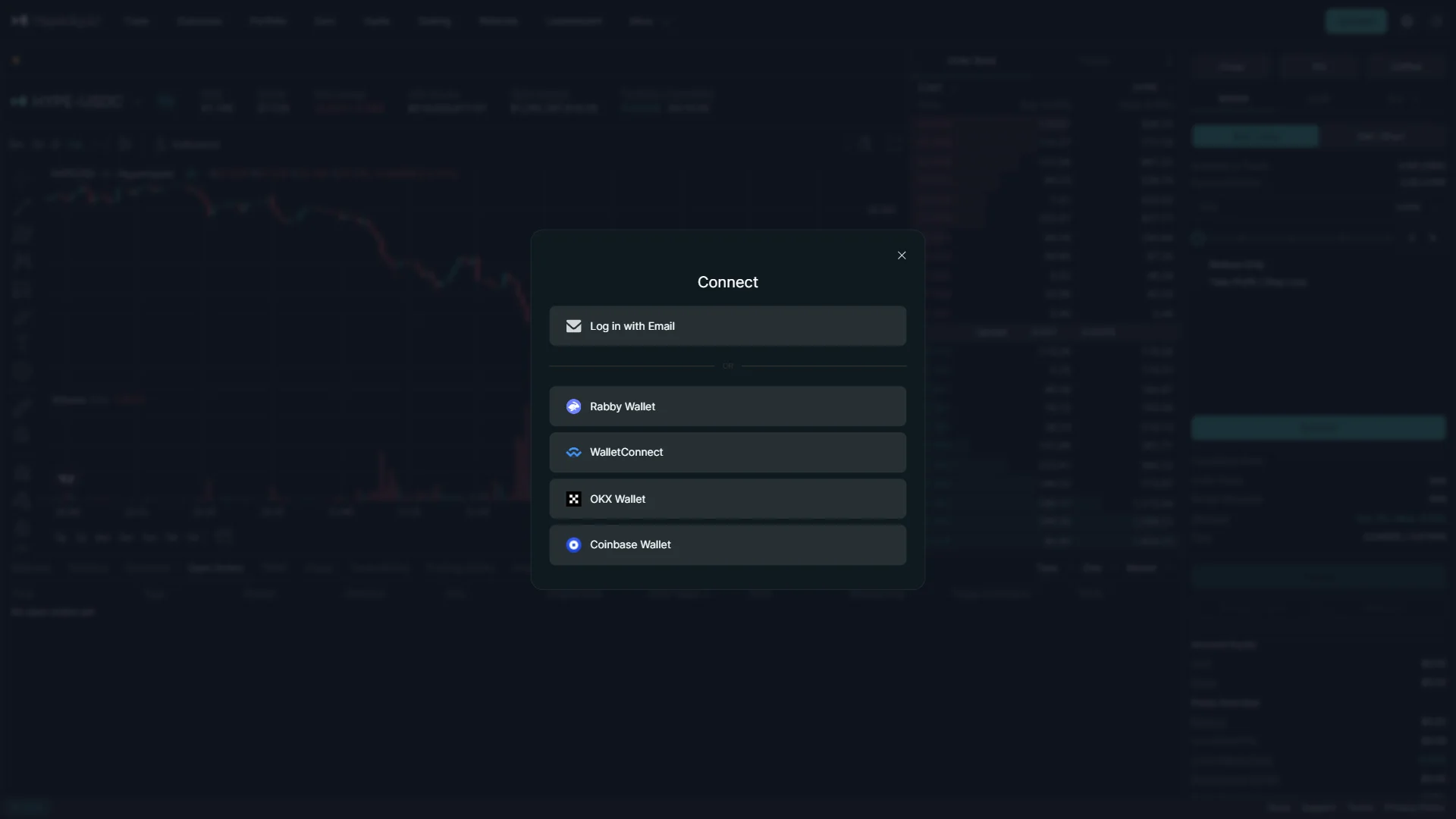
The "Connect" panel lists four wallets, with "Log in with Email" shown above them as a separate desktop route. Source: chainhelm editorial Pick your wallet from the “Connect” panel, which lists “Rabby Wallet”, “WalletConnect”, “OKX Wallet”, and “Coinbase Wallet”. On desktop the same panel offers “Log in with Email” above that list as a separate route; on a phone that option is replaced by a note telling you to visit the site from a regular browser, so choose one of the four wallets if you are on mobile.
Approve the connection request in your wallet once it appears. That prompt comes from your wallet rather than the Hyperliquid interface, so it is not pictured here. After you approve it, the terms you need to accept come up next.
-
Read the terms before you agree
— Figure 4Consent boxes still empty2026-07-25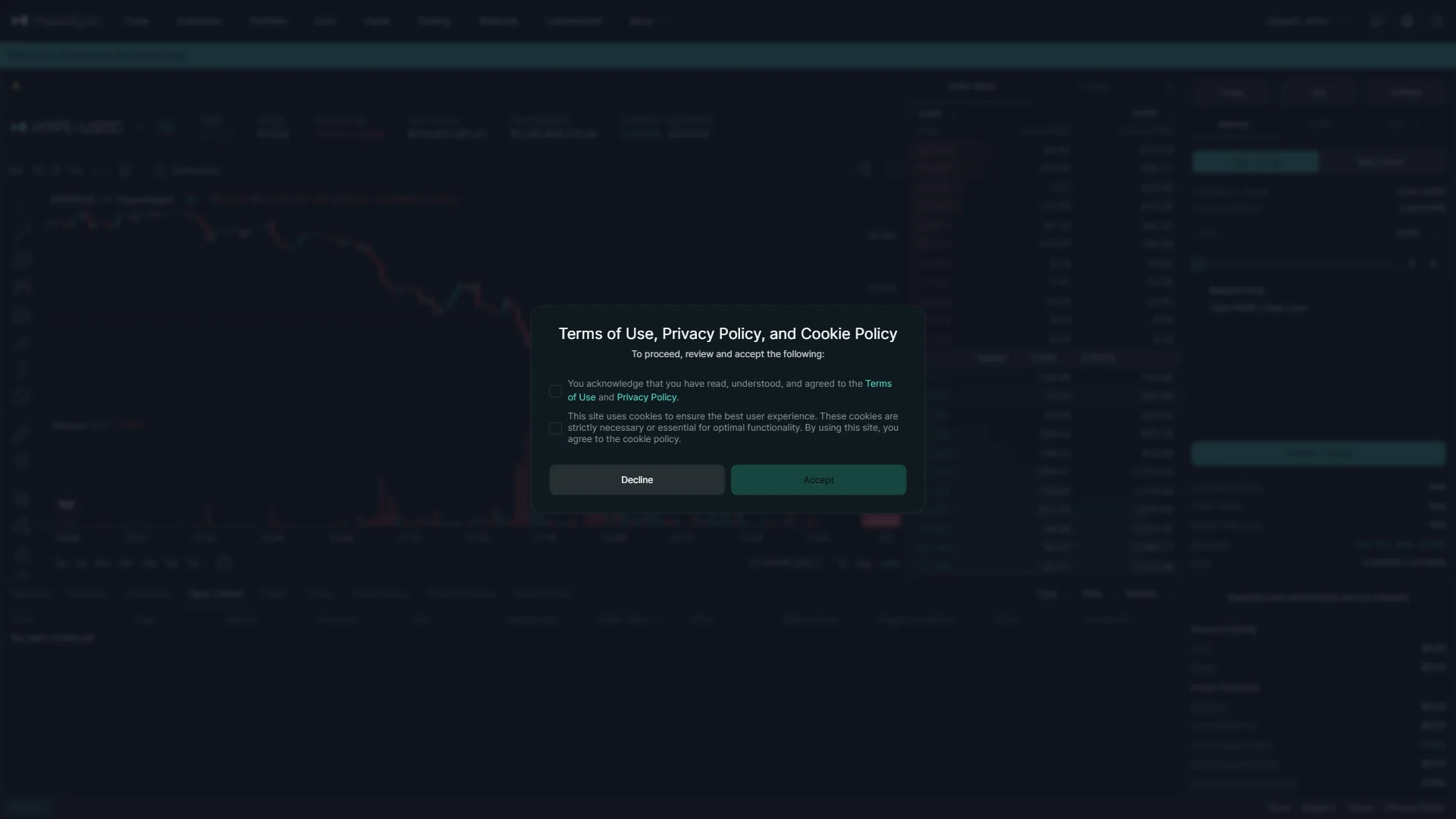
Both consent checkboxes sit empty and "Accept" stays dimmed; "Decline" is the only other choice on the panel. Source: chainhelm editorial Read both statements in the “Terms of Use, Privacy Policy, and Cookie Policy” panel before you check anything. Under the line “To proceed, review and accept the following:” the first statement covers the “Terms of Use” and “Privacy Policy”, each linked in the sentence itself so you can open and read them, and the second covers this site’s use of cookies.
Check both boxes once you have read them. “Decline” is there if you decide not to continue, and leaving either box empty keeps “Accept” out of reach.
-
Accept and continue
— Figure 5Consent given, Accept active2026-07-25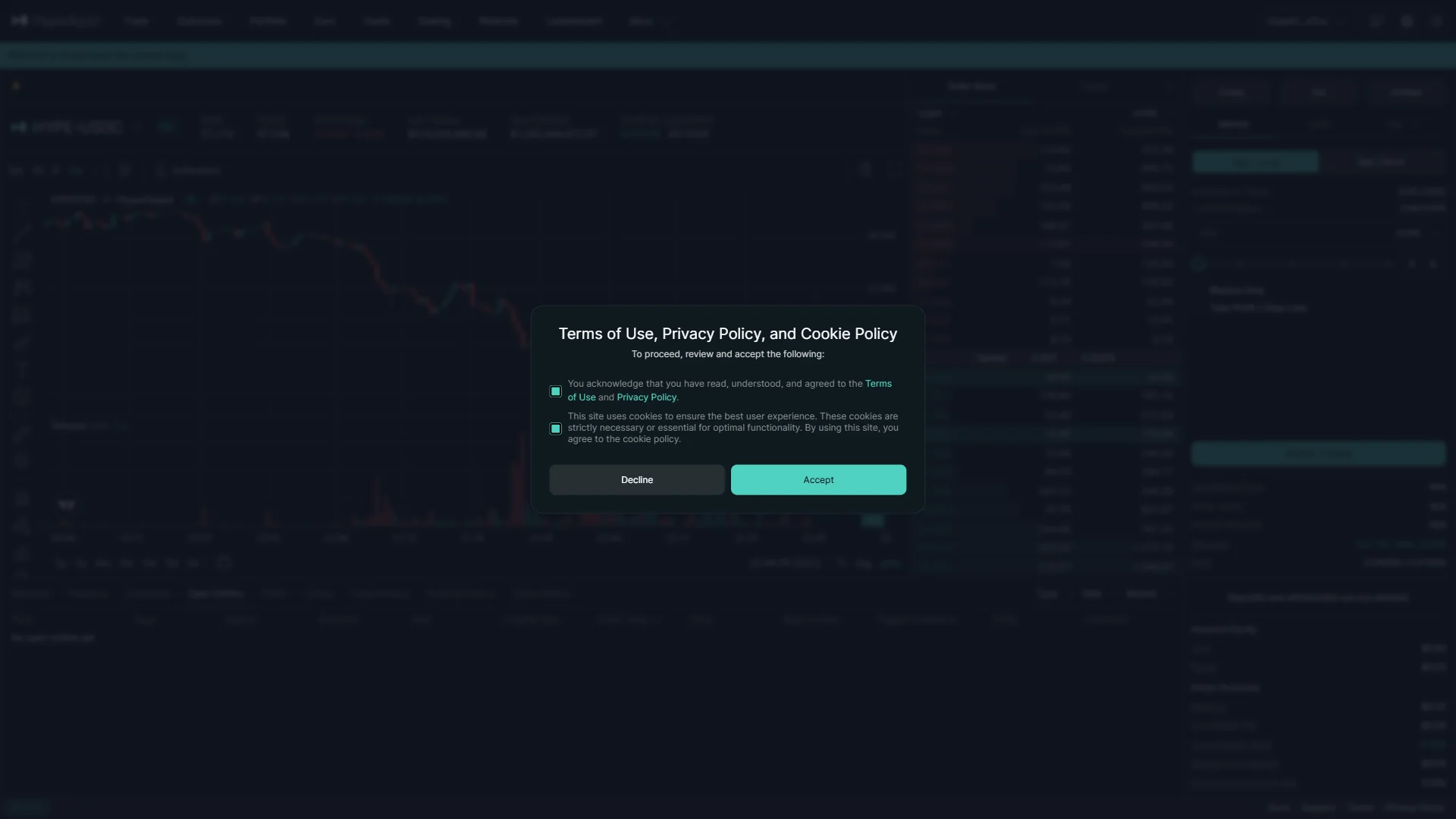
With both boxes checked, "Accept" turns solid teal and is ready to select. Source: chainhelm editorial Confirm that both boxes are now checked. Once they are, “Accept” brightens from its dimmed state, and that change is your signal that the panel will let you through.
Select “Accept”. Hyperliquid then asks you to sign for the connection, and the signature panel opens.
-
Sign to establish the connection
— Figure 6Gas-free connection signature2026-07-25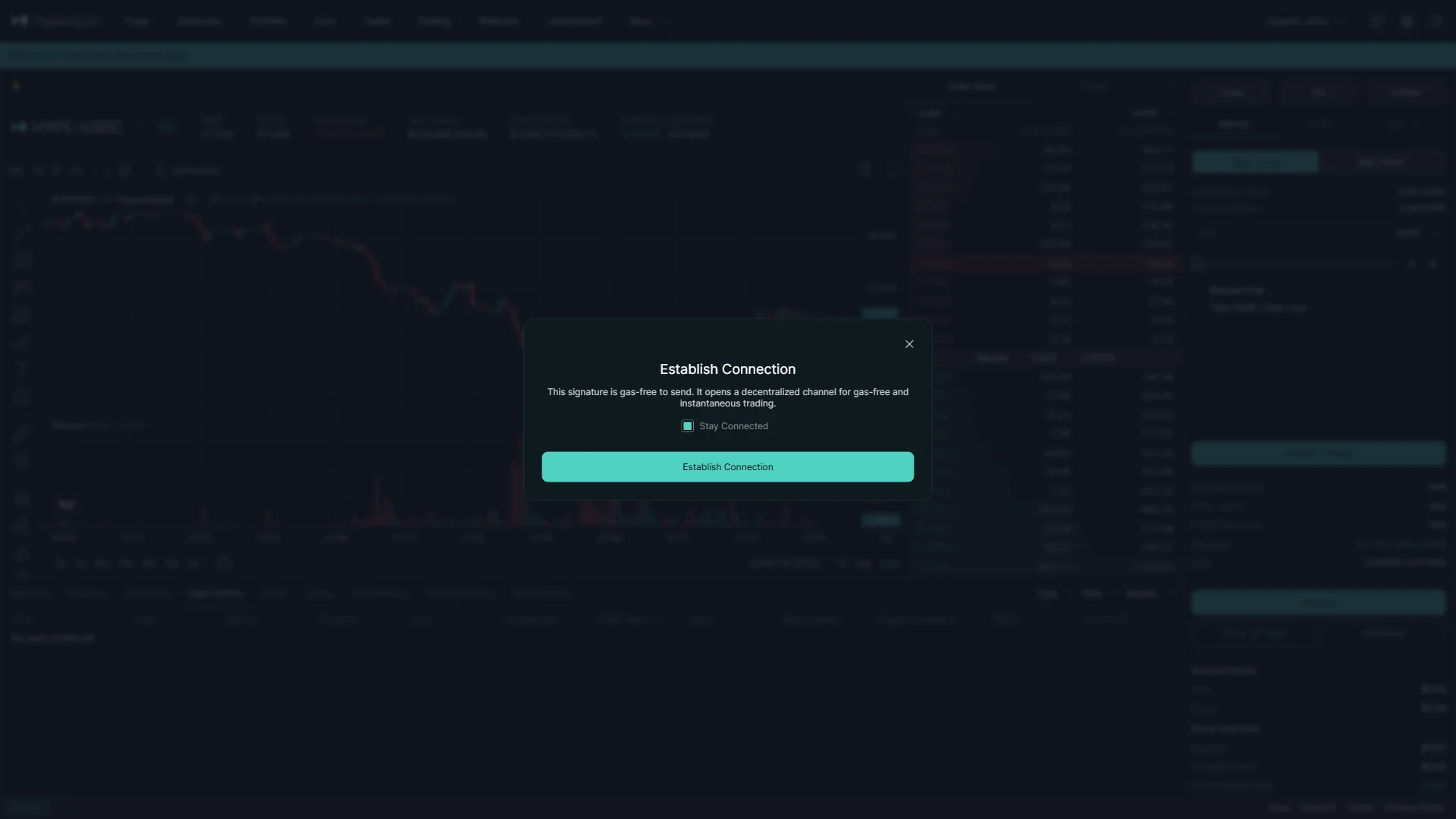
The panel states that the signature is gas-free and opens a trading channel, with "Stay Connected" checked. Source: chainhelm editorial Read what the “Establish Connection” panel says before you sign: “This signature is gas-free to send. It opens a decentralized channel for gas-free and instantaneous trading.” Confirm that for yourself rather than assuming it — this signature costs no gas and moves no funds; it only opens the channel you trade through.
Decide whether to leave “Stay Connected” checked, select “Establish Connection”, then approve the signature request in your wallet. That prompt belongs to your wallet and sits outside the screens shown here. Once you sign, the join confirmation comes up.
-
Apply the referral code
— Figure 7Join confirmation with the code2026-07-25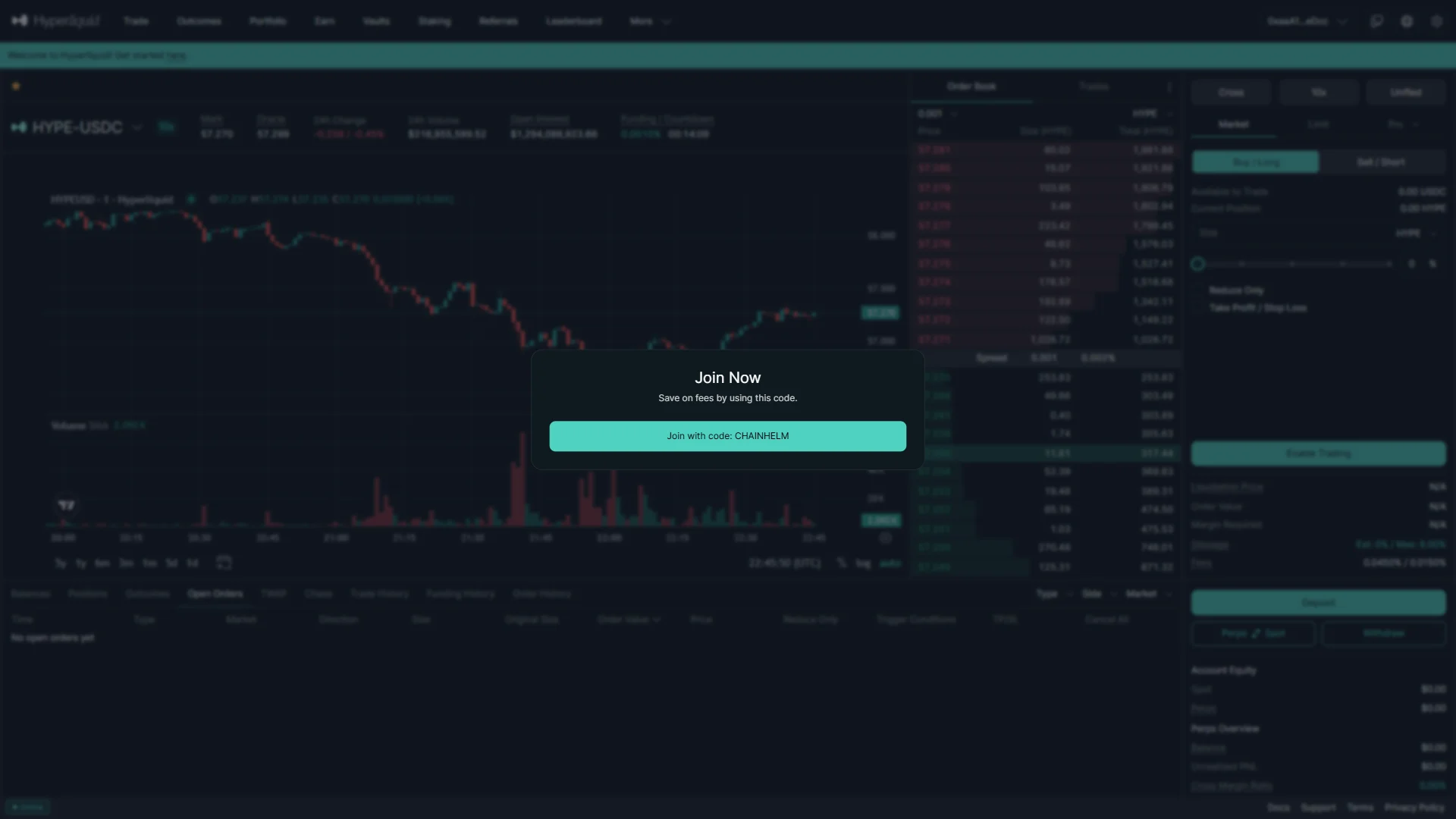
The "Join Now" panel carries the code on its button, and the header now shows a shortened wallet address. Source: chainhelm editorial Read the code printed on the button before you act, then select “Join with code: CHAINHELM” in the “Join Now” panel. This is the point where the code is tied to your account, and the line “Save on fees by using this code.” above the button refers to that same code.
Check the header afterward: it has changed from “Connect” to a shortened wallet address, which confirms the wallet is attached. From here you can open the Referrals page and verify the result.
-
Open the Referrals page
— Figure 8Referrals page after connecting2026-07-25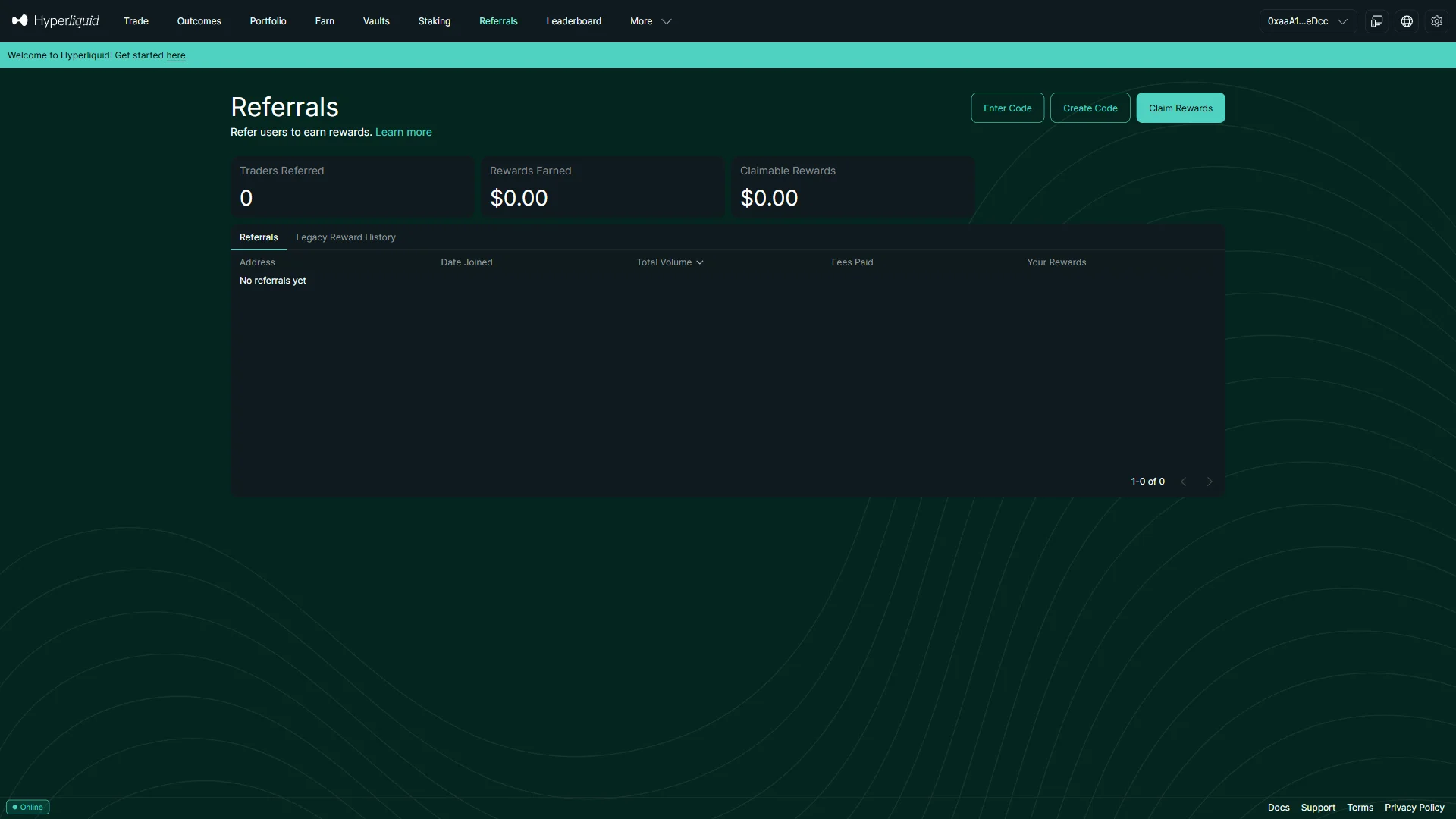
The "Referrals" page offers "Enter Code", "Create Code", and "Claim Rewards" above a referral table that is still empty. Source: chainhelm editorial Open “Referrals” from the site navigation — the top navigation bar on desktop, the menu button on a phone. The page gives you three controls: “Enter Code”, “Create Code”, and “Claim Rewards”.
Select “Enter Code” to verify the code already applied to your account. A confirmation panel opens.
-
Confirm the code is applied
— Figure 9Applied code confirmed2026-07-25 The "Enter Code" panel reports "You are using the code: CHAINHELM" and shows no entry field. Source: chainhelm editorial Read the line in the “Enter Code” panel: “You are using the code: CHAINHELM”. There is no entry field here, and the “Enter” button below stays inactive, because the code arrived with the join link and is already recorded against your account. Treat this panel as confirmation that the code took effect, not as a second chance to type it in.
Close the panel once you have confirmed the code. Connecting the wallet and applying the referral code are both settled at this point, and funding the account is a separate step covered next.
Smartphone (iOS / Android) connection steps
-
First, open the Hyperliquid official page in your mobile browser or your wallet app’s in-app browser (the link applies the referral code). When you open it, you’ll see a screen like the one below.
-
Open the invite link and select Connect
— Figure 10Invite panel with the code2026-07-25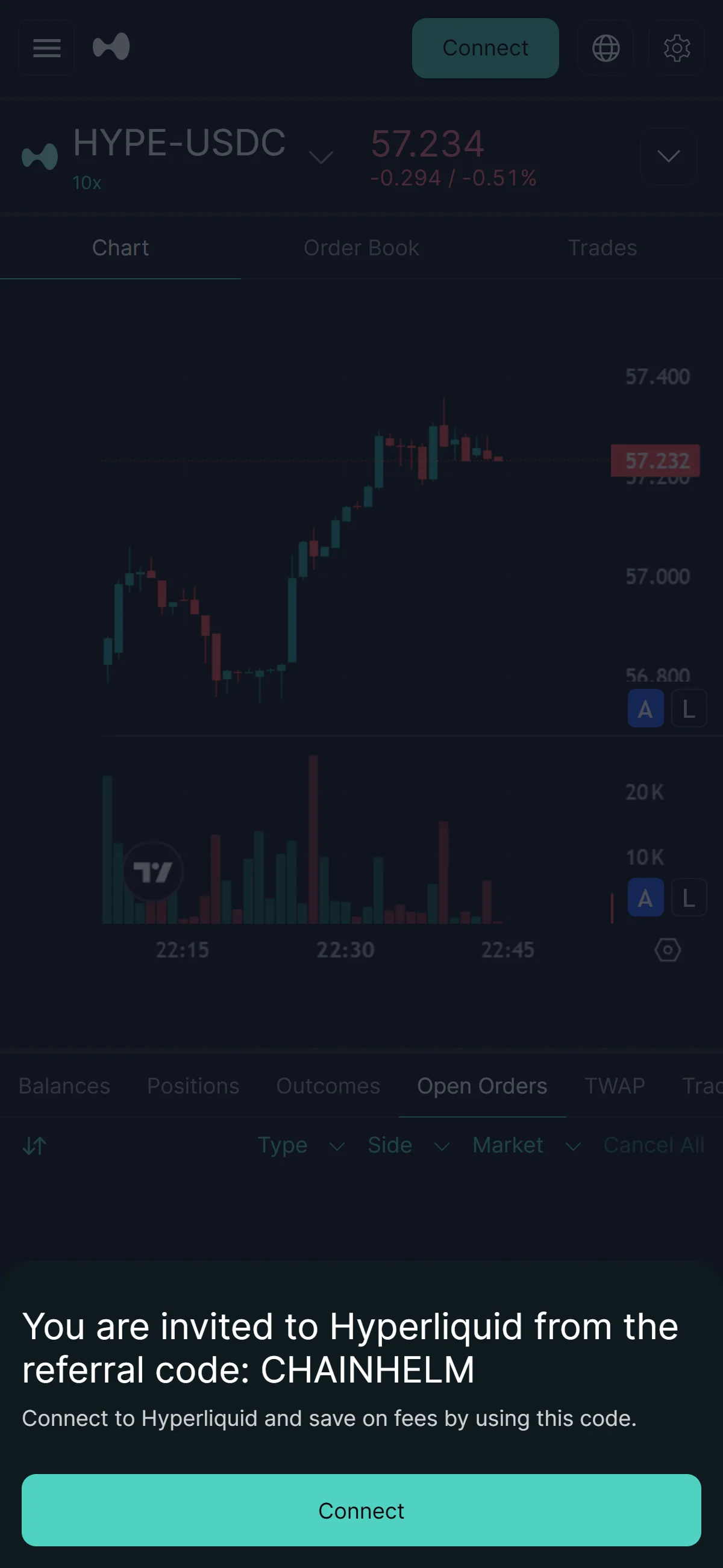
The invite panel names the referral code CHAINHELM above a single "Connect" button, while the header still reads "Connect". Source: chainhelm editorial Open the join link that carries the referral code. Before going any further, check that the panel names the code you expect: it reads “You are invited to Hyperliquid from the referral code: CHAINHELM”, with the line “Connect to Hyperliquid and save on fees by using this code.” underneath. The code travels with the link, so there is nothing to type at this point. The header still shows “Connect”, which tells you no wallet is attached yet.
Select “Connect” to move on to the wallet selection panel.
-
Choose the wallet you want to connect
— Figure 11Wallet options under Connect2026-07-25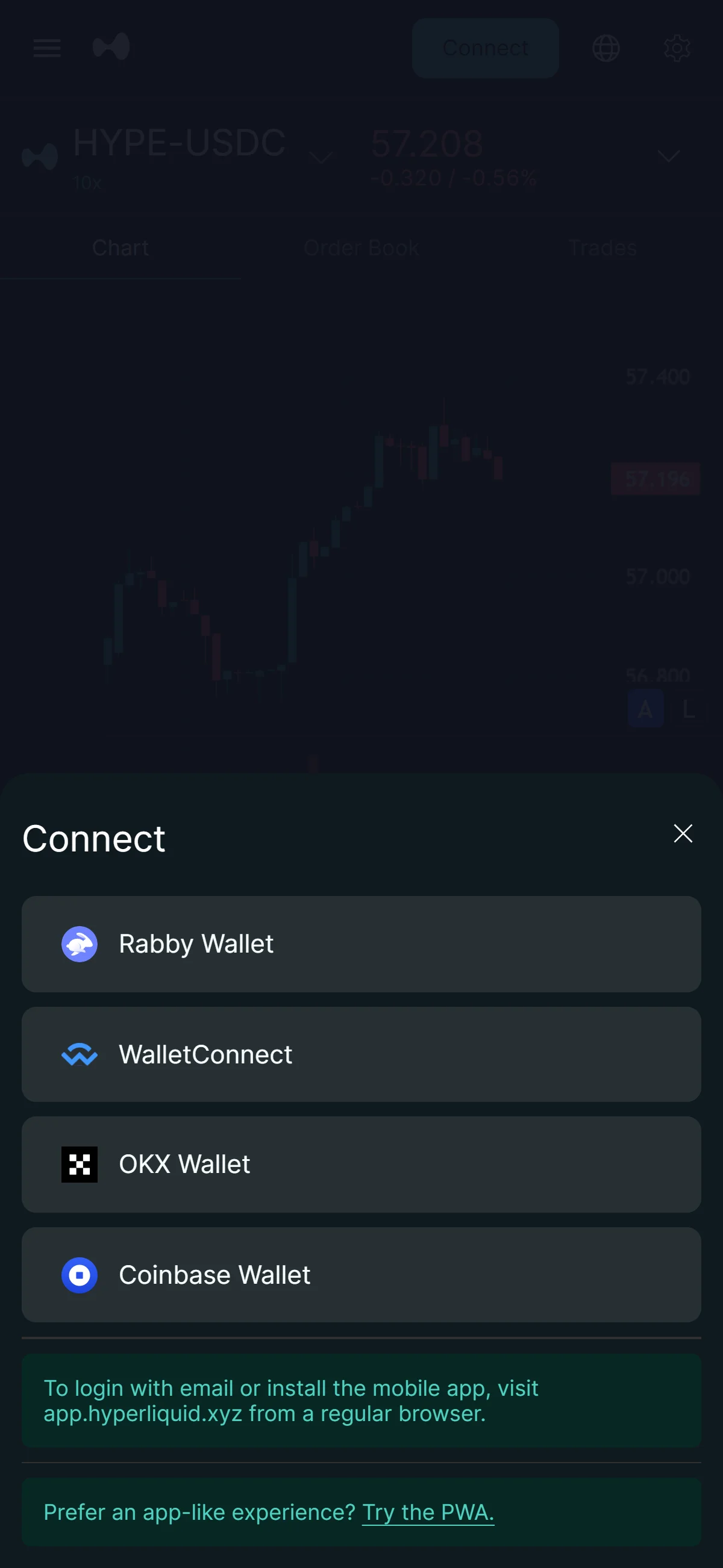
The "Connect" panel lists four wallets, with "Log in with Email" shown above them as a separate desktop route. Source: chainhelm editorial Pick your wallet from the “Connect” panel, which lists “Rabby Wallet”, “WalletConnect”, “OKX Wallet”, and “Coinbase Wallet”. On desktop the same panel offers “Log in with Email” above that list as a separate route; on a phone that option is replaced by a note telling you to visit the site from a regular browser, so choose one of the four wallets if you are on mobile.
Approve the connection request in your wallet once it appears. That prompt comes from your wallet rather than the Hyperliquid interface, so it is not pictured here. After you approve it, the terms you need to accept come up next.
-
Read the terms before you agree
— Figure 12Consent boxes still empty2026-07-25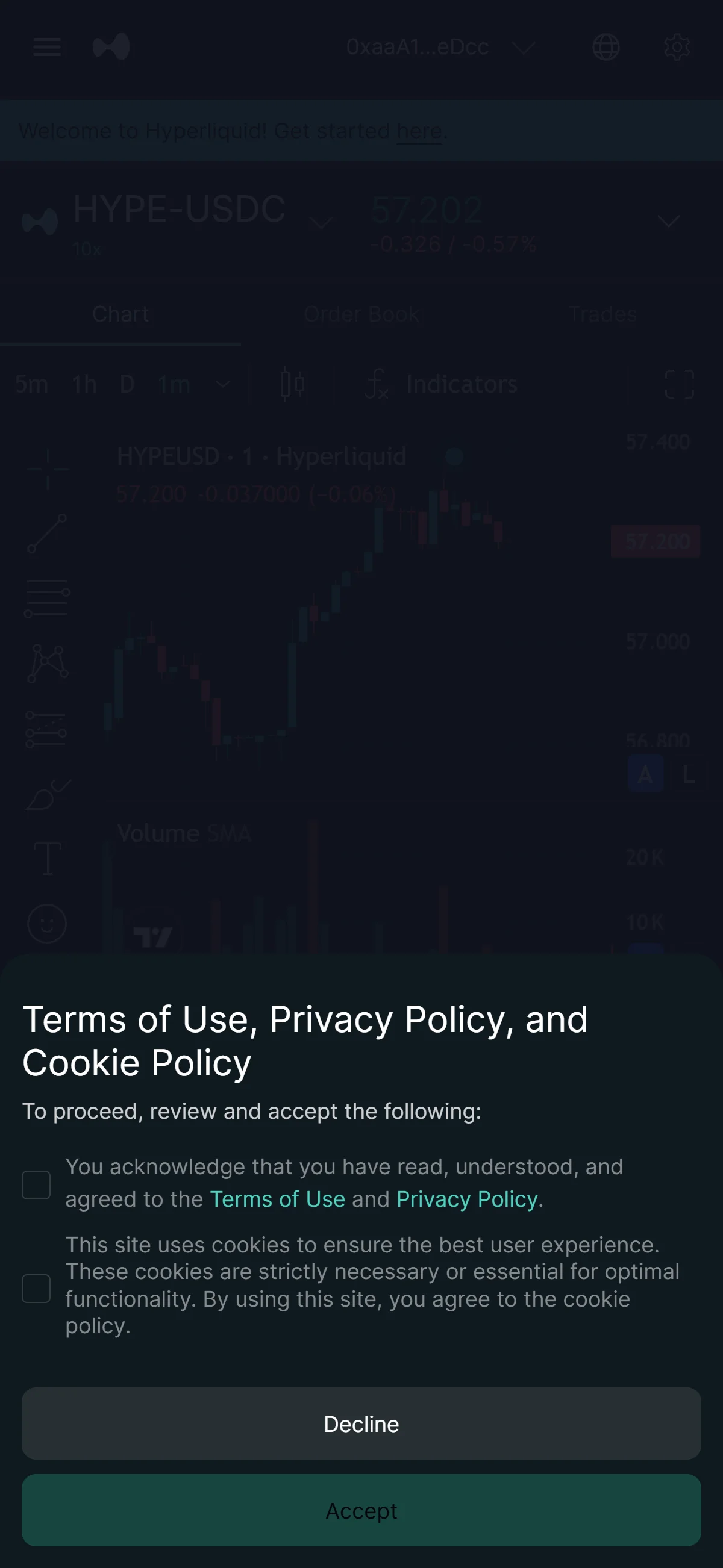
Both consent checkboxes sit empty and "Accept" stays dimmed; "Decline" is the only other choice on the panel. Source: chainhelm editorial Read both statements in the “Terms of Use, Privacy Policy, and Cookie Policy” panel before you check anything. Under the line “To proceed, review and accept the following:” the first statement covers the “Terms of Use” and “Privacy Policy”, each linked in the sentence itself so you can open and read them, and the second covers this site’s use of cookies.
Check both boxes once you have read them. “Decline” is there if you decide not to continue, and leaving either box empty keeps “Accept” out of reach.
-
Accept and continue
— Figure 13Consent given, Accept active2026-07-25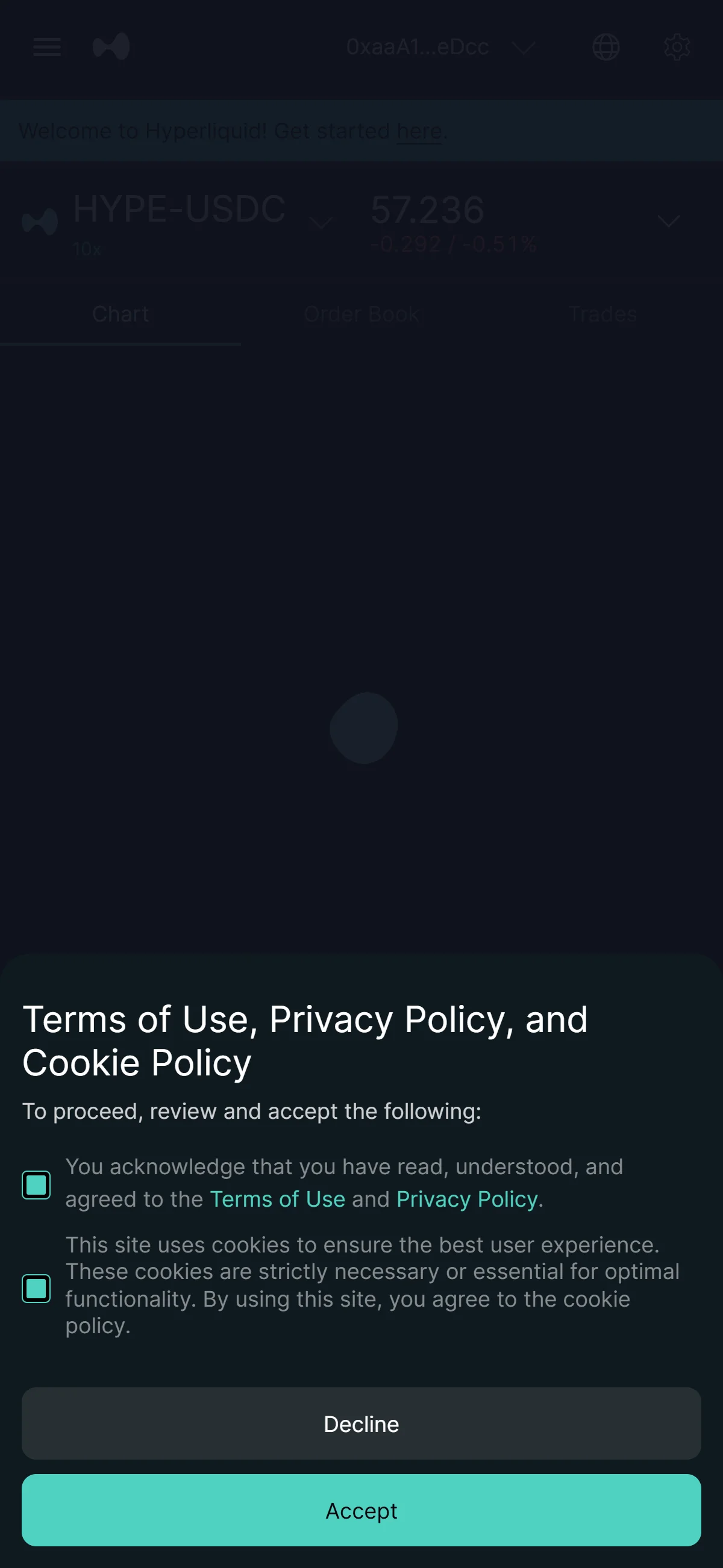
With both boxes checked, "Accept" turns solid teal and is ready to select. Source: chainhelm editorial Confirm that both boxes are now checked. Once they are, “Accept” brightens from its dimmed state, and that change is your signal that the panel will let you through.
Select “Accept”. Hyperliquid then asks you to sign for the connection, and the signature panel opens.
-
Sign to establish the connection
— Figure 14Gas-free connection signature2026-07-25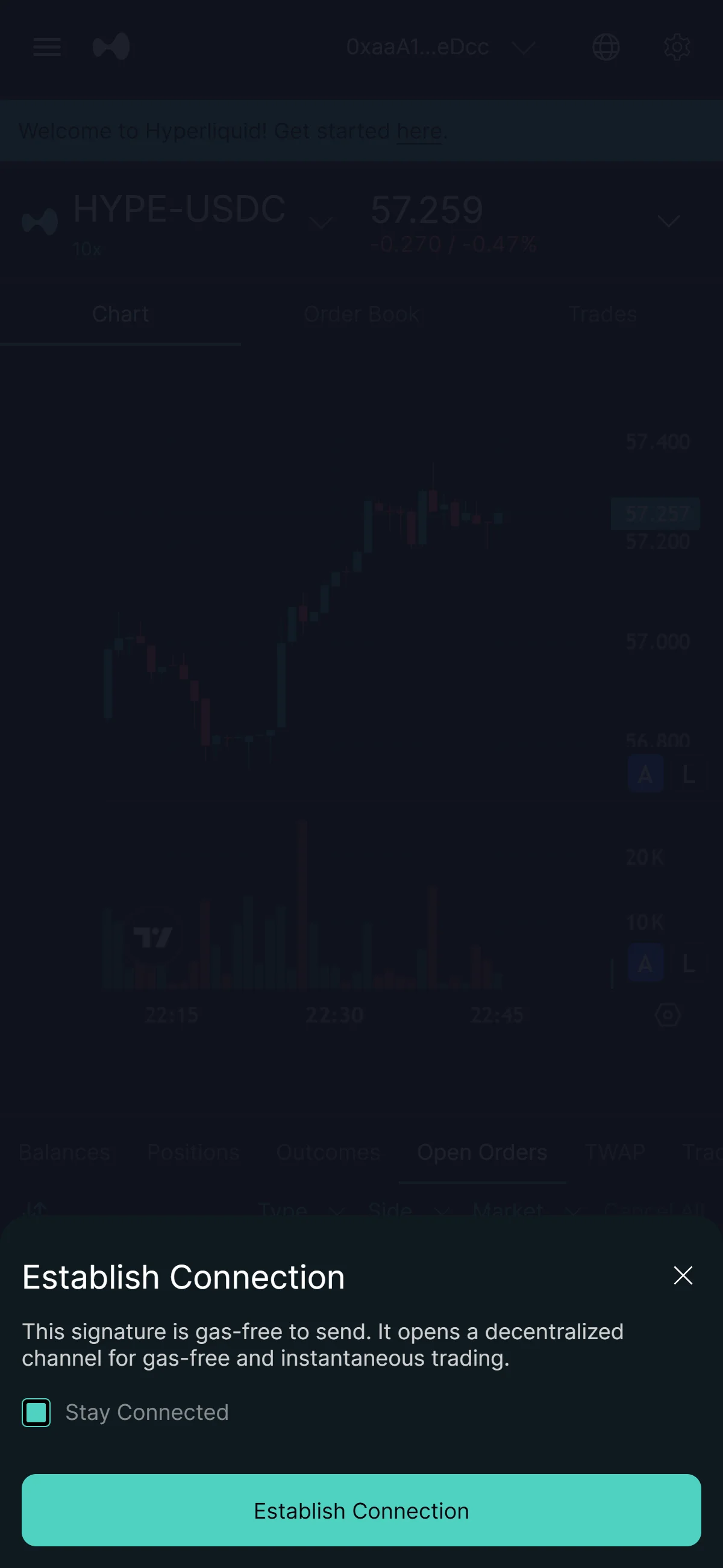
The panel states that the signature is gas-free and opens a trading channel, with "Stay Connected" checked. Source: chainhelm editorial Read what the “Establish Connection” panel says before you sign: “This signature is gas-free to send. It opens a decentralized channel for gas-free and instantaneous trading.” Confirm that for yourself rather than assuming it — this signature costs no gas and moves no funds; it only opens the channel you trade through.
Decide whether to leave “Stay Connected” checked, select “Establish Connection”, then approve the signature request in your wallet. That prompt belongs to your wallet and sits outside the screens shown here. Once you sign, the join confirmation comes up.
-
Apply the referral code
— Figure 15Join confirmation with the code2026-07-25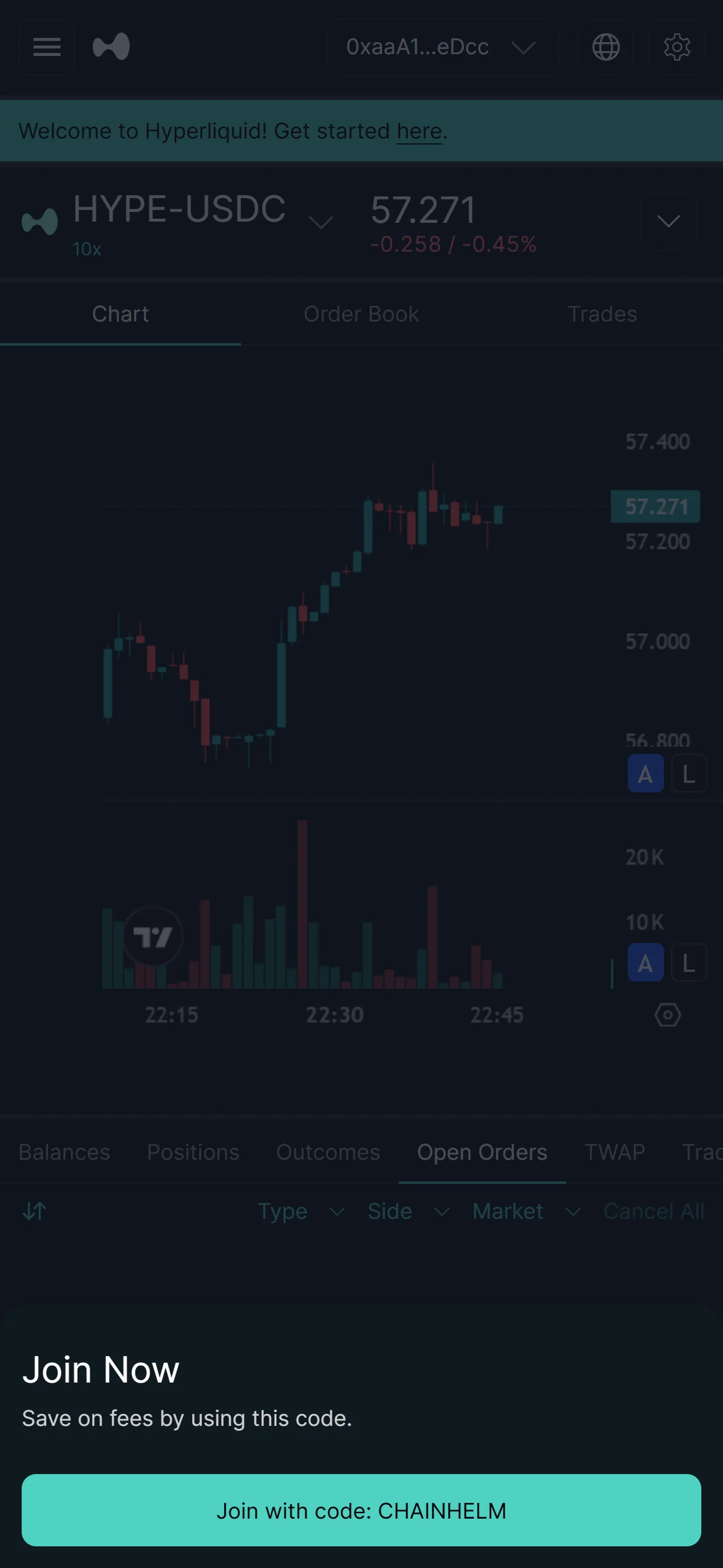
The "Join Now" panel carries the code on its button, and the header now shows a shortened wallet address. Source: chainhelm editorial Read the code printed on the button before you act, then select “Join with code: CHAINHELM” in the “Join Now” panel. This is the point where the code is tied to your account, and the line “Save on fees by using this code.” above the button refers to that same code.
Check the header afterward: it has changed from “Connect” to a shortened wallet address, which confirms the wallet is attached. From here you can open the Referrals page and verify the result.
-
Open the Referrals page
— Figure 16Referrals page after connecting2026-07-25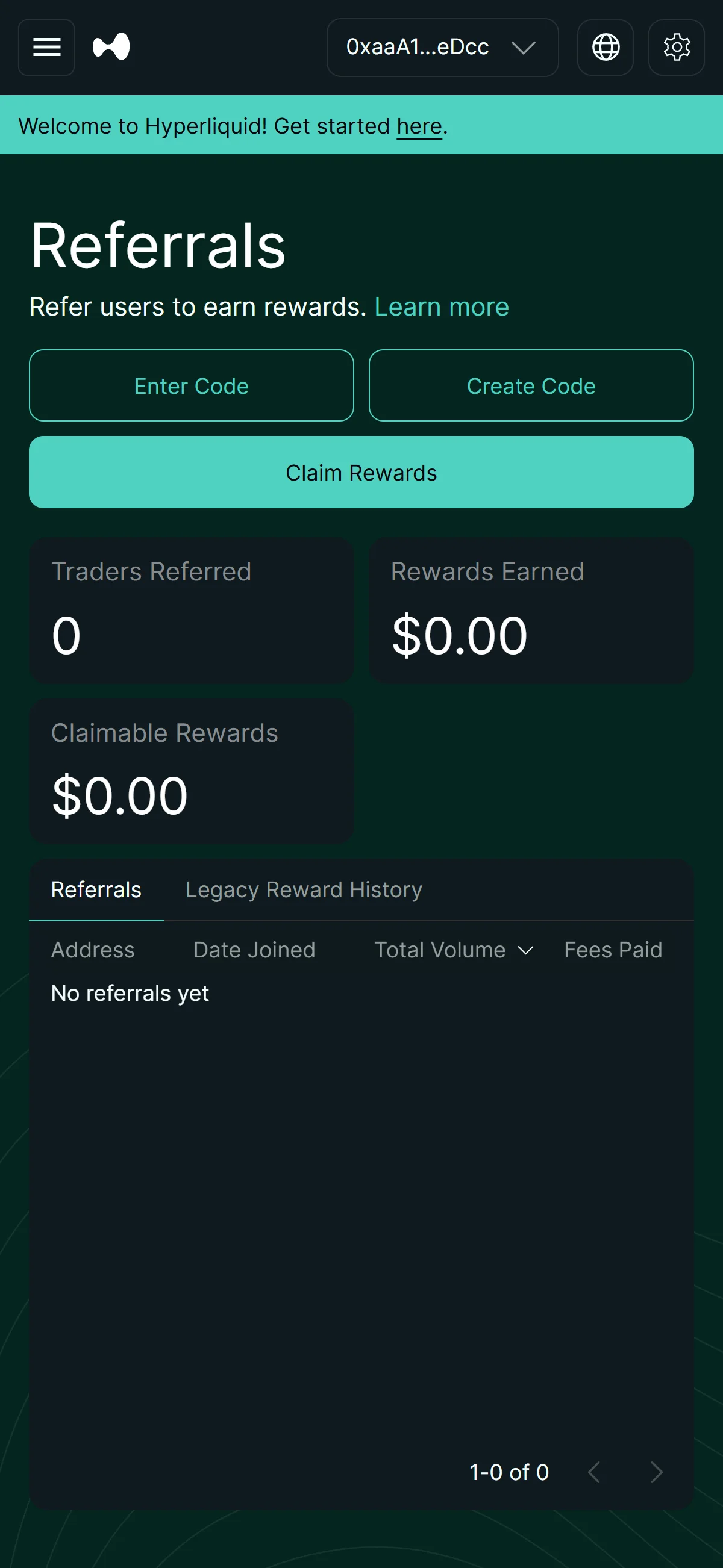
The "Referrals" page offers "Enter Code", "Create Code", and "Claim Rewards" above a referral table that is still empty. Source: chainhelm editorial Open “Referrals” from the site navigation — the top navigation bar on desktop, the menu button on a phone. The page gives you three controls: “Enter Code”, “Create Code”, and “Claim Rewards”.
Select “Enter Code” to verify the code already applied to your account. A confirmation panel opens.
-
Confirm the code is applied
— Figure 17Applied code confirmed2026-07-25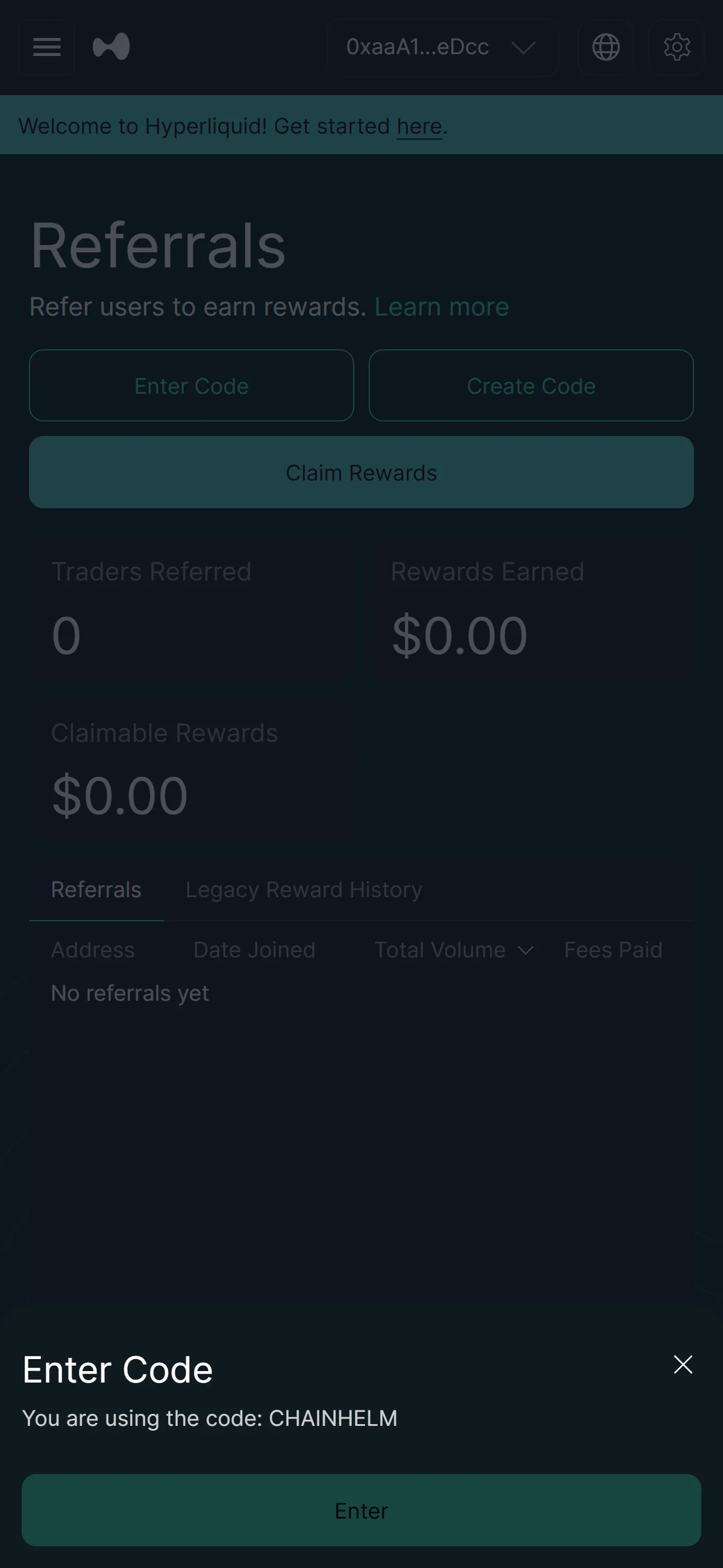
The "Enter Code" panel reports "You are using the code: CHAINHELM" and shows no entry field. Source: chainhelm editorial Read the line in the “Enter Code” panel: “You are using the code: CHAINHELM”. There is no entry field here, and the “Enter” button below stays inactive, because the code arrived with the join link and is already recorded against your account. Treat this panel as confirmation that the code took effect, not as a second chance to type it in.
Close the panel once you have confirmed the code. Connecting the wallet and applying the referral code are both settled at this point, and funding the account is a separate step covered next.
What to do after connecting to Hyperliquid
We cover the deposit process separately for PC/browser and smartphone (mobile).
PC/browser deposit steps
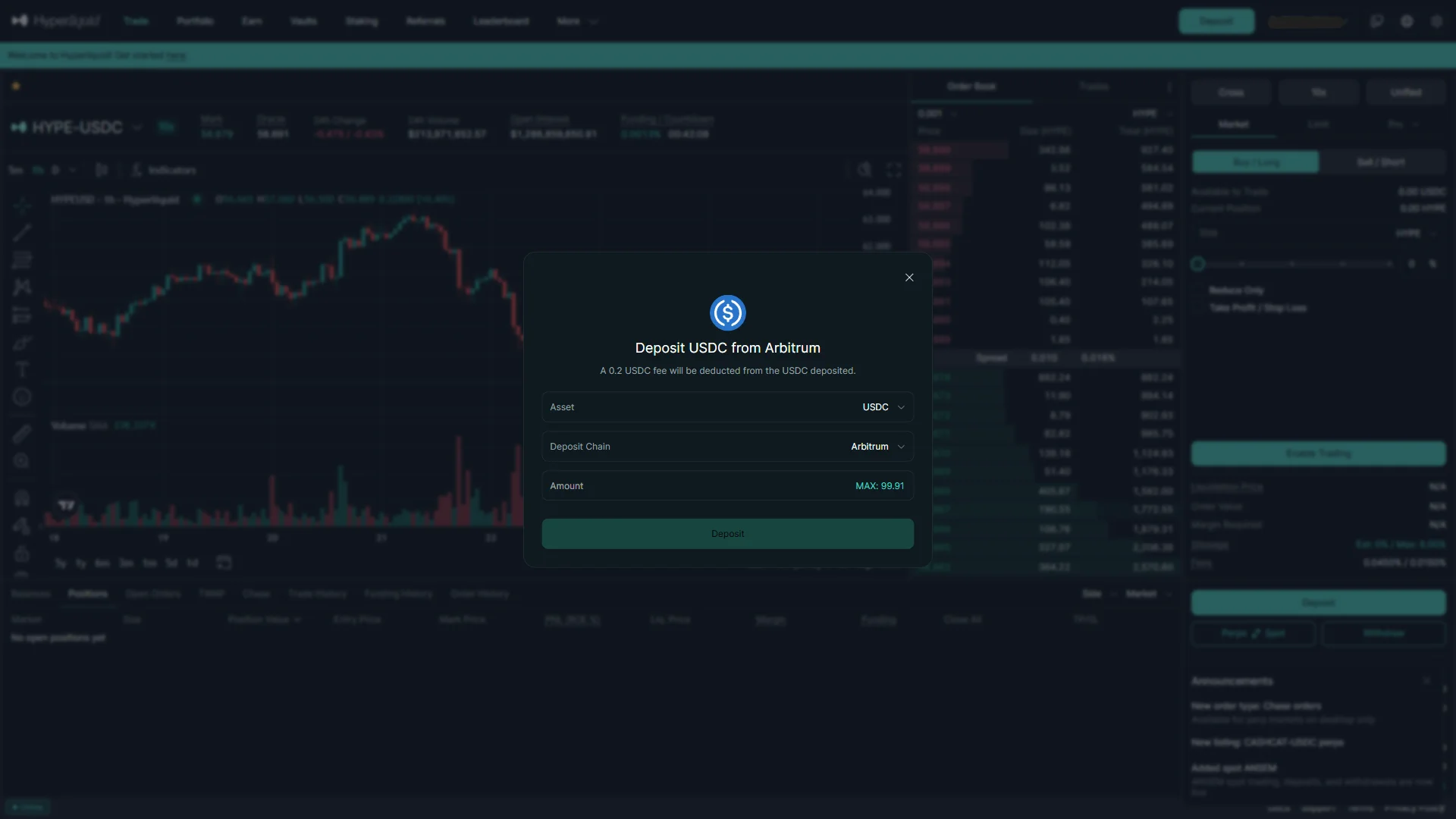
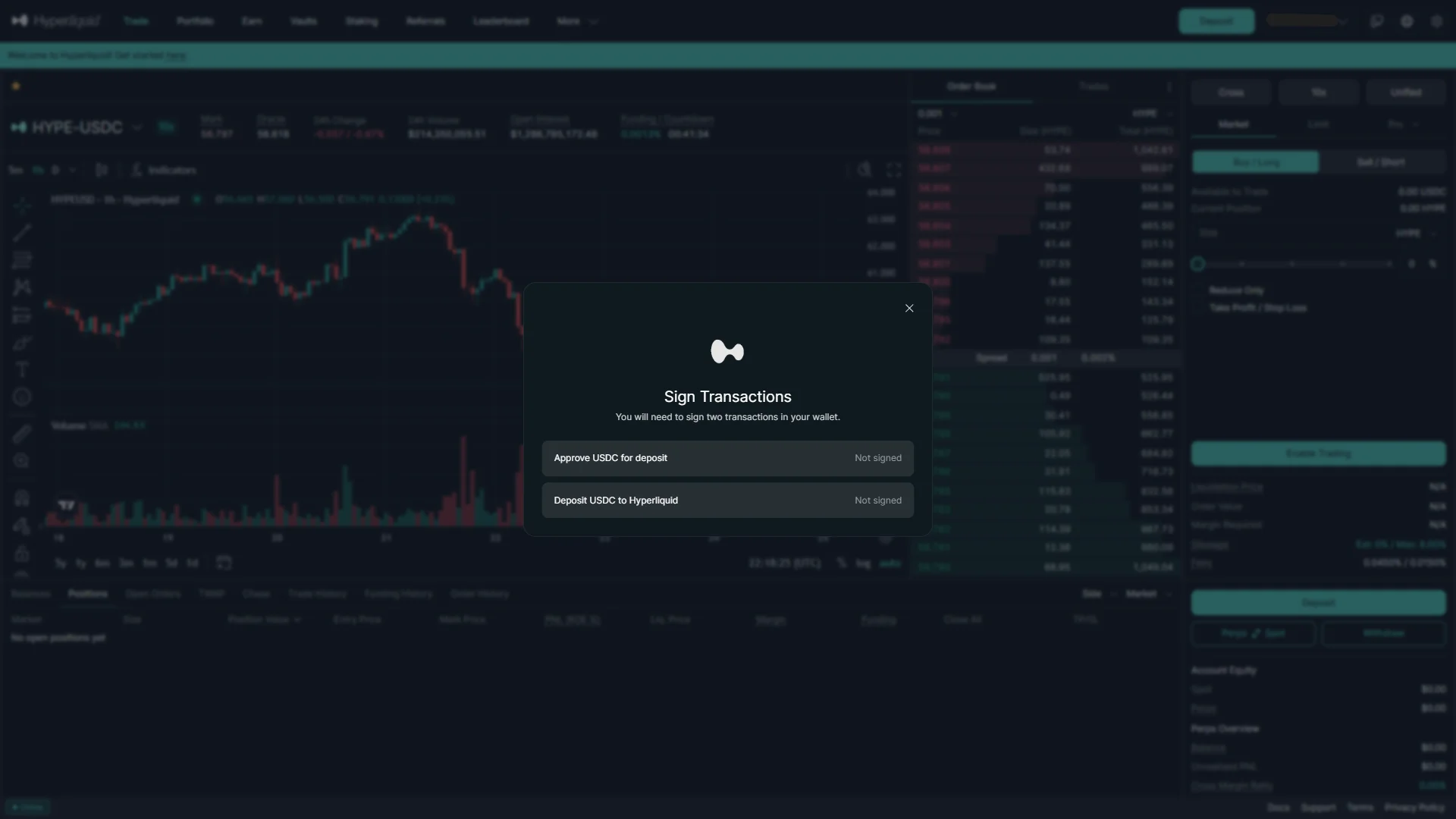
Check the three fields in the deposit panel before you commit to anything. “Asset” is set to “USDC” and “Deposit Chain” to “Arbitrum”, so what you send has to be USDC on Arbitrum — sending a different asset, or the right asset over a different chain, is the usual way a deposit goes wrong. Read the fee line as well: “A 0.2 USDC fee will be deducted from the USDC deposited.”
Enter the amount you want to move in “Amount”. The MAX figure beside that field reflects the USDC your connected wallet can send, so read it as a ceiling rather than a suggestion.
Select “Deposit” once the fields read the way you intend. The signature panel opens next.
Expect two signatures rather than one. The “Sign Transactions” panel states it plainly — “You will need to sign two transactions in your wallet.” — and lists them as separate rows, “Approve USDC for deposit” and “Deposit USDC to Hyperliquid”, each marked “Not signed” until you act on it.
Approve the requests in your wallet in turn and watch the status on each row as you go. Both signatures are required, and approving only the first leaves the transfer unfinished. This guide stops at the panel exactly as pictured, before either signature is given: whether to send funds, and how much, is your decision.
Smartphone (iOS / Android) deposit steps
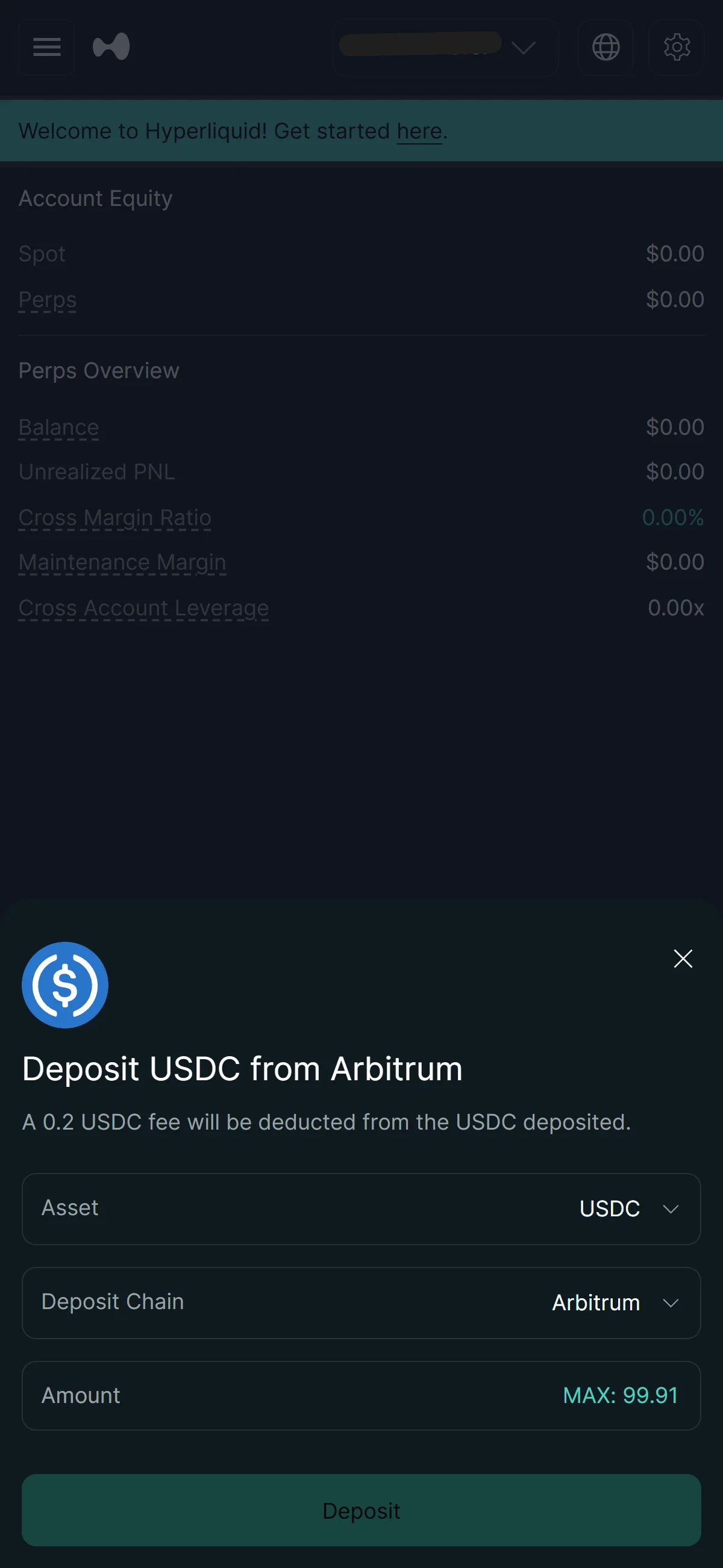
Check the three fields in the deposit panel before you commit to anything. “Asset” is set to “USDC” and “Deposit Chain” to “Arbitrum”, so what you send has to be USDC on Arbitrum — sending a different asset, or the right asset over a different chain, is the usual way a deposit goes wrong. Read the fee line as well: “A 0.2 USDC fee will be deducted from the USDC deposited.”
Enter the amount you want to move in “Amount”. The MAX figure beside that field reflects the USDC your connected wallet can send, so read it as a ceiling rather than a suggestion.
Select “Deposit” once the fields read the way you intend. The signature panel opens next.
Expect two signatures rather than one. The “Sign Transactions” panel states it plainly — “You will need to sign two transactions in your wallet.” — and lists them as separate rows, “Approve USDC for deposit” and “Deposit USDC to Hyperliquid”, each marked “Not signed” until you act on it.
Approve the requests in your wallet in turn and watch the status on each row as you go. Both signatures are required, and approving only the first leaves the transfer unfinished. This guide stops at the panel exactly as pictured, before either signature is given: whether to send funds, and how much, is your decision.
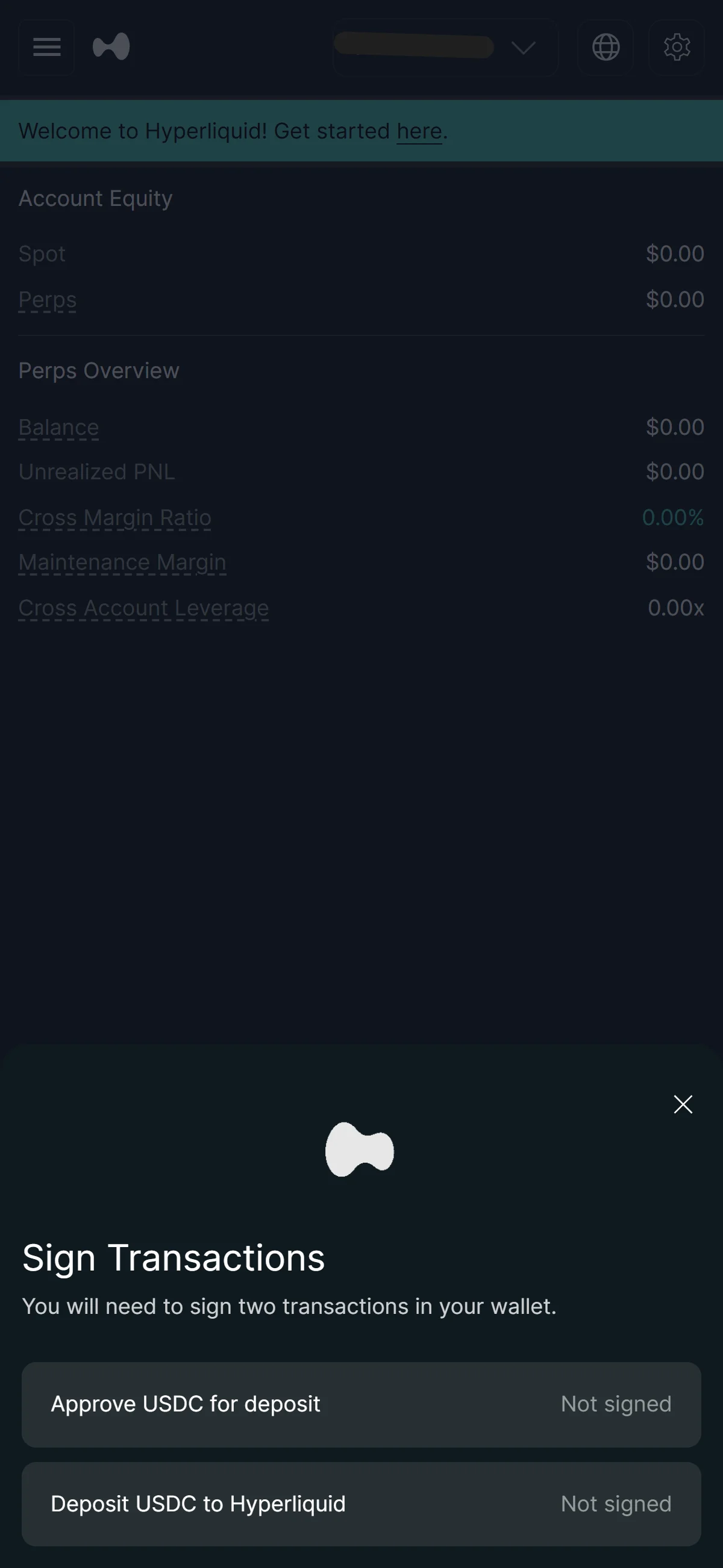
This guide takes the deposit as far as it can be checked on screen — “Asset” and “Deposit Chain” set to USDC on Arbitrum, the amount you enter, and the 0.2 USDC fee deducted from what you send — and stops at the signature panel. Whether to send the funds is yours to decide.
The Hyperliquid referral code cannot be added after sign-up
The referral code can only be applied when you connect your wallet — it cannot be added afterwards.
If you overlook this and complete the connection without the code, there is no mechanism for linking it to that wallet after the fact.
Registering again with a fresh wallet is an option worth considering.
- Is the referral code CHAINHELM shown as applied when you connect your wallet? (check any on-screen notice that appears when you arrive via the referral link, and the code field where the venue provides one)
- After connecting, open the Referral / Rewards page and check that the referral is reflected there — referral-linked displays such as the commission rate appear only once a wallet is connected
◆ ◇ ◆
Hyperliquid points program and airdrop
Two closed points phases and the HYPE genesis distribution
Readers who come through a referral link often arrive with a second question attached: whether connecting now also buys a place in a points program. It does not, and the reason is worth setting out properly rather than waving away, because the history is a large part of why Hyperliquid is discussed the way it is. The official docs call the scheme the Hyperliquid points program, and it ran in two phases that are both closed.
Phase 1
L1 phase
Both phases ran on the same weekly rhythm: activity was measured to Wednesdays at 00:00 UTC and points landed on Thursdays. What was never published was the formula. The docs say points rewarded users who contributed to the protocol’s success and that the criteria were updated on a recurring basis, which is a description of intent rather than of arithmetic. Affiliates earned 1 point for every 4 points earned by the users they referred — stated here in the past tense, because the program that paid it has ended. None of this is a complaint; it is the honest shape of a scheme that asked participants to trade first and learn the scoring later.
The distribution itself is documented precisely. HYPE genesis took place on 2024-11-29 at 07:30 UTC, and the Hyper Foundation published the full split of a 1,000,000,000 HYPE maximum supply.
One line in that post carries more weight than the percentages: the Hyper Foundation states there were no allocations for private investors, centralized exchanges or market makers. That is an unusual structure for a venue of this size and it deserves to be stated plainly — and left there, because a distribution structure says nothing about what the token is worth. One number you will meet elsewhere is missing above by design: the Hyper Foundation never said how many wallets received the genesis distribution. The figure of roughly 94,000 wallets is repeated widely, but no first-party source supports it, so treat it as unverified reporting rather than a fact you can rely on.
Where the program stands now, in Hyperliquid’s own words
For a reader connecting today, that is the whole practical answer: you are trading on the published fee schedule, not accruing anything toward a future distribution. It is also why this article keeps the referral benefit and the points history in separate chapters — one is a live arrangement, the other is a closed record.
On what comes next, Hyperliquid has said remarkably little, and the little it has said is worth quoting rather than interpreting. The docs reserve the right to modify previous point distributions at the protocol’s sole discretion. The reserved share shown in the genesis split above is framed as future emissions and community rewards, but it carries no commitment to a further airdrop and names no date, size or mechanism. No second season has been announced. Those are the boundaries of the public record, and this article stops at them: no estimate of value, no guess at timing, no conversion rate, no expectation of an allocation.
What can be described is what the token does inside the system, because that is published design rather than forecast. Trading fees are directed to HLP, to the assistance fund and to deployers rather than to the team, and the assistance fund converts fees into HYPE within L1 execution and burns them. Read that as a description of where fee revenue goes, and nothing more.
What is Hyperliquid
An on-chain order book running on its own layer-1
Most of what makes Hyperliquid unusual follows from one decision: it does not rent block space, it runs its own layer-1. The chain is secured by HyperBFT, a HotStuff-derived proof-of-stake consensus, and its state is split between HyperCore, which holds the order books, margining and matching, and HyperEVM, a general-purpose EVM. The two share one state and one consensus layer rather than bridging to each other.
That architecture is what lets the order book be genuinely on-chain. The docs state that HyperCore does not rely on off-chain order books; orders match in price-time priority with one-block finality. The measured performance is roughly 200,000 orders per second, with median end-to-end latency of 0.2s and a 99th percentile of 0.9s for a co-located client, on a 0.07s block time. For a trader, the practical meaning is that the matching engine is auditable in principle rather than a private service you are asked to trust — and the latency figures are the price of admission for that claim to be interesting at all.
The scale it operates at, captured on 2026-07-24, is the other half of the picture. Every figure below states whether the nine HIP-3 builder dexs are included, because the scope changes the number materially, and all of them move continuously.
Coverage is broad: 177 active perpetual markets on the main dex, 295 once the nine builder dexs are counted, plus 316 spot pairs across 476 registered tokens. Leverage is where a headline number misleads most reliably. The ceiling is 40x, available on BTC — but the distribution underneath it tells a different story. The tier snapshot below, taken from the API on 2026-07-24, spans all 232 listed main-dex markets, a broader set than the 177 active ones.
The shape above is the point: 40x is what the structure permits at its extreme, not what the venue looks like in normal use. That distinction matters enough that the risk chapter returns to it.
Who operates what is less tidy. Hyperliquid Corp. runs the interface at app.hyperliquid.xyz and states in its Terms that it does not own, control or operate the blockchain. Hyperliquid Labs is the self-funded core contributor. The Hyper Foundation, established in 2024, runs the bug bounty and funded user reimbursement after the incident of 2025-03-26. None of the three discloses a jurisdiction of incorporation, and no registry filing for any of them was located — a fact worth knowing before you deposit, and not an accusation. The build-out has been quick: launch in 2023 with a closed alpha through 2023-10-31, HyperEVM mainnet on 2025-02-18, a permissionless validator set on 2025-04-21, HIP-3 builder-deployed perpetuals on 2025-10-13, and HIP-4 outcome markets on 2026-05-02.
Trading costs, funding, and the native staking discount
What a perpetual position actually costs is never one number. It is the trading fee, plus funding for as long as the position is open, plus whatever it costs to get funds in and out.
- Perpetual trading fees
- 0.015% maker and 0.045% taker at tier 0, stepping down on rolling 14-day weighted volume (14-day perps volume plus twice 14-day spot volume), assessed daily in UTC. One tier applies across perps, HIP-3 perps and spot. Figures as of 2026-07-24.
- Spot trading fees
- 0.040% maker and 0.070% taker at the entry tier.
- Funding
- Paid hourly at one eighth of the computed 8-hour rate, with the interest-rate component fixed at 0.01% per 8 hours and the premium sampled every 5 seconds against the oracle price. Funding is peer-to-peer and the protocol takes no cut.
- Gas
- Trading on HyperCore is gasless from the user’s side, including the signature that enables trading. HyperEVM transactions pay gas in HYPE.
- Deposits and withdrawals
- No Hyperliquid-side deposit fee, though source-chain gas applies. Withdrawal to Arbitrum costs a flat 1 USDC, charged on Hyperliquid to cover validators’ gas.
The funding line is the one most likely to surprise someone comparing venues on headline rates. Because it is peer-to-peer and the protocol keeps none of it, it is not a fee in the ordinary sense — it is a holding cost paid to whoever is on the other side of the prevailing skew, and it accrues whether or not the position is working. A rate table cannot show you that, which is precisely why an honest cost comparison has to include it.
Fees can also be reduced natively, through the protocol’s own schedule. Staking HYPE moves the account down a six-step schedule, from a 5% reduction at 10 HYPE staked to 40% at 500,000 HYPE staked, and it stacks multiplicatively with the volume tiers. The mechanism has a condition attached that the docs state in unusually direct language.
That is a serious trade-off to accept in exchange for a fee reduction, and it belongs in the same paragraph as the schedule rather than in a footnote. Finally, a correction some readers will need: this is not a zero-fee venue. Only HIP-4 outcome markets are currently free during initial testing, where fees are charged on closing or settling and never on opening. Choosing USDC as the aligned quote asset carries 20% lower taker fees, 50% better maker rebates and 20% more volume contribution — a real difference for anyone trading at size, and one that sits entirely inside the protocol’s own schedule.
What makes Hyperliquid distinct
Where it stands against rival perpetual venues
Relative position is only meaningful on a stated basis, so here is one: reported 24h volume across perpetual protocols on DefiLlama, measured 2026-07-24. Hyperliquid ranks first, and the gap to the field is not marginal.
In share terms that is 40.1% of reported 24h perpetual volume, easing to 37.1% over 30 days, and roughly 63% of total perpetual open interest — 11.4 billion of 18.076 billion USD, with second-placed Aster at 1.916 billion. Widen the frame to all derivatives venues, centralized ones included, and the ranking changes usefully: CoinGecko placed Hyperliquid second by open interest behind Binance, at 173,366 BTC against 385,354 BTC. Reading “rank 1” as rank 1 of everything is the mistake this paragraph exists to prevent.
Two caveats belong here rather than in a footnote. Reported volume across perpetual venues is subject to wash trading and incentive-driven distortion, and aggregator figures are not audited. Listed-pair counts are similarly elastic: the same venue counts 177, 295 or 362 markets depending on whose scope you take. This comparison therefore keeps to a small fixed set of metrics, states the basis and the date, and goes no further. Everything above is a relative figure against other venues; Hyperliquid’s own absolute numbers are in the previous chapter.
The structural differences behind that position
The substantive difference is architectural. Most perpetual DEXs either price against an AMM or oracle model, or run an off-chain matching engine and settle the result on-chain. Hyperliquid puts both matching and margining into consensus state on a purpose-built L1. That is the claim the latency and throughput figures are actually measuring, and it is the reason the comparison above is not simply a comparison of incentive budgets.
Listing is the second difference, and it is more radical than it first sounds. Under HIP-3, anyone staking 500,000 HYPE can deploy an independent perpetual dex with its own markets, oracles, leverage limits, collateral and fee share, inheriting HyperCore’s matching, margining and liquidation. Deployers face validator-voted slashing of up to 100%, with slashed stake burned. That turns listing from a venue decision into an open, capital-backed process — and it has extended the venue into equity, index and commodity perpetuals without Hyperliquid itself choosing any of them. In practice, though, the openness has concentrated.
Nine builder dexs are live. On 2026-07-24, one of them, “xyz” (TradeXYZ), carried 4.281 billion of the 4.291 billion USD traded across all of them.
Third is HLP, the vault that market makes, takes over liquidated positions and accrues fees, with roughly 245.9 million USD of total equity on 2026-07-24. The role a centralized venue normally keeps on its own balance sheet is open to public deposit here, which makes its profit and loss visible on-chain instead of asserted in a blog post. The same fact is a differentiator and a risk: what a centralized venue would absorb itself lands on depositors instead. The risk chapter takes that up properly.
Onboarding is the last difference, and the most immediate one for a reader following this guide. Trading requires a non-custodial wallet connection and one gasless signature, with an email login backed by an embedded wallet as an alternative, and there is no identity verification step anywhere in the flow. HIP-4 outcome markets, live since 2026-05-02, are fully collateralized with no leverage and no liquidation, and they sit in the same margin account as perps and spot.
Where another venue is the better fit
No venue suits everyone, and three groups of readers are better served elsewhere for reasons that have nothing to do with preference.
Restricted Persons
Fiat access, or a counterparty to complain to
A licensed or registered venue
For the first group that is not a matter of fit at all — using something else is the only lawful route, and this article names no substitute anywhere, for reasons set out in the availability chapter. For the second and third, it is a genuine trade-off: what you give up in protection you may or may not get back in cost and access, and only you can price that.
The positive verdict is narrower than the volume figures suggest. Hyperliquid suits derivatives traders who are already comfortable with self-custody, and it suits automated or algorithmic traders particularly well — authentication is by wallet signature rather than issued API keys, rate limits scale with cumulative traded volume, the minimum order is 10 USD, and the barrier to starting is low. The explicit non-fit is anyone who wants investor protections, fiat rails, or leverage limits set by a supervisor rather than by a protocol. That is positioning, not a recommendation to go elsewhere as a way around a restriction, and whether the venue is reachable from where you live is a separate question answered further down.
Hyperliquid regulatory landscape
The jurisdictions the Terms of Use exclude
The exclusions are contractual, and they are specific. Terms of Use section 1.6, last updated 2026-06-15, defines Restricted Persons as persons or entities residing in, located in, incorporated in or with a registered office in the United States of America or Ontario, Canada; the same categories for jurisdictions subject to economic and trade sanctions or export control laws; and citizens of those territories regardless of where they actually live. Restricted Persons are strictly prohibited from accessing or using the interface.
The second limb of that definition is deliberately open-ended, and readers should know why they will not find a country list. No list is published, because the sanctions and export-control limb resolves dynamically against whichever regimes apply at the time. Country names do circulate in secondary write-ups, but they do not appear in the Terms and this article will not present them as an official roster.
A second and much narrower restriction applies only to HIP-4 outcome markets. Section 1.7 defines Excluded Persons by reference to jurisdictions the company designates from time to time, plus anyone for whom access would be unlawful or would require a license they do not hold. Section 1.8 states the company may implement technical measures to block the outcome markets tab, and section 10.2(k) disclaims liability for loss of access caused by updates to that list. That designated list is not published either.
Unlike most of this chapter, that second gate can be watched working.
What that single observation establishes is narrow but real: the product-level gate exists and it is enforced per jurisdiction. What it cannot tell you is when any given country was added, because no designation date is published for any of them.
How the exclusion is enforced, contractually and technically
Enforcement runs on two layers that are easy to confuse and important to keep apart.
What the Terms say
What the front-end bundle shows
The honest reading is that neither layer yields a country list. No first-party statement of general IP-level geo-blocking of the whole interface was located, and secondary claims of it were excluded as unconfirmed; the blocked set is not enumerable from the client either. So the contract states the restriction, the bundle shows that a gate exists, and the map remains unpublished. Those are two separate findings and this article does not merge them into one.
The Terms are also explicit about what an exclusion actually reaches. Section 1.1 states that the interface facilitates interaction with a decentralized, permissionless blockchain that Hyperliquid Corp. does not own, control or operate, whose functionality, security or availability it cannot modify, and that the interface is not the exclusive means of accessing it. Section 1.2 states that transactions are executed by a decentralized validator set, and that markets surfaced through the interface — including permissionlessly deployed ones — are not reviewed or approved by the company. The structural consequence is that a geographic exclusion restricts use of the official front end rather than the protocol behind it. That is a statement about architecture and nothing else: the Terms prohibit circumventing restrictions, and this article describes no route, tool or method of any kind, here or anywhere else.
Regulators that named Hyperliquid in 2026, and what has not happened
2026 was the year authorities started saying the name out loud.
Read that list carefully, because four different things sit inside it. A warning-list entry is a consumer alert about unauthorized business. A research report commissioned by a regulator is an observation about market structure. A hearing mention is a legislator talking. Lobbying by incumbent exchanges is competitors asking for scrutiny. Collapsing them into “regulators are cracking down” would misrepresent every one of them.
Two statements have to stay precise, and they pull in opposite directions. No license is held anywhere — Terms section 1.3 says so affirmatively, so this is not an inference from silence. And no lawsuit, enforcement action, settlement, sanction or formal proceeding against Hyperliquid or its associated entities was located in any jurisdiction as of 2026-07-24. Absence of a warning is not authorization, and a warning-list entry is not a finding of wrongdoing. The standing US precedent for where the perimeter sits remains the CFTC’s 2023 settlements with DeFi perpetuals providers, which were actions against other platforms, not against Hyperliquid.
The direction of travel is genuinely two-sided. Toward engagement: Hyperliquid Labs filed CFTC comments on perpetuals and 24/7 trading in May 2025, and the policy center it funds has since petitioned the CFTC directly, as the entries above show. Toward tightening: pressure from incumbent exchanges grew more pointed as HIP-3 extended the venue into equity, index and commodity perpetuals — the more it resembles a regulated market, the harder that argument becomes to ignore. As of 2026-07-24 none of it had changed the legal position: the United States and Ontario remain excluded, no license is held, no enforcement action has been brought.
◆ ◇ ◆
Hyperliquid availability across major jurisdictions
Everything above describes the protocol’s own standing. This chapter answers the narrower question a reader actually has, which is whether any of it is available where they live. Across the five markets this edition addresses, the answer differs sharply — closed at the official front end in one of them, reachable but unprotected in the other four.
Each section below describes a state of play and stops there. No alternative venue or product is suggested in any of them, including the one whose readers cannot use the venue at all, and no method of reaching a restricted service is named or implied.
United States: excluded by the Terms and blocked at the front end
A reader in the United States cannot sign up through the official interface, and the walkthrough earlier in this article does not apply to them.
Two layers sit behind that, and merging them produces the wrong impression in both directions. Contractually, using the interface as a US person breaches the Terms, which also prohibit misrepresenting residency and permit suspension or termination at the company’s discretion. On the regulatory side, the Commodity Exchange Act registration and retail-leverage requirements attach to the operator or the offeror — that is the basis on which the CFTC settled with DeFi perpetuals providers in 2022 and 2023 — and no US source imposing a penalty on an individual merely for using a non-custodial perpetual DEX was located. The restriction operates at platform level.
It is also worth stating what has not happened. No US regulatory action has ever been taken against Hyperliquid or its entities. The documented contacts are a congressional hearing mention on 2026-04-16 and an SEC Crypto Task Force meeting on 2026-07-14 that the memorandum records as dialogue only.
If the tax question arises at all, it is entirely self-reported. The venue performs no identity verification and issues no US tax documents, the Terms place reporting and payment squarely on the user, and the rule that would have required DeFi front ends to file information returns was nullified in 2025 — so no third-party form is produced by anyone.
One limitation, stated rather than papered over: behavior from a US IP was not directly observed. The blocking is evidenced on the primary side by the Terms and by the front-end bundle’s IP-blocked states. The earliest directly verified text of the US exclusion is the Terms revision of 2025-01-26; when it was first introduced could not be established.
United Kingdom: named on the FCA Warning List
The Warning List entry is aimed at the firm, not at the reader — no UK rule makes it an offense for a resident to access the venue, and the protections named above simply do not reach it.
The entry itself is precise. The FCA added Hyperliquid to the Warning List on 2026-05-21, with the entry last updated 2026-06-07. The notice states that the firm “may be providing or promoting financial services or products without our permission”, that consumers “should avoid dealing with this firm”, and that it “is not authorised by us and may be targeting people in the UK”; it lists hyperfoundation.org, app.hyperliquid.xyz and the project’s social channels. The FCA spells out the consumer consequence directly: no access to the Financial Ombudsman Service and no FSCS protection. A Warning List entry is an unauthorized-business alert, not a fine, an injunction or a finding of wrongdoing, and no UK proceeding has been opened.
For a reader personally, the obligations identified all run to firms. The retail cryptoasset-derivatives restriction in COBS 22.6 applies to listed firm categories marketing, distributing or selling in or from the UK, and the financial promotions offense under section 21 FSMA falls on the promoter. The warning is framed as consumer risk rather than user illegality, and the Terms in any case place responsibility for local legality on the user.
One fact runs against what most readers will assume: Hyperliquid did not add the UK to its restricted list after the warning. The Terms revision of 2026-06-15 — later than both the entry and its update — still names only the United States, Ontario and sanctioned jurisdictions. No public response to the FCA warning from Hyperliquid, Hyperliquid Labs or the Hyper Foundation was found.
Tax runs through Self Assessment. HMRC requires individuals to report cryptoasset disposals and gains, with a dedicated cryptoasset section on returns from the 2024-25 tax year. The venue issues no tax documents and the Terms disclaim any representation about your tax position, so there is no counterparty statement to reconcile against. The UK Cryptoasset Reporting Framework duties in force from 2026-01-01 fall on reporting cryptoasset service providers, and it is not established on the public record that this venue is one.
Front-end reachability was not tested from a UK IP. It rests on the Terms, on the FCA’s own wording — which presupposes a service reachable from the UK — and on secondary reporting that no UK block is applied. The FCA does not disclose what changed in the 2026-06-07 update.
Singapore: named on the MAS Investor Alert List
Trading itself is not prohibited for residents, and Singapore does not appear in the Terms’ restricted list. What the alert noted above means in practice is that a reader proceeds without local regulatory protection.
The listing’s scope is worth reading exactly. MAS added Hyperliquid on 2026-06-26 under record id 5997, citing hyperfoundation.org and app.hyperliquid.xyz. MAS describes the list as naming persons who may be wrongly perceived as licensed, authorized or regulated by MAS. It carries no prohibition, no penalty and no trading restriction, MAS attached no explanatory note, and MAS itself states the list is not exhaustive.
Hyperliquid responded publicly on the day of the listing, saying that it does not constitute a ban, an enforcement action or a finding of wrongdoing, that as permissionless infrastructure it has never claimed to be licensed or authorized by MAS, and that nothing about the network or its operation changed. That response was published on its own social channel and is recorded here from secondary coverage rather than from a first-party page verified directly — a distinction worth keeping, since it is the venue’s account of its own position.
The user-side position is settled and long-standing. MAS has said since 2018 that there is no strong case to ban cryptocurrency trading, and stated in 2020 that its measures for crypto derivatives do not apply to entities it does not regulate, that many trading platforms operate overseas and outside its oversight, and that investors trading on them must exercise caution. The retail credit and leverage prohibition in Guidelines PS-G03 binds licensed digital payment token service providers, not individual users of an offshore venue.
Tax is self-assessed with no platform documentation to lean on. Singapore has no general capital gains tax, and the IRAS e-Tax Guide on the income tax treatment of digital tokens — third edition, dated 2026-01-30 — decides by the badges of trade whether disposal gains are taxable: gains that are revenue in nature are taxable, a long-term investment holding is not, unrealized fair-value movements are neither taxable nor deductible, and FIFO or weighted average cost is accepted for cost basis. The guide contains no guidance specific to perpetual futures, and this article states that gap rather than filling it.
The live render used a Singapore locale and timezone but egressed from Japan, so behavior from a Singapore residential IP was not directly observed; availability rests on the Terms. Whether Singapore is designated for the outcome-markets exclusion is not published.
Australia: no ASIC license, and no local investor protection
ASIC maintains a standing warning about trading crypto-asset financial products through unlicensed entities, and no explicit prohibition on residents using offshore DEXs was located.
The regulatory anchor starts with a checked negative. ASIC has issued no warning, alert-list entry or enforcement action naming Hyperliquid — verified against the full Moneysmart investor alert dataset. What exists instead is general: the standing warning of 2021-08-18 cautions Australians against trading crypto-asset derivatives through unlicensed entities, and INFO 225, updated 2025-10-29, states that derivatives referencing digital assets — expressly including perpetual futures — are financial products, and that using offshore or decentralized structures does not remove key obligations. Hyperliquid holds no Australian financial services license.
Being named is not the same as being targeted, and Australia supplies a clean example of the difference. ASIC Report 835, published 2026-06-30, names Hyperliquid as a market-structure observation: it “dominated the perpetual DEX segment for most of 2025, averaging 72% market share”. That report is a landscape review rather than an action, and it describes whether offshore or decentralized perpetual offerings sit inside the Australian perimeter as an unresolved question.
For the reader, the licensing obligations run to issuers and providers, and no explicit prohibition on residents using offshore DEXs was found. What follows is the absence of Australian investor protection rather than personal illegality — and since ASIC itself calls the perimeter question unsettled, this article reports that rather than resolving it on the regulator’s behalf.
Tax is entirely self-assessed, and the record-keeping burden is the part people underestimate. The ATO places that duty on the taxpayer: records of each crypto asset and each transaction, including dates, counterparty details and Australian-dollar values, kept for five years from the later of preparation, completion of the transaction, or the year in which the CGT event happens. The venue issues no tax documentation and operates without account registration, so nothing arrives at the end of the year to reconcile against.
No render from an Australian vantage point was performed, and AUSTRAC’s register could not be reached during research, so registration status there is unverified. Availability rests on the Terms, in which Australia does not appear.
India: outside the regulatory perimeter, inside the tax regime
Use is not prohibited, but the absence of a prohibition is not the same as protection. FIU-IND has demonstrated that it will reach offshore platforms serving Indian users, and the tax regime noted above applies on a self-assessment basis regardless.
Here too the anchor opens with a checked negative: no Indian authority — SEBI, RBI or FIU-IND — has named Hyperliquid in any statement, alert or classification. What exists is a demonstrated reach over offshore platforms generally. FIU-IND issued PMLA show-cause notices to nine offshore virtual digital asset providers on 2023-12-28 and sought URL blocking, and issued non-compliance notices to a further twenty-five in 2025-10, invoking Information Technology Act powers to direct takedown of their apps and URLs.
The user-side position is unregulated rather than prohibited. The Ministry of Finance confirmed in Parliament on 2026-02-05 that virtual digital assets remain unregulated while still subject to AML oversight and taxation, and a parliamentary committee recommended an interim framework in 2026-07. Whether a non-custodial perpetual DEX interface is a reporting entity owing FIU-IND registration is unresolved, and this article leaves it unresolved.
Where India-specific exposure actually sits is on the fiat rail rather than on the protocol: foreign exchange rules bear on how funds leave and re-enter the banking system, not on the act of connecting a wallet.
Tax is fully self-reported with no platform documents. The 30% flat tax on virtual digital asset income and the 1% TDS regime apply on self-assessment, and how perpetual futures are characterized for tax purposes is genuinely unresolved — the CBDT has issued no guidance on the point. Stating that uncertainty is more useful than picking a treatment on a reader’s behalf.
Reachability was not tested from an Indian IP. It rests on the Terms, in which India does not appear, plus a check that no client-side country blocklist ships in the front-end bundle. Whether India is designated for the outcome-markets exclusion cannot be determined from any published source.
Risks to acknowledge before using Hyperliquid
Audit coverage, closed source, and who can act on the protocol
Two published audits exist, and both are narrower than the venue’s size would suggest. Both were performed by Zellic and both cover the Arbitrum bridge contracts: the assessment of 2023-08-14 returned six findings with no critical issues, comprising one high, one medium and the rest informational, and the patch review of 2023-11-27 found no security issues at all. Nothing public covers the L1 node software, HyperCore matching and margining, HyperEVM, HIP-3 or HIP-4 — which is precisely the layer where most user-facing risk sits. The official docs’ own risks page acknowledges that the L1 has not undergone as extensive testing and scrutiny as established chains.
Control over the protocol is a mixed picture, and both halves deserve to be stated. On the reassuring side, the bridge contract is not upgradeable: source inspection found no proxy pattern, no initializer, no delegatecall upgrade path and no owner-admin. Bridge authority rests with stake-weighted validator sets rather than a fixed multisig, with deposits credited and withdrawals authorized above a two-thirds signing threshold and unlocking after a dispute requiring cold-wallet quorum. On the concerning side, protocol changes ship as new signed node binaries adopted by validators, no governance timelock is documented, and a validator quorum can act on very short timescales — the delisting on 2025-03-26 executed in roughly two minutes. Speed is a virtue in an emergency and a hazard the rest of the time.
Decentralization of the validator set is real but young. It became permissionless on 2025-04-21, and an API query on 2026-07-24 returned 34 validators with 27 flagged active and roughly 436.1 million HYPE staked. The exact size of the active set differs across sources and should not be treated as settled. Concentration points remain in any case: closed-source node binaries, a single company-operated official front end, and quorum action on very short timescales. No automatic slashing for consensus faults is implemented, and unresponsive validators are jailed non-punitively rather than penalized.
The oracle deserves separate attention because it connects directly to whether your position survives. There is no external oracle provider. Validators publish spot oracle prices every 3 seconds from a weighted median of eight centralized-venue spot prices plus Hyperliquid’s own, and the clearinghouse price is the stake-weighted median of validator submissions. Those prices drive funding and form a component of the mark price used for margining and liquidation, and the docs name oracle manipulation as a risk in their own terms. The documented mitigations are open-interest caps and a rule that orders cannot rest further than 1% from the oracle price — with HLP exempt from both.
Leverage, liquidation, and where the losses land
Leverage of up to 40x on BTC and 25x on ETH is available immediately, with no identity check and no suitability gate, and maintenance margin is half the initial margin at maximum leverage. Most markets sit far lower, between 3x and 10x, so the headline number describes the ceiling of what the structure permits rather than a typical position. The risk is not the number itself. It is that the structure hands it to anyone, instantly, with no step in between.
What happens when those positions fail is the part that distinguishes this venue from a centralized one. HLP is not a segregated insurance fund. It is a community-owned, user-depositable vault that market makes, takes over positions from the liquidation engine, and absorbs liquidation profit and loss directly — so losses land on its depositors, as they did three times during 2025 in the episodes recorded below. When HLP can no longer absorb liquidation risk, auto-deleveraging force-closes profitable counterparty positions instead.
That mechanism is not hypothetical. Cross-margin auto-deleveraging fired platform-wide for the first time on 2025-10-11 during the market-wide crash, reported in the 21:16-21:21 UTC window. Traders running hedged books across venues found one leg closed while the hedge remained open — the worst possible outcome for a position that was supposed to be neutral. This was the mechanism operating as designed under extreme conditions rather than a protocol failure, and the magnitude figures circulating in secondary coverage are unverified, so they are omitted here.
Funding is the quieter cost. It is charged hourly with a fixed interest-rate component of 0.01% per 8 hours and paid peer-to-peer, so a position held against the prevailing skew accrues cost continuously regardless of which way the price moves. Over a long hold that is the expense a headline fee comparison never shows.
Self-custody changes the failure modes at the edges too. The seed phrase is a single point of failure and transactions are irreversible, with no operator standing by to reverse a mistake. The thresholds around moving money are unforgiving in a way that catches people testing with small amounts.
- Deposits under 5 USDC
- Not credited to the trading account; redirected to an embedded wallet.
- Deposits under 1 USDC
- Lost outright.
- Minimum order value
- 10 USD.
- Withdrawal to Arbitrum
- A flat 1 USDC, charged on Hyperliquid.
What has actually gone wrong, and what stands behind the account
Four episodes anchor the track record. They are set out below at the size they actually were, without dramatization in either direction.
Read as a set, that record points somewhere specific, and it is not where most readers expect.
No successful exploit of the bridge, contracts, matching engine or consensus layer has been reported to date. The recurring loss pattern is economic rather than cryptographic: manipulation of thin markets pushing bad debt onto HLP depositors.
Availability has held up alongside that: the status page showed all systems operational on 2026-07-24, with 100% uptime over the preceding 90 days, interrupted only by two brief scheduled upgrades. If you are weighing where to worry, the evidence says worry less about the code being broken and more about being a depositor in the vault that absorbs someone else’s manipulated position.
The other half of the picture is what happens if something does go wrong for you personally.
Where regulators have spoken, they have said the same thing in their own local vocabulary — the UK warning discussed earlier states plainly that there is no Financial Ombudsman Service access and no FSCS protection. Two independent sources describing the same absence is about as clear a signal as this subject produces.
Finally, access itself is a dependency rather than a guarantee. The outcome-markets exclusion list is designated at the company’s discretion, and the Terms disclaim liability for loss of access caused by updates to it; the front end is a single company-operated interface. The fiat on-ramp is a third-party service with its own terms, support and requirements, and the native bridge to Arbitrum carries its own dispute-period mechanics. None of that is a reason to panic, and none of it is a route around any restriction. It is simply the honest answer to a question worth asking before you fund an account: what, exactly, would still be there tomorrow if any one of these pieces changed?