— Contents 12 sections
- 01 Is the Pacifica referral code “CHAINHELM” still active?
- 02 What the Pacifica referral code “CHAINHELM” gets you
- 03 Pacifica sign-up steps with the referral code
- 04 What to do after connecting to Pacifica
- 05 The Pacifica referral code cannot be added after sign-up
- 06 The points program pays out 10 million points a week, and no token stands behind them
- 07 A Solana-native order book that matches off-chain and settles on-chain
- 08 Ninth by 24-hour volume, with a market list that runs from BTC to pre-IPO names
- 09 Twelve countries are shut out by the Terms, enforced by IP address
- 10 Pacifica’s standing in the US, the UK, Singapore, Australia and India
- 11 The audit cannot be read, there is no insurance fund, and Pacifica runs the engine itself
- 12 The code is settled; the venue is what you are actually deciding
chainhelm’s exclusive Pacifica referral code is .
As of 2026-08-07, we connected a new wallet and confirmed that the referral code was applied.
Apply the code when you connect your wallet to receive a +5% boost to your airdrop points. We recommend taking care of it right then and there.
This article covers the sign-up process (wallet connection) with the Pacifica referral code, Pacifica’s distinguishing features, availability in the United States, the United Kingdom, Singapore, Australia and India, and the risks to acknowledge — with the connection flow and code application verified first-hand by chainhelm’s editorial team.
Is the Pacifica referral code “CHAINHELM” still active?
The chainhelm editorial team connected to Pacifica with a fresh wallet on 2026-08-07 and confirmed that the referral code “CHAINHELM” is still active.
Here is the actual screen captured during verification.
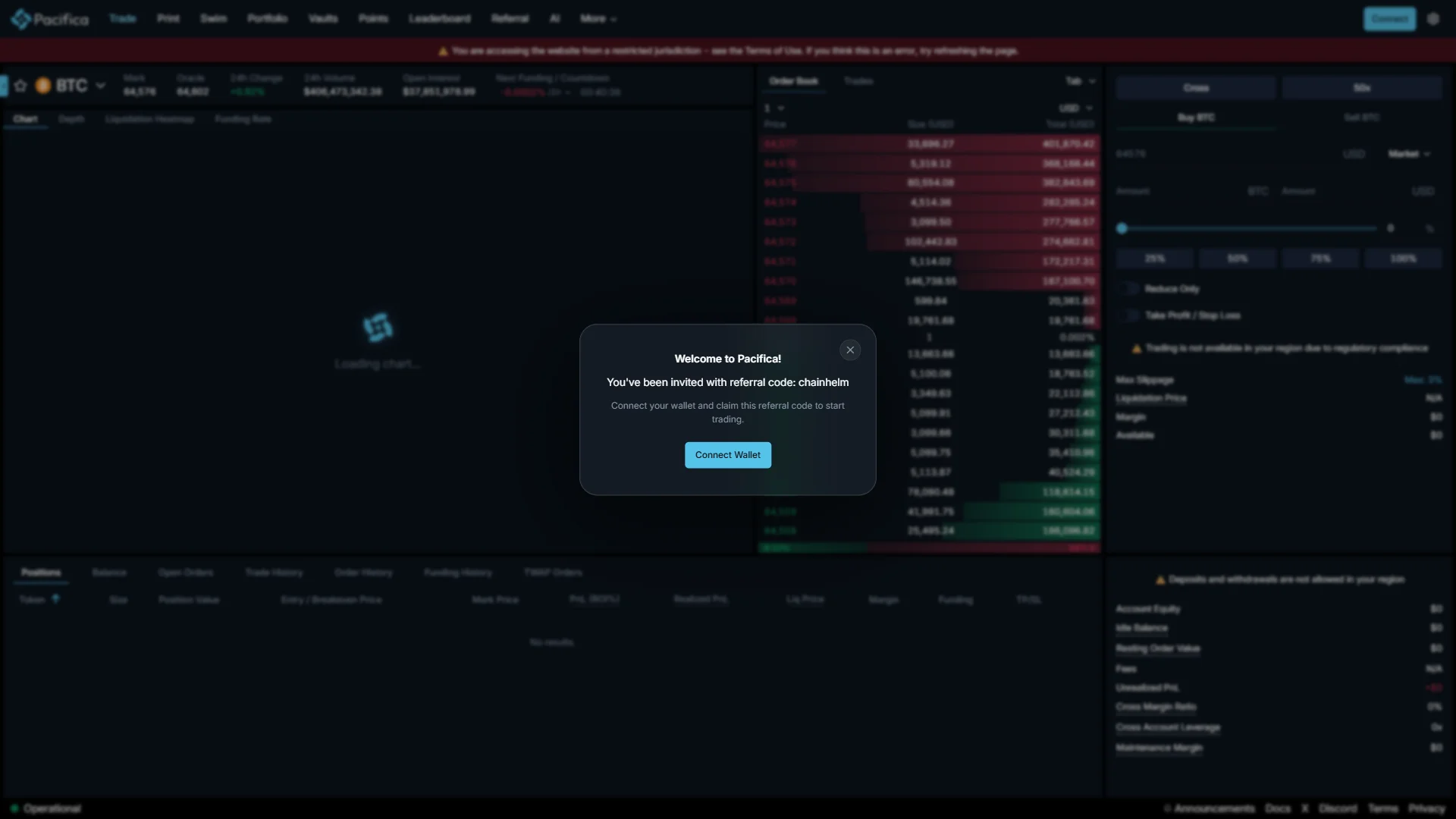
The screen shows “You’ve been invited with referral code: chainhelm”, confirming that referral code CHAINHELM has been retained from the link and will be applied when you connect your wallet.
chainhelm continuously verifies the validity of the code and confirms it remains usable.
There are two ways the code can reach an account. Opening Pacifica through the referral link applies it for you, which is the path captured above and the one the rest of this article follows. If you arrive without the link, an optional code field is available at the point you connect, and entering the code there does the same job.
What the Pacifica referral code “CHAINHELM” gets you
Apply this code when you connect to receive the following benefits on Pacifica:
- Benefit
- a +5% boost to your airdrop points
- Expiration
- None
- Eligibility
- New users
To receive the benefits, you need to apply the code when you connect your wallet. Be careful not to miss this step.
Read the eligibility line twice, because it is doing more work than fine print usually does. The code is for new users, which in practice means the wallet you connect with has to be one that has not signed up to Pacifica before.
Pacifica sign-up steps with the referral code
We cover the connection process separately for PC/browser and smartphone (mobile).
One thing that is not in this flow anywhere: an identity check. There is no document upload and no KYC step between opening the page and placing your first trade.
PC/browser connection steps
- First, open the Pacifica official page (the link applies the referral code). When you open it, you’ll see a screen like the one below.
2. Check the referral code and connect your wallet
On the welcome dialog that opens over the trading screen, confirm it shows you were invited with the referral code chainhelm, then click “Connect Wallet”. Arriving through the referral link applies the code for you, so there is no code to type in here, and the wallet list opens next.
3. Pick Phantom from the wallet list
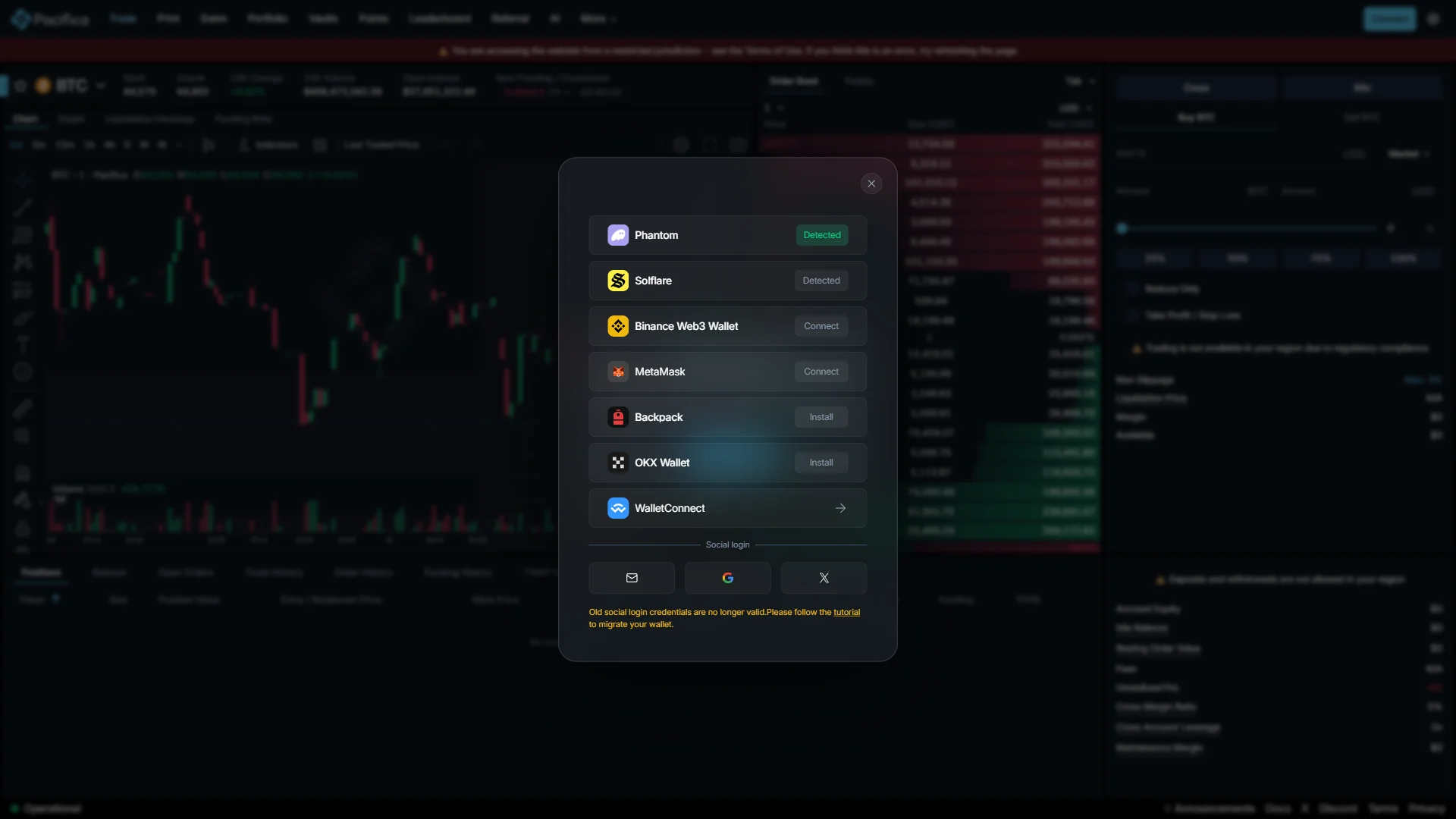
In the wallet list that opens, click “Phantom”; this walkthrough continues with Phantom throughout. “Solflare”, “Binance Web3 Wallet”, “MetaMask”, “Backpack”, “OKX Wallet” and “WalletConnect” sit alongside it, with the list marking which ones your browser already has, and “Social login” signs you in with email, Google or X instead.
One caveat on that last option: social login creates an embedded wallet, so the keys sit with the login provider until you export them, which is a different custody arrangement from the self-custody wallets above it.
4. Approve the connection in Phantom
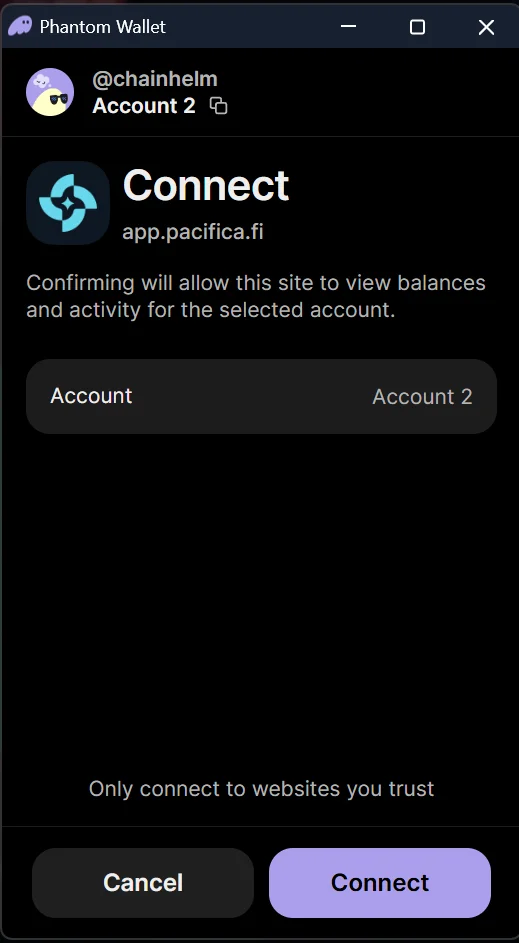
Phantom opens its connection request in the extension window; check that the site it names is app.pacifica.fi, then click “Connect”. The approval only lets the site read the balances and activity of the selected account, and once you confirm it, the welcome dialog comes back with your wallet connected.
5. Continue with a signature
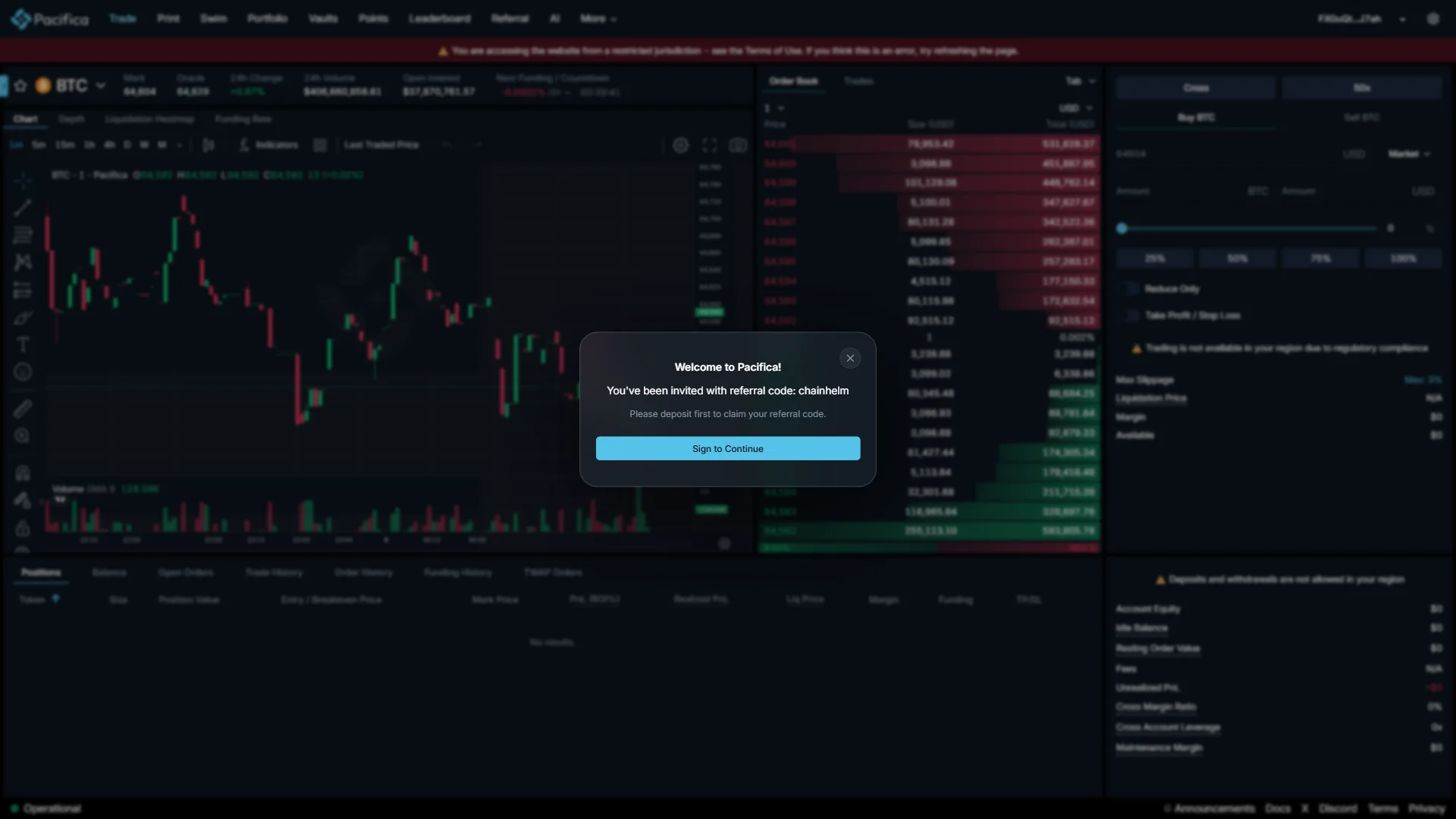
Back on the welcome dialog, your connected wallet now appears in the header; click “Sign to Continue”. The dialog also notes that the referral code is claimed once you deposit, which the later steps cover, and the signature options open next.
6. Sign the gas-free connection
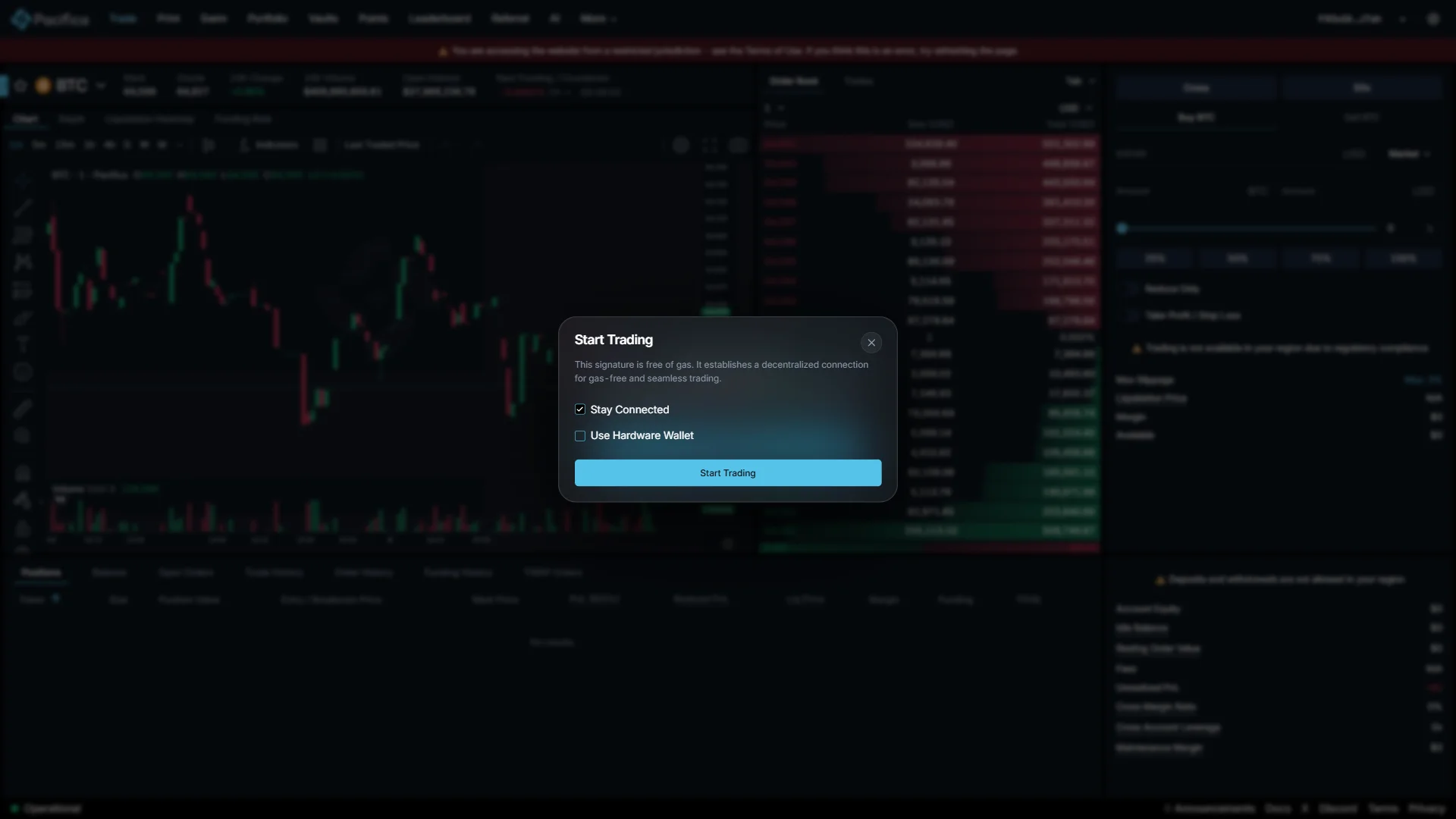
On the “Start Trading” dialog, leave “Stay Connected” checked as it comes by default and click “Start Trading”. The note above the options explains that this signature costs no gas and only establishes a decentralized connection for trading, and “Use Hardware Wallet” stays off unless you sign from a hardware device.
7. Confirm the signature request
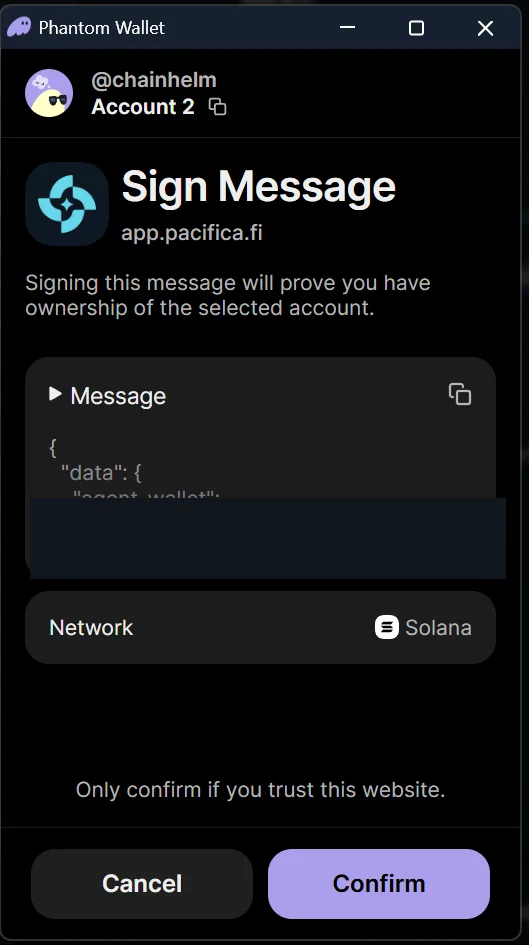
Phantom opens a “Sign Message” request from app.pacifica.fi; click “Confirm” to sign it. The signature only proves you own the account Phantom names at the top and moves no funds, so use “Cancel” if the site is not the one you opened.
8. Move on to the first deposit
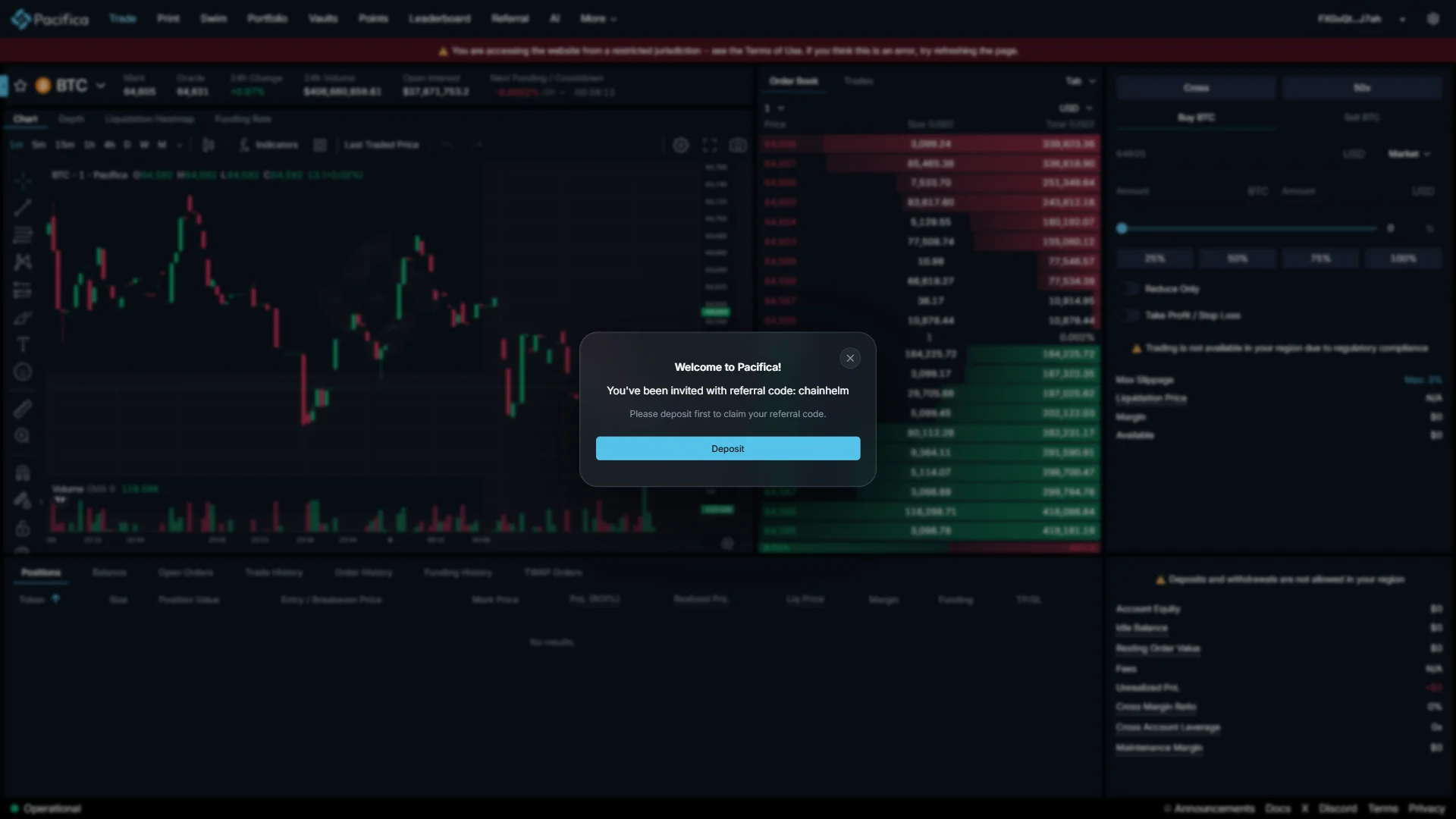
The welcome dialog returns with a “Deposit” button under the notice about claiming your referral code; click it to start funding the account. That first deposit is what locks the code in, so the deposit steps that follow finish the sign-up.
Smartphone (iOS / Android) connection steps
- First, open the Pacifica official page in your mobile browser or your wallet app’s in-app browser (the link applies the referral code). When you open it, you’ll see a screen like the one below.
2. Check the referral code and connect your wallet
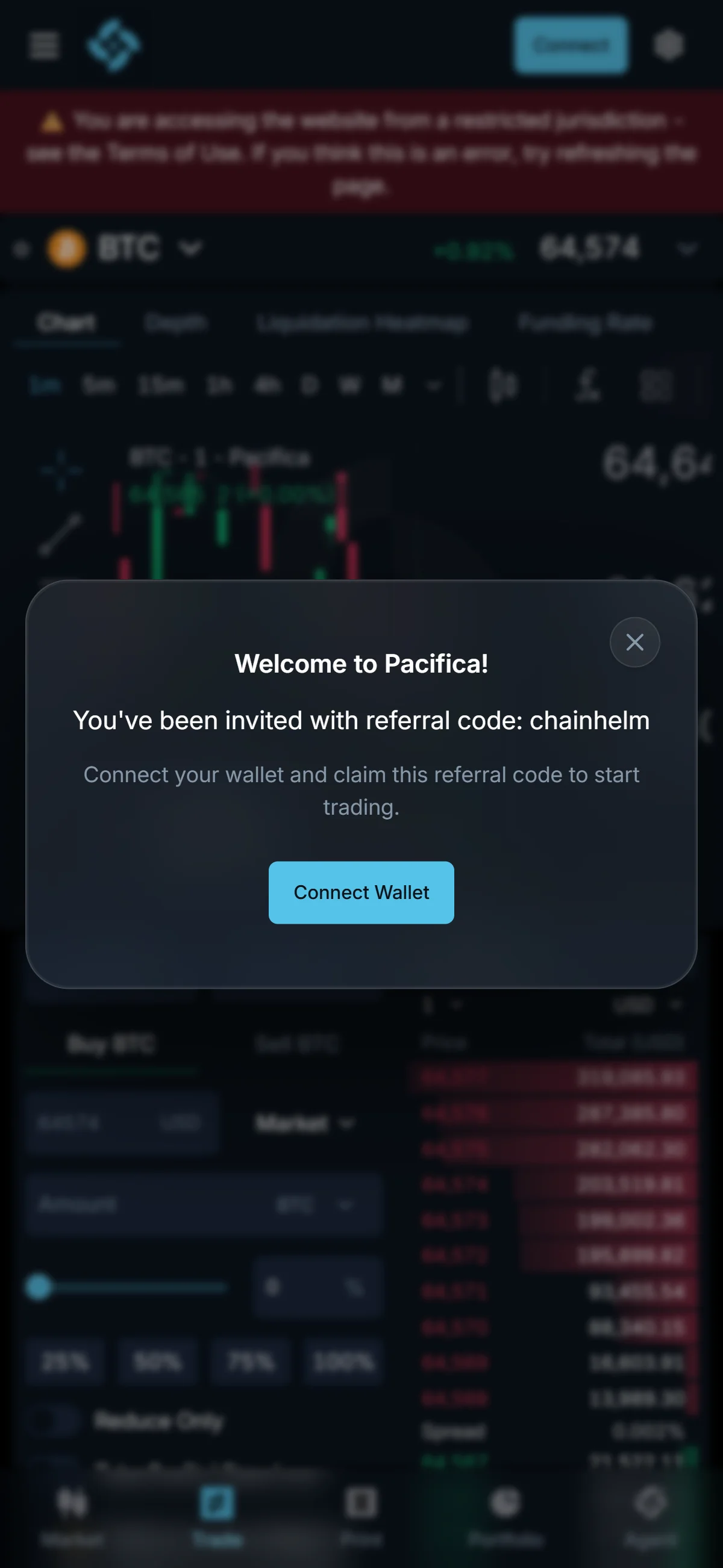
The welcome dialog opens over the trading screen showing that you were invited with the referral code chainhelm; confirm that line, then tap “Connect Wallet”. The referral link applies the code for you, so nothing has to be entered by hand, and the wallet list opens next.
3. Pick Phantom from the wallet list
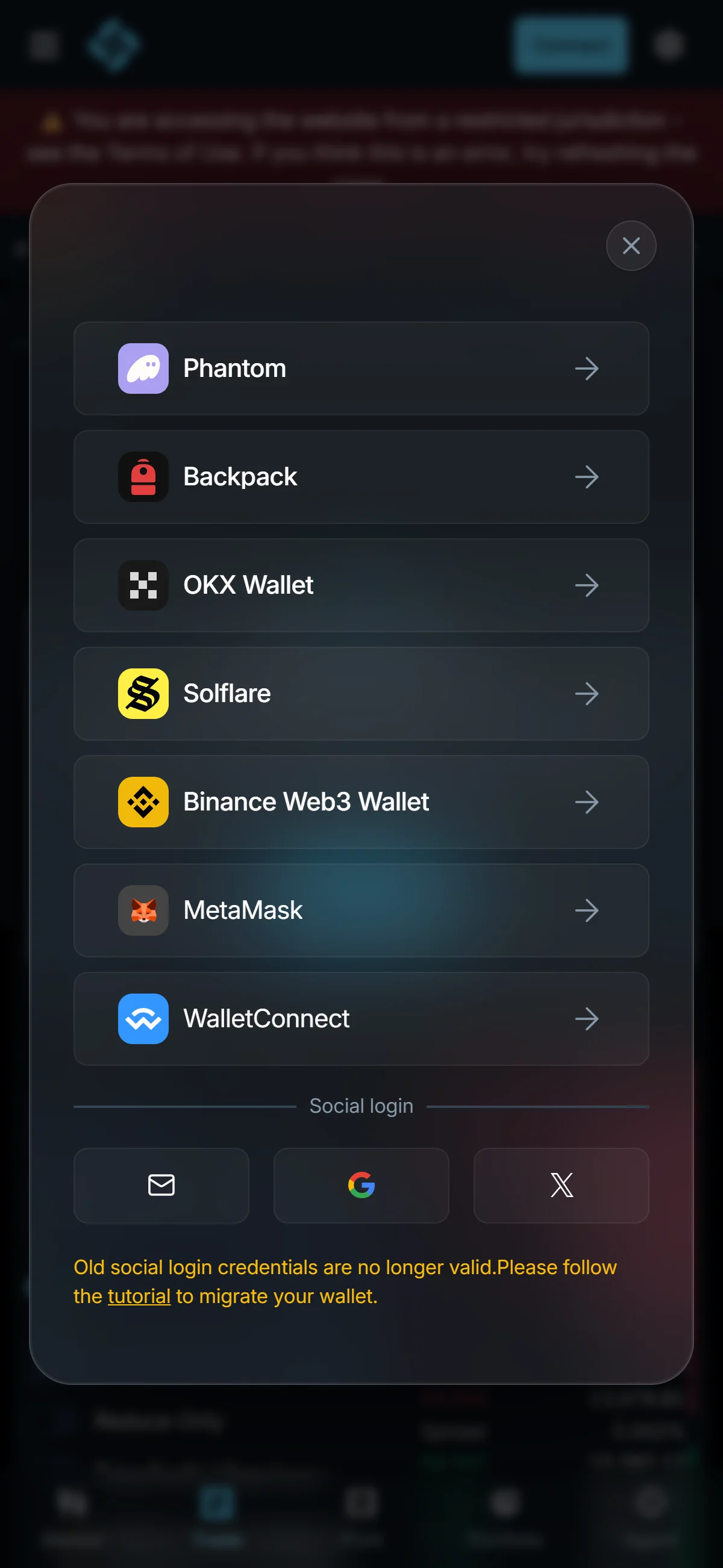
Tap “Phantom” in the wallet list that opens; this walkthrough continues with Phantom throughout. “Backpack”, “OKX Wallet”, “Solflare”, “Binance Web3 Wallet”, “MetaMask” and “WalletConnect” follow below it, and “Social login” starts you off with email, Google or X instead.
4. Approve the connection in Phantom
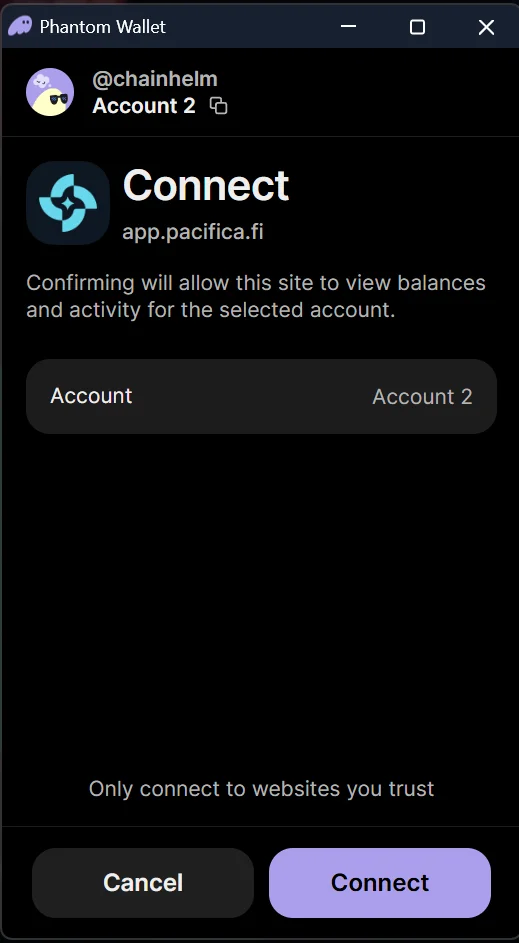
Phantom opens with the connection request from app.pacifica.fi; check the site name, then tap “Connect”. Approving only lets the site read the balances and activity of the selected account, and you land back on the welcome dialog with your wallet connected.
5. Continue with a signature
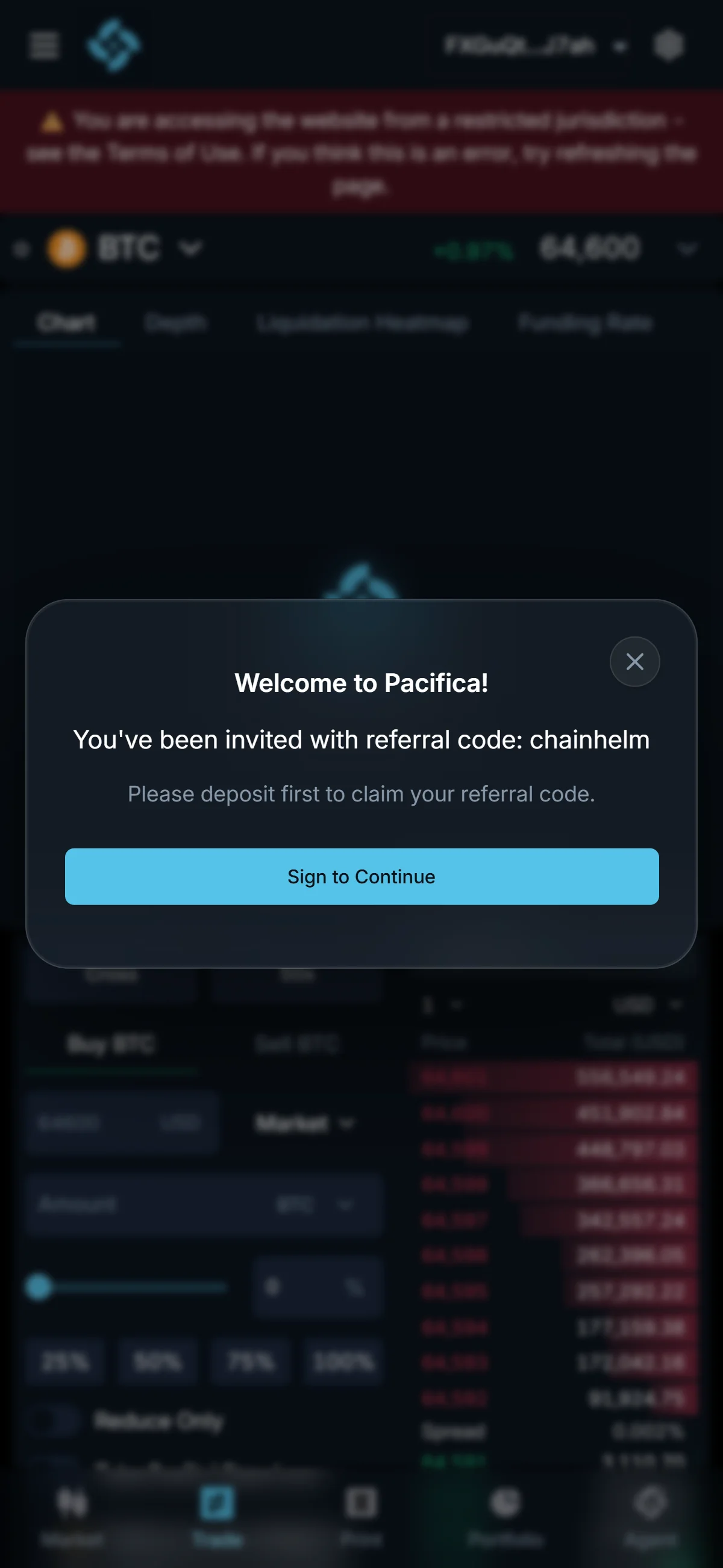
The welcome dialog returns with your wallet address shortened in the top bar; tap “Sign to Continue”. It notes that the referral code is claimed once you deposit, and tapping opens the signature options.
6. Sign the gas-free connection
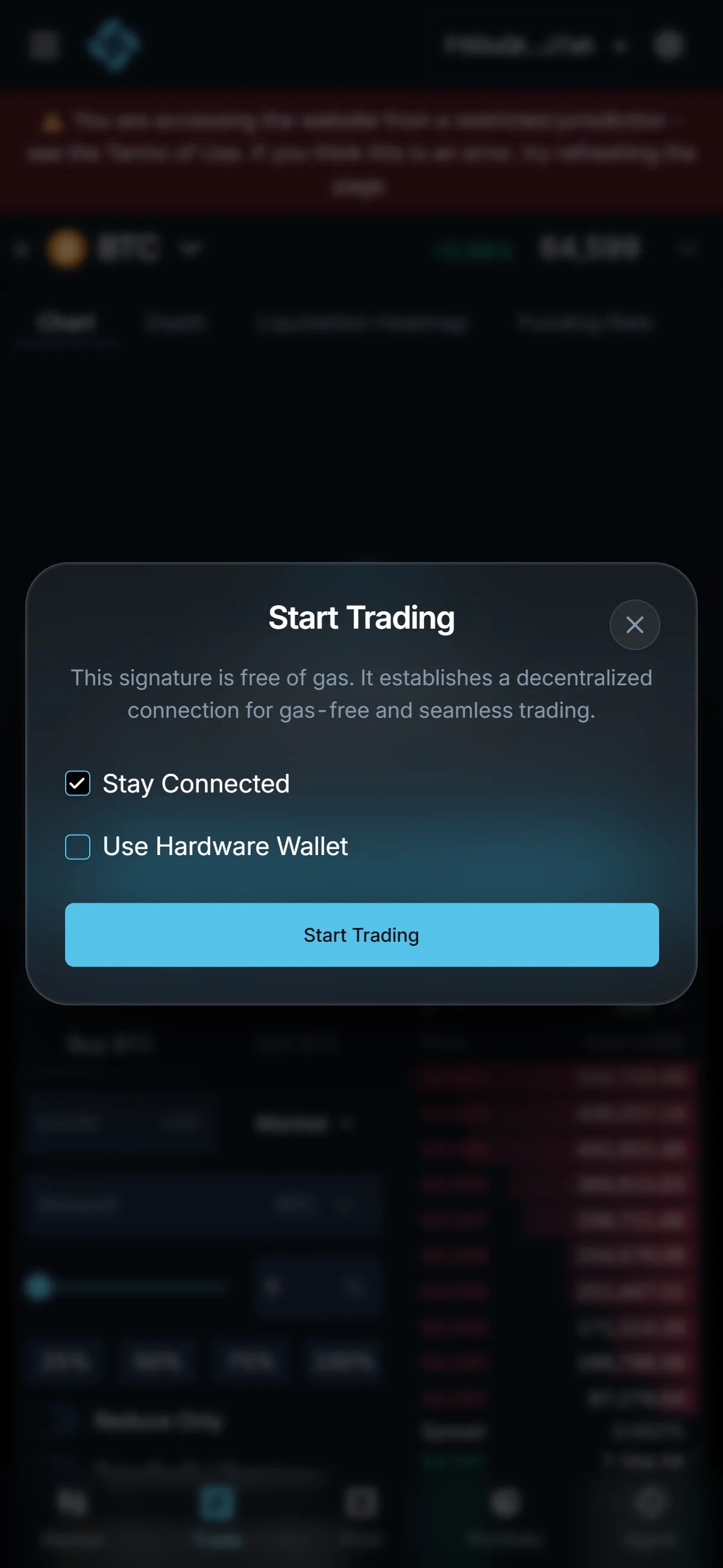
On the “Start Trading” dialog, leave “Stay Connected” checked and tap “Start Trading”. The note above the options explains that the signature costs no gas and only sets up a decentralized connection for trading, and “Use Hardware Wallet” stays off unless you sign from a hardware device.
7. Confirm the signature request
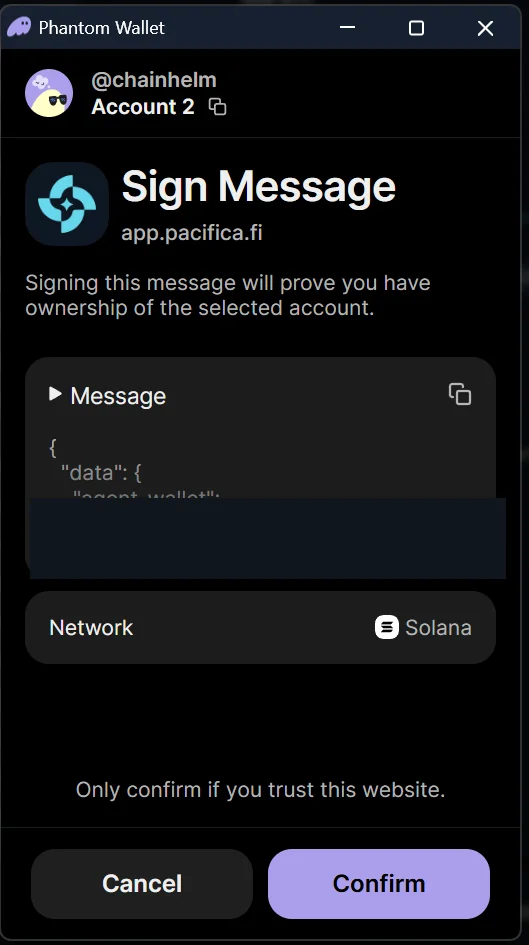
Phantom opens the “Sign Message” request from app.pacifica.fi; tap “Confirm” to sign it. The signature only proves you own the account named at the top, and no funds move at this point.
8. Move on to the first deposit
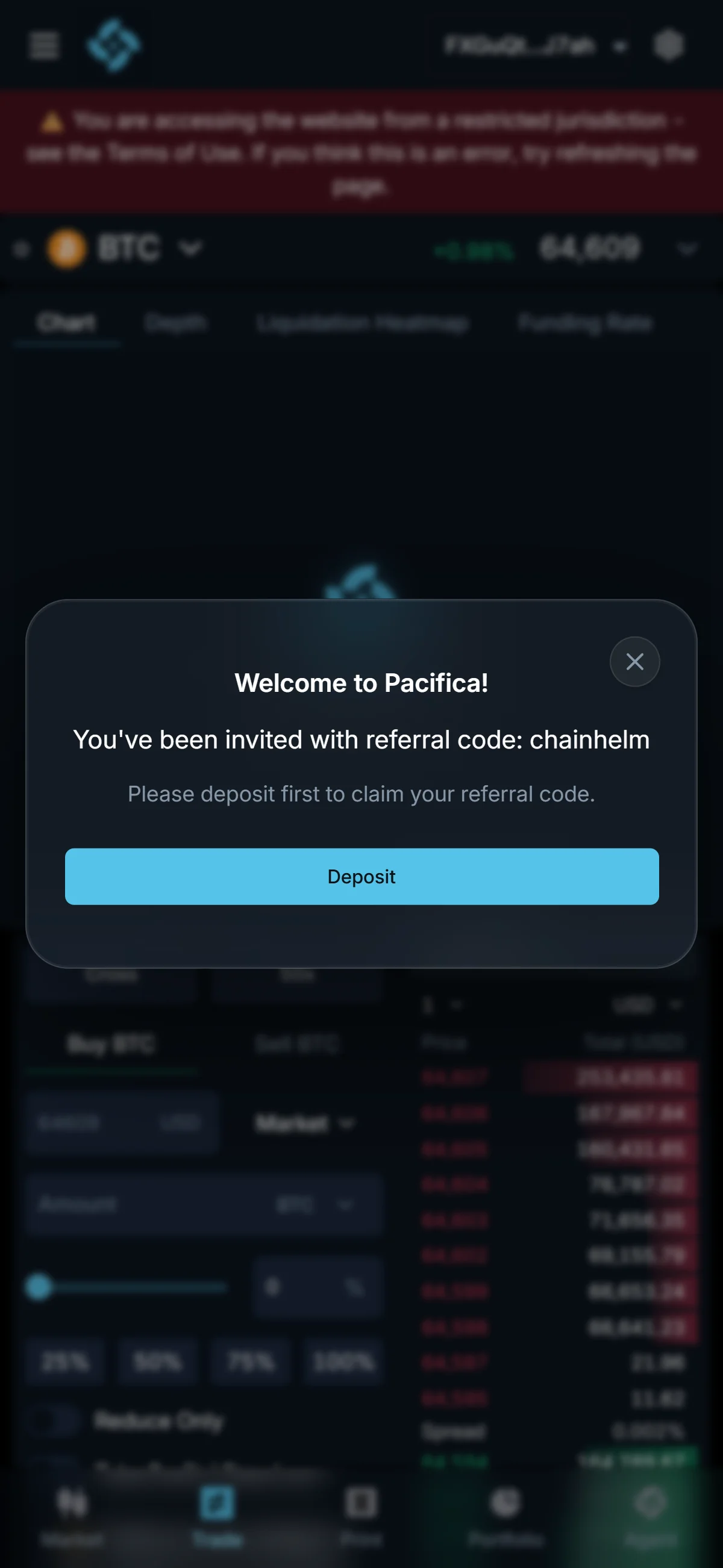
The welcome dialog comes back with a “Deposit” button under the notice about claiming your referral code; tap it to start funding the account. That first deposit is what locks the code in, so the deposit steps below finish the sign-up.
What to do after connecting to Pacifica
We cover the deposit process separately for PC/browser and smartphone (mobile).
Treat this deposit as part of the sign-up rather than as housekeeping you can leave for later. The reason is sitting in the flow you just finished: the dialog said the referral code is claimed once you deposit.
PC/browser deposit steps
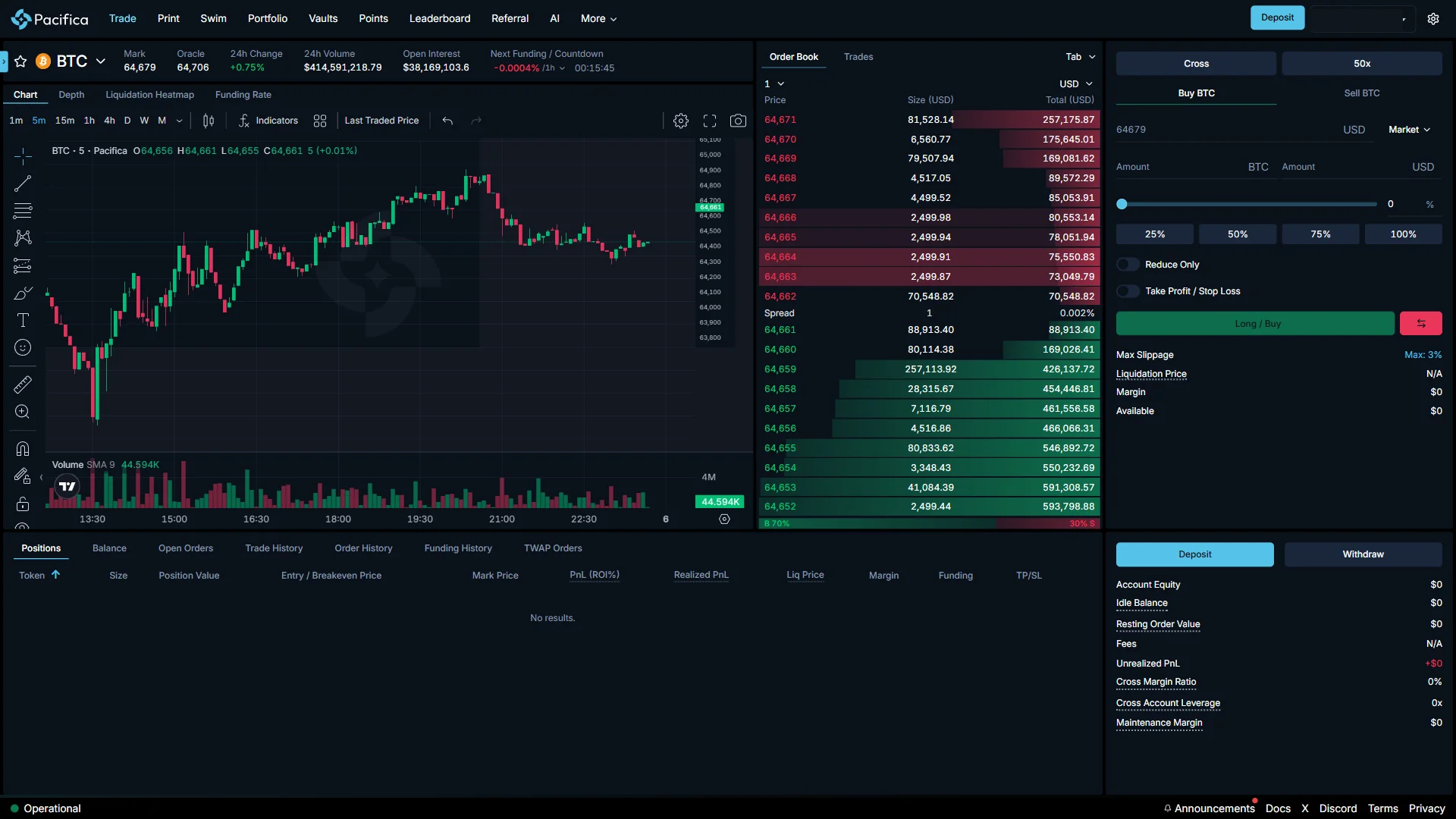
From the trading screen, click “Deposit” in the header to open the deposit dialog. The same button also sits above the account panel on the right, so either entry point gets you there.
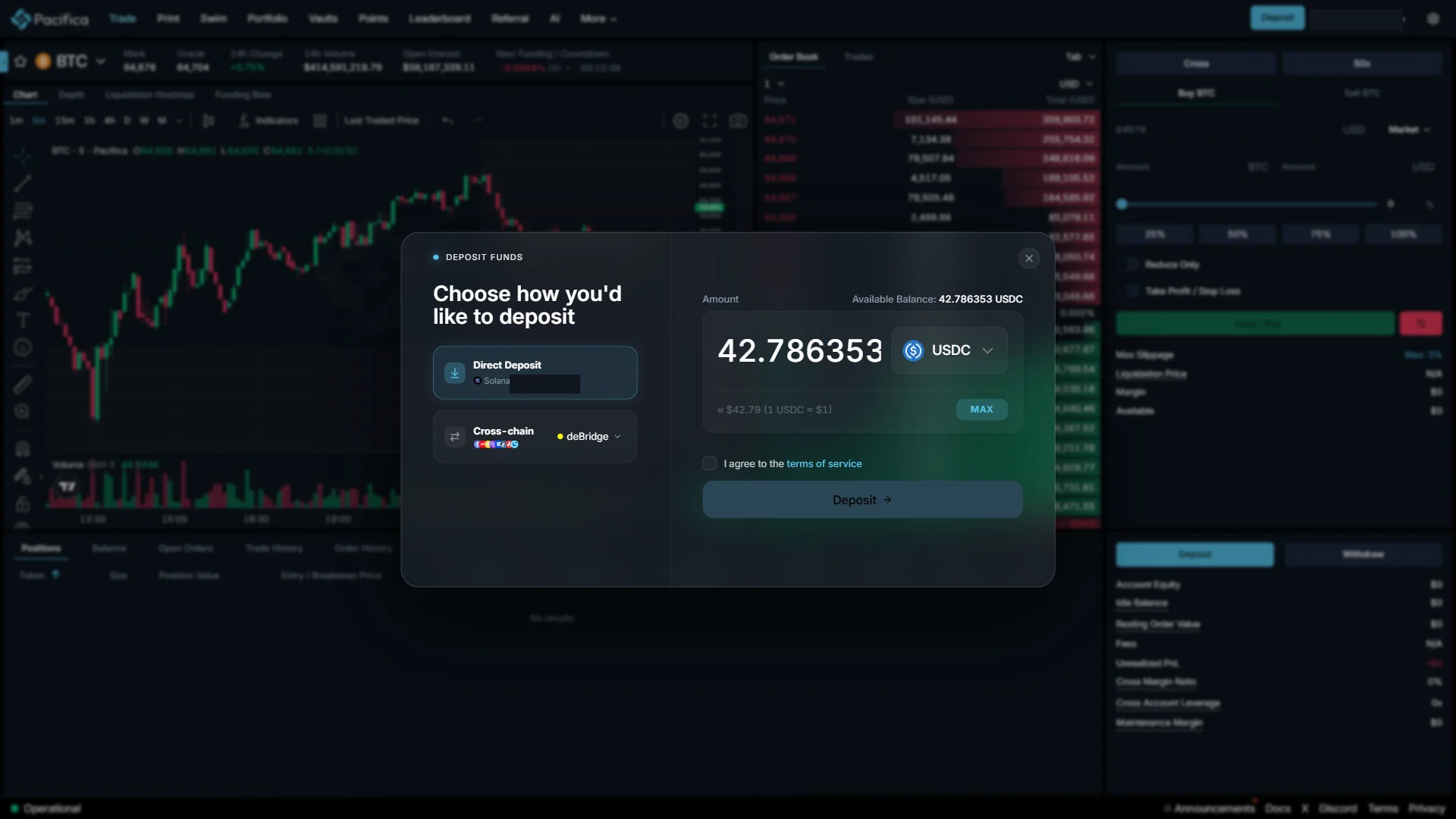
In the deposit dialog, leave “Direct Deposit” selected to send USDC over Solana, then type the amount you want to deposit; “Max” fills in the whole “Available Balance” for you.
“Deposit” stays inactive until you check “I agree to the terms of service”. If your funds sit on another chain, “Cross-chain” brings them in through deBridge instead.
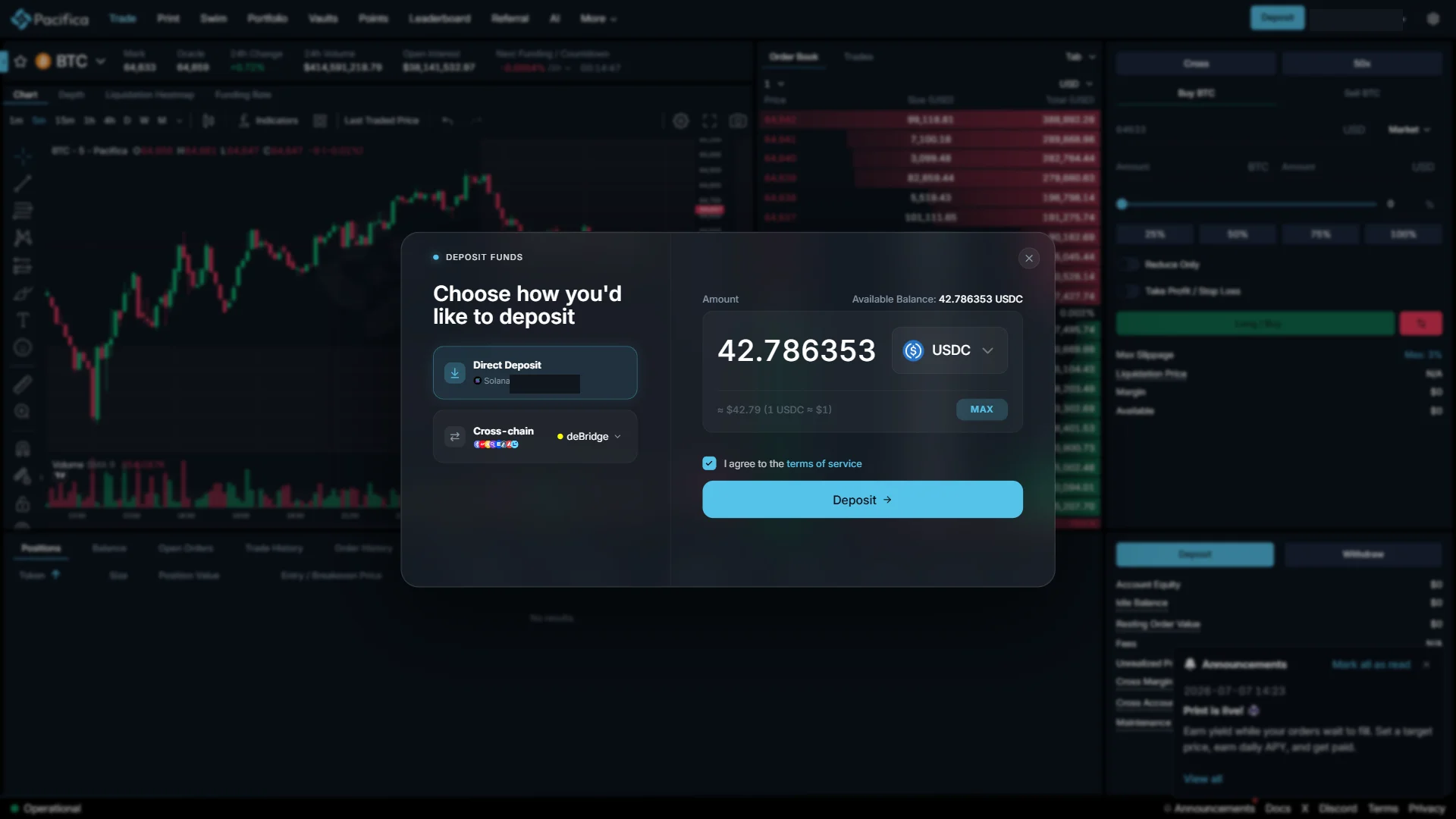
Check “I agree to the terms of service” and the “Deposit” button turns active, so click it to submit. Give the amount and the network one last look before you do, since the wallet confirmation comes straight after.
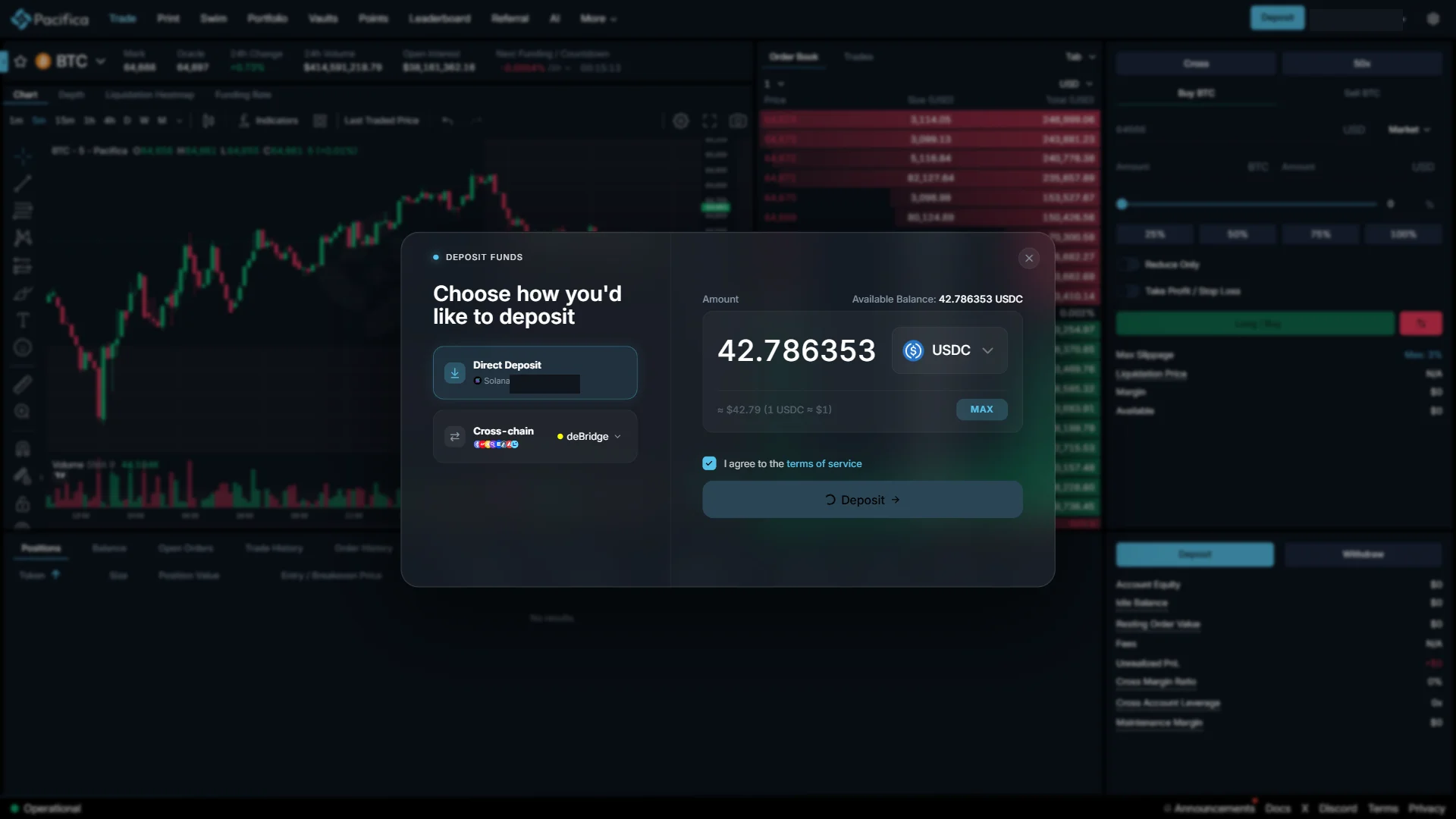
The “Deposit” button switches to a loading state while the request is prepared, so leave the dialog open and wait a moment. Your wallet takes over from here with the transaction to confirm.
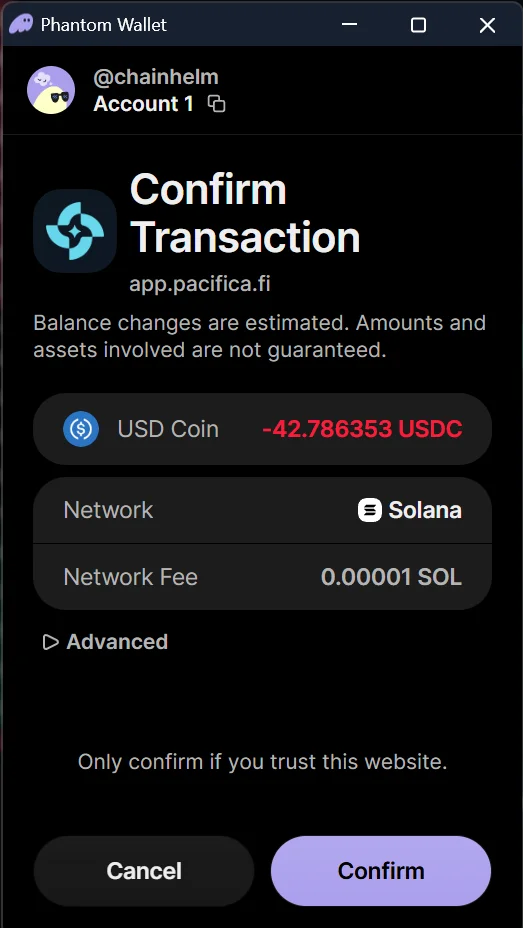
Phantom lists the USDC leaving your wallet along with the network fee in SOL; click “Confirm” to send the transaction. Check the amount against what you entered, and note that the fee is charged in SOL separately from the USDC you are depositing.
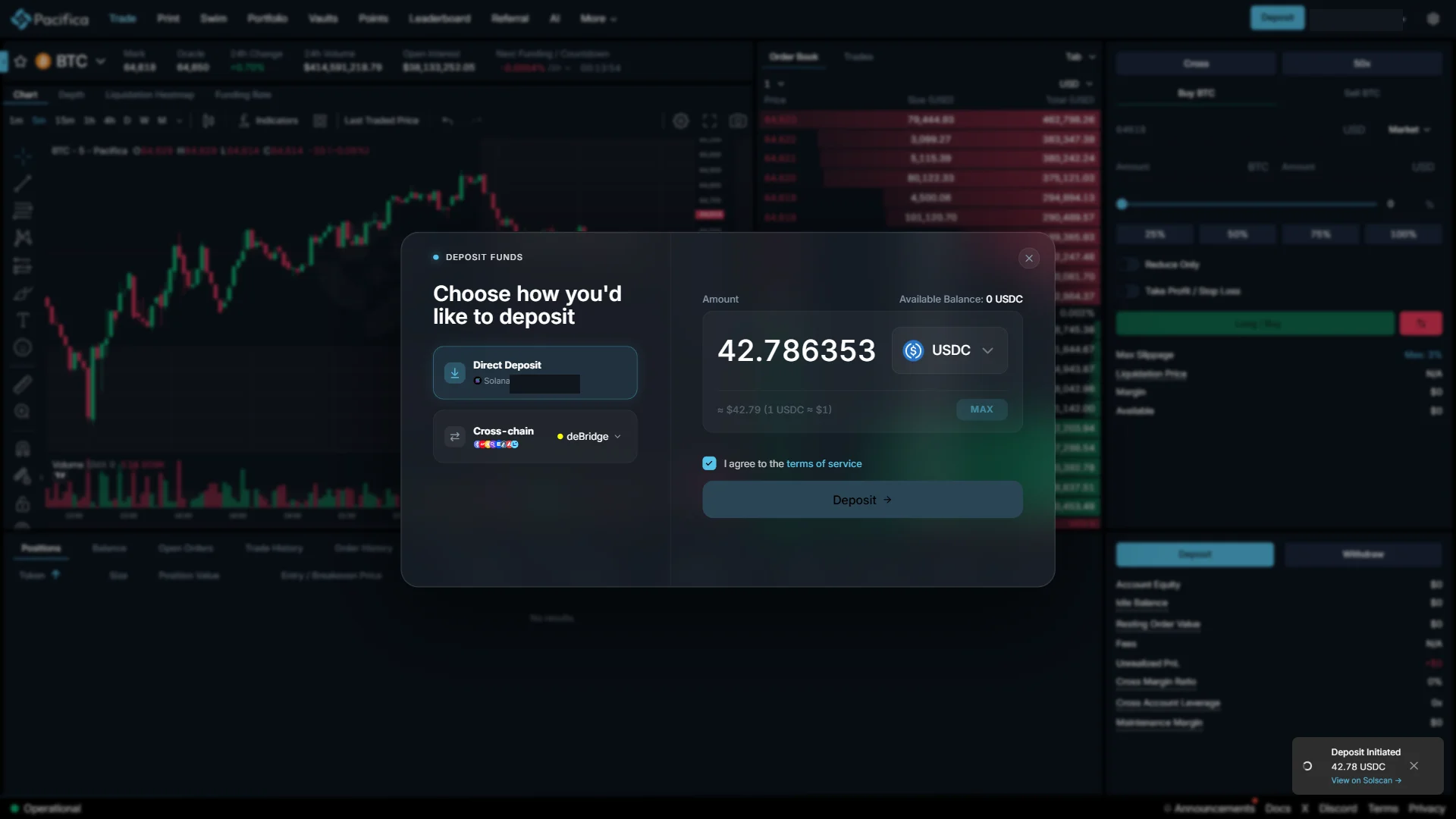
Check the amount on the “Deposit Initiated” notice, then click “View on Solscan” to follow the transaction on-chain. This first deposit is what claims the referral code you saw at sign-up.
Smartphone (iOS / Android) deposit steps
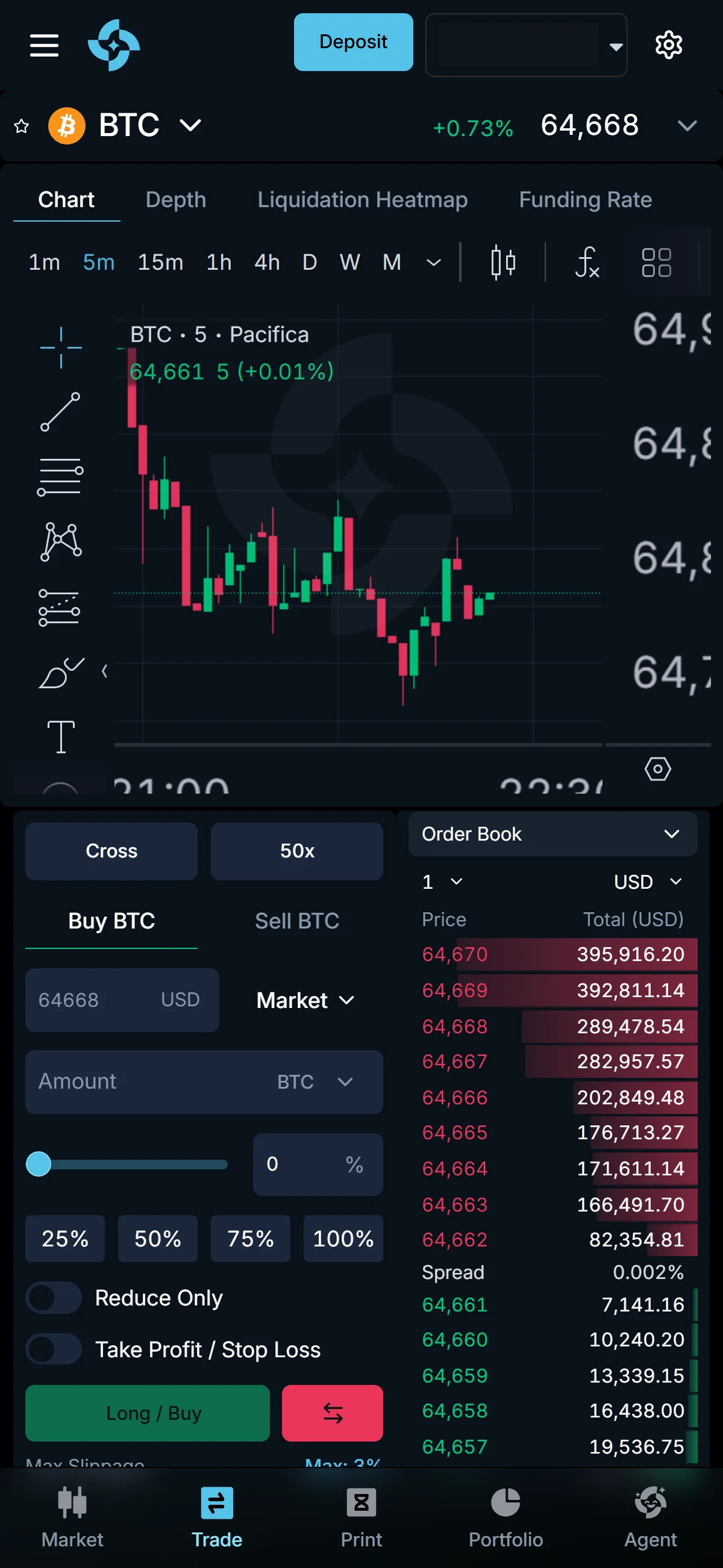
On the trading screen, tap “Deposit” in the top bar to open the deposit dialog. This screen is the “Trade” tab at the bottom, so this is where you return whenever you need to add funds.
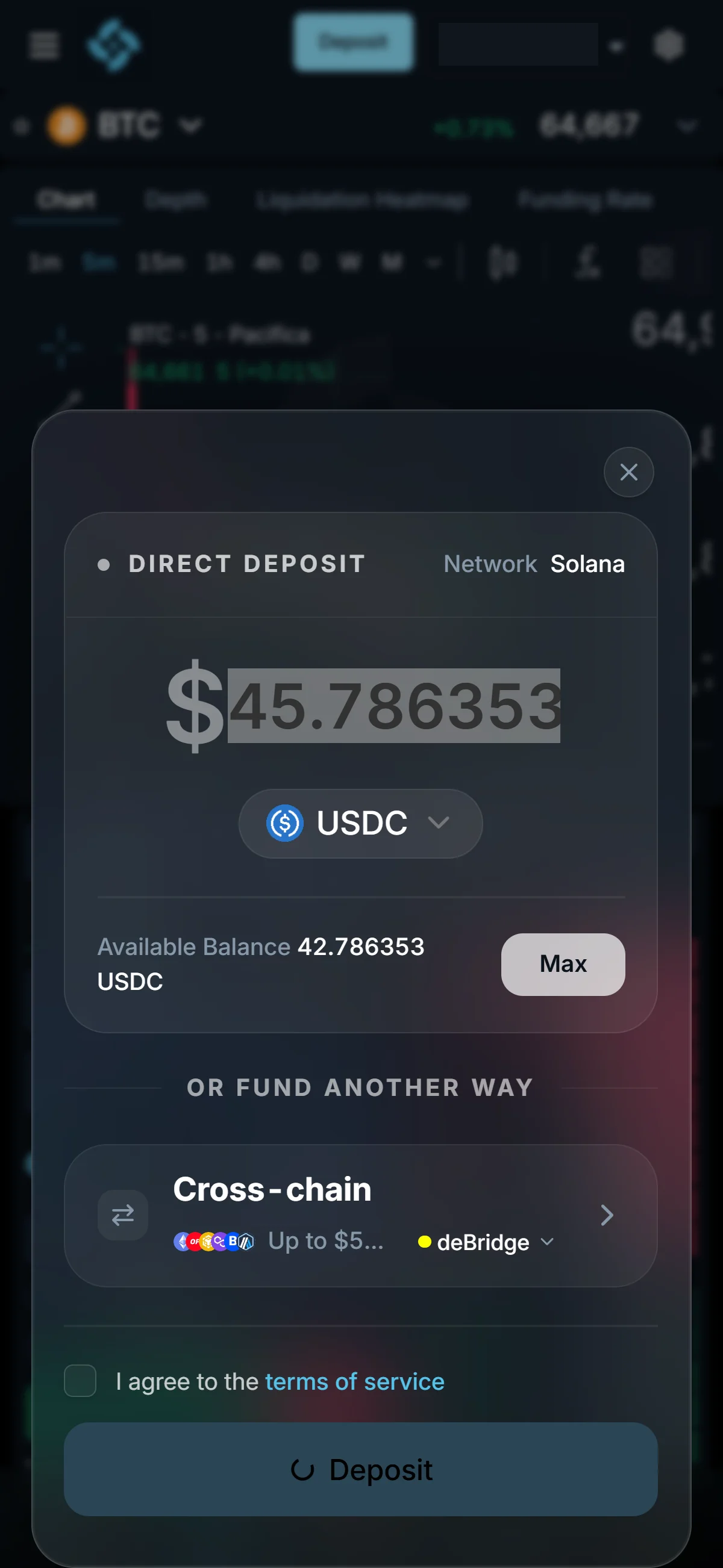
“Direct Deposit” over the “Solana” network is already selected, so tap the amount and enter how much USDC to send; “Max” fills in the whole “Available Balance”.
“Deposit” stays inactive until you check “I agree to the terms of service”. Under the heading for funding another way, “Cross-chain” brings funds over from another chain through deBridge.
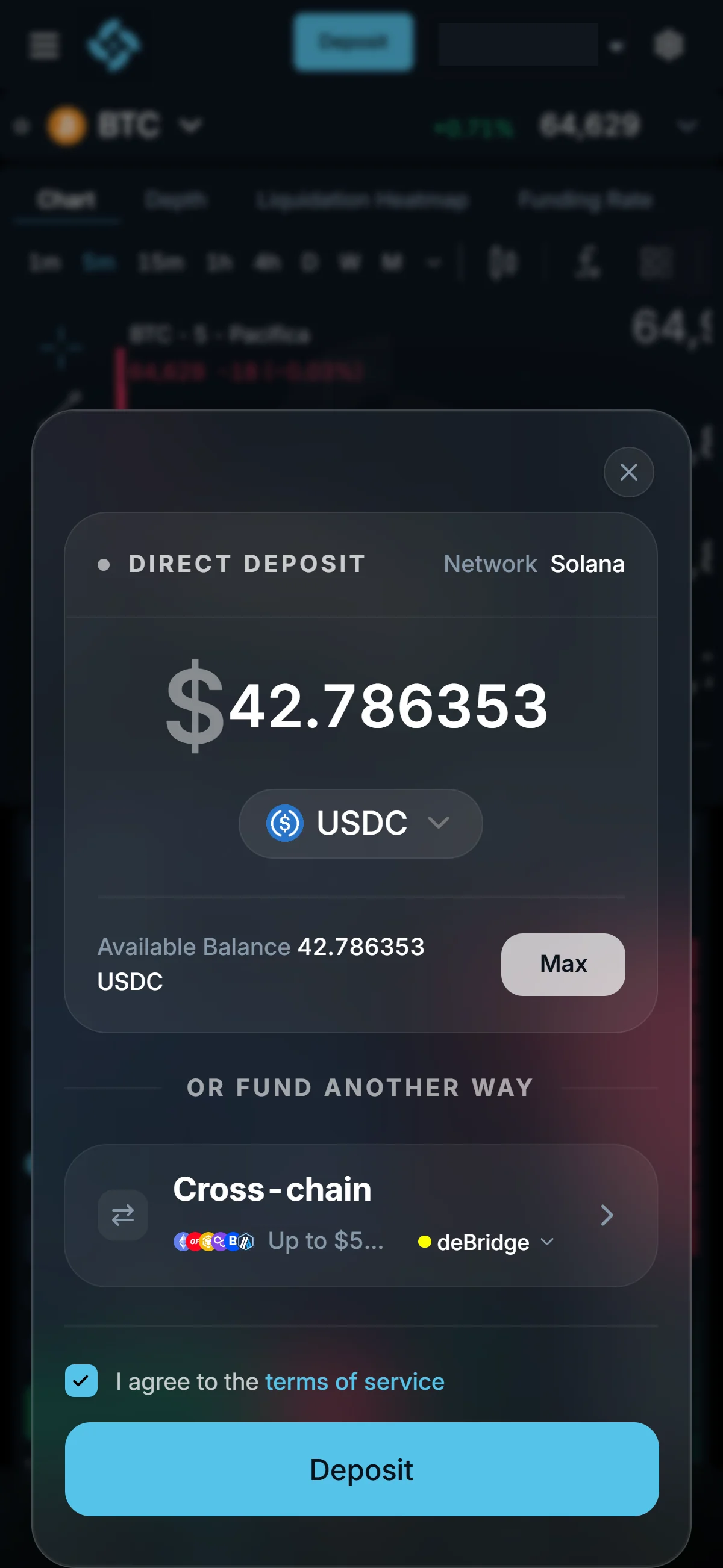
Check “I agree to the terms of service” and “Deposit” turns active, so tap it to submit. Look over the amount and the “Solana” network once more first, since the wallet confirmation follows immediately.
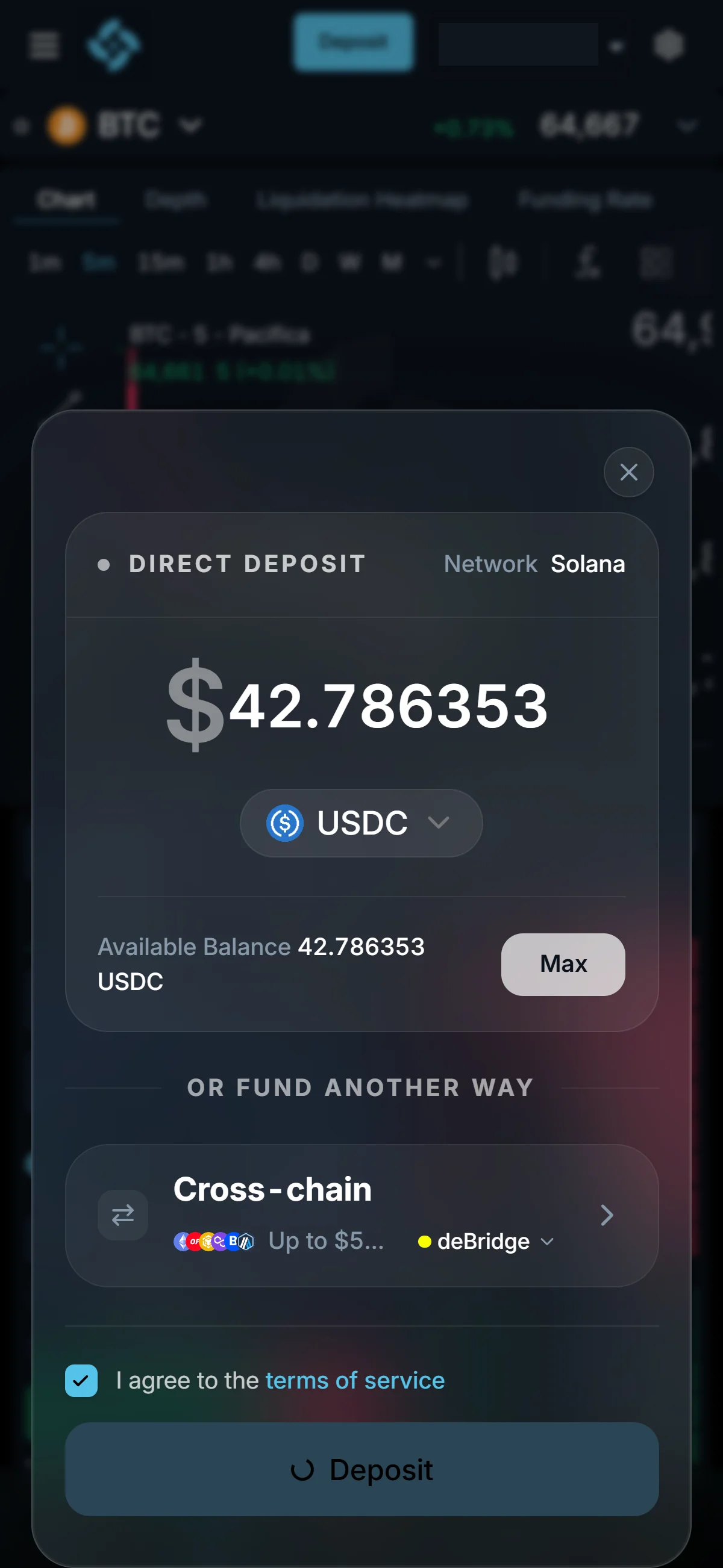
“Deposit” dims and shows a spinner while the request is prepared, so keep the dialog open and wait a moment. Phantom comes up next with the transaction to confirm.
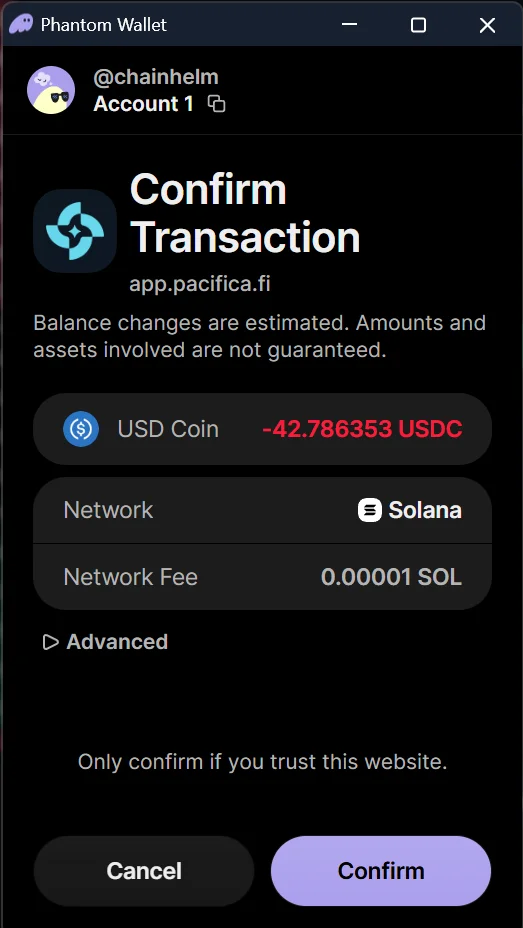
Phantom opens with the USDC leaving your wallet, the Solana network and the fee in SOL; tap “Confirm” to send the transaction. The amount should match what you entered, and the fee is taken in SOL rather than out of the deposit.
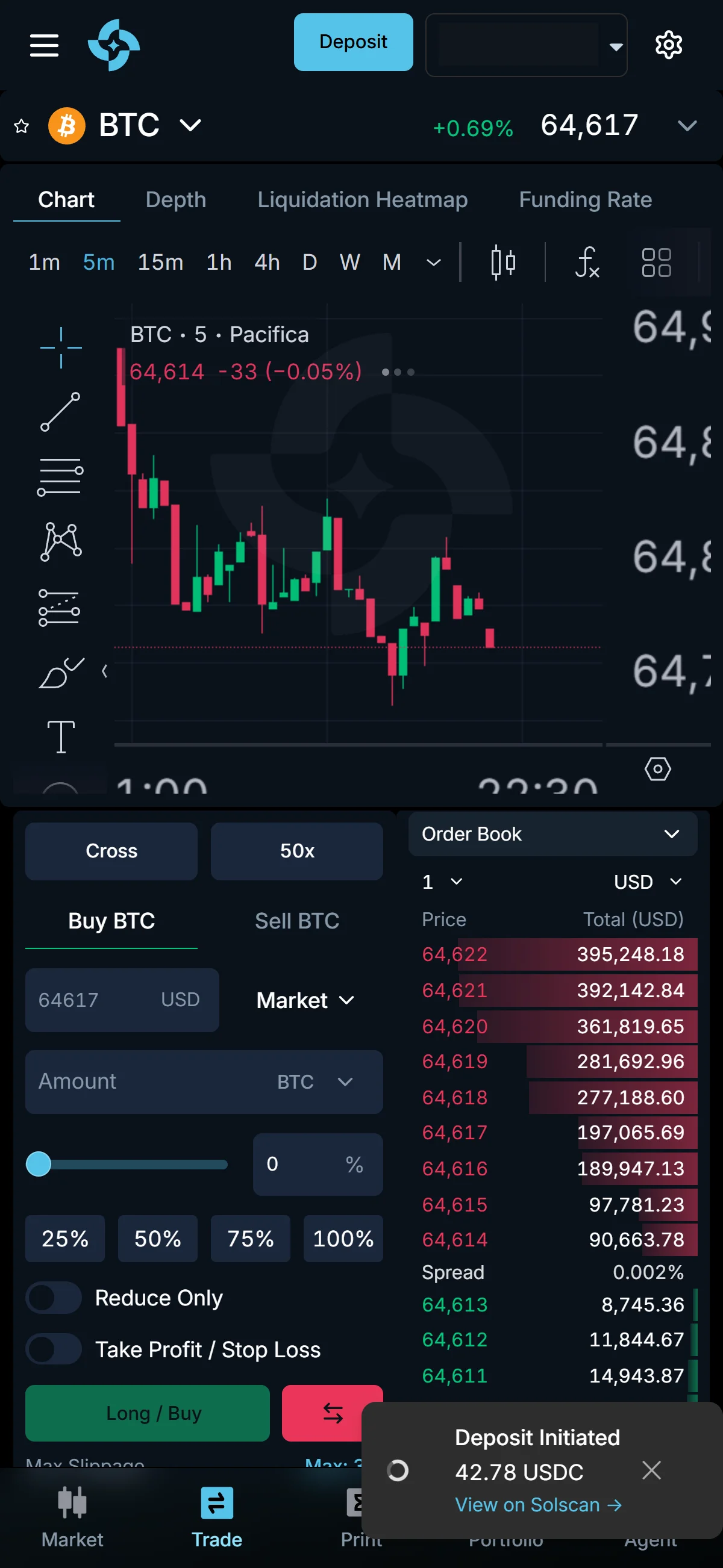
A “Deposit Initiated” notice appears at the bottom of the trading screen with the amount sent; tap “View on Solscan” to check the transaction on-chain. This first deposit is what claims the referral code you saw at sign-up.
Three rails decide whether that deposit lands at all, and none of them is obvious from the screens. The first is the asset: USDC on Solana only, with the official support documentation stating plainly that deposits sent on other networks or in other tokens are not credited. The second is size: below 10 USDC the deposit is not credited automatically. The third is gas, which you pay in SOL at the deposit and again at withdrawal, and nowhere in between — placing an order on Pacifica costs the trader no network fee at all.
Once the deposit lands, the referral code is claimed and the funded account is ready to trade.
The Pacifica referral code cannot be added after sign-up
The referral code can only be applied once — the first time you connect your wallet.
If you complete the connection without the code applied, there is no way to link it to that wallet afterwards, and the only route left is to start over with a new wallet.
- Is referral code CHAINHELM shown as applied when you connect your wallet? (check the notice that appears when you arrive via the link, and what the code field contains)
The reason it works this way is that the code binds to the wallet, not to a person or a login. An account that has already been funded from a wallet that connected without the code cannot be re-attached to it later, and support cannot attach it for you. What remains is the plain version: a fresh wallet, opened through the referral link or with the code entered at connect.
◆ ◇ ◆
The points program pays out 10 million points a week, and no token stands behind them
The code raises your points by 5%, which only means something once you know what the points are. Pacifica’s weekly points program is the reason most people are there at all, so it is worth reading on its own terms before you decide the boost is worth trading for.
Ten million points go out every week, with no season numbering
What the official documentation does not define is any season or epoch numbering, and it announces no end date. That absence is worth stating out loud, because third-party guides circulate a season label and a fixed program length that no official Pacifica source states anywhere.
For a reader deciding today, the cadence above is the part that matters: this is a weekly cycle that keeps running, not a countdown you are late for. Joining this week is not materially different from joining next week.
Only organic trading earns, and the formula is opaque by design
So how does anyone earn a share of it? By trading. Points accrue from organic trading activity, whether you place orders through the interface or through the API, and the points for a stretch of trading may be credited immediately or spread across several distributions.
What Pacifica will not tell you is the formula. The documentation says it is dynamic and opaque by design, updated weekly as usage evolves, and known in detail only to a few people on the team. That is the venue’s own stated position, reported here as such rather than as a criticism.
The rules that are stated are the negative ones. Self-trading, sybil activity and other manipulative behavior earn nothing, and running a hundred accounts confers no advantage over running one. No points were allocated to anyone in advance, and points cannot be bought.
The consequence is worth sitting with before you commit any trading to this. You cannot work out in advance what a given amount of volume will earn, which means effort here cannot be budgeted the way a fee rebate can. A rebate is arithmetic; this is not.
No token exists, and nothing says the points will convert
Then what are the points actually worth? At the time of writing, there is no token and no TGE, and no airdrop has been conducted. Three separate observations corroborate that: no token or tokenomics appears anywhere in the official documentation or the Terms, the aggregator that tracks the protocol reports a null market cap, and Pacifica describes itself as self-funded.
The binding language is in section 10 of the Terms of Use.
That is the whole of the commitment, and it is the hinge of this section. Nobody has promised that these points become anything. If your question is whether the program is worth trading for, the answer available from published sources is that it cannot be priced — you would be acting on what has not been ruled out, which is a different thing from what has been offered.
Geography, conduct and discretion can each remove points
Three documented layers can take points away from someone who has already earned them. The geographic layer comes first: program benefits are subject to laws that may restrict or prohibit participation in some jurisdictions, and that sits on top of the Restricted Territories that bar access to the interface outright. The conduct layer is the earning rule above, read from the other end — manipulative activity earns nothing. The discretionary layer is the reserved power in the box above, which the operator may exercise where it determines or suspects prohibited activity, including on a retroactive review.
The geographic layer is the one that depends on where you live, and it is settled country by country further down rather than here.
A Solana-native order book that matches off-chain and settles on-chain
That is the program. The venue running it is a different question, and it is the one you are really deciding.
Founded in 2025, run from Panama, and short on named people
Read that for pace rather than for content. This is a venue that went from founding to mainnet in about six months and has shipped a major addition roughly every two months since, and it is barely a year and a half old.
The interface — the web front end, the mobile app and the API — is provided by SkyLake Global Corp, a company incorporated in Panama, and it has been named as the counterparty in the Terms of Use since the revision dated 2026-06-11.
Leadership is harder to pin down. Industry media names a co-founder who was previously COO of FTX until 2022-11, and no official Pacifica source — site, documentation or Terms — names any founder or officer at all; the documentation describes the team only by the firms its members came from. Both halves of that matter: the attribution exists, and it rests on secondary reporting from a single publisher. The limit is part of the fact rather than a footnote to it.
Off-chain matching, on-chain settlement, and how much sits on it
Pacifica is a central limit order book rather than an automated market maker, and it is a hybrid one. Orders are matched by an off-chain engine that Pacifica operates, while settlement and custody happen on Solana. Deposits and withdrawals move through Pacifica’s own Solana bridge programs, with a hot wallet under a programmatic spending limit and a cold vault under a multi-signature program.
That single structural fact is what makes the rest of this article legible. It is why placing an order costs you no gas, why the referral code binds to a wallet instead of to an account you log into, and why a later section about risk talks about an operator at all — because there is one, and it stands between your order and the chain.
On the size of it: DeFi Llama put Pacifica’s TVL at about 27.9 million USD and its 30-day volume at about 10.85 billion USD as of 2026-07-29. Read both as a dated snapshot rather than a current reading, and read them together, since they come from the same source and the same conventions.
Seventy-two markets, with leverage set per market
The market specification table enumerates 72 rows, and the mix is the interesting part.
Pacifica’s own About page still carries an older, rounded-down count of the markets; the table above is the current one, and one of those special pairs is a spot market rather than a perpetual.
The real-world-asset block is what distinguishes the venue. It covers single-name equities, an S&P 500 index market, an ETF market, two FX pairs, six commodities and pre-IPO instruments — all of them cash-settled perpetuals that reference the underlying price rather than the security itself.
Maximum leverage is set per market rather than account-wide. The ceiling is 50x, which applies to BTC, ETH and the two FX pairs, and the tiers step down from there market by market.
The cost of a trade — maker, taker, funding and gas
- Maker fee
- 0.015% at the base tier, falling to zero at the VIP tiers.
- Taker fee
- 0.040% at the base tier, and it never reaches zero — the floor is 0.028%.
- Funding
- Applied at the end of each one-hour interval, with the rate sampled every five seconds and hourly funding capped at plus or minus 4%.
- Gas
- None per trade. Solana gas applies only at the deposit and withdrawal boundary, and withdrawal carries a fee of about 1 USD.
The base tier above is where you start: it is the rate for 30-day rolling volume of zero, and there are eight tiers in total. The asymmetry between maker and taker is the part to notice, because the maker side eventually disappears and the taker side never does.
Gas behaves that way because matching happens off-chain: placing, editing, canceling and filling orders all cost the trader nothing on Solana.
One thing readers coming from token-based venues will look for and not find: there is no native token, so there is no token-based fee discount. Fee reduction here is volume-based only.
Ninth by 24-hour volume, with a market list that runs from BTC to pre-IPO names
Ninth by volume, eleventh by open interest, absent from the fee tables
Every figure in this section comes from one dataset on one date — the DeFi Llama perps page as of 2026-07-29 — and none of them should be set beside a number from a different aggregator.
The gap between the first two is worth reading rather than skipping. Ranking lower on open interest than on volume means positions turn over faster here than at several venues sitting around it — money moves through rather than staying put. That is a characteristic of the venue, not a verdict on it.
The third box costs the analysis something concrete. Fee revenue is the figure normally used to sanity-check a volume ranking, because revenue is harder to inflate than turnover, and Pacifica publishes no fee revenue figure of its own either. The usual cross-check simply is not available here.
Two volume conventions that cannot be mixed
There is a reason this section pins itself to one source. On the same day, one aggregator reported roughly 360 million USD of 24-hour volume for Pacifica while two others reported roughly 735 to 742 million USD. Each set is internally consistent, and the roughly 2x ratio between them is the signature of counting both sides of a trade rather than one.
None of the three publishes its convention, so that explanation stays unconfirmed. The same pattern shows up again between Pacifica’s self-reported cumulative volume and the all-time total on the aggregator side.
The practical instruction is the point of all this. Any comparison between venues has to stay inside a single dataset, and a headline volume figure means nothing on its own until you know which convention produced it.
Equities, pre-IPO markets and a money market on one margin account
Real-world assets and pre-IPO names
One account, backed by a lending pool
A first-party API surface
Twelve countries are shut out by the Terms, enforced by IP address
Twelve named territories, plus anywhere under comprehensive sanctions
The Restricted Territories clause of the Terms names these twelve.
United States Canada United Kingdom China Russia Ukraine Cuba Iran Venezuela Syria North Korea Philippines
The list is open-ended rather than closed. Any jurisdiction under comprehensive economic sanctions administered by the United Nations, the United States, the European Union or the United Kingdom is excluded as well, even though it is not enumerated above. Eligibility separately requires that you do not appear on sanctions or denied-party lists and that you are at least 18.
Enforcement, as the operator describes it, runs on IP-based geolocation blocking of the interface. Pacifica logs IP addresses specifically for enforcing geographic access restrictions, and reserves the right to suspend or terminate access, including by blocking specific devices or wallet addresses. Use of the mobile app from a Restricted Territory is prohibited outright.
Because there is no identity verification anywhere in the trading flow, that enforcement is necessarily IP- and device-based rather than identity-based.
The Terms split Interface from Protocol, and the split is narrower than it sounds
The Terms draw a two-layer distinction that is easy to over-read. The interface is provided by the Panama operating company, and it is the interface that the Terms and the geo-block govern. The protocol is described separately as a decentralized, permissionless set of smart contracts, and the Terms note that third parties may provide other means of access to which the Terms do not apply.
The honest reading has to include one qualification. Order matching runs on an engine Pacifica operates, and the hot wallet spending limit and cold vault sit under Pacifica-governed multi-signature control. The separation is therefore narrower in practice than the language implies, because the parts that decide whether your order fills and whether your funds move are not permissionless at all.
That describes where responsibility sits. It is not a description of how anyone reaches the venue from anywhere, and no such route appears in this article.
No license anywhere, and no regulator has acted against it
Pacifica claims no license, registration or authorization in any jurisdiction, anywhere on the official site, in the documentation or in the Terms. The operating company is incorporated in Panama and disputes are routed to arbitration seated in Singapore — neither of which is a financial services license, and the second is a private contractual choice rather than a supervisory relationship.
On the other side of the ledger, no regulatory action, warning, restriction, lawsuit, settlement or sanction against Pacifica by any authority in any jurisdiction was found, and that absence comes from targeted searching rather than from not looking.
Both of those need saying in the same breath. Pacifica runs on a geo-block-and-disclaim model rather than a licensed one, which is standard for this product category and also means no regulator supervises it on your behalf. An absence of findings is not the same thing as a clean record.
The exclusion list is widening as the product list widens
The Terms were last updated 2026-06-11, and that revision grew the named list from seven jurisdictions to twelve, adding Canada, the United Kingdom, China, Russia, Ukraine, Venezuela and the Philippines. The same revision added explicit mobile app clauses covering app-store distribution, device blocking and prohibited downloads.
The plausible link is the product rather than enforcement pressure. Equity, index and pre-IPO perpetuals are precisely the instruments most likely to attract securities and derivatives licensing exposure in exactly the countries that were added. These are cash-settled perpetuals referencing the underlying price, and no securities regulator has published any determination about the venue.
The direction of travel is what a reader should take from this: broader exclusion and more explicit enforcement language over time, chosen by the venue rather than imposed on it, with no external regulatory event visible on the public record. A country that is unrestricted today is not guaranteed to stay that way.
Pacifica’s standing in the US, the UK, Singapore, Australia and India
Two questions get tangled together here, and they have different answers. The first is whether Pacifica lets you in. The second is whether your own country’s law says anything to you, as opposed to saying something to the operator.
What decides the first question is the venue’s own Terms of Use, as revised 2026-06-11. There is no domestic license to check instead, because Pacifica holds none anywhere. A private contract is the operative document for access.
On the second question, none of the five countries below has a regulator that has acted against Pacifica specifically. Where domestic measures exist they address operators, and the sections below spell that out country by country.
United States: excluded by the Terms and blocked by IP
The United States is named first among the twelve Restricted Territories, and the exclusion covers the whole interface — web, mobile app and API. Pacifica states that it enforces this with IP-based geolocation blocking. The attribution matters: that is the operator’s own statement in its own document, not a block chainhelm observed from a US connection.
The exclusion is also not new. The US appears as restricted in every archived and live version of the Terms examined, back to the earliest snapshot of 2025-09-28, and no version was found in which US persons were permitted.
There is no US registration on the other side of it either. Neither the venue nor its operating company appears on the CFTC’s list of Foreign Boards of Trade, and no designated contract market, swap execution facility or futures commission merchant registration was identified. No SEC statement or action referring to Pacifica was found.
The question a US reader actually has is who the domestic duties bind. Under the Commodity Exchange Act the obligation attaches to the offeror and to intermediaries providing access, and every enforcement action located in this category has run against operators: bZeroX and Ooki DAO on 2022-09-22, and orders against Opyn, ZeroEx and Deridex on 2023-09-07. No federal provision was identified that penalizes a US resident merely for trading on an unregistered offshore venue.
The practical position, without softening it: the platform-side exclusion is contractual and geo-enforced, so for a US reader the code is not usable at this venue, and using it in breach of the Terms would leave no contractual recourse.
United Kingdom: a contractual exclusion rather than a technical block
The United Kingdom sits in the Restricted Jurisdictions clause of the Terms as revised 2026-06-11. It was not there before — the versions dated 2025-09-17 and 2025-11-18 did not restrict the UK — and the change was published as a Terms revision with no announcement, which means it is discoverable only by reading the document.
The bar is contractual rather than technical — what stands between a UK reader and the venue is the agreement itself. The consequence is the part worth writing down: trading in breach of the Terms means no contract-based recourse against the operator, and an unregistered offshore venue carries no ombudsman access and no compensation-scheme protection.
Pacifica does not appear on the FCA Financial Services Register, checked 2026-07-29, and no FCA statement, warning or publication naming it was found.
The domestic measure that matters most is aimed at firms rather than at clients. The FCA’s policy statement and the resulting Handbook rule, in force since 2021-01-06, ban firms in or from the UK from selling, distributing or marketing cryptoasset derivatives to retail clients. There is no corresponding client-side offense. What the ban removes is lawful UK-facing supply.
The UK is mid-transition to an authorization regime for cryptoasset trading platforms that commences 2027-10-25, and no public source says whether this operator will apply. Nothing connects that regime, or any regulatory event, to the venue’s decision to exclude the UK — no source states a reason for it.
Singapore: reachable, and outside the regulator’s perimeter
Singapore has never appeared in the Restricted Territories in any published version of the Terms, and the interface is reachable. Where Singapore does appear in the current Terms is in the governing-law and arbitration clauses: Singapore law, with arbitration seated in Singapore. That is easy to misread as regulatory approval, so it is worth stating plainly: choosing Singapore law confers no authorization and no regulatory protection whatsoever.
Neither the venue nor its operating company appears in the MAS Financial Institutions Directory, and neither appears on the Investor Alert List. The regulator’s own caution about reading that absence applies here: not being listed does not mean an entity is safe to deal with.
Licensing duties sit on providers, not on users. No MAS-administered provision was identified that prohibits a Singapore resident from accessing an offshore platform, and the regulator’s published position on an analogous offshore failure was that residents could reach the service online and that the regulator could not help because the platform was unlicensed and offshore. What a user gives up is protection, not legality.
The fact that matters most for a Singapore reader is narrower and sharper than any of that. The retail leverage prohibition is written to bind licensed digital payment token service providers, and this venue holds no such license, so the rule does not reach it. Concretely: a Singapore retail reader cannot obtain leveraged crypto exposure through a licensed provider, and can select up to 50x here. The absence of an applicable rule is a gap in protection, not a signal that the product is any less risky.
Access could still end, and there is a precedent with a date on it. The regulator and the police blocked two unregulated offshore leveraged-trading platforms for Singapore residents from 2025-06-20, using the Internet Code of Practice rather than any license action. Pacifica has not been subject to such action.
Australia: reachable, with no AFS license behind it
Australia is not a Restricted Territory and is not in the country list the production front end enforces. That reads as deliberate rather than accidental: Australia was not added even when the named list roughly doubled in the 2026-06-11 revision, so its absence is a maintained position rather than an oversight.
There is no Australian authorization of any kind. The venue and its operating company are absent from the current AFS licensee dataset, hold no Australian market license and no identified exemption, and the regulator has published nothing naming Pacifica, including on its investor alert list.
The regulator’s published guidance treats perpetual futures referencing digital assets as likely derivatives, states that Australian law applies where services are provided in Australia including from offshore, and states that an offshore or decentralized structure does not remove obligations. Those obligations run to the provider. The sector-wide no-action position, which had given firms time to apply for a license, lapsed on 2026-06-30.
No Australian source prohibits a resident from accessing an offshore platform. The regulator frames the consumer side as lost protection rather than as an offense: its standing warning records that Australians using unlicensed platforms have experienced significant losses through excessive leverage, outages or unfair liquidations, with no internal dispute resolution and no client money protections when something goes wrong.
The contrast that makes it concrete is a pair of numbers. The domestic retail cap on crypto-asset leverage is 2:1, and it binds issuers inside the supervised perimeter. It does not limit what an Australian can select on an unsupervised venue, where the ceiling is 50x. That is a contrast, not an endorsement of either figure.
India: reachable, with no FIU-IND registration
India is absent from the restricted list in all three published generations of the Terms, including the 2026-06-11 revision that widened the list materially. Calling it reachable rests on the text of the Terms rather than on a test from an Indian connection, and it should be read that way.
There is no Indian license for this venue to hold. The government’s position, stated in Parliament on 2026-03-30, is that virtual digital assets are unregulated in India. The registration that does exist, with the financial intelligence unit, is an anti-money-laundering reporting obligation that the ministry has clarified is neither an endorsement nor a license. Pacifica holds no such registration.
Duties run to service providers, not to users. Indian law does not prohibit residents from acquiring, holding or transferring virtual digital assets, or from using offshore platforms, and the enforcement instrument used against non-compliant offshore platforms has been blocking of apps and URLs rather than any penalty on the people using them.
Those measures carry a detail that matters. Show-cause notices went to nine offshore virtual-digital-asset service providers on 2023-12-28, and non-compliance notices with takedown requests went to twenty-five more on 2025-10-01. Pacifica appears on neither list, and every named entity is a centralized custodial exchange or a peer-to-peer platform rather than a perpetuals DEX. Whether those registration duties could reach a non-custodial protocol at all is untested, and no Indian authority has ruled on it.
Trading here is not an offense, but it also sits entirely outside Indian investor-protection and grievance-redressal machinery, so there is no domestic channel to appeal to if something goes wrong.
The audit cannot be read, there is no insurance fund, and Pacifica runs the engine itself
The one audit on file cannot be read
Pacifica’s audits page lists exactly one report, from BlockSec, with no date and no scope. The linked PDF returns a 404 on both the documentation host and the CDN behind it, and Pacifica does not appear in that auditor’s public report index.
The question a reader has here is whether the word “audited” means anything for this venue, and the answer is that it currently cannot be checked. The audit is asserted by Pacifica and is not independently verifiable by anyone reading from outside.
The missing date and scope deserve a sentence of their own. They are unknown because no source states them, not because nobody looked.
Neither the matching engine nor the on-chain program source is published. Three MIT-licensed repositories exist under the project’s public organization, and none of them is the exchange. The four Solana program addresses are disclosed, so on-chain behavior can be inspected even where the source itself cannot be read.
There is no insurance fund, so other traders absorb the shortfall
Pacifica has no insurance fund. When an account’s equity falls below two-thirds of its maintenance margin, a backstop liquidator takes over the position and the remaining collateral; when equity goes negative, profitable positions on the other side are closed, in order of risk, to cover the hole.
The economic difference is worth spelling out. Losses that a fund would absorb are pushed onto other traders instead, which means a position that is winning can be closed out because somebody else’s position failed.
There is a second edge to this that runs straight back to what the venue sells. The backstop liquidator does not accept positions in eighteen named markets — the commodities, the FX pairs, the single-name equities, the index and the pre-market instruments. Traders in exactly the markets Pacifica advertises as its differentiator therefore sit on a different liquidation path from traders in the crypto majors.
Pacifica runs the engine, and holds the keys alongside it
The operator controls execution
The cold vault sits behind multi-signature
Pacifica documents both sides itself rather than concealing either, and that is worth crediting before anything else is said about it.
The judgment here comes down to one thing: this design is better than the single upgradeable contract that a key compromise would empty in one transaction, and you still cannot verify the parameters that would tell you how much better.
The price that liquidates you comes from four centralized exchanges
There is no third-party decentralized oracle network here. Pacifica computes its own price as a weighted average of feeds from four centralized exchanges, updating every three seconds, and takes the mark price as the median of three inputs.
The reason to care is what the mark price does. It drives liquidations, margin requirements and unrealized PnL, so the price that closes your position originates from a small set of centralized venues rather than from an independent network built to resist exactly that concentration.
Pre-markets sit under a different regime again. They are priced against Pacifica’s own mark with a smoothing average, a band of plus or minus 30% and strict open interest caps, until other major venues list the same market.
Other people’s borrowing can freeze your orders
The shared USDC money market is what makes unified margin work, and those thresholds are what it costs. In practice: a constraint created by other users’ collective borrowing can restrict what you are able to do with your own position, at the moment you are most likely to want to act on it.
A clean incident record would need a record to check
No exploit, oracle manipulation, governance attack, outage or front-end incident specific to Pacifica was found, and that is the result of searching rather than an inference from silence.
Pacifica publishes no status page and no incident archive, and its announcement feed carries a single entry, so a complete record could not be reconstructed from primary sources. Read that as none found in public sources, not as a verified clean history over the life of the protocol.
◆ ◇ ◆
The code is settled; the venue is what you are actually deciding
The code is live as of the date we verified it, it attaches to the wallet you connect with, the first deposit claims it, and what it grants is a +5% boost to your airdrop points. That part is settled, and there is nothing to come back and fix later.
What is not settled is everything the boost applies to. The points carry no token commitment: no token exists, and the Terms reserve the right to modify, cancel or discontinue the program at the operator’s sole discretion. Nobody has said the points convert into anything.
The one audit the venue lists cannot be read, so anyone deciding on the strength of it is relying on an assertion rather than on a document.
And country status splits the decision rather than shading it. In the United States and the United Kingdom, the Terms exclude you. In Singapore, Australia and India the venue is reachable and unsupervised: the domestic duties bind the operator rather than you — and that same fact is what removes your recourse when something goes wrong.
Which leaves the judgment where it started, with you. Deciding not to sign up is a legitimate outcome of reading this, and it is the right one for anyone who needs the audit to be checkable or the points to be promised.