— Contents 11 sections
- 01 Is the StandX referral code “helmcode” still active?
- 02 What the StandX referral code “helmcode” gets you
- 03 StandX sign-up steps with the referral code
- 04 What to do after connecting to StandX
- 05 The StandX referral code cannot be added after sign-up
- 06 StandX points program and airdrop
- 07 What is StandX
- 08 What makes StandX distinct
- 09 StandX regulatory landscape
- 10 StandX availability across major jurisdictions
- 11 Risks to acknowledge before using StandX
chainhelm’s exclusive StandX referral code is .
As of 2026-07-26, we connected a new wallet and confirmed that the referral code was applied.
Apply the code when you connect your wallet to receive a permanent 5% boost to your own trading points. We recommend taking care of it right then and there.
This article covers the sign-up process (wallet connection) with the StandX referral code, StandX’s distinguishing features, availability in major jurisdictions, and the risks to acknowledge — with the connection flow and code application verified first-hand by chainhelm’s editorial team.
Is the StandX referral code “helmcode” still active?
The chainhelm editorial team connected to StandX with a fresh wallet on 2026-07-26 and confirmed that the referral code “helmcode” is still active.
Here is the actual screen captured during verification.
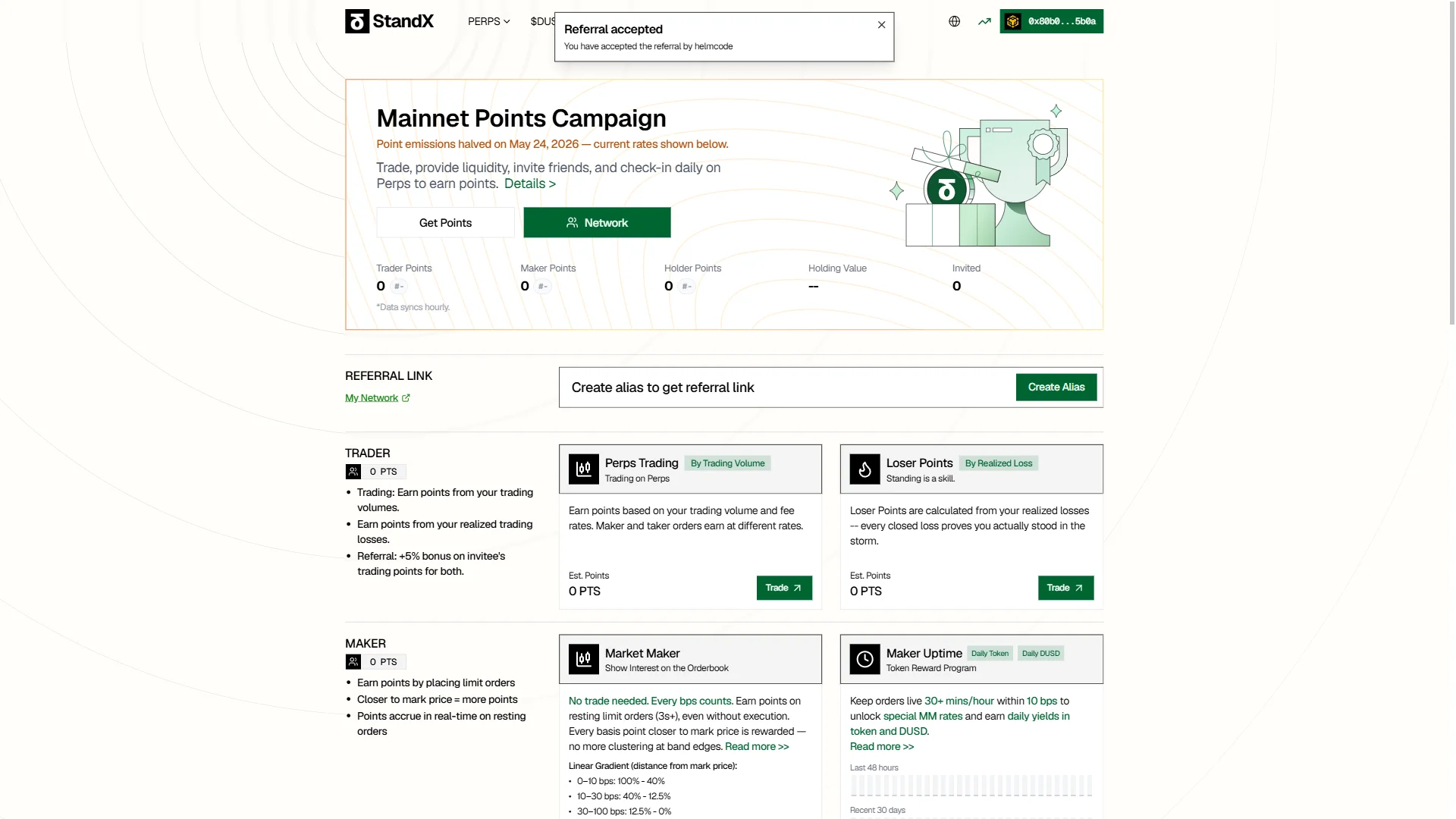
The screen shows “Referral accepted” and “You have accepted the referral by helmcode”, confirming that the referral code helmcode was correctly applied.
chainhelm continuously verifies the validity of the code and confirms it remains usable.
What the StandX referral code “helmcode” gets you
Apply this code when you connect to receive the following benefits on StandX:
- Benefit: a permanent 5% boost to your own trading points
- Expiration: None
- Eligibility: New users
To receive the benefits, you need to apply the code when you connect your wallet. Be careful not to miss this step.
StandX sign-up steps with the referral code
We cover the connection process separately for PC/browser and smartphone (mobile).
PC/browser connection steps
-
First, open the StandX official page (the link applies the referral code). When you open it, you’ll see a screen like the one below.
-
Open the referral link
— Figure 2Referral landing before connecting2026-07-26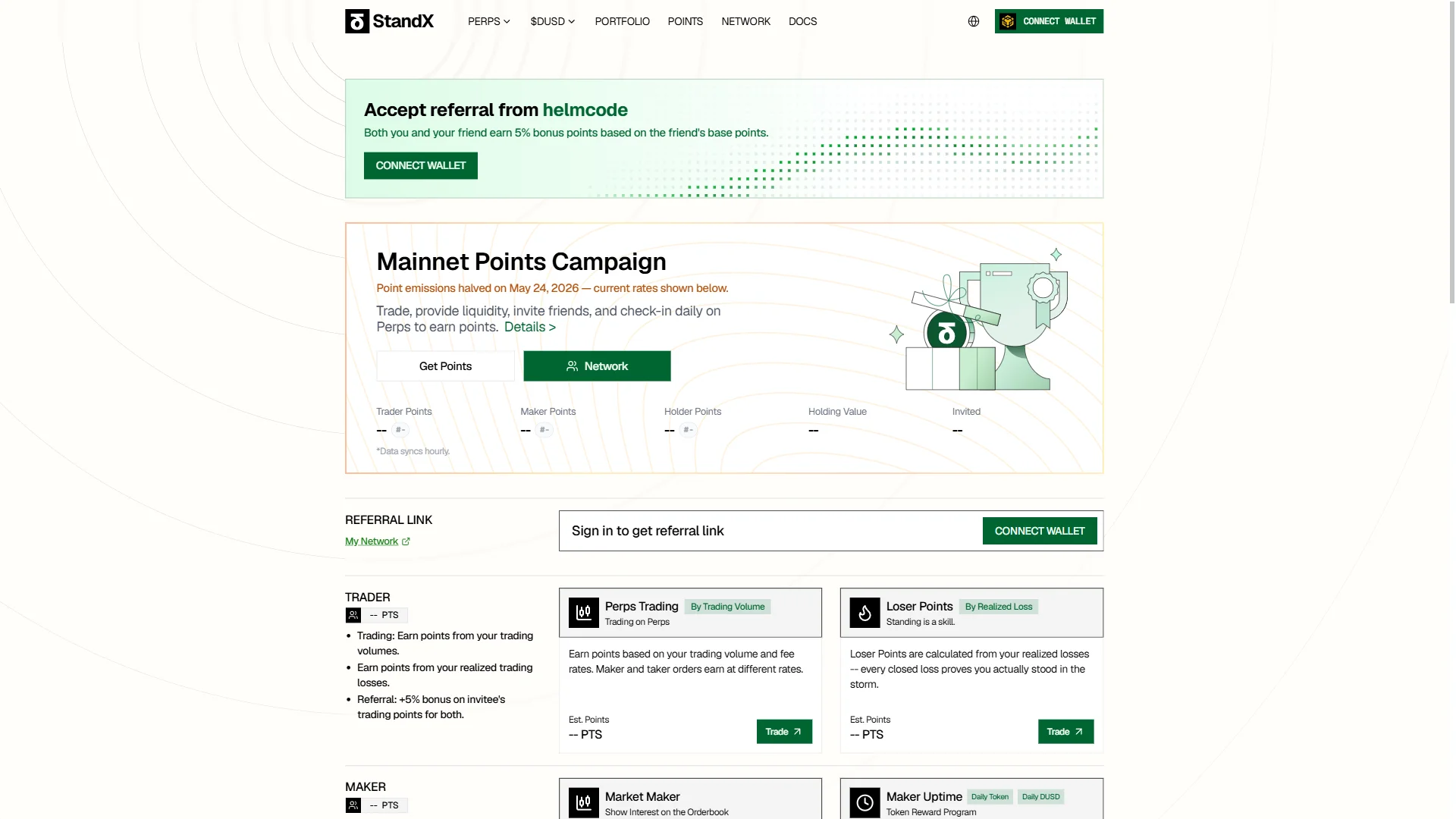
The referral banner from helmcode sits above a points panel that still reads "--". Source: chainhelm editorial Open the referral link and check the banner at the top of the page first. “Accept referral from helmcode” tells you the code is already applied to this session, and the line under it sets out the terms: both you and your friend earn 5% bonus points based on the friend’s base points.
Before you connect anything, note that the “Mainnet Points Campaign” panel is empty — Trader, Maker, and Holder Points, Holding Value, and Invited all read ”—”, because no wallet is attached yet. Click “CONNECT WALLET”, either in the banner or in the header, to open the wallet selection modal.
-
Choose your wallet
— Figure 3Wallet selection modal2026-07-26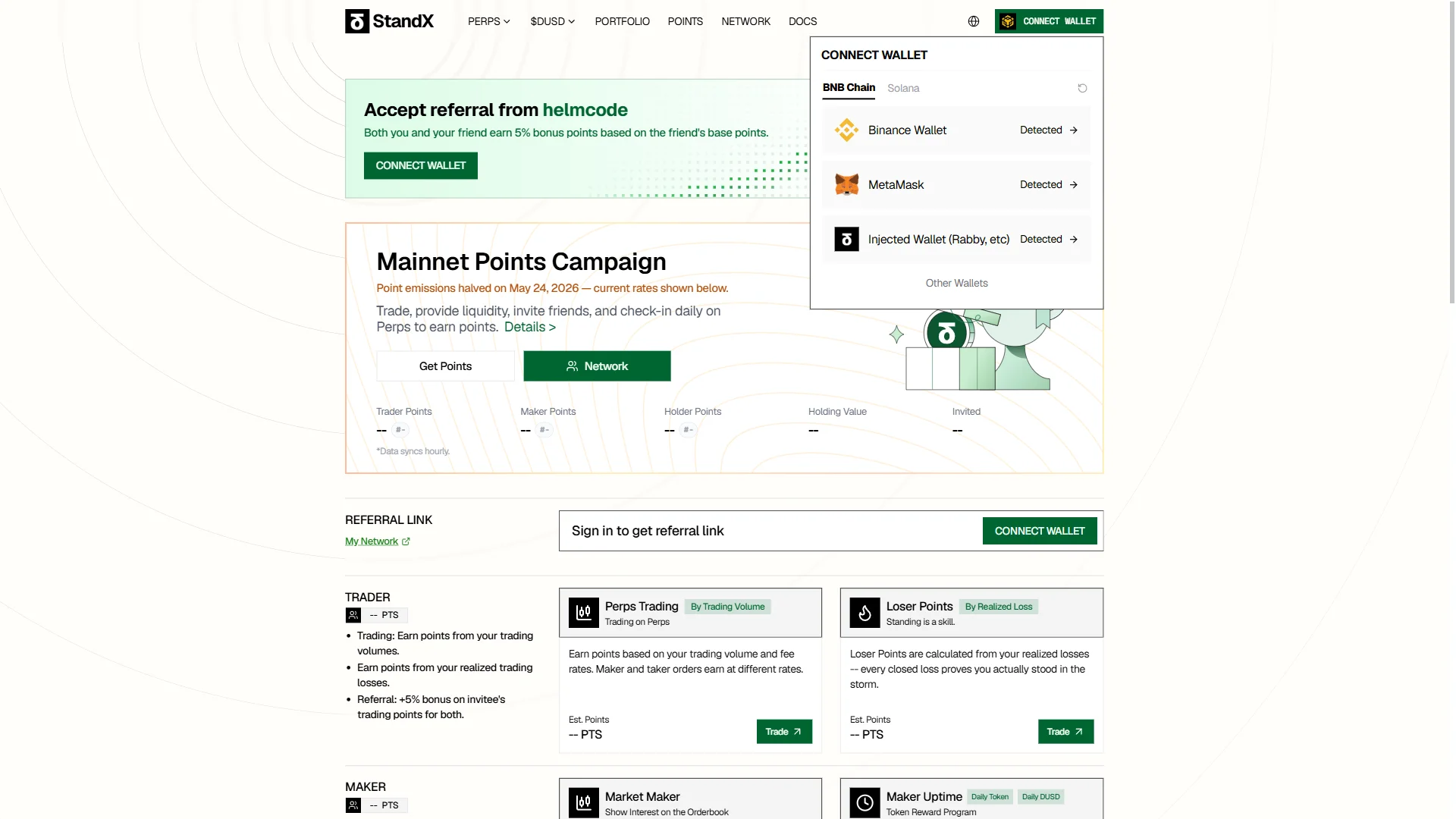
The "CONNECT WALLET" modal lists three detected wallets under the "BNB Chain" tab. Source: chainhelm editorial Pick the network you want to connect on — the modal opens on the “BNB Chain” tab and also offers “Solana” — then choose your wallet from the list below it.
Wallets the browser can already see are flagged “Detected”, and here that covers “Binance Wallet”, “MetaMask”, and “Injected Wallet (Rabby, etc)”. If yours is not on the list, open “Other Wallets” instead. Selecting an entry hands off to that wallet, which raises its own connection prompt.
-
Approve the connection
— Figure 4Wallet connection prompt2026-07-26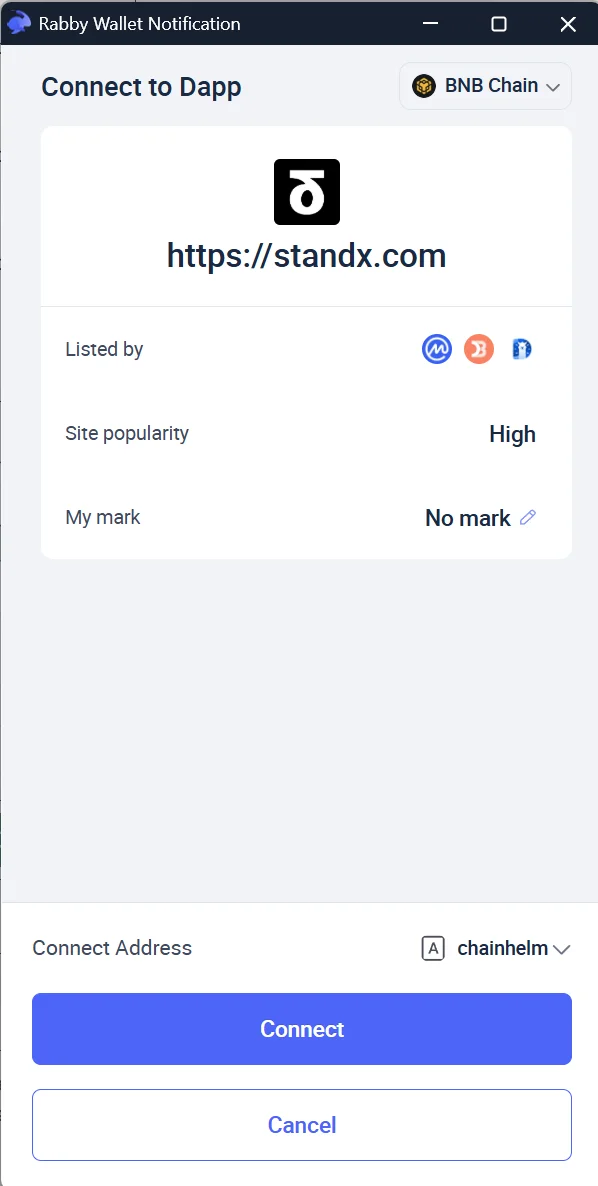
Rabby asks to connect to https://standx.com on "BNB Chain", with "Connect" and "Cancel". Source: chainhelm editorial Check what the prompt is actually asking for before you approve it. The header reads “Connect to Dapp”, the site named in the card is
https://standx.com, and the network selector at the top right shows “BNB Chain”. Below that, Rabby adds its own read on the site with “Listed by” and “Site popularity” rows. Confirm that the account in the “Connect Address” row at the bottom is the one you mean to use, then click “Connect” — or “Cancel” if any of it looks wrong.This screenshot is the Rabby browser extension on desktop. On mobile you approve the same connection inside whichever wallet app you selected. Once you approve, the wallet is linked and standx.com switches to its connected state.
-
Sign in from the wallet panel
— Figure 5Connected wallet panel2026-07-26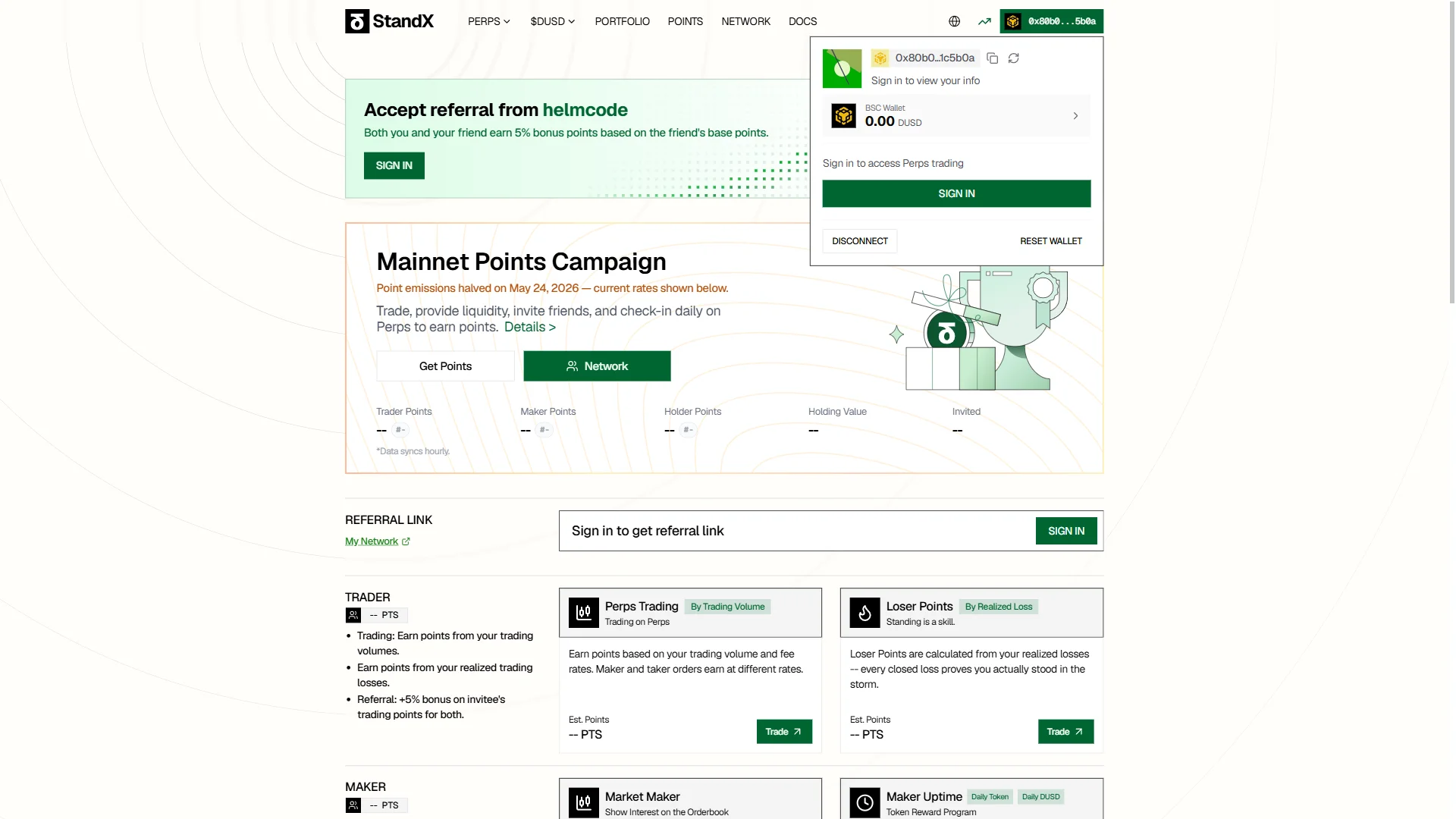
The "CONNECTED" panel shows a truncated address and a "SIGN IN" button above "DISCONNECT". Source: chainhelm editorial Read the “CONNECTED” panel that has taken the place of the connect button. It carries a truncated form of your address, a “BSC Wallet” row with the DUSD balance held there, and the note “Sign in to access Perps trading”; the header now shows the same truncated address.
Connecting is not the finish line. The banner CTA has changed from “CONNECT WALLET” to “SIGN IN”, and the campaign figures still read ”—” until you authenticate. Click “SIGN IN” to open the sign-in confirmation. “DISCONNECT” and “RESET WALLET” sit at the bottom of the same panel if you need to undo the connection before going any further.
-
Confirm the sign-in terms
— Figure 6Sign-in confirmation modal2026-07-26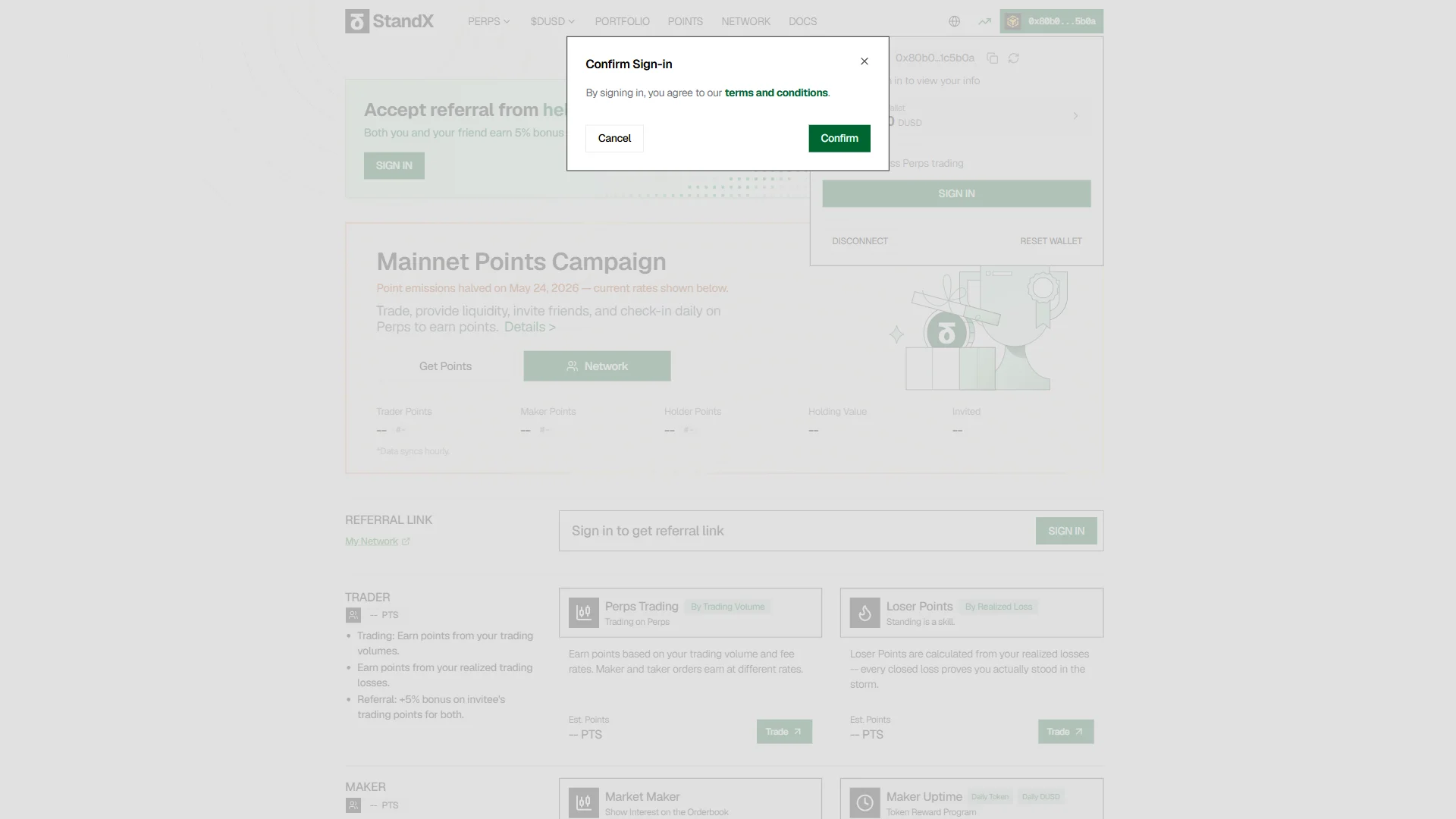
The "Confirm Sign-in" modal ties signing in to the linked "terms and conditions". Source: chainhelm editorial Read the “Confirm Sign-in” modal before you go further: signing in means you accept the “terms and conditions” linked in that one sentence, so open the link and read it now if you have not already. “Cancel” backs out without signing anything.
Click “Confirm” and your wallet takes over with a signature request.
-
Review and sign the message
— Figure 7Sign-in message in the wallet2026-07-26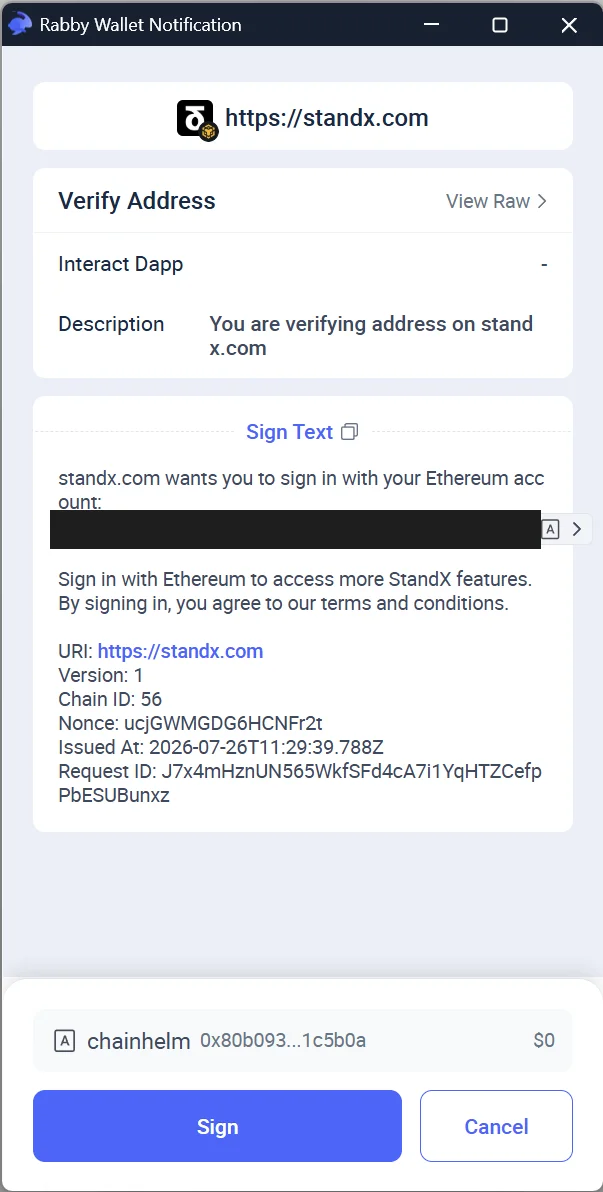
The "Sign Text" panel shows the sign-in message with URI, Chain ID, and nonce. Source: chainhelm editorial Check the message before you sign it. Rabby labels the request “Verify Address” and prints the body under “Sign Text”: standx.com asks you to sign in with your account, and the fields underneath — “URI:
https://standx.com”, “Chain ID: 56”, a single-use “Nonce”, an “Issued At” timestamp, and a “Request ID” — are what let you verify the request came from the site you are on. What you are approving is a text signature, not a transaction.This screenshot is the Rabby browser extension on desktop; on mobile you approve the same message inside the wallet app you selected. Click “Sign” to move to the confirmation stage of the prompt, or “Cancel” to drop it.
-
Submit the signature
— Figure 8Signature submit state2026-07-26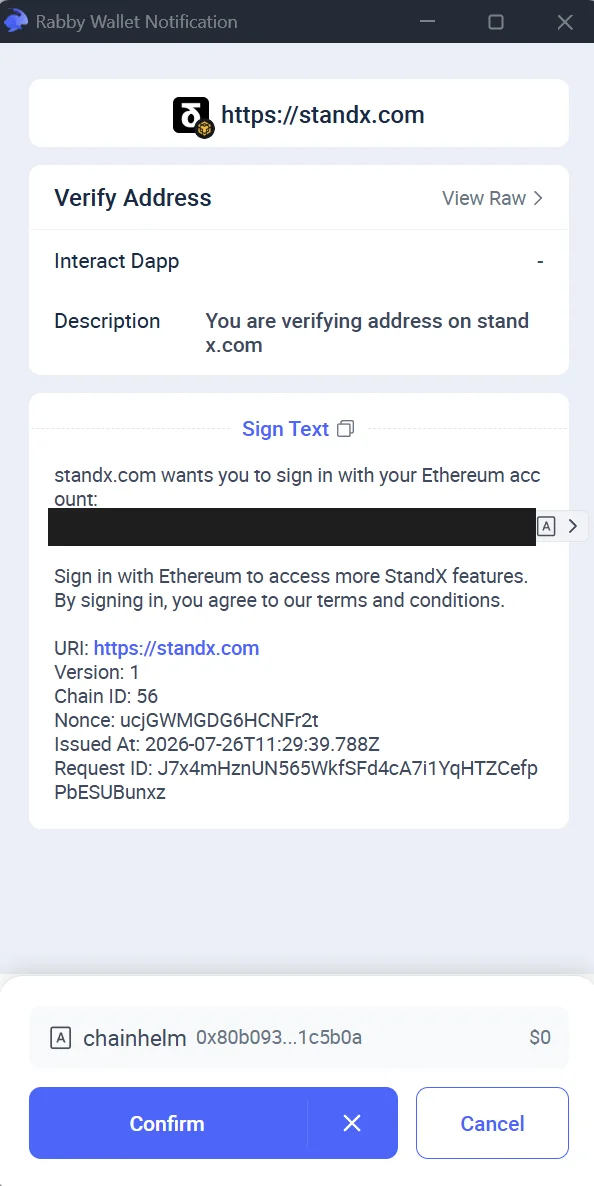
The same "Sign Text" prompt, with the bottom button now reading "Confirm". Source: chainhelm editorial Click “Confirm” to submit the signature. The prompt has kept the message on screen and only swapped the bottom button from “Sign” to “Confirm”, so use that moment to compare the text one last time; “Cancel” still backs you out.
This screenshot is again the Rabby browser extension on desktop, and on mobile the same second approval happens inside your wallet app. Once the signature goes through, the prompt closes and you are handed back to standx.com to accept the referral.
-
Accept the referral
— Figure 9Accept referral confirmation2026-07-26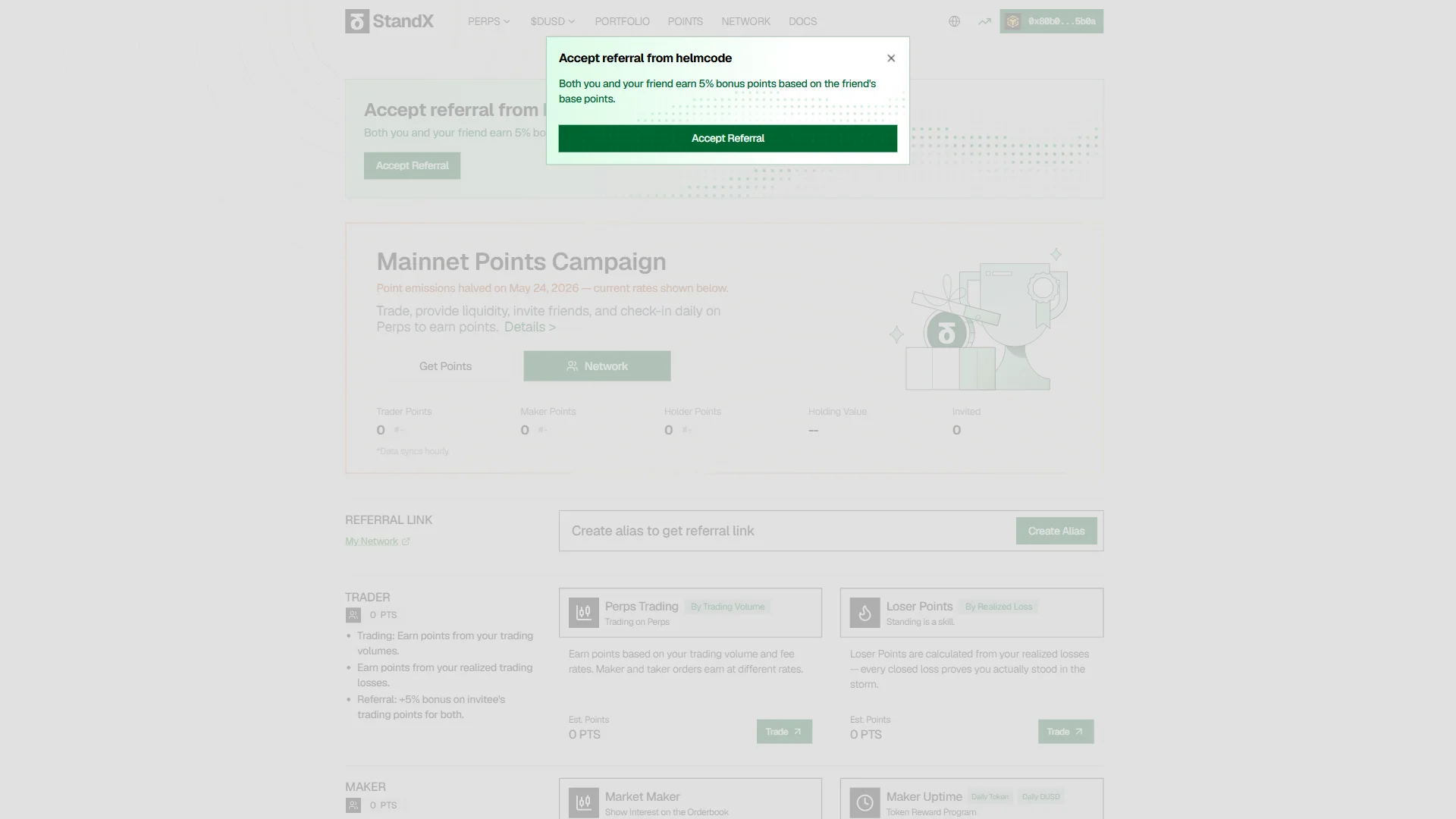
The "Accept referral from helmcode" modal restates the 5% bonus over a signed-in page. Source: chainhelm editorial Click “Accept Referral” in the “Accept referral from helmcode” modal, which restates the terms one last time before you commit: both you and your friend earn 5% bonus points based on the friend’s base points.
Behind the modal you can confirm that signing in took effect — Trader, Maker, and Holder Points have gone from ”—” to 0, Invited reads 0, and the referral link row now offers “Create Alias” where it used to ask you to sign in. Accepting closes the modal and returns a confirmation message.
-
Check the confirmation
— Figure 10Referral accepted toast2026-07-26 The "Referral accepted" toast confirms the code from helmcode applied to this wallet. Source: chainhelm editorial Confirm the result in the message at the top of the page: “Referral accepted”, with “You have accepted the referral by helmcode” underneath. That is your evidence the code was applied to this wallet, so read it before you dismiss it with the close icon.
The referral banner is gone from the page now, and the campaign panel reports 0 across Trader, Maker, and Holder Points and 0 under Invited — the starting baseline for a freshly signed-in account.
Smartphone (iOS / Android) connection steps
-
First, open the StandX official page in your mobile browser or your wallet app’s in-app browser (the link applies the referral code). When you open it, you’ll see a screen like the one below.
-
Open the referral link
— Figure 11Referral landing before connecting2026-07-26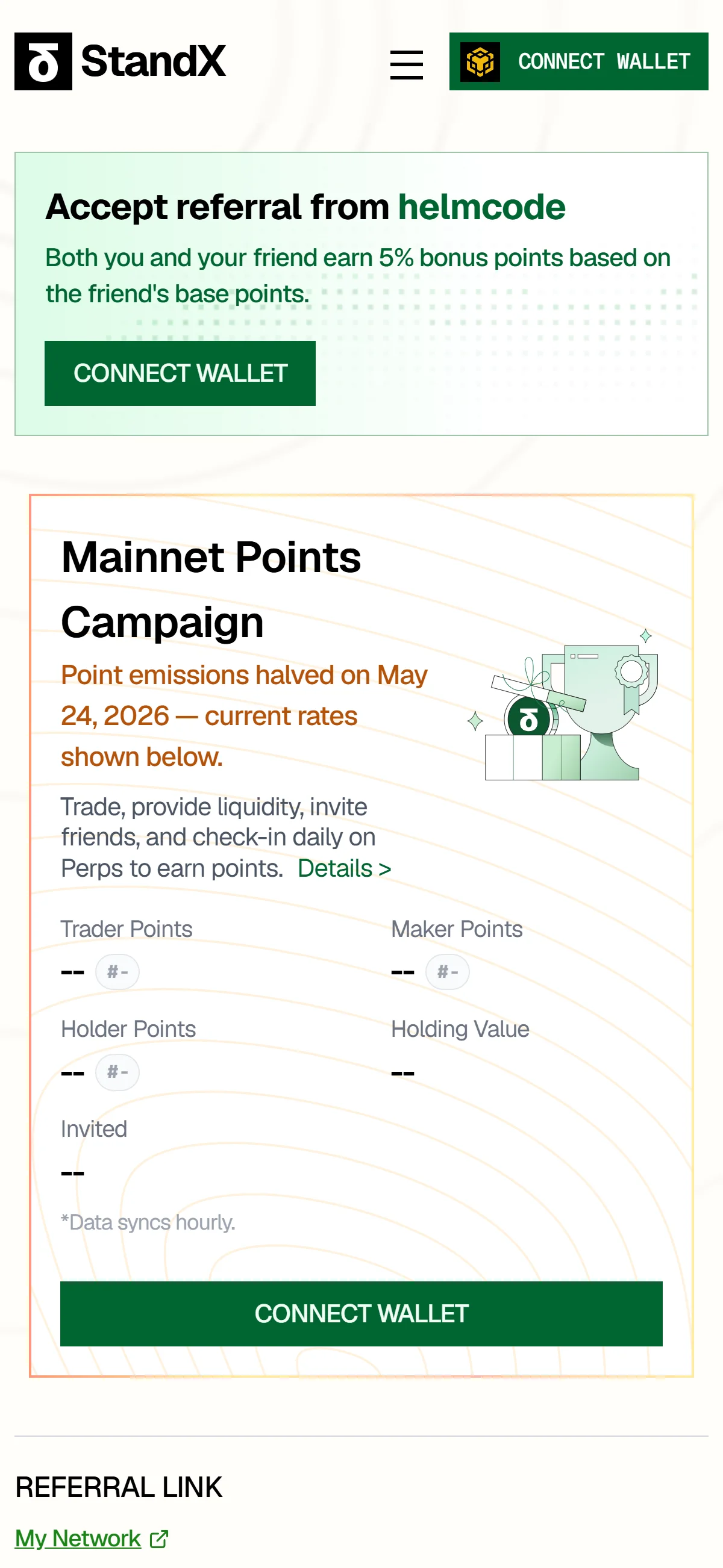
The referral banner from helmcode sits above a points panel that still reads "--". Source: chainhelm editorial Open the referral link and check the banner at the top of the page first. “Accept referral from helmcode” tells you the code is already applied to this session, and the line under it sets out the terms: both you and your friend earn 5% bonus points based on the friend’s base points.
Before you connect anything, note that the “Mainnet Points Campaign” panel is empty — Trader, Maker, and Holder Points, Holding Value, and Invited all read ”—”, because no wallet is attached yet. Click “CONNECT WALLET”, either in the banner or in the header, to open the wallet selection modal.
-
Choose your wallet
— Figure 12Wallet selection modal2026-07-26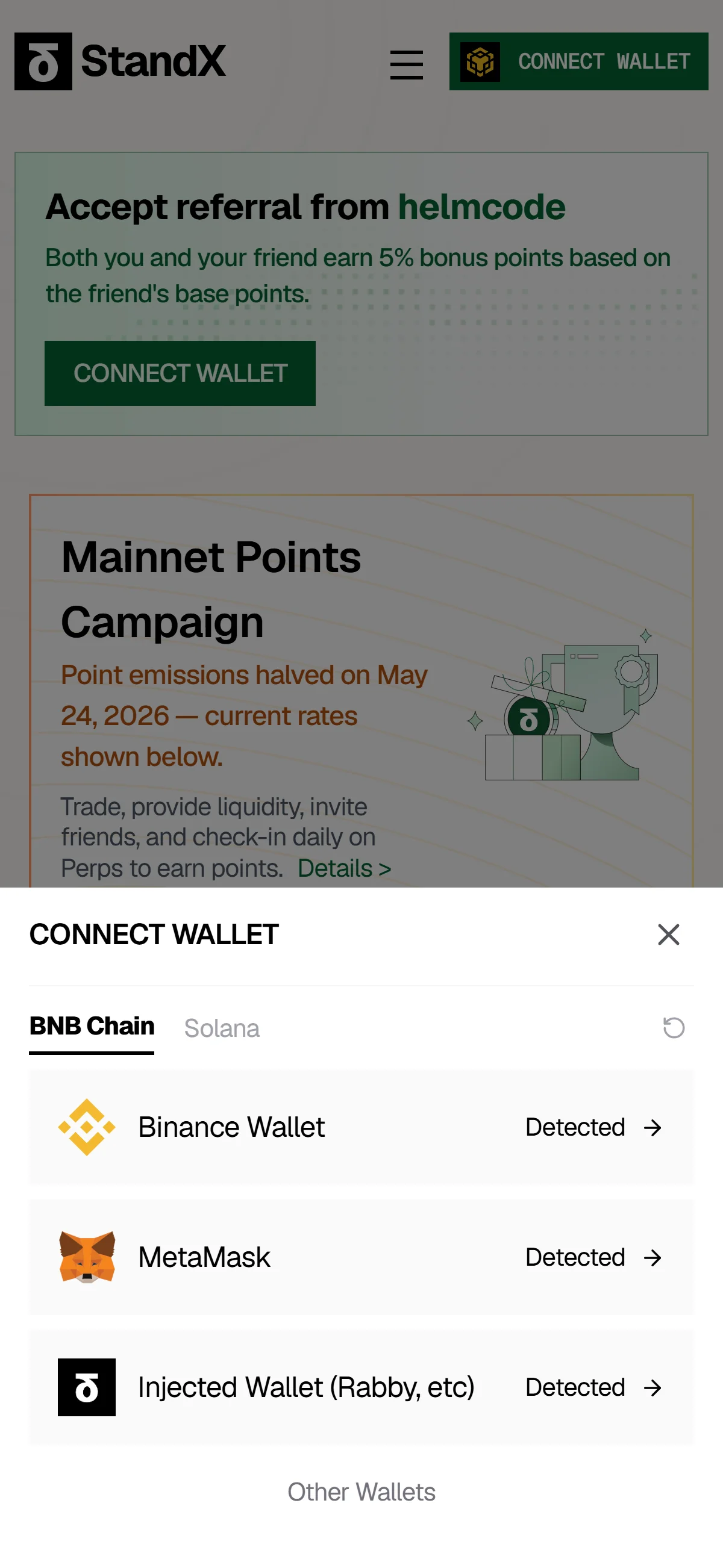
The "CONNECT WALLET" modal lists three detected wallets under the "BNB Chain" tab. Source: chainhelm editorial Pick the network you want to connect on — the modal opens on the “BNB Chain” tab and also offers “Solana” — then choose your wallet from the list below it.
Wallets the browser can already see are flagged “Detected”, and here that covers “Binance Wallet”, “MetaMask”, and “Injected Wallet (Rabby, etc)”. If yours is not on the list, open “Other Wallets” instead. Selecting an entry hands off to that wallet, which raises its own connection prompt.
-
Approve the connection
— Figure 13Wallet connection prompt2026-07-26 Rabby asks to connect to https://standx.com on "BNB Chain", with "Connect" and "Cancel". Source: chainhelm editorial Check what the prompt is actually asking for before you approve it. The header reads “Connect to Dapp”, the site named in the card is
https://standx.com, and the network selector at the top right shows “BNB Chain”. Below that, Rabby adds its own read on the site with “Listed by” and “Site popularity” rows. Confirm that the account in the “Connect Address” row at the bottom is the one you mean to use, then click “Connect” — or “Cancel” if any of it looks wrong.This screenshot is the Rabby browser extension on desktop. On mobile you approve the same connection inside whichever wallet app you selected. Once you approve, the wallet is linked and standx.com switches to its connected state.
-
Sign in from the wallet panel
— Figure 14Connected wallet panel2026-07-26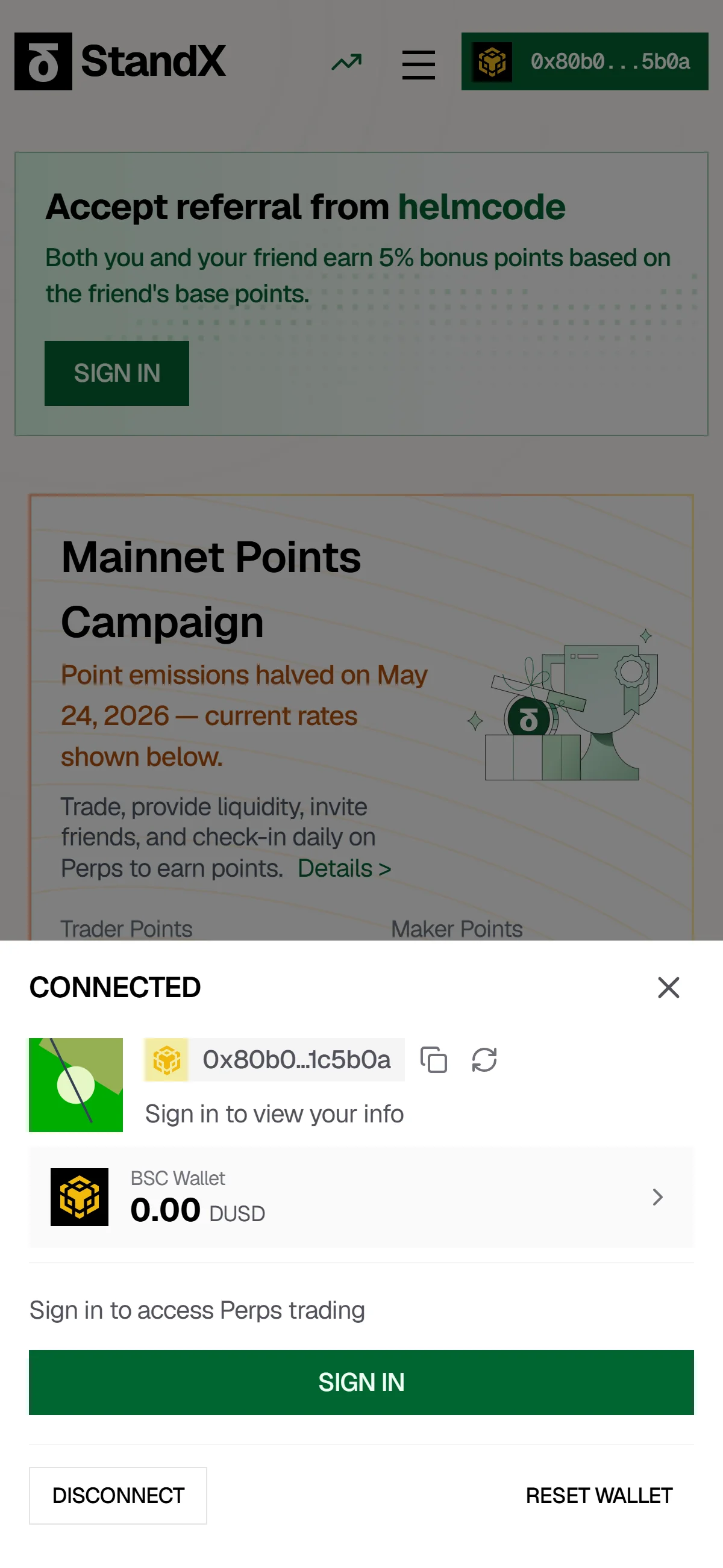
The "CONNECTED" panel shows a truncated address and a "SIGN IN" button above "DISCONNECT". Source: chainhelm editorial Read the “CONNECTED” panel that has taken the place of the connect button. It carries a truncated form of your address, a “BSC Wallet” row with the DUSD balance held there, and the note “Sign in to access Perps trading”; the header now shows the same truncated address.
Connecting is not the finish line. The banner CTA has changed from “CONNECT WALLET” to “SIGN IN”, and the campaign figures still read ”—” until you authenticate. Click “SIGN IN” to open the sign-in confirmation. “DISCONNECT” and “RESET WALLET” sit at the bottom of the same panel if you need to undo the connection before going any further.
-
Confirm the sign-in terms
— Figure 15Sign-in confirmation modal2026-07-26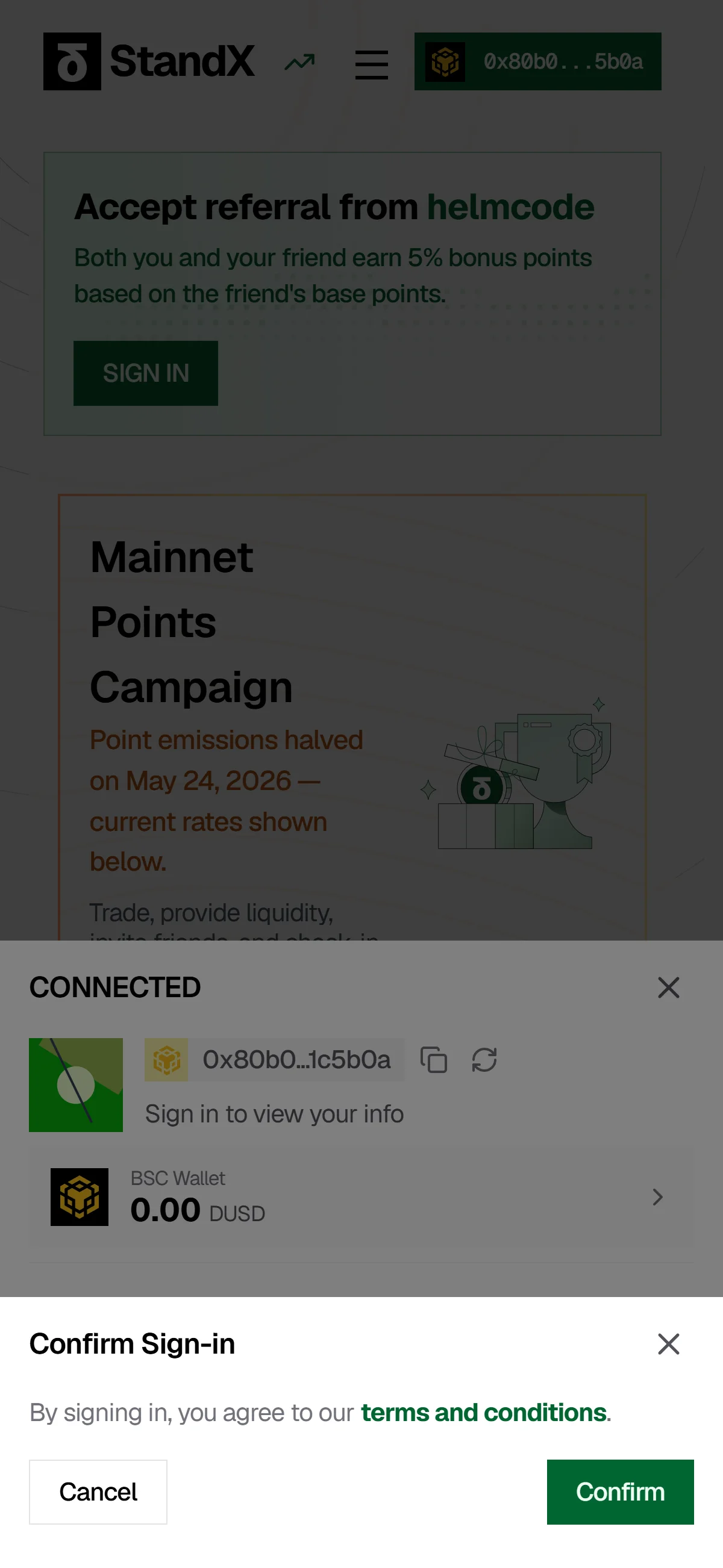
The "Confirm Sign-in" modal ties signing in to the linked "terms and conditions". Source: chainhelm editorial Read the “Confirm Sign-in” modal before you go further: signing in means you accept the “terms and conditions” linked in that one sentence, so open the link and read it now if you have not already. “Cancel” backs out without signing anything.
Click “Confirm” and your wallet takes over with a signature request.
-
Review and sign the message
— Figure 16Sign-in message in the wallet2026-07-26 The "Sign Text" panel shows the sign-in message with URI, Chain ID, and nonce. Source: chainhelm editorial Check the message before you sign it. Rabby labels the request “Verify Address” and prints the body under “Sign Text”: standx.com asks you to sign in with your account, and the fields underneath — “URI:
https://standx.com”, “Chain ID: 56”, a single-use “Nonce”, an “Issued At” timestamp, and a “Request ID” — are what let you verify the request came from the site you are on. What you are approving is a text signature, not a transaction.This screenshot is the Rabby browser extension on desktop; on mobile you approve the same message inside the wallet app you selected. Click “Sign” to move to the confirmation stage of the prompt, or “Cancel” to drop it.
-
Submit the signature
— Figure 17Signature submit state2026-07-26 The same "Sign Text" prompt, with the bottom button now reading "Confirm". Source: chainhelm editorial Click “Confirm” to submit the signature. The prompt has kept the message on screen and only swapped the bottom button from “Sign” to “Confirm”, so use that moment to compare the text one last time; “Cancel” still backs you out.
This screenshot is again the Rabby browser extension on desktop, and on mobile the same second approval happens inside your wallet app. Once the signature goes through, the prompt closes and you are handed back to standx.com to accept the referral.
-
Accept the referral
— Figure 18Accept referral confirmation2026-07-26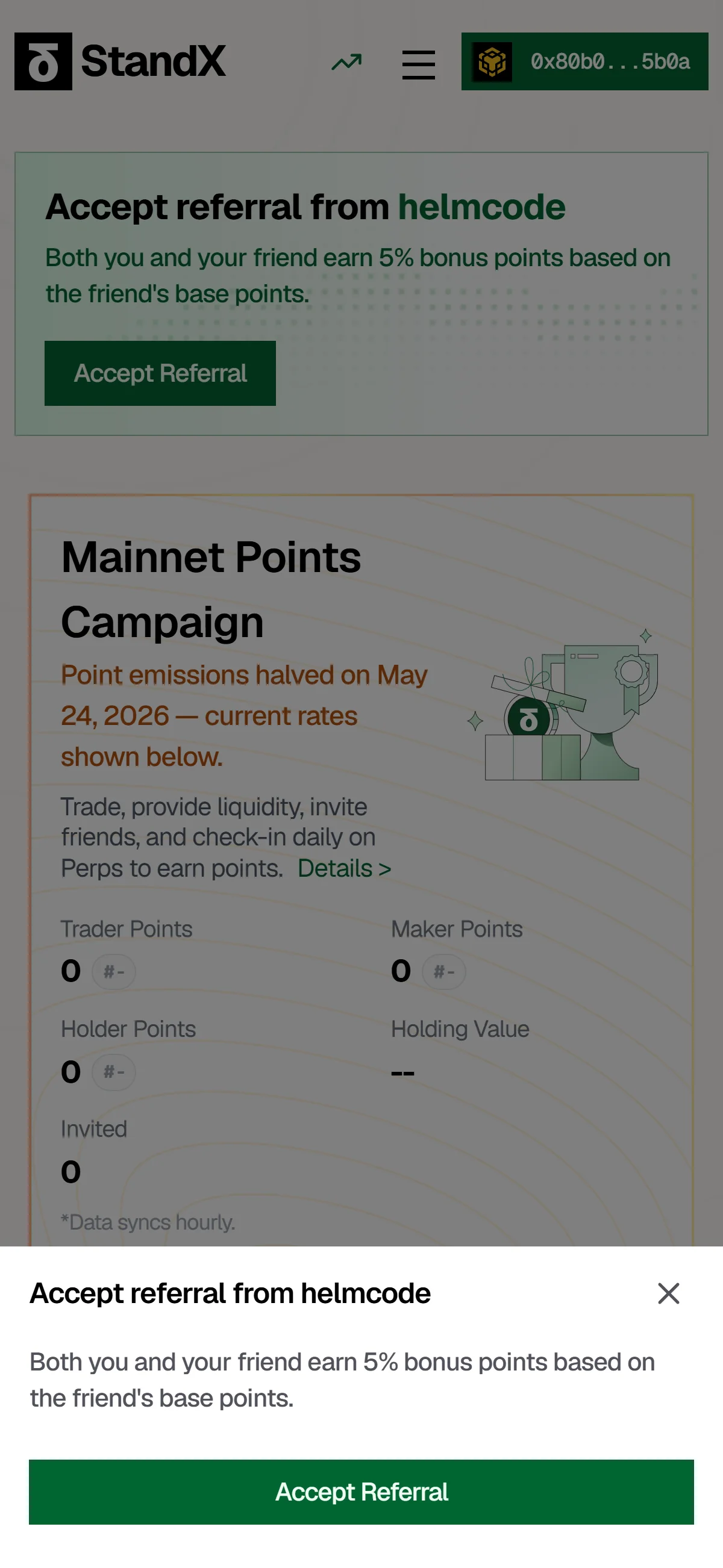
The "Accept referral from helmcode" modal restates the 5% bonus over a signed-in page. Source: chainhelm editorial Click “Accept Referral” in the “Accept referral from helmcode” modal, which restates the terms one last time before you commit: both you and your friend earn 5% bonus points based on the friend’s base points.
Behind the modal you can confirm that signing in took effect — Trader, Maker, and Holder Points have gone from ”—” to 0, Invited reads 0, and the referral link row now offers “Create Alias” where it used to ask you to sign in. Accepting closes the modal and returns a confirmation message.
-
Check the confirmation
— Figure 19Referral accepted toast2026-07-26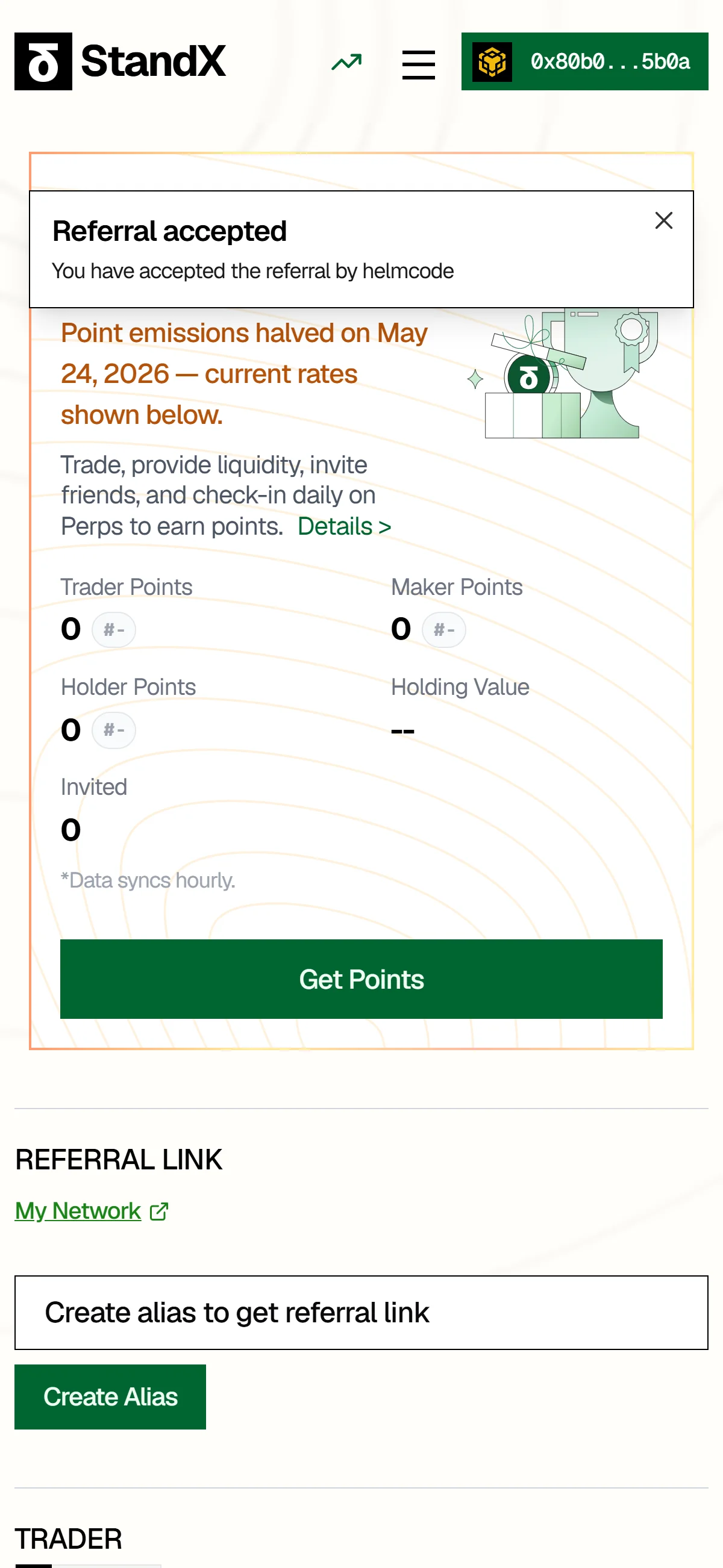
The "Referral accepted" toast confirms the code from helmcode applied to this wallet. Source: chainhelm editorial Confirm the result in the message at the top of the page: “Referral accepted”, with “You have accepted the referral by helmcode” underneath. That is your evidence the code was applied to this wallet, so read it before you dismiss it with the close icon.
The referral banner is gone from the page now, and the campaign panel reports 0 across Trader, Maker, and Holder Points and 0 under Invited — the starting baseline for a freshly signed-in account.
What to do after connecting to StandX
We cover the deposit process separately for PC/browser and smartphone (mobile).
PC/browser deposit steps
The connection flow leaves the desktop account in a usable state: the wallet is connected, the sign-in signature is on record, and the referral is bound to that wallet. Funding is the next action, and it happens inside the venue’s own interface rather than through anything the referral link carries.
chainhelm’s first-hand verification covers the connection and the code application, not the deposit path, so this section shows no captured screens. Deposit interfaces are also the part of a venue that goes stale fastest as chains are added and screens are rearranged, which is why this article keeps chain lists, minimum amounts and bridge routes out of the procedure and treats the collateral itself — what it is and where it has to sit — in the overview and risk chapters below.
Smartphone (iOS / Android) deposit steps
On a phone the state after connecting is the same, whether you arrived through the mobile browser or a wallet app’s in-app browser: the wallet is connected, the sign-in signature is on record, and the referral is bound to that wallet. Funding again happens inside the venue’s own interface.
The same scope limit applies here — no deposit screens were captured on mobile either, and the same details that go stale first are the ones a mobile guide is most tempted to hard-code. The overview and risk chapters below carry what the collateral is and what holding it commits you to.
Once the “Referral accepted” message appears, the wallet is signed in and the account is ready to use.
The StandX referral code cannot be added after sign-up
The referral code can only be applied when you connect your wallet — it cannot be added afterwards.
If you overlook this and complete the connection without the code, there is no mechanism for linking it to that wallet after the fact.
Registering again with a fresh wallet is an option worth considering.
- Is the referral code helmcode shown as applied when you connect your wallet? (check any on-screen notice that appears when you arrive via the referral link, and the code field where the venue provides one)
- After connecting, open the Referral / Rewards page and check that the referral is reflected there — referral-linked displays such as the commission rate appear only once a wallet is connected
◆ ◇ ◆
StandX points program and airdrop
The shape of the Mainnet Points Campaign
Points campaigns are usually described in the abstract. This one has a datable history, and that history is the most useful thing about it. StandX runs a single continuous Mainnet Points Campaign rather than numbered seasons, and the rounds that came before it are closed rather than folded in.
Read the 2026-05-24 line before any of the others. Halving emissions on three of the tracks while leaving two untouched is the only change on the record that alters the economics rather than the surface, and it settles a question the campaign pages never answer directly: the accrual rate is an operator setting, not a schedule. Someone starting today earns at half the rate an early participant earned for the same activity, and nothing published commits the operator to holding even that.
The rest of the entries make a smaller version of the same point. Bonuses appear and expire, a new way to earn is bolted on in January, a daily bonus is retired in February. This is a campaign edited in flight, which is worth knowing before you plan around any single number on it.
The four axes points accrue on
Points here do not simply track volume, and that is the part worth slowing down for.
- Trading volume
- Trader points accrue on traded volume at separate maker and taker rates. Realized losses also earn, at 5 points per 1 USD since 2026-01-14.
- Resting maker orders
- Limit orders that sit on the book for 3+ seconds earn, weighted by distance from mark price, whether or not they are ever filled.
- DUSD held in the product
- 0.5x for balances in the Perps Wallet and 0.625x in a Vault. Cash Wallet balances earn nothing.
- Listed LP positions
- 0.5x for DUSD and 0.6x for USDT/USDC in the listed pools.
Three of those four pay for holding and quoting rather than for trading, which is unusual on a perp venue, and the multipliers say plainly where the operator wants balances to sit. The same DUSD earns at three different rates depending on which screen it is parked on, and one of those rates is zero. For a reader that is a placement decision made once and then forgotten about — leave the balance one screen to the left of where it should be and it accrues nothing at all.
Referrals are wired into the same machinery through Network Yield, which pays a referrer a tiered share of invitees’ trading fees: 5% from 500,000 DUSD of personal trading volume, rising to 10% at 2.5M DUSD of network volume, 15% at 7.5M and 20% at 15M, with an application-only Community Builder structure sharing group yield inside the same 20% ceiling. That is how the program is built. What a reader receives for using chainhelm’s code is the benefit chapter’s business, not this one’s.
Eligibility then has a geographic limb the multipliers do not show. Residents of the geo-blocked jurisdictions, and any Prohibited Person under the terms, are barred from the site and from DUSD outright, so none of the above reaches them. The one placement trap worth naming separately is restaking: LP tokens have to stay in your own wallet, because moving them can transfer ownership and forfeit the rewards attached to them.
No token yet, and nothing promised about one
State the position flatly, because the alternative is letting a reader fill the gap themselves. There is no platform token as of 2026-07-26, and no token generation event has taken place. The documentation refers to a platform token whose allocation already accrues under Community Maker Yield, but that token is not live; DUSD is the collateral stablecoin, not the awaited one. The airdrop history is empty — there is no past distribution to report, so there is no precedent to reason from either.
What the operator has actually said is a short list with dates on it. In the 2025-12-03 Discord townhall the co-founder declined to give a date and pointed to a prediction-market probability instead of committing. The mainnet campaign pages publish no conversion ratio. The documentation states that the token is not yet live while allocation entries keep accruing. That is the whole record.
Points accrue against an unstated future: no platform token as of 2026-07-26, no date offered for one, and no published conversion ratio.
So this chapter estimates nothing — not what points might be worth, not when a distribution might come, not what other venues’ airdrops paid. None of it is knowable from what StandX has published, and a reader deciding how much activity to put through the venue is better served by that blank than by a number someone invented for it.
What is StandX
Eight months live, 8th of 197 by daily volume
Age frames everything else here. Perps mainnet went live on 2025-11-24 on BNB Chain and Solana, after a waitlisted alpha that opened 2025-10-14, and the first product was not the exchange at all but DUSD, announced 2024-12-08 and launched 2025-01-27. The venue a reader would actually be trading on is roughly eight months old.
Half of those numbers need their context carried with them. The volume figure placed StandX 8th of 197 tracked perp protocols on 2026-07-26, at a 4.74% share of the USD 7.42B tracked that day, and it is falling fast: DeFi Llama recorded a one-month change of -60.79%. Open interest is the sturdiest figure in the set and ranks 13th of the 69 perp protocols for which DeFi Llama reports it at all.
The other two are the ones most often misread. DUSD supply is not the same thing as DeFi Llama’s protocol TVL of USD 33.2M, which measures something narrower. And the Standers count is a community number, not a trading one — a separate official post counts 19,206 DUSD holders on BNB Chain as of 2026-07-16, an order of magnitude lower and the closer proxy for people with money on the venue.
One dated claim needs retiring explicitly, because it is still in circulation. On 2026-06-28 StandX stated it had reached the number 4 perp DEX slot at roughly USD 700M a day. A month later DeFi Llama put it 8th at USD 351M. It was true when it was said; it is not the current position, and it should not be quoted as one.
Eleven perpetual markets are live: BTC, ETH, SOL, BNB and HYPE, plus gold (XAU), silver (XAG), crude oil (CL) and three US equities (TSLA, MU and SPCX), all margined in the same collateral. The counterparty on the other side of the terms is StandX Issuer Ltd, a British Virgin Islands company registered as 2163662, with the terms governed by the laws of England and Wales and disputes going to LCIA arbitration seated in London. No separate legal entity is named for the trading venue itself, leadership names circulate only through media coverage — one instance of it labeled sponsored content — official channels use first names and initials, and there is no team page. The practical reading for a reader is narrow but real: the entity you would be in dispute with is named and offshore, and the party running the order book is not named anywhere.
Maker 0.01%, taker 0.04%, and where the fee revenue goes
A perpetuals bill is four things, and only the first of them is on the rate card.
- Trading fee
- Maker 0.01% and taker 0.04% of notional (1.0 and 4.0 bps), with no volume tier ladder published for ordinary users as of 2026-07-26.
- Funding
- Settles hourly, with premium and impact inputs sampled every 5 seconds, a baseline interest rate of 0.00125% per hour and a cap of 4% per hour that can be configured lower per market. Paid between traders, not to the platform.
- Gas
- Matching is off-chain, so orders cost no gas. Chain gas applies only to on-chain actions: minting DUSD, depositing, submitting a withdrawal request, block-trade approvals.
- DUSD mint and redemption
- Minting is free with a USD 5 minimum. Redeeming to USDT or USDC costs 0.1% with a 7-day redemption period, or exits immediately on third-party pools at their own pool fees.
The absence of a retail tier ladder is worth saying plainly rather than implying one is hidden: for ordinary users there simply is not one. No platform fee is documented for perps deposits or withdrawals either, which means the costs that actually accumulate away from the rate card are funding and chain gas. Funding is the line that surprises people — at the cap it is not a rounding item on a leveraged position, and because it flows between traders rather than to the venue, there is nobody to appeal to about it.
The only published fee ladder belongs to market makers. Monthly evaluation of Community Maker Yield performance sets the next month’s rates, with taker falling from 3.00 bps at the entry tier to 2.00 bps at the top and maker reaching a rebate of -0.50 bps; qualifying means two-sided orders within 10 bps of mark price for at least 30 minutes an hour. And because no platform token exists, there is no token-holding or staking discount at all — worth stating out loud, because on this class of venue a token discount is the default assumption a reader arrives with.
This is also not a zero-fee venue, and where the revenue goes is the distinctive part: SIP-3 routes net trading fee revenue daily into the DUSD settlement pool, and SIP-2 pays a configured share of net eligible fee flow to positions held past a minimum time, subject to risk-validity checks and a maximum rewardable leverage. A taker paying 4 bps is, in part, paying into a pool that pays holders of the very collateral they had to post.
Off-chain matching, on-chain settlement, DUSD as the only collateral
StandX runs no chain of its own. Settlement, custody and cross-chain messaging run through StandX-deployed contracts on BNB Chain and Solana — Gateway for mint and deposit, Settler for settlement, Highway for cross-chain messaging — while matching happens off-chain on the operator’s engine. The one-line reading to carry forward is that the venue is non-custodial for balances and centralized for execution; what that costs is the risk chapter’s subject.
The book itself is a central limit order book with maker and taker roles and GTC, IOC and ALO time-in-force, matched off-chain and settled on-chain, with withdrawals going through what the documentation calls a dual-validation withdrawal system, combining off-chain processing with an on-chain withdrawal request.
Collateral is where the design stops resembling its peers. DUSD is the single collateral token for perps, minted 1:1 from USDT or USDC with a USD 5 minimum, and balances sit in two places: a Cash Wallet for deposits and withdrawals, and a Perps Wallet for trading, with instant transfer between them. Margin held as DUSD keeps earning while it backs open positions.
Read that ladder as a specification rather than an invitation. Position size, not appetite, decides what leverage is actually reachable, and at maximum leverage only reduce-only orders are accepted. What the same structure does to a reader who uses the top of it is the risk chapter’s subject, not this one’s.
What makes StandX distinct
Where StandX sits against Hyperliquid and the rest of the field
Mid-table is the honest description. The venues ahead of StandX by 24-hour volume on 2026-07-26 were Hyperliquid, Lighter, ApeX Protocol, Aster, Grvt, Variational and edgeX — a list that tells a reader more than a rank does, because it is the field they are actually choosing between.
Those are relative figures against the field, and they carry their date for a reason. Reported perp volume is inflatable by wash and incentive-driven trading, and listed market counts are trivially easy to pad, so the comparison stays on a small fixed metric set rather than a scorecard. StandX’s own one-month volume change of -60.79% is the best argument for that restraint: a single-day ranking on this metric is worth very little a month later.
Breadth is the one gap that is not arguable. Eleven live markets against venues listing hundreds is a different product, and the route that would widen it — SIP-5, the permissionless listing proposal — sits at Review status dated 2026-03-31 with its Shield and Reward vaults marked coming soon. That is roadmap, not product, and a reader choosing on coverage today should treat it as absent.
Yield-bearing collateral and fee revenue routed back to users
The genuine differentiator is the collateral itself. DUSD is yield-bearing and it is the sole perps margin, so margin keeps earning while it backs an open position, with no staking step and no lock-up. The yield comes from staking rewards on hedged spot assets plus funding received on the short hedge legs, tracked per address and settled weekly.
Against mainstream perp DEXs, where margin is USDC or a native token and idle collateral earns nothing at the venue level, that is a structural difference rather than a promotional one. It also has a price, and the price is not in this chapter: the thing generating the yield is an actively managed hedge, and posting it as margin is not optional here.
- Fee revenue recycled, not bought back
- SIP-3 (implemented 2026-04-14) routes net trading fee revenue daily into the DUSD settlement pool; SIP-2 (implemented 2026-03-31) pays a configured share of net eligible fee flow to positions that stay open past a minimum hold time. Neither routes to a token buyback or an insurance pool.
- Rewards for quoting, not turnover
- Maker points accrue on resting limit orders that sit for 3+ seconds even if never filled, weighted by distance from mark, and Community Maker Yield pays daily for keeping two-sided quotes within 10 bps for 30+ minutes an hour, with per-market caps.
- Markets and trade types crypto-only venues do not carry
- Gold, silver, crude and three US equities trade on the same collateral and risk engine as the crypto perps, and SIP-1 Block Trade lets a maker publish a negotiated order on-chain for up to 25 counterparties, isolated from the central book so mark price, funding and candles are unaffected.
Read together, those three describe a venue that pays its users out of its own revenue and pays them for supplying liquidity rather than for consuming it. That is a coherent design, and it also explains who ends up here: it rewards patience — idle margin, resting quotes, positions left open — far more than it rewards turnover.
Who it suits, and when another venue is the better answer
Two groups get real value from that design. Traders who hold stablecoin margin idle between positions and want it to keep earning. And passive market makers who can quote two-sided within 10 bps and be paid for uptime rather than for fills. The venue’s own stated audience matches closely: active perp traders with meaningful idle stablecoin balances, market makers and quoting bots chasing uptime-based rewards, and points-oriented users who accept an unpromised platform token.
- If you trade long-tail or altcoin markets
- Only 11 markets are live, and the route that would widen them is unshipped.
- If you are in the United States, the United Kingdom, Russia or another excluded jurisdiction
- The terms bar you outright.
- If you want collateral without issuer or hedge-strategy risk
- Margin must be DUSD, whose value rests on an actively hedged portfolio run through third-party venues, on a reserve fund, and on a 7-day redemption queue with a 0.1% fee.
- If you require audited, open-source matching and settlement
- The published audits cover the DUSD contracts and the messaging layer, not the perps engine, and the audited contract repositories referenced inside the reports return 404.
That is a fit assessment and nothing more. Whether a reader can use StandX at all is a separate question with a separate answer, and it has its own chapter below; nothing here proposes a substitute for anyone the list rules out.
StandX regulatory landscape
The 35 jurisdictions on StandX’s exclusion list
Naming them is the point. The terms define 35 Geo-Blocked Jurisdictions, and what makes the list worth reading rather than skimming is its composition: sanctions-driven entries sit beside two large regulated markets, the United States and the United Kingdom, and beside entries such as Guatemala, Moldova and Niger. The terms give no reason for any individual listing.
The 35 Geo-Blocked Jurisdictions, in full
The exclusion runs on two tracks at once. Contractually, residence in a listed jurisdiction makes a person a Prohibited Person, and every user warrants that they are not one. Technically, the shipped frontend evaluates the visitor’s region against the same list and renders a full-page “Restricted Jurisdiction” notice on a match — jurisdiction research observed that state rendering, with market data still visible read-only and the wallet control replaced by a disabled one. The United States is captured twice over, once as a named jurisdiction and once as its own limb of the Prohibited Person definition.
One caution about dating the list. The terms document carries no consistent effective date across the sources checked, so this article does not date the list from it. What is datable is that archived captures from 2025-06-16 and 2026-04-15 show the same list, and that it still stood on 2026-07-26 — stable for roughly a year, in other words, but not fixed.
The two layers behind the block, website and contracts
The block is a property of the website. The contracts on BNB Chain and Solana carry no jurisdictional gate of their own, which is precisely why the terms bind by representation rather than by technical impossibility — a promise the user makes, not a door the protocol closes. That architecture explains the shape of the terms.
No license anywhere, and no regulator action naming StandX
The license list is empty by the issuer’s own declaration, not by a gap in research. The terms state that neither the issuer nor any group member is regulated, supervised or otherwise licensed by any financial services regulator, including the British Virgin Islands Financial Services Commission, and that the user has no recourse to any statutory compensation scheme on insolvency. No application is on record in any jurisdiction researched.
No regulator action naming StandX or StandX Issuer Ltd was found in any jurisdiction as of 2026-07-26. That finding deserves its exact weight and no more. It is the result of searching rather than an assumption, and it is weak evidence: the venue has been live only since 2025-11-24, and several of the lists checked say on their face that they are not exhaustive. It is not clearance, approval or supervision by anybody.
Every one of those is category evidence, never a finding about StandX. They are useful because they show where the attention in this sector falls — and where StandX’s own forward exposure sits is not hard to read off its product list. The equity- and commodity-referencing perpetuals are the products most likely to attract securities or derivatives-licensing scrutiny, and the two jurisdictions with the most active enforcement in that area, the United States and the United Kingdom, are both excluded up front.
The trajectory, in one line, is static-restrictive rather than tightening or loosening. The venue launched already excluding the United States, the United Kingdom, Russia and 30-odd other jurisdictions, claims no license anywhere, and no directional regulatory event has occurred since mainnet. The exposure sits in the product mix, not in any pending action.
StandX availability across major jurisdictions
Two of the five markets this edition covers are shut out by StandX itself; the other three are open but unlicensed. Those are different situations and they ask different things of a reader, so the summary below is a starting point rather than an answer.
United States: excluded by the terms and blocked at the front end
The answer ends the question for a US-based reader: you cannot sign up, and you cannot apply a referral code. The restriction is StandX’s own, not the consequence of anything an authority has done to it.
The backdrop is a settled position rather than a live case. In its 2023-09-07 settled orders against three DeFi protocol operators, the CFTC set out that perpetual contracts of this kind are swaps and leveraged or margined retail commodity transactions, which may be offered to retail users only on a registered exchange — and in the same orders it found that one operator’s steps to exclude US users were not sufficient to actually block them. StandX is named in none of it.
Something changed separately, and it is worth a US reader knowing. On 2026-05-29 the CFTC issued a policy statement on listing perpetual contracts and approved a designated contract market’s bitcoin-referencing perpetual, so a lawful onshore channel for crypto perpetual futures now exists. “Perps are barred in the US” is therefore no longer an accurate summary. StandX is not part of that channel, is not CFTC-registered in any capacity, and the existence of a registered route authorizes nothing about unregistered offshore venues.
The negative evidence is thorough and still limited. No US action naming StandX was found: all 284 entries of the CFTC RED List were checked, SEC EDGAR full-text search returned zero hits, and CFTC and SEC enforcement searches surfaced nothing. Absence of a public action is not evidence that no non-public inquiry exists.
Two layers should not be collapsed into one. Every US enforcement action located ran against operators rather than retail users, and no primary source was found penalizing a US retail user for trading perps on an unregistered venue. But StandX’s own terms make any person located or organized in the United States a Prohibited Person, so use by a US resident breaches those terms regardless of route, with no US forum and no compensation scheme behind it. Separately, tax is self-reported and nothing arrives from the venue: the DeFi front-end broker reporting rule was disapproved under the Congressional Review Act and enacted as Public Law 119-5 in April 2025. That is the position.
United Kingdom: excluded by the terms, alongside the FCA’s retail derivatives ban
The same answer comes first: a UK reader cannot register or apply a code. Two separate things then sit on top of each other, and they are worth keeping apart — the venue’s own exclusion, and the UK’s own rules.
Perpetual futures are crypto derivatives, so the 2021 ban is directly on point — but it binds firms inside the UK perimeter rather than the individual consumer, and that distinction carries the whole sub-section. The limb with teeth for an overseas venue is the promotions regime: a non-compliant promotion breaches section 21 FSMA, a criminal offense, and the FCA states it will act, including website takedown requests. Whether a venue of this shape falls inside the perimeter being built for 2027 is genuinely unsettled, because the DeFi guidance that would decide it has not been consulted on yet.
No FCA, HM Treasury, Bank of England, HMRC or UK court statement naming StandX was found, and the venue does not appear in the FCA register. The FCA Warning List could not be searched programmatically, so this is negative evidence and nothing more — it is not the FCA having cleared anything.
On the user side the honest answer is that the question is not directly addressed. No primary source was found making it an offense for an individual UK resident to trade on an offshore perpetuals DEX, and equally none stating that it is permitted, against a clear contractual prohibition on the venue’s side. What is unambiguous is what is missing: no Financial Services Compensation Scheme protection, and no Financial Ombudsman recourse.
Singapore: reachable, and outside the MAS perimeter
Singapore is not among the excluded jurisdictions, so the question for a Singapore reader is not whether they can sign up but what they are signing up to. StandX holds no MAS license.
Where the product sits in MAS’s own scheme is the substantive point here, and it is not intuitive. Guideline PS-G02 classifies payment token derivatives as contracts referencing digital payment tokens, and states that MAS does not regulate them unless they are offered by an Approved Exchange under the Securities and Futures Act. A crypto perpetual offered by a venue that is not an Approved Exchange therefore falls outside MAS regulation of the product itself — and even customers of MAS-regulated entities have no statutory protection for their digital payment token trading. The perimeter is narrower than most readers assume.
MAS’s posture toward offshore venues is stated plainly enough. Its 2023-11-23 media release on consumer access measures urges consumers “not to deal with unregulated entities, including those based overseas”, and its Investor Alert List has stayed active through 2026: KuCoin on 2026-02-11, Bybit on 2026-06-17, and the permissionless perpetual venue Hyperliquid on 2026-06-26. StandX was not on that list on 2026-07-26. Given the cadence, read the absence as a point-in-time reading of a list that says on its face it is not exhaustive.
What a Singapore reader carries, then, is an unlicensed offshore venue and the loss risk on their own account. StandX makes no statement either way about providing tax documents, and takes no Singapore-specific tax position beyond the generic clause pointing users to their own advisers.
Australia: reachable, with no Australian license behind it
Australia is not within any excluded-region category of the terms, so what an Australian reader has to weigh is not access but what stands behind the venue once they are on it. StandX holds no Australian license.
ASIC has been unusually explicit about this product class, which makes the anchor here a strong one. The updated Information Sheet 225, published 2025-10-29, names perpetual futures expressly among the derivatives requiring an Australian financial services license, and states that the use of offshore or decentralized structures does not mean key obligations under Australian laws do not apply. It makes no determination about StandX.
The distance between the first two figures is what an Australian reader should sit with — not because StandX is bound by the Australian limit, but because it measures the gap between what a licensed provider may offer here and what is reachable by default on this venue. ASIC has already drawn that comparison itself: on 2025-07-28 it issued a named investor alert against a different offshore venue over unlicensed crypto asset futures offered at up to 125:1, noting that Australians using unlicensed products lose access to internal dispute resolution and client money protections. That is class-level evidence and creates no finding about StandX, which was also absent from the AUSTRAC public register of virtual asset service providers under a regime that commenced 2026-03-31.
What is genuinely unresolved deserves to be left unresolved. No Australian law was located prohibiting a resident from trading on an offshore non-custodial perpetuals DEX, and the obligations identified are directed at providers. Whether StandX requires an AFS license, and whether the CFD product intervention order reaches its perpetuals, are both open in the primary sources. Tax, meanwhile, is entirely self-reported: the ATO requires records of every crypto transaction including Australian-dollar values at the time of each, kept for five years, and no tax documentation facility for Australian users exists on the venue side.
India: reachable, with tax entirely self-assessed
India is not listed as a Geo-Blocked Jurisdiction, so an Indian reader reaches the perpetuals on the same terms as any other non-blocked country. StandX was not found registered under India’s framework.
The framework’s reach is the substantive point. FIU-IND’s AML and CFT guidelines for virtual digital asset service providers, updated 2026-01-08, state that obligations are activity-based and apply irrespective of physical presence or registered location, that smart-contract automation does not relieve controlling parties of their Chapter IV PMLA obligations, and that an unregistered provider is liable to action under section 13 of the PMLA. What does not exist is a FIU-IND determination on whether a non-custodial perpetuals DEX falls inside the notified-activity hook. That gap is real, and stating it as a gap serves a reader better than papering over it.
The reach is not theoretical either. FIU-IND has twice acted against offshore providers under section 13 PMLA: nine on 2023-12-28, with a request to block their URLs, and twenty-five on 2025-10-01, with app and URL takedown notices. The second wave reached offshore derivatives venues but no non-custodial DEX, and StandX is named in neither. Category evidence again, not a finding.
The arithmetic of those three lines lands entirely on the reader. StandX is not a prescribed reporting entity, provides no tax documentation and disclaims tax advice — so the withholding that would ordinarily be an exchange’s job, and the reporting that would ordinarily arrive from it, both become the reader’s own work.
◆ ◇ ◆
Risks to acknowledge before using StandX
Audits that stop short of the trading venue
Start with the audit coverage gap, because it is the specific thing a reader is most likely to get wrong. Six audit reports are published, and every one of them covers the DUSD contracts or the cross-chain messaging layer.
Nothing published covers the perps matching engine, the settlement flow as deployed, the system vault or the community vaults — and no report is dated after 2025-11-14, even though three protocol improvements shipped during 2026. On this venue, “audited” does not mean the trading venue was audited, and a reader treating the audit page as coverage of the place they are trading is reading it for something it does not say.
On-chain does not mean immutable here either. Direct RPC reads on 2026-07-26 show that the BSC DUSD token, Gateway, Settler and Highway addresses are all delegatecall proxies loading their implementation from storage, and the Gateway implementation exposes UUPS upgrade and role-based access control selectors. There is no public disclosure of who holds the admin or upgrader role, or whether those keys are multisig-controlled; the audit itself flags that role members are not enumerable on-chain; and no timelock is documented or visible in the deployed selectors, so upgrades appear executable without an enforced delay.
The bridge path is thin in a way that reaches your money. The WatchPug audit of the Highway messaging layer notes that only one validator address exists in that path — a single-signer bridge validator at the time of audit — and records two medium findings in the same layer. Deposits and withdrawals across BNB Chain and Solana run through it, which is what turns a technical footnote into a funds-access question.
Nor is the venue open source in any meaningful sense. The public organization holds audit PDFs, adapter forks and an assets repository; no protocol source is published; and the two contract repositories referenced from inside one audit report both return 404, so even the audited snapshots are unreadable. No bug bounty or responsible-disclosure program was found. Deployed bytecode can still be inspected, since the contract addresses are published — that is the whole of what an outsider can independently check.
The clean record should be priced correctly rather than read as reassurance. No exploit, oracle manipulation, governance attack, outage or depeg affecting StandX was found after active searching, and no litigation or regulatory action involving the venue or its founders was located. Both are searched findings, and both are weak evidence: the venue has been live only since 2025-11-24 and publishes no status page, so a short outage would surface in chat and nowhere else.
40x, auto-deleveraging, and a single collateral token
Leverage belongs at the front of a risk chapter for this venue rather than in an aside. Up to 40x is reachable at tier 1 with a 1.25% maintenance margin ratio on BTC, ETH, gold, silver and crude, 30x on BNB and SOL, 20x on the equity and HYPE markets, and the ladder steps down to 5x at the largest tier. The structural point is what sits in front of it: no identity check and no jurisdictional suitability assessment. The same design that makes access easy also removes every intermediary that would otherwise stand between a reader and a 40x position.
Into the book
System vault
Auto-deleveraging
The third stage is the one readers do not expect, and it is worth putting in plain terms: a profitable position can be closed for reasons that have nothing to do with that trader’s own risk. A 1.25% clearance fee applies on forced closes, waived when the position is bankrupt.
The backstop behind all of that has no published size. There is no separately branded insurance fund — the system vault plays that role — and its current size is not disclosed. The last public figure came from a Discord townhall summary dated 2025-12-03 and is eight months stale as of 2026-07-26. DUSD’s hedging documentation separately mentions a reserve fund to absorb negative funding periods, also with no size disclosed. A reader cannot size the thing that is supposed to absorb the tail, which is itself the finding.
Funding is a real cost rather than a rounding item. It settles hourly with a cap of 4% per hour, configurable lower per market, and flows between traders rather than to the platform. On a leveraged position held through a persistently one-sided market, that hourly transfer becomes a material carrying cost — one that keeps running whether or not the position is going your way.
Collateral concentration closes the section, and it is the price of the yield-bearing margin the previous chapter credits. Margin can only be DUSD, so every position inherits that token’s risk profile: a value that depends on an actively managed market-neutral hedge run through third-party venues and custody arrangements, on a reserve fund of undisclosed size, and on a redemption path that takes 7 days and costs 0.1% to exit directly with the issuer, the immediate alternative being a third-party pool at pool prices. That is a different risk profile from posting a fully fiat-reserved stablecoin, and here it is not optional.
Operator-run execution and a single route to your positions
Pricing depends on centralized exchange data, which is worth stating on a venue that presents as decentralized. No oracle provider is named for the live markets; the documentation refers only to a reliable oracle index, and the named feeds appear solely in a proposal still at review status. Mark price is a median of three inputs, and StandX continuously benchmarks its mark against three large centralized exchanges, temporarily adopting their median mark on significant divergence until conditions stabilize.
Execution is operator-run in the same way. Matching happens off-chain on the operator’s engine, so the venue is non-custodial for balances but centralized for execution: order acceptance, matching and the withdrawal request path all depend on operator-run services continuing to run.
Self-custody cuts both ways, and the burden side belongs in this chapter. The terms state that the venue never has custody, possession or control of user assets and that the user is solely responsible for the private keys. Nothing on the venue side can restore access to a lost key, and there is no identity-bound account to recover through. There is also no third-party or alternative frontend and no documented permissionless contract interface for trading, so the official site is the practical access path to a position that is already open.
Non-custodial for your DUSD, operator-run for your exit, and audited where the token lives rather than where it is traded.