— Contents 12 sections
- 01 Is the GMTrade referral code “chcode” still active?
- 02 What the GMTrade referral code “chcode” gets you
- 03 GMTrade sign-up steps with the referral code
- 04 What to do after connecting to GMTrade
- 05 The GMTrade referral code cannot be added after sign-up
- 06 GT points are minted by the fees you pay, not handed out in seasons
- 07 What GMTrade is: the GMX DAO’s Solana deployment, run by contributors it does not name
- 08 Fifth by reported 24-hour volume, and the highest-ranked Solana-native perp venue in that one aggregator’s snapshot
- 09 GMTrade names one excluded country in its terms and holds no license anywhere
- 10 The United States is blocked, while the UK, Singapore, Australia and India reach the full interface
- 11 A winning position can be closed for you, and no one has published who can upgrade the programs
- 12 Before you connect: the discount attaches once, to one wallet
chainhelm’s exclusive GMTrade referral code is .
As of 2026-08-10, we connected a new wallet and confirmed that the referral code was carried through and ready to apply.
Connect your wallet using this code to receive an ongoing 10% discount on your trading fees, not a one-time thing. The code takes effect only on that first connection — that step happens once, the discount that follows does not.
This article covers the sign-up process (wallet connection) with the GMTrade referral code, GMTrade’s distinguishing features, availability in the United States, the United Kingdom, Singapore, Australia and India, and the risks to acknowledge — with the connection flow and code application verified first-hand by chainhelm’s editorial team.
Is the GMTrade referral code “chcode” still active?
The chainhelm editorial team connected to GMTrade with a fresh wallet on 2026-08-10 and confirmed that the referral code “chcode” is still active.
Here is the actual screen captured during verification.
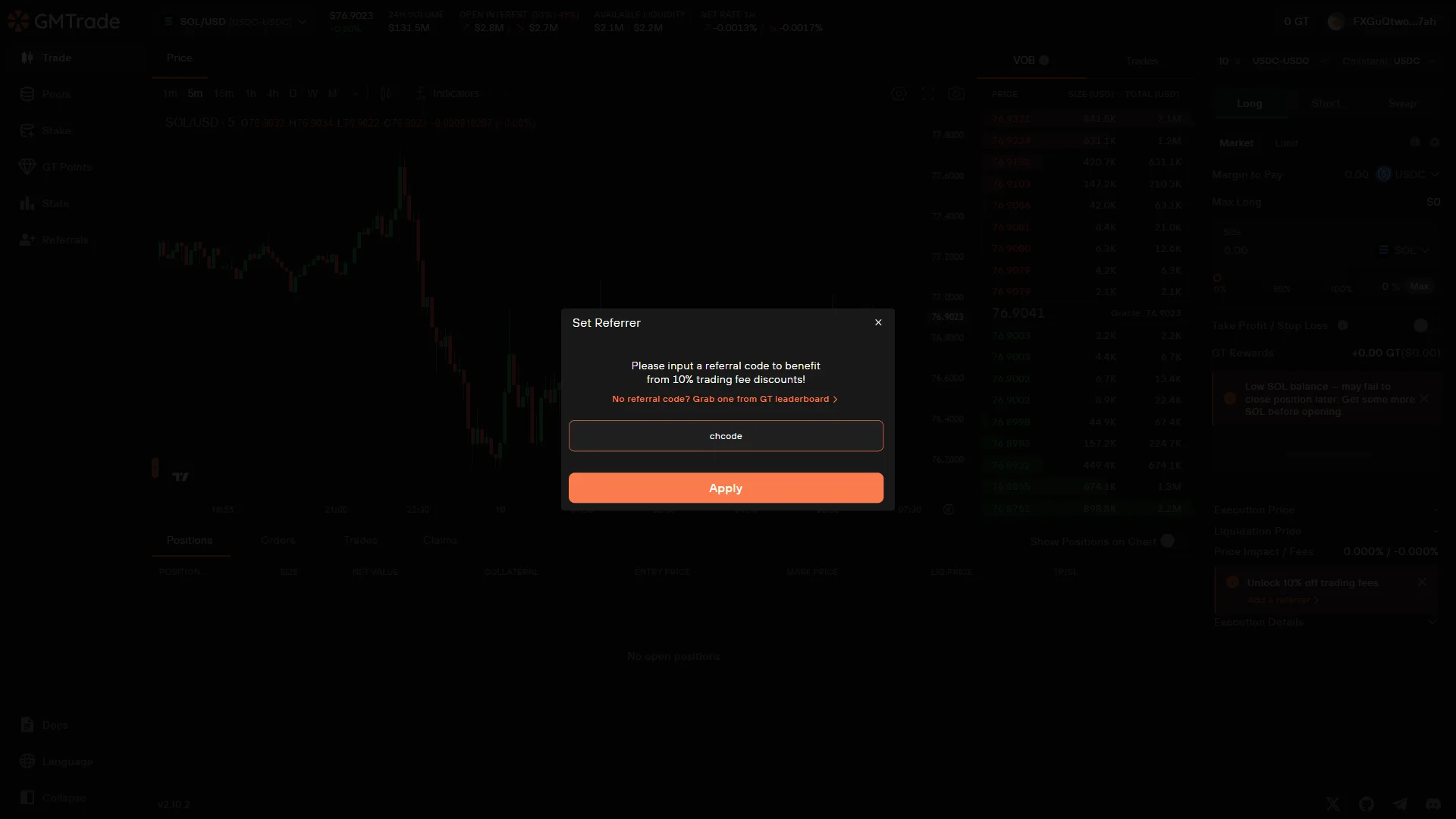
chainhelm continuously verifies the validity of the code and confirms it remains usable.
What that session covers is narrow, and it is worth being exact about it. Opening the /r/chcode link brought up the Set Referrer window with chcode already sitting in the code field, and pressing Apply put the button into an “Applying…” state with a green “Setting referrer…” notice — a display that belongs to the flow and then disappears. We did not verify any permanent confirmation surface on the referred side: there is no “Referred by” row we can point you to, because the referrer is written by an on-chain transaction, and the wallet used for the capture held no SOL to pay for one. Everything after this chapter — the fee schedule, the rules in your country, the risks — comes from documents and public registers, not from that session.
What the GMTrade referral code “chcode” gets you
Connect your wallet using this code to receive the following benefits on GMTrade:
- Benefit
- an ongoing 10% discount on your trading fees, not a one-time thing
- Expiration
- None
- Eligibility
- New users
You only receive these benefits when you connect your wallet using the code. Connect without it and you won’t be able to get them afterward.
GMTrade sign-up steps with the referral code
We cover the connection process separately for PC/browser and smartphone (mobile).
PC/browser connection steps
-
First, open the GMTrade official page (the link applies the referral code). When you open it, you’ll see a screen like the one below.
-
Connect your wallet from the referral link
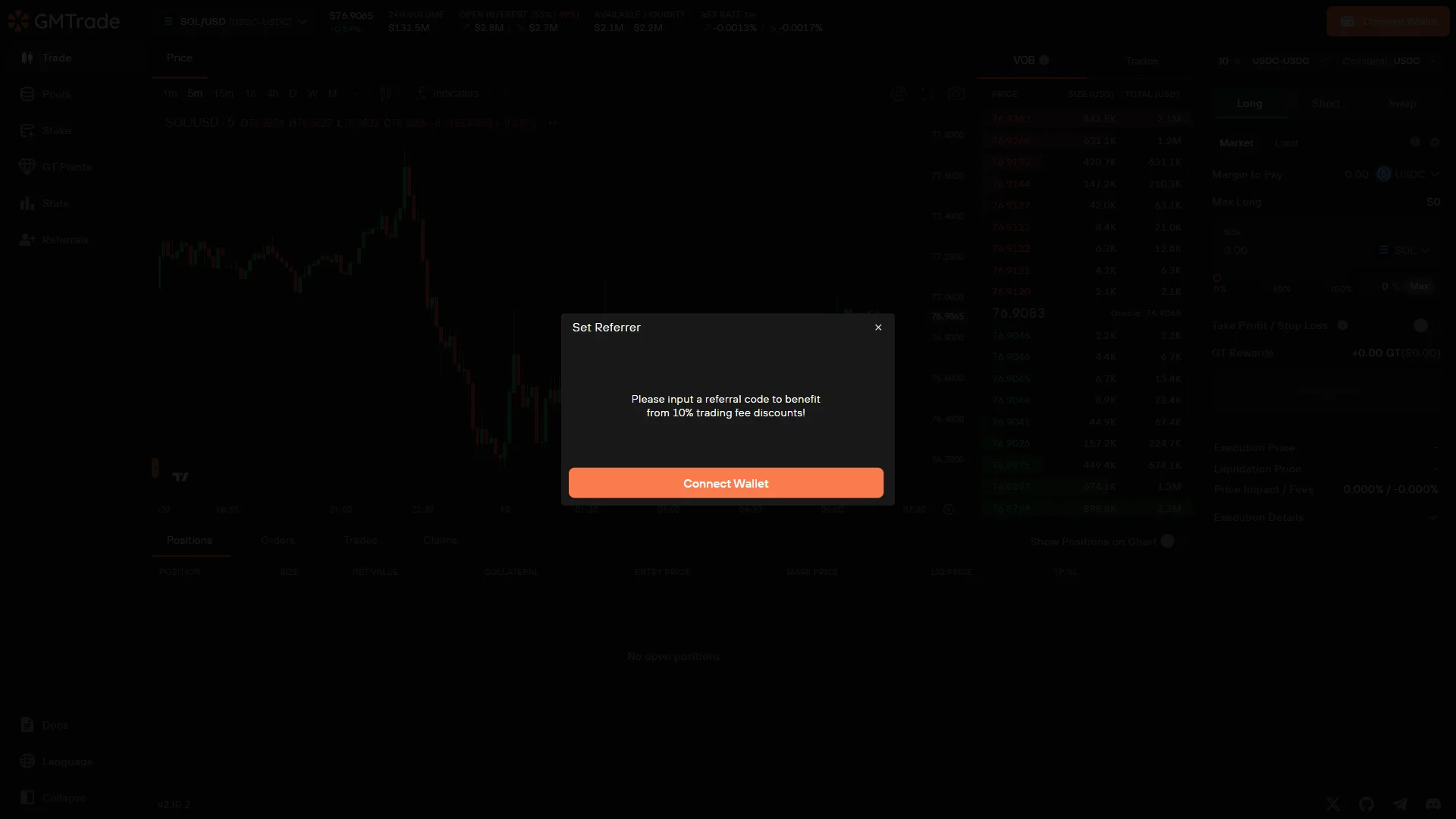
Open the referral link and click “Connect Wallet” in the “Set Referrer” window that opens over the trading screen.
At this stage the window carries only the line “Please input a referral code to benefit from 10% trading fee discounts!” and that button, so there is nothing to type in yet; clicking it brings up the wallet chooser.
- Select Phantom on Solana
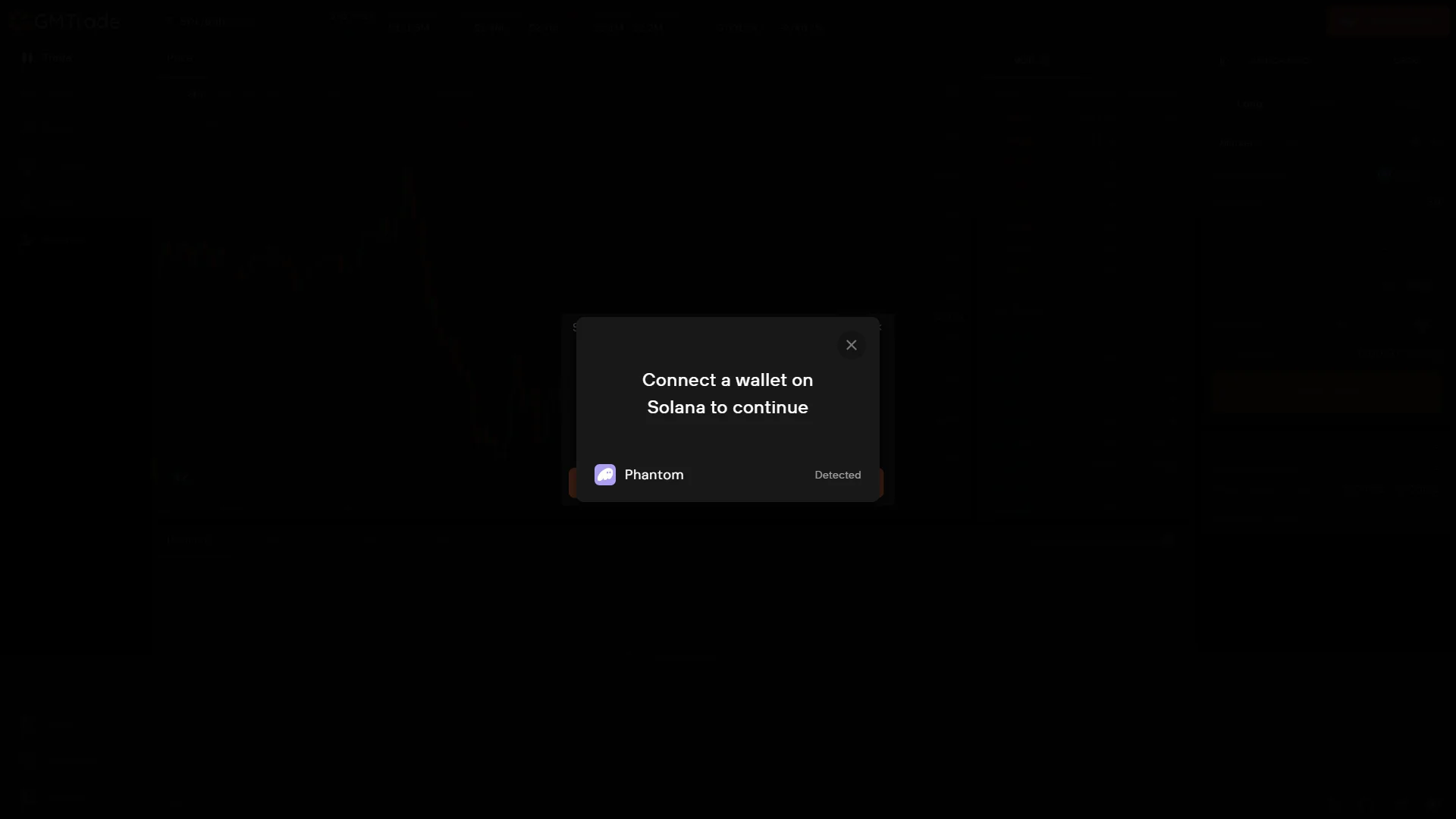
Click “Phantom” in the “Connect a wallet on Solana to continue” window, then approve the connection request in Phantom.
Phantom is listed with “Detected”, so this browser already has the wallet available; once you approve, the “Set Referrer” window comes back with the wallet linked.
- Apply the referral code
The referral link has already put “chcode” into the code field of the “Set Referrer” window, so check that value and click “Apply”.
Your connected wallet now appears in the header in place of the connect button, and the code is applied to that wallet without the window closing.
- Confirm the transaction in your wallet
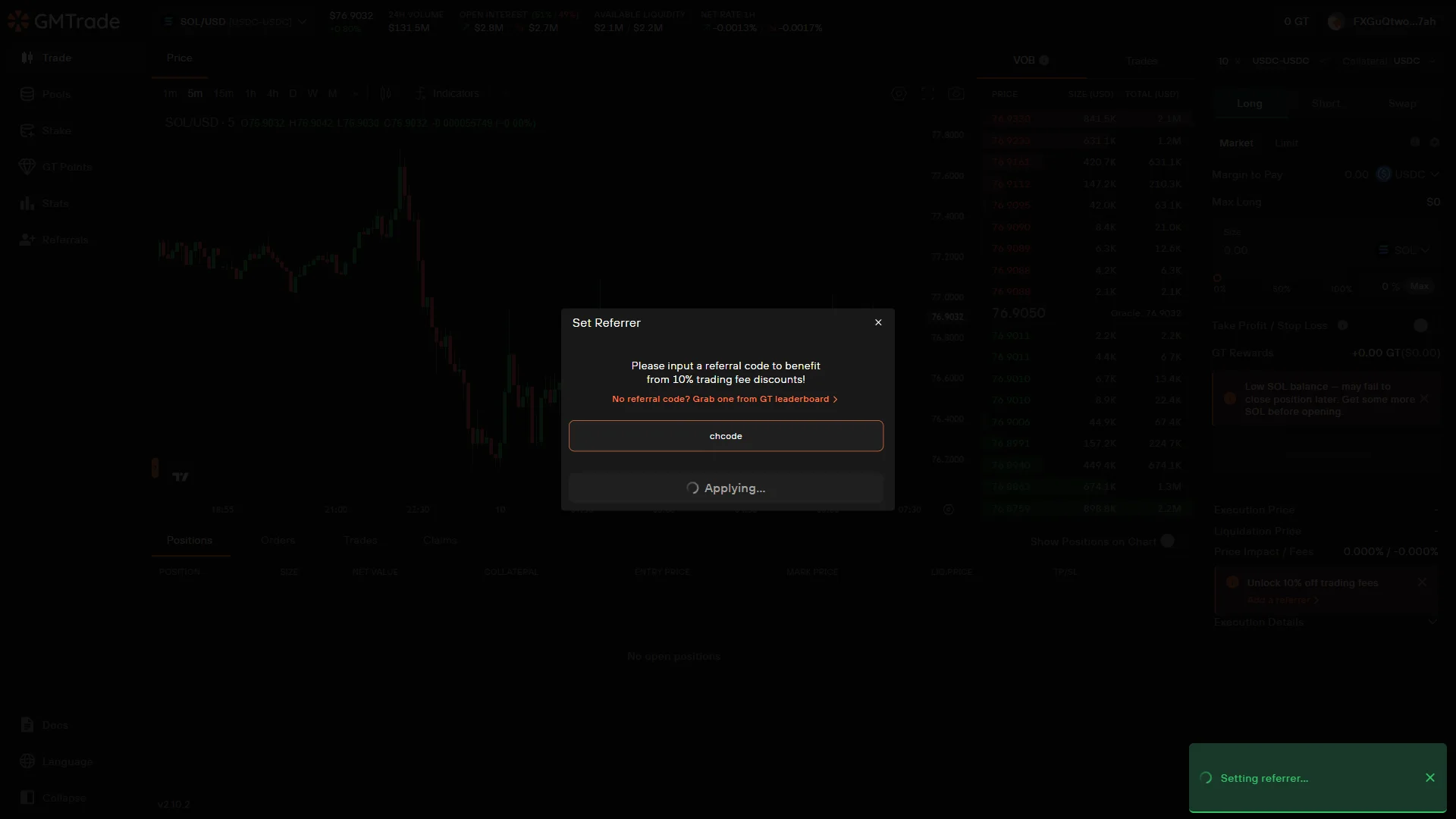
While the button reads “Applying…”, approve the transaction in your wallet: the referrer is recorded on-chain, so the wallet needs a small amount of SOL for the network fee.
The green “Setting referrer…” notice at the bottom right stays up while the transaction is in flight, and the referrer is set once you confirm.
That last step is the one to slow down for. Setting the referrer is a transaction on Solana rather than a form submission, so the wallet has to hold a little SOL before you press Apply — with an empty wallet the transaction fails at the simulation stage and the code does not attach. The code is applied once that wallet transaction confirms, and there is no later screen that reports your referred status back to you, so treat the confirmation in your wallet as the receipt.
Nothing else has to be set up: no email address, no password, no identity check. A Solana wallet in the browser is the whole account.
Smartphone (iOS / Android) connection steps
-
First, open the GMTrade official page in your mobile browser or your wallet app’s in-app browser (the link applies the referral code). When you open it, you’ll see a screen like the one below.
-
Connect your wallet from the referral link
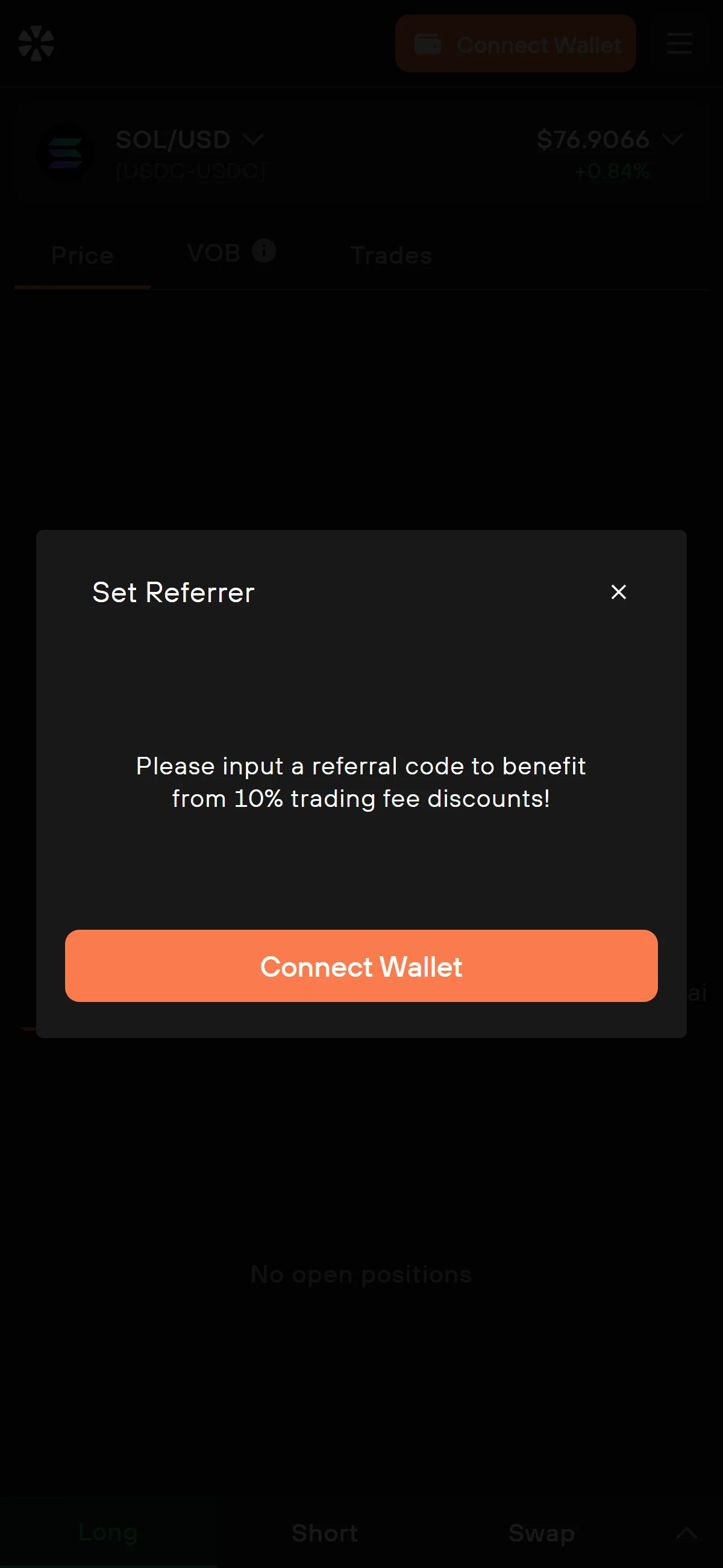
Open the referral link and tap “Connect Wallet” in the “Set Referrer” panel that opens over the trading screen.
The panel carries only the line “Please input a referral code to benefit from 10% trading fee discounts!” and that button, so there is nothing to type in yet; tapping it brings up the wallet chooser.
- Select Phantom on Solana
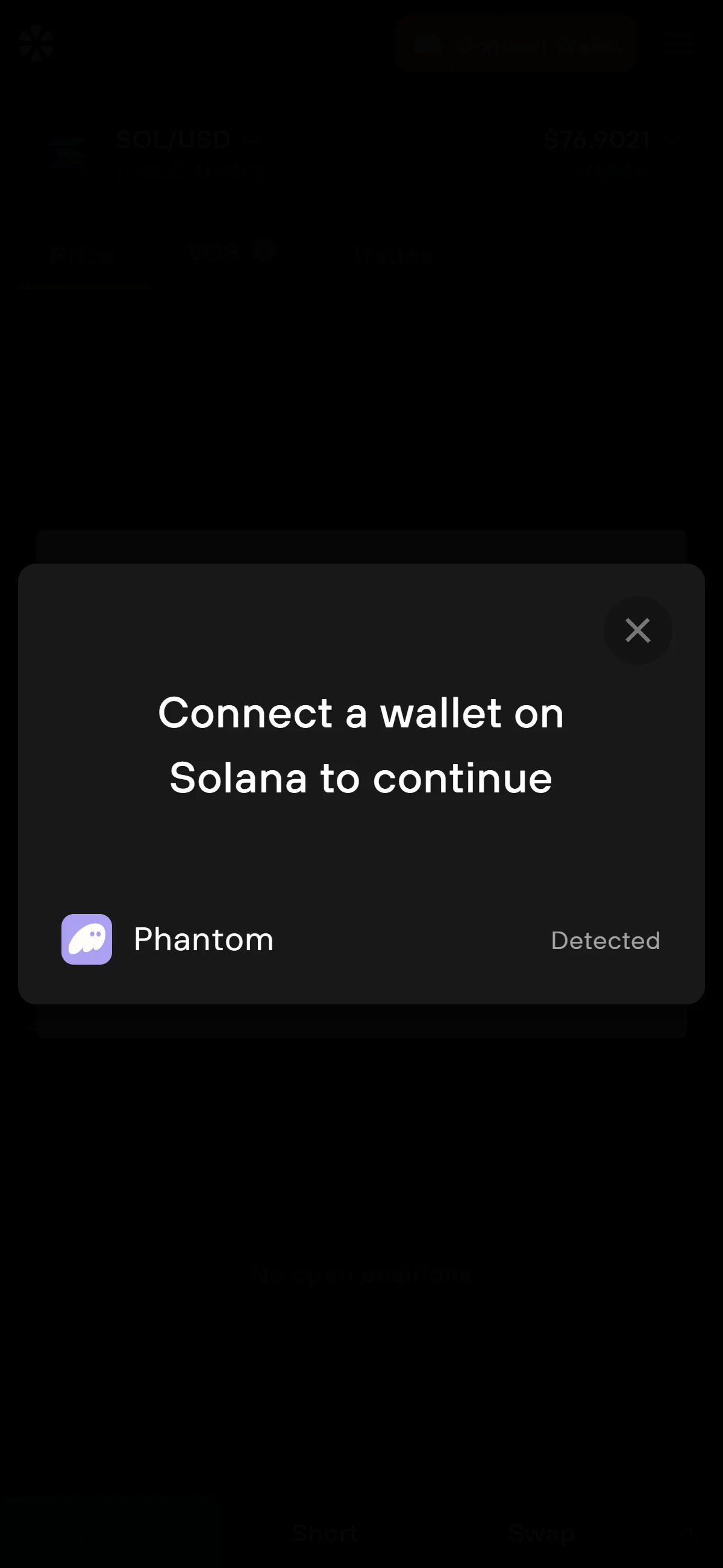
Tap “Phantom” in the “Connect a wallet on Solana to continue” panel, then approve the connection in the Phantom app.
Phantom is the one entry in the list and it shows “Detected”; after you approve, you land back on the “Set Referrer” panel with the wallet linked.
- Apply the referral code
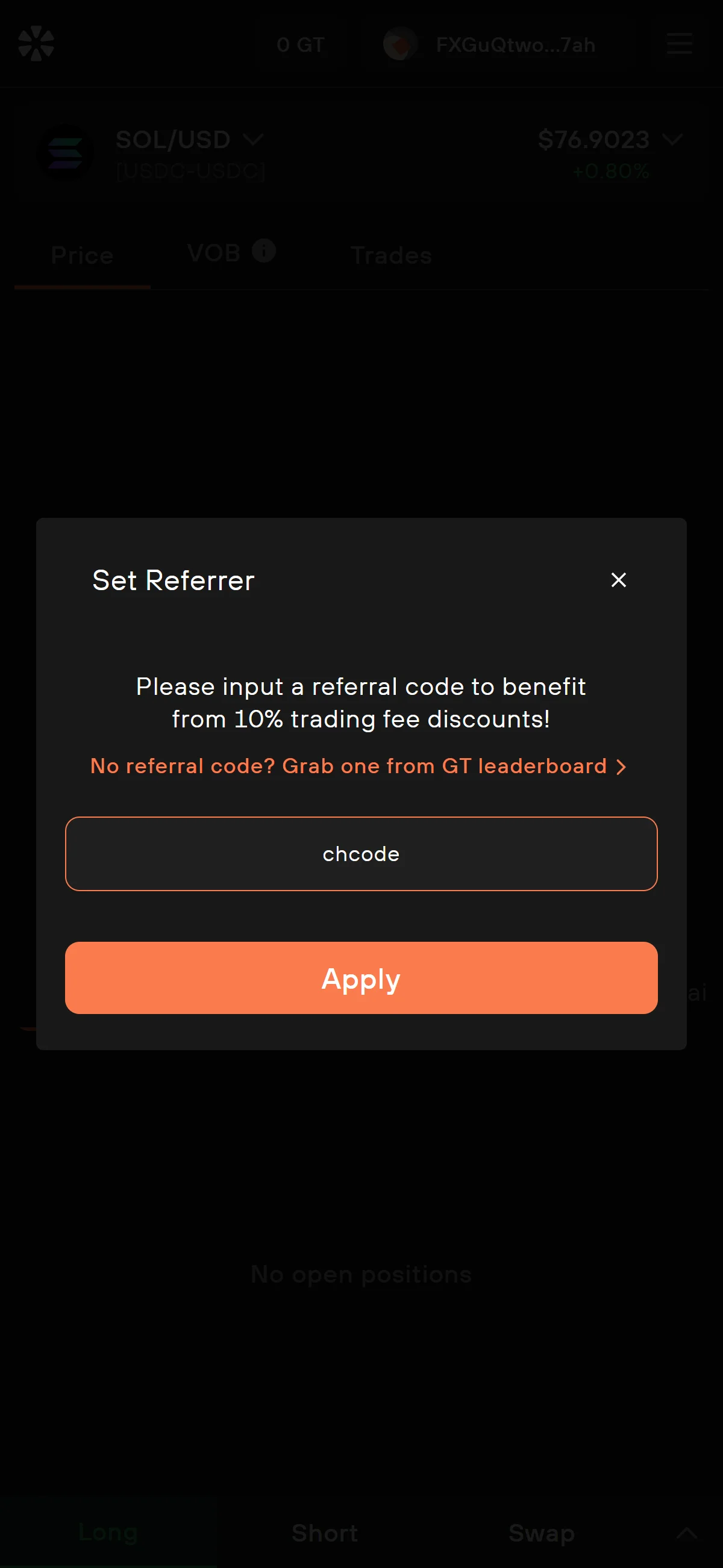
The referral link has already put “chcode” into the code field of the “Set Referrer” panel, so check that value and tap “Apply”.
Your connected wallet now shows at the top of the screen, and the code is applied to that wallet without the panel closing.
- Confirm the transaction in your wallet
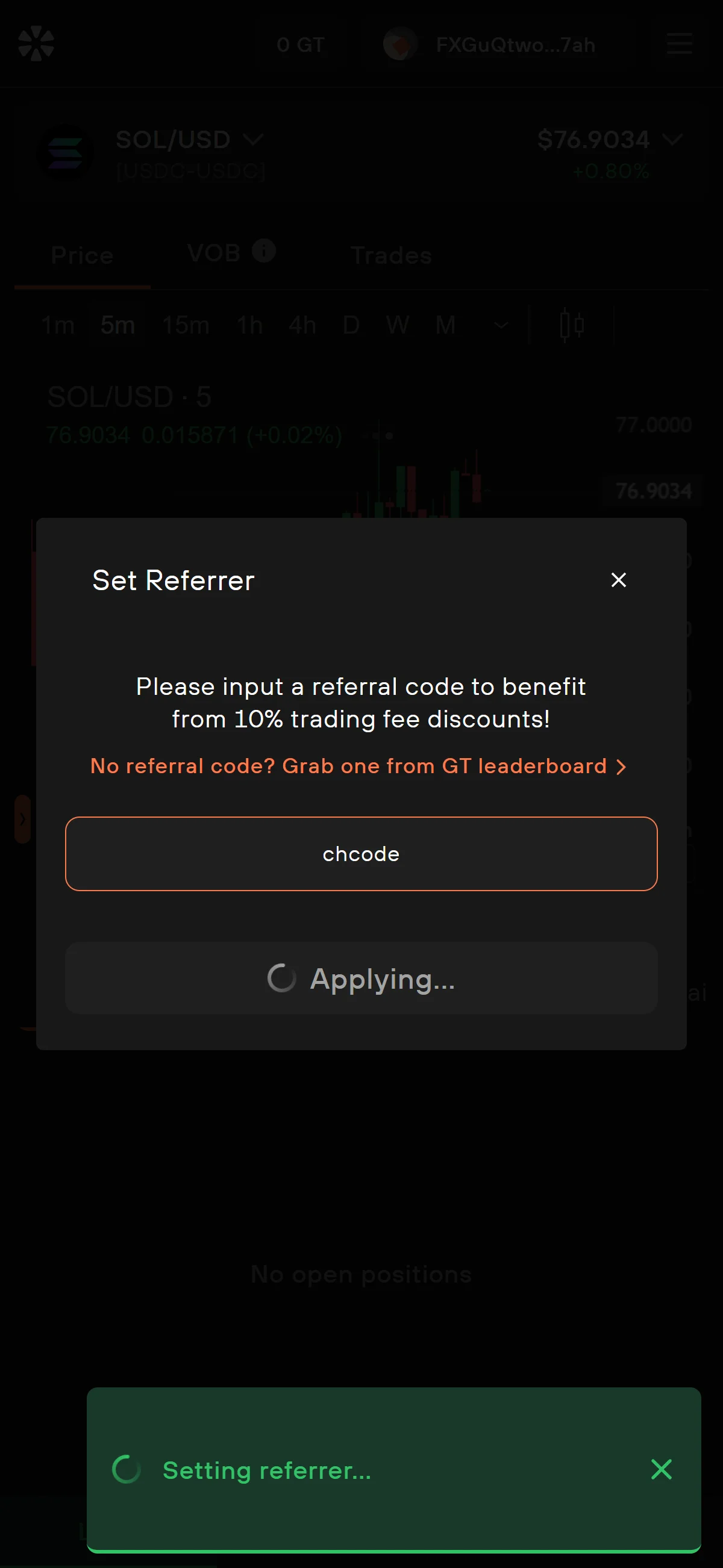
With the button on “Applying…”, approve the transaction when your wallet app prompts you: the referrer is recorded on-chain, so the wallet needs a small amount of SOL for the network fee.
The green “Setting referrer…” notice across the bottom of the screen stays up while the transaction is in flight, and the referrer is set once you confirm.
On a phone the same detail decides whether any of this took effect. Because the referrer is written on-chain, a wallet with no SOL in it produces a failed transaction at the approval prompt and no binding. Put a little SOL in the wallet first, tap Apply, approve in the wallet app, and the code is applied the moment that transaction confirms.
There is no sign-up form on mobile either — no email address, no password, no identity check — so the wallet app is doing the job an account would do elsewhere.
What to do after connecting to GMTrade
We’ll walk you through how to start trading, with separate steps for PC/browser and for smartphone (mobile).
How to start trading on PC/browser
This is the point in the process where a custodial exchange would ask you to fund an account.
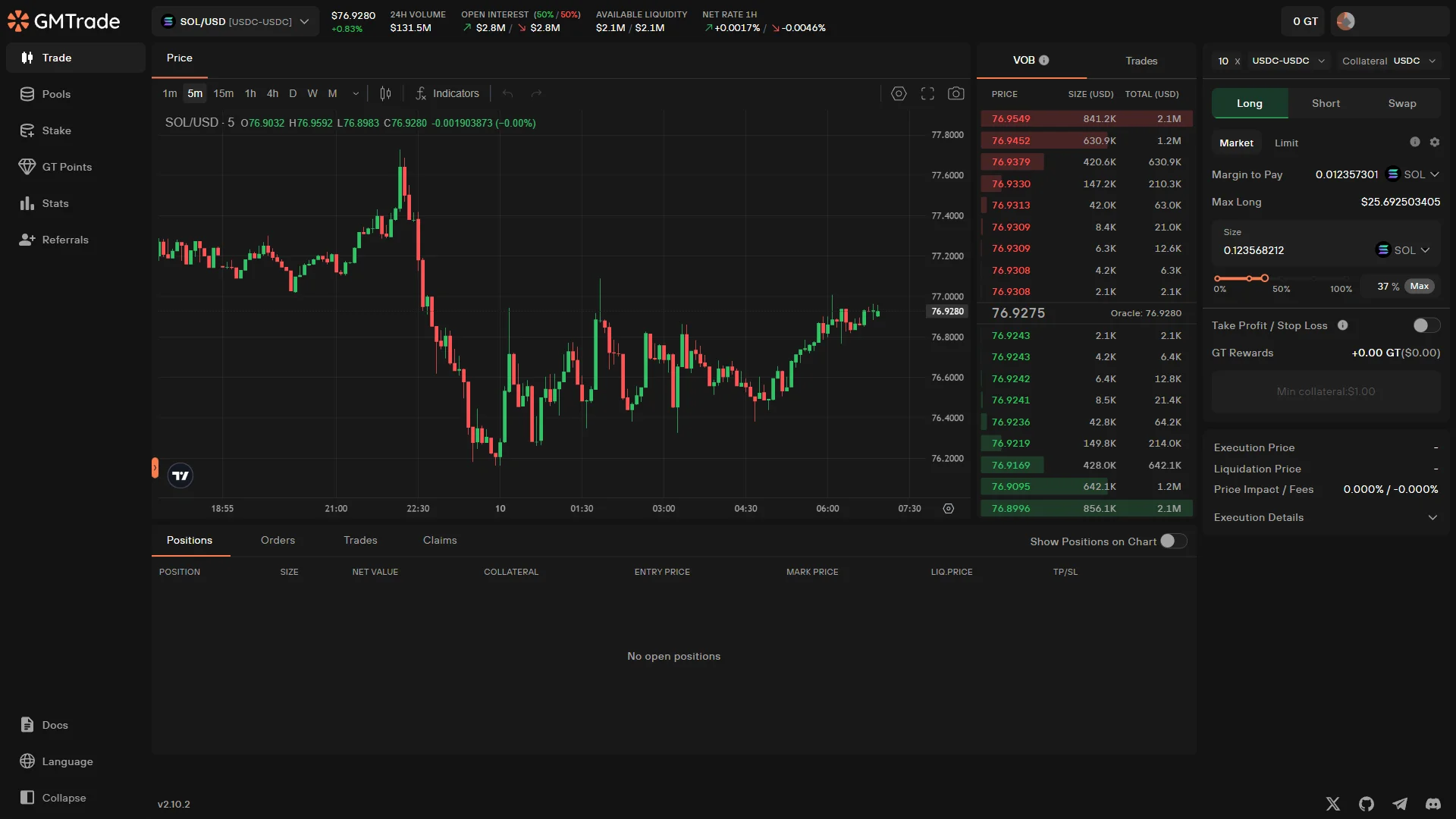
No deposit screen stands between your wallet and the order form: pick “Long” or “Short”, leave the order on “Market” or switch to “Limit”, and enter how much to trade in “Size”.
“Margin to Pay” is taken straight from the connected wallet in the asset you choose beside it, “SOL” on this screen with “USDC” also available, and “Max Long” shows how large a position that wallet balance supports.
How to start trading on your smartphone (iOS / Android)
The mobile layout keeps the same order form behind the buttons in the bar at the bottom of the screen.
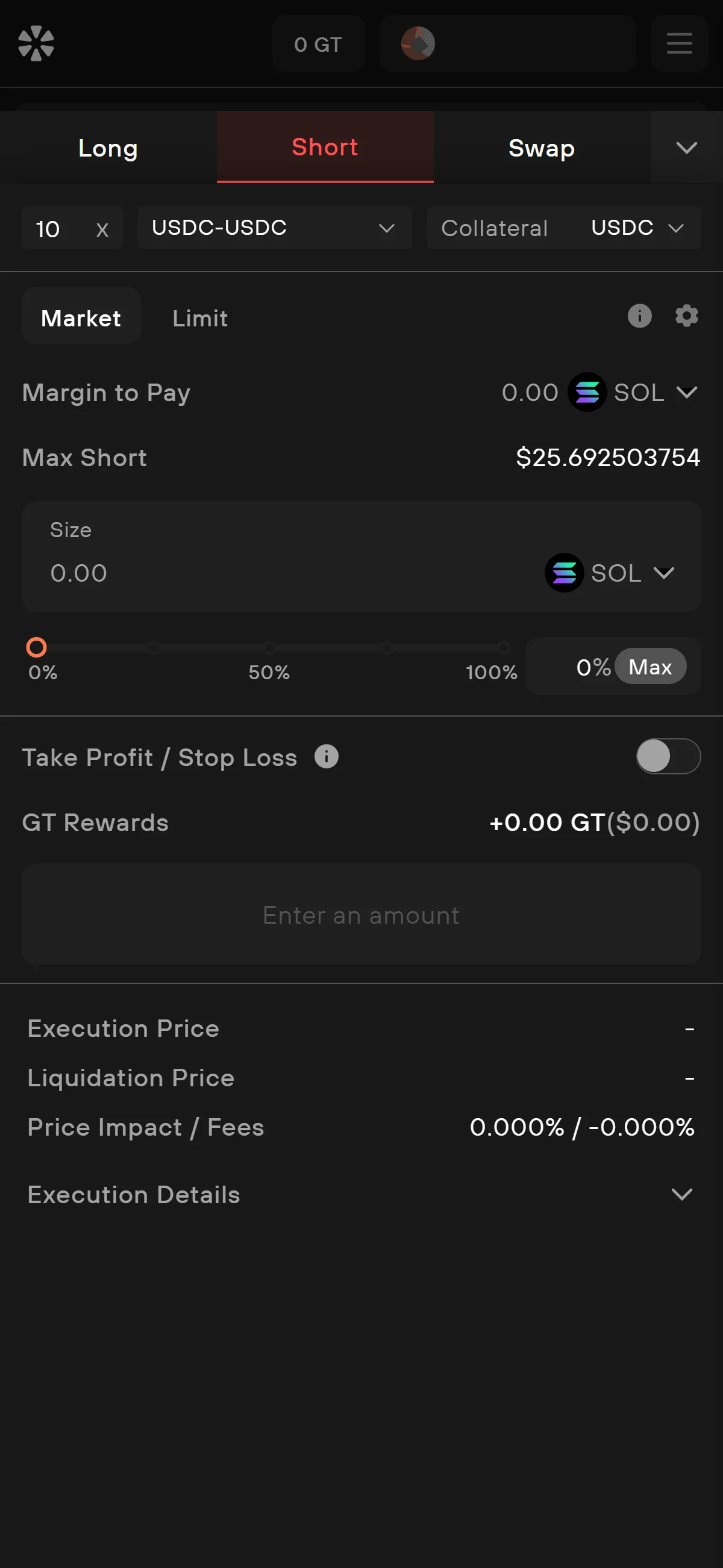
There is no deposit step on mobile either: tap “Long” or “Short” in the bar at the bottom of the trading screen to open the order panel, keep the order on “Market” or switch to “Limit”, and type the amount into “Size”.
“Margin to Pay” comes out of the connected wallet in the asset shown next to it, “SOL” here, and “Max Short” is the size that wallet balance supports; the button stays on “Enter an amount” until a size is filled in.
GMTrade does not take custody of your funds, so once the wallet holds SOL for network fees along with the collateral you want to trade, you can go straight to the order form with no deposit step in between.
So the preparation happens in the wallet rather than on the site. You need SOL to pay Solana network fees, which the venue advertises at about USD 0.0008 per action, and you need an asset the market you picked will accept as collateral. Which assets those are depends on the market and on the pool backing it — the documented examples are WSOL and USDC — and a single market can be served by more than one pool, so the collateral choice appears next to the size field rather than being fixed for the whole venue.
Getting the assets there is your side of the arrangement, and the venue is explicit that it does not help. Whatever you trade has to be on Solana already: GMTrade operates and documents no bridge of its own, and no third-party service for buying crypto with a bank card or transfer is built into the site.
The GMTrade referral code cannot be added after sign-up
The referral code can only be applied once — the first time you connect your wallet.
If you complete the connection without the code applied, there is no way to link it to that wallet afterwards, and the only route left is to start over with a new wallet.
There are two ways the code can attach, and both of them happen at that same moment. Opening the /r/chcode link fills the code in for you; alternatively you type it into the code field of the Set Referrer window yourself before you connect. Either way the binding is written as you connect, an address can be bound to only one referral code, and the discount applies to the trades you make after it is set rather than to anything already behind you.
That is why there is nothing to repair later. If a wallet has connected and traded without the code, no settings page, support request or second attempt changes that wallet’s position — only a wallet that has never been bound can take the code. And since we could not verify any permanent confirmation screen on the referred side, the honest end point is the one from the walkthrough: the code is applied when the wallet transaction confirms, not when a page tells you so.
◆ ◇ ◆
GT points are minted by the fees you pay, not handed out in seasons
Anyone arriving at a perp DEX in 2026 has learned to ask about the points program, so GMTrade’s is worth clearing up. GT is not a campaign you join, and there is no leaderboard to climb into. It is issued when fees are paid, which makes it a byproduct of trading — you get it for doing the thing you came to do, at a rate that has nothing to do with how early you showed up.
Trading fees, staked pool tokens and referrals are the three documented routes to GT
The first route is trading. Order fees and borrowing fees that you pay convert into an equal dollar amount of GT at the current minting price, calculated after any discounts have been applied. Pay a dollar in fees, and a dollar’s worth of GT at today’s price is minted to you.
The second route is providing liquidity. Staking GLV or GM pool tokens earns GT according to how long the stake has been in place and the APR tier it falls into. For pools linked to real-world assets, staking is only available while the underlying market is open, though unstaking and claiming what you have earned stay available at any time.
The third route belongs to the other side of the arrangement this article is about: a referrer earns a share of the GT that the users they referred generate, at a rate set by the referrer’s VIP level.
Eligibility is not governed by any points-specific rule. It comes from the User Terms, which exclude U.S. Persons, residents and nationals of embargoed Restricted Territories, and anyone on a sanctions list. If those terms exclude you from the venue, they exclude you from the points as well.
The minting price started at $0.01 and rises 2.1% every 210,000 GT
The structure is what separates this from the seasons-and-epochs model most points programs use. There are no seasons and no epochs: issuance runs as one continuous sequence of minting cycles, and the cost of minting a GT steps up at every cycle boundary. As of 2026-08-09, the counters stood here:
The mechanical consequence for you is simple, and it is the only consequence anyone can state: the same fee buys progressively less GT as the cycles advance. A trader paying the same fees next quarter as this quarter receives a smaller number of points for them.
GT has no token event, no market price and no promised allocation
As of 2026-08-09 no token generation event has taken place. GT exists as an on-chain point with a minting price attached to it, not as a transferable listed token, and it carries no market price — there is nowhere to sell it and nothing quoting it.
The official position on what it is for is a single sentence, and this is the whole of it: GT points serve as credentials for participation in a future token generation event. No date has been announced, no conversion ratio, no allocation size, no airdrop.
That is the boundary of what can honestly be said. Nobody, including the operator, has published anything that would let you put a value on the GT you accumulate, so it belongs in your reasoning as an unpriced credential rather than as deferred compensation for your fees.
What GMTrade is: the GMX DAO’s Solana deployment, run by contributors it does not name
A GMX DAO expansion that launched in March 2025 and took its own name in November
If you searched for this venue and found two names attached to it, that is the rebrand rather than two products.
The link to GMX did not become nominal with the new name. It is financial and it runs both ways: GMX DAO is described as the largest holder of GT and receives a discount when it performs GT treasury swaps, while the GMTrade Treasury buys into the GLV GMX-USDC pool, which keeps GMTrade holding GMX exposure in return.
The operating side is where the picture thins out. No founder, chief executive or team member is named anywhere on the site, in the docs or in the GitHub organization that publishes the code, which refers only to unnamed groups of core contributors. The interface operator is likewise unnamed; the Bahamas appears in the User Terms as the choice of governing law and nothing more, which is not evidence of a company incorporated or licensed there.
On scale, GMTrade’s own pages report 27,048 cumulative unique traders since launch, which counts traders who have ever traded rather than active ones. Deposited assets sitting in the protocol’s contracts come to USD 32,851,607 by DeFi Llama’s measure. The landing page also displays a “Liquidity” figure of USD 340,900,000, roughly ten times larger; the two are not rival measurements of the same thing, since individual pools are each listed with liquidity exceeding the whole deposited-asset total, and the venue publishes no definition of either label. The venue states 60+ markets across forex, commodities, equities, indices and crypto — an open-ended floor rather than a count.
Trades fill against pools at an oracle price, with no account to open
There is no order book here, which is the piece that trips up anyone whose experience comes from a centralized exchange. Nobody takes the other side of your trade. You take a position against a pool: GM pools each back a single market with a long token and a short token, and GLV vaults sit above several GM markets and move liquidity between them.
What you feel from that design is the pricing. Your entry and exit prices come from oracle feeds — outside price sources rather than a live order book — adjusted for price impact, which depends on how your trade shifts the balance between longs and shorts and between the pool’s tokens. Limit, stop-loss and take-profit orders exist, but once triggered they execute as market orders against the pool, so a trigger price is not a fill price. Settlement runs on Solana programs — the chain’s own word for smart contracts — combined with off-chain keepers and both price and risk oracles.
Getting in requires no account, no email address and no identity check. Connecting a wallet is the whole of it.
Opening and closing costs 0.004-0.006% on forex and 0.010-0.012% elsewhere, before funding and price impact
The fee schedule has two tiers, and what selects between them is not the order type. The lower rate applies when your trade brings long and short open interest closer to balance, and the higher rate when it pushes them further apart — a market order can pay the lower rate and a limit order the higher one, depending entirely on which way the book of positions is leaning when you arrive.
- Open and close fee, forex markets
- 0.004-0.006% of position size, charged on the way in and again on the way out
- Open and close fee, commodity, equity and crypto markets
- 0.010-0.012% of position size, on the same two-tier basis
- Borrowing fee
- Charged to whichever side of the market is larger, at a rate that varies with how heavily the pool is being used
- Funding
- Adaptive: it drifts continuously with the long/short imbalance rather than settling at fixed intervals, and can invert so that the other side pays you
- Price impact
- Applied on entry and on exit, and it can fall either way
- Solana network fee
- About USD 0.0008 per action, paid out of your own wallet rather than by the protocol
- Swap fee
- 0.05-0.07% of the amount converted, where an asset has to be swapped first
The reason to read the whole list rather than the headline rate is that the headline rate is not the bill. On a leveraged position held for any length of time, borrowing and funding accumulate against you or for you continuously, and price impact arrives twice: once on the way in and once on the way out.
The venue’s own discount comes from holding GT, not from trading volume
The VIP ladder here is unusual in a way worth one sentence: it is keyed to how much GT you hold, not to how much you trade. Volume tiers reward activity; this one rewards a holding, which means a large trader with no GT sits at the bottom of it.
The documented ceiling is a 10% maximum fee discount, reached at 6,000,000 GT held. Where the fees you pay end up is documented too:
Most of what you pay, in other words, goes to the people whose capital is in the pool you traded against, compounding inside the pool token rather than being paid out to an operator. The Treasury share is stated to belong to GT holders.
Ten audit reports are public and the bug bounty tops out at $100,000
“Is this thing safe” is the question behind most searches about a venue like this, and the only useful answers are artifacts with dates on them.
There are ten audit reports in a public archive repository: one by Sherlock in 2024-12 and nine by Zenith between 2025-03 and 2026-07, with the most recent dated 2026-07-17, about three weeks before we checked. That cadence matters more than any single report — the code is being looked at repeatedly rather than once before launch. Two of the audits were funded by GMX DAO as a condition of approving the expansion. Alongside them runs a live Immunefi bug bounty with a maximum payout of USD 100,000, where a working proof of concept is mandatory at every severity.
What that is not: a verdict on the code. We read the archive’s file listing, not the contents of the reports, so this is a record of how often the programs are audited and by whom. What the audits do not reach at all is the subject of the risk section further down.
Fifth by reported 24-hour volume, and the highest-ranked Solana-native perp venue in that one aggregator’s snapshot
Volume depends on who is counting: $804.76M, $168.54M or $96.56M for the same day
At the 2026-08-09 snapshot GMTrade ranked 5th of all perp protocols listed on DeFi Llama by reported 24-hour volume, accounting for 5.43% of the perp volume the aggregator tracks. The four protocols above it were Hyperliquid, ApeX, Lighter and edgeX, which makes GMTrade the highest-ranked Solana-native perp venue at that moment, ahead of Jupiter and Pacifica.
Then the number itself falls apart. Three sources describe the same 24-hour window:
USD 804,760,000
USD 168,540,000
USD 96,564,989
That spread is roughly eight to one, and it is a methodology gap rather than an error by anyone. Counting leveraged notional produces a much bigger number than counting whatever the venue counts, and neither of the two smaller figures comes with a published definition to check. So a volume figure for this venue means nothing without the source attached to it — there is no such thing here as the volume.
Open interest behaves the same way: USD 65,550,000 on the venue’s stats page against USD 34,840,000 at DeFi Llama, whose own series showed a very large single-day drop when we checked, suggesting its latest data point may be partial. We could not find a complete open-interest ranking, so we make no claim about where the venue places on that measure.
Fees paid are the harder number to inflate: 3rd of 69 derivatives protocols over 24 hours
Reported volume can be inflated by trading with yourself. Fees actually paid cannot, at least not cheaply, which makes fee revenue the more honest read on whether real money is moving through a venue.
USD 171,736 in fees paid by users in 24 hoursDeFi Llama, 2026-08-09
That placed GMTrade 3rd of 69 protocols in DeFi Llama’s Derivatives category for the day. One day is not a position, though: over a 30-day window the same ranking is 5th, and the 24-hour figure fell on a day when fees rose sharply against the day before. Read that 3rd place as a good day inside a top-five range. None of these figures is a rate you pay — the rates a trader pays are in the fee schedule above.
The liquidity sits in forex and metals, not in crypto pairs
The clearest way to see what this venue actually is comes from the pool data rather than the marketing. The ten largest GM pools by liquidity are USD/CAD, USD/JPY, USD/MXN, GBP/USD, AUD/USD, EUR/USD, USD/CHF, XAU/USD, NZD/USD and XAG/USD — every one of them a currency pair or a metal, with no crypto pair among them.
For someone choosing where to trade, that reorders the whole comparison. This is a real-world-asset perpetuals venue that also lists crypto, not a crypto venue that has added a forex tab, and its deepest liquidity is in the instruments a crypto-native competitor does not carry. It also means the markets it is built around keep the hours of the exchanges they reference, which brings mechanics no crypto-only venue has to think about. Those mechanics cost you leverage and money at specific times, and the risk section below has the detail.
GMTrade names one excluded country in its terms and holds no license anywhere
The United States is named; everywhere else is defined by sanctions rather than by a list
This section is about the protocol’s own standing. Where you personally stand comes next.
The terms publish no country list, and the United States is the only jurisdiction named in them. Every user has to represent that they are not a U.S. Person as defined in Regulation S under the Securities Act of 1933, and User Terms section 8.2 states that because of restrictions under the Commodity Exchange Act and CFTC regulations, no U.S. Person may enter into perpetual contracts using the interface.
Everything else is drawn by reference. The terms define Restricted Territories as countries subject to embargo or similar sanctions by the United States, the United Kingdom or the European Union, so the countries that definition covers move with sanctions policy rather than sitting in a list you can read off the page; people on US, UK, EU or UN sanctions lists are excluded separately.
How any of it is applied is the part readers usually get wrong. Eligibility is handled contractually, through representations you make at the point of access, rather than through documented technical enforcement. The one technical measure we found anywhere is the in-app notice shown to visitors detected as being in the United States.
No regulator has acted against GMTrade, and no regulator has licensed it either
Both halves of that sentence have to be read together, because either one alone misleads. We found no regulatory action, warning, restriction, lawsuit, settlement or sanction against the protocol in any jurisdiction. We also found no license, registration or authorization in any jurisdiction.
The venue says the second part itself, plainly: gmtrade.xyz is not registered or licensed by any regulatory agency or authority, and no such agency or authority has reviewed or approved use of the site or interface. The Bahamas, again, is the choice of governing law and confers no regulatory status.
Equity, index, forex and commodity perpetuals are listed without registration anywhere
The structural exposure is the distance between what is offered and what is authorized. Perpetuals on equities, equity indices, forex and commodities are the instrument classes most likely to attract the attention of securities and derivatives regulators, and they are being offered with no registration anywhere and no named operator behind them.
The venue does not pretend otherwise. Its own risk disclaimer states that decentralized finance regulation varies by region and continues to evolve, and that future developments may affect its operation.
Then there is the layer that surprises people most. The site you would actually trade on disclaims being the venue: the User Terms describe gmtrade.xyz as informational, state that it is not an available access point to the GMTrade Protocol, that it operates no exchange platform and provides no trade execution or clearing services, that it has no possession, custody or control of user funds, and that it cannot recover assets. Read that as a fact about recourse rather than a legal curiosity. The assumptions you carry over from a custodial exchange — an operator with your money, a support desk that can reverse things, a regulator to escalate to — have nothing to attach to here.
Where this is heading is genuinely unresolved. Nothing in the record points to a tightening or a loosening specific to this venue, and no direction can honestly be read into it.
The United States is blocked, while the UK, Singapore, Australia and India reach the full interface
Of the five countries this article covers, one is closed and four are open — and the four that are open share a shape worth naming before the detail: the interface loads, no local license stands behind it, and no local body will hear a complaint about it.
One limitation applies to every access check below. The method varies by country: a browser set to the country’s locale and timezone, with geolocation added where that applied, alongside reading the country list shipped in the site’s own code and, for the United States, a controlled test of the country value the site relies on. None of the checks was run from a resident’s own IP address, so a block applied at the IP level cannot be ruled out. What follows is the status of this venue country by country; each country’s wider crypto rules appear only as far as that status needs them.
United States: closed by the terms and by the frontend
If you are reading this from the United States, the answer arrives before everything else: GMTrade is closed to you at both layers, and the rest of this article is background rather than instructions.
The contractual layer is the categorical one. User Terms section 8.2 states that as a result of restrictions under the Commodity Exchange Act and CFTC regulations, no U.S. Person may enter into perpetual contracts using the interface, and section 1.1.3 designates the United States a restricted jurisdiction by requiring every user to represent that they are not a U.S. Person.
The technical layer needs to be described precisely rather than dramatically. The site’s own production code contains a hard-coded block list that includes the United States, and visitors detected as being in the US are shown an in-app jurisdiction notice pointing to the User Terms. We verified that on 2026-08-09 through a controlled test that rewrote the country value the site relies on, not from a US address. So what is established is a notice shown in your browser, triggered by location detection on the site’s own servers; we are not in a position to claim that the venue technically prevents US users from trading.
On enforcement, the CFTC actions we reviewed in this area (Releases 8590-22, 8774-23 and 8961-24) ran against platforms, operators and protocol front-ends, and none of them charged an ordinary retail trader. Whether a US resident’s own act of trading is itself chargeable is genuinely unresolved: no source we found says that it is, and none says that it is lawful. The prohibition on access, though, is not unresolved at all — it is stated flatly, and it applies whatever an enforcement pattern suggests.
United Kingdom: the interface loads, and the FCA ban binds firms rather than you
From the United Kingdom the site simply comes up. Rendered on 2026-08-09 under an en-GB locale with a London timezone and London geolocation, the full trading interface loaded with no geo-block, no country gate and no jurisdiction attestation.
The rule most UK readers have in mind does not point at them. The retail crypto-derivatives prohibition, COBS 22.6.5R, is addressed to enumerated categories of FCA-regulated firms and stops them from selling, distributing or marketing crypto derivatives to retail clients. Read as written, it imposes no prohibition and creates no offense for a retail client who trades.
What a UK reader loses is not access but the safety net. GMTrade is absent from the FCA cryptoasset firms register, so there is no FCA authorization behind it, and users of a venue in that position are unlikely to be covered by the Financial Ombudsman Service or the Financial Services Compensation Scheme. Disputes go to confidential binding arbitration before an arbitral body in Madrid under Bahamian governing law, with court actions waived: no UK court, and no UK redress body.
The forward-looking picture is unsettled rather than promising. The FCA’s PS26/11 notes that where an activity is carried on in a genuinely decentralized way, with no person carrying it on by way of business, it falls outside the scope of the incoming regulated activities, assessed case by case. And cryptoasset derivatives — the product class this venue is built on — are expressly deferred from the 2026 policy statements to later work.
Singapore: no gate, no MAS license, no MAS alert
Singapore is not in the frontend’s blocked-country list, and on 2026-08-09 the interface rendered the complete trading screen with no jurisdiction gate of any kind.
On the user side, we found no Singapore statute, regulation or MAS ruling prohibiting a resident from accessing a non-custodial DEX interface. Licensing obligations under the Payment Services Act attach to service providers, not to individual users. That is the absence of a prohibition we could find, and it is worth saying what it is not: MAS has made no statement that this kind of use is approved or advisable.
On the venue side there is nothing on file either. GMTrade holds no MAS license or registration — its own User Terms section 8.3 declares that it is not registered or licensed by any authority, and the MAS Financial Institutions Directory returns no match for it. It was also not on the MAS Investor Alert List as of 2026-08-09, which carries no implication of approval either way; MAS says that list is not exhaustive and reflects what was known when it was published.
MAS’s posture is what frames the trade-off. It has urged consumers not to deal with unregulated entities, including those based overseas. For a Singapore reader the consequence of ignoring that is a loss of regulatory recourse rather than an act of illegality. One footnote, because the terms invite the question: the liability caps in them are written in Singapore dollars, which is a contractual currency choice and not a sign of Singapore supervision.
Australia: access is unrestricted, and no AFS license sits behind it
From Australia there is no gate at all — no geo-block, no country selection screen, no Australia-specific notice. Both the marketing site and the trading interface rendered fully on 2026-08-09.
The central Australian fact is a status mismatch rather than a prohibition. ASIC treats perpetual futures referencing digital assets as derivatives, and derivatives offered into Australia normally require an Australian Financial Services license. GMTrade holds none: a search of ASIC’s Australian Financial Services Licensee dataset, 6,507 records at the 2026-08-09 snapshot, returns zero matches for it.
Those are two different statements and they need to stay apart, because running them together is the usual mistake. A provider being unlicensed is not the same thing as a resident’s use being unlawful. We found no Australian law prohibiting a resident from accessing an offshore or decentralized protocol, and the licensing obligation attaches to the provider rather than to the customer. ASIC’s own framing is protection-loss: unlicensed providers are not permitted to promote to Australians, and Australians who use unlicensed products cannot reach internal dispute resolution or client money protections if something goes wrong.
One question here is genuinely open, and we will leave it open. Australia’s retail leverage cap for cryptoasset contracts for difference is 2:1, which is the benchmark applied to licensed providers and the source of the gap with the 500x this venue advertises. Whether that cap reaches a non-custodial protocol at all has not been determined: ASIC’s guidance expressly declines to say when a participant in decentralized finance needs a license, and a review published by ASIC notes that perpetuals offered through offshore venues may sit outside the traditional regulatory boundaries. Treat the 2:1 as the local yardstick, not as a rule established to bind GMTrade.
India: fully reachable, and officially not regulated rather than prohibited
From an Indian browser nothing stood in the way. On 2026-08-09 the landing page, the trading interface and the pools page all loaded and rendered the full trading screen under an en-IN locale, with no country gate and no restriction pop-up.
For a resident, holding, buying, selling and transferring virtual digital assets is not prohibited, and the Government’s own characterization — given in the Lok Sabha on 2026-02-05 — is that virtual digital assets are not regulated rather than prohibited.
That distinction is the one to carry into a decision. Not prohibited is not the same as regulated, and neither is the same as protected: there is no Indian licensing regime, investor-protection framework or recourse mechanism covering a resident’s dealings with an offshore non-custodial protocol.
The venue’s registration status in India is genuinely indeterminate, and rounding it off in either direction would be guesswork. FIU-IND publishes no complete public register of registered virtual digital asset service providers, so GMTrade’s registration can be neither confirmed nor excluded from public sources. What can be said is narrower: GMTrade appears on neither of FIU-IND’s published enforcement lists of offshore providers, and every entity named on those lists is a custodial centralized exchange.
A winning position can be closed for you, and no one has published who can upgrade the programs
Auto-deleveraging can close a profitable position before you do
Start here, because it is the least expected of the risks and it has nothing to do with being wrong about the market.
This is not a variant of liquidation. Liquidation happens when your collateral runs out; this happens when your position is winning too much for the pool backing it to pay, and it can arrive while the trade is going exactly as you planned.
The mechanism exists because no insurance fund is documented anywhere. No official source states that one does or does not exist, so treat that as undocumented rather than denied. What is documented is structural: markets that are fully backed cap open interest below what the pool holds, so profits are always payable, and synthetic markets rely on auto-deleveraging to close the gap. If you plan to hold a large winning position in a synthetic market, that is the design you are inside.
Liquidation is assessed on the oracle price, and the leverage ceiling moves with the market
Liquidation eligibility is judged on the oracle price with price impact deliberately excluded, and the actual price impact is then applied when the position closes. The practical read: the price that triggers your liquidation is not the price you exit at, and the exit can be worse than the number that set the process off.
Two of those values are less fixed than they look. Because borrowing and funding accrue continuously, your liquidation price is not static — it drifts even on a day when the market does not. And the leverage ceiling is reduced outside the trading hours of a real-world-asset market, and falls as a pool’s open interest rises, so the maximum available to you depends on which market you are in and when you arrived.
Market hours are worth spelling out, because crypto markets do not have any. On real-world-asset markets, borrowing fees are increased on both sides while the underlying market is closed, as compensation to liquidity providers, on top of the leverage cap in that same window. A position in gold or in a currency pair therefore costs more to hold overnight and on weekends than the same position during market hours.
Two more design details matter. The venue’s own risk disclaimer warns that oracle failure, delay or manipulation may cause incorrect execution and losses — that admission stands despite the three-provider oracle design, and since every price you trade at comes from those feeds, it is not a peripheral dependency. And the ten-day rebate delay above is deliberate rather than administrative: where a position closes with price impact beyond the market’s maximum, the wait exists so that accounts suspected of manipulating prices can be excluded before the excess is paid back.
The upgrade authority is undocumented, and there is no operator to appeal to
The largest disclosure gap we found is not about trading at all. Nobody has published who can upgrade the deployed programs, or under what delay. No documentation page and no clause in the terms establishes it, and for a protocol running this volume that silence is the material fact.
What is disclosed, by contrast, is the Treasury: a 5-of-7 multisig in which GMX Core Contributors hold four signatures and GMTrade Core Contributors three, so neither group can reach the threshold alone. The identities behind both groups are undisclosed, which means the check is structural on paper and unverifiable in practice.
Then the recourse question loops back to what the regulatory sections above already showed. There are no named principals and no incorporated entity, which limits both what you could pursue if something went wrong and what an empty enforcement record can be taken to prove. The interface disclaims custody, control and any ability to recover assets, so a mistake, a bug or a loss has no operator to appeal to. On this venue, being your own custodian also means being your own complaints department.
A clean incident record over 17 months, and what it cannot prove
We found no exploit, no oracle manipulation, no governance attack and no protocol-attributable outage between the 2025-03-12 mainnet launch and 2026-08-09.
That is worth having, and it is worth reading correctly: an absence of found evidence over roughly seventeen months of operation, not a certification. It is weakened by the same gap as everything else in this section — with no named entity, there is less to search against than there would be for an incorporated exchange.
One risk sits outside GMTrade itself. GMTrade inherits Solana’s network liveness risk, which its risk disclaimer acknowledges; if the chain stalls, positions cannot be adjusted. That is a chain-level risk rather than something attributable to this protocol, and the distinction is worth keeping intact in both directions.
◆ ◇ ◆
Before you connect: the discount attaches once, to one wallet
This decision gets made at the wallet-connect screen, in the seconds before you press Apply, so it is worth having the short version in your head when you get there.
The code is chcode, and chainhelm connected a fresh wallet on 2026-08-10 to confirm that it still applies. What it grants is what the operator states: an ongoing 10% discount on your trading fees, not a one-time thing.
The conditions decide whether you get any of it. One wallet address takes one referral code, the binding is written as you connect, and nothing is credited backwards — a wallet that connected without the code keeps that status for as long as you use it.
One practical precondition sits under the whole thing. The referrer is recorded on-chain, so the wallet needs a small amount of SOL in it before you press Apply; without that, the transaction fails and the code never attaches. Fund the wallet, open the link, connect, approve the transaction, and the discount travels with that address from its first trade onward.