— Contents 11 sections
- 01 Is the Antarctic referral code “6LAP168t” still active?
- 02 Antarctic sign-up steps with the referral code
- 03 What to do after connecting to Antarctic
- 04 The Antarctic referral code cannot be added after sign-up
- 05 AX Points accrue on every trade, and the token behind them does not exist yet
- 06 A 32-market perpetual venue whose operator names no one
- 07 Where Antarctic sits among perp DEXes, and why its own numbers do not agree
- 08 Thirteen countries are shut out by the terms, and no regulator has named Antarctic
- 09 The US and Singapore are shut out by Antarctic’s terms; the UK, Australia and India are not
- 10 No audit, no named oracle, and one address that can upgrade the staking contracts
- 11 A verified code, a single application window, and two countries where none of it applies
chainhelm’s exclusive Antarctic referral code is .
As of 2026-08-16, we connected a new wallet and confirmed that the referral code was applied.
The referral code takes effect only on your first wallet connection — a one-time thing.
This article covers the sign-up process (wallet connection) with the Antarctic referral code, Antarctic’s distinguishing features, availability in the United States, the United Kingdom, Singapore, Australia and India, and the risks to acknowledge — with the connection flow and code application verified first-hand by chainhelm’s editorial team.
Is the Antarctic referral code “6LAP168t” still active?
The chainhelm editorial team connected to Antarctic with a fresh wallet on 2026-08-16 and confirmed that the referral code “6LAP168t” is still active.
Here is the actual screen captured during verification.
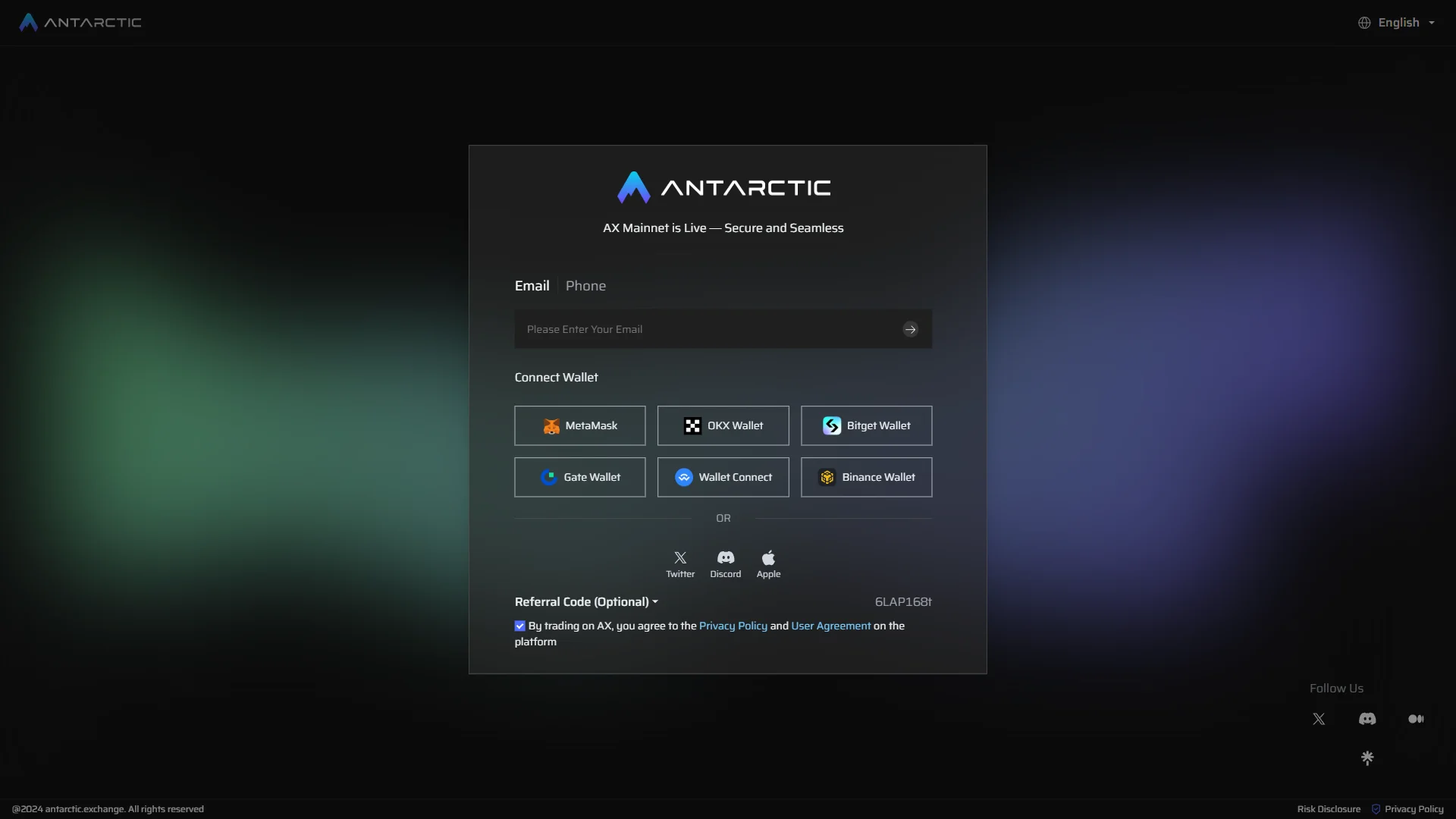
What that screen proves is narrow and specific, and it is the one thing worth checking before you connect. Opening https://partner.antarctic.live/code/6LAP168t brings up the login window with the field marked “Referral Code (Optional)” already carrying 6LAP168t — before any wallet is picked, and before anything is signed. We checked it the same way on a phone on 2026-08-16, and that screen appears further down in the mobile steps.
Two paths get the code attached at sign-up. Arriving through the link fills the field for you, or you type 6LAP168t into that same field yourself before connecting. Same field, same moment, either way.
What the screen does not confirm is worth stating just as plainly. The field is labeled optional and stays editable, and we did not find a screen after the connection that tells you who referred you. So the check belongs in the seconds before you choose a wallet, not afterwards — look at the field, confirm the code is sitting in it, then connect.
chainhelm continuously verifies the validity of the code and confirms it remains usable.
Antarctic sign-up steps with the referral code
We cover the connection process separately for PC/browser and smartphone (mobile).
PC/browser connection steps
- First, open the Antarctic official page (the link applies the referral code). When you open it, you’ll see a screen like the one below.
2. Click “Trade Now” on the referral landing page
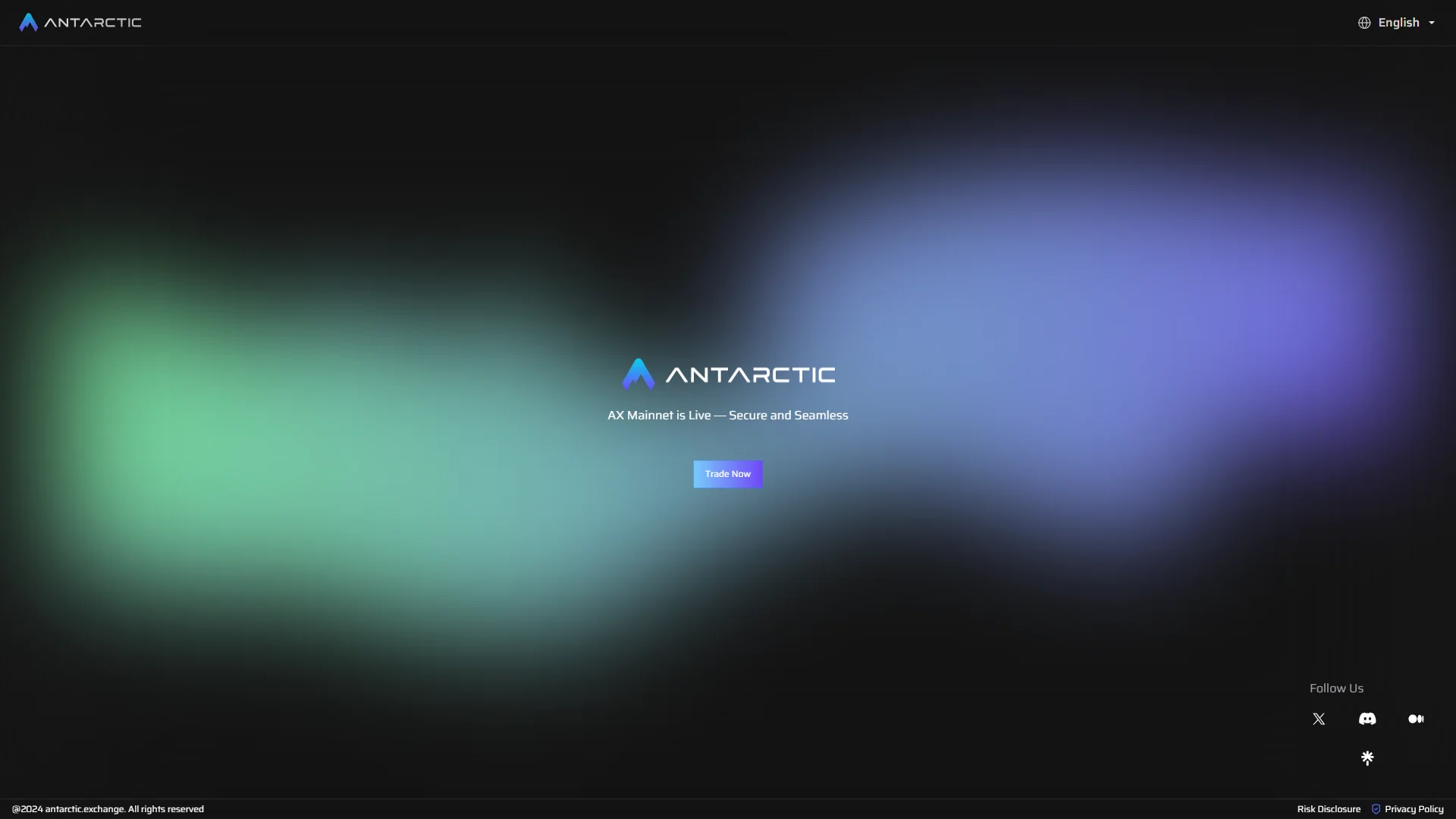
Open the referral link and click “Trade Now” at the center of the Antarctic landing page to bring up the login window. Arriving through the link is what carries the referral code over to that window, so avoid typing the address in by hand.
3. Choose a wallet and check the referral code
In the login window, pick the wallet you use under “Connect Wallet” — “MetaMask”, “OKX Wallet”, “Bitget Wallet”, “Gate Wallet”, “Wallet Connect”, and “Binance Wallet” are listed there.
Before you click it, check that “Referral Code (Optional)” already carries “6LAP168t” from the link and leave that field as it is, and that the box agreeing to the “Privacy Policy” and “User Agreement” is checked. Clicking your wallet then hands off to the wallet’s own approval prompt.
The same window also lets you start with an email address, a phone number, or a Twitter, Discord, or Apple account, and the referral code applies whichever route you take.
4. Approve the connection in your wallet
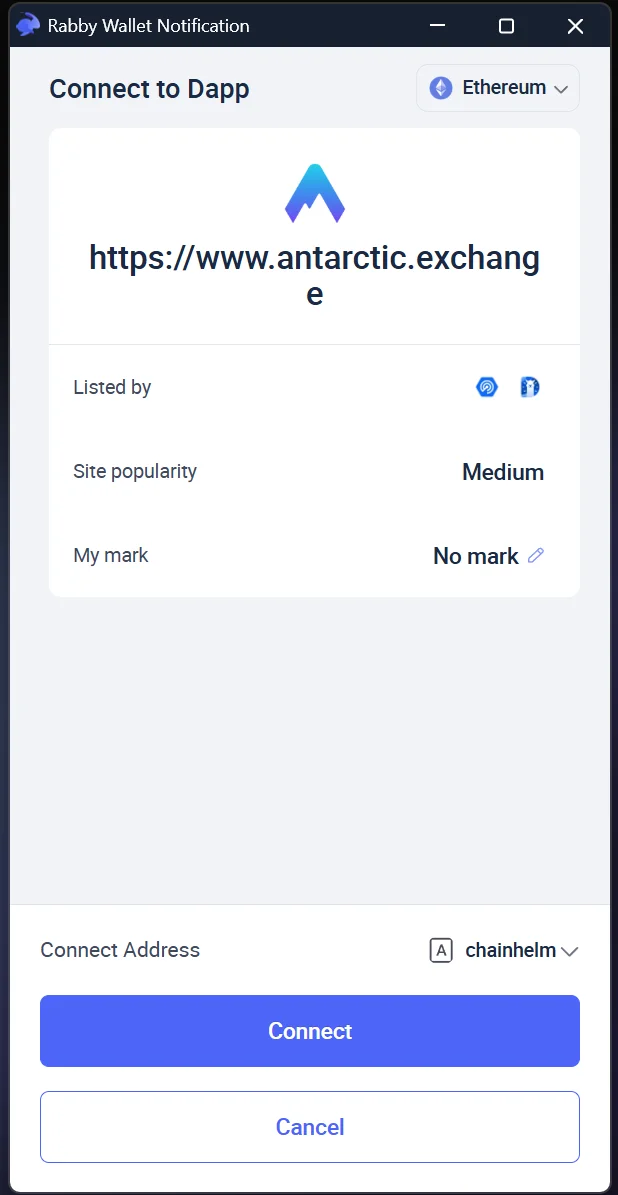
In the “Connect to Dapp” popup your wallet extension opens, confirm that the site asking to connect is https://www.antarctic.exchange and that the network selector at the top right reads “Ethereum”, then click “Connect” so the site can move on to its signature request. If the origin shows anything other than that address, close the popup with “Cancel”.
5. Open your wallet extension for the request
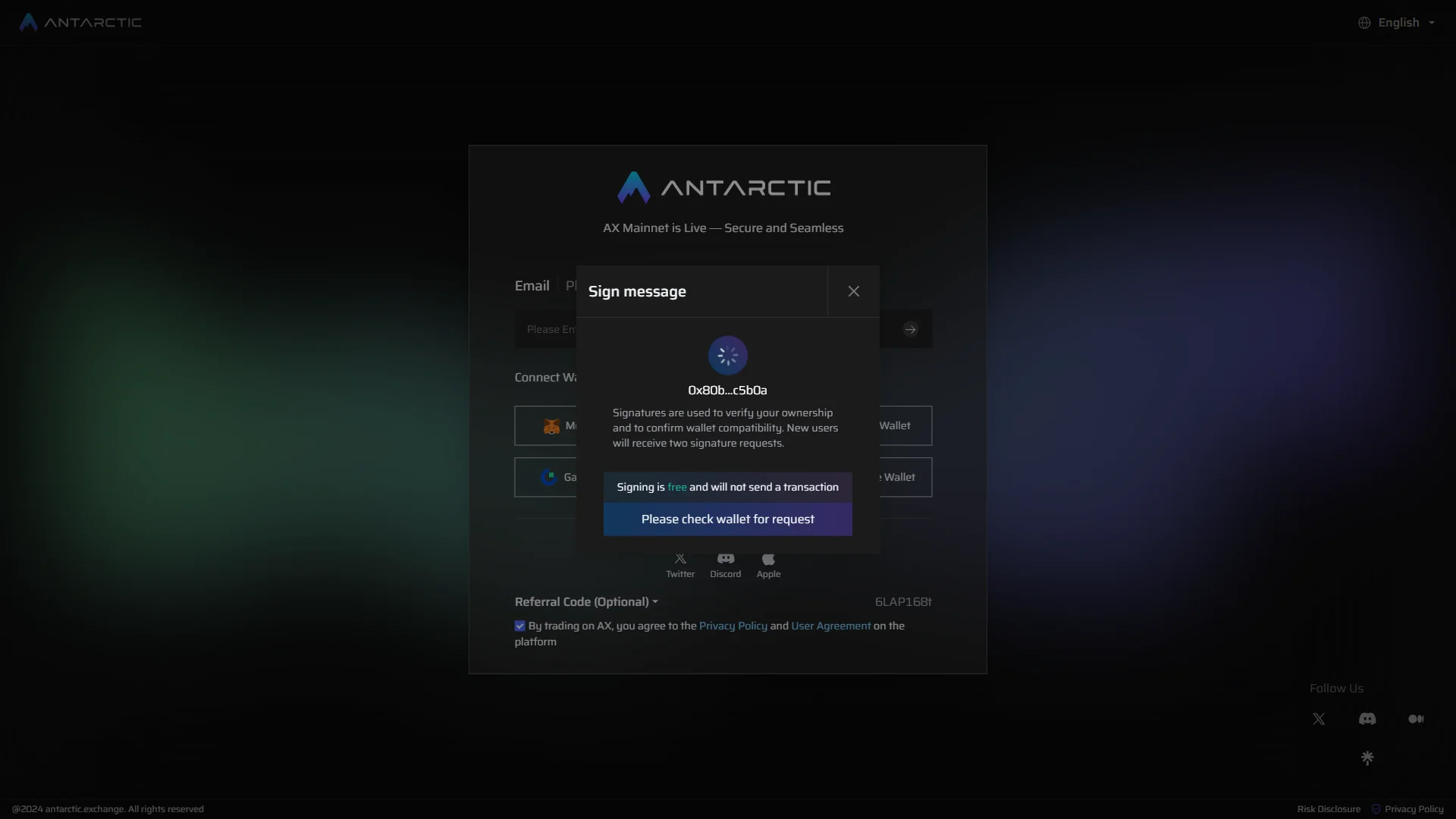
With the “Sign message” window waiting and the connected address shown in shortened form, open your wallet extension to pick up the request — the window asks for exactly that with “Please check wallet for request”. Signing costs nothing at this point: the notice reads “Signing is free and will not send a transaction”, and a new account receives two signature requests, so expect a second one after this.
6. Sign the login message
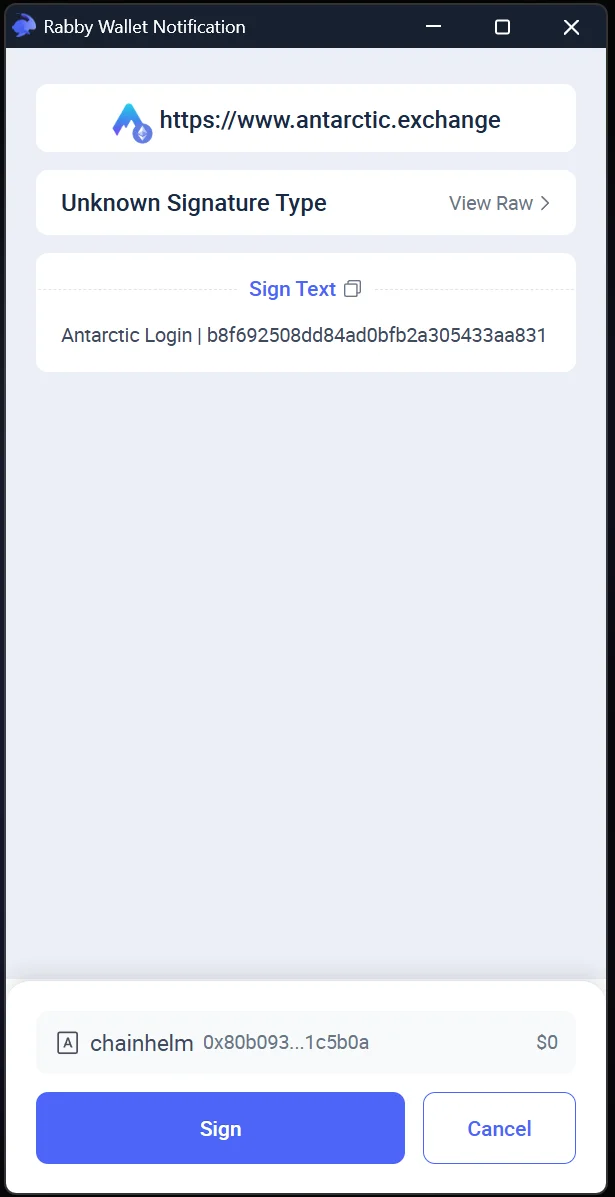
Back in the wallet extension popup, read the “Sign Text” block — “Antarctic Login” followed by a one-time string, with https://www.antarctic.exchange named as the origin — and click “Sign”. If either the origin or the message text differs from that, stop with “Cancel”; once you sign, the same popup switches to a confirm step.
7. Finish with “Confirm”
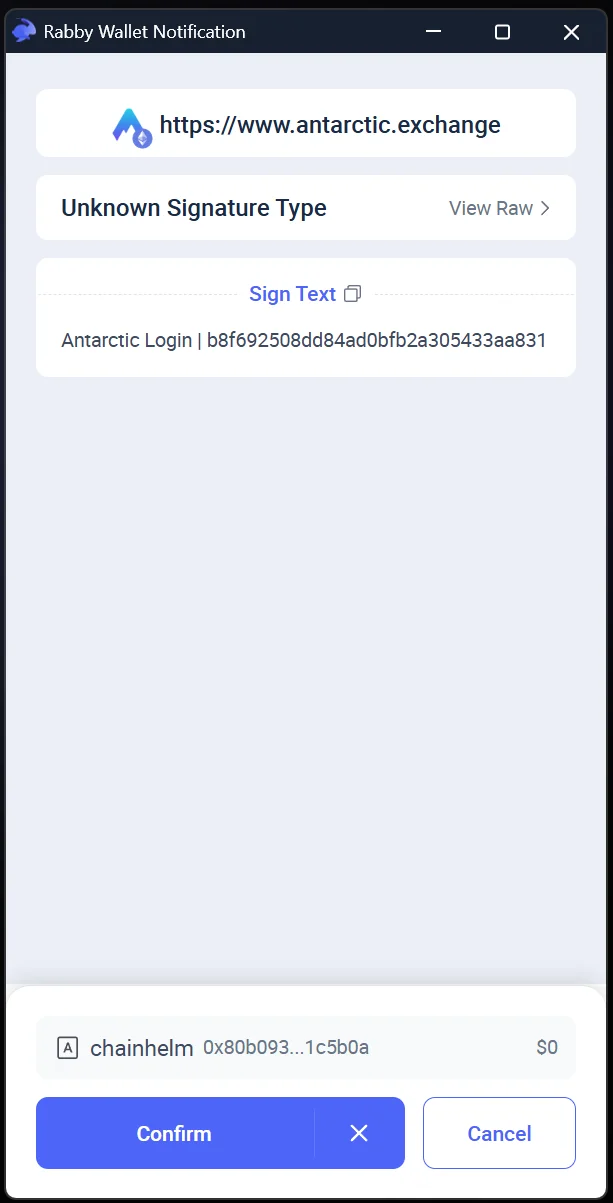
The sign text is unchanged from the previous prompt and only the button has become “Confirm”, so click it to complete the signature. Confirming here is what leaves the wallet signed in and connected; until you click it, “Cancel” still backs the request out.
Smartphone (iOS / Android) connection steps
- First, open the Antarctic official page in your mobile browser or your wallet app’s in-app browser (the link applies the referral code). When you open it, you’ll see a screen like the one below.
2. Tap “Trade Now” on the referral landing page
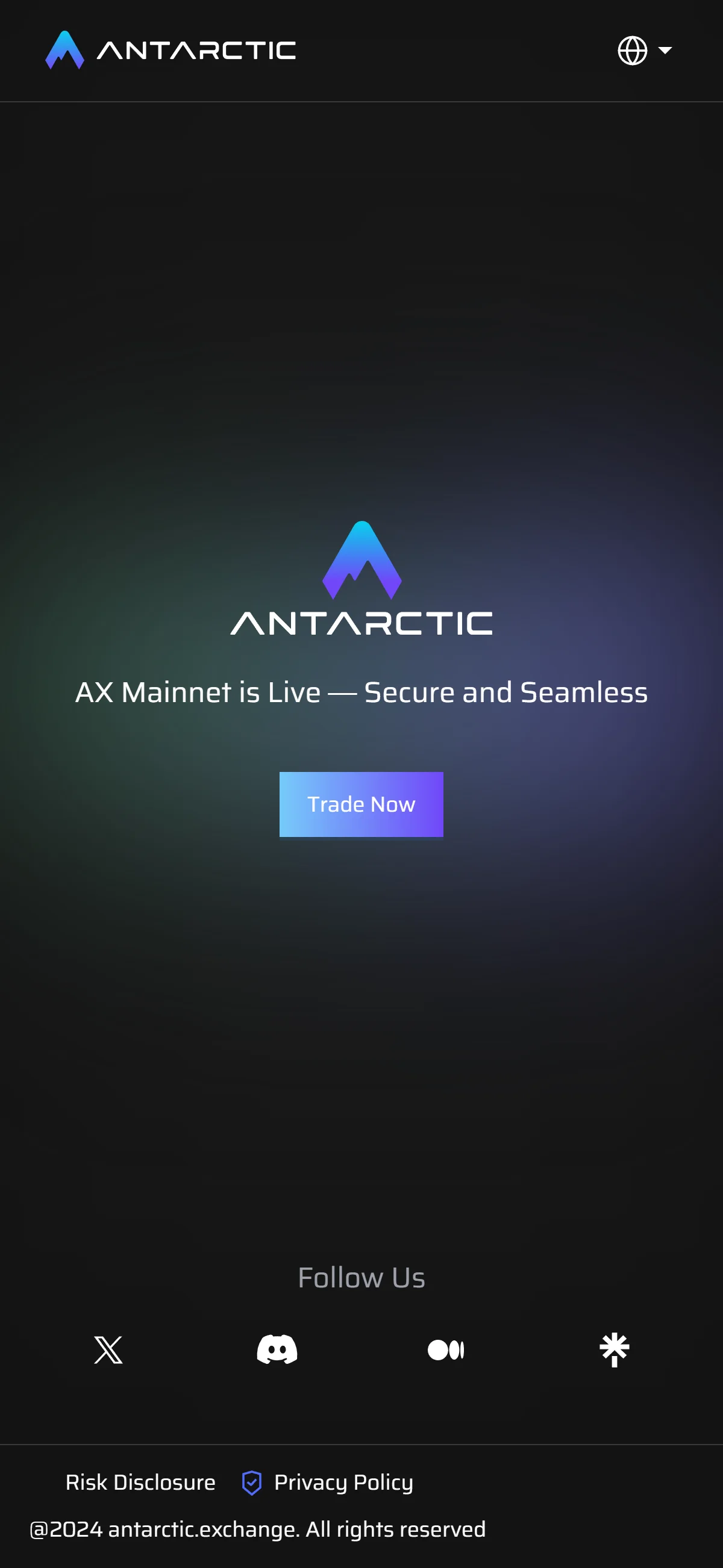
Open the referral link on your phone and tap “Trade Now” below the Antarctic logo to bring up the login screen. Arriving through the link is what carries the referral code over to that screen, so avoid typing the address in by hand.
3. Choose a wallet and check the referral code
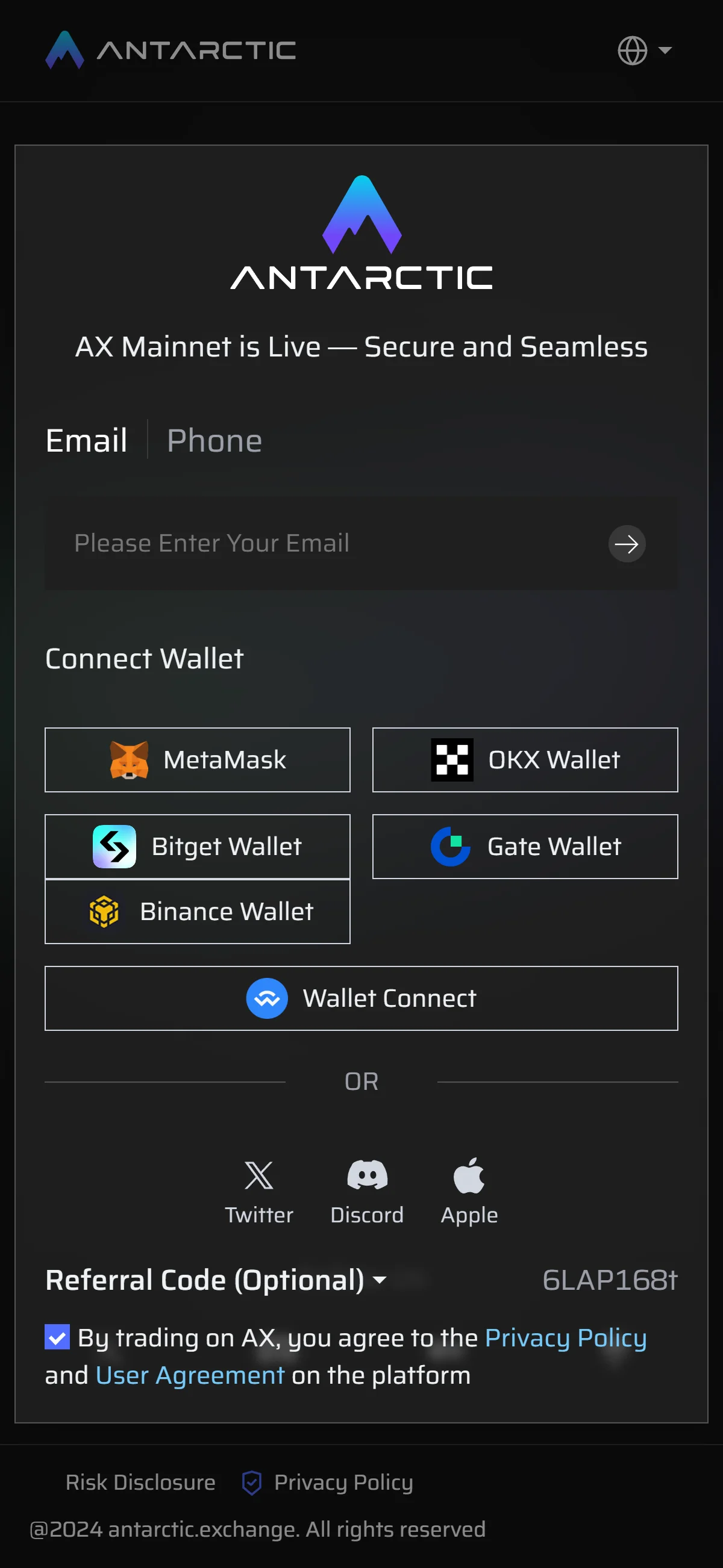
On the login screen, pick the wallet you use under “Connect Wallet” — “MetaMask”, “OKX Wallet”, “Bitget Wallet”, “Gate Wallet”, and “Binance Wallet” are listed, with “Wallet Connect” on its own row below them.
Before you tap it, check that “Referral Code (Optional)” already carries “6LAP168t” from the link and leave that field as it is, and that the box agreeing to the “Privacy Policy” and “User Agreement” is checked. Tapping your wallet then switches over to the wallet app for approval.
You can also start with an email address, a phone number, or a Twitter, Discord, or Apple account here, and the referral code applies whichever route you take.
4. Approve the connection in your wallet app
In the “Connect to Dapp” request that opens in your wallet app, confirm that the site asking to connect is https://www.antarctic.exchange and that the network shown reads “Ethereum”, then tap “Connect” so the site can move on to its signature request. If the origin shows anything other than that address, back out with “Cancel”.
5. Open your wallet app for the request
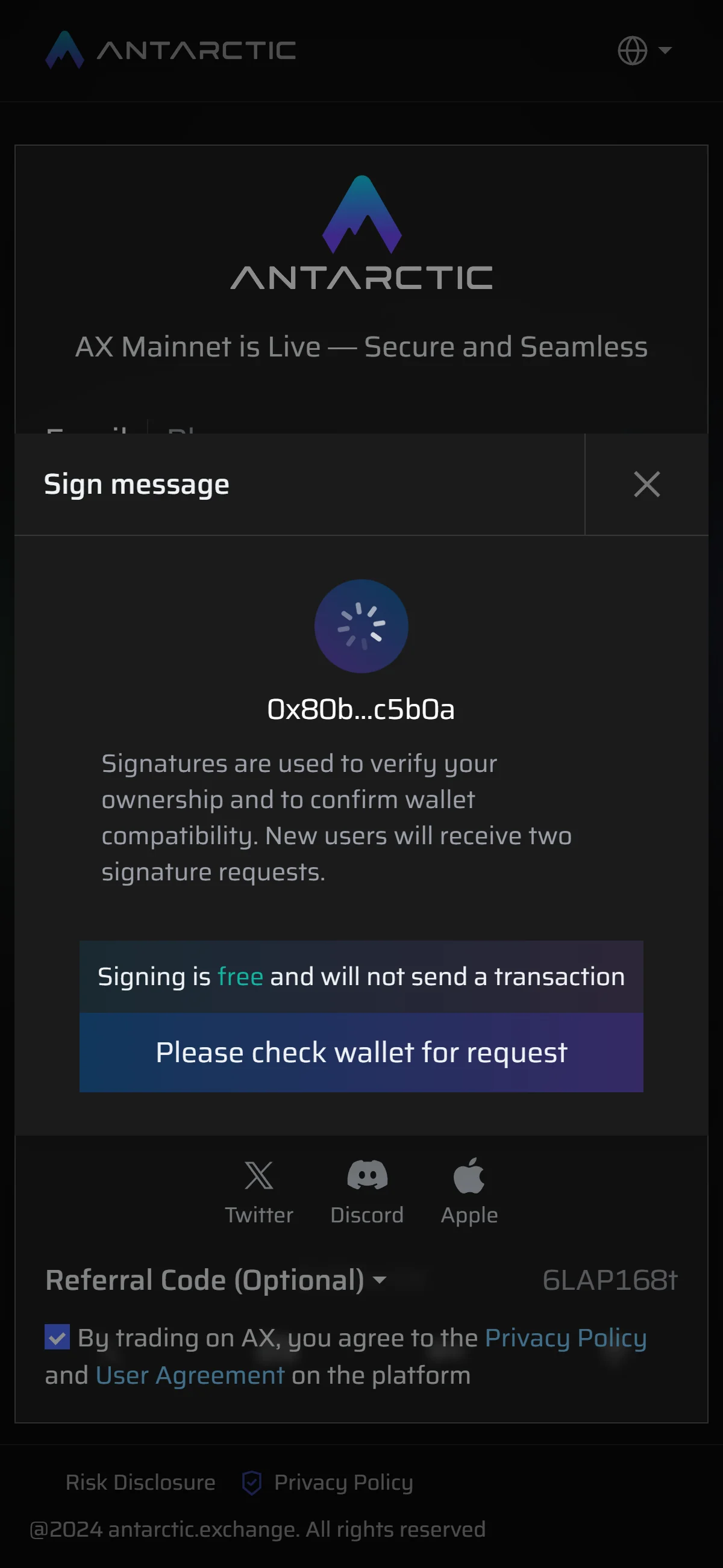
With the “Sign message” panel waiting and the connected address shown in shortened form, switch to your wallet app to pick up the request — the panel asks for exactly that with “Please check wallet for request”. Signing costs nothing at this point: the notice reads “Signing is free and will not send a transaction”, and a new account receives two signature requests, so expect a second one after this.
6. Sign the login message
In the signature request that opens in your wallet app, read the “Sign Text” block — “Antarctic Login” followed by a one-time string, with https://www.antarctic.exchange named as the origin — and tap “Sign”. If either the origin or the message text differs from that, stop with “Cancel”; once you sign, the same request moves on to a confirm step.
7. Finish with “Confirm”
The sign text is unchanged from the previous request and only the button has become “Confirm”, so tap it to complete the signature. Confirming here is what leaves the wallet signed in and connected; until you tap it, “Cancel” still backs the request out.
The wallet you use barely matters here. Antarctic’s own FAQ names MetaMask, OKX Wallet, Binance Wallet and Ledger as directly supported and routes anything else compatible through WalletConnect by QR code, and the login window we opened also listed Bitget Wallet and Gate Wallet. The same window accepts an email address, a phone number, or a Twitter, Discord or Apple account instead, and a Web2 login of that kind generates an address for you automatically. Whichever route you pick, the referral field is the same field on the same screen — that is the part worth slowing down for. One honest limit on the email and social route: the operator does not document which social providers are offered, or who holds the key material behind the address it generates for you.
What to do after connecting to Antarctic
We cover the deposit process separately for PC/browser and smartphone (mobile).
Before either sequence: the deposit screen lists Arbitrum, Ethereum and BNB Smart Chain, but only Arbitrum appears in the operator’s published coin configuration as a USDT route, so confirm Ethereum or BNB Smart Chain in the product before you send anything on them.
PC/browser deposit steps
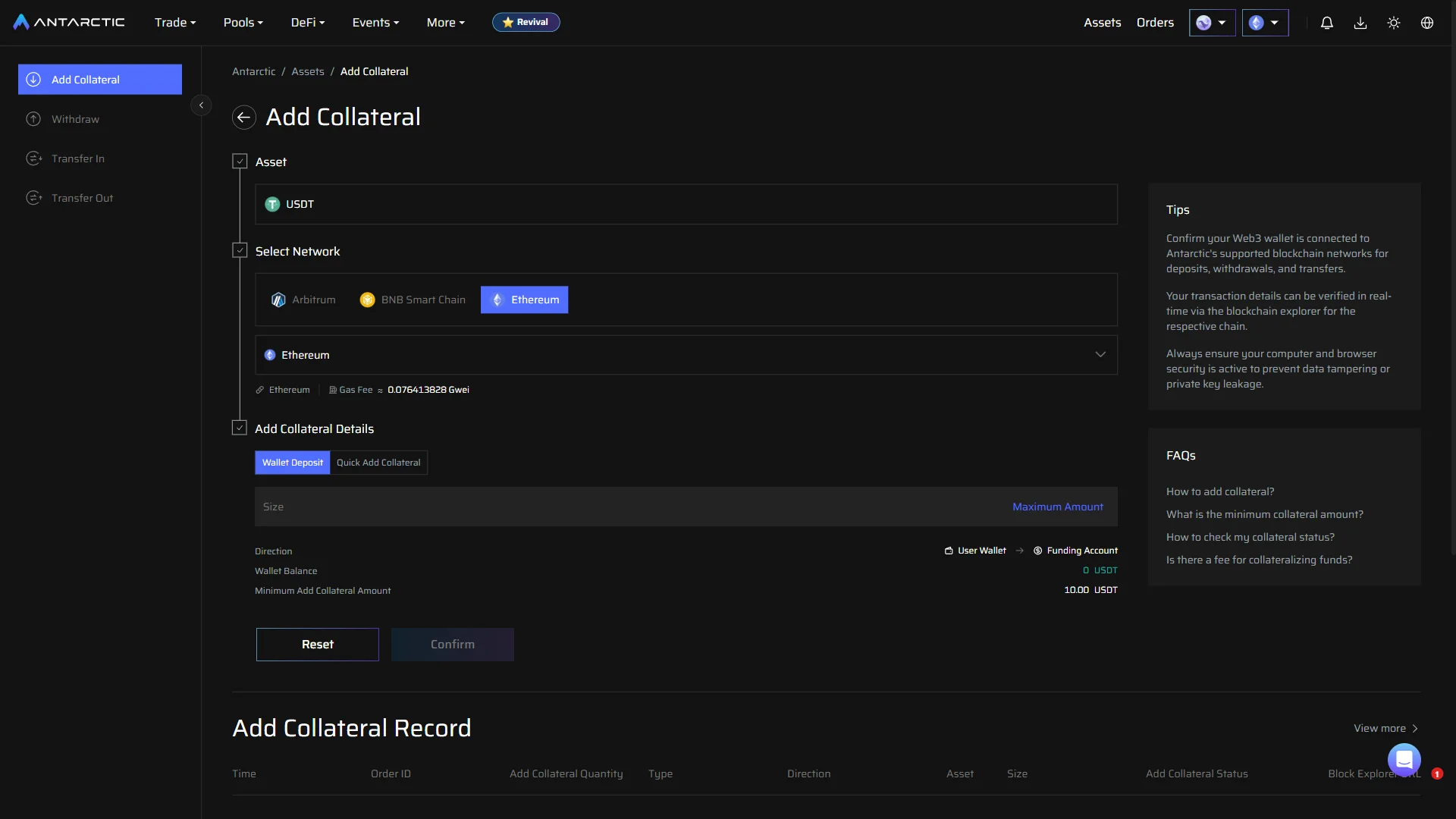
From “Assets”, open “Add Collateral”: “USDT” is already set as the asset, so pick the chain you are sending from under “Select Network” — “Arbitrum”, “BNB Smart Chain”, and “Ethereum” are offered, with “Ethereum” selected here. Check the estimated gas fee just below the selector, since it reflects the chain you picked.
With the “Wallet Deposit” tab open, enter the amount in “Size”, or use “Maximum Amount” to fill in the whole balance; “Quick Add Collateral” sits next to it as the other tab. Check the “Direction” line, which shows the funds moving from “User Wallet” to “Funding Account”.
Check that your amount clears the “Minimum Add Collateral Amount” of “10.00 USDT”, then click “Confirm”.
Smartphone (iOS / Android) deposit steps
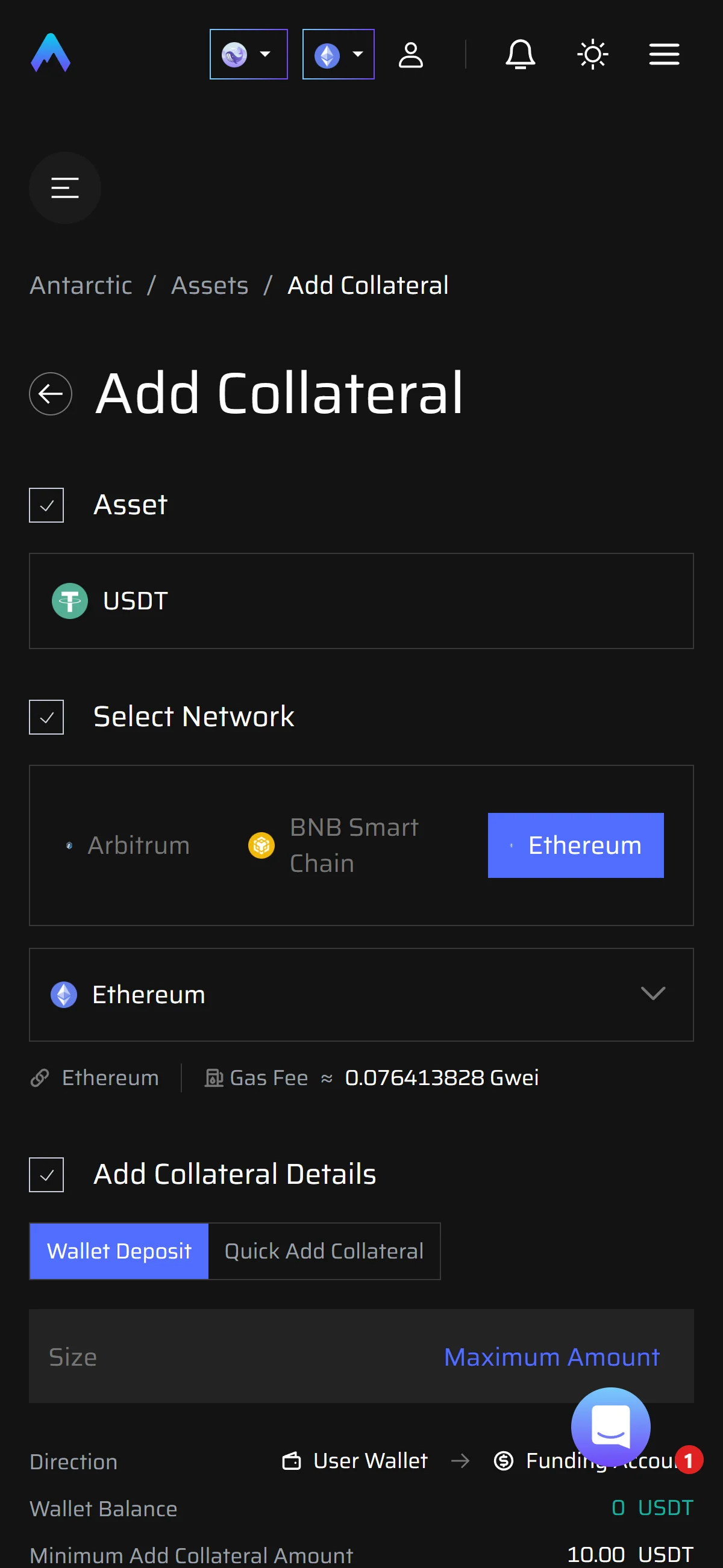
From “Assets”, open “Add Collateral”: “USDT” is already set as the asset, so pick the chain you are sending from under “Select Network” — “Arbitrum”, “BNB Smart Chain”, and “Ethereum” are offered, with “Ethereum” selected here. Check the estimated gas fee just below the selector, since it reflects the chain you picked.
On the “Wallet Deposit” tab, enter the amount in “Size”, or tap “Maximum Amount” to fill in the whole balance; “Quick Add Collateral” sits beside it as the other tab. Check the “Direction” line, which shows the funds moving from “User Wallet” to “Funding Account”.
Check that your amount clears the “Minimum Add Collateral Amount” of “10.00 USDT”, then scroll down and tap “Confirm”.
A few things about that screen are worth knowing before you send anything. Three chains are named for deposits — Arbitrum, Ethereum, BNB Chain — and the operator’s chain configuration confirms all three, but the published coin configuration currently returns a USDT profile for Arbitrum only, and the points task list offers deposit tasks for Arbitrum One and Ethereum and not for BNB Chain. Treat Arbitrum as the route the venue actually settles through, and confirm the other two in the product before you rely on them.
USDT is the only asset in the whole system: the only collateral, the only quote asset across all 32 markets, and the only asset you can deposit or withdraw. No fiat on-ramp is advertised anywhere on the site, in the docs or in the FAQ, so if you are funding from a bank account, you buy USDT somewhere else first and arrive here with it. The minimum deposit is 10 USDT, which is the same “Minimum Add Collateral Amount” shown on the screen above.
What lands is not yet margin. The deposit credits a per-chain funding account, and a separate internal transfer moves value from there into the chain-independent trading account that futures margin is actually drawn from. That split is why the “Direction” line reads from “User Wallet” to “Funding Account” rather than straight into a trading balance. Trading actions themselves carry no gas here, but the deposit is an ordinary wallet transaction, so you pay network gas on whichever chain you send from.
After “Confirm” goes through, the USDT moves from your connected wallet to the Funding Account, and trading can start as soon as that collateral is in place.
The Antarctic referral code cannot be added after sign-up
The referral code can only be applied once — the first time you connect your wallet.
If you complete the connection without the code applied, there is no way to link it to that wallet afterwards, and the only route left is to start over with a new wallet.
The mechanism behind that rule is in the operator’s own documentation: the invitation relationship is established at registration, through the invitation link or by entering the invitation code, and no wallet-address-based attribution is documented for anything that happens later. There is one moment when the relationship is written, and it is the moment you register.
Which is exactly why the check belongs in the login window. The field sits right there under the wallet buttons, it is labeled optional, and it stays editable until you connect — so confirming that 6LAP168t is in it costs a couple of seconds, and it is the only place those seconds buy you anything.
If a wallet is already connected without the code, the only honest route left is starting again with a new wallet: a fresh address, the link, the field checked before the connection. Nothing you do inside the existing account will attach the code to it retroactively.
◆ ◇ ◆
AX Points accrue on every trade, and the token behind them does not exist yet
Everything you do on Antarctic after that first deposit feeds one program, and the payout at the end of it does not exist yet. What follows is what the operator has published: how points accumulate, what happens to them when you stop, and where its own pages disagree about what they eventually turn into.
Points accrue per 100 USDT traded, with no daily cap
The program is called AX Points, and the published base rate is 1 point per 100 USDT traded. That rate is banded rather than flat: it holds at 1 point per 100 USDT up to 500,000 USDT of volume in a day, rises to 1.5 points per 100 USDT in the 500,000 to 3,000,000 band, and reaches 2 points per 100 USDT above 3,000,000, with each lower band continuing to earn at its own rate. Trading points are credited when a position is fully closed, and balances settle daily at 08:00 UTC. An earlier daily cap of 1,000 points has been removed.
Around that sits a published list of one-off tasks, and a liquidity rate that pays more the longer the position stays put.
- Bind an X account
- 50 points, once
- Bind a Discord account
- 50 points, once
- Deposit USDT on Arbitrum One
- 100 points, once
- Deposit USDT on Ethereum
- 100 points, once
- Add liquidity
- 200 points, once
- Complete a first transaction
- 200 points, once
- Hold liquidity
- 2 points per day per 100 USDT of liquidity provided on days 1 to 7, 3 points on days 8 to 30, 4 points from day 31. Withdrawing that liquidity resets the holding period to the base tier.
Two qualifiers sit on top of all of it. The program runs as one continuous mainnet season under the heading “Points Season” rather than as numbered rounds, with the end date given as TBA, and an older testnet balance is kept separate from the mainnet one. And the operator reserves the right to apply contribution-quality multipliers built from 30-day factors — trading volume, account performance, accumulated liquidations, weighted average leverage, liquidity participation, profile completeness — so the rates above are the floor of the calculation rather than the whole of it.
A quiet account loses points on a published schedule
A balance that stops moving shrinks. Once an account goes 7 consecutive days without a trade or a referral, its points decay 5% per week. Leave it longer and the schedule hardens: across a 28-day inactivity cycle, three weekly cuts of 5% are followed by a 50% burn in the fourth week, and the cycle then repeats. Testnet points are exempt from the burn.
This is the mechanic most worth knowing before you start, because it turns the program into a commitment rather than a claim you can bank and walk away from. Points earned early are not sitting safely while you wait to see what they convert into; on a published schedule, they are being taken back.
ATTX has not been issued, and 8% of supply is reserved against these points
The token is called ATTX. The published allocation gives it a fixed total supply of 100,000,000 and reserves 8,000,000 (8%) of that for airdrop, described as pre-mined, represented by user-collected points, and released in batches gradually after the token generation event (TGE).
That event has not happened: as of 2026-08-17 no TGE has taken place, no date for one has been announced, and the full tokenomics paper is promised before the TGE rather than published now. So a points balance today is a claim on a token that does not yet exist, with no price, no announced date and no published conversion arithmetic behind it. Anyone putting a number on what a point will be worth is guessing, and the operator has published nothing that would turn that guess into a calculation.
Two official Antarctic pages say different things about conversion
The one question that decides whether points are worth accumulating gets two different answers from the operator’s own surfaces.
Points are not a token
Points will convert at a set ratio
We are not going to average those two into one comfortable sentence. The conservative wording is the one to plan around, because it is the one in the documentation that governs the program, and because the promise on the product page carries no ratio, no date and no commitment that survives a rule change. The disagreement itself is the fact worth carrying away: on the only question that gives points any value, the operator’s own record contradicts itself.
Conduct rules can reduce, freeze or void a balance
Points and campaign rewards sit under the platform’s risk-control rules, and those rules name the conduct they are aimed at: multiple related or controlled accounts, self-referrals, fake or fraudulent referral activity, wash trading and self-matching, malicious hedging to exploit campaign rules, extremely frequent open-and-close cycles, and programmatic trading used for exploitation.
The measures attached are not confined to the points ledger: rewards can be adjusted or deducted, tiers changed, funds temporarily restricted or frozen, and accounts limited, suspended or terminated. In other words a points balance here is revocable by the operator on its own assessment, which makes it a different kind of asset from one that settles on-chain. Residents of the countries named in the terms are outside the program altogether, which is what the country section further down is about.
A 32-market perpetual venue whose operator names no one
Who is behind the venue, and what the legal documents leave out
First, a clarification, because this name is crowded in English search results: this is the perpetual futures venue at antarctic.exchange, not a similarly named wallet product and not a national polar research program.
The only corporate name that appears anywhere is ANTARCTIC EXCHANGE CORPORATION, which is the publisher of record for the iOS app — and that name appears nowhere on the website, in the docs, in the User Agreement or in the Privacy Policy. The agreement a user actually enters into is made with “Antarctic Trading Platform”, with no registered company name, no company number and no registered office disclosed. CoinGecko lists the country as Panama; the operator confirms that nowhere.
The same agreement chooses Singapore law and arbitration under SIAC, the arbitration institution based in Singapore, while Singapore sits on the venue’s own prohibited-countries list. That is worth stating flatly, because a governing-law clause is easy to misread as a sign of authorization: it is not one, and no MAS license exists behind it.
No individual is named either. The docs describe the team only in the aggregate, and the homepage leans on unattributed claims about the veterans and proven professional team behind it. No founder, chief executive or other officer appears in any operator material or third-party listing we checked.
On size, the homepage claims 280,000+ active traders and 21.9B+ in lifetime volume. Neither carries a definition of “active”, a methodology or a date, and no independent source publishes a user count for this venue, so both are claims the operator makes about itself rather than measurements anyone can check.
Two different founding years are both defensible depending on the question, which is why the record below separates them.
Read that as a funding year and a trading year that are not the same year. The money and the engineering belong to 2024; anything a trader would recognize as a live venue belongs to 2025 and after.
Matching runs off-chain, and the rollup behind it cannot be inspected
The operator describes a zk-rollup settlement layer: trades and account updates are batched off-chain and committed on-chain as a Merkle state root plus a zk-SNARK validity proof. That is the venue’s central technical pitch, and it is the reason it gets grouped with the zk cohort of perpetual DEXes rather than with fully on-chain order books.
What is missing from the claim matters as much as the claim. The docs name no data-availability layer, no chain ID, no verifier contract address and no block explorer, so no third party can check that the proof system does what it says. The only Antarctic contracts identified on a public chain are the AMLP and AHLP liquidity tokens and their staking contracts on Arbitrum; DefiLlama attributes 100% of protocol TVL to Arbitrum and classifies the volume and fee adapters as off-chain.
The book itself is a central limit order book with maker and taker roles, but the liquidity behind it is a vault counterparty model — AMLP for market making, AHLP for hedging — and the operator’s own FAQ says AMLP providers become a counterparty to users’ trades. So the party on the other side of your fill is frequently the venue’s own liquidity pool rather than another trader.
32 markets, and leverage that steps down as position size goes up
There are 32 perpetual markets, every one of them USDT-margined, and no spot market at all. The advertised maxima are 500x on GOLDUSDT, 100x on BTCUSDT and ETHUSDT, 50x across most crypto majors and alts, and much lower on the equity and ETF markets: 10x on QQQ and SPY, 8x on AAPL, AMZN and GOOGL, 5x on NVDA and TSLA.
The headline number is the top of a ladder, not a setting you get to keep. On BTCUSDT the public bracket data shows five notional brackets, and the maximum leverage falls as the position grows.
Size up on the strength of the advertised number and you will not get that number — the ladder takes it back a bracket at a time. Both cross and isolated margin are available on every market, cross by default. And nine of the 32 markets reference something other than crypto: gold, silver and seven US equities and ETFs. That is where the venue’s largest regulatory exposure sits, and it comes up again below.
What a trade costs, and what the fee page does not settle
The base tier is 0.02% maker and 0.05% taker at VIP 0, and VIP 0 is the tier that applies to anyone arriving through a referral link. Six tiers run on rolling 14-day notional volume across all markets, recalculated daily at 07:00 UTC, and the maker fee only reaches 0% — with a 0.02% taker — at VIP 5, which requires 500,000,000 USDT of volume in 14 days.
Any sentence about “the fee” here needs the market attached, though. The per-symbol data shows 26 of the 32 markets on the published 0.02% and 0.05% base, while a minority carry hard-coded rates of 0.04% on both sides instead, so the tier table is not uniform across the listed markets.
Funding is charged but not explained. No funding interval, premium-index formula, interest component, clamp or cap is published anywhere in the docs or the FAQ. The next-collection times served through the venue’s own market API line up with an eight-hour schedule, but the operator states no interval anywhere, so the schedule is undocumented rather than confirmed. Funding is a recurring cost of holding a position, and here it is one you cannot model in advance.
Trading actions carry no gas, because matching happens off-chain; wallet-side gas still applies to deposits, withdrawals and liquidity interactions. And the ATTX fee discount does not exist yet: the token is unissued, and the docs commit only that its functions “will include” fee discounts and VIP status at launch, with no percentage, staking threshold or holding requirement published. There is nothing there to factor into today’s cost.
Opening an account asks for nothing, and the terms reserve the right to ask later
No identity check stands in front of connecting a wallet, depositing, trading or withdrawing, and the published configuration sets the non-KYC daily withdrawal ceiling equal to the general one at 200,000 USDT, so there is no verified-versus-unverified tiering on the way out.
That is not a no-KYC guarantee, and the gap between the two is where a user gets caught. The User Agreement reserves termination of account services without prior notice if a user does not complete identity verification; the Privacy Policy enumerates full individual and corporate KYC and AML data sets, including biometric data; and AML review can require evidence of source of funds before a withdrawal is released. Nothing at the start, discretionary verification later, at a moment the operator chooses.
Where Antarctic sits among perp DEXes, and why its own numbers do not agree
How much actually trades here depends on which source you read
Four sources, four answers, for the same day.
- Operator market API, summed across all 32 markets, 2026-08-17
- 70,054,955 USDT of 24h perpetual volume
- CoinMarketCap, 2026-08-17
- 43,418,728 USD, on a different snapshot window
- DefiLlama, 30 days to 2026-08-17
- 3.936B USD, which implies roughly 131M a day
- CoinGecko, 2026-08-17
- 0 — its feed for this venue is not populated
The first line is the one to anchor on, because it is a direct read of the venue’s own data: the sum of the 24h turnover field over every listed market from its public market API, which is the same data the trading interface displays. The rest are worth reading with their source and date attached, rather than choosing one of them as the answer. And the homepage counter advertising 21.9B+ of trading volume is a lifetime total, not a day, so it should never be set beside any of these.
Fee income is the steadier signal. DefiLlama records 1,141,539 USD of protocol fees over 30 days, and ranks Antarctic 9th of 65 derivatives protocols by 24h fees and 9th of 82 by 30-day fees. Locked capital tells a smaller story: about 9.6M USD sits in the two liquidity vaults, which is 24th among derivatives protocols and roughly 0.5% of that category’s total. Fees and volume say mid-table; the capital committed behind the book says small. Both are true, and the gap between them is the interesting part.
The open interest figure nobody can reconcile
Open interest — the total value of the positions open on a venue at one time — is where this venue’s published record stops being merely inconsistent and becomes unusable without a caveat. Three sources give three magnitudes for the same quantity.
That is a gap of roughly 79x to the tracker figure and roughly 540x to the marketing counter. The operator’s own API total is at least internally consistent: BTCUSDT alone reads 2,555,488 USD there, and the trading interface shows the same number. DefiLlama’s adapters for this protocol are fed by operator-supplied endpoints on a host that returned an error during research, so the methodology behind the much larger figure could not be checked from outside.
That matters for the rank, because the rank rests on the larger number. Antarctic sits 6th of 66 derivatives protocols reporting non-zero open interest on DefiLlama — above Extended Perps and GMTrade, below Hyperliquid Perps, Aster Perps, Variational, Lighter Perps and Grvt Perps — entirely on the strength of the 265.9M figure. The rank is real, and it is worth exactly as much as that one number is.
The third-party record is patchy in a way that compounds the problem: CoinGecko shows zero volume and leaves open interest blank for this venue, and CoinMarketCap displays open interest as ”—” with no rank, launch date or jurisdiction filled in.
What Antarctic offers that most perp DEXes do not
Five things distinguish the product, and one of them — the markets that reference shares and metals — comes attached to a constraint the other four do not carry.
The zk-rollup settlement model puts it with the zk cohort rather than with fully on-chain order-book venues — subject to the verification limit already noted, that the proof system cannot be inspected from outside.
The liquidity design uses two vaults instead of one pooled counterparty: AMLP for market making and AHLP for hedging, both denominated in USDT, with liquidity providers receiving 60% of trading fees and standing directly against trader flow. Splitting market making from hedging is uncommon among perpetual DEXes.
The nine markets referencing gold, silver and US equities and ETFs, cash-settled in USDT with no share delivery, are the clearest differentiator in the product set — and the clearest source of regulatory exposure, which is why they should not be read as a plain feature. The country section below picks that up.
The interface layer offers two modes over one matching engine, a CEX-style layout and a DeFi-native one, plus native TradingView charts and the email or social login that generates an address for you.
And the Trader Revival Account is unusual enough to spell out: after a 14-day settlement period in which a user records an eligible realized net loss, the platform issues a separate funded account sized at 50% of that loss, whose principal cannot be withdrawn, with only settleable profits distributed. That is the mechanism as published; it is a consolation structure, not a reason to trade.
Thirteen countries are shut out by the terms, and no regulator has named Antarctic
The thirteen entries on the prohibited list, and how old the clause is
Before any regulator has a view, the venue itself has one, and it is written into the User Agreement.
The list runs to 13 entries, and the exclusion is broad rather than product-level: no account opening, access, trading, deposit, withdrawal, API use or campaign rewards, and it reaches residents of those places, people located there, and people accessing the platform from there. The clause also states that the list is non-exclusive and subject to change at any time at the operator’s sole discretion, so anyone outside it today has no assurance of staying outside it tomorrow.
The date on the document carrying that clause matters: it predates the product as it exists now by more than a year — the V2 mainnet upgrade, the equity and commodity markets and the mobile app all came later. A list that old is more likely to lag current practice than to describe it, so read it as a dated clause rather than as a live compliance record.
The exclusion is a promise the user makes, not a gate the site shows
The mechanism is contractual self-declaration. Users represent and warrant that they are not resident in, located in, or accessing the platform from a prohibited country, and the operator reserves the right to investigate, terminate the account and liquidate open positions where location is misrepresented.
Nothing technical is documented behind that promise. No IP-level gate, wallet screening or attestation step is described in the legal documents, and none was observed in the frontend during research. The operator-side control that does run continuously is different in kind: third-party AML screening of on-chain fund flows, which watches money rather than geography.
One inconsistency belongs on the record. The official iOS app is listed in the United States App Store storefront while the United States sits on the prohibited list. The two facts are published by the same operator, and it does not reconcile them anywhere.
Self-custody here does not mean the operator cannot reach your funds
The two-layer story told about fully on-chain perpetual DEXes — a frontend that can be restricted, contracts that stay reachable — holds only partly here. Matching, mark pricing, funding and the account ledger are operator-run and off-chain, and there is no permissionless alternative frontend or public contract interface leading to the same order book.
The on-chain footprint identified here is limited to deposit and withdrawal flows plus the liquidity vault contracts on Arbitrum.
So self-custody in this design means something real but narrow: fund movements are signed by the user, and the vault contracts are non-custodial. It does not mean the operator is unable to restrict access, freeze funds or delay withdrawals. The User Agreement and the risk management framework expressly reserve those powers. Self-custody here keeps the operator from spending your collateral; it does not keep it from stopping you.
The equity and commodity markets carry the heaviest regulatory weight
Antarctic lists cash-settled perpetuals referencing US-listed equities and ETFs — NVDA, AAPL, TSLA, AMZN, GOOGL, SPY and QQQ — alongside gold and silver, all quoted and settled in USDT, with no delivery of the underlying asset.
Contracts referencing securities are treated as securities-based swaps in several jurisdictions and are typically confined to eligible participants. The operator publishes no license, no exemption and no disclosure addressing that, and its only related control is the prohibited-countries list quoted above. It also lists XMR and ZEC markets — assets that are delisted or restricted on many regulated venues.
No license in the operator’s own documents, no action naming the venue, and neither fact settles much
No license, registration or authorization is claimed in the operator’s own documents — not on the site, not in the User Agreement, not in the docs. For a perpetual DEX that is the ordinary state of affairs rather than a finding in itself.
The app store listings are where that silence breaks, in two different ways. The iOS description calls Antarctic “a compliant crypto derivatives exchange”, while no named license, regulator or jurisdiction appears in any of the operator’s own documents to support that description. And the Google Play listing states that Antarctic is operated by Antarctic Exchange Corporation and registered with FinCEN in the United States as a money services business, registration number 31000294120669 — a claim chainhelm has not checked against the FinCEN register. Read what it would mean even if it holds: a money services registration is an anti-money-laundering filing rather than permission to offer derivatives, it says nothing about any country outside the United States, and the United States is on Antarctic’s own prohibited-countries list.
No regulatory action, warning-list entry or enforcement proceeding naming Antarctic was identified. That finding comes with limits: general web search was unavailable for the venue-wide check, so this is “none found”, not “none exists”. The country-by-country work was narrower and firmer — each regulator’s own register and warning list was searched by name — and those checks are in the next section.
There is no stated regulatory direction either. The operator has published nothing about regulatory strategy beyond that static clause dated 2024-09-17, and the only movement visible in the product — adding equity- and commodity-referenced markets — enlarges the regulatory surface rather than reducing it.
◆ ◇ ◆
The US and Singapore are shut out by Antarctic’s terms; the UK, Australia and India are not
Everything above is about the venue. This part is about you, and about one question first: whether the door is open where you live. Two of the five countries covered here are closed by Antarctic’s own terms before any regulator gets a word in; in the other three the venue is reachable, and what changes is the protection you do not have.
United States — closed by Antarctic’s own terms
The United States is named in the prohibited-countries clause of the User Agreement, which states that Antarctic does not provide services, accept registration of users, or accept trade applications from those countries, and withholds account opening, access, trading, deposit, withdrawal, API use and campaign rewards from residents of those countries, from anyone located in them and from anyone accessing the platform from them. Antarctic is therefore not available to a US resident by the venue’s own terms.
The clause sits in an agreement whose stated last update is 2024-09-17. No separate effective date for the US entry is published, and earlier versions of the document could not be retrieved, so how long the United States has been on that list is unknown.
Antarctic holds no US registration that shows up in a public register — no CFTC or NFA registration, no SEC filing — and its own site, docs and User Agreement claim none either. The one US registration claimed for it anywhere is the unverified FinCEN money services filing on its Google Play listing, described above. For a venue that excludes the market outright, that is the expected condition rather than a separate finding.
US enforcement in this area has been aimed at operators rather than traders. The CFTC’s orders of 2023-09-07 against Opyn, ZeroEx and Deridex concerned offering leveraged retail commodity transactions in digital assets without registering, and what those orders judged was whether US exclusion actually worked in practice, not whether a clause existed on paper. No federal provision was found that makes a US resident’s own trading on an offshore unregistered perpetual venue an offense — an absence in the record, not a clearance, and not legal advice.
So the constraint that actually binds a US reader is the contract, and what it puts at risk is the money in the account. The venue closes the door itself, and an account opened against its terms can be terminated with open positions liquidated. That is the whole of it.
United Kingdom — open to the reader, outside the FCA perimeter
The United Kingdom is not on the prohibited-countries list, and on 2026-08-17 the site and the trading app both loaded in full in a browser set to UK locale and time zone. That check ran from outside the UK, so blocking at the IP level was not tested; what it does show is that the app carries no gate of its own that turns a UK visitor away.
Antarctic holds no FCA registration or authorization, and neither of the two UK routes into the regulated perimeter is in place: not the cryptoasset AML registration that has applied to firms carrying out cryptoasset activities in the UK since 2020-01-10, and not FSMA authorization. A name search of the Financial Services Register returns only unrelated firms.
The FCA’s ban on selling, marketing and distributing crypto derivatives to UK retail clients has been in force since 2021-01-06, and perpetual futures on unregulated transferable cryptoassets sit squarely inside that product class. The nuance that matters for someone deciding today is who the rule binds: it binds firms acting in or from the UK, and no UK rule was found that prohibits a UK resident from reaching an overseas venue on their own initiative. When retail access to crypto exchange-traded notes opened in October 2025, the FCA restated that the derivatives ban stays.
What a UK reader gives up is concrete rather than abstract. No compensation from the Financial Services Compensation Scheme and no recourse to the Financial Ombudsman, because both attach to authorized firms. And none of the retail protections that would apply to an authorized firm offering the non-crypto contracts: a minimum margin requirement that caps gold at roughly 20:1, margin close-out at 50% of required margin, and negative balance protection that caps a retail client’s loss at the money in the account. Antarctic advertises gold at 500x with none of that behind it.
The date to watch is 2027-10-25, when overseas platforms serving UK consumers will need FCA authorization under the incoming UK cryptoasset regime. The application window runs from 2026-09-30 to 2027-02-28, and the FCA has said the duty sits with the platform even where it operates from overseas, with DeFi arrangements assessed case by case where a controlling person is identifiable.
Tax and records stay with you. HMRC says the reports an exchange supplies are not tax calculations and tells taxpayers to keep their own records, and no evidence was found that this venue reports under the UK cryptoasset reporting framework.
Singapore — closed by Antarctic’s own terms
Singapore is named in the prohibited-countries clause, so the venue is not available to a Singapore resident, and the exclusion is service-wide rather than product-specific: account opening, access, trading, deposit, withdrawal, API use and campaign rewards, and it reaches the liquidity vault products on the same basis.
Antarctic holds no MAS license, registration or exemption. The MAS Financial Institutions Directory returns no result for the name, checked 2026-08-17.
MAS told Parliament on 2020-01-06 that crypto derivatives are not suitable for most retail investors, that it regulates them only when they are listed on Approved Exchanges, and that many trading platforms operate online from overseas and sit outside its oversight.
Singapore’s rules address providers rather than users, and no statute was found that penalizes a resident for trading on an unlicensed offshore venue. The barrier here is the contract, and behind it there is no MAS protection at all if the terms are ignored: the agreement reserves termination of the account and liquidation of open positions.
Two things a Singapore reader should not misread. The agreement chooses Singapore law and SIAC arbitration while listing Singapore as prohibited; that is a choice of law, not authorization. And absence from the MAS Investor Alert List means nothing here: MAS itself has said that list targets entities soliciting Singapore customers without a license, and that it cannot possibly enumerate every unsafe entity in the world.
Australia — open, with no license standing behind the venue
Australia is not on the prohibited-countries list, and on 2026-08-17 the trading app loaded end to end — market list, order book, leverage tiers — in a browser set to Australian locale and time zone, with no region gate anywhere in it. That check also ran from outside Australia, so blocking at the IP level was not tested.
Antarctic holds no Australian financial services license — the ASIC licensee dataset was checked on 2026-08-17 with no match — and its AUSTRAC registration status could not be queried, so that one is unknown rather than known to be absent.
ASIC’s position on the product itself is unusually direct. Its updated guidance treats contracts for difference, options, forwards and futures referencing digital assets, including perpetual futures, as derivatives and therefore as financial products, and states that Australian law applies where services are provided in Australia, including from offshore. Whether a license is required in a particular decentralized arrangement is a facts-and-circumstances question that ASIC has not answered for this venue.
What does not reach an Australian user is the protective half of that regime. ASIC’s product intervention order caps retail crypto CFD leverage at 2:1 for in-scope issuers, and ASIC warned Australians on 2021-08-18 to be wary of crypto-asset financial products from providers without a license. No ASIC determination applies that cap to this venue, which advertises 100x on BTC and ETH. The distance between 2:1 and 100x is the fact worth seeing; no authority has found a breach, and none is asserted here.
Licensing-linked protections and external dispute resolution through the Australian Financial Complaints Authority (AFCA) do not attach to an unlicensed provider, and no Australian law was identified that prohibits a resident from using an offshore unlicensed non-custodial perpetual venue. That is an absence of evidence rather than a permission.
The date to watch is 2027-04-09, the commencement date ASIC’s implementation roadmap sets for Australia’s new digital assets regime: the Corporations Amendment (Digital Assets Framework) Act 2026 (No. 38, 2026) received Royal Assent on 2026-04-08 and creates two new financial product categories — “digital asset platforms” and “tokenised custody platforms” — with ASIC as licensing supervisor. The transitional class no-action position that ran to 2026-06-30 is no shelter for a venue like this one: its conditions include AFCA membership and registration as a foreign company, which an unregistered offshore protocol does not meet.
Records are your own job: the ATO requires per-transaction crypto records kept for five years, and has published nothing specific to perpetual futures, so whether these results count as income or as capital is not settled by published guidance.
India — open, with tax and remittance strings attached
India is not on the prohibited-countries list, and Antarctic appears in neither of the two published FIU-IND enforcement rounds against offshore providers. The site and the BTC/USDT trading page also loaded on 2026-08-17 in a browser set to Indian locale and time zone — from outside India, so blocking at the IP or ISP level inside the country is untested.
Registration status here is genuinely unknown rather than confirmed absent. Antarctic is not shown to be registered with FIU-IND as a virtual digital asset service provider, but FIU-IND publishes counts rather than a searchable registry of names, so it cannot be confirmed either way. The duty in question is the provider’s: the 2026 guidelines restate that obligations are activity-based and apply irrespective of physical presence in India, and that automating functions through smart contracts does not relieve the controlling parties behind them of those obligations.
No Indian provision was found that prohibits the individual: holding or trading virtual digital assets is not barred, no user-side penalty is prescribed for using an unregistered platform, and the Supreme Court set aside the RBI banking restriction in 2020. That covers the trading itself. How money reaches the venue is a separate question, and it is the one with rules attached.
What an Indian reader actually carries is the tax. Income from the transfer of a virtual digital asset is taxed at a flat 30% with no deduction beyond cost of acquisition, no set-off of losses against other income and no carry-forward, plus 1% tax deducted at source (TDS) on transfers, declared in the virtual digital asset schedule of the return.
Because a venue with no India-facing reporting deducts no TDS and issues no statements, the entire computation and disclosure sits with the taxpayer — while the tax department cross-checks returns against data filed by platforms that do report. Trades made on a non-reporting venue are undocumented, not exempt.
Moving the money is the second constraint. The Liberalised Remittance Scheme does not permit remittances in the nature of margin or margin calls to overseas exchanges or counterparties, with penalty exposure under the Foreign Exchange Management Act (FEMA) for contraventions. Whether sending stablecoins from a self-custodied wallet to a settlement contract counts as such a remittance has not been clarified by the RBI and has not been tested in a decided case, so it stands as an open question rather than as a rule — and an open question about your own money is one to put to someone who can look at your specific facts.
India imposes no leverage cap on crypto derivatives, so nothing on the venue’s side is constrained by Indian product rules.
No audit, no named oracle, and one address that can upgrade the staking contracts
What Antarctic does not disclose
Some risks come from what a venue does. These come from what it has not published.
The audit line is worth a second read. The full documentation index runs to 39 pages and contains no audit page, no auditor name and no report link, and DefiLlama’s record for this protocol carries zero audits. That is not the same as an audit whose status is unknown; it is a venue that holds user collateral and has published no third-party review of the code that holds it.
The oracle gap has a sharper edge. The venue serves its own index and mark prices for every market, but the constituent venues behind them, the weighting, the update cadence and any manipulation safeguards are not published. Mark-price formation is what decides when a position is liquidated, so on this venue the number that closes your position is set by the operator and cannot be checked from outside.
Who can change what
The AMLP and AHLP staking contracts on Arbitrum sit behind ERC-1967 upgrade slots, and those slots are populated — meaning the logic running at those two addresses can be replaced with different logic.
Both staking contracts report the same owner, 0x63730113bd32b7f9a34157bf8b70f066b3d4d2c6 — an address with no bytecode on Arbitrum, so a single key rather than a multisig.Arbitrum RPC reads, 2026-08-17
No key management, signer-set or key-ceremony disclosure is published to sit alongside that. A timelock is claimed in the docs for critical parameter updates, but no timelock contract address, delay duration or queued-change view exists anywhere, and no timelock stands in front of those two staking contracts as they are deployed. The only concrete user-facing delay that is actually documented is the liquidity exit period.
Governance is stated to be team-controlled at first, with a DAO taking over as decentralization advances. No governance contract, forum or vote record is published, so there is nothing to check that against.
What happens when a position goes wrong
The same bracket ladder that caps leverage also sets the maintenance margin, from 0.5% at the smallest BTCUSDT bracket to 9.5% at the largest, so the distance between your entry and your liquidation price moves as the position grows rather than staying where you first calculated it.
Liquidation itself is charged at 0.05%, the highest taker rate on the fee schedule, regardless of the VIP level a trader has reached.
Behind liquidation sits the insurance fund of undisclosed size, and behind that, auto-deleveraging. If the fund is depleted and a position cannot be closed above the bankruptcy price, opposing traders’ positions are reduced instead, ranked by leverage and profit ratio, with each account shown a queue indicator in 20% steps. That is the exposure a profitable trader carries here even when their own position is sound: someone else’s loss can close your winner.
How fast money can leave
The published ceilings shape the answer more than the fee schedule does.
Withdrawals also wait on 200 block confirmations, and operator powers sit on top of the caps. Third-party AML screening can delay a withdrawal, the operator may ask for evidence of source of funds before releasing it, and it warns that attempting to interfere with a review — including creating public pressure — may itself extend the review. The agreement separately reserves freezing funds without notice and terminating accounts.
The 7-day exit is not the whole of the liquidity vaults’ risk. The vaults are the counterparty to trader flow, so a liquidity position here is not a passive yield product: its returns move inversely to aggregate trader profit and loss, and the exit clock starts only when you ask to leave.
What everything here rests on
USDT is the sole collateral, quote, deposit and withdrawal asset across all 32 markets. There is no USDC option, no fiat and no multi-stablecoin choice, and the operator publishes no stablecoin-specific disclosure. Single-issuer exposure is not a setting you can turn off here; it is a condition of using the venue at all.
What the record does not tell you
The venue’s own published metrics do not reconcile with each other — open interest alone appears at three values that are orders of magnitude apart — so any single figure read on its own misstates the size of the place you are about to fund.
And on incidents: no exploit, oracle manipulation, governance attack, outage, depeg or frontend incident was identified for Antarctic. What that finding is worth belongs in the same breath: general web search was unavailable when the check was made and the operator’s own blog was unreachable, so this is “none found”, not “none occurred”.
A verified code, a single application window, and two countries where none of it applies
The code is 6LAP168t, the sign-up link is https://partner.antarctic.live/code/6LAP168t, and chainhelm checked both by connecting a fresh wallet on 2026-08-16.
One condition decides whether any of that counts for you. The code has to be sitting in the login window’s referral field at the moment the wallet is first connected. Nothing after that connection attaches it — not a later screen, not support, not a second attempt with the same address — which is why the five seconds spent looking at the field before you click your wallet are the only five seconds that matter.
And the boundary, plainly: if you are reading this from the United States or Singapore, the question does not arise, because Antarctic’s own terms exclude you before the code does anything. The country section above sets out what that means and what the terms reserve.