— Contents 11 sections
- 01 Is the Catapult Trade referral code “4AL8G1IR” still active?
- 02 Catapult Trade sign-up steps with the referral code
- 03 What to do after connecting to Catapult Trade
- 04 The Catapult Trade referral code cannot be added after sign-up
- 05 Catapult Points are live, and $PULT has not been issued yet
- 06 Catapult Trade trades synthetic charts off chain, against its own vault
- 07 No independent tracker publishes a single number for this venue
- 08 The platform excludes one named country, while its token sale restricted eight regulated markets
- 09 What the record shows for the United States, the United Kingdom, Singapore, Australia and India
- 10 What you take on here: an unattested vault, a documented house edge and no licensed recourse
- 11 The code, the one condition that decides it, and where the platform is closed
chainhelm’s exclusive Catapult Trade referral code is .
As of 2026-08-14, we connected a new wallet and confirmed that the referral code was applied.
The referral code takes effect only when your account is first created — a one-time thing.
This article covers the sign-up process (wallet connection) with the Catapult Trade referral code, Catapult Trade’s distinguishing features, availability in the United States, the United Kingdom, Singapore, Australia and India, and the risks to acknowledge — with the connection flow and code application verified first-hand by chainhelm’s editorial team.
Is the Catapult Trade referral code “4AL8G1IR” still active?
The chainhelm editorial team connected to Catapult Trade with a fresh wallet on 2026-08-14 and confirmed that the referral code “4AL8G1IR” is still active.
Here is the actual screen captured during verification.
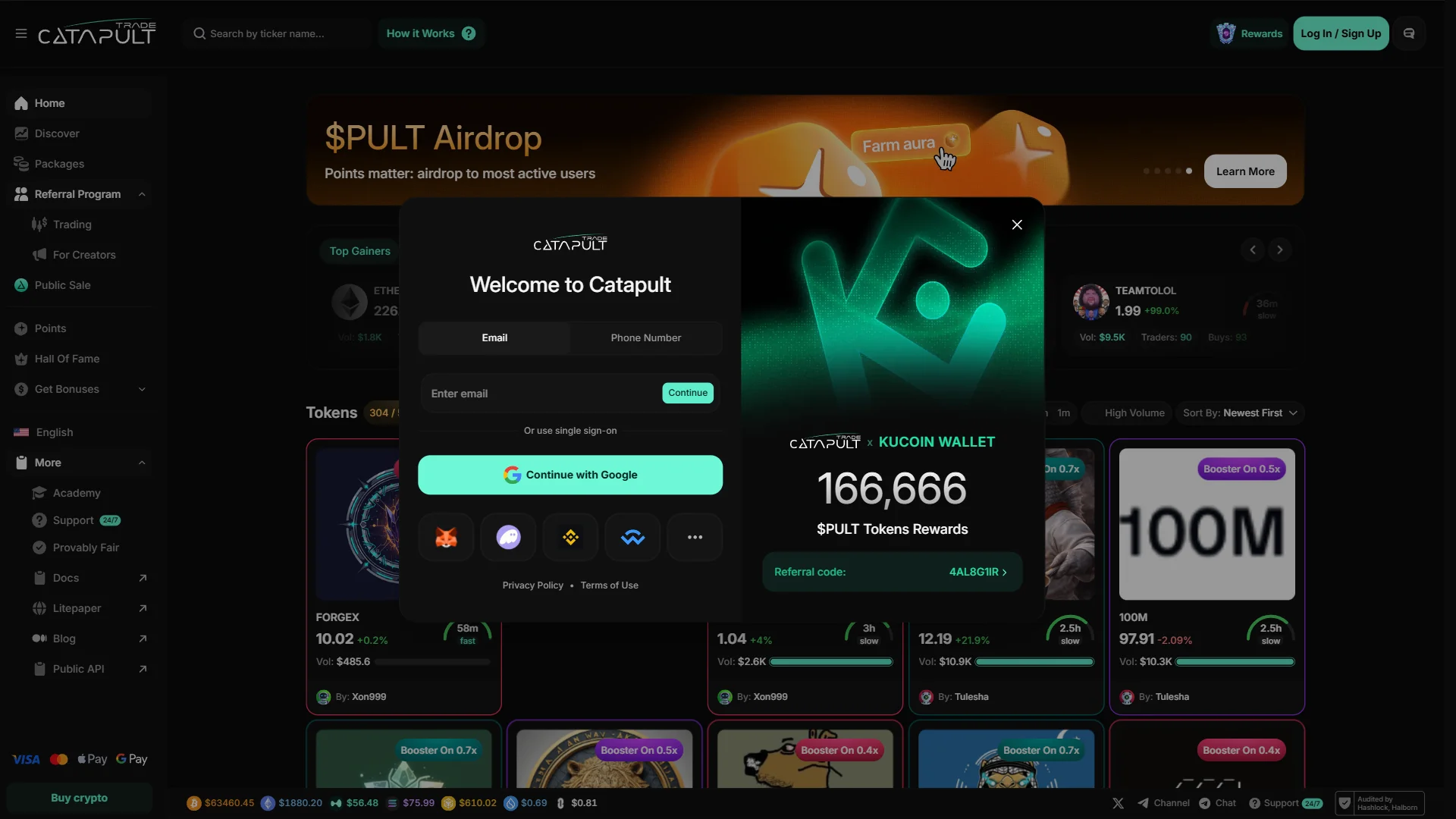
The line to look at is the one that reads “Referral code: 4AL8G1IR”. It is already filled in when the window opens, before a wallet is connected and before anything is deposited, and we saw the same line on both a desktop browser and a phone.
That happens because the code travels inside the link rather than being typed. A Catapult referral link takes the form catapult.trade/r/{CODE}, and ours is https://catapult.trade/r/4AL8G1IR; opening it hands the site a refCode parameter, which the sign-up window then displays as applied. In the flow we walked through there was no code entry field at any point, so there is nothing to paste and nothing to mistype.
Two limits on what we checked, stated plainly. What we verified first-hand is the sign-up flow and the fact that the code shows as applied on 2026-08-14; everything later in this article about availability, regulation and risk comes from published documents and public registers, not from our own testing. And we did not find a screen that confirms the code again after the wallet is connected, so treat the sign-up window as the place to look, not as one of several.
chainhelm continuously verifies the validity of the code and confirms it remains usable.
Catapult Trade sign-up steps with the referral code
We cover the connection process separately for PC/browser and smartphone (mobile).
PC/browser connection steps
- First, open the Catapult Trade official page (the link applies the referral code). When you open it, you’ll see a screen like the one below.
2. Open the referral link and start signing up
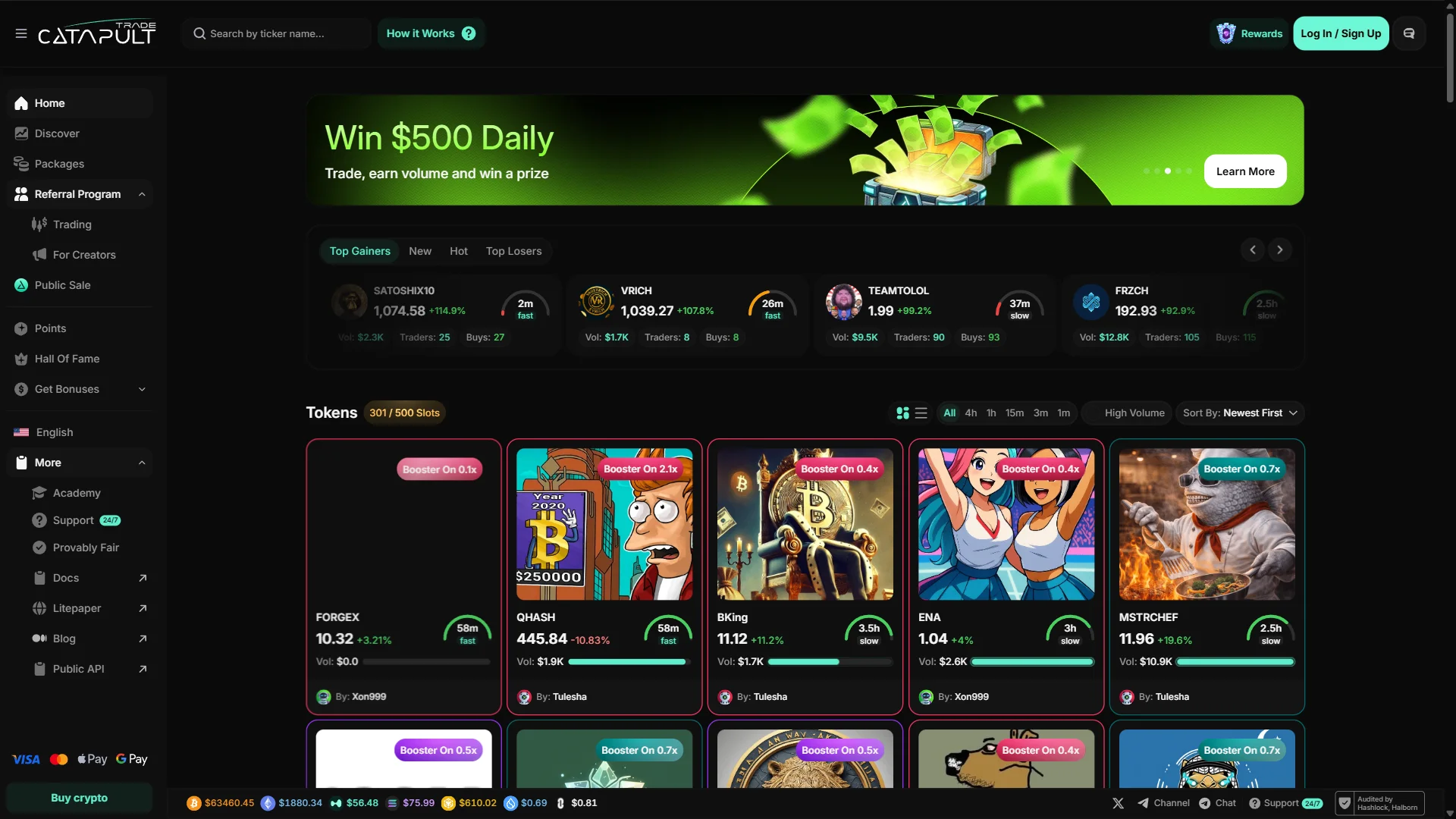
Open the referral link and click “Log In / Sign Up” in the top right of the logged-out home page. The referral code travels with the link, so there is nothing to type by hand — it carries over to the sign-up window that opens next.
3. Check the referral code and pick your wallet
Check that “Referral code:” already reads 4AL8G1IR in the “Welcome to Catapult” window — the link fills it in for you. Then click the wallet you use from the icon row below “Continue with Google” to move on to the network choice.
You can also start from the empty email field or from “Continue with Google” instead of a wallet.
4. Choose the network for your wallet
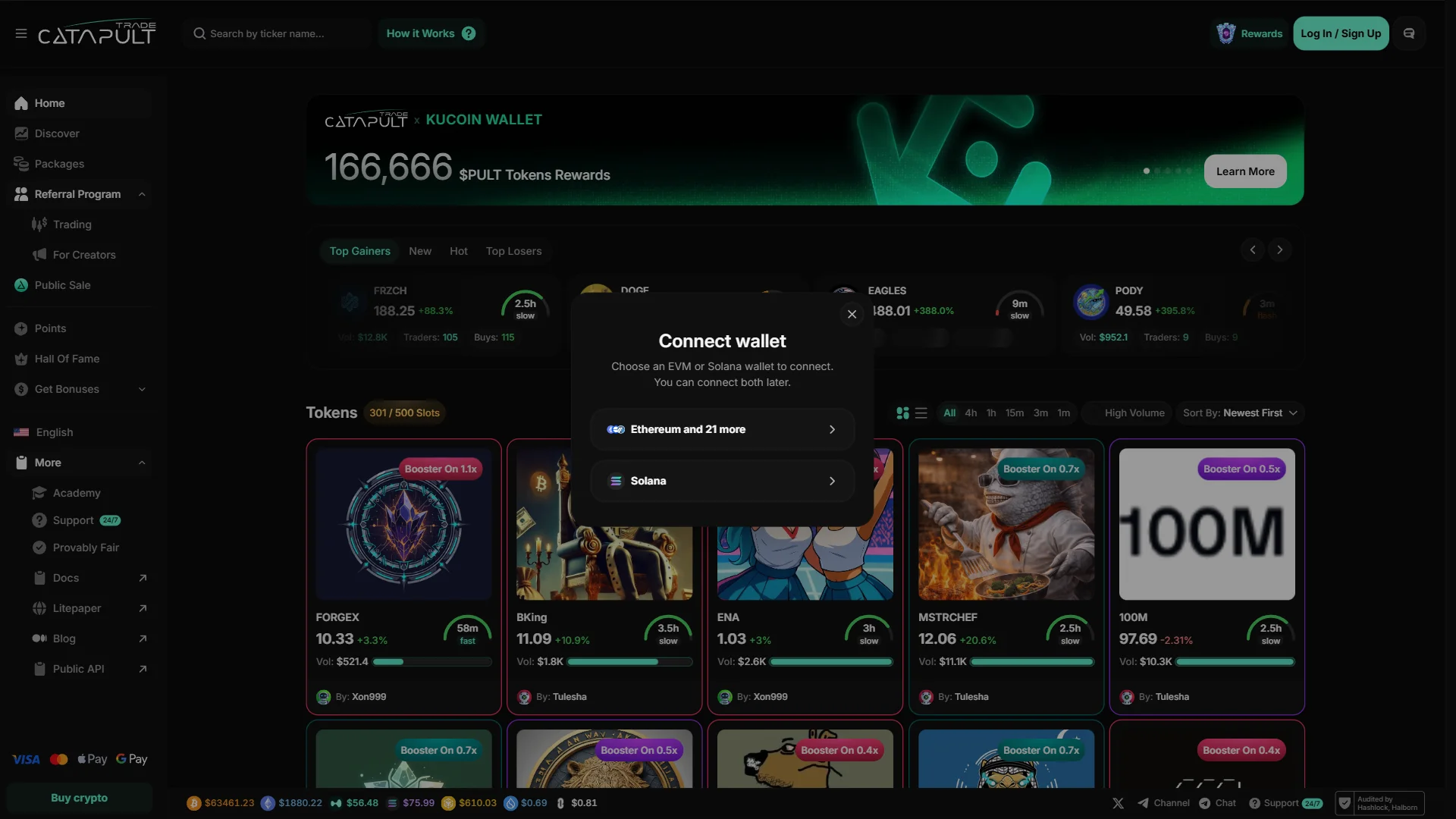
In the “Connect wallet” window, click “Ethereum and 21 more” or “Solana” to match the network your wallet runs on. Only one is needed now — the window notes you can connect the other later — so start with the wallet you actually plan to use.
5. Wait for the wallet prompt
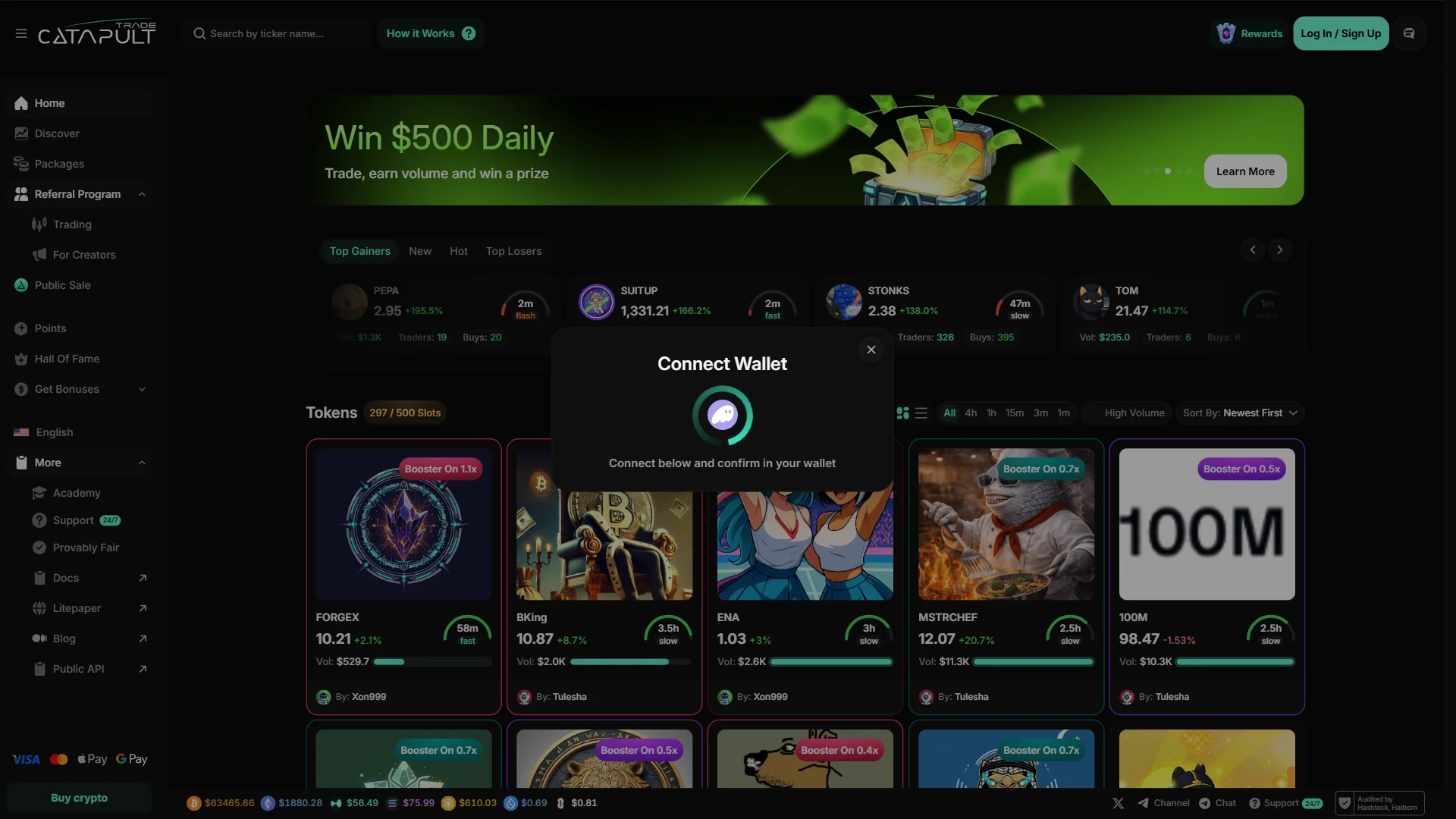
Leave the “Connect Wallet” window as it is while the progress ring turns and the line “Connect below and confirm in your wallet” asks you to finish on the wallet side. The wallet extension opens its own approval window a moment later.
6. Approve the connection in your wallet
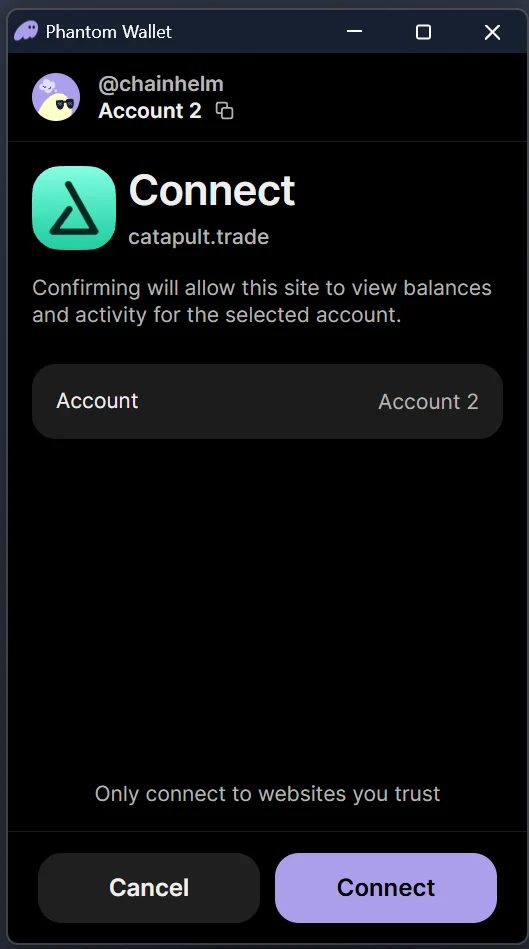
Check that the wallet window names catapult.trade as the site making the request and that the account shown is the one you want to use, then click “Connect”. Approving grants that site read access to the account’s balances and activity, and “Cancel” backs you out if the site name is not the one you opened.
7. Sign the message to finish
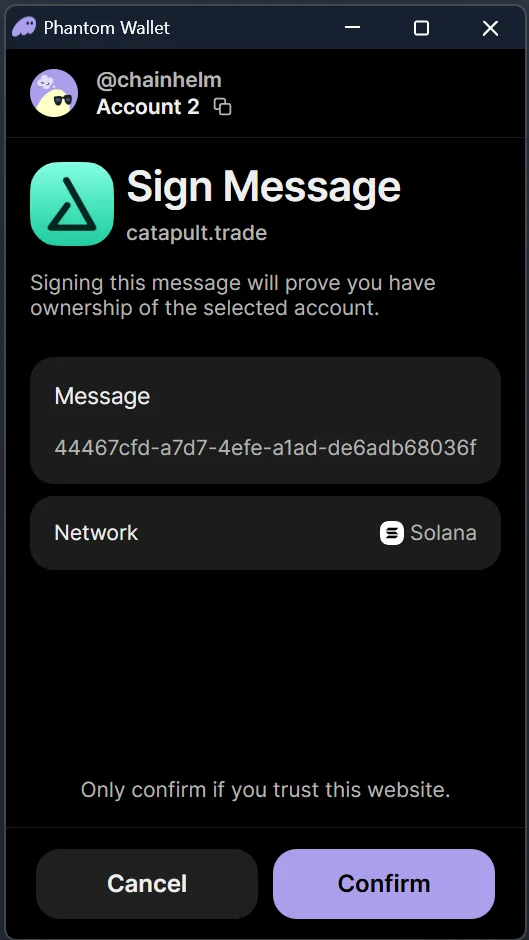
On the “Sign Message” prompt, check that “Network” reads “Solana” and that the request comes from the site you opened, then click “Confirm”. Phantom spells out that this signature proves ownership of the selected account, so use “Cancel” if anything in the request looks unfamiliar.
Smartphone (iOS / Android) connection steps
- First, open the Catapult Trade official page in your mobile browser or your wallet app’s in-app browser (the link applies the referral code). When you open it, you’ll see a screen like the one below.
2. Open the referral link on your phone
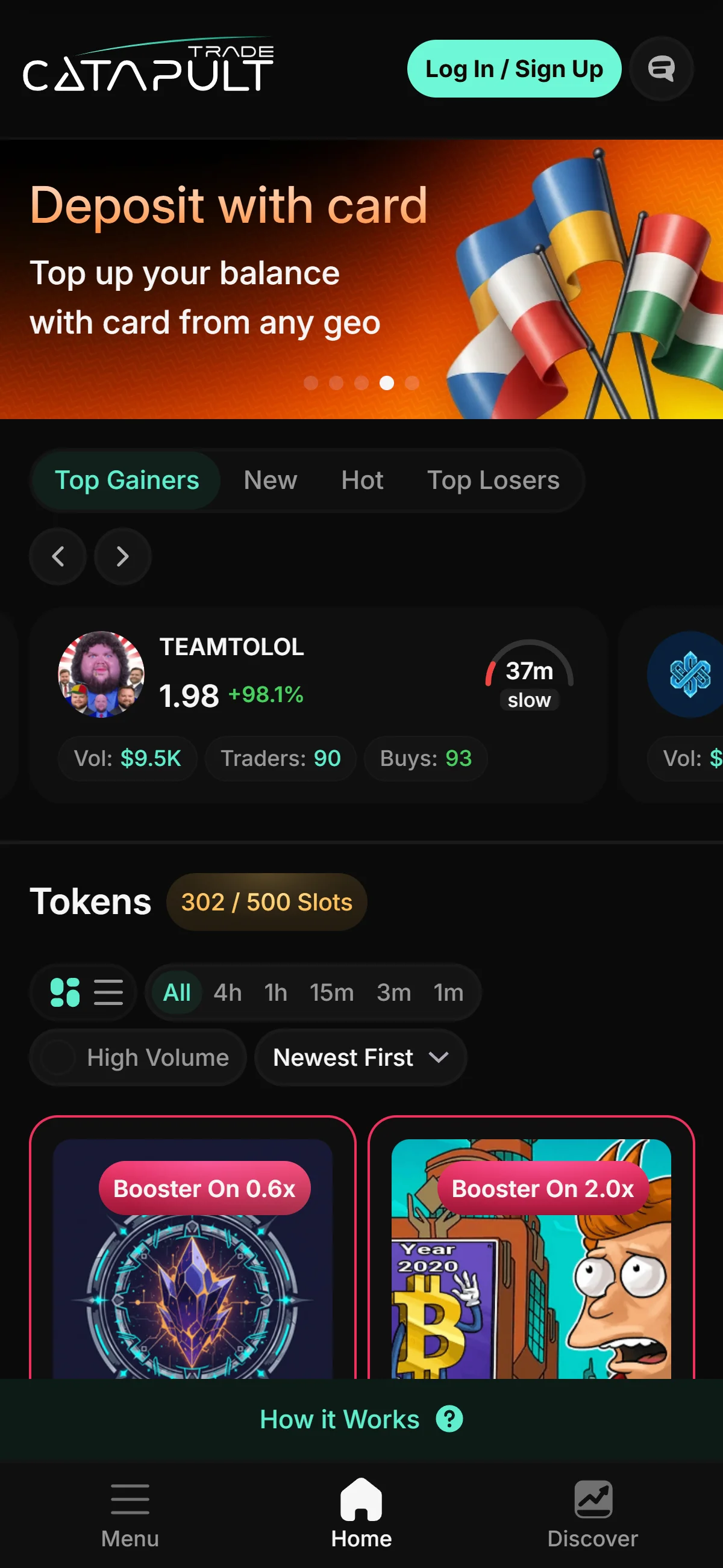
Open the referral link in your phone browser and tap “Log In / Sign Up” at the top of the home screen. The referral code comes in with the link, so you never enter it yourself — it shows up on the sign-up sheet that slides up next.
3. Check the code and choose a wallet
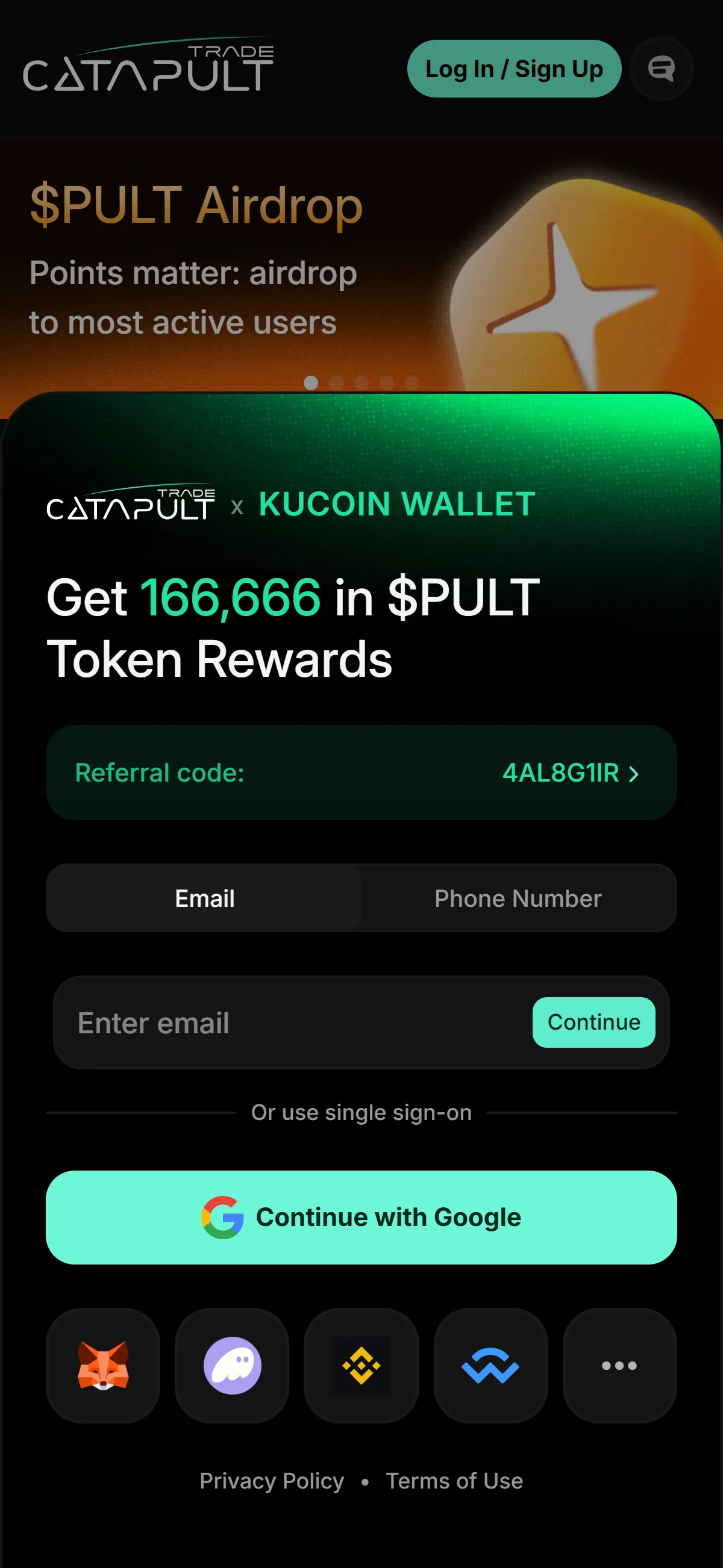
Check that “Referral code:” already reads 4AL8G1IR on the sign-up sheet, then tap the wallet you use from the icon row below “Continue with Google” to move on to the network choice.
If you would rather not start from a wallet, the still-empty email field and “Continue with Google” do the same job.
4. Choose your wallet’s network
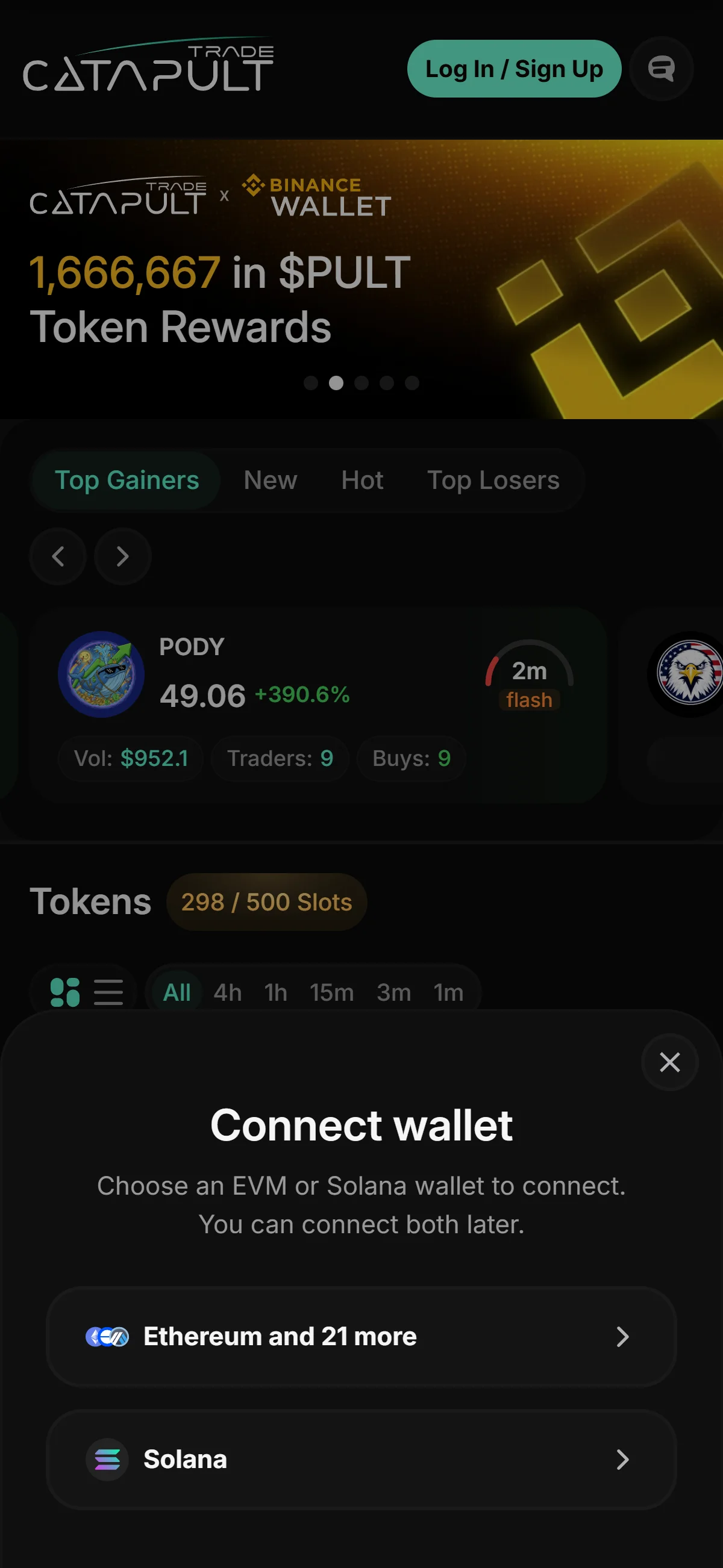
On the “Connect wallet” sheet, tap “Ethereum and 21 more” or “Solana” depending on the network your wallet runs on. One is enough for now, since the sheet notes the other can be connected later.
5. Wait for the wallet app prompt
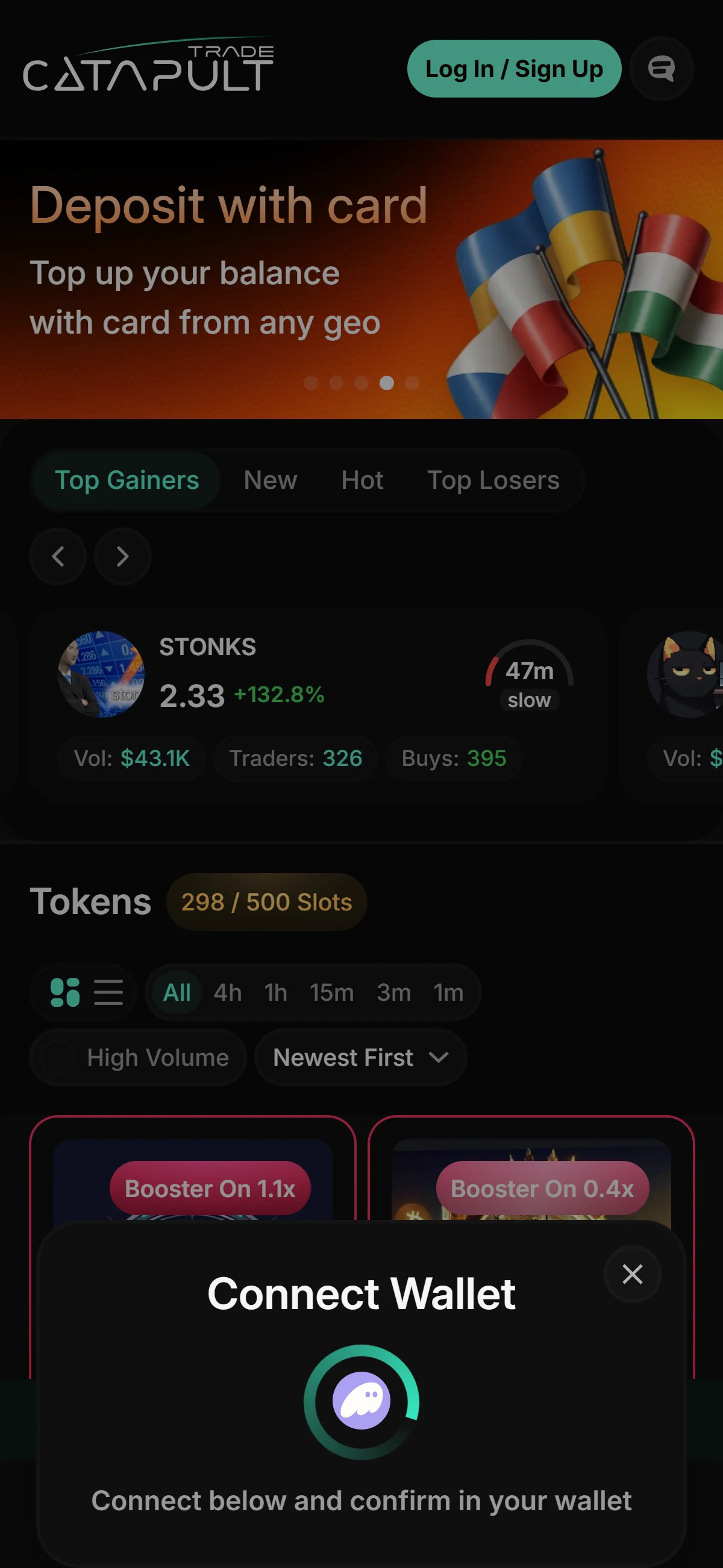
Keep the “Connect Wallet” sheet open while the progress ring turns and the line “Connect below and confirm in your wallet” points you to the wallet side. Your phone switches over to the wallet app for the approval a moment later.
6. Approve the connection in the wallet app
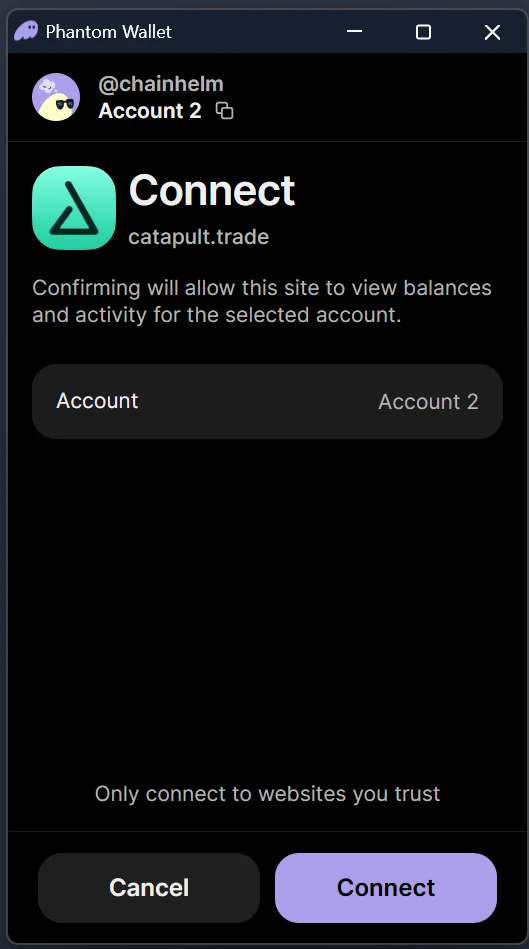
In the wallet app’s connection request, check that catapult.trade is the site asking and that the account listed is the one you mean to use, then tap “Connect”. The request grants read access to that account’s balances and activity, so tap “Cancel” if the site name does not match.
7. Sign the message in your wallet
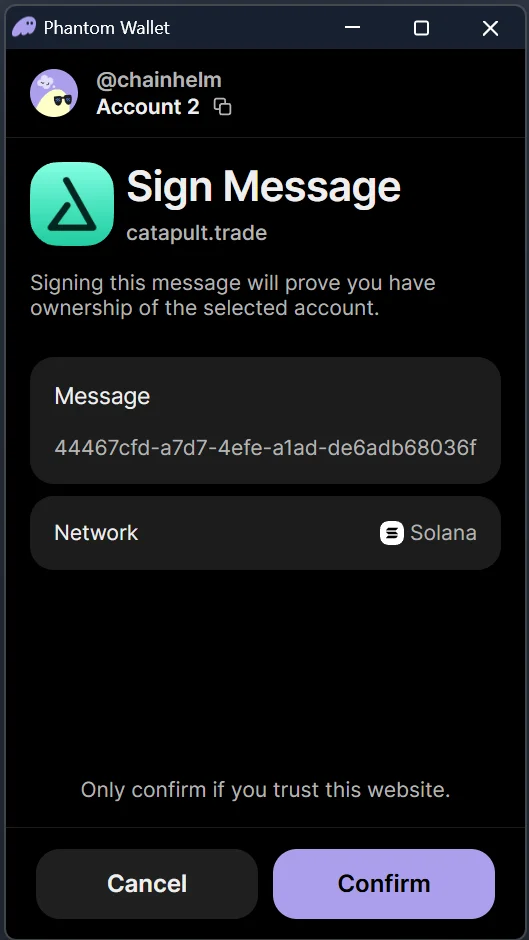
On the signature request, check that “Network” reads “Solana” and that the site named is the one you opened, then tap “Confirm”. The wallet states that signing proves ownership of the selected account, so tap “Cancel” if the request does not look right.
What to do after connecting to Catapult Trade
Funding the account is the next thing you will be asked to do, and the shape of it is worth knowing before you start.
Three networks take a deposit straight from a connected wallet: HyperEVM, Arbitrum and Ethereum. Everything else the platform supports — Solana, Base and BNB Chain — is routed through Relay, a third-party cross-chain bridge rather than one Catapult runs itself. Tron and TRC-20 USDT sit awkwardly between the two: the operator announced them live on 2026-04-14 and they appear among the token-sale deposit options, but they are absent from the deposits documentation page, and we are reporting that unevenness rather than smoothing it over.
The listed supported assets are USDT, USDC, ETH and SOL. Once inside, everything is denominated in USDT: your platform balance and every monetary field the public API returns are expressed in it, whatever you sent in.
The minimum deposit is 1 USD, with one caveat that matters. The documentation gives that figure as an example rather than as a universal rule — its wording is a minimum threshold of, for instance, 1 USDC on Base — and it says the threshold may differ by network without publishing a per-network table. Anything below the floor is not credited.
If you would rather not send crypto at all, card and bank rails have been live since 2026-06-20, reached through Deposit and then “Use Cash”: card, bank transfer, Google Pay, Apple Pay, Revolut and a peer-to-peer option. No official source names the payment processor behind the card and P2P rails. One thing to set expectations rather than to worry about: card availability is gated by region at the payment layer, independently of whether the platform itself is open to you.
There is no published deposit or withdrawal fee schedule of any kind. What the documentation gives you instead is a list of cost factors: gas on the source chain, Relay slippage on the indirect routes under a predetermined auto-maximum that depends on liquidity between networks, and Relay processing time on top of source-chain finality.
Two hazards are documented in enough detail that they are worth reading twice, because both end in funds that cannot be recovered.
The first is the deposit address. When Relay generates one for you, it is strictly single use. Sending a second transaction to an address you already used results in permanent loss of the funds — the address is not a standing account you can top up.
The second is the withdrawal destination. Withdrawals must not be sent directly to an exchange deposit address, because exchanges typically do not credit deposits that originate from a smart contract. Withdraw to a wallet you control first, then move on from there if you want the funds on an exchange.
Gas, finally, is a boundary phenomenon here. Trading itself costs you nothing in gas, because the embedded wallet the platform provisions holds a virtual balance and needs no signature per transaction; on-chain gas applies only when funds cross in or out. That follows from the account model, which is covered under the account and identity heading further down.
With the wallet connected, funding starts on the home screen, where the “Deposit with card” banner and the “Buy crypto” button are the two ways to add funds.
The Catapult Trade referral code cannot be added after sign-up
The referral code can only be applied once — when the account is first created.
If you finish signing up without the code applied, there is no way to attach it to that account afterwards, and the only route left is to start over with a new account.
Two things are worth checking before you commit, and both are quick:
- Is there a field to type the code into? In the flow we verified, there is none. The link carries the code and the field never appears, which means there is nothing to type and nothing to forget to type — but it also means the link is the only thing doing the work.
- Where do you confirm it? On the sign-up window you reach from the link, on the line that names the referral code. That window is the one confirmation surface we were able to verify, and it appears before any wallet is connected, so the check costs you nothing.
The reason this ordering matters is structural rather than procedural. A referral relationship binds to the account, and it is fixed at the moment the account comes into existence — whichever route you took to create it, a wallet, the email field or Google. So the decision point is while the sign-up window is still open — not later, and not once you have funded anything.
◆ ◇ ◆
Catapult Points are live, and $PULT has not been issued yet
Anyone arriving here from a points or airdrop discussion should start with the calendar. Catapult Points went live on 2026-01-06, replacing an earlier scores system, with balances migrated one for one. The program is running today. The token it is associated with is not.
Points accrue on volume, token creation and boosted tokens
Points come from three activities the platform can measure directly: every 1 USD of trading volume earns points, creating a token earns points, and posting about the platform earns points through a social channel the operator calls Mindshare Mining. Creators can buy boosts for their tokens, and while a boost runs, traders on that token collect up to seven times the usual points.
The operator’s own account of what points are for is a single line, and it is worth reading as intent rather than as a commitment: points “will be the criterium in the future iterations of rewards and incentives”.
Two adjacent systems sit alongside the points program and do not change a sign-up decision. Mindshare Mining is a separate weekly leaderboard for social posts, and Network Strength is an experience-point ladder tied to activity across a network of accounts.
Two concurrent leaderboards, not numbered seasons
There is no season here to be early or late for. What runs instead is two leaderboards at once: general activity rewards distributed daily, and Mindshare Mining scored weekly, with separate pools and separate weights so that social posting does not drain the trading pool.
Seasons do exist in one place, and it is a different product. The Creator Program, which sells token-launch packages rather than trading access, closed its Season 1 on 2026-07-08. A Season 2 was announced with no date attached, new package purchases were disabled pending a redesign, and holders were offered a refund button and a temporary conversion of credits into the token instead.
The absence of a season structure on the trading side is the answer to the timing question, and it is not a reason to hurry.
The operator has published no conversion from points into the token
This is the part that decides whether points are a reason to open an account today, so it is worth being precise about what exists and what does not.
What is published: an in-app promotional card reading “$PULT Airdrop — Points matter: airdrop to most active users”, and a pre-launch statement that leaderboard score airdrops would carry “future eligibility for protocol revenue share”.
What is not published: any conversion ratio between points and the token, any eligibility snapshot date, any allocation size. The operator does not use airdrop language for the ongoing points program at all. It has also never said that no airdrop will happen. That is the whole of the record, and neither silence should be read as a signal in either direction.
As for the token itself, $PULT had not been issued as of 2026-08-15. Maximum supply is fixed at 1,000,000,000, and the operator’s own wording on listing timing is “H2 2026” — a plan the operator has stated, not a confirmed date.
Two campaign allocations are announced but not yet delivered
Binance Wallet campaign
KuCoin Web3 campaign
Both campaigns distribute after the token launches. That means the tokens above were allocated and, as of 2026-08-15, have not been delivered to anyone — the fact a reader arriving from campaign coverage most needs, and the one most easily lost in the headline numbers.
Notice also where the eligibility rules live. They are campaign-specific rather than program-wide: a particular wallet brand, every task completed with partial completion disqualified, a hard cap on participants. For the points program itself, the only thing the operator publishes is that it is strict about fraudulent activity. There is no published policy on multiple accounts or other forms of abuse.
For context on what “airdrop” has meant here so far: the pre-launch campaign that concluded on 2025-08-24 with 7,135 participants paid out in platform credits and USD-denominated value, not in a token.
Catapult Trade trades synthetic charts off chain, against its own vault
The operator is a St. Vincent company with no named founder
The legal entity is Catapult LLC., incorporated in St. Vincent & the Grenadines. It is named as the operator and data controller for the token launchpad, the Turbo trading product, and all the related interfaces, APIs and code.
Only one person is publicly named anywhere: a VP of Growth and Co-Founder appointed on 2026-05-06. No individual is identified as founder or as chief executive on the site, in the documentation, in the litepaper, on the blog or in any announcement channel. That gap stays open, because St. Vincent & the Grenadines keeps no public registry of directors, officers or beneficial owners — there is no search that would close it.
The operating history takes some reconciling, because the operator’s own sources describe it two ways. The roadmap labels a public alpha in the first half of 2026, while the blog says the platform has been live since December 2025. Reading them together: a gated alpha from 2025-08-28/29, an invite-code private beta from 2025-09-19, and open operation from December 2025.
The milestones that shaped the product you would meet today are quick to list: on-chain token graduation launched 2026-01-28, futures arrived in beta 2026-02-14, position caps and leverage were raised repeatedly through 2026-04-23, the public API opened 2026-06-04, and fiat deposit rails went live 2026-06-20.
The tradable instruments are generated, not tracked
If you read one section of this article before deciding, make it this one, because the most common assumption about a venue like this is wrong here.
A market on Catapult is not a trading pair against a real asset. It is an algorithmically generated synthetic token with a fixed lifetime, created by a user. Lifetimes run from 30 seconds to four hours. There is no fixed universe of pairs to browse, and the only limit on how many markets exist at once is a cap of 600 concurrent public token slots.
“Futures” here means leveraged long and short positions on those generated tokens. There is no funding rate and no external index, because there is nothing external to reference. A position closes when you close it, when it is liquidated, or when the token’s time window expires. “Spot” means the same generated price path without leverage — not spot trading of real crypto.
The price itself comes from a discrete-time Geometric Brownian Motion model with drift fixed at zero, and the whole path is computed before trading opens.
All of that means the vocabulary a perpetual DEX comes with — order book, oracle, index price, funding, TVL, open interest — has nothing here to attach to, and those words appear below only as absences.
Every position settles against the operator’s vault
There is no order book and no automated market maker. Every trade executes instantly at the current engine price with zero slippage regardless of size, and settles against the protocol vault. In plain terms, the counterparty to every position you open is the operator, not another trader.
Where it all runs is mostly off chain. The price engine and the backend are the operator’s own systems. HyperEVM is named as the network the platform currently operates on for its on-chain touchpoints, and the synthetic tokens that make it on chain are deployed to Solana. The on-chain components stop at three things: deposits and withdrawals, the published fairness commitment, and the liquidity pools of those deployed tokens.
One classification is worth a line because it is not the operator’s own word for itself: DeFiLlama, the independent tracker that lists the protocol, records its chain as “Off Chain”.
That adds up to a centralized design. There is no validator set, no sequencer, no on-chain matching engine and no governance mechanism. The single trust-minimizing element is the commit-reveal fairness scheme, and what that does and does not cover is the subject of the next chapter.
Leverage reaches 125x, and liquidation can fire before the calculated price
Maximum leverage is enforced by the engine and depends on how fast the market you picked is set to move.
The API documentation attaches a caveat to that ladder which is really the main point about it: these are current configuration values that can change server-side. The same reading applies to the position cap: 20,000 USD of notional per position, server-enforced, with the operator’s own note that it should be checked against live configuration.
Collateral is isolated per position and denominated in USDT inside your platform balance. Notional is collateral multiplied by leverage, and the collateral is deducted when you open the position, net of the roughly 1% opening fee.
Liquidation happens automatically at -100% of margin, and the full margin is lost. The detail that catches people out is the maintenance buffer. Because the price path advances in discrete ticks rather than continuously, a single tick can jump straight past the theoretical liquidation level, and the buffer shifts the trigger earlier to absorb that. How much earlier depends entirely on the speed mode: movement from one tick to the next runs about 0.42% on SLOW but up to roughly 9.7% on MAYHEM. There is no partial liquidation, no separate liquidation penalty and no automatic deleveraging documented — the position closes, and the margin is gone.
Every trade pays 1%, and the profit fee is documented two ways
The trading fee is 1% of the trade’s collateral value, charged on every buy and every sell, split evenly between the protocol and the token’s creator at 0.5% each.
On top of that, winning positions pay a fee on the profit. Losing positions are exempt. The size of that fee is the one number in this article that the operator’s own current documentation does not agree with itself about.
There are no volume tiers and no staking tiers: the trading fee and the profit fee are the same for everyone. Temporary discounts have been run as campaigns, but a campaign is not a schedule. And the fee discount announced for stakers of the platform’s token is not in effect, for the straightforward reason that the token has not been issued.
The account is an embedded wallet, and no identity check applies
Onboarding is not wallet-only, which surprises people who arrive expecting a connect-wallet-or-nothing flow. Email sign-up and “Continue with Google” sit on the same screen as the wallet icons, and whichever route you take, a service called Privy creates a wallet for you inside the platform when you log in. That embedded wallet holds a virtual balance the platform manages.
The consequence for custody is worth stating plainly, because it runs against what “connect wallet” normally implies. With a provisioned wallet and a balance the platform maintains, the practical custody model here is closer to holding an account at a centralized venue than to a self-custodial connection to a protocol.
No identity verification is documented at any point — not at sign-up, not at deposit, not at trading, not at withdrawal. The Privacy Policy goes further than silence and states affirmatively that the operator will not request, store or process government identification documents, biometric templates, residential addresses, telephone numbers, or credit-card or bank details.
What makes that notable rather than routine is the pairing: the card, bank transfer, Apple Pay, Google Pay, Revolut and peer-to-peer rails described earlier have been live since 2026-06-20, with no identity gate behind them. There is also a stated minimum age of 18, with no verification mechanism documented for it.
No independent tracker publishes a single number for this venue
Every figure about this venue’s size comes from the operator
The usual way to place a venue is by its 24-hour volume, its open interest and its protocol fee revenue. None of the three exists here — not unpublished by choice, but untracked by anyone. The absence is itself the position.
DeFiLlama does list the protocol, as id 8144 in the Derivatives category, but records its chains as “Off Chain” and carries a placeholder where a working volume feed would be, so it publishes no volume figures for the venue and appears nowhere in the perps volume ranking. There are no fee-revenue figures either. On the token side there is nothing to find: a CoinGecko search returns no result, and the DeFiLlama record carries no CoinGecko or CoinMarketCap mapping, which is consistent with a token that has not launched.
What remains are the operator’s own figures, and a media figure from a month earlier.
The last two figures cannot be reconciled from outside the platform, and their labels are the reason: notional volume on a leveraged product counts the face value of positions, which a leverage multiple can inflate well beyond the capital actually deployed. Both figures trace back to the operator, and neither can be checked against an independent series, because none exists. A larger user number circulates on one of the operator’s own marketing cards, with no definition of what it counts behind it.
So read every scale figure here as an operator claim rather than as measured data, and in particular not as something comparable to the on-chain volume of a perpetual DEX.
The fairness proof covers the chart, not the money
The mechanism is genuinely clever and worth understanding before judging it. Before a market opens, the engine computes the entire price path, then hashes it together with a secret salt and the tick-speed parameter into a fairHash, which is published before the first trade is accepted. When the market expires, the salt and the full price string are revealed, and anyone can recompute the hash in the browser or locally and see that it matches.
Where the idea comes from explains what it can prove. Commit-reveal proofs are standard in online casino software; perpetual DEXs prove execution integrity a different way, by settling on chain against real order flow. Catapult uses the casino method because its markets have no external reference point to verify against — there is nothing to compare the chart to.
So: the proof establishes that the published path was not altered after it was committed. It does not establish that the platform is solvent, that deposits are safe, or that the parameters chosen before the commitment were favorable to you. Keeping those two claims apart matters more here than anywhere else in this article, because the fairness proof and the two security audits are this venue’s strongest trust signals, and both are narrower than they first appear.
Markets need no liquidity provider, and the median chart drifts down
There is no order book, no liquidity provider and no external price feed. Trades fill instantly at the engine price with zero slippage at any size, and creating a market costs a flat listing fee and nothing else — no seed liquidity has to be put up at all. For anyone who has watched new markets fail to bootstrap, that is a real piece of engineering.
The trade-off is the other half of the same fact: a price with no order flow behind it has no economic meaning outside the platform — no arbitrage link, no index, no underlying asset.
Volatility, meanwhile, is not something that emerges from supply and demand here. It is a parameter chosen when the market is created, from five speed modes.
- SLOW (4 hours)
- Daily sigma 0.50, and about 0.42% of movement from one tick to the next.
- FAST (1 hour)
- Daily sigma 0.75, about 1.25% per tick.
- FLASH (15 minutes)
- Daily sigma 1.00, about 3.33% per tick.
- CRACK (3 minutes)
- Daily sigma 1.25, about 9.32% per tick.
- MAYHEM (1 minute in the documentation and litepaper, 30 seconds in the API documentation)
- Daily sigma 0.75, about 9.68% per tick.
Maximum leverage moves inversely to it — the faster the mode, the lower the ceiling — which is where the ladder in the previous chapter comes from.
One consequence of this design is documented by the operator itself: because Geometric Brownian Motion carries a variance drag, the median path drifts downward even with drift set to zero. Most markets therefore produce falling charts, and whatever profit exists concentrates in the rare paths that move a long way.
A chart that clears 50,000 USD in volume can graduate to a real Solana pool
At 50,000 USD of volume, a synthetic token becomes eligible for on-chain deployment. Its contract address is published, a 15-minute cooldown gives the creator time to finalize the metadata, and the protocol then seeds a Meteora liquidity pool on Solana using the 0.5% creator fees and 0.5% platform fees that accumulated while the token was still synthetic.
The distribution is 98% of supply into the pool and 2% to the creator’s wallet, with buyers in the first block heavily penalized as anti-sniping protection. A token that fails to reach the threshold within a week returns 50% of the liquidity to its creator.
It is the only documented bridge between the simulated side and a real on-chain market, and it is where the on-chain touchpoints mentioned earlier actually surface. It launched on 2026-01-28.
Rewards track activity, and outside validation stops at a backer and two wallet listings
The reward layer is keyed to how much you do, not to how well you do. Trading Ranks pay one-time milestones across 25 ranks based on cumulative absolute profit and loss, from 1,000 USD up to 10,000,000 USD — absolute, meaning losses count toward progress just as gains do. Payment runs over 14 days with 25% on day one, and any day you do not claim is forfeited. Alongside it sit a daily raffle splitting a 500 USD pool among the top 10 traders by collateral volume, boosters that creators buy to grant traders up to seven times the points, a 99-level experience ladder, and paid social posting.
That is a design fact rather than an inducement: rewards accrue on the volume of activity, whether or not the account is profitable.
Third-party validation on the record is short, and this is the whole of it. Two security audits, whose scope is the off-chain price-generation service and which are examined in the risk chapter. One venture backer disclosure, KuCoin Ventures, announced 2026-03-23. And distribution: Binance Wallet added the platform to its curated dApps list on 2026-06-25, and there have been campaigns with KuCoin Web3 Wallet and Gate.
Distribution deals are reach, not endorsement.
The platform excludes one named country, while its token sale restricted eight regulated markets
Two published exclusion clauses, and one country named in either
The operator’s eligibility clause is short. The Services are intended only for natural persons aged eighteen or older and are “not available to residents, citizens or entities organised in the United States or in any territory appearing on OFAC’s sanctions list”.
Half of that exclusion is a fixed country and half of it is a moving target: the OFAC territories are pulled in by reference rather than listed out, so what they cover changes whenever the sanctions programs change.
That clause sits in the Privacy Policy, under the heading “Eligibility & locality”. A second one sits in the Terms of Use, at section 2.2, headed “Excluded Jurisdictions”, and it is built the same way. It bars anyone located in, incorporated in, or a citizen or resident of the United States; of any jurisdiction officially embargoed or sanctioned by St. Vincent & the Grenadines, the United States, the United Nations, the European Union, the United Kingdom or another applicable sanctions authority; or of any jurisdiction where using the platform would break the local law.
Read together, the two documents name exactly one country between them. Everything else they shut out is defined by reference — to somebody else’s sanctions program, or to your own country’s law — so there is no list published anywhere that you can look yourself up on. The last limb is the one to notice, because it hands the legality question back to you rather than answering it.
A note on where that Terms of Use wording comes from, because it is the kind of thing that trips up anyone trying to check it for themselves. The application the site ships carries only the document’s title and the legal-entity line in its own text; the clause is served by the live page, and that is where we read it on 2026-08-15.
The token sale carried a far longer list, and it named four of this article’s five markets
The scope comes before the lists, because getting it backwards misstates the operator’s position in both directions: what follows governed participation in the $PULT public token sale only, and it never restricted access to the trading platform.
The two exclusion clauses
The sale restriction list
The restricted tier is the line that matters here. Four of the five countries this article covers sit on it — the United States, the United Kingdom, Singapore and Australia — and for the United Kingdom, Singapore and Australia it is the only operator list that names them at all.
The sale is closed, so the list is history in the operational sense. It still matters, because it is the only enumerated country-level restriction set the operator has ever published, and it shows which regulated markets the operator itself treats as sensitive. What each of those countries means for someone living there comes next.
Enforcement is a reserved right, not a described mechanism
What the operator actually commits to is one sentence: it reserves the right to geo-block traffic or withhold access to enforce these restrictions. That asserts discretion. It does not promise that any blocking is actually in place.
What is documented for the trading platform is a set of absences. No IP-blocking policy. No wallet-screening or sanctions-screening vendor. No self-declaration step. A read of the code the site ships found no country lookup, no restricted-region pop-up and no country selector. The token sale, by contrast, did have a mechanism, and it was the lightest one available: participants confirmed their own eligibility.
There is a structural reason the picture looks like this. A residency-based exclusion has to check residency against something, and this platform collects no identity data at all. The only technical means disclosed anywhere that could support geo-blocking is Cloudflare, named as the service that delivers and protects the site, which logs the country or region a request comes from.
None of that is a claim that the exclusion fails, and this article describes no route around any restriction.
A block here is a hard block, because nothing sits behind the interface
The familiar reassurance about decentralized venues — that a blocked website is an inconvenience because the contracts remain reachable — does not transfer to this platform. There is no permissionless protocol layer to reach.
The price engine, the order handling, the balance ledger and the settlement vault are all operator-run and off chain, and they are reachable only through the operator’s own interfaces. That includes the GraphQL API, which requires a key issued to an account. The only genuinely on-chain, operator-independent surfaces are deposit and withdrawal transactions and the Solana liquidity pools of graduated tokens.
So an access decision made on the operator’s side is effective here in a way it would not be for a permissionless on-chain protocol.
No license anywhere, and no regulator has acted so far
An empty license set is what this operating model predicts rather than a discovery, so the part worth the words is what it removes.
No financial-services, derivatives, e-money, virtual-asset or gambling license, registration or authorization is claimed anywhere — not on the site, not in the documentation, not in the litepaper, the privacy policy, the terms or any announcement. The stated entity is an International Business Company in a jurisdiction whose financial regulator does not license or supervise forex or derivatives brokerage, and which keeps no public registry of officers or beneficial owners.
And what it removes is concrete: no recourse against a licensed entity, no requirement to segregate client money, no compensation scheme, and no regulated complaints channel.
As for regulator action, none naming this venue was found in searches across financial-regulator and gambling-regulator warning lists. It is worth being careful about what that does and does not prove. The platform has been in open operation for roughly eight months. Absence of action over that span reflects elapsed time, not a positive clearance.
One unresolved question sits underneath every country section below: the operator itself describes the product in iGaming terms — the vocabulary of online gambling — and refers to a house edge, and no authority anywhere has classified it as a derivative, as gambling, or as neither.
The direction of travel is wider consumer distribution, not regulatory accommodation
Nothing in the record points toward the operator seeking authorization anywhere. What it shows instead is reach.
Card, Apple Pay, Google Pay, Revolut and peer-to-peer rails went live on 2026-06-20 with no identity gate. Binance Wallet added the platform to its curated dApps listing on 2026-06-25. Campaigns ran with KuCoin Web3 Wallet and with Gate. An acquisition dated 2026-05-04 brought in a branded social network with a claimed reach of more than 15 million. The announced roadmap moves into real-asset gamified trading and prediction markets in the third quarter of 2026, and both of those sit closer to regulated derivatives and to betting than generated charts do.
The tension worth naming, finally, is the gap between the operator’s own two lists: a trading platform that excludes one country, and a token sale that named eight regulated markets.
What the record shows for the United States, the United Kingdom, Singapore, Australia and India
Two separate questions run through every country below: whether the operator lets you in, and whether anyone where you live supervises what happens after that.
One pattern holds across all five: not one of them has a license, registration or authorization covering this venue, and the rules that do exist are aimed mainly at the provider rather than at you. Where they reach the individual instead — one Singapore statute, and a minority of US state gambling schemes — the country section below says so. What differs country by country is everything else. No alternative venue is suggested below, and no route around any restriction is described.
The United States is the one market the operator excludes by name
For a US reader the operator settles the question before any regulator does. The Privacy Policy states the Services are “not available to residents, citizens or entities organised in the United States” — a blanket service-level exclusion covering residents, citizens and US-organized entities alike. Using the platform from the United States contravenes the operator’s own eligibility terms, whatever any statute turns out to say.
Precision on enforcement matters here, in both directions. The wording is permissive: the operator reserves the right to geo-block traffic. So the policy exclusion is documented while active technical geo-blocking is not verified. No country check was found in the code the site serves. The other half of that test we could not run: our checks leave from Tokyo, so no page load originating in the United States was possible. What we can report is the adjacent observation — the render we ran for the United Kingdom on 2026-08-15 happened to leave from a US-based IP address, and the site came back in full, live trading interface included, which points away from a block at the page-load stage. That establishes neither that US traffic is blocked nor that it is served: an edge rule can be switched on at any time, and the operator’s exclusion stands whether or not anything enforces it.
Both trading products sit inside the exclusion — the leveraged Turbo futures and the unleveraged Turbo spot. There is no US carve-out, no reduced-leverage US tier and no US onboarding path published anywhere. The token sale listed the United States separately, in its restricted tier.
On registration, the record is empty: an SEC EDGAR full-text search returned zero hits on 2026-08-15, and no SEC, CFTC, NFA or FinCEN registration is claimed in any of the operator’s own material. The CFTC RED List needs a careful reading rather than a quick one. The venue is not on it. Absence from that list is not a clean bill of health, because the CFTC itself says inclusion does not mean a violation was found — by the same logic, exclusion means only that the entity has not been added.
Underneath all of that is a classification question nobody has answered. As of 2026-08-15 no US authority has classified this venue or its synthetic product, and two frameworks could in principle reach it.
The first is commodity derivatives. Section 2(c)(2)(D) of the Commodity Exchange Act treats leveraged retail commodity transactions as futures requiring a registered venue, and the CFTC enforced exactly that against DeFi protocol operators on 2023-09-07. Whether it applies here is genuinely doubtful, though, for a reason particular to this product: there is no underlying commodity at all for the provision to attach to.
The second is gambling. The Unlawful Internet Gambling Enforcement Act, at 31 U.S.C. 5362(1), turns on whether something is “a game subject to chance”, and the carve-out at 5362(1)(E), which covers transactions conducted on or subject to the rules of an entity registered under the Commodity Exchange Act, is unavailable to a venue holding no such registration. Whether a commit-reveal generated price path is such a game has not been adjudicated for this class of product.
State law applies independently of either. Connecticut’s cease-and-desist orders of 2025-12-03 over event contracts show a state asserting gambling jurisdiction over products marketed as regulated derivatives, which means a federal derivatives framing does not automatically preempt state gambling law.
On the direction of liability: these schemes are aimed principally at operators and payment processors, though a minority of states also reach the individual. Individual exposure in any particular state is unresolved here, and nothing above says that use is either legal or illegal.
The United Kingdom is open to the platform and was barred from the token sale
The split is the thing a UK reader is most likely to get wrong in one direction or the other. The United Kingdom is not named in the operator’s excluded-jurisdictions clause, and no geo-block was observed on the live interface. The $PULT public sale, separately and explicitly, restricted the United Kingdom — and that sale bar is the only place the operator names the UK at all. It was a self-declaration requirement rather than a verified technical block, and the sale has since closed.
Two register checks were completed on 2026-08-15. No Catapult entity appears on the FCA Financial Services Register; the five “Catapult”-named hits are unrelated UK firms. A Gambling Commission business-register search returned zero of 2,659 records. One check could not be completed: the FCA Warning List.
The question worth asking is who the rules actually bind, and the answer is consistent. The FCA ban on selling crypto-derivatives to retail consumers, PS20/10, in force since 2021-01-06, is expressed to bind firms acting in, or from, the UK. The cryptoasset financial promotions regime, in force since 2023-10-08, binds firms marketing to UK consumers, including overseas firms. Both are duties on the provider. Neither has been applied to this venue by the FCA or by a court, and whether these synthetic instruments even reference unregulated transferable cryptoassets is itself undetermined.
What a UK reader does not have is an FCA-authorized counterparty and FCA supervision. In concrete terms, the operator’s terms cap aggregate liability at the greater of USD 100 or the fees you paid, exclude indirect and consequential damages, waive class actions, impose a one-year limitation on claims, and state that the sole remedy for dissatisfaction is to stop using the platform.
One detail in those terms is easy to misread. Disputes are referred to arbitration administered by the London Court of International Arbitration, seated in London. A London arbitral seat is a private contractual choice. It confers no UK regulatory status, no license and no supervision, and it should not be read as any form of UK recognition.
The characterization question is open here too: whether this is gambling under the Gambling Act 2005, a regulated derivative under FSMA 2000, or neither, has not been determined by the FCA, the Gambling Commission or any court.
Looking forward: the FCA published its cryptoasset regime policy statements on 2026-06-30; the authorization gateway opens 2026-09-30 and the regime commences 2027-10-25, with overseas firms serving UK consumers stated to be in scope.
Singapore is not excluded, and MAS does not regulate what this is
Singapore’s position is the same split as the United Kingdom’s — open to the platform, named only in the token sale’s restricted tier — and what differs is what MAS says about a product like this one.
There is no MAS license. The operator is incorporated in St. Vincent & the Grenadines with no identified Singapore establishment, and the Digital Token Service Provider regime under Part 9 of the Financial Services and Markets Act 2022, in force since 2025-06-30, turns on a connection to Singapore that this operator does not have.
MAS’s own framing answers the question more directly than a register check does. MAS states that it does not license or regulate DeFi applications; that its crypto-derivatives regulations apply only to products listed on Approved Exchanges; and that it will not be able to help someone who loses money on digital tokens it does not regulate. The consequence, in the regulator’s own terms, is loss of recourse.
The Investor Alert List was searched directly on 2026-08-15 for both “catapult” and “pult”, with no results — and a control search confirmed the query itself was working. Absence carries no endorsement and no licensing implication — MAS describes the list as non-exhaustive and as naming persons who may be wrongly perceived as MAS-regulated.
There is a precedent showing how access could change. MAS and the Singapore Police Force had the websites of two unregulated offshore leveraged-trading platforms blocked for Singapore users from 2025-06-20, following an announcement on 2025-06-06 in which MAS said the prohibition extends to offshore entities that solicit or advertise to Singapore persons or have a substantial number of Singaporean users. That measure was directed at providers, and it named those platforms, not this one.
Retail leverage protections do not reach this operator either. The MAS consumer-protection guidelines that restrict retail leverage bind digital payment token service providers inside the Payment Services Act perimeter, and this operator sits outside it. The practical effect is the reverse of protection: the leverage available to you is set by the operator alone.
Singapore is where the direction of the rules turns. The Gambling Control Act 2022 extends to a game of chance conducted outside Singapore that persons in Singapore can play. It defines playing a game of chance broadly enough to cover computer-generated outcomes with no other human players. And section 20 makes it an offence for an individual to gamble with a provider contravening the licensing requirement, where that individual knows or ought reasonably to have known, carrying a fine of up to SGD 10,000 or imprisonment of up to six months. Of the five countries here, that is the only statute we could identify which creates an offence for the individual out of the act of using a venue like this one, rather than for the provider — the United States being the other place where individual exposure exists at all, in the minority of state gambling schemes that reach the bettor, none of which has been applied to this product.
And whether this product falls inside that definition has never been determined by the Gambling Regulatory Authority, the Singapore Police Force, MAS or any court; no determination naming this venue was found. The statutory text and the operator’s own description of its product sit side by side, unresolved.
Australia sits outside the licensed perimeter and was barred from the token sale
The split is sharpest here, because the operator’s only Australia-specific statement is the sale bar. Australia is not excluded by the eligibility clause; the frontend carries no country-gating logic at all; and the word “Australia” occurs exactly once in the entire shipped application, in the token-sale FAQ.
No Australian authorization of any kind is claimed in any operator material: no AFS license, no Australian market license, no AUSTRAC digital currency exchange registration. Two checks could not be completed, so this rests on the operator’s own silence rather than on a clean pair of lookups: the AUSTRAC register was unreachable, and ASIC Connect’s professional registers were not searched directly.
On who the rules bind, ASIC has been consistent. Its 2021 warning about trading crypto-asset-related financial products through unlicensed entities, and its investor alert of 2025-07-28 against another offshore venue, both frame the licensing obligation as falling on the offshore provider. ASIC’s message to users is loss of protection — no internal dispute resolution, no client money protections — rather than illegality.
The two leverage figures sit awkwardly next to each other, and the comparison needs care. ASIC’s product intervention order caps retail leverage on contracts for difference (CFDs) referencing crypto-assets at 2:1, and it runs to 2027-05-23. This venue advertises up to 125x. Those are two facts side by side rather than a measured gap: 2:1 is the standard applying to Australian retail CFD issuers, and 125x is what this venue offers. Two antecedent questions are unanswered — whether a synthetic generated chart is a crypto-asset for the order’s purposes, and whether an offshore operator with no Australian authorization is within its reach — so the difference is not an established breach.
One question about where this product sits is genuinely open. The Interactive Gambling Act excludes from prohibited interactive gambling services anything relating to contracts that are financial products under Chapter 7 of the Corporations Act, which makes the ASIC and ACMA perimeters mutually exclusive. The operator describes its product in terms drawn from both worlds. No Australian authority has classified it either way, and none has named the venue in any warning, alert, enforcement action or guidance located as of 2026-08-15.
Looking forward: the Digital Assets Framework Act received Royal Assent on 2026-04-08 and commences 2027-04-09, and ASIC’s no-action position for digital asset businesses runs to 2026-09-30 — relief addressed to firms entering the Australian regime, not a safe harbor for offshore operators.
India appears on no exclusion list, and enforcement so far has been aimed at operators
India is absent from both of the operator’s exclusion lists — the platform eligibility clause and the token-sale FAQ — so unlike the United Kingdom, Singapore and Australia, there is no split to reconcile.
One concrete detail points the other way from exclusion: the site ships a complete Hindi interface translation in its live application, which is affirmative evidence of an intent to serve Hindi-speaking users.
On registration, India runs a PMLA reporting-entity registration regime rather than a licensing regime, and no dedicated crypto law had been enacted as of 2026-08-15. FIU-IND publishes no browsable registry, so non-registration rests on converging evidence rather than a lookup: the operator claims no registration anywhere, the word “India” occurs zero times in the live application, the venue is absent from both FIU-IND enforcement lists, and a no-identity posture is structurally incompatible with the KYC and Travel Rule duties a registered reporting entity has to discharge. The venue is, in short, not registered with FIU-IND.
As for the user’s own position: no Indian statute makes it an offence for a resident to hold, buy, sell or trade virtual digital assets, and the PMLA obligation attaches to the service provider rather than to the user.
The enforcement pattern tells you what the practical exposure actually is. FIU-IND issued PMLA non-compliance notices and IT Act takedown directions against 25 named offshore providers on 2025-10-01, following show-cause notices to nine providers on 2023-12-28. This venue was on neither list. Because the operative remedy is URL and app blocking, the realistic risk for an Indian reader is loss of access — assets or open positions stranded on a platform that becomes unreachable — rather than criminal liability for having used it.
The tax and reporting duties stay with the resident, and they change the arithmetic of every trade. Income from the transfer of a virtual digital asset is taxed at a flat 30% under section 115BBH, with no deduction other than the cost of acquisition, no set-off of losses against other income, and no carry-forward of losses. Section 194S imposes 1% TDS on transfer, and where the transfer is not through an exchange acting as deductor, CBDT guidance places the deduction obligation on the buyer. On a venue like this one, that means a user can be both the taxpayer and the person responsible for withholding, with no platform performing either function.
Third-party reporting closes the loop, and it closes it unevenly. From 2026-04-01, prescribed reporting entities must furnish user-level crypto-asset transaction statements to the Income Tax Department. A platform that collects no identity data falls outside that chain, so activity here will not be surfaced to the tax authorities by the platform. That reduces neither the charge under section 115BBH nor the withholding obligation under section 194S.
On direction: the RBI told the Parliamentary Standing Committee on Finance on 2026-07-02 that virtual digital assets should not be legalized, flagging the difficulty of monitoring offshore entities — a policy position, not a rule with legal effect — while the Committee itself leaned toward a framework with an interim self-regulatory arrangement. Nothing had been enacted as of 2026-08-15.
Which leaves this: India has published no guidance on whether its virtual digital asset rules apply to a platform of this structure. That is an unregulated gap, not a settled permission.
What you take on here: an unattested vault, a documented house edge and no licensed recourse
Nobody outside the operator can check that the deposits are there
Deposits pool into an operator-controlled vault that is the direct counterparty to every trade, and your balance is tracked as a virtual balance inside an embedded wallet.
There is no proof of reserves, no reserve attestation, no solvency disclosure and no published wallet address, and no independent figure for the value held, because the protocol is tracked as off chain. Put together, that means there is no way — for you or for any third party — to verify that deposited funds are backed.
That is the single largest unverifiable trust assumption in the platform, and it is a different question from whether the price engine is fair.
Both audits stop at the price engine, and nothing backstops the rest
The two security audits cover the same narrow component: the off-chain backend service that generates and commits synthetic price paths. Hashlock, dated 2026-01, rated the service “Secure” with 1 medium, 3 low and 1 QA finding, all stated resolved, and its follow-up review looked only at whether those findings had been fixed. Halborn, on 2026-05-05, ran a penetration test of the same service, reporting 0 critical, 0 high, 3 medium (solved), 2 low and 2 informational findings, with features added after remediation explicitly out of scope.
What neither audit touches is the list that matters for your money: custody of user funds, the deposit and withdrawal pipeline, the vault that is the counterparty to every trade, the liquidation engine, balance accounting, and any contract holding user assets. DeFiLlama independently records audits as zero for this protocol.
So the conclusion available from the audits is a narrow one. They support the claim that chart outcomes cannot be manipulated after commitment. They do not support a claim that funds are secured or that the platform is solvent — two claims that are easy to mistake for one.
Nor is there a backstop behind them. No insurance fund or reserve covers the live product. The insurance pool described in the litepaper belongs to a product mode that has not been released and is funded from that mode’s own revenue.
Engine settings can change server-side, and the code is closed
No admin-key structure, upgrade policy, multisig configuration or timelock is documented anywhere. That is structurally consistent rather than suspicious: an off-chain platform has no on-chain governance surface to document in the first place.
What matters operationally is the same fact in a different form: engine configuration is changeable server-side, and the API documentation says as much about leverage and lifetime values. The working assumption to hold is full unilateral operator control.
The platform is also closed source. The repository named in both audit reports is private, and the operator’s public code account holds a single unrelated repository. You can verify one chart’s commit-reveal hash after the fact; you cannot inspect the engine, the accounting system or the vault logic.
A bug bounty is referenced in the Privacy Policy’s description of the security program, but no bounty page, scope, reward table or submission channel is published anywhere. One detail gives that some weight: the auditor’s higher rating is reserved for projects running an ongoing bug bounty or on-chain monitoring, and this venue received the lower one.
The engine is neutral before fees, and the fees are not
The arithmetic below is the operator’s own. The engine is expectation-neutral before fees, with drift set to zero, and the fee structure is what creates negative drift. In the operator’s own description, the 1% collateral fee raises the cost of entering and exiting, while the profit fee reduces the net size of outlier wins. The operator adds that the edge scales with the token’s volatility tier, and that half of the structural edge is returned to traders through rank rewards.
The structural difference from a real perpetual DEX is what turns a cost into a risk. Where fees are paid on trades against other traders, a fee is a cost of access. Here the operator’s vault is the direct counterparty to every position, so the fee is the operator’s revenue from that position.
And on the fastest modes, as the overview chapter set out, the discrete tick size means liquidation can trigger before the calculated level.
One engine failure, and a recurring pattern at the money boundary
Every incident below comes from the operator’s own disclosures.
Two readings of that list. The event of 2026-01-19 is the only disclosed occasion on which the trading engine itself malfunctioned rather than a payment rail; everything else clusters at the money boundary, and mostly at the third-party bridge. And no loss figure or affected-amount figure was disclosed for any of them, so the impact cannot be assumed to have been small.
Two documented ways to lose funds outside of trading
These two are the only documented ways to lose funds outright through ordinary use, as distinct from losing them by trading, and they are the two most likely to bite in the first hour. The mechanics are in the deposit chapter above.
The documentation lags the product, and lookalike sites fill the gap
Documentation that trails the live product is common. The specific instances here matter because both involve money. The docs still describe private tokens that were discontinued on 2026-03-31. They also still describe the Season 1 package tiers, with stated monthly return percentages, although new purchases were disabled on 2026-07-08. Where documentation and dated announcements conflict, the announcement is the newer source.
The return figures need care in particular. They sit on a documentation page for a program currently closed to new purchases, so they describe what was once sold rather than a return available to you now.
The more useful thing is knowing which domains are actually the operator’s. The only ones evidenced in operator material are the five below; third-party sites presenting themselves as Catapult properties or as reviews were observed carrying return-rate claims that appear nowhere in official material.
There is no regulated complaints channel behind any of this
This is where the country chapter left off: no identity verification exists and no regulated complaints channel exists, so there is no licensed-entity recourse standing behind anything above.
Support runs through the operator’s own ticket system, Discord and Telegram. That is what the incident record shows in practice, and it is what you would be relying on.
◆ ◇ ◆
The code, the one condition that decides it, and where the platform is closed
The chainhelm editorial team verified the referral code first-hand on 2026-08-14, and the screen reached from the link showed it as already applied before a wallet was connected. That is the state of the code as this article was written.
The one condition that decides whether it works for you has not changed since the top of the page: it has to be applied when the account is first created. Nothing attaches it afterwards.
Where the platform is closed, the operator has been explicit about exactly one market. It excludes the United States, so a reader there is outside the operator’s own eligibility terms regardless of how the unresolved legal questions eventually land.
And two facts about the venue itself bear on opening an account today rather than later. The points program is running. The token behind it has not been issued, and no conversion between the two has been published.