— Contents 11 sections
- 01 Is the Arcus referral code “CHAINHELM” still active?
- 02 What the Arcus referral code “CHAINHELM” gets you
- 03 Arcus sign-up steps with the referral code
- 04 What to do after connecting to Arcus
- 05 The Arcus referral code cannot be added after sign-up
- 06 Arcus is a six-week-old beta venue built by dYdX Labs on Robinhood Chain
- 07 Rank 26 by perpetual volume, with a book that is mostly stocks rather than crypto
- 08 Arcus bars three countries by contract and screens the rest at the network edge
- 09 Arcus is blocked in the US and the UK, and not restricted in Singapore, Australia or India
- 10 The disclosure gaps and beta-stage settings you take on by trading here
- 11 What the code gives you, and the one moment you can claim it
chainhelm’s exclusive Arcus referral code is .
As of 2026-08-14, we connected a new wallet and confirmed that the referral code was applied.
Connect your wallet using this code to receive a 5% discount on trading fees. The code takes effect only on that first connection — a one-time thing.
This article covers the sign-up process (wallet connection) with the Arcus referral code, Arcus’s distinguishing features, availability in the United States, the United Kingdom, Singapore, Australia and India, and the risks to acknowledge — with the connection flow and code application verified first-hand by chainhelm’s editorial team.
Is the Arcus referral code “CHAINHELM” still active?
The chainhelm editorial team connected to Arcus with a fresh wallet on 2026-08-14 and confirmed that the referral code “CHAINHELM” is still active.
Here is the actual screen captured during verification.
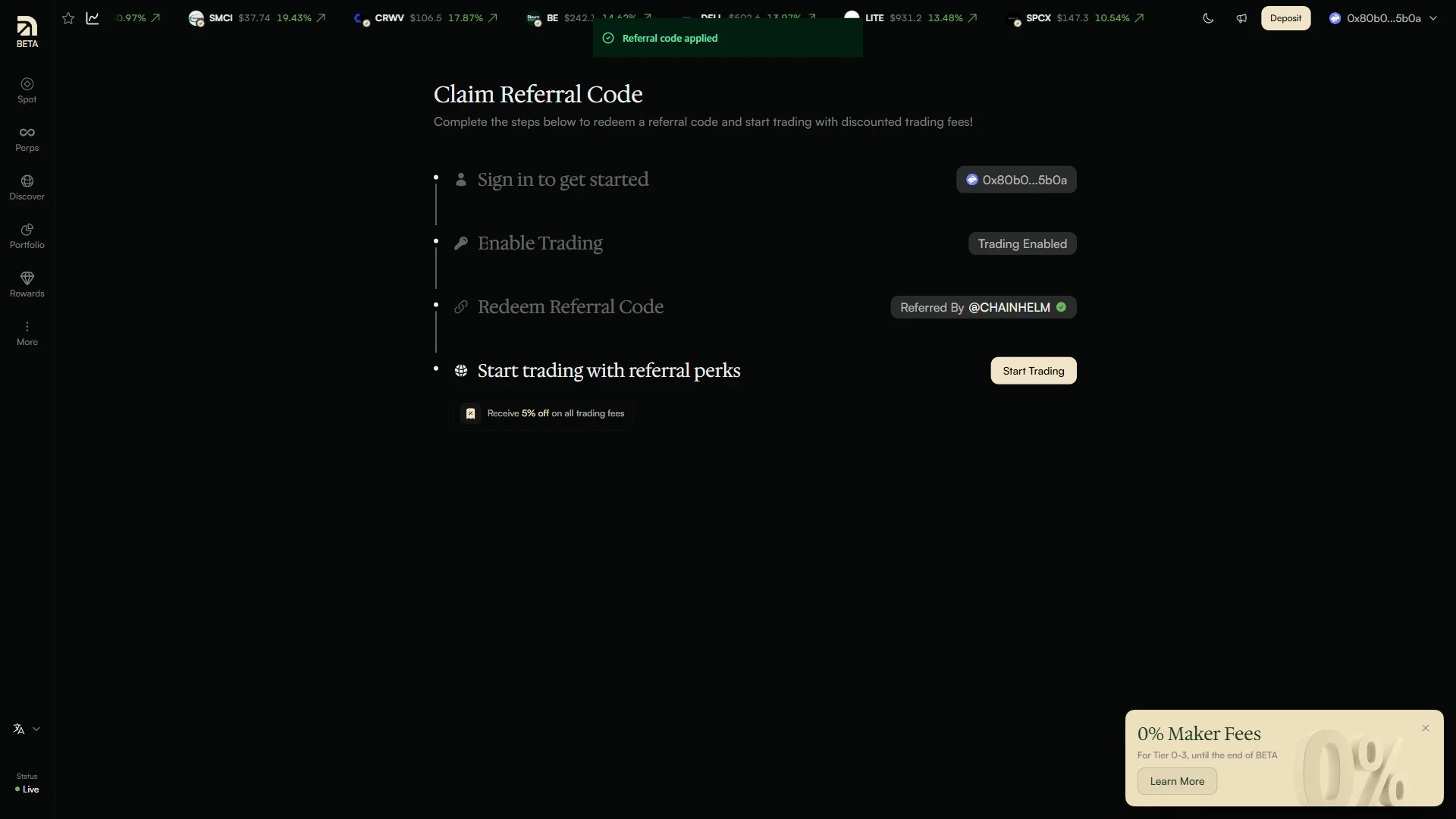
The screen shows “Referral code applied”, confirming that the referral code CHAINHELM was correctly applied.
chainhelm continuously verifies the validity of the code and confirms it remains usable.
That check took in the connection flow and the code itself, and nothing beyond it. The link opens the Claim Referral Code page with the code already sitting in the field, and if you open the same link again later you get a Referral Already Claimed page showing Referred By, Referrer Address and Fee Discount — the surface you can come back to at any time to see what your wallet is tied to.
What the Arcus referral code “CHAINHELM” gets you
Connect your wallet using this code to receive the following benefits on Arcus:
You only receive these benefits when you connect your wallet using the code. Connect without it and you won’t be able to get them afterward.
Arcus sign-up steps with the referral code
We cover the connection process separately for PC/browser and smartphone (mobile).
PC/browser connection steps
- First, open the Arcus official page (the link applies the referral code). When you open it, you’ll see a screen like the one below.
2. Connect your wallet on the referral page
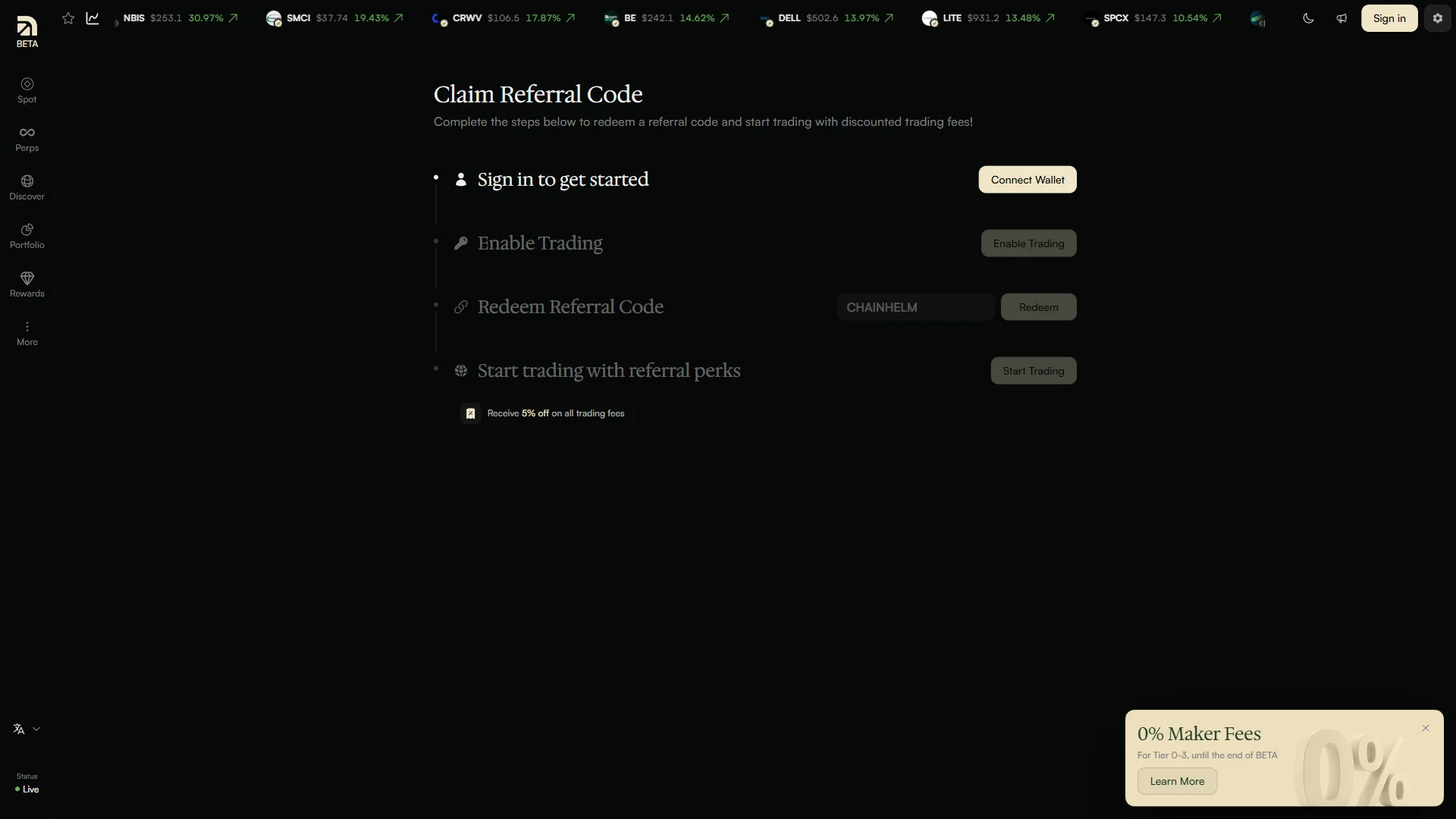
On the “Claim Referral Code” page, click “Connect Wallet” in the first row of the four-step checklist to open the sign-in options. Check that the code field in the third row already shows “CHAINHELM”, since the rows for “Enable Trading”, “Redeem Referral Code”, and “Start trading with referral perks” stay grayed out until your wallet is connected.
3. Choose how to sign in
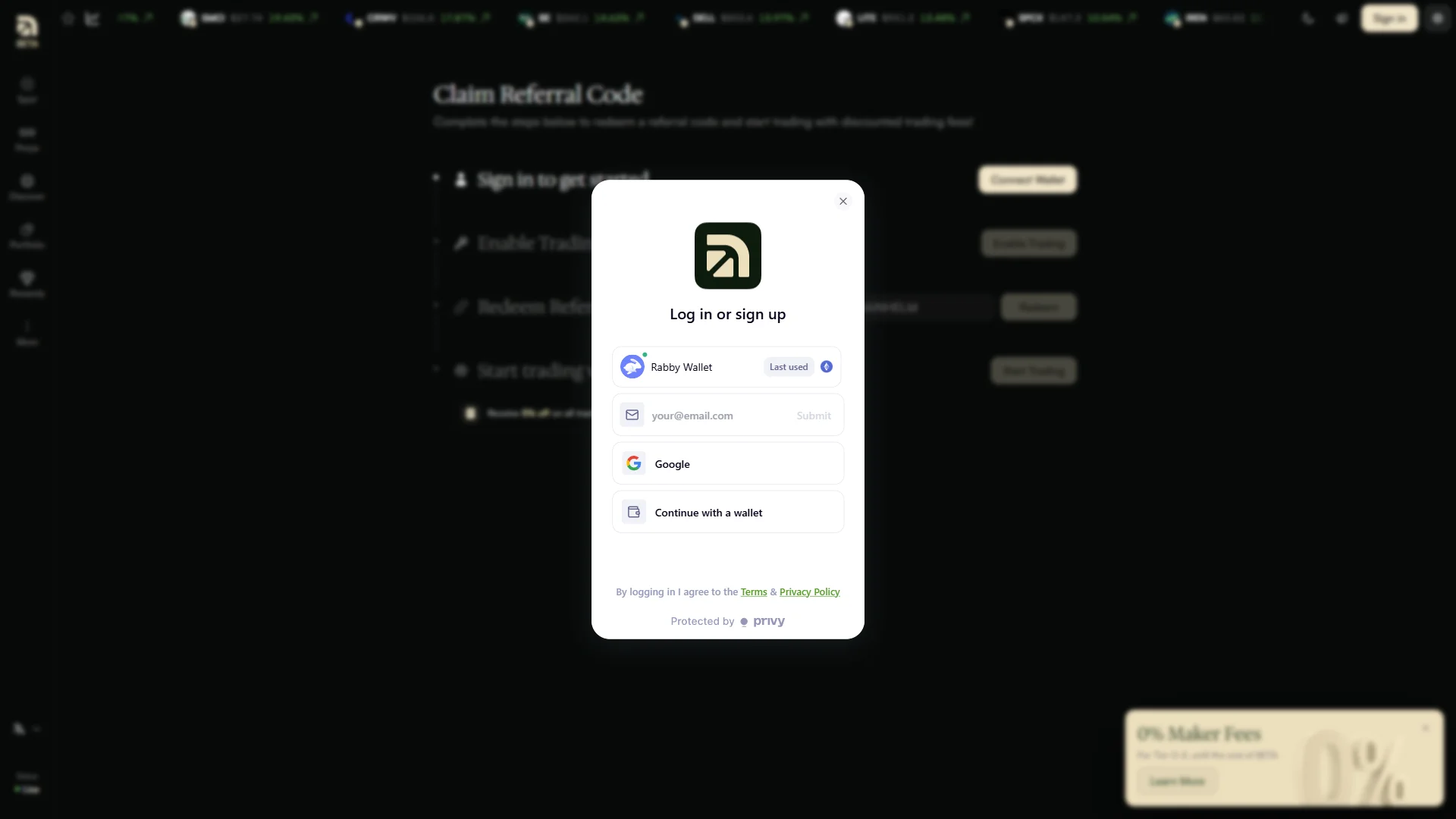
In the “Log in or sign up” dialog, click “Rabby Wallet” or whichever browser wallet you use, and the wallet opens its own request next. If your wallet is not listed, use “Continue with a wallet” to find it; an email address and “Google” work as sign-in routes as well.
4. Sign the address verification
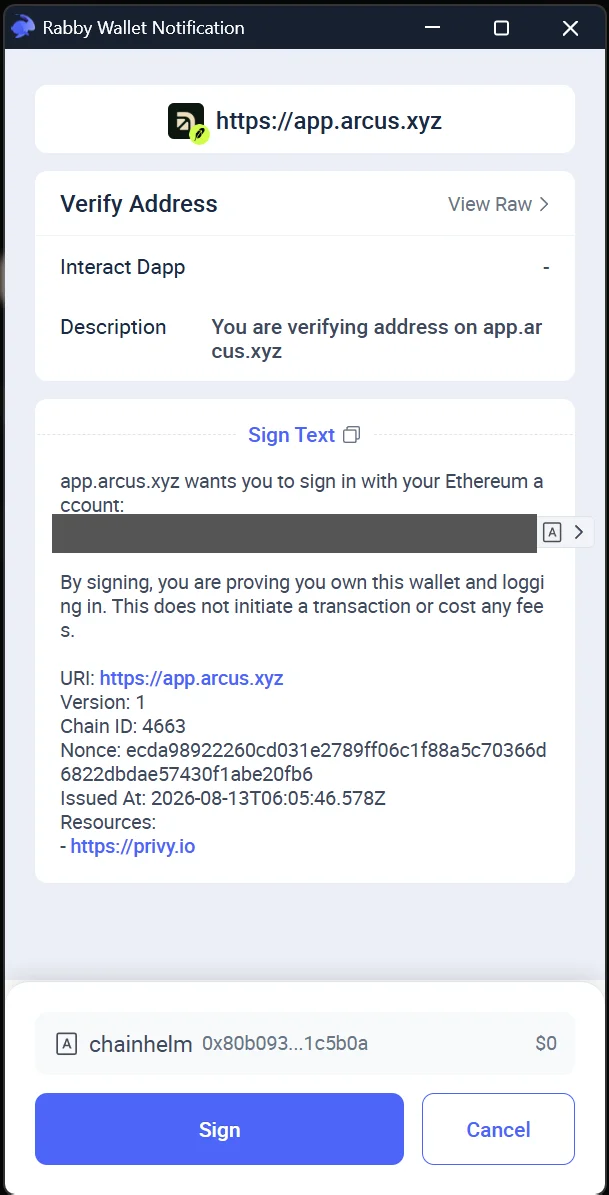
In the “Verify Address” request your wallet opens, click “Sign” to prove the address is yours. Read the “Sign Text” message first: it says the signature only logs you in, without starting a transaction or costing a fee.
5. Confirm the sign-in signature
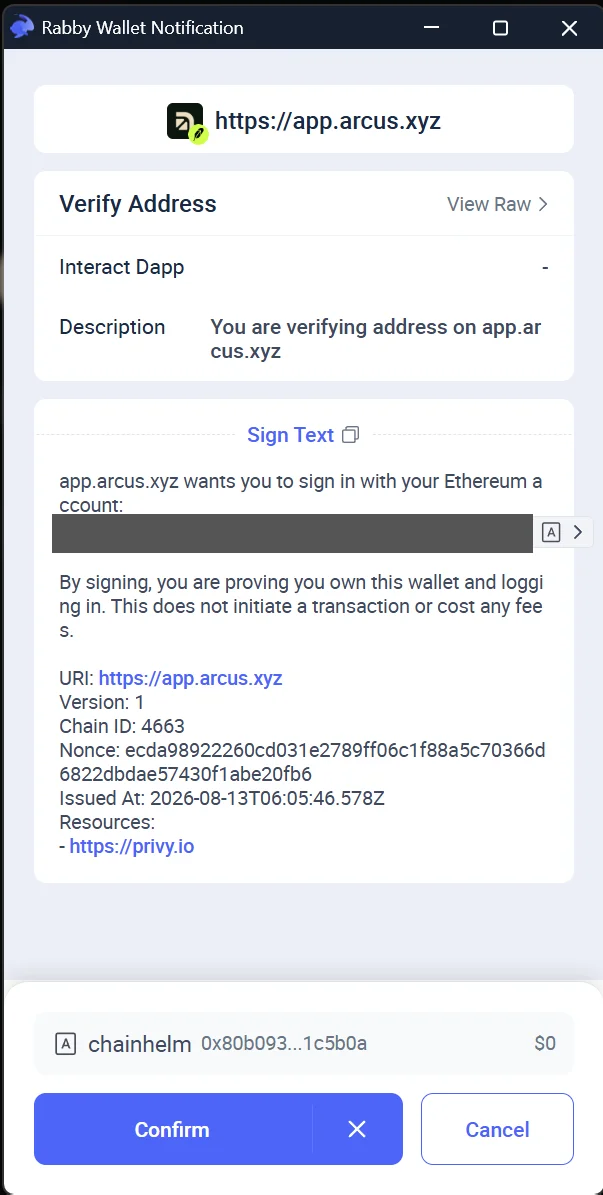
Click “Confirm” in the same wallet window to complete the signature and connect the wallet to the site. Check that app.arcus.xyz is still named at the top before you confirm, because “Cancel” is the last way out.
6. Enable trading from the checklist
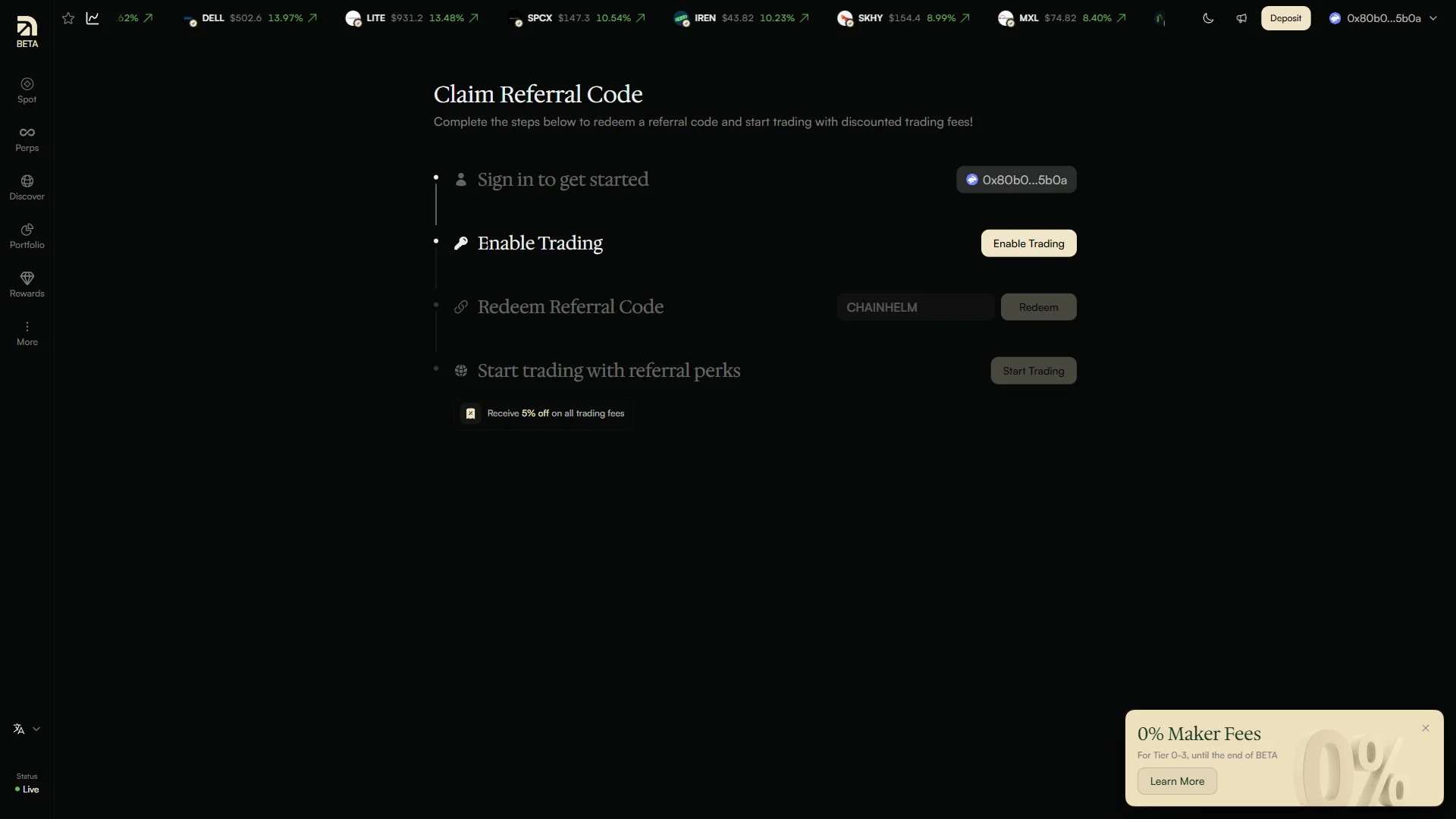
Back on the claim page, click “Enable Trading” in the second row, which is active now that you are signed in. The first row shows your address in shortened form, so check that it matches the wallet you just connected.
7. Agree to the terms in the dialog
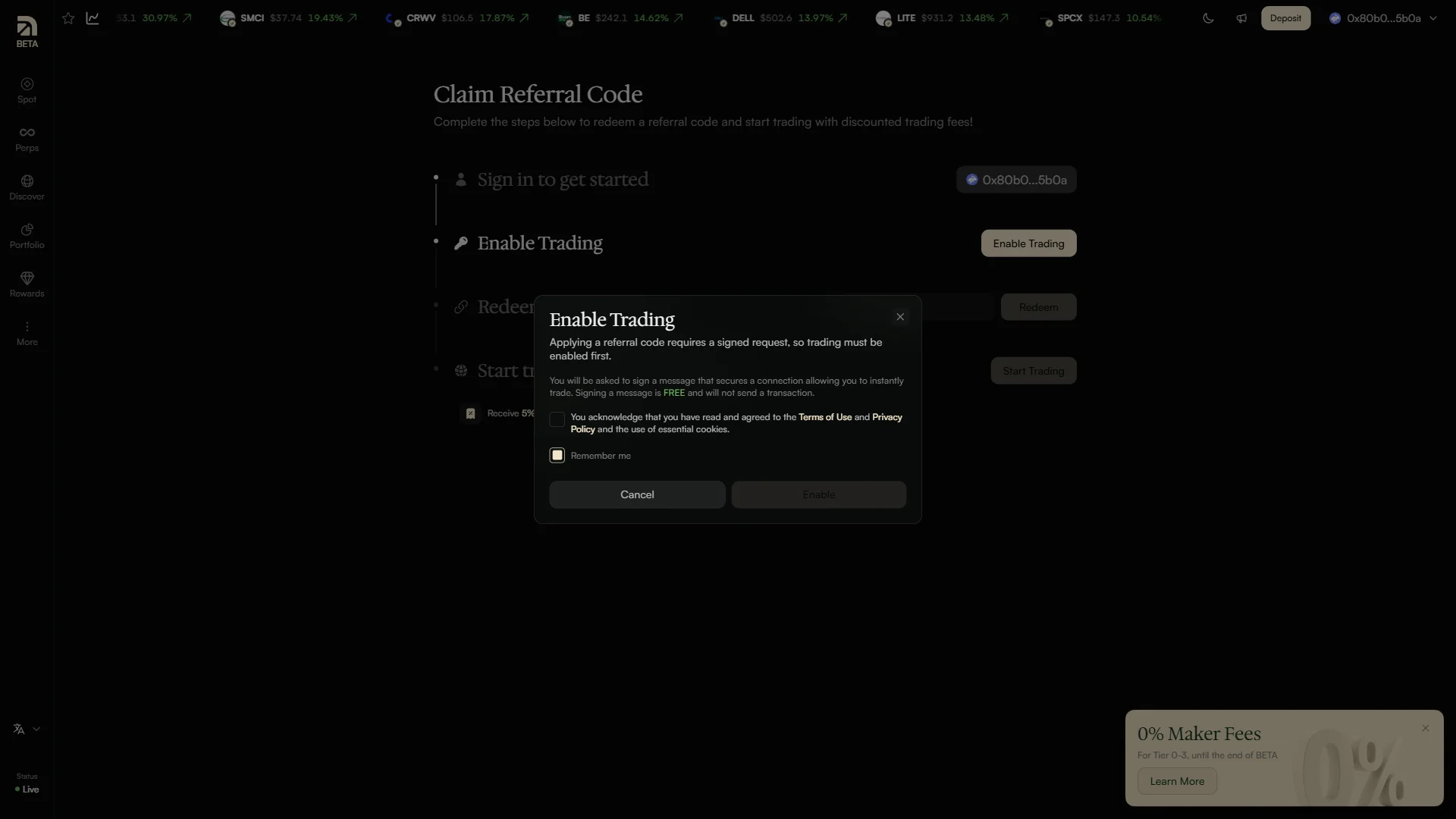
In the “Enable Trading” dialog, click the acknowledgment checkbox for the “Terms of Use”, “Privacy Policy”, and essential cookies. The dialog explains that applying a referral code needs a signed request, so trading has to be turned on first, and “Enable” stays inactive until that box is checked.
8. Submit the enable request
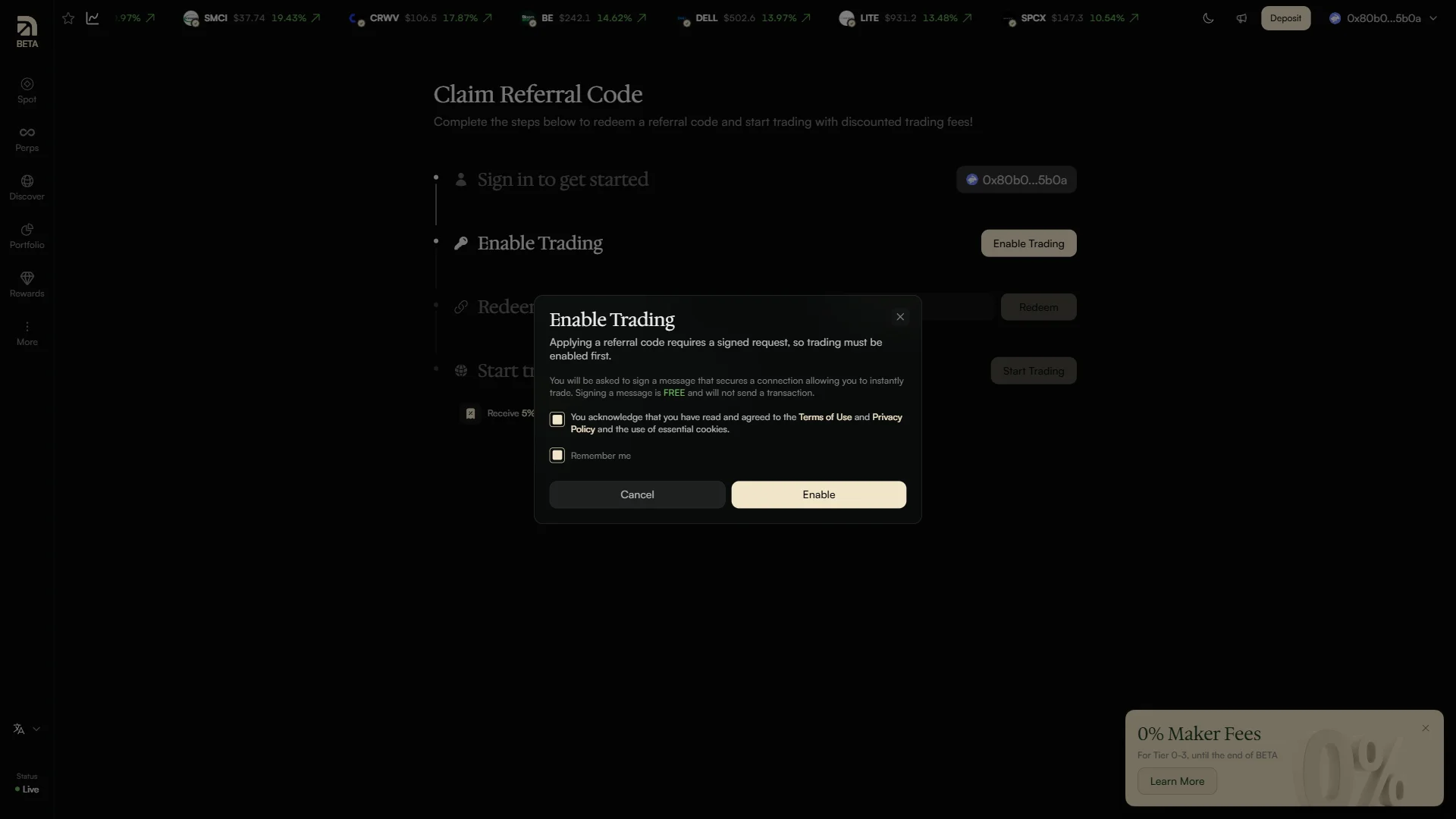
With the acknowledgment checked, click “Enable” to request the signature that turns trading on. If “Enable” still looks grayed out, the box above it is not checked yet.
9. Sign the trading session request
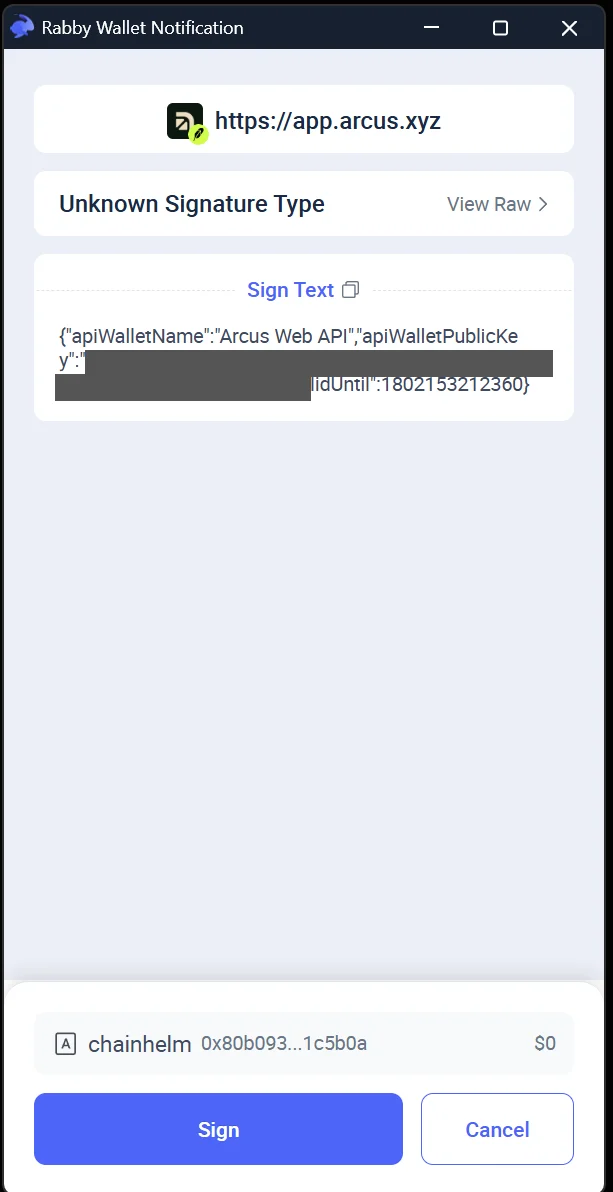
When your wallet opens the second request, click “Sign” to authorize the trading session. The wallet labels this one as an unknown signature type and shows the session data under “Sign Text”, so check that app.arcus.xyz is still the site named at the top before signing.
10. Confirm the session signature
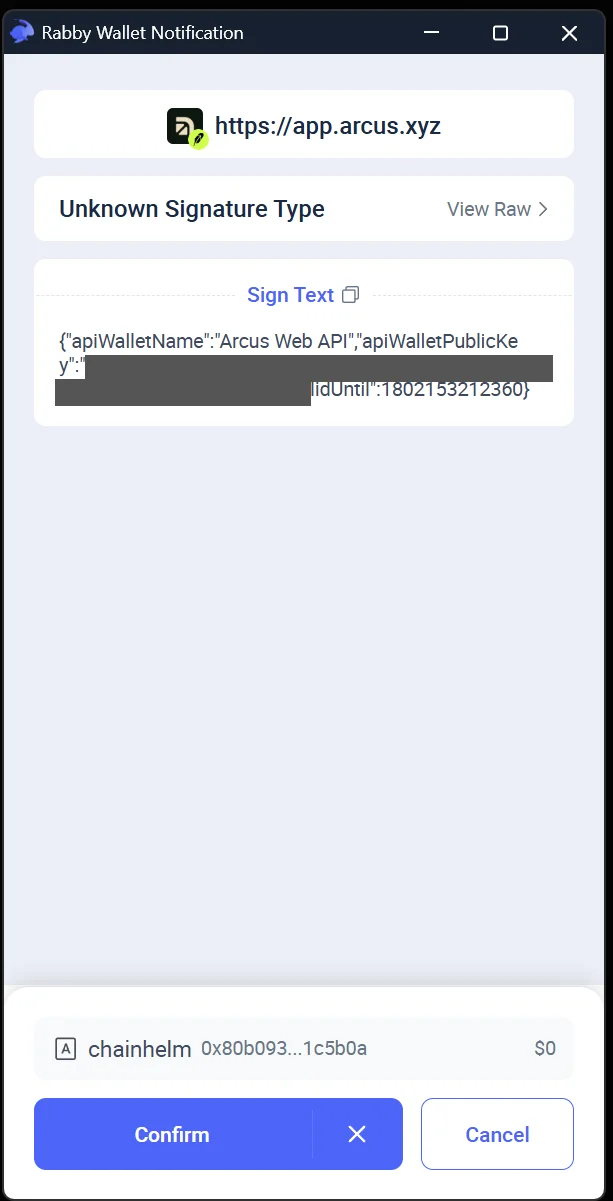
Click “Confirm” to send the session signature back to the site. Check that the site named at the top has not changed before you confirm, and use “Cancel” if you want to stop instead.
11. Redeem the referral code
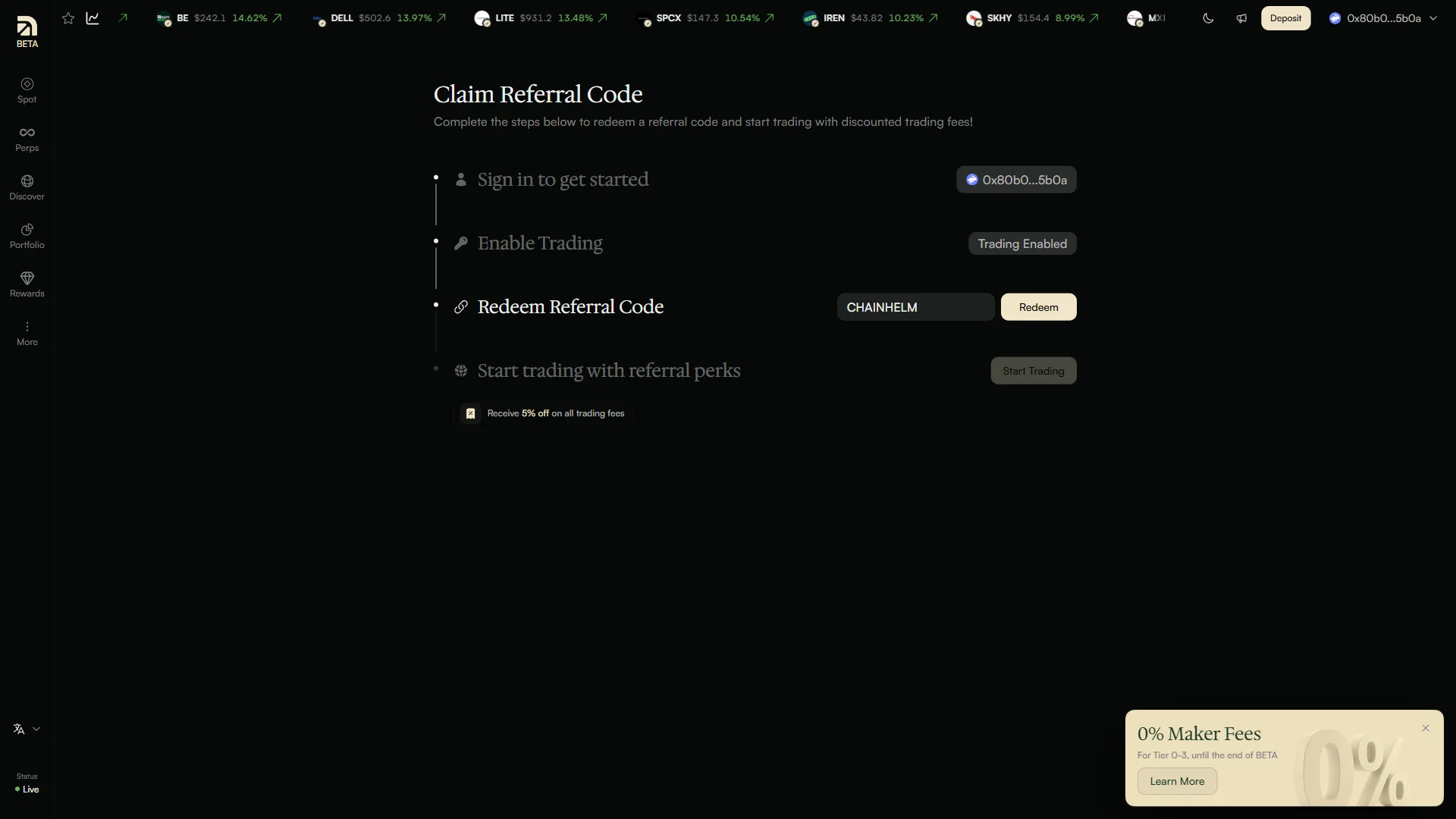
With “Trading Enabled” showing in the second row, click “Redeem” next to the code field in the third row. Check that the field still reads “CHAINHELM” first, since that is the code your account gets tied to.
12. Check that the referral is applied
Read the result on the same page: a “Referral code applied” notice appears at the top and the third row switches to “Referred By @CHAINHELM” with a check mark. If the code field is still sitting there instead, the code has not been applied yet.
Smartphone (iOS / Android) connection steps
- First, open the Arcus official page in your mobile browser or your wallet app’s in-app browser (the link applies the referral code). When you open it, you’ll see a screen like the one below.
2. Open the referral page and connect your wallet
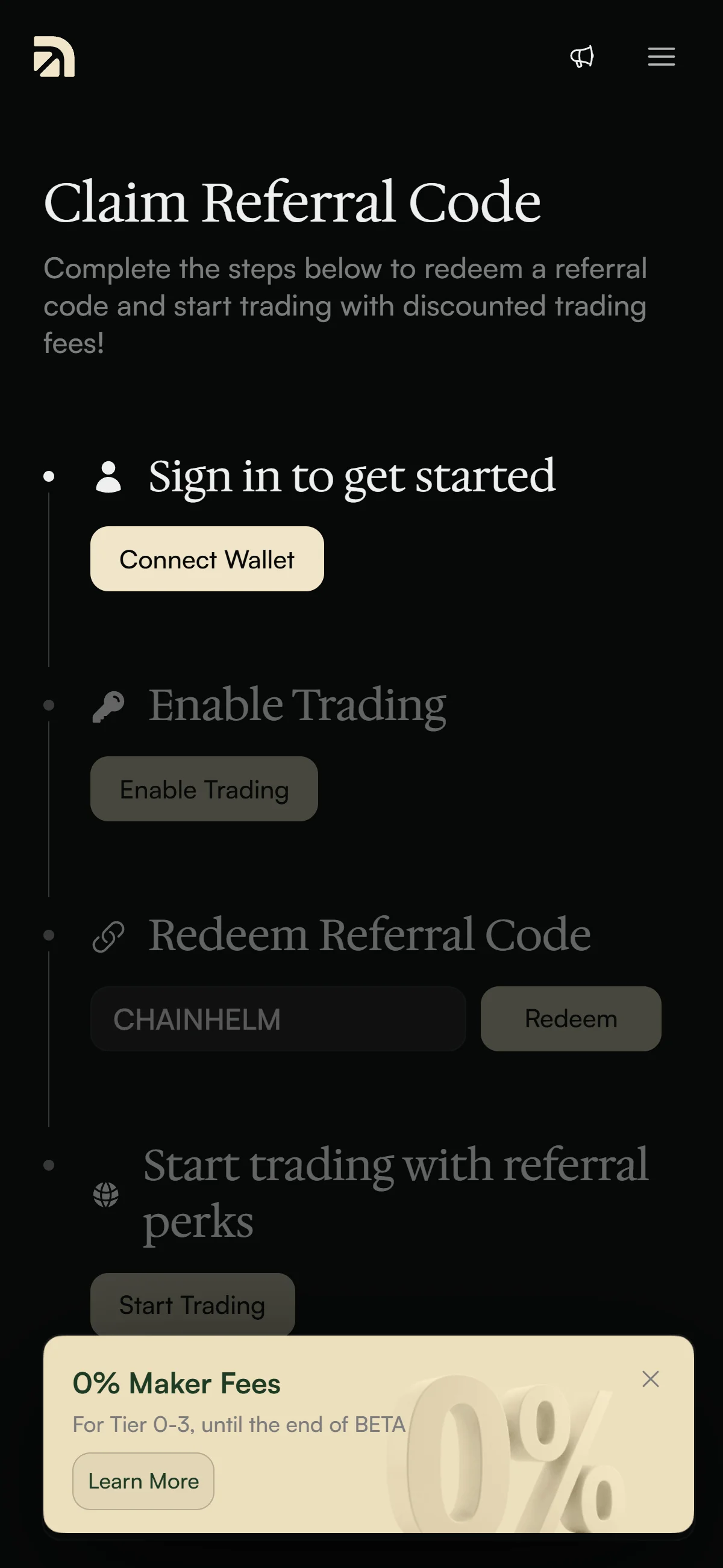
On the “Claim Referral Code” screen, tap “Connect Wallet” under the first item of the four-step checklist to open the sign-in options. Check that the code field further down the screen already shows “CHAINHELM”, since the items for “Enable Trading”, “Redeem Referral Code”, and “Start trading with referral perks” stay grayed out until your wallet is connected.
3. Choose how to sign in
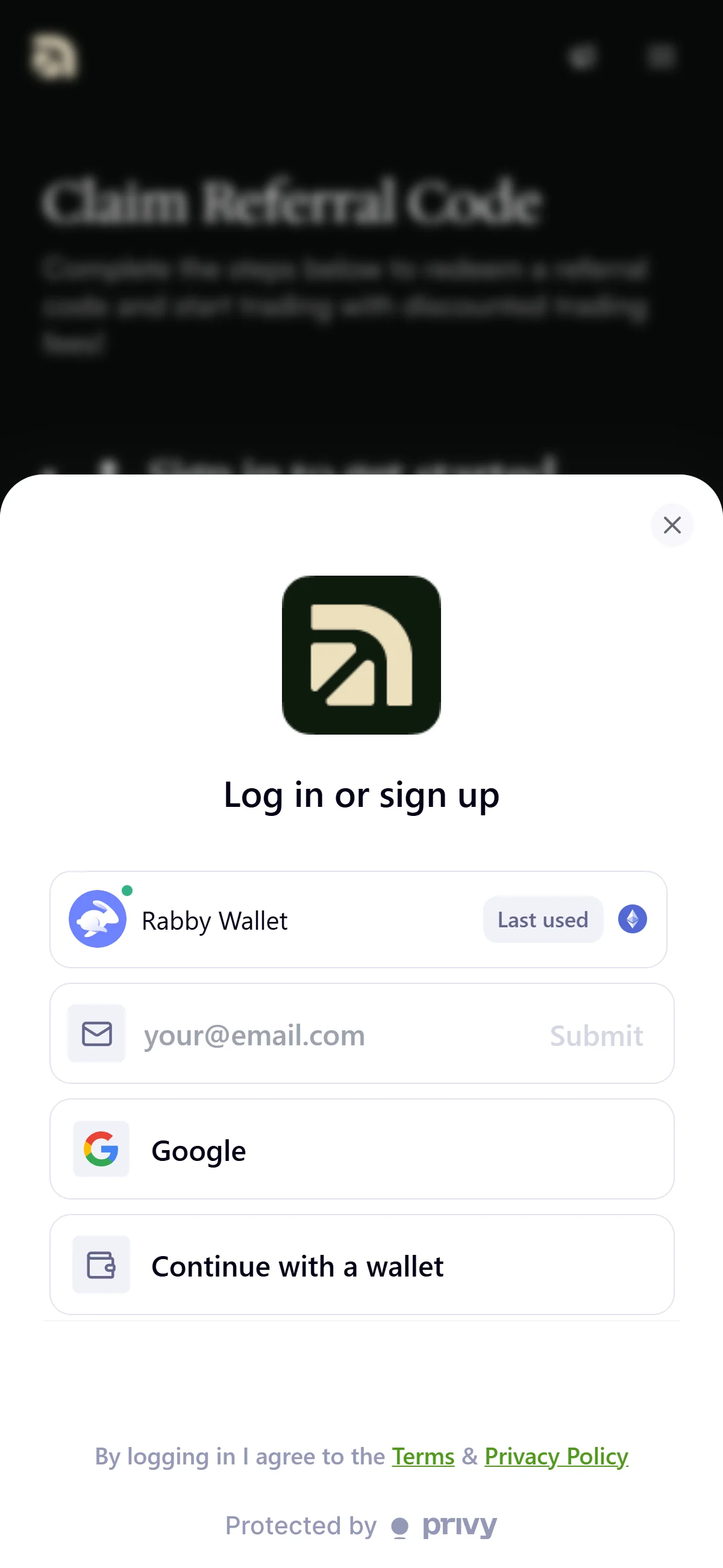
In the “Log in or sign up” sheet, tap “Rabby Wallet” or the wallet app you use, and your wallet takes over from there. If your wallet is not listed, tap “Continue with a wallet” to look for it; an email address and “Google” work as sign-in routes as well.
4. Sign the address verification
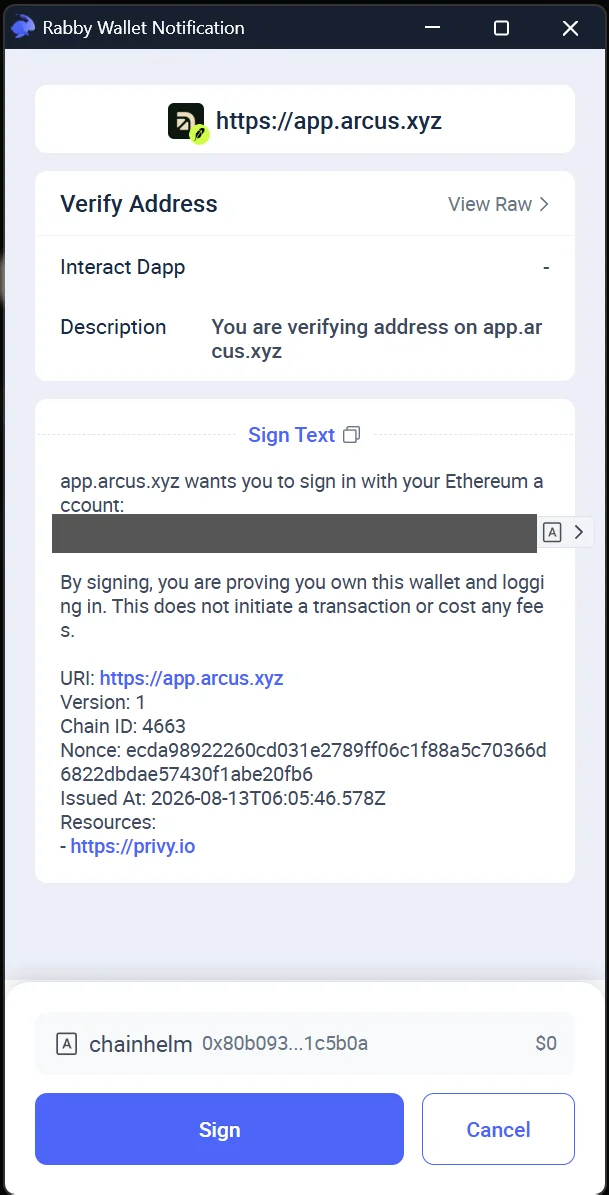
Your wallet app opens a “Verify Address” request, so tap “Sign” to prove the address is yours. Read the “Sign Text” message first: it says the signature only logs you in, without starting a transaction or costing a fee.
5. Confirm the sign-in signature
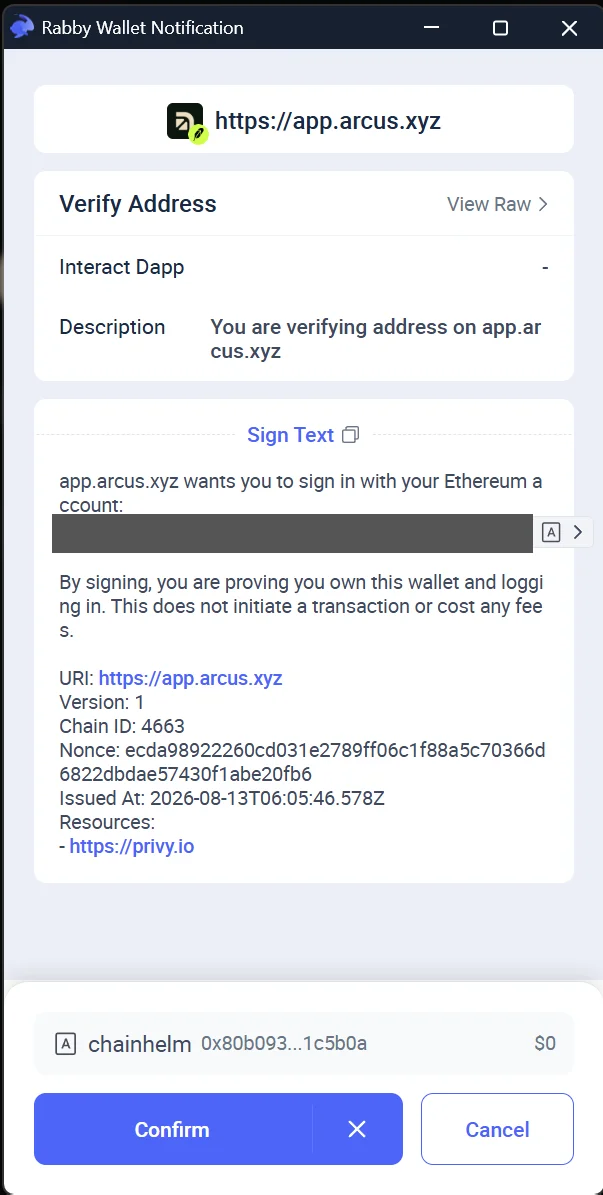
Tap “Confirm” in your wallet to complete the signature and connect the wallet to the site. Check that app.arcus.xyz is still named at the top before you confirm, because “Cancel” is the last way out.
6. Enable trading from the checklist
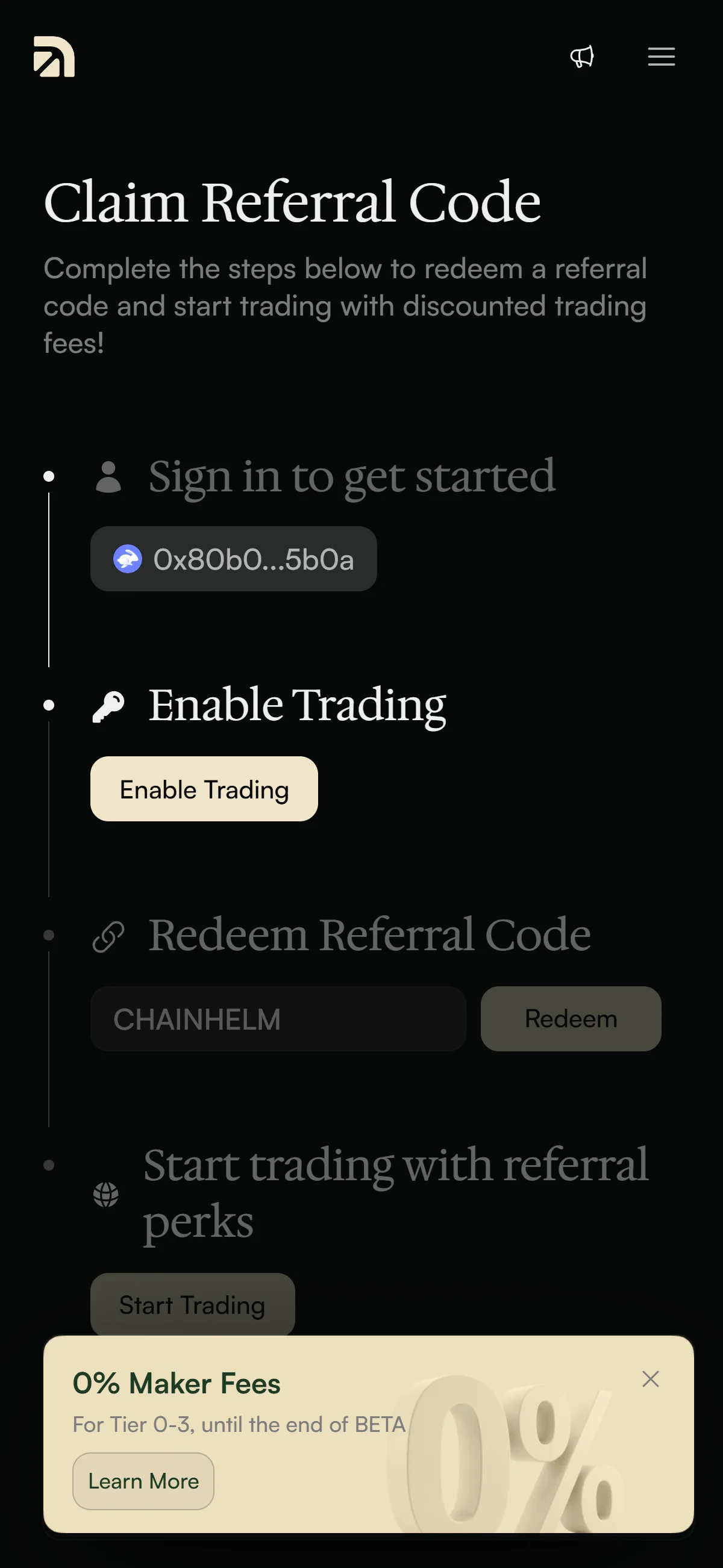
Back on the claim screen, tap “Enable Trading”, which is active now that you are signed in. The first item shows your address in shortened form, so check that it matches the wallet you just connected.
7. Agree to the terms in the sheet
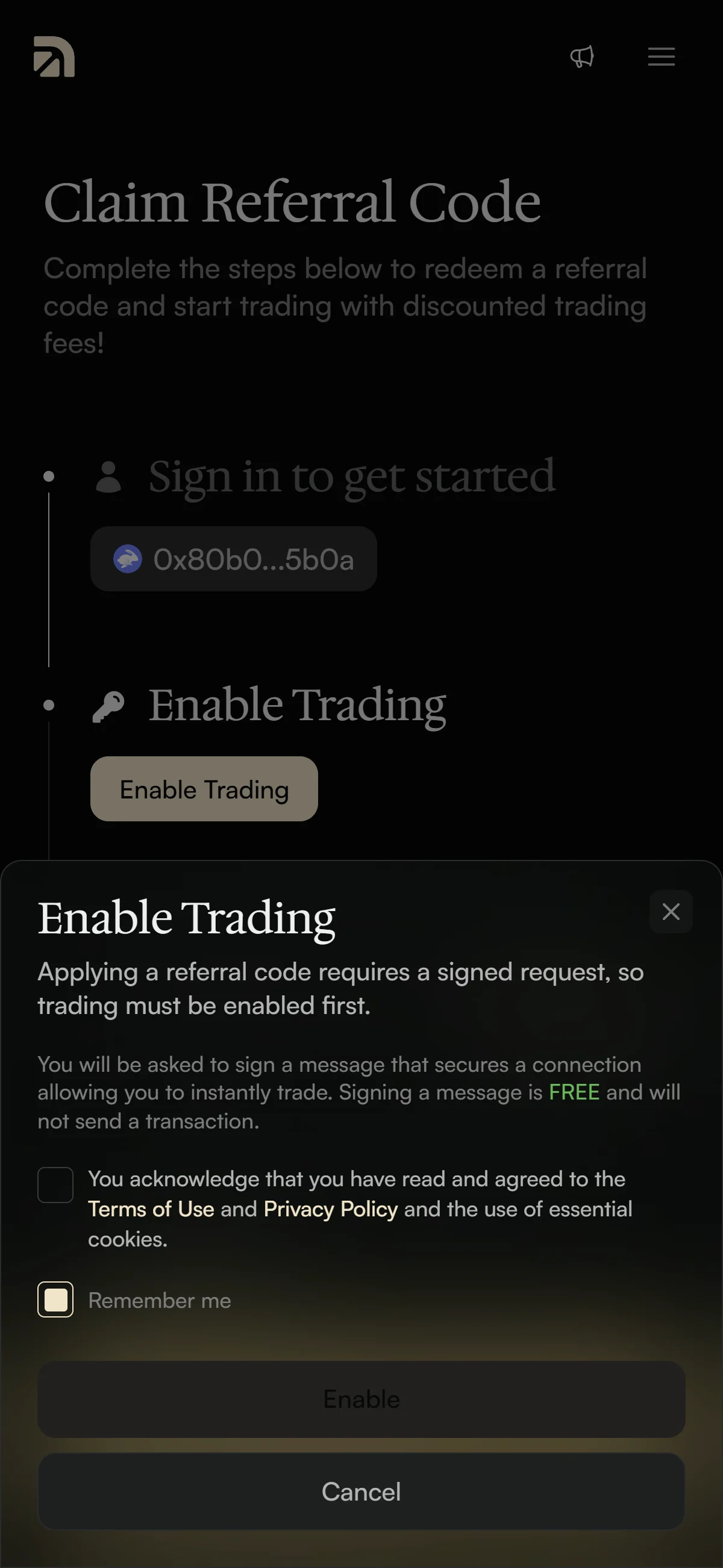
In the “Enable Trading” sheet, tap the acknowledgment checkbox for the “Terms of Use”, “Privacy Policy”, and essential cookies. The sheet explains that applying a referral code needs a signed request, so trading has to be turned on first, and “Enable” stays inactive until that box is checked.
8. Submit the enable request
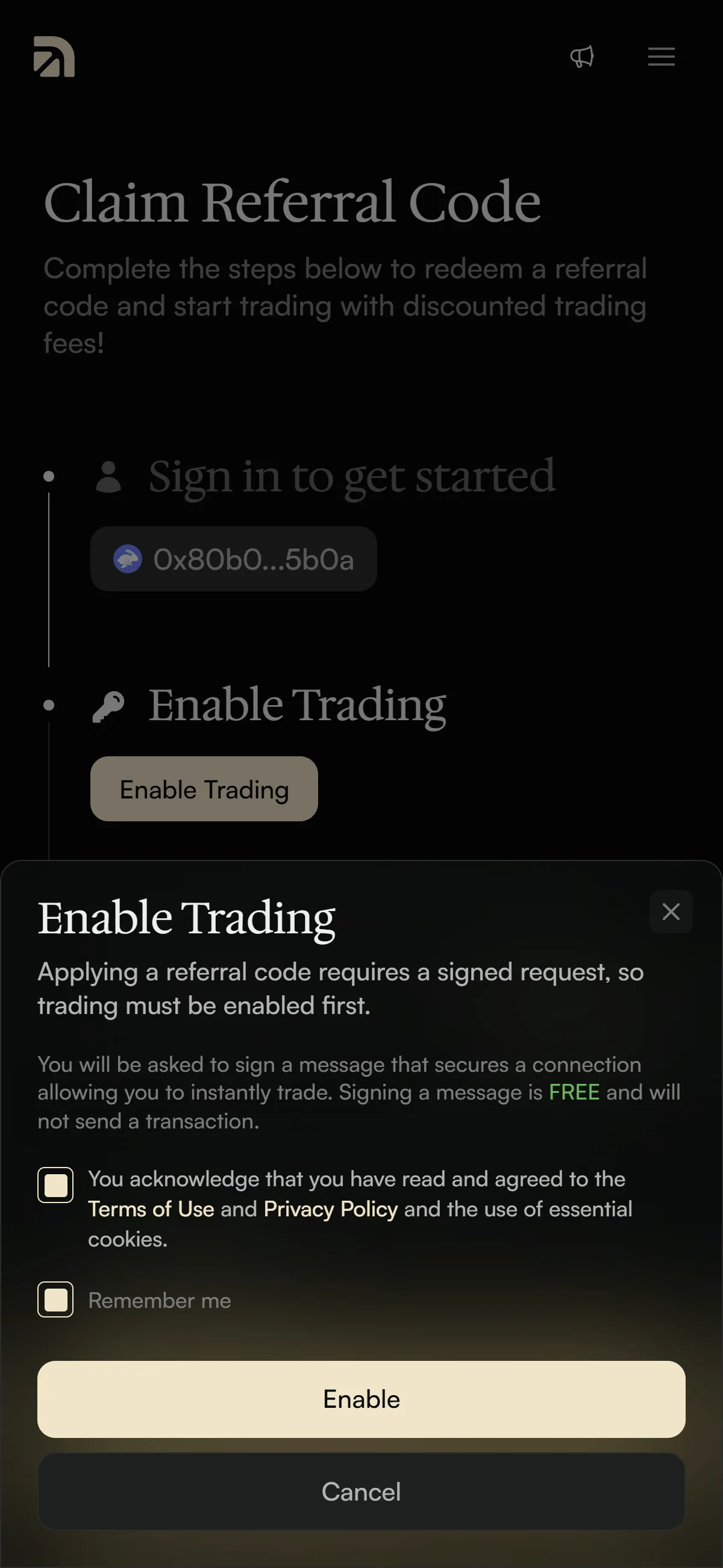
With the acknowledgment checked, tap “Enable” to request the signature that turns trading on. If “Enable” still looks grayed out, go back to the box above it.
9. Sign the trading session request
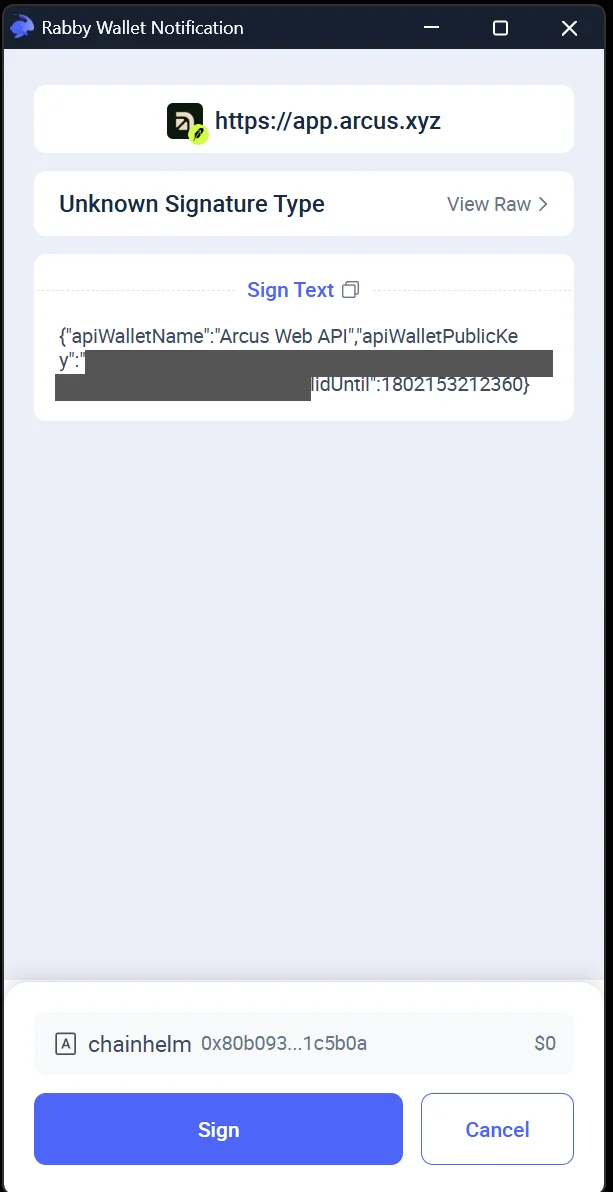
Your wallet app opens a second request, so tap “Sign” to authorize the trading session. The wallet labels this one as an unknown signature type and shows the session data under “Sign Text”, so check that app.arcus.xyz is still the site named at the top before signing.
10. Confirm the session signature
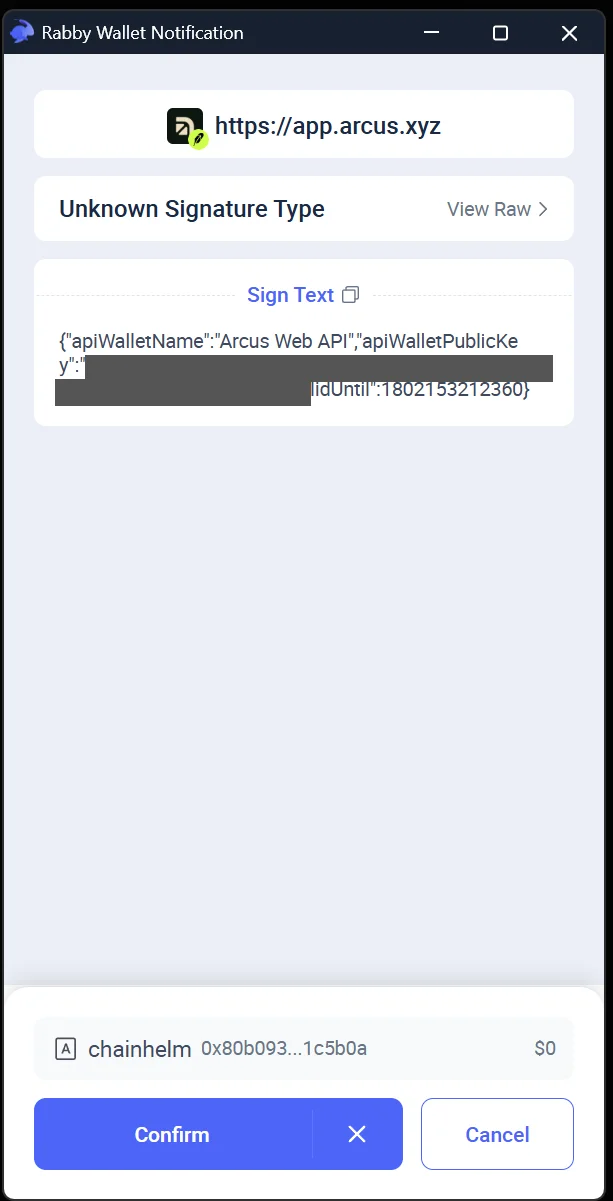
Tap “Confirm” to send the session signature back to the site. Check that the site named at the top has not changed before you confirm, and use “Cancel” if you want to stop instead.
11. Redeem the referral code
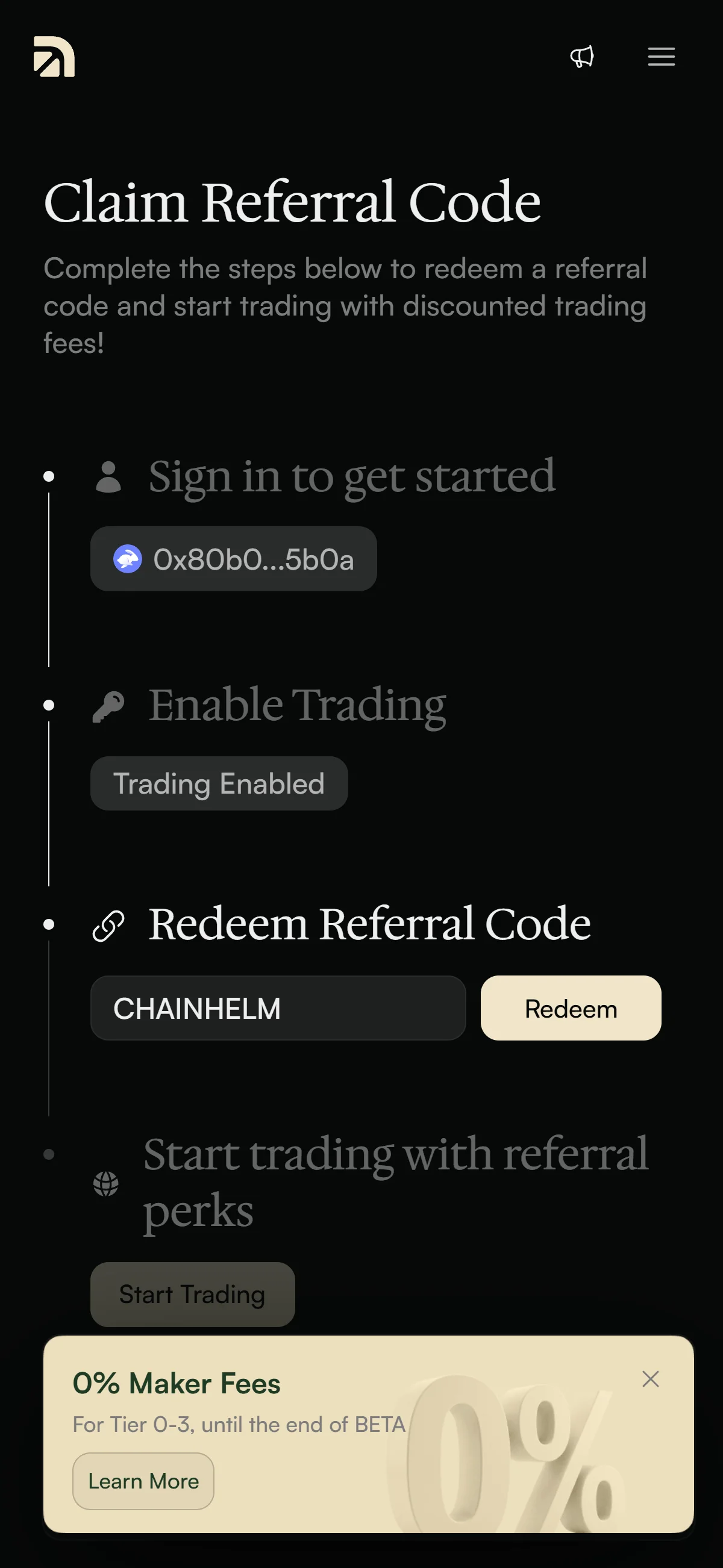
With “Trading Enabled” showing on the second item, tap “Redeem” beside the code field. Check that the field still reads “CHAINHELM” first, since that is the code your account gets tied to.
12. Check that the referral is applied
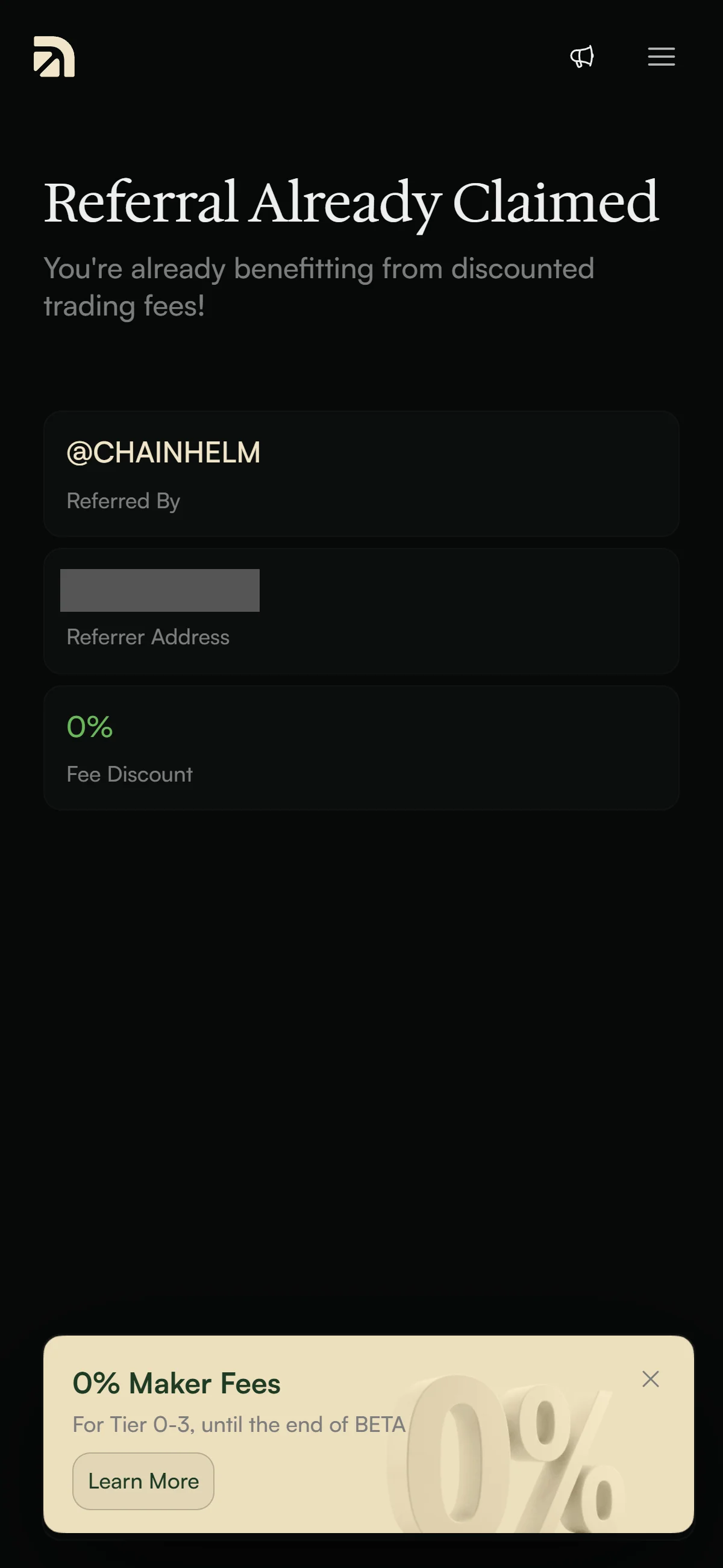
Check that the screen now reads “Referral Already Claimed” and that the “Referred By” panel names “@CHAINHELM”, which is how an applied code is recorded. If you still see the claim checklist with the code field instead, the code has not gone through yet.
What to do after connecting to Arcus
We cover the deposit process separately for PC/browser and smartphone (mobile).
PC/browser deposit steps
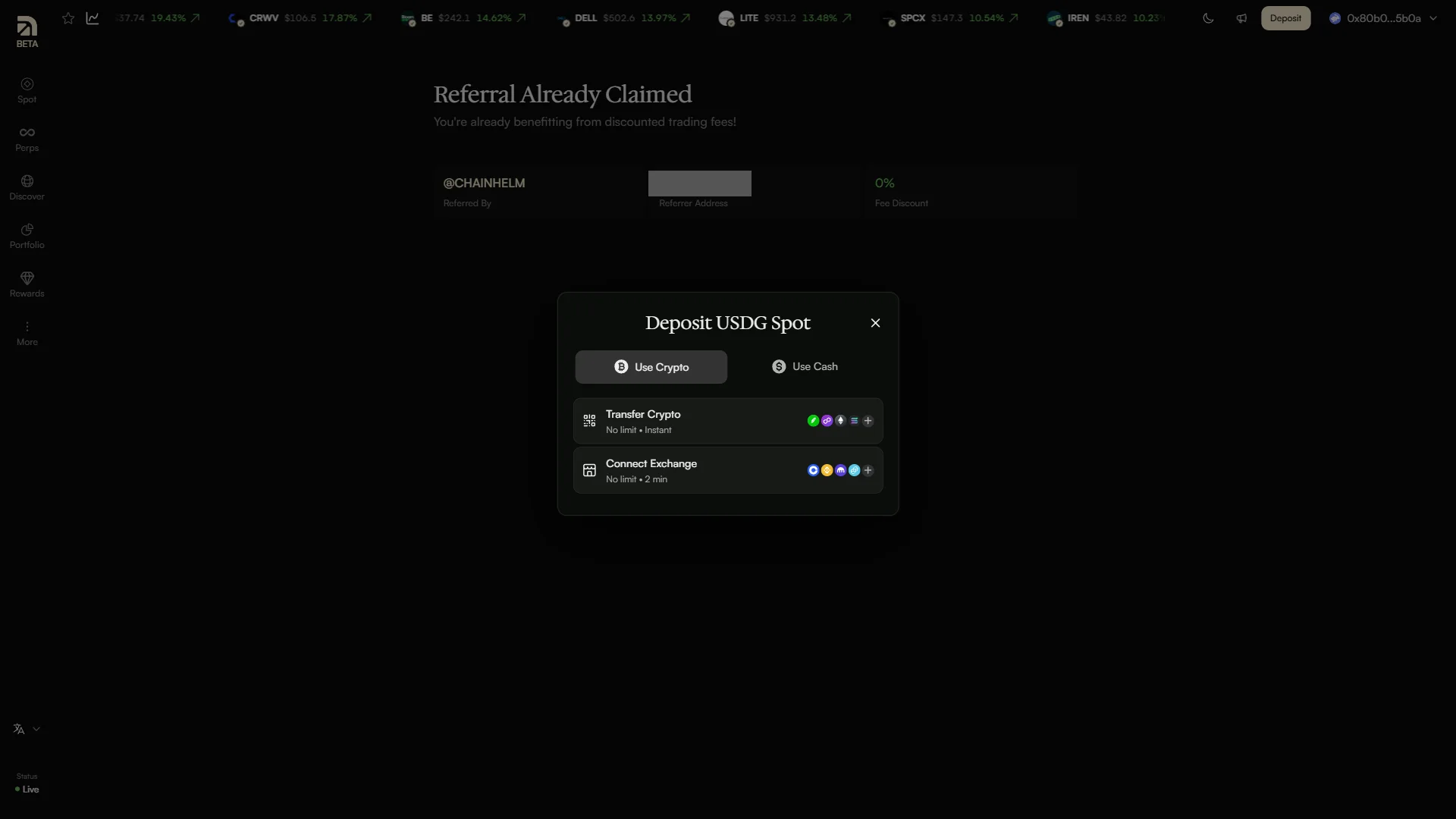
In the “Deposit USDG Spot” dialog, stay on the “Use Crypto” tab and choose “Transfer Crypto” to send coins in from a wallet, or “Connect Exchange” to bring them over from an exchange account. Neither route lists a limit, “Transfer Crypto” is marked instant while “Connect Exchange” shows two minutes, and the “Use Cash” tab is there if you would rather not send crypto.
Smartphone (iOS / Android) deposit steps
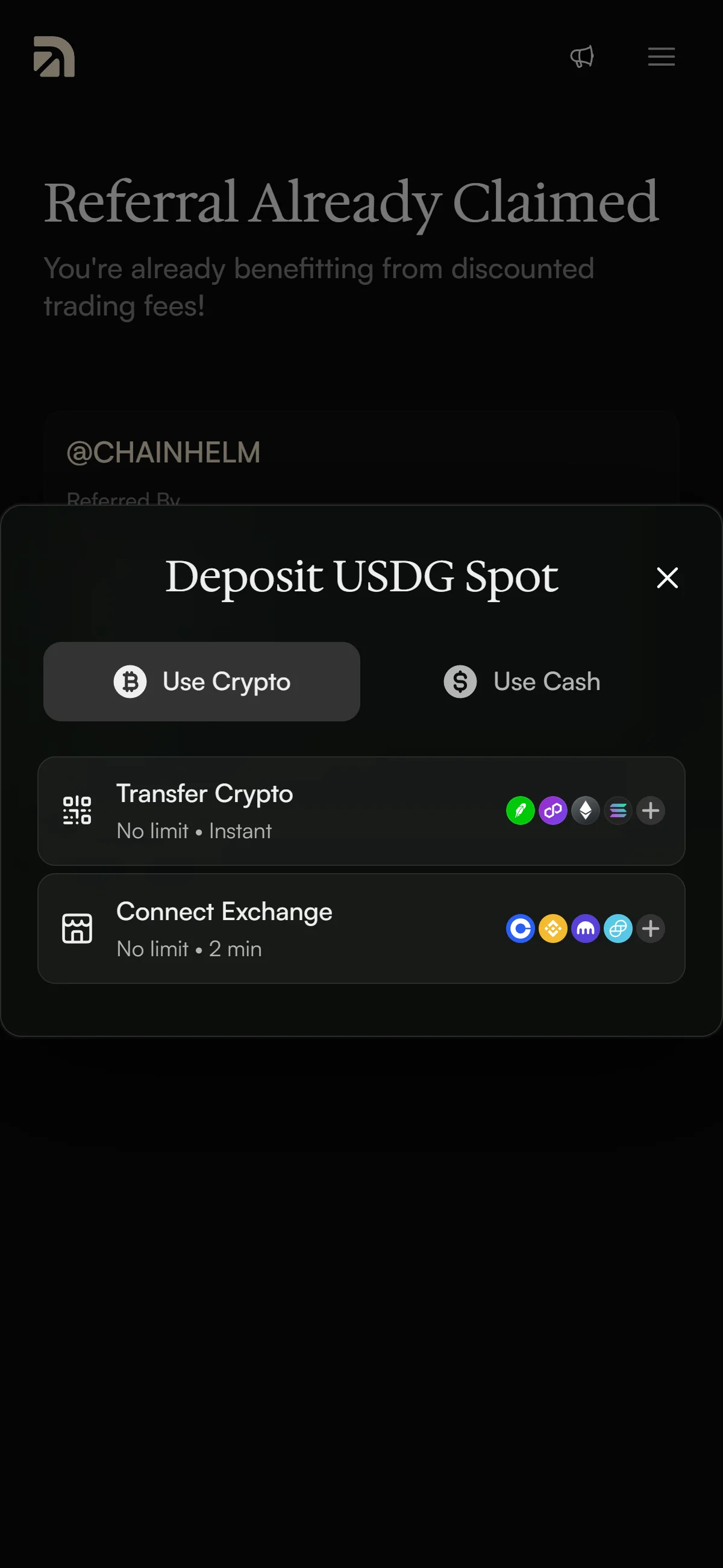
In the “Deposit USDG Spot” sheet, stay on the “Use Crypto” tab and tap “Transfer Crypto” to send coins in from a wallet, or “Connect Exchange” to bring them over from an exchange account. Neither route lists a limit, “Transfer Crypto” is marked instant while “Connect Exchange” shows two minutes, and the “Use Cash” tab is there if you would rather not send crypto.
Whatever you send arrives as something else. USDG is the only collateral asset on Arcus, so anything that is not already USDG is swapped and bridged to USDG as it comes in, in one flow. The official docs name Bitcoin, Ethereum, Solana, Base and Arbitrum as deposit chains and then say the full list is maintained by the deposit partner rather than by Arcus, so treat those five as the named ones rather than the complete set. There is no Arcus-operated bridge: both deposits and withdrawals route through that partner flow, and the cash rails behind the “Use Cash” tab — Apple Pay, card, Google Pay and AstroPay — are third parties with their own processing fees, because Arcus runs no fiat rail of its own.
On cost, Arcus charges no deposit fee and states zero fees on USDG deposits and withdrawals, so what you actually pay is the third-party processing charge on a cash route plus whatever the swap or bridge costs on a crypto route; a minimum withdrawal size is enforced but its value is not published. No minimum deposit is published either, and the nearest published floor of any kind is the 5 USD minimum order notional that applies once you start trading.
Crypto transfers, an exchange connection, and cash are all offered as funding routes, so you can fund through whichever one suits you and start trading once the balance lands.
The Arcus referral code cannot be added after sign-up
The referral code can only be applied once — the first time you connect your wallet.
If you complete the connection without the code applied, there is no way to link it to that wallet afterwards, and the only route left is to start over with a new wallet.
- Is referral code CHAINHELM shown as applied when you connect your wallet? (arriving via the link only fills the code field, so the notice to look for is the one that appears after you click Redeem)
- After connecting, open the referral page and check that the referral is reflected there
The binding is per wallet, which is why the check matters before you click Redeem rather than after. Two paths put the code in place: arriving through the referral link, which fills the field for you, or typing it into the code field at the connection step. Either way the surface that tells you it worked is the one shown above — the row that reads “Referred By @CHAINHELM”, or the Referral Already Claimed page you get if you open the link again.
◆ ◇ ◆
Arcus is a six-week-old beta venue built by dYdX Labs on Robinhood Chain
The two companies behind the protocol and the interface
Two separate companies sit behind what looks like one website, and the session request your wallet just showed came from the second of them. Arcus Labs Ltd, a Cayman Islands exempted company, publishes the Protocol Terms of Use and holds the copyright on the site. Pocket Protector Labs Inc., a Delaware company, operates the interface at arcus.xyz and app.arcus.xyz under its own Interface Terms. The venue was built by dYdX Labs, which had earlier acquired Pocket Protector, and the acquired team leads Arcus: Eddie Zhang is CEO and founder, and dYdX founder Antonio Juliano sits on the board. Robinhood Crypto is a strategic investor, with the amount undisclosed, and it operates Robinhood Chain, the network Arcus settles on — but it is not an operator of the Arcus protocol or of the interface. That boundary is worth holding onto, because a familiar broker’s name attached to a trading venue invites the opposite assumption.
Spot open to all, perpetuals behind a waitlist
Both product lines are still in beta. Arcus says the full launch comes “later in 2026”, and it had not happened when we checked. The practical consequence for anyone redeeming a code today is simple enough to state plainly: redeeming does not put you into the perpetual market. Spot is the side a new account can use immediately, and perpetuals stay behind the waitlist queue until your cohort is let in.
How many people are already inside is not something Arcus publishes — there is no official trader or wallet count. The nearest public figure is a third-party report of more than 75,000 signups for the perpetuals waitlist, which counts people who joined a queue rather than people who trade. Getting in yourself takes either an existing self-custody wallet or an in-app wallet created from an email address or a social sign-in, and no identity verification is required at any point.
Off-chain matching with on-chain settlement on Robinhood Chain
Robinhood Chain is a permissionless, EVM-compatible Ethereum Layer 2 built on the Arbitrum stack, with ETH as its gas token, and it settles to Ethereum mainnet. That is the chain Arcus settles on. The exchange sitting on top of it is built in three layers.
- Off-chain core exchange
- A sequencer sets a fixed sequence for incoming orders and a matching engine pairs them off. None of this touches the chain.
- Permissioned appchain
- A validator set independently re-verifies signatures, margin and the validity of each fill, then votes state commitments on-chain.
- EVM rootchain
- A Checkpoint Manager records those commitments and a Bridge Vault holds the funds, performs final settlement and honors withdrawals, with an escape hatch meant to stop withdrawals being censored.
The two products reach a price differently, which changes what you see on screen. Perpetuals run a central limit order book — the same queue of resting bids and offers a stock exchange runs — matched off-chain and settled on-chain without the venue taking custody. Spot works by request-for-quote instead: a market maker off-chain prices your order and you get one quote, with the trade settling atomically on-chain rather than against a liquidity pool.
47 perpetual markets and 222 spot markets, mostly equities
The spot side is the one moving fastest: the 2026-08-11 additions in the timeline above roughly doubled it, which is worth knowing before you treat any count on this page as durable. One third-party tracker lists 175 spot markets rather than 222; that is the subset it tracks with usable data, not a contradiction of the venue’s own figure. Leverage is not uniform across the perpetual markets either, and the headline number on the marketing site belongs to a single market — the per-market caps are further down, in the risks.
A fee schedule that is currently a beta promotion
What a new account pays is the entry tier: a maker fee of 0.0% and a taker fee of 0.0225% of notional. Tiers move on trailing 30-day notional volume, and the taker rate falls as far as 0.0095% at the top tier with maker rebates at the top two — a ladder that matters little here, because anyone arriving through a referral code is not standing on it. The entry-tier taker rate is the number a trading-fee discount is applied to.
Arcus’s own fee documentation goes further and publishes no numbers at all, telling developers to read the current rates live from its API instead. So the figures above are what the API returned on 2026-08-14 and nothing more durable than that.
The cost a discount does not touch is funding, charged hourly on any perpetual position you hold. Crypto markets run off a base rate of 0.01% per 8 hours with a dead-band around it; real-world-asset markets use SOFR plus 0.5% per year and lock to that base rate once the underlying market closes for the day. Gas is a smaller story than on most chains: because matching happens off-chain and only settlement touches the chain, you pay no per-trade gas to Arcus, and Arcus states no deposit fee of its own and zero fees on USDG deposits and withdrawals. The docs put no figure on any residual on-chain settlement cost. There is also no token-holding or staking discount to chase, because there is no token. On the spot side, Stock Token trading is free at launch, and the cost arrives as the maker’s spread inside the quote rather than as a commission, with a quote slippage setting shown in the app.
Rank 26 by perpetual volume, with a book that is mostly stocks rather than crypto
Where the volume, open interest and fee numbers put Arcus
The two reporting bases disagree by roughly 8% on volume and 7% on open interest, and we are reporting both rather than quietly picking one: they are different snapshot windows built by different methods, and neither is authoritative over the other. What it does mean is that a rank only holds on one basis: rank 26 and the 0.39% share are both read off the DeFi Llama page, and neither belongs next to the API figure. There is no open-interest rank to give you at all — the page we captured does not publish one, and the ranking data now sits behind a paywall. The fee number needs one clarification, because it is easy to misread: it is revenue collected by the protocol over a day, not the rate you pay. And DeFi Llama’s coverage of this venue is itself only about a week old — its 7-day and all-time fee totals are identical — so the cumulative figures understate what has actually happened. Every number here was read on 2026-08-14, on a venue about six weeks old. It tells you where Arcus stood that day, not where it is heading.
A perp book that is 38 real-world assets against 9 crypto markets
Equities, indices and commodities together account for 38 of the 47 perpetual markets — real-world assets, against 9 crypto markets — and all of them trade from a single cross-margined account against one USDG collateral balance. That inversion is the thing to notice. Most perpetual DEXs are crypto venues that have bolted on a handful of equity or index markets; here the equity set is the larger half of the book.
That composition has consequences. This venue’s behavior is governed by markets that close at the end of a trading day, which is why it needs the off-hours rulebook below at all, and why the margin questions in the risks section land harder here than they would on a crypto-only venue.
A published rulebook for what happens when the stock market closes
Crypto never closes, so crypto-native venues never had to answer this; Arcus did, and it published the answer. Once an underlying equity or ETF market shuts for the day, funding on that market locks to the base rate instead of continuing to track a premium. Initial margin is raised while maintenance margin is held where it was, which is the deliberate part: closure on its own does not push an adequately margined position toward liquidation. With no live external quote to work from, the mark price falls back to a 2.5-minute rolling average of the impact mid — the price at which a realistically sized order could actually trade — and price bands hold that range in place, widening only gradually if pressure keeps up. None of this is a safety guarantee, and what it costs you while it is running is in the risks section.
One account for tokenized-equity spot and perpetuals
The spot side is 222 markets, predominantly tokenized equities, trading around the clock at zero commission and settling non-custodially from wallet to wallet through the quote flow. When no native fill is available, an upgradeable wrapped token is minted as a stand-in, and the maker settles it afterwards. The structural point is the pairing rather than either half: a tokenized-equity spot venue and a perpetuals venue sharing one account and one collateral balance, instead of synthetic exposure alone. What a Stock Token actually is in legal terms comes next.
Arcus bars three countries by contract and screens the rest at the network edge
The countries Arcus names, and the one it does not
Both Terms documents carry the same exclusion list. Anyone who resides in, is located in, is incorporated in, or has a registered office or principal place of business in the United States, Canada or the United Kingdom is a Restricted Person. So is any sanctioned person, and anyone in a comprehensively sanctioned jurisdiction — the Terms name Iran, Cuba and North Korea, plus the regions of Crimea, Donetsk and Luhansk — along with anyone designated on OFAC or equivalent restricted-party lists. Users must also be 18 or older.
That list is shorter than the set actually enforced. Arcus’s own spot help page names Switzerland as unavailable, and Switzerland appears in neither Terms document.
The evaluation itself is mechanical. A public compliance service resolves the country and region you are connecting from at the network edge and returns separate restriction results for perpetuals and for spot, so the two products can be gated independently in the same country; documented screening of wallet addresses against restricted-party lists runs alongside it. Someone connecting from a restricted country can still read data from the API, while any request that would change something is refused. That caveat applies to every country section below.
Two contracts behind one website
Protocol Terms
Interface Terms
The two documents apply in addition to one another rather than as alternatives, and the Interface Terms describe the interface as one but not the exclusive means of reaching the protocol. Which document governs depends on which layer you are touching. What matters is that both carry the identical Restricted Persons definition, so the two-layer structure is not an opening.
No license anywhere, no authority action, and the operator’s own disclaimer
As of 2026-08-14 no regulatory action anywhere names Arcus, and Arcus holds no license in any of the jurisdictions covered here. Both of those lists are empty after an active search rather than because nobody looked. For a perpetuals DEX this is the expected state rather than a finding, and Arcus says as much itself: it states directly that it is not a regulated financial services provider, and its own disclaimer concedes “uncertain or evolving regulatory treatment” of what it offers. As for where this is heading, the venue is about six weeks old, so no enforcement history could exist yet; the risk that does exist is categorical rather than specific to Arcus, because tokenized equities sit in unsettled territory everywhere. The clearest read of that risk is the operators’ own — they pre-emptively excluded the United States, the United Kingdom and Canada, the three jurisdictions with the most developed securities-law exposure for tokenized equity.
Stock Tokens as a claim on an issuer, not a share
Arcus characterizes Stock Tokens as “tokenised securities that provide economic exposure to a relevant underlying equity instrument or ETP through a contractual claim against the Issuer for a cash Redemption”. Read that slowly, because the operative words are contractual claim and cash. A holder has a contractual right to redeem for the cash market value, not for the underlying share, and the documentation nowhere states that shareholder rights come with it. The issuer is a third party, Bitstamp Global Ltd of the British Virgin Islands, and Arcus states that it is the trading venue and not the issuer — which settles the question of who you would have a claim against. Arcus discloses its own list of risks alongside that characterization: limited redemption access, liquidity constraints, price or tracking divergence from the underlying, private-key loss, and uncertain or evolving regulatory treatment. The risks section takes them further.
Arcus is blocked in the US and the UK, and not restricted in Singapore, Australia or India
Here is where the five countries this article covers stood on 2026-08-14.
United States: blocked, and named in the Terms as a Restricted Person
Arcus is not available in the United States, and there is no softer way to put it. Access is geo-blocked, the homepage states that Arcus “isn’t available in the United States, United Kingdom, Canada, or other restricted jurisdictions”, and the Terms of Use define residents of the United States as Restricted Persons — a contractual prohibition, not a temporary product gap. On the registration side, the answer is short: the Interface Terms themselves disclaim registration with the SEC as a broker-dealer and with the CFTC, and an SEC EDGAR full-text search for the interface operator returned zero hits on 2026-08-14.
The user-side question deserves precision rather than a slogan. The US authority we located — section 4(a) of the Commodity Exchange Act and the CFTC’s 2023 DeFi orders — imposes duties on the platform or the offeror, and no primary source establishes that a US resident incurs individual statutory liability merely by accessing a venue like this one. Both halves of that need saying: the absence of user-side authority is not evidence that access is permitted, and platform-side illegality is not evidence that a user is liable. We are not resolving it in either direction, and nothing here substitutes for advice about an individual’s own position. One piece of 2026 context is worth adding only because it is being misread: the CFTC’s package of 2026-05-29 opened routes to perpetuals through registered designated contract markets and through the Part 30 foreign futures channel via a registered FCM. Neither route is open to an unregistered DeFi venue, so “perpetuals came onshore in 2026” does not mean Arcus became reachable.
United Kingdom: blocked, with no Arcus entity on the FCA register
Arcus is not available in the United Kingdom either, and geo-blocks it on the same basis. Both the Interface Terms and the Protocol Terms define UK residents as Restricted Persons, and the exclusion has applied since the venue first became publicly available rather than being imposed on UK users later. Searching the FCA Financial Services Register on 2026-08-14 for both operating entities returned nothing. A plain search for the brand name does return UK firms — several of them, in unrelated businesses — and that name collision is not registration of this venue.
Why exclude rather than apply for permission? Because there is no permission to apply for. The FCA’s ban on selling crypto-derivatives to UK retail consumers dates from 2020-10-06 and binds authorized firms through COBS 22.6, and when the FCA reopened retail access to crypto exchange traded notes in 2025 it stated explicitly that the derivatives ban stays. So the wall a UK reader hits is the operator’s own terms plus its geo-blocking — not the FCA acting against Arcus. No FCA statement, warning or action names Arcus, and nothing here should be read as suggesting one does. On the user side, the UK obligations we identified bind firms and the people communicating financial promotions, not consumers, and no UK provision prohibiting an individual from accessing an overseas protocol was identified. That is a research finding rather than a legal opinion, and it says nothing about a reader’s own tax or sanctions obligations.
Singapore: not restricted, and not supervised either
Singapore is not named in any Arcus restriction text — the word does not appear once in either Terms document, which makes the venue available from Singapore as far as its own published rules go. Hold that together with the caveat above: the enforced set is server-side, so this is “not currently excluded” rather than a guarantee, and chainhelm did not test access from a Singapore connection.
Supervision is the expected story. No Arcus entity appears in the MAS Financial Institutions Directory, and Arcus is not on the MAS Investor Alert List as of 2026-08-14. The part that actually informs you is what that second fact does not mean: absence from that list is not approval. It is a rolling consumer-warning list that MAS adds to over time, and a venue six weeks old has had little chance to appear on it. One likely misreading is worth heading off, too. Two counterparties in the stack do hold MAS licenses in their own right — Paxos Digital Singapore, the issuer of the USDG that settles your account, and Robinhood Singapore — and neither of those licenses covers the Arcus protocol or its interface.
The harder question for a Singapore reader is whether MAS’s rules reach a venue like this one at all. The MAS guide on tokenisation of capital markets products applies a test of economic substance rather than of labels; it says that a person operating a trading platform in Singapore for tokenized capital markets products may be operating an “organised market”, which requires approval or recognition under the Securities and Futures Act unless exempted; and it says that activity carried on partly in or wholly outside Singapore may attract SFA requirements extra-territorially where it has “a substantial and reasonably foreseeable effect in Singapore”. Arcus’s own documents, meanwhile, call Stock Tokens tokenized securities. Those are the inputs and that is the gap. No MAS document has applied any of it to Arcus, and we are not predicting that one will.
On the user side, no Singapore instrument prohibits a resident from accessing an offshore non-licensed DEX in a personal capacity, because the licensing and conduct obligations attach to providers. What MAS emphasizes for consumers is the loss of protection rather than any illegality on their part, and here that gap is concrete. The consumer-protection guidelines that would stop a MAS-licensed provider from entering a leveraged digital payment token transaction or a DPT derivatives contract with a retail customer bind licensed and exempt providers only. A Singapore retail user trading perpetuals on Arcus is therefore outside that safeguard perimeter rather than inside a permitted exception to it, with no recourse under the laws MAS administers. One last thing, so it is not mistaken for a local rule: perpetuals are waitlist-gated everywhere, not in Singapore specifically.
Australia: not restricted, and outside ASIC’s transitional relief for derivatives
Australia is not restricted by Arcus and appears nowhere in its Terms, which makes the venue available from Australia on the published rules — subject to the same caveat as above, since the enforced set is server-side and chainhelm did not test access from an Australian connection.
The license check is quickly settled, because the answer is the expected one: Arcus holds no Australian financial services license, verified against ASIC’s own AFS Licensee Dataset for August 2026 and its 6,510 licensee rows, with no matching row for Arcus, dYdX or Robinhood. One qualification in the interest of honesty — AUSTRAC registration could not be verified either way, so treat that as unverified rather than as confirmed absent.
The Australian fact that should actually change what you do is a different one. ASIC classifies perpetual futures as derivatives and treats tokenized securities as securities, so both Arcus product lines sit inside the Australian financial product perimeter. ASIC’s sector-wide no-action position for digital asset businesses, extended to 2026-09-30, expressly excludes crypto derivatives. Arcus perpetuals therefore sit outside the transitional relief that is covering other digital asset activity through 2026.
There is a second gap, of a different kind. ASIC’s product intervention order caps retail crypto-asset CFD leverage at 2:1 and runs to 2027-05-23, against the up-to-50x that Arcus advertises. That is two separate regimes rather than a finding that anyone is in breach, and it cannot be settled here: no ASIC determination addresses whether the order reaches Arcus, a perpetual future and a CFD are related but not identical instruments, and ASIC expressly declines to say when a DeFi arrangement requires a license at all.
The Terms carry one more clause worth reading closely. It bars perpetuals and derivatives access for persons in any jurisdiction where those products are prohibited by law. Australian law regulates these products rather than prohibiting them, so on the clause’s own wording it does not plainly apply to Australia — a reading of the text, not a determination by ASIC or by Arcus. On the user side, no Australian law we identified prohibits a resident from accessing an offshore non-custodial protocol; the licensing duty is provider-side, and the consequence ASIC names is the loss of investor protections: no AFCA external dispute resolution, no client money protections, no design and distribution obligations. And the perpetuals gate you will run into is the global closed-beta waitlist, not anything Australian.
India: not restricted, in a market with no dedicated regime
India is not named in any Arcus restriction text either; a full-text scan of both Terms documents returned zero occurrences of India, so the venue is available from India on its published rules — subject to the same server-side caveat, and chainhelm did not test access from an Indian connection.
On registration there is little to report, but it is worth saying what kind of check that rests on. Arcus holds no Indian registration and claims none. FIU-IND publishes no roster of registrants, so this is an absence check against its publications and the published offshore notice lists rather than a positive lookup in a registry. Underneath that sits an open question: whether a non-custodial protocol whose operator never takes custody even falls within the notified PMLA activities, which turn on acting “for or on behalf of” another person. No Indian authority has ever determined that.
As for where that leaves you, India has no dedicated legal regime for these assets at all. The Ministry of Finance said as much in a written reply to the Standing Committee on Finance: the sector is subject to regulation for anti-money laundering and taxation purposes even though no dedicated legal regime exists. Platforms are therefore neither prohibited nor authorized as such. The PMLA obligations run to service providers rather than users, and the enforcement mechanism that has actually been published runs against entities — section 13 notices, and requests to take down URLs or apps — so the practical consequence for a user is losing access rather than incurring liability.
One Arcus-specific clause matters more than the rest if you are deciding today. The Protocol Terms make perpetuals and derivatives access conditional on local law, barring persons located in any jurisdiction where those features are prohibited and permitting spot only to the extent local law allows. India is not named, and no Indian law prohibiting these products for residents was found, so the clause does not currently bite. But it is self-executing: if India legislated, its effect would change automatically, with no amendment to the Terms and no announcement from Arcus.
Two further things are unresolved rather than answered. Under the Liberalised Remittance Scheme the RBI lists remittance for margins or margin calls to overseas exchanges as a prohibited transaction, and no primary source addresses whether that reaches a margin account funded with crypto rather than through the banking channel. The answer would materially change a resident’s exposure, which is exactly why it should not be guessed at. Separately, Arcus calls its Stock Tokens tokenized securities and India has no framework for tokenized securities. The Standing Committee on Finance flagged precisely that on 2026-07-23, describing instruments carrying leverage and exposure to an underlying asset or index as falling outside the securities code and creating what it called a “regulatory grey area”, and recommending that a statutory framework be examined. Its recommendations are not binding law, and it names no platform.
The disclosure gaps and beta-stage settings you take on by trading here
Bounded decentralization, and the control points that are not published
The concentration points on Arcus are explicit rather than hidden. The appchain validator set is permissioned, so validation is not open participation. Matching and sequencing are operated off-chain by the core exchange. And at the chain layer, Robinhood Chain runs a single Robinhood-operated sequencer in its initial phase, even though deploying contracts on it is permissionless.
There is a counterweight, and it carries a dependency of its own; either one stated alone misleads. Those validators are what constrain the core exchange from exerting substantial control over user funds, and an escape hatch permits emergency settlement if Arcus or the validators go offline — a mechanism that itself depends on validators keeping data availability decentralized. So the non-custodial claim rests on validator honesty plus a fallback that also rests on validators.
Which makes what is not published matter. How validators are selected, who operates them, and how the set changes are not disclosed. No multisig configuration is published — no signer set, no threshold, no addresses. No timelock on privileged actions is described anywhere. The OpenZeppelin review says only that privileged roles are “scoped deliberately”, without publishing the role set. All of that was actively searched for rather than simply not stumbled upon: the gap is in what Arcus publishes, not in where we looked.
The audits themselves are real and worth reading with their scope attached rather than treated as a badge. OpenZeppelin reviewed the rootchain bridge and checkpoint contracts — seven Solidity files at a pinned commit — and reported 13 issues with none critical, high or medium, 12 of the 13 resolved, in a report published 2026-07-01. Trail of Bits published a separate rootchain security review dated 2026-06, whose findings chainhelm did not extract, so we cannot tell you it came back clean. Both reviews cover the rootchain contracts and not the off-chain matching engine, and OpenZeppelin notes that the system’s security relies on the validator set behaving honestly, as documented. Finally, the audited rootchain source repository is not public — only ABIs and deployed addresses are published, with no license declared — and no bug bounty or responsible-disclosure page was found, the only published security contact being a support address.
No documented insurance fund, and an oracle that is never named
What is published as loss containment is narrower: off-hours price bands, and per-market open interest caps present on 32 of the 47 markets. The mechanics themselves are stated plainly enough. A position becomes eligible for liquidation when account equity — your collateral plus unrealized profit and loss — falls below the maintenance requirement, and the docs say the aim is to close risk in an orderly way rather than to penalize you beyond the collateral at stake. Cross margin is the only mode at launch, so every position you hold shares one collateral balance; isolated margin is described as planned rather than available.
The oracle — the price feed a venue values positions against — needs care here, because everything else depends on that input. Nowhere in the text of its public documentation does Arcus name an oracle provider. Pyth is inferred from a pythId field and Lazer-style numeric IDs in the public markets data, not from anything Arcus has said, and Robinhood Chain separately documents Chainlink for price data at the chain layer, which is a different layer and should not be conflated with this one. Treat the provider as inferred, then note what rests on it: mark price drives every risk calculation on this venue, including when your position gets liquidated.
The 50x headline against the caps that actually apply
- 50x
- SPY-USD, and no other market
- 40x
- BTC-USD
- 25x
- ETH-USD, GLD-USD, SLV-USD, QQQ-USD
- 20x
- SOL-USD, USO-USD, NVDA-USD, AAPL-USD, XRP-USD
- 10x
- 24 markets — the most common cap on the venue
- 5x
- 12 markets
Two things are true at once: the headline is accurate, and it is unrepresentative. The advertised ceiling is real on the one market that carries it, and the caps above are what the rest of the book trades at.
Off-hours behavior is the second thing that changes what a position costs. While an underlying equity or ETF market is closed, initial margin is raised — the observed off-hours initial-margin fractions run from 0.025 to 0.30, against 0.02 to 0.20 in regular hours — while maintenance margin is held unchanged, and the mark price runs off a 2.5-minute rolling average of the impact mid inside price bands. In plain terms: opening or adding to a position while the underlying is shut costs you more margin, and during those hours the price your position is marked against is the venue’s own construct rather than an outside quote. Crypto perpetuals have no off-hours regime, so this applies to the real-world-asset side that makes up most of the book.
Beta-stage settings that revert with notice
Both product lines are still in beta roughly six weeks after launch, and the fee settings are explicitly promotional: zero maker fees across tiers 0-4 and halved taker fees, set on 2026-08-04, which Arcus says will revert with advance notice. Its own fee documentation publishes no numbers and points developers at the live API instead. The consequence for anyone reading this page for the code is simple: a discount applies to whatever the schedule happens to be at the time, and the schedule quoted in this article is dated 2026-08-14. The same goes for every volume, fee, market-count and ranking figure above — snapshots of a venue whose numbers are still moving.
What the instruments are not, and what an empty record does not prove
A Stock Token is a contractual claim against an issuer for a cash redemption, not ownership of a share. The issuer is a third party and Arcus is the venue; holders have no stated shareholder rights; and the disclosed risks include limited redemption access, liquidity constraints, price or tracking divergence from the underlying, and uncertain or evolving regulatory treatment. Those are Arcus’s own disclosures about its own product, not inferences chainhelm has drawn.
There is no token and no points program. The only official statement on the subject is dYdX Labs’ conditional wording that an allocation of any future Arcus token will be reserved for the dYdX community — with no ticker, no supply, no mechanism, no eligibility snapshot and no date published — and Arcus’s own blog, documentation and app contain no token or airdrop commitment at all. That is the whole of the record, and this article stops there.
The incident record is empty too: no incidents, no past legal issues and no regulatory actions were found, all after active searching. What that does not prove is the important part. The venue is about six weeks old, so an empty record carries very little signal about how it behaves under stress, and it should not be read as a track record of safety.
◆ ◇ ◆
What the code gives you, and the one moment you can claim it
CHAINHELM was live when chainhelm checked it on 2026-08-14, and what it gets you is a 5% discount on trading fees, for new users. The condition that decides everything is timing. The code binds once, at the first wallet connection, and it binds to that wallet: if the connection completes without it, there is no adding it afterwards, and the only route left is to start again with a new wallet.
Two things sit around that discount. What it is applied to is the current beta fee setting at the entry tier, which Arcus says reverts with advance notice — so the base can move even when the discount does not. And redeeming the code is not the same as being able to trade perpetuals: that side of the venue is still behind a waitlist for everyone, while spot is open to anyone eligible.